Implications
Injection anaesthesia (ketamine/azaperone) and analgesia (meloxicam) during the castration of pigs is considered as a welfare friendly alternative to conventional castration without any anaesthesia and post-castration pain treatment. Our study suggests that this combination of injection anaesthesia and analgesia in particular impairs the short-term suckling behaviour and teat order of piglets. In contrast, analgesia treatment alone resulted in a higher suckling order stability with no changes to a lower (posterior) teat position and increased time spent at the teat after being reunited with the sow. The results suggest that analgesia treatment alone has an effect on post-castration behaviour, perhaps due to less post-castration pain.
Introduction
For animal welfare reasons, research on alternatives to common surgical castration without anaesthesia and analgesia has been demanded by scientists (European Food Safety Authority (EFSA), 2004), producer organizations (Declaration of Brussels, 2010) and the European Commission (2011). The need for specific research pertaining to general anaesthesia and analgesia has been recently expressed (von Borell et al., Reference von Borell, Baumgartner, Giersing, Jäggin, Prunier, Tuyttens and Edwards2009; PIGCAS Report, 2009).
Research by Lahrmann et al. (Reference Lahrmann, Kmiec and Stecher2006 and Reference Lahrmann, Fink and Luy2008) show that neuroleptanalgesia (injection anaesthesia with ketamine and azaperone (K/A)) can reduce the defensive struggle during castration but cannot always prevent it. However, as an alternative to anaesthesia-free piglet castration, they refer to this method as practical and as in conformity with animal welfare legislation. A disadvantage of this type of general anaesthesia is the long post-operative sleeping phase (∼3 h) that makes it necessary to separate the piglets to prevent them from being crushed by the sow.
Behavioural analyses by Wemelsfelder and van Putten (Reference Wemelsfelder and van Putten1985) noted lasting symptoms of pain as well as a decrease in the activity and play behaviour of castrated piglets. They therefore concluded that piglets experience pain for up to 5 days after the operation. The results obtained by McGlone et al. (Reference McGlone, Nicholson, Hellman and Herzog1993) and Hay et al. (Reference Hay, Vulin, Génin, Sales and Prunier2003) demonstrated that castrated animals spend less time suckling on the first day after castration than non-castrated animals. Llamas Moya et al. (Reference Llamas Moya, Boyle, Lynch and Arkins2008) found that castrated animals (without anaesthesia or analgesia) were less active (walking) directly after castration than non-castrated animals. Zonderland and Verbraak (Reference Zonderland and Verbraak2007) did not note any difference in post-operative behaviour between castrated piglets with or without the administration of analgesic medication (meloxicam), whereas a single preoperative i.m. injection of meloxicam, at a dose of 0.4 mg/kg was reported to contribute to the relief of stress and post-operative pain associated with castration in piglets (Keita et al., Reference Keita, Pagot, Prunier and Guidarini2010). Although behavioural changes alone do not allow definitive conclusions to be drawn, changes in the activity level and suckling behaviour of piglets appear to be strong indicators of pain or stress.
The EFSA report (2004) recommends that anaesthesia should influence piglet behaviour as little as possible after surgery.
The aim of our study was therefore to analyse the behaviour of piglets after castration that had received combined general injection anaesthesia (K/A) and analgesia (meloxicam), which was suggested to be a welfare improving method (Lahrmann et al., Reference Lahrmann, Kmiec and Stecher2006 and Reference Lahrmann, Fink and Luy2008). We wanted to evaluate the influence of medication and separation on post-operative behaviour for this method because post-castration well-being is important to consider. Other studies also cite this as an important factor when choosing alternatives to anaesthesia-free castration (McGlone et al., Reference McGlone, Nicholson, Hellman and Herzog1993; Prunier et al., Reference Prunier, Bonneau, von Borell, Cinotti, Gunn, Fredriksen, Giersing, Morton, Tuyttens and Velarde2006).
Material and methods
The study took place at the Experimental Farm of the University and included 82 male piglets (5 to 7 days old, >2 kg, Hermitage × Piétrain) from 29 litters. In each litter, piglets were randomly assigned to three types of treatment and castrated in the morning within 5 min of each other: Group 1 (n = 29) received a combination of anaesthesia (K/A) and analgesia (meloxicam); Group 2 (n = 24) was only given analgesic medication; Group 3 (n = 29) served as control group and was castrated without medication, but received the same sham handling before castration. Injections were applied behind the base of the ear. Group 1 received the anaesthesia behind one (K/A mixed in one syringe) and analgesia behind the base of the other ear. The drugs (ketamine: Ursotamin®, 25 mg/kg BW, Serumwerke Bernburg AG, Bernburg, Germany; azaperone: Stresnil®, 2 mg/kg BW, Janssen Animal Health, Neuss, Germany; meloxicam: Metacam®, 0.4 mg/kg BW, Boehringer, Ingelheim, Germany) were administered i.m. 10 min before castration. The absorption for meloxicam was reported to occur within 1 h following this route and dose of administration in pigs (Fosse et al., Reference Fosse, Haga, Hormazabal, Haugejorden, Horsberg and Ranheim2008; Keita et al., Reference Keita, Pagot, Prunier and Guidarini2010). After surgery, all male piglets were separated from the sow by a board in their farrowing pen during a 3 h post-operative sleeping and recovery period to protect them from being crushed, whereas female piglets (that were equally represented in the litter as males) remained all the time with the sow. A second piglet nest with a piglet mat and heat lamp was set up behind the board to protect these pigs from hypothermia.
Evaluation of animal behaviour
Piglet behaviour was observed for 3 h on the day before castration and at the same time of the day for 3 h after castration (after being reunited with the sow and female piglets following a 3 h recovery period). A single observer who was unaware (‘blinded’) of the different treatments conducted focal animal observations from video. The duration of time that the animals spent active outside of the suckling area (standing, walking) was assessed in comparison to the time spent at the sow's teat (massaging and milk intake with the snout at the teat while lying, sitting or standing). Two criteria were used to evaluate the consistency of the suckling position:
1. During the observation period before castration, the suckling position (1 to 7, cranial to caudal) in which a piglet spent most of its time (preferred teat position (PTP)) was determined, and this was compared with the position after castration/separation (change in direction to anterior = higher in rank, posterior = lower in rank).
2. The number of teats used (at which a piglet spent more than 2 min over a 3-h period) was measured and compared.
Weight gain
Each piglet was taken out of the crate once a day in the morning and weighed to compare the daily weight gain (g/day).
Statistical analysis
The duration of time that piglets spent at the teat and away from the suckling area of the sow was analysed using a linear mixed model in SAS 9.1 (2006). The treatment (three levels) and time period (two levels) were considered as fixed effects in the model. The individuals were clustered for each litter/sow (29 levels) and considered as random effect. Because the data were not normally distributed, data were ranked for analysis. A Wilcoxon matched pair test was used in a before/after comparison of the number of teats used. The change in PTP was evaluated using a logistical analysis of variance (ANOVA). In addition, a Spearman rank correlation coefficient was calculated for the teat positions. The weight gains were compared using unifactorial ANOVA.
Results
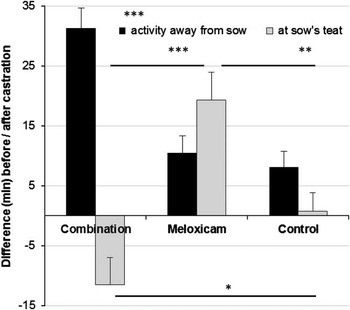
With a difference of almost 200% (corresponding to 31 min/3 h), the anaesthetized animals (Group 1) spent a significantly longer time active away from the sow's teat area (difference between before and after castration) than the other two treatments (Group 3: 49%, Group 2: 52%, P < 0.001). They showed a decrease of 27% in the duration of time spent at the teat (Figure 1). There was no difference in activity away from the sow's teat area between animals with and without analgesic treatment. The piglets that underwent analgesic treatment spent 68% more time at the teat of the sow (corresponding to 19 min/3 h) after separation, whereas the animals of the control group spent about the same time at the teat as before castration (Figure 1). All three treatments revealed significant differences in the time spent at the sow's teat (Group 1 to 2: P < 0.001; Group 2 to 3: P = 0.002; Group 1 to 3: P = 0.018).
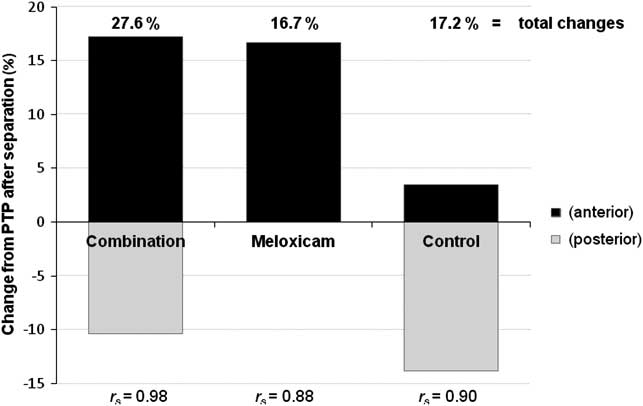
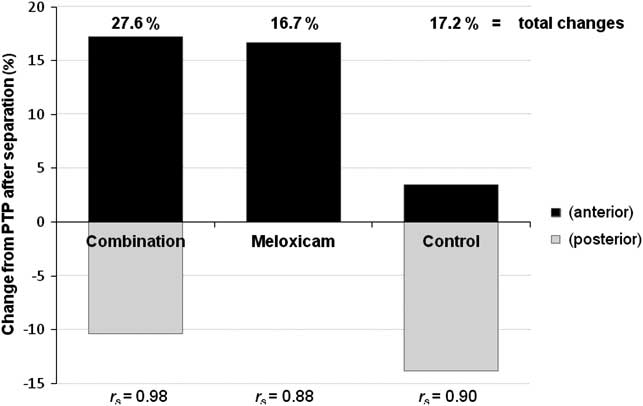
Proportion of piglets (%) changing from their preferred teat position (PTP) after castration/separation, to a lower (posterior) or higher (anterior) position. rs = Spearman rank correlation coefficient. Differences were not significant (χ 2 = 5.3, P = 0.07).
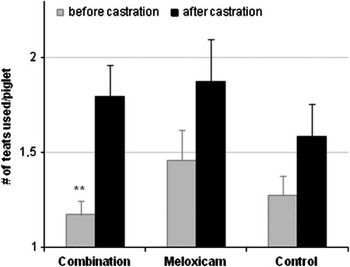
After castration and separation, all piglets used a greater number of teats than before castration. However, this increase was only significant for the anaesthetized piglets (P = 0.004; Group 2: P = 0.054; Group 3: P = 0.068; Figure 2).
Average number (#) of teats used per piglet (longer than 2 min in 3 h) before (light columns) and after (dark columns) castration (±s.e.). **Denotes significant difference between before and after castration (P < 0.01).

The group of anaesthetized animals contained the highest proportion of piglets that changed their preferred teat (PTP), but the difference was not significant (Group 1: 27.5%; Group 2: 16.0%; Group 3: 17.2%). In Group 2 (meloxicam), none of the piglets switched to a ‘lower-rank’ teat position (anterior: high, posterior: low), whereas 10.3% of the anaesthetized animals and 13.8% of animals in the control group lost their PTP after 3 h of separation (χ 2 = 5.3, P = 0.07; Figure 3). The Spearman rank correlation coefficients of rs = 0.98, 0.88 and 0.90 revealed a highly significant relationship for the teat positions used before and after castration in all treatment groups.
Comparisons between time spent active away from the sow (min, dark columns) as well as time spent at the sow's teat (min, light columns) before and after castration (±s.e.). ***Above bar denotes significant difference between before and after castration (P < 0.001). *(P < 0.05), **(P < 0.01), ***(P < 0.001) between bars denotes significant differences for the time spent at the sow's teat between treatments.

The average weight was 2630, 2600 and 2520 g for Group 1 to 3 on castration day. From the day of castration to day 1 after castration, the piglets of Groups 1 and 3 experienced a slight decrease in weight gain compared with the previous day (before castration to castration day), whereas weight gain of Group 2 increased (Figure 4). However, these differences were not significant and already compensated for at day 2 after castration.
Daily weight gain (g/day) of piglets from the day before castration to castration day, as well as from castration day to the following 4 days (±s.e.). Differences were not significant (P > 0.05).

Discussion
The high correlation of rank before and after castration shows that the suckling order (3 to 6 h after castration) was not substantially influenced by the 3-h separation of male animals. Nonetheless, although not significant, nearly 30% of the anaesthetized piglets changed their PTP, which indicates a certain amount of disturbance after being reunited. Accordingly, for every treatment, there was a rise in the number of teats used and hence an increased change in position after reunification. This disturbance arising from the re-establishment of the suckling order could have a negative effect on all members of the litter when leading to stressful fights over teat positions (Van Putten, Reference Van Putten1990). Interestingly, it appeared easier for the piglets that had received analgesia alone to be re-integrated into the group. These animals exhibited the lowest proportion of changes and were not displaced into lower ranking positions. The analgesic treatment may give them an advantage in recovering their PTP. Accordingly, they spent significantly more time at the sow's teat than the other treatment groups.
McGlone et al. (Reference McGlone, Nicholson, Hellman and Herzog1993) and Hay et al. (Reference Hay, Vulin, Génin, Sales and Prunier2003) demonstrated that castrated piglets spent less time nursing (massaging and suckling) and were less active than non-castrated animals. Langhoff et al. (Reference Langhoff, Zöls, Barz, Palzer, Ritzmann and Heinritzi2009) confirmed a tendency towards a reduction in teat stimulation in the first hours after castration for piglets without analgesic treatment and the contrasting positive effect of meloxicam on suckling behaviour. In the present study, the animals that received analgesic treatment spent more time suckling 3 to 6 h after castration than before, whereas this duration almost remained unchanged in the control group (Figure 1).
The results obtained by Llamas Moya et al. (Reference Llamas Moya, Boyle, Lynch and Arkins2008) demonstrated that piglets ‘in pain’ (castrated) were less active after surgery than animals ‘without pain’ (non-castrated). In our study, there was no difference in activity away from the sow's teat area between animals with and without analgesic treatment (meloxicam), thus preventing the conclusion that the animals were ‘pain-free’ (Figure 1, away from sow). However, ‘time spent at sow's teat’ also includes active behaviour (e.g. standing with teat in snout). It increased after castration in piglets that received analgesia, but stayed similar in control piglets. Therefore, this result might still fit to the finding of Llamas Moya et al. (Reference Llamas Moya, Boyle, Lynch and Arkins2008) stated above.
The strong increase in activity away from the sow's teat area of the anaesthetized animals (combination) after castration probably arises from impaired coordination. They moved about within the pen apparently disoriented and restless, whereas piglets that underwent the other treatments searched for a teat or rested more quickly after reunification. This impaired orientation could also have contributed to the decreased suckling time.
In earlier studies, K/A anaesthesia has been described as being ‘practical and in conformity with animal welfare laws’ with reference to the reduction of pain during surgery (Lahrmann et al., Reference Lahrmann, Kmiec and Stecher2006 and Reference Lahrmann, Fink and Luy2008). On the basis of our results, it is however doubtful that the animal's post-operative well-being is improved by this method, because the additional handling, recovery from anaesthesia (von Borell et al., Reference von Borell, Baumgartner, Giersing, Jäggin, Prunier, Tuyttens and Edwards2009) and long post-operative sleeping and hunger phase are also stressful for the animals and, furthermore, may lead to a significant loss of energy (Prunier et al., Reference Prunier, Bonneau, von Borell, Cinotti, Gunn, Fredriksen, Giersing, Morton, Tuyttens and Velarde2006). Separating piglets by a board in the pen is stressful for both piglets and sow, since they both hear each other's vocalizations but cannot reach each other for 3 h. However, it would be impractical to separate the piglets by removing them from the pen owing to reasons of lack in space under on-farm conditions.
Neonatal animals are sensitive to hypothermia and their metabolic and excretory functions may still be too underdeveloped to completely process drugs (Prunier et al., Reference Prunier, Bonneau, von Borell, Cinotti, Gunn, Fredriksen, Giersing, Morton, Tuyttens and Velarde2006). According to the EFSA report (2004), an animal's behaviour should be influenced as little as possible after surgery. However, our results show that especially anaesthetized piglets exhibit significant behavioural changes during an observation period of up to 6 h after castration compared with the observation period one day before castration. In the first days after birth, in particular, separating and reuniting the male animals could be a stress factor for the entire litter as the suckling hierarchy is established during this period (Newberry and Wood-Gush, Reference Newberry and Wood-Gush1985; Sambraus and Porzig, Reference Sambraus and Porzig1991). Reducing the stability of the suckling order can trigger fights between piglets (Van Putten, Reference Van Putten1990). If the milk intake is also reduced as a consequence, this can be particularly critical for young pigs (De Passillé et al., Reference De Passillé, Rushen and Hartsock1988). According to Ewbank (Reference Ewbank1976), a stable suckling hierarchy is the basis for a calm, ‘satisfied’ and productive group of piglets.
The weight comparisons in this study, however, showed that separation for 3 h and re-establishing the suckling order do not significantly affect the piglets’ weight increases. Daily live weight gain up to weaning was also reported to be unaffected by analgesic treatment (Keita et al., Reference Keita, Pagot, Prunier and Guidarini2010).
Another alternative to injection anaesthesia such as inhalation anaesthesia using isoflurane, halothane or CO2 (carbon dioxide) exists. Although these methods are associated with their own disadvantages (von Borell et al., Reference von Borell, Baumgartner, Giersing, Jäggin, Prunier, Tuyttens and Edwards2009; PIGCAS Report, 2009), the short post-operative sleeping phase should be considered advantageous in comparison to K/A injection anaesthesia because it presumably has less of an effect on piglet post-castration behaviour.
In conclusion, our study suggests that analgesia treatment alone could have a beneficial effect on post-castration behaviour, perhaps due to less post-castration pain. However, the combination of K/A injection anaesthesia and analgesia with associated separation seems to influence piglet behaviour negatively and may cause a stressfull post-castration disturbance to the litter.
Acknowledgements
The authors thank Serumwerke Bernburg AG (Ursotamin®) and Boehringer Ingelheim GmbH (Metacam®) for the provision of drugs. They also thank G. Woitow, H. Nitzer and M. Zühl for their assistance within this study.