From Institutional Dynamics to Institutional Performance
How do state institutions – here understood to encompass executives, legislatures and judiciaries – perform in East Central Europe (ECE)? Two decades after the fall of communism in ECE and five years after the first Eastern enlargement of the European Union (EU) we know a good deal about the trajectories that institutional developments have followed. An early wave of studies focused on transition, transformation, democratisation and consolidation – typically in one or several countries of ECE, but sometimes also seeking to make comparisons to post-authoritarian change in other parts of Europe or beyond (Przeworski Reference Przeworski1991; Elster et al. Reference Elster, Offe and Preuss1998; Lijphart and Waisman Reference Lijphart and Waisman1996). These studies devoted much attention to describing and explaining the downfall of communism; the dynamics of turbulent political change in the first years of democratic transition; the post-communist transformation paths and the factors – both external and domestic – that shaped them; and the evidence of, and obstacles to, the institutionalisation and progressive consolidation of democracy.
From the mid-1990s, research on transition, transformation and democratisation began to be complemented and, as time went on, superseded by studies that concentrated on the impact of European integration on the ECE systems of government. The ‘post-communist’ perspective gradually gave way to ‘pre-accession’ analyses (Lippert and Schneider Reference Lippert and Schneider1995; Henderson Reference Henderson1998; Lippert and Becker Reference Lippert and Becker1999; Nunberg Reference Nunberg2000). It was not before long that early general references to a ‘return to Europe’ were replaced by accounts that stressed ‘EU conditionality’ and the adaptive requirements associated with EU integration (Vachudova Reference Vachudova2005; Grabbe Reference Grabbe2005; Schimmelfenning and Sedelmeier Reference Schimmelfennig and Sedelmeier2005). By now, the theme of ‘Europeanisation’ has come to hold sway over the study of the state in ECE, in particular in the area of core executives, public administration and regionalization (Brusis Reference Brusis2004; Dimitrova Reference Dimitrova2004; Hughes et al. Reference Hughes, Sasse and Gordon2004; Zubek Reference Zubek2008a).
Not surprisingly, the concern with describing and explaining developmental trajectories went hand in hand with attempts to characterise the new political systems that emerged with reference to comparative typologies. In the main, analysts resorted to typologies developed in the context of Western democracies. What types of democracy were developing – e.g., consensus vs. majoritarian democracies; polyarchies vs. defective democracies? What types of government – e.g. presidential, semi-presidential, or parliamentary? What types of executives – e.g., prime ministerial vs. cabinet government? What types of party-executive relations? What types of legislatures – e.g., uni-cameral vs. bicameral; arena vs. transformative parliaments? What types of central administration – e.g., Weberian bureaucracies vs. public management? And what types of judicial orders– e.g., systems with strong vs. weak constitutional review?
Given this extensive recourse to typologies that had originated in different contexts, it was only to be expected that much research and academic comment sought to assess the extent to which the ECE institutions approximated Western, and, in particular, Western European, models and practices. Did the institutions that emerged meet the standards of Western democracies? There has certainly been no lack of criticism of state institutions in ECE. As Wiesenthal (Reference Wiesenthal and idem2001) noted, it is easy to fall into the trap of ‘calamity diagnoses’ when studying ECE. Such diagnoses tend to focus on the discrepancy between some ‘ideal’ state and an imperfect reality; the (partially) unmet demands and expectations of external agencies (notably the EU); the unrealised ambitions of institutional reformers; or more or less normative arguments about ‘good governance’. In such analyses, the emphasis is typically on ‘what remains to be done’ and on the need for ‘catching up’, whether it concerns public administration (Nunberg et al. Reference Nunberg1999), the transposition of EU law (Nicolaides Reference Nicolaides2002), policymaking accountability (Rose-Ackerman Reference Rose-Ackerman2005) or the creation of a judiciary capable of ensuring the rule of law (Emmert Reference Emmert2003).
By contrast, less is known about the actual institutional effects in East Central Europe. The fluidity of formal institutional arrangements, particularly in the early 1990s, has discouraged academic analysis from shifting attention from patterns of institutionalisation to patterns of effects. This mood was well-captured by Valerie Bunce who remarked that, ‘[i]n the Eastern Europe context at least, institutions are best understood as dependent, not independent, variables. Institutions (political or otherwise, formal and informal) are in the process of formation in the postcommunist context’ (Bunce Reference Bunce and von Mettenheim1997: 162–3). Under such conditions, informality and, in particular, personalisation have often been stressed as defining features of post-Communist politics and government (Staniszkis and Kisiel Reference Staniszkis and Kisiel1991; Zybertowicz and Los Reference Zybertowicz and Los2000; Meyer Reference Meyer and idem2008).
Yet, in the last decade or so, state institutions in ECE have increasingly stabilized, in particular at the constitutional level. In a comprehensive cross-temporal comparison of 27 post-communist political systems, Armingeon and Careja (Reference Armingeon and Careja2008: 456) note the remarkable persistence of the institutional choices made at the beginning of the democratic transition. They conclude that,
‘[…] there has been little institutional change since the early 1990s. This is true for the ‘core’ of the institutional order, such as constitutional rules, but it is also true, although to a lesser extent, for the flexible elements of the institutional order such as electoral rules, party systems or type of cabinet. Our analysis did not provide evidence for the hypothesis that those countries that have become richer and more democratic have translated such gains into changes to their main institutional framework’.
To employ a distinction emphasised by Müller-Rommel (Reference Müller-Rommel2008), actor constellations might be fluid (though not necessarily more so than in Western Europe), while institutional conditions appear to have consolidated.
In line with such an observation, we witness a subtle, but important shift in recent analyses of the ECE state: from the study of developmental trajectories, a concern with typologies and categorisation, and an emphasis on the weakness of many public institutions, towards an institutionalist agenda that is centred on examining their systematic effects. For example, Elgie and Moestrup (Reference Elgie, Moestrup and idem2008) have explored whether semi-presidentialism in ECE has had an ‘independent effect on the political process’ or whether ‘economic, social and political factors supervene’ (see also Beliaev Reference Beliaev2006). Dimitrov, Goetz and Wollmann (Reference Dimitrov, Goetz and Wollmann2006) have attempted to examine the effect of executive institutions on fiscal performance (see also Hallerberg and von Hagen Reference Hallerberg and von Hagen2006; Hallerberg, Strauch and von Hagen Reference Hallerberg, Strauch and von Hagen2009), while Zubek (Reference Zubek2005; Reference Zubek2008a) has linked variation in core executive configurations to the pace of transposition of European Union directives. Finally, there is important work on the effects of constitutional courts (Sadurski Reference Sadurski2005; see also Sadurski et al. Reference Sadurski, Czamota and Krygier2006; Smithey and Ishiyama Reference Smithey and Ishiyama2002).
This special issue asks: What systematic effects can be observed in institutional performance in East Central Europe? Are they in line with what previous analysis led us to expect? First, at an empirical level, the contributions provide fresh comparative data on the configuration of state institutions and their effects on economic performance, fiscal sustainability, policy predictability, judicial strategies, compliance with EU law, and regulatory quality. Thus, we learn how executives, legislatures and the judiciary are institutionalised and how this shapes their performance. Since the configurative analysis mostly draws on established typologies – e.g., types of executives and types of legislatures – the articles assembled here also offer insights into the degree to which ECE institutions approximate standard types identified in Western experiences.
At the theoretical level, we engage with the extensive literature on state institutions and their effects mainly from Western democracies (Weaver and Rockman Reference Weaver and Rockman1993; Congleton and Swedenborg Reference Congleton and Swedenborg2006; Lane and Ersson Reference Lane and Ersson2000; Cooter Reference Cooter2002; Roller Reference Roller2005). This comparative research usually takes institutional ‘types’ (or variants thereof) as the starting point for formulating hypotheses about their effects. But what is often contested is, first, which rules and behavioural regularities should form the basis of comparative analysis; second, the theoretical assumptions that should underpin hypotheses about the link between rules and behaviour; and, third, the theory that informs arguments linking institutional arrangements to policy. The question of whether ECE governments ‘perform to type’ then raises at least one major conceptual and two basic theoretical questions. Do the typologies employed in comparative research on ECE ‘fit’ the institutional configurations as they have evolved? Which theoretical approaches that seek to link rules and behaviour work in the ECE context (here, the basic distinction between rationalist, sociological and historical institutionalisms is of special importance)? And how good is theory at accounting for institutional effects in ECE?
Finally, the work introduced here is also of practical relevance, as it helps to inform the debate about the ‘state of the state’ in ECE. In recent years, pre-accession optimism about improved government performance has given way, at least in some ECE countries, to growing doubts about the depth and lastingness of improvements. For example, in Poland, public exposure of an unprecedented series of corruption scandals in 2003–4 has sparked off vigorous discussions about the overhaul of the constitutional system by reinforcing the presidency and switching from a proportional to a majoritarian electoral system. In Hungary, the fiscal crisis of 2007–8 has reignited the domestic debates about the merits of the existing institutional framework, including fiscal governance. The need for reform, in particular regarding public administration development, is also emphasized by international organizations. Verheijen (Reference Verheijen2006) has suggested that in much of the region, civil service development has stalled and ‘structural flaws’, such as politicisation, have reappeared. A similar point is made in Meyer-Sahling's (Reference Meyer-Sahling2009) broad ranging examination of the sustainability of civil service reforms in Central and Eastern Europe since accession, which highlights that pre-accession reforms have largely been overturned since.
Has the Dust Settled? Trajectories and Types of State Institutions
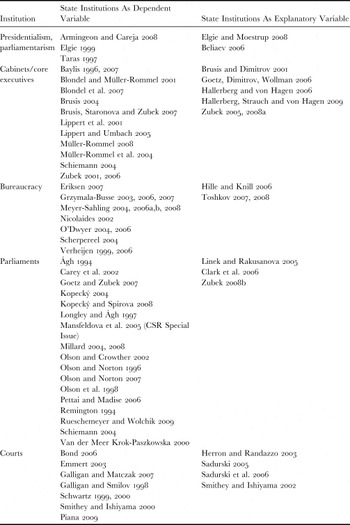
A great amount of empirical work has studied in what ways the institutions that exercise public authority in the ECE have changed, what types of institutions have evolved and what factors have shaped this development. In much of this work, the institutions of government constituted the ‘dependent variable’, whose evolution was to be mapped and explained. A smaller, but growing body of research, treats government institutions as the ‘independent variable’ and enquires into their effects. Table 1 lists central contributions in English.
Key works in English on state institutions in East Central Europe

Parliamentarism and Presidentialism
The changing role of presidents in ECE since the fall of Communism (Baylis Reference Baylis1996; Taras Reference Taras1997; Elgie Reference Elgie1999) has been well documented. It has often been noted that, early signs to the contrary, presidents with strong executive powers did not become the norm in the region. While four states have directly elected presidents and can at least formally be classified as semi-presidential – Lithuania, Slovakia, Slovenia and Poland – it is only the Lithuanian and Polish heads of state that have fairly extensive prerogatives. Significantly, the basic parameters of semi-presidentialist systems have remained remarkably stable since the mid-1990s (Elgie and Moestrup Reference Elgie, Moestrup and idem2008). Only in Poland did the new constitution of 1997 substantially curb the powers of the president. Between 1990 and 2008, there was only one case of switching the type of political system in ECE. In Slovakia, a constitutional amendment in 1999 introduced direct presidential elections, establishing a semi-presidentialist system. The emerging picture is thus one of limited institutional change and strong lock-in effects (Armingeon and Careja Reference Armingeon and Careja2008).
Summarizing the results of a comparative analysis of ECE states, Elgie and Moestrup (Reference Elgie, Moestrup and idem2008: 239) have explored the ‘independent effect’ of semi-presidentialism compared to other ‘economic, social and political factors’, including EU accession. They conclude, first, that ‘the process of democratisation in the countries of Central and Eastern Europe (…) was determined more by factors unrelated to semi-presidentialism than the impact of this type of constitutional arrangement’ (ibid.). Second, they stress that ‘where semi-presidentialism did have an impact over and above such factors, then more often than not its effect was somewhat negative, or at least unhelpful to the democratisation process’ (ibid.: 257). In a similar vein, Beliaev (Reference Beliaev2006) suggests that stronger executive powers for presidents in post-Communist countries make for worse democratic performance and have a negative impact on democratic consolidation, although his study includes 22 post-communist states.
Executives
Scholarship on executives in ECE gives particular emphasis to i) the distribution of power and patterns of decision-making within government; (ii) ministerial organisation and the evolution of co-ordinating institutions, such as core executives and centres of government; and (iii) the institutionalisation of the bureaucracy. As regards the first, the political dynamics of decision-making in ECE governments have featured prominently in the comparative work of Blondel and Müller-Rommel (Reference Blondel and Müller-Rommel2001) and the same authors and Malová (2007). Their key concern has been with the extent to which governments in ECE have come to approximate the Western system of cabinet government. Closely related has been research into the nature of the links between party and government (Müller-Rommel et al. Reference Müller-Rommel, Fettelschoss and Harfst2004), reflecting a long-standing comparative interest in the nature of ‘party government’. In the main, this research observes that, while in some states, cabinets may still be in ‘a state of development’, most ECE countries have achieved ‘a governmental system that compares well with the governmental systems of Western Europe’ (Blondel et al. Reference Blondel, Müller-Rommel and Malova2007: 193).
The administrative aspects of the executive – including ministerial organisation, centres of government and, in particular, patterns of co-ordination – have assumed central importance in the work of Dimitrov et al. (Reference Dimitrov, Goetz and Wollmann2006), Goetz (Reference Goetz2001), Zubek (Reference Zubek2001, Reference Zubek and Dimitrov2006, Reference Zubek2008a) and Brusis et al. (Reference Brusis, Staronova and Zubek2007). Contrary to the ‘strong-man image’ that is often projected in popular accounts of ECE politics, there appears to be little comparative evidence for a progressive centralization of authority inside ECE executives. Perhaps with the partial exception of Hungary, the centres of government in ECE have consistently operated as technical government registrars. The ‘solitary centre’ (Goetz and Margetts Reference Goetz and Margetts1999) in ECE governments of the 1990s may have become somewhat less solitary over time, as ministers and their staff have come to trust it more (as is suggested by Müller-Rommel Reference Müller-Rommel2008), but a centralised prime ministerial core executive is still very much the exception.
A third emphasis has been on the institutionalisation of the bureaucracy in ECE. Grzymala-Busse (Reference Grzymala-Busse2003, Reference Grzymala-Busse2006, Reference Grzymala-Busse2007) discusses aspects of the bureaucracy as part of a broader analysis of the manner in which political parties have sought to gain access to, and explore, state resources in ECE. O'Dwyer (Reference O'Dwyer2004, Reference O'Dwyer2006) adopts a similar perspective and stresses the importance of patronage politics in the post-communist development of state bureaucracies. By contrast, Verheijen (Reference Verheijen1999, Reference Verheijen2006) and, in particular, Meyer-Sahling (Reference Meyer-Sahling2004, Reference Meyer-Sahling2006a, Reference Meyer-Sahlingb, Reference Meyer-Sahling2008, Reference Meyer-Sahling2009) concentrate on the civil service, providing detailed comparative analyses of how this institution has evolved. A key concern in the work of the latter are patterns of politicisation in the ministerial bureaucracy. The role of the EU in shaping civil service policy in the region has been explored by Dimitrova (Reference Dimitrova2002, Reference Dimitrova, Schimmelfennig and Sedelmeier2005). This research finds perhaps the least degree of institutional stabilization in ECE, as civil service regulations tend to change frequently over time and across countries.
In contrast to work treating political executives and bureaucracy as ‘dependent variables’, studies that attempt to examine the effects of state institutions are few and far between. There are two exceptions. Some authors have probed into the effects of executive organisation on how governments respond to European integration. Thus, Zubek (Reference Zubek2005, Reference Zubek2008a) has studied the extent to which core executive organisation can explain compliance with transposition requirements. In a similar vein, Hille and Knill (Reference Hille and Knill2006) have found bureaucratic capacity to be a strong predictor of pre-accession alignment (see also Toshkov Reference Toshkov2007; Reference Toshkov2008). The second area is fiscal governance. Brusis and Dimitrov (Reference Brusis and Dimitrov2001; see also Dimitrov et al. Reference Dimitrov, Goetz and Wollmann2006: Chapter 8) and, in particular, Hallerberg and von Hagen (Reference Hallerberg and von Hagen2006; see also Hallerberg, Strauch and von Hagen Reference Hallerberg, Strauch and von Hagen2009) have tested the link between patterns of executive organisation and fiscal performance.
Legislatures
As for parliaments, analysts have looked at two main institutional features: (i) executive-legislative relations, and (ii) internal structures and procedures. Research on the former has in the main sought to determine the extent to which governments have come to dominate the parliamentary arena in ECE (Kopecky Reference Kopecký2004; Olson and Norton Reference Olson and Norton2007; Millard Reference Millard2008; Pettai and Madise Reference Pettai and Madise2006; Carey et al. Reference Carey, Formanek, Karpowicz, Loewenberg, Squire and Kiewiet2002; Kopecky and Spirova Reference Kopecký and Spirova2008; Goetz and Zubek Reference Goetz and Zubek2007; Zubek Reference Zubek and Dimitrov2006; Reference Zubek2008b; Mansfeldova et al. Reference Mansfeldova, Linek and Rakusanova2005; Schiemann Reference Schiemann2004; van der Meer Krok-Paszkowska Reference Van Der Meer Krok Paszkowska2000). Initially, there was an emphasis on ‘overparliamentarisation’ of ECE polities, which was seen to be promoted by the inexperience of executives, low party loyalty of MPs, high political polarization and extensive formal prerogatives that the new parliaments had inherited from the Communist past (Ágh Reference Ágh1994; Olson and Norton Reference Olson and Norton1996; Carey et al. Reference Carey, Formanek, Karpowicz, Loewenberg, Squire and Kiewiet2002). Although some scholars have drawn attention to a gradual reinforcement of ECE executives (Kopecký Reference Kopecký2004; Pettai and Madise Reference Pettai and Madise2006; Millard Reference Millard2008), others have argued that the legislatures in ECE are still, in essence, ‘legislating’ rather than ‘legitimising’ parliaments (Olson and Norton Reference Olson and Norton2007; Goetz and Zubek Reference Goetz and Zubek2007; Zubek Reference Zubek2008b).
When it comes to internal parliamentary structures and procedures, studies of parliamentary committees dominate (Longley and Ágh 1997; Olson and Crowther Reference Olson and Crowther2002; Olson et al. Reference Olson, Van Der Meer-Krok-Paszkowska, Simon and Jackiewicz1998). Scholarship has concentrated on mapping the trajectories of committee institutionalization in ECE and has attempted to account for cross-country differences (Olson and Crowther Reference Olson and Crowther2002). The key question has been to what extent committee systems have stabilized and regularized in terms of number, size, incumbency rates, agenda control or floor control. Also, the extent to which ECE committees have come to resemble West European practices has been debated (Olson et al. Reference Olson, Van Der Meer-Krok-Paszkowska, Simon and Jackiewicz1998). The general finding is that in some countries – mainly the Czech Republic, Hungary and Poland – committees have achieved a relatively high degree of institutionalization, whereas in others, such as Estonia or Lithuania, their position appears less secure. When it comes to the social composition of parliaments, the study of women in power by Rueschemeyer and Wolchik (Reference Rueschemeyer and Wolchik2009) stands out.
Legislatures have been mainly treated as a dependent variable. There has been some work assessing their effects, but most studies are single-country studies, from which it is inappropriate to generalize. For example, Linek and Rakusanova (Reference Linek and Rakusanova2005) have analyzed in what way the procedural privileges of parliamentary groups in the Czech parliament affect levels of voting cohesion, but found no significant impact. Clark et al. (Reference Clark, Verseckait and Lukosaitis2006) show how formal constraints on the powers of Estonian committees may account for the observed government success in inducing committee chairs to toe the government line. Zubek (Reference Zubek2008b) has argued that the combination of liberal procedural rules and low party institutionalization is critical in explaining the extensive amendment of government bills in the Polish parliament.
Judiciary
Scholarship on the judiciary in ECE has focused on constitutional courts, whilst administrative courts have received little attention (but see Galligan and Smilov Reference Galligan and Smilov1998; Galligan and Matczak Reference Galligan, Matczak, Coman and De Waele2007). Most are historical and look at how these courts have been established in a specific country (Melone Reference Melone1996; Sabaliunas Reference Sabaliunas1996; Schwartz Reference Schwartz, Schedler, Diamond and Plattner1999; Reference Schwartz2000; Smith Reference Smith2008; Piana Reference Piana2009). There is also some research that investigates the factors behind different institutional choices. For example, Magalhaes (Reference Magalhaes1999) explains judicial reforms in Bulgaria, Hungary and Poland with reference to a bargaining process between power-maximizing political actors. In a multi-country comparative study, Smithey and Ishiyama (Reference Smithey and Ishiyama2000) assess a number of explanations for differences in the degrees of independence that policy-makers have given to constitutional courts. They conclude that the best predictor is the degree of political competition – the more competition, the less powerful the courts. Bond (Reference Bond2006) examines differences in the position of constitutional courts in Hungary and Poland, arguing that they can be explained with reference to the context of legal continuity and the courts' strategic responses to that context.
The position of constitutional courts has stabilized to an extent that research on the effects of institutional choices has been more and more prominent. First and foremost, there is work on the effects of the independence of constitutional courts, perhaps most notably by Sadurski (Reference Sadurski2005; see also Sadurski et al. Reference Sadurski, Czamota and Krygier2006). Contrary to the very positive evaluation that tends to be accorded to constitutional courts, he argues that the protection of constitutional rights by the courts has often been deficient and that they may, in fact, weaken democratic participation and discourse. Smithey and Ishiyama (Reference Smithey and Ishiyama2002) have explored the relationship between judicial independence and judicial activism understood as the extent to which judges disallow policy choices of other policy makers; perhaps surprisingly, they have found no correlation. Herron and Randazzo (Reference Herron and Randazzo2003) similarly find that judicial power does not seem to influence the probability of judges overturning legislation in whole or in part.
Performing to Type? Studying Institutional Effects in ECE
Given the fairly detailed picture of the developmental trajectories that executives, parliaments and the judiciary have followed in ECE, the external and domestic factors that have shaped these trajectories, and the type of formal institutions that have emerged, we now have ample material for studying institutional effects (see for example Steinmo, Thelen, Longstreth Reference Steinmo, Thelen and Longstreth1992, Congleton and Swedenborg Reference Congleton and Swedenborg2006; Weaver and Rockman Reference Weaver and Rockman1993; Lane and Ersson Reference Lane and Ersson2000).
There is much to be said for approaching the study of ECE institutional performance through the lens of existing theoretical models. This is the approach favoured by most of the contributors to this special issue. For example, Hallerberg and Ylaoutinen (Reference Hallerberg and Yläoutinen2010) use a delegation vs. contracts model to examine the impact of fiscal governance on budgetary outcomes; Zubek and Stecker (Reference Zubek and Stecker2010) rely on party and agenda control models to understand policy uncertainty; and Falkner (Reference Falkner2010) employs an approach to explaining compliance with EU law that was first developed in the context of the EU-15. Yet we argue, that for these models to yield reliable insights, both the specification of the ‘independent’ variable – the configuration of state institutions – and the causal chain assumed to link institutions and effects must be specified in a manner that is sensitive to the particular ECE context. In ‘sensitising’ the institutional approaches, attention to degrees, time, preferences and resources are of particular importance.
Degrees matter
Sociological approaches emphasize degrees of institutionalization. Institutions regulate behaviour subject to the constructive interpretations of rules by actors (March and Olsen Reference March and Olsen1989; Reference March, Olsen, Rhodes, Binder and Rockman2006). They bring about regularities in behaviour only to the extent that actors have become socialized into, and have internalized, culturally defined norms and practices. In the ECE context, this close association between habituation and regular effects is doubly problematic. For one thing, institutionalization in ECE is likely to have been a gradual and precarious process, as new institutions have become slowly imbued with ‘increasing clarity and agreement about behavioural rules’, ‘increasing consensus concerning how behavioural rules are to be described, explained, and justified’; and ‘increasing shared conceptions of what are legitimate resources in different settings and who should have access to, or control, common resources’ (Olsen Reference Olsen2009: 10). But higher degrees of institutionalization may not only have been difficult to achieve; insofar as institution-building has followed external demands – notably in the context of accession conditionality – it may in fact have been undesirable. Under the conditions of a marked power asymmetry between the ECE countries and the EU during the accession negotiations, it may have been rational for ECE governments to pursue a strategy of ‘shallow institutionalisation’ to keep sunk costs low and to minimise the thresholds for further institutional reform when eventual accession could be expected to entail a major rebalancing of the EU-ECE power relations (Goetz Reference Goetz, Bulmer and Lequesne2005). Reversals in the institutionalisation of the politics-administration nexus in the ministerial executives following EU accession in several ECE may be read as an illustration of this argument (Meyer-Sahling Reference Meyer-Sahling2009).
A second, and related, issue is the relationship between formal and informal institutions. It is often argued that formal rules do not produce effects in isolation from informal norms, routines and conventions (Shvetsova Reference Shvetsova2003). State institutional arrangements may, accordingly, have quite different effects as societal characteristics vary from country to country (Przeworski Reference Przeworski2004). Institutional theory offers a rich repertoire of ‘contextual’ and ‘intervening’ variables, such as culturally determined mental models that influence the way in which actor process information; shared norms of appropriate behaviour that influence the way in which actors value actions and outcomes; or culturally bound heuristics for deciding the best strategy of action (see Ostrom Reference Ostrom2005: 104–116). These insights are particularly relevant in ECE, not least because many of the state institutions have been, at least in part, created on the basis of templates borrowed from Western Europe and beyond (Flockhart Reference Flockhart2005; Jacoby Reference Jacoby2004; Orenstein et al. Reference Orenstein, Bloom and Lindstrom2008). While such transfer has helped to fit formal ECE state institutions into typologies first developed for Western democracies, the contexts in which they meant to be applied often differs in ways that inhibit drawing straightforward lessons (Rose Reference Rose2008; Reference Rose2009).
Time matters
For historical institutionalists, research is especially sensitive to the role of time (Pierson Reference Pierson2004). There are several ways in which time matters. First, different dimensions of institutionalisation are likely to follow different temporal rules in terms of timing, sequences, speed and duration. For example, formal rule change is likely to take place faster than the internalisation of rules by individual actors. There was an early emphasis in the transition literature on the importance of timing, sequencing and speed in bringing about political, economic and social change and on the time horizons required (see Schmitter and Santiso Reference Schmitter and Santiso1998). But the latter issue, in particular the extent to which ‘deep’ rather than ‘shallow’ institutional change could be accelerated, tended to be neglected later on, not least because external actors, such as the EU, took a highly voluntaristic approach to the temporal structuring of institutional reform. We should, then, expect asynchrony in institutional development both within and between institutions, with consequences for their capacity to generate regular effects.
A second way in which time matters concerns variation over time. The issue here is not just the expectation of institutional reversals or even de-institutionalisation. The massive de-institutionalisation constituted by the demise of the Communist system may have made analysts less sensitive to later instances of more routine instances of de-institutionalisation. Rather, what effect institutions produce and the strength of these effects can be expected to vary over time even if the configuration and the degree of institutionalisation stay constant. Political institutions – and all state institutions, including the administration and the judiciary are, of course, political to varying degrees – have distinct time horizons. For government and parliament, the date of the next election is critical and consequential, as the broad literature on the electoral business cycles highlights. But political institutions also produce affects that vary, e.g., the distribution of legislative initiatives in parliament over the course of a legislative term. It is also likely that the strength of the effects varies over time, especially as the likelihood of actors abiding by formal rules is affected by the time horizons within which they operate. In general, the probability that actors will play ‘fast and loose’ with rules will increase, as the end of their mandate – whether elected or appointed – approaches, especially if a renewal of the mandate is unlikely or impossible.
A third concern is that of time lags. Effects are rarely instantaneous and often the most important effects take longest to materialise and even longer to detect. In hypothesising about the effects that particular types of ECE state institutions are likely to generate, we thus need to pay attention both to the substance and the temporality of effects.
Preferences matter
Rationalist approaches stress the equivocal and contingent nature of institutional effects. It is argued that one cannot draw conclusions about the expected nature of policies under different institutional set-ups by examining the institutions alone (Hammond and Butler Reference Hammond and Butler2003). To determine the nature of policy outcomes one must focus on the interaction of institutional rules and the policy preferences of the actors involved (Tsebelis Reference Tsebelis2002). Hammond and Butler state that,
To demonstrate empirically that ‘institutions matter’ requires that we must somehow control for the impact of the different preference profiles which two different institutional systems may face (…). If we were to compare two different institutional systems without taking the preference profiles into account, it might happen that the two systems would produce different outcomes simply because they are facing different preference profiles (ibid: 188).
A perennial problem is learning about actor preferences (cf. Rothstein Reference Rothstein, Goodin and Klingemann1996). This is particularly problematic in the ECE context. The key collective political actors – political parties – often campaign on vague policy platforms and tend to lack a track record. This makes the use of standard preference estimating techniques doubtful.
A second way in which preferences matter is perhaps less direct. Institutions are more likely to shape human behaviour in a predictable fashion to the extent that they are exogenous rather than endogenous, i.e. cannot be changed at will by the actors at which they are directed. If the same actors whose behaviour is to be governed by them can alter rules easily, then doubts may arise as to how effective such rules can be (Cox Reference Cox2000). In this connection, Shepsle's (Reference Shepsle, Rhodes, Binder and Rockman2006) distinction between institutions as equilibrium and equilibrium institutions is pertinent. In the case of the latter, rules reflect an agreement by the actors to abide by them so as to facilitate exchanges or cooperation; but the selfsame actors may change equilibrium institutions at any time, and hence they do not have a constraining effect per se. With this distinction in mind some scholars question whether, legislative rules or internal executive rules are, indeed, likely to have compelling effects (McGann Reference McGann2006). Such rules are typically established by majority parties and can be changed at any time. It contrast, McGann suggests that constitutional rules – bicameralism, presidentialism, judicial review or federalism – will have more determinate effects because they cannot be changed easily. It is thus to be expected, that the search for systematic institutional effects in ECE should in the first instance concentrate on rules that are established at the constitutional level.
Resources matter
That rules and institutional effects are dependent on resources is a standard theme in institutional, organisational and administrative theory. The argument comes in many guises, as in resource dependency theory, which stresses the link between the successful quest for resources and an organisation's power; March and Olsen's (Reference March, Olsen, Rhodes, Binder and Rockman2006: 3) ‘new institutionalism’, which understands an institution as ‘a relatively enduring collection of rules and organized practices, embedded in structures of meaning and resources’; or, to use a different example, Hood's (Reference Hood1983) analysis of the ‘tools of government’, stressing nodality, authority, treasure and organisation as decisive resources for the efficacy of government institutions. That rules need to be tied to resources so that they can produce effects is uncontentious. It is also unsurprising that different theoretical strands emphasise the importance of different types of resources, ranging from the standard types stressed in public management approaches, such as human, financial, physical or informational resources, to less tangible resources, such as organisational trust or organisational legitimacy. What matters here is both the level of resources available and their combinations.
It is difficult to generalise about the quantity and quality of resources available to state institutions in Central and Eastern Europe; but the predominant impression is still one of relative resource scarcity when compared to EU-15 averages, whether it concerns the size of the public sector in terms of public consumption in relation to GDP and the share of public employment, or physical and informational infrastructures. Differentials in resource endowments are likely to matter, in particular, when the rules to be enforced are identical across countries, as is, e.g., suggested by Falkner's (Reference Falkner2010) analysis of problems of compliance with EU law in the Czech Republic, Hungary, Slovakia and Slovenia.
Trust in public institutions, another critical resource, is also low in ECE compared to the EU average (Eurobarometer 2009). Whilst, on EU-average, 32 per cent of the people trust their national government, only 13 per cent of Hungarians, 15 per cent of Latvians, 17 per cent of Lithuanians, 21 per cent of Czechs, and 26 per cent of Poles trust their national government. Estonians are exceptional: 56 per cent trust their government. The figures for parliament, police and political parties are similar. Since the efficacy of democratic institutions relies critically on their ability to muster consent, low levels of trust must be taken into account when we try to understand institutional effects in ECE.
A preview
State institutions matter in ECE and they matter systematically rather than randomly. Contrary to what may have been the case during transition (Bunce Reference Bunce and von Mettenheim1997), state institutions can and should now also be examined as an independent variable.
The contributions assembled in this special issue help to advance our understanding of different institutional configurations and their effects in ECE. The study by Jahn and Müller-Rommel draws on a large dataset on institutional factors, political actors and policy performance indicators across Central and Eastern Europe. What makes their contribution especially convincing is that they draw attention to the interaction between institutional factors and changeable actor constellations, which, in their view, should not be conflated.
In Hallerberg and Yläoutinen's analysis of fiscal institutions and budgetary outcomes, the impact of institutional choices – in this case: different models of fiscal governance – is critically affected by actor constellations. Thus, the two basic forms of fiscal governance they distinguish – ‘fiscal contracts’ and ‘delegation’ – strongly affect budgetary outcomes through the interaction between institutional choice and dominant party actor constellations.
A similar argument is made by Zubek and Stecker. They examine whether the characteristics of national legislatures, notably political parties and legislative organization, affect the level of policy uncertainty. Uncertainty over the contents of future policies, they argue, is significantly lower in systems with higher party institutionalization. There is also some evidence that restrictive parliamentary agenda control lowers policy uncertainty and that this effect mediates the influence of party institutionalization.
The two articles dealing with law, institutions and policy both emphasize that change in the law need not equal change in practice. Matczak, Bencze and Kühn examine to what extent far-reaching changes in the legal systems of ECE since the mid-1990s have altered adjudication strategies. Relying on an original dataset of over a thousand business-related cases from the Czech Republic, Hungary and Poland, they show that – despite some variation across countries and time – judges have largely failed to respond to the incentives contained in the new constitutional frameworks. The analysis links these weak institutional effects to the influence of constitutional courts, case overload and educational legacies. Falkner compares the performance of state institutions and compliance with EU law in the Czech Republic, Hungary, Slovakia and Slovenia. She includes public institutions enforcing EU social standards, labour inspectorates and equal treatment authorities. The four countries she examines all fall within a ‘world of dead letters’ as far as their compliance with EU law is concerned. In this ‘world’, EU directives tend to be transposed on time and in a correct manner, but there is frequent non-compliance in monitoring and enforcement. Institutional shortcomings, in particular, resource shortages – staff, finance and information – are seen to be at the heart of the problem.
In the final article Staroňová (Reference Staroňová2010) traces the evolution of the formal frameworks for regulatory impact assessments during the executive stages of the preparation of legislation in Central and Eastern Europe and asks how these have affected the quality of the information provided to decision-makers. Her conclusion is largely negative. With the exception of Estonia and the partial exception of the Czech Republic, the institutionalisation of systems for regulatory impact assessment has failed to lead to significant improvements in the informational bases for decisions, an observation that she links both to differences in patterns of institutionalisation and the quality of resources available.
Acknowledgements
This special issue of the Journal of Public Policy has been prepared within the framework of the Central European Observatory at the European Institute, London School of Economics and Political Science (LSE). The Observatory has been established with the generous support of the Ernst & Young Better Government Progamme to foster academic research into executive government and law-making in Central Europe.
With one exception, first drafts of the papers assembled here were discussed at a workshop hosted by the European Institute in February 2009. We wish to thank Frank Bönker, Damian Chalmers, Paul Lewis, Ferdinand Müller-Rommel, Edward C. Page, Richard Rose and Waltraud Schelkle whose constructive comments as discussants at this event helped to shape the revisions of the papers. The workshop could not have been organised without the assistance of Elaine Hemmings, the European Institute Manager.
We are indebted to Richard Rose, Editor of this Journal, who responded enthusiastically to the idea of a special issue and made sure that the authors and guest editors stayed on track and on time. All articles were subject to anonymous external refereeing and we wish to thank our reviewers for the great care with which they have discharged this vital responsibility. Our greatest debt is to our authors, who readily agreed to take part in this project and responded to several rounds of comments and revisions with efficiency and good humour.
An earlier version of this paper was presented at the workshop ‘Towards Effective Government? Institutional Performance in New EU Member States’, 20–21 February 2009, European Institute, LSE. We would like to thank the workshop participants and, in particular, our discussant, Ferdinand Müller-Rommel, and the editor of the Journal of Public Policy, Richard Rose, for valuable comments.