I. INTRODUCTION
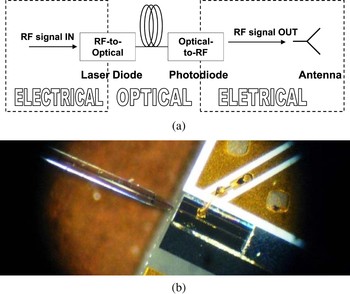
Worldwide availability of 7 GHz of unlicensed bandwidth in the millimeter wave (mmw) band constitutes a solution for the ever-increasing need for high date rate wireless communications in indoor networks. The 60 GHz WPANs allow for a dense multi-user environment while providing high-speed access. However, remoting access points from the data gateway requires a flexible distribution architecture for the radio signals. The optical fiber represents a low-cost solution that nevertheless allows for reduced complexity in the access point when transmitting a radio signal over the fiber. RF transmission over a fiber optic link requires a double conversion between the electrical and optical domain. In a basic downlink as shown in figure 1(a), the light source is modulated in intensity (IM) with the RF signal, transported to the access point via the fiber, and directly detected (DD) by a square-law detector. For down- and uplink architectures the like, low-cost mmw generation is one of the key issues to be solved.
RoF transmission and key component: (a) basic transmission scheme and (b) mode-locked laser diode (MLLD) chip coupled to SMF, CPW access.

The straightforward method to transport an RF signal over a fiber optic link seems to modulate the laser injection current accordingly. This simple method requires a modulation source with mmw capability, and it also depends strongly on the laser's modulation response which cannot yet for a while be expected to overstep the 40 GHz boundary. Direct RF modulation might also disturb the lasing process and thus lead to an increased phase noise level. The classical solution for mmw generation has thus been the use of external electro-optical modulators [Reference Li and Yu1, Reference Kuri2]. However, the modulating mmw wave has to be applied to the electrodes of the modulator and a costly external mmw source is needed. Electro-optical (E/O) modulators are also expensive in fabrication and do not easily lend themselves to integration. An all-optical way of producing mmw signals is to use the beat signal of several interfering lasing modes separated in wavelength by the RF frequency and originating from either a single laser or separate devices [Reference Grosskopf3]. This approach is however hindered by the need for a coherent phase relation between the lasing modes.
Based on the same principle, MLLD represent a class of multimode semiconductor lasers whose optical modes exhibit, under certain conditions, inherent phase lock. Recent architectures allow for controlling the free spectral range (FSR) of the optical spectrum (i.e., the λ-separation of modes) and stable mode-locking regime at DC bias [Reference Lelarge4]. MLLD are low-cost devices, small in size (as shown in Fig. 1(b): single-mode fiber coupled to ML laser device) and can easily be packaged. MLLD devices have successfully been used for mmw generation in RoF links [Reference Braun5], recently serving as mmw sources for gigabit transmission [Reference Charbonnier6]. However, MLLD-based systems have not yet been fully understood. In particular, no investigation has yet been carried out on the modulation of MLLD devices for UWB transmission, nor for narrowband transmission according to the available WLAN standards. The paper aims to fill this gap and is organized as follows: Section II is dedicated to a brief presentation of RoF modulation techniques. We describe our experimental setup and evaluation method in Section III. The results of the comparative study of directly and externally modulated links are discussed in Section IV. Finally, we will conclude in Section V.
II. GENERATION OF MMW WAVE SIGNALS USING MLLD
A) Mode-locking in laser diodes and RF carrier generation
The mode-locked laser signal can be modeled as an optical wave consisting of N longitudinal modes with intensities A k of the form

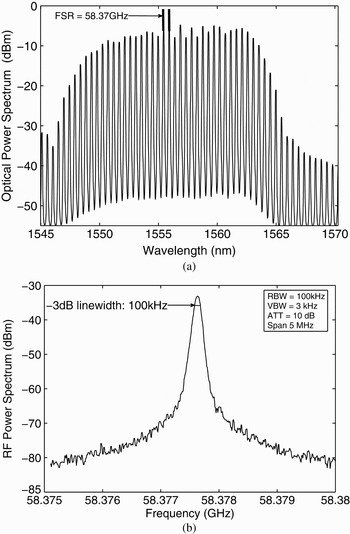
where ωk+1−ωk = ωRF,k corresponds to the laser's FSR, and Φk+1− Φk = ΔΦk is the phase difference between adjacent modes. Fig. 2(a) shows a typical comb spectrum centered around ωopt = 1557 nm measured on a laser diode with an FSR of 58.37 GHz. The laser's internal architecture lets the device phase-lock under the condition of appropriate DC supply.
Spectrum measurements on ML laser diode with FSR of 58.37 GHz: (a) optical spectrum and (b) RF beating spectrum.

Letting the lightwave beat on a photodetector produces an electrical current proportional to the optical power P opt incident on the diode. The corresponding RF spectrum is calculated from the interference of neighboring modes when choosing the bandwidth BW of the photodetector according to the FSR of the laser spectrum, so that FSR < BW < 2FSR:

For a constant FSR with ωRF, k = ωRF, the power of the recovered RF signal depends only on the phase relation between the optical modes. Maximum RF power is recovered for perfect phase lock (ΔΦk = constant). By making the appropriate choices in the design of the laser cavity, ωRF = 2 π f RF can be fixed to the desired RF carrier frequency in the 60 GHz band (see Fig. 2(b)).
B) Direct and external modulation
Amplitude modulation of the laser injection current I produces an output lightwave modulated in intensity. The RF carrier can thus easily be modulated at frequencies within the laser's modulation bandwidth. For sinusoidal AM with I(t) = I DC + I mf(t) and f(t) = sin(ω mt), the optical output wave from equation (1) is modulated as follows:

where m(t) is the field modulating function, m represents the AM index, and β the FM index, as each direct modulation to some extent implies AM-FM conversion of the laser signal. Thus, in the IM-DD link, the modulation sidebands appear at the frequencies f RF ± f m in the electrical spectrum.
In order to capitalize on the full 7 GHz of available bandwidth, or whenever the laser shows little robustness to direct modulation, it can make sense to use the MLLD for carrier generation only and to externally apply the modulation signal by means of an E/O modulator. Assuming linear bias and appropriate loss conditions, the output lightwave from a Mach–Zehnder modulator (MZM) depends on the modulator's transfer function such that

where T i is the modulator's insertion loss, V π the bias voltage that causes a phase difference of π between the electrodes, and γ an equilibrium factor between the two electrodes. The modulating function g(t) = V m cos(ω mt) as the argument in the exponential generates the first modulation sidebands at the frequencies f RF ± f m, and the corresponding intermodulation frequencies with intensities according to the Bessel functions of the first kind.
III. TRANSMISSION EXPERIMENTS
A) Experimental setup
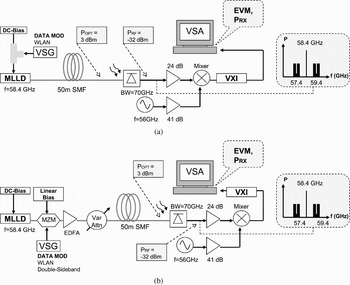
Two different downlink architectures have been set up to compare the robustness of the direct modulation versus the external modulation of a quantum-dash MLLD with reduced RF linewidth previously presented in [Reference Lelarge4]. The experimental setups for both modulation techniques are shown in Fig. 3. The laser chip is placed on a 6 × 2 mm copper submount and receives its current signal via a ground-signal-ground (GSG) probe. The fiber is coupled to the laser by micro-positioning the fiber at the edge of the chip. For WLAN transmission, a vector signal generator (VSG) serves as modulation source, modulating either the laser injection current (Fig. 3(a)) or the MZM voltage (Fig. 3(b)). The WLAN sidebands are centered at 1 GHz. Due to the considerable loss of about 16 dB electrical of the MZM, an optical amplifier (erbium-doped fiber amplifier, EDFA) followed by a variable attenuator is needed to fix the optical power at 3 dBm, as in the case for direct modulation. The signal is transported across a standard single-mode fiber (SMF). The photodetector is limited at 70 GHz and delivers at its output about −32 dBm RF carrier power at 58.37 GHz. Due to the bandwidth of the analyzer (6 GHz VXI and VXI-based vector signal analyzer software package), a mixing stage after an additional RF amplifier becomes necessary. For UWB transmission, the VSG is replaced by a low-cost MB-OFDM UWB transmitter, capable of generating the first three sub bands (band group 1) of 528 MHz, as compliant with the ECMA UWB standard proposed in 2005 [7]. Note that direct modulation was not possible at these center frequencies.
Experimental setups for both link modulation techniques: (a) direct modulation and (b) external modulation.

B) Evaluation and figure of merit
The link quality is evaluated by means of the error vector magnitude (EVM) which represents the residual symbol error after an ideal version of the symbol has been stripped away. The EVM can directly be linked to the system signal-to-noise ration (SNR) [Reference Shafik8] and so provides an easy-to-handle figure of merit. As the mixing stage has not been taken into account, the equivalent EVM at mmw frequencies is expected to be even lower than the measured values.
VI. DISCUSSION OF RESULTS
A) WLAN and UWB transmission
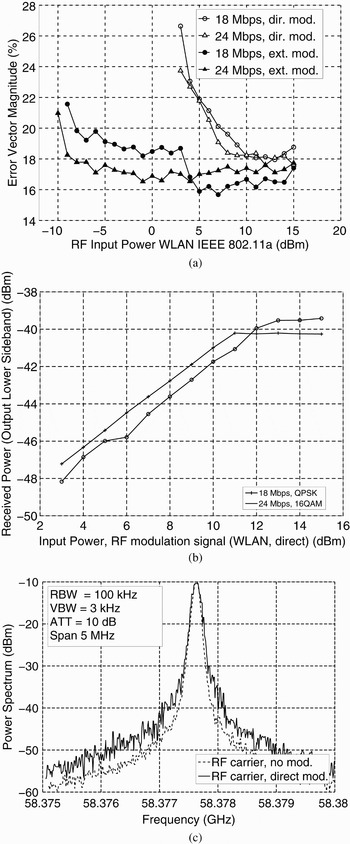
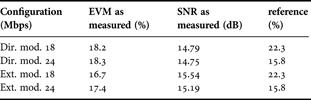
WLAN transmission over the MLLD-RoF link has been investigated at 18 and 24 Mbps, modulated in quadrature phase-shift keying (QPSK) and quadrature amplitude modulation (16QAM) formats, respectively (see Figs. 6(a) and (b)). For a directly modulated link, the EVM shows a pronounced dependency on RF input power, while in first approximation, it remains constant for the external modulated link (Fig. 4(a)). The EVM seems to reach a floor around 18%, hinting at a noise limitation induced by the laser phase noise. While awaiting the publication of the mmw-WLAN standard (11ad), IEEE 802.11a[9] serves as a reference for link quality in terms of EVM. Table 1 shows the measured EVM values and corresponding SNR, as well as the standard values. With an EVM around 18%, and referencing [9], the 18 Mbps transmission conforms to the WLAN standard. Compliance is expected also for 24 Mbps transmission when taking into account the mixer stage. In Fig. 4(b), the received power detected in the lower sideband is shown for both techniques. For a directly modulated link, the detected power is about 17 dB lower than for the externally modulated link. This circumstance is attributed to the modulation response of the laser. Perturbations of the laser cavity through direct modulation lead to an increase in carrier phase noise (Fig. 4(c)). However, for an input modulating power P mod > 9 dBm, the EVM for both techniques differs only insignificantly, showing very good robustness of the directly modulated link. Both systems reach compression beyond P mod = 12 dBm. The high link loss for both setups makes the use of electrical RF amplifiers at the antenna front-end, for the moment, indispensable. The constellations show good symmetry.
WLAN transmission at 18 and 24 Mbps: (a) EVM(P mod), dir. modulation, (b) P RX(P mod), dir. modulation, and (c) Robustness to direct modulation.

WLAN transmission.
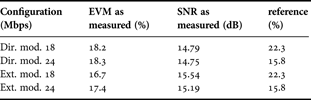
Performances at P mod = 10 dBm.
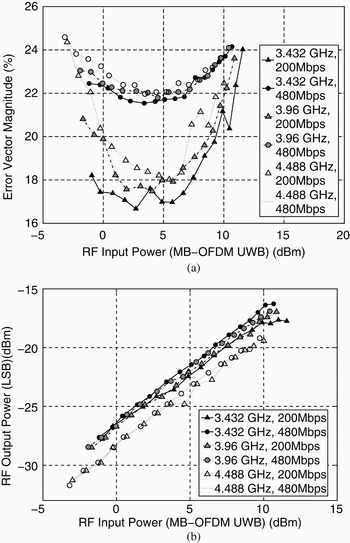
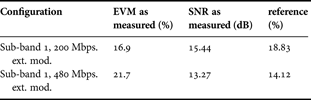
UWB transmission over the MLLD-RoF link has been investigated at 200 and 480 Mbps (QPSK modulation, see Figs 6(c) and (d)) employing external modulation, as the laser modulation bandwidth does not enable direct modulation for elevated band center frequencies. Figure 5(a) shows a distinct optimum at about P mod = 5 dBm, reaching again a floor of 17% as observed in the WLAN case. As can be seen from Table 2, the achieved EVM performances of 16.9% at 200 Mbps are standard - compliant, compliance is assumed for 480 Mbps again taking into account the influence of the mixer stage. The systems behaves linearly over a wide range of tested input power values, compression setting in at about P mod = 11 dBm. The overall link loss of about 30 dB coincides well with the values commonly found in the literature (e.g. [Reference Cox I.10]). The constellations show a systematic phase error of the symbols yet to be investigated. This phase distortion is equally pronounced for different values of values of P mod and is most likely related to laser phase noise that appears to be more relevant for broadband transmission than for narrowband WLAN signals (Fig. 6).
MB-OFDM UWB transmission at 200 and 480 Mbps: (a) EVM (P mod) and (b) P RX (P mod).

Visualization of relative constellation error: (a) 18 Mbps WLAN, (b) 24 Mbps WLAN, (c) 200 Mbps UWB, and (d) 480 Mbps UWB.

UWB transmission.
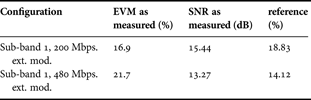
Performances at P mod = 5 dBm.
B) Limitations of the MLLD-RoF-system
For links employing direct modulation, the principal limitation remains the laser's modulation bandwidth which we expect to see improving considerably during the years to come, making the use of E/O modulators with high conversion loss unnecessary. Aiming towards gigabit transmission, the laser phase noise represents another limiting parameter. However, this phase noise can be reduced when selecting the appropriate optical modes by the use of an optical filter. For externally modulated links, the loss of the modulator needs to be compensated by a noisy EDFA that can only be discarded when a relatively high power level can be attained at the output of the laser or the modulator.
V. CONCLUSIONS
We have presented and compared MLLD-based RoF systems employing direct and external modulation for mmw distribution. We have shown the excellent robustness of MLLDs to direct modulation, as no additional degradation has been observed compared to external modulation. MLLD-RoF links employing external modulators help to overcome the bandwidth limitation of the laser diodes, while at the same time taking advantage of the inexpensive mmw carrier generation capability of the laser device. WLAN transmission at 60 GHz has been demonstrated for 18 and 24 Mbps, showing EVM values well compliant to the WLAN standard. UWB transmission has been shown for 200 and 480 Mbps at standard-compliant EVM levels and at acceptable link loss.
ACKNOWLEDGEMENTS
This work was supported by the French ANR Teldot project.
 Friederike Brendel was born in 1982 in Crailsheim, Germany. She received the Dipl. Ing. (M.S.E.E.) degree from the University of Karlsruhe (TH), Germany in 2009. She is currently working towards her Ph.D. degree at the IMEP-LAHC in Grenoble, France. Her main research interests are radio-over-fiber systems in the 60 GHz region.
 Julien Poëtte got in 2002 the engineer and master M.Sc. degrees in opto-electronics. He obtained the Ph.D. in 2005 from RENNES 1 University, France. Since 2008, he is an associate professor at GRENOBLE INP and researcher at the IMEP-LAHC on microwave-photonics techniques. He has contributed to 14 technical publications.
 Béatrice Cabon, Ph.D. 1986, is a professor at Grenoble Institute of Technology, France, since 1989 and senior researcher at IMEP-LAHC. She has coordinated two European projects, IST-2001-32786 NEFERTITI and FP6-IST-2659 ISIS. She has authored more than 240 technical publications and is an Editor of five books in the area of microwave-photonics.
 Frédéric van Dijk works at Alcatel-Thales III-V Lab on the design, fabrication, and characterization of laser sources for microwave applications. He is in particular involved in studies on directly modulated DFB lasers, mode-locked lasers for frequency synthesis and clock recovery, dual wavelength lasers, and microwave photonic systems.