


Introduction
Traditionally defined as unnecessary actions intended to prevent, minimize, or escape a feared outcome and associated distress, safety behaviours are ubiquitous across anxiety disorders (Telch and Lancaster, Reference Telch, Lancaster, Neudeck and Wittchen2012). Cognitive behavioural models posit that although safety behaviours are often intended to decrease anxiety, they can paradoxically engender (Olatunji et al., Reference Olatunji, Etzel, Tomarken, Ciesielski and Deacon2011), maintain (Salkovskis, Reference Salkovskis1991), and exacerbate (Purdon, Reference Purdon1999) anxiety over time.
In the context of exposure-based cognitive behavioural therapy (CBT) for anxiety, the presence of safety behaviours is associated with poorer treatment outcome (Hedtke et al., Reference Hedtke, Kendall and Tiwari2009; Helbig-Lang et al., Reference Helbig-Lang, Richter, Lang, Gerlach, Fehm, Alpers and Gloster2014; Powers et al., Reference Powers, Smits, Whitley, Bystritsky and Telch2008; Sloan and Telch, Reference Sloan and Telch2002) and eliminating safety behaviours is associated with enhanced treatment outcome (Kim, Reference Kim2005; Morgan and Raffle, Reference Morgan and Raffle1999; Wells et al., Reference Wells, Clark, Salkovskis, Ludgate, Hackmann and Gelder1995). Therefore, a common therapeutic goal in exposure-based CBT for anxiety is the reduction of safety behaviours during exposure to feared stimuli (Deacon and Abramowitz, Reference Deacon and Abramowitz2004).
Exposure-based CBTs are based on cognitive behavioural theory which posits that the beliefs an individual holds regarding safety behaviours directly influence the individual’s use of safety behaviours (Abramowitz, Reference Abramowitz2013). Accordingly, many exposure-based CBT treatment manuals assert that anxious individuals believe safety behaviours are necessary to tolerate anxiety and mitigate threat (Abramowitz et al., Reference Abramowitz, Deacon and Whiteside2012; Brosan et al., Reference Brosan, Cooper and Shafran2013; Craske et al., Reference Craske, Antony and Barlow2006; Schmidt, Reference Schmidt2012; Whiteside et al., Reference Whiteside, Ale, Young, Dammann, Tiede and Biggs2015). Such manuals contend that exposure tasks should involve the elimination of safety behaviours in order for the client to learn that they are, in fact, not necessary to tolerate anxiety or mitigate threat. However, there is rarely a distinction made between the belief that safety behaviours are necessary to reduce the likelihood of threat and the belief that safety behaviours are necessary to reduce the severity of threat, if it were to occur. Furthermore, it is possible that clients believe safety behaviours are necessary for reasons other than their perceived impact on anxiety tolerability and threat, such as their perceived impact on functioning (Meyer et al., Reference Meyer, Clapp, Whiteside, Dammann, Kriegshauser, Hale and Deacon2018). Understanding the precise beliefs an individual has regarding the necessity of their safety behaviours would enable clinicians to tailor exposure tasks more precisely to modify the individual’s specific maladaptive beliefs. Unfortunately, there is a dearth of research on the beliefs individuals hold regarding safety behaviours. One reason for the lack of research in this area may be that there are few options for assessing the construct of beliefs about safety behaviours beyond measures which assess positive beliefs about specific safety behaviours such as distraction (Senn and Radomsky, Reference Senn and Radomsky2015) and worry (Hebert et al., Reference Hebert, Dugas, Tulloch and Holowka2014). To the authors’ knowledge, there exists no comprehensive measure of beliefs about safety behaviours.
The present study aimed to examine the relationship between beliefs about safety behaviours and safety behaviour use among individuals with clinically elevated anxiety. To this end, the Safety Behaviour Scale (SBS) was developed and its psychometric quality was evaluated. The SBS (see Supplementary Material) consists of a transdiagnostic checklist of safety behaviours, the SBS-Behaviour scale which measures safety behaviour use (i.e. frequency and duration) and the SBS-Belief scale which measures positive beliefs about safety behaviours (e.g. safety behaviours are necessary to tolerate distress). It was hypothesized both of the SBS scales would demonstrate sound item-level psychometric properties, significant positive correlations with established measures of safety behaviour use and anxiety severity, and a significant negative correlation with quality of life. Lastly, it was hypothesized that beliefs about safety behaviours would predict safety behaviour use, even when controlling for anxiety severity. No a priori hypotheses were made regarding specific beliefs in predicting safety behaviour use.
Method
Participants
Participants included 254 US residents recruited via Amazon.com’s Mechanical Turk (MTurk, http://www.mturk.com), an online crowdsourcing market where individuals complete tasks for monetary compensation. MTurk has been shown to be an effective strategy for gathering high-quality data from populations with clinical psychiatric problems (Shapiro et al., Reference Shapiro, Chandler and Mueller2013). To help ensure high-quality data, only MTurk workers who had at least 90% of their previous work approved were eligible to participate.
Due to the web-based nature of data collection, it was not possible to recruit a sample of treatment-seeking individuals with confirmed diagnoses. To increase the internal validity of the results and in order to be able to control for symptom severity of a specific anxiety problem, two clinical analogue groups were formed by screening 960 individuals in Part 1 of the study for clinically representative levels of anxiety related to negative evaluation of others (social anxiety) and physiological sensations of anxiety (anxiety sensitivity). Social anxiety and anxiety sensitivity were specifically chosen as clinical analogue groups, as validated, self-report, disorder-specific measures of safety behaviour use and anxiety severity for these issues are available. In order to be eligible for a clinical analogue group, participants must have received a score equal to, or greater than, 27 on the Brief Fear of Negative Evaluation – Straighforward (BFNE-S) or 12 on the Anxiety Sensitivity Index-3 (ASI-3) Physical Concerns subscale (both measures described below), in line with the mean scores of individuals dianosed with social anxiety disorder (Carleton et al., Reference Carleton, Collimore, McCabe and Antony2011; Teale Sapach et al., Reference Teale Sapach, Carleton, Mulvogue, Weeks and Heimberg2015) and panic disorder (Taylor et al., Reference Taylor, Zvolensky, Cox, Deacon, Heimberg, Ledley and Stewart2007; Wheaton et al., Reference Wheaton, Deacon, McGrath, Berman and Abramowitz2012), respectively. The BFNE-S and ASI-3 Physical Concerns subscale were preferred over symptom-based assessments as they facilitate the selection of individuals with substantial concerns about specific feared outcomes.
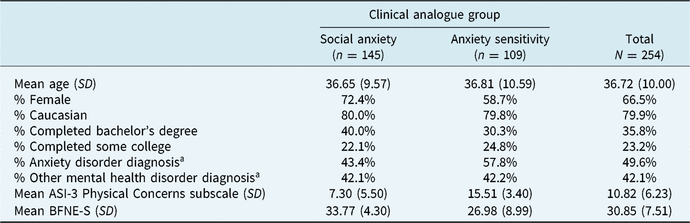
The final sample (N = 254, mean age = 36.7 years, 66.5% female, 79.9% Caucasian) consisted of a social anxiety group (n = 145) and an anxiety sensitivity group (n = 109). Most respondents had completed a bachelor’s degree (35.8%) or some college (23.2%). Demographic information for both clinical analogue groups and the total sample are included in Table 1.
Sample demographics

ASI-3, Anxiety Sensitivity Index-3; BFNE-S, Brief Fear of Negative Evaluation-Straightforward. aDiagnoses were based on self-report.
Measures
Screening measures
Brief Fear of Negative Evaluation – Straightforward (BFNE-S)
Screening for the social anxiety group was based on BFNE-S scores. The BFNE-S (Rodebaugh et al., Reference Rodebaugh, Woods, Thissen, Heimberg, Chambless and Rapee2004) is an 8-item version of the BFNE (Leary, Reference Leary1983) which assesses fear of negative evaluation (e.g. ‘I am afraid that other people will find fault with me’). Items are rated on a 5-point Likert-type scale ranging from 1 (not at all characteristic of me) to 5 (entirely characteristic of me). The BFNE-S has excellent internal consistency and convergent validity with a variety of validated measures of social anxiety (Weeks et al., Reference Weeks, Heimberg, Fresco, Hart, Turk, Schneier and Liebowitz2005). In the current sample, internal consistency for the BFNE-S was excellent (α = .94).
The social anxiety group was intended to be a social anxiety disorder analogue sample. The BFNE-S was chosen as a screening measure for this group, as it assesses fear of negative evaluation. According to the most recent Diagnostic and Statistical Manual of Mental Disorders (DSM-5), a diagnosis of social anxiety disorder requires that an individual ‘fears that he or she will act in a way or show anxiety symptoms that will be negatively evaluated’ (American Psychiatric Association, 2013, p. 202).
Anxiety Sensitivity Index-3 (ASI-3) Physical Concerns subscale
Screening for the anxiety sensitivity group was conducted using the ASI-3 Physical Concerns subscale (Taylor et al., Reference Taylor, Zvolensky, Cox, Deacon, Heimberg, Ledley and Stewart2007), which consists of six items assessing the fear of anxiety-related sensations based on their perceived negative physical consequences (e.g. ‘When I feel pain in my chest, I worry that I’m going to have a heart attack’). Respondents indicate their level of agreement with each item on a 5-point scale ranging from 0 (very little) to 4 (very much).
The ASI-3 Physical Concerns subscale was chosen as a screening measure for the anxiety sensitivity group, as this group was intended to be a panic disorder analogue sample. Although panic disorder is strongly associated with anxiety sensitivity as a whole (Olatunji and Wolitzky-Taylor, Reference Olatunji and Wolitzky-Taylor2009), it has been shown to be more strongly linked with the physical manifestations of anxiety compared with the social or cognitive manifestations of anxiety (Deacon and Abramowitz, Reference Deacon and Abramowitz2006). In their evaluation of the ASI-3, Wheaton et al. (Reference Wheaton, Deacon, McGrath, Berman and Abramowitz2012) found the ASI-3 Physical Concerns subscale to be more strongly correlated with panic symptoms than the ASI-3 Social Concerns subscale, ASI-3 Cognitive Concerns subscale, or ASI-3 total score. The authors concluded that specific anxiety sensitivity dimensions are more useful in differentiating between anxiety problems than anxiety sensitivity as a whole. Taylor et al. (Reference Taylor, Zvolensky, Cox, Deacon, Heimberg, Ledley and Stewart2007) found the ASI-3 Physical Concern subscale to have good criterion, convergent and discriminant validity. In the present study, the ASI-3 Physical Concerns subscale demonstrated good internal consistency (α = .88).
Measures completed by both clinical analogue groups
Safety Behaviour Scale (SBS)
The SBS was developed for the current study as a transdiagnostic measure of safety behaviour use (SBS-Behaviour scale) and positive beliefs regarding safety behaviours (SBS-Belief scale). The measure begins by asking the respondent to write the outcome they most fear (e.g. being negatively judged, experiencing a medical catastrophe, being attacked) and to complete the measure based on the behaviours they perform in order to manage that feared outcome. For the current study, to ensure participants in the social anxiety group responded based on social anxiety and participants in the anxiety sensitivity group responded based on anxiety sensitivity, the instructions asked participants to write their most feared outcome related to social situations or arousal-related body sensations, respectively.
Safety behaviours on the SBS are categorized into two types, preventive safety behaviours and restorative safety behaviours, based on a classification system initially described by Rachman and Hodgson (Reference Rachman and Hodgson1980) and further developed by Helbig-Lang and Petermann (Reference Helbig-Lang and Petermann2010). Preventive safety behaviours are actions performed before confrontation with a fear-related stimulus (e.g. avoiding feared stimuli, rehearsing or planning what one will say or do). Restorative safety behaviours are actions performed after confrontation with a fear-related stimulus (e.g. taking anti-anxiety medication).
As research has found differential impacts of preventive and restorative safety behaviours on treatment outcome (Goetz et al., Reference Goetz, Davine, Siwiec and Lee2016), these two types of safety behaviours are evaluated in two distinct sections of the SBS. Each section begins with an unscored checklist of different types of safety behaviours developed based on existing safety behaviour measures (Abramowitz et al., Reference Abramowitz, Deacon, Olatunji, Wheaton, Berman, Losardo and Adams2010; Cuming et al., Reference Cuming, Rapee, Kemp, Abbott, Peters and Gaston2009; Kamphuis and Telch, Reference Kamphuis and Telch1998; Olatunji et al., Reference Olatunji, Etzel, Tomarken, Ciesielski and Deacon2011; Pinto-Gouveia et al., Reference Pinto-Gouveia, Cunha and do Céu Salvador2003; Salkovskis et al., Reference Salkovskis, Clark and Gelder1996), an informal review of the safety behaviour literature, clinical experience, and discussions with other researchers and clinicians who specialize in anxiety. These checklists provide the clinician with a comprehensive list of the client’s safety behaviours and orient the client to the exact behaviours to base their responses on when answering the questions that follow.
Both checklists of safety behaviours are followed by an identical set of seven items, each rated on a 5-point Likert-type scale, yielding a total of 14 items. One of the seven items assesses the amount of time spent engaging in preventive and restorative safety behaviours each day and is rated from 0 (none) to 4 (8 hours or more each day). Another item assesses the number of times preventive and restorative safety behaviours are performed each day and is rated from 0 (none) to 4 (16+ times each day). To form the 4-item SBS-Behaviour scale score, responses to these two items on both the preventive safety behaviour section and the restorative safety behaviour section of the SBS are averaged. Lastly, five items assess the degree to which respondents believe that preventive and restorative safety behaviours are necessary for the following: tolerating distress; functioning in everyday life; functioning in anxiety-provoking situations; reducing likelihood of the feared outcome; and reducing severity of feared outcome. The word ‘necessary’ was deliberately chosen to facilitate treatment outcome assessment for clinicians delivering CBT, which aims to help clients learn that safety behaviours are unnecessary. Belief items are rated from 0 (very little) to 4 (very much) and were developed based on beliefs specified in exposure-based CBT manuals (Abramowitz et al., Reference Abramowitz, Deacon and Whiteside2012; Craske et al., Reference Craske, Antony and Barlow2006; Schmidt et al., Reference Schmidt, Buckner, Pusser, Woolaway-Bickel, Preston and Norr2012; Whiteside et al., Reference Whiteside, Ale, Young, Dammann, Tiede and Biggs2015), findings from a similar study assessing parental beliefs about accommodation of youth anxiety (Meyer et al., Reference Meyer, Clapp, Whiteside, Dammann, Kriegshauser, Hale and Deacon2018), clinical experience, and discussions with expert anxiety researchers and clinicians. To form the 10-item SBS-Belief scale score, responses to these five items on both the preventive safety behaviour section and the restorative safety behaviour section of the SBS are averaged. The SBS can be obtained by contacting the first author.
Quality of Life Enjoyment and Satisfaction Questionnaire – Short Form (Q-LES-Q-SF)
The Q-LES-Q-SF (Stevanovic, Reference Stevanovic2011) is a brief, self-report measure of quality of life, adapted from the original 93-item measure (Endicott et al., Reference Endicott, Nee, Harrison and Blumenthal1993). Sixteen items are rated on a 5-point scale from 1 (very poor) to 5 (very good). Stevanovic (Reference Stevanovic2011) found the Q-LES-Q-SF to have sound internal consistency, test–retest reliability, and convergent and criterion validity, with 80% sensitivity and 100% specificity in detecting changes in quality of life at 4-week follow-up. The internal consistency of the Q-LES-Q-SF in the current study was excellent (α = .92).
Measures only completed by social anxiety group
Liebowitz Social Anxiety Scale-Self Report (LSAS-SR)
The LSAS-SR (Baker et al., Reference Baker, Heinrichs, Kim and Hofmann2002) is a self-report measure of social anxiety adapted from the original clinician-rated LSAS (Liebowitz, Reference Liebowitz1987). Twenty-four items depict social situations, each of which is rated on two 4-point Likert-type scales assessing the individual’s fear (0 = none; 1 = mild; 2 = moderate; 3 = severe) and avoidance [0 = never (0%); 1 = occasionally (1–33%); 2 = often (33–67%); 3 = usually (67–100%)] of each situation. All fear and avoidance ratings are summed to yield a total score, ranging from 0 to 144. The LSAS-SR has good test–retest reliability, internal consistency, convergent and discriminant validity (Baker et al., Reference Baker, Heinrichs, Kim and Hofmann2002). The internal consistency of the LSAS-SR was excellent in the current sample (α = .96).
Subtle Avoidance Frequency Examination (SAFE)
The SAFE (Cuming et al., Reference Cuming, Rapee, Kemp, Abbott, Peters and Gaston2009) assesses the frequency with which individuals engage in various safety behaviours while in social situations. Thirty-two items are rated according to how often the individual would engage in each behaviour on a 5-point Likert-type scale from 0 (never) to 4 (always). The SAFE has strong internal consistency, good construct validity, and discriminates between individuals with and without social anxiety disorder (Cuming et al., Reference Cuming, Rapee, Kemp, Abbott, Peters and Gaston2009). In the current sample, the SAFE had excellent (α = .94) internal consistency.
Measures only completed by anxiety sensitivity group
Panic Disorder Severity Scale-Self Report (PDSS-SR)
The PDSS-SR (Houck et al., Reference Houck, Spiegel, Shear and Rucci2002) is a self-report assessment of panic disorder severity adapted from the original clinician-rated version (Shear et al., Reference Shear, Brown, Barlow, Money, Sholomskas, Woods and Papp1997). Seven items assess the following domains: panic frequency, distress during panic, panic-related anticipatory anxiety, avoidance of situations, avoidance of physical sensations, impairment in work functioning, and impairment in social functioning. Each item is rated on a 5-point Likert-type scale ranging from 0 to 4, with the qualitative descriptions differing for each item. The PDSS-SR has excellent internal consistency, good test–retest reliability, and is sensitive to change following treatment (Houck et al., Reference Houck, Spiegel, Shear and Rucci2002). In the current sample, the internal consistency of the PDSS-SR was excellent (α = .92).
Texas Safety Maneuver Scale (TSMS)
The TSMS (Kamphuis and Telch, Reference Kamphuis and Telch1998) assesses the frequency with which individuals engage in various safety behaviours related to panic. Fifty items are rated on a 5-point Likert scale ranging from 0 (NEVER to manage anxiety or panic) to 4 (ALWAYS to manage anxiety or panic). There is also a response option (YES, BUT NOT to manage anxiety or panic) which is rated as a 0. The TSMS has high internal consistency and good convergent and discriminant validity (Kamphuis and Telch, Reference Kamphuis and Telch1998). In the current sample, the TSMS had excellent (α = .95) internal consistency.
Procedure
Part 1 (screening)
Participants read a description of the study on the MTurk website and then clicked on a link which directed them to www.surveymonkey.com, where all study-related documents were displayed and data were collected. After providing informed consent, respondents completed a demographic questionnaire, screening measures (BFNE-S, ASI-3 Physical Concerns subscale), and were asked for their consent to be contacted to participate in Part 2 of the study. In order to be eligible for Part 2 of the study, individuals must have provided consent to be contacted for Part 2, completed all Part 1 survey items, and passed three attention checks based on Oppenheimer et al. (Reference Oppenheimer, Meyvis and Davidenko2009). In addition, participants must have received a score equal to, or greater than, 27 on the BFNE-S or 12 on the ASI-3 Physcial Concerns subscale.
Of the 960 individuals who completed Part 1, 571 did not exhibit elevated enough scores on the screening measures to be invited for Part 2, 121 failed one or more of the three attention checks, six had incomplete data, and five did not consent to be contacted for Part 2. Some participants exhibited two or more of these exclusion criteria. Of the 330 individuals who met all Part 2 eligibility criteria, 74 exhibited elevated anxiety sensitivity scores and were allocated to the anxiety sensitivity group, 148 exhibited elevated social anxiety scores and were allocated to the social anxiety group, and 108 exhibited both elevated anxiety sensitivity and social anxiety scores. In order to balance the sample sizes for the two clinical analogue groups to facilitate group comparisons, individuals who exhibited both elevated anxiety sensitivity symptoms and social anxiety symptoms were randomized at a 2:1 ratio to the anxiety sensitivity and social anxiety groups, respectively, using a random number generator. Although this randomization procedure resulted in individuals with similar clinical profiles being present in both clinical analogue groups, individuals were asked to answer the items on the SBS based on their assigned clinical analogue group, facilitating internal validity of the findings. The randomization process resulted in a total of 146 individuals being invited to take part in the anxiety sensitivity group and 184 individuals being invited to take part in the social anxiety group. All 960 individuals who participated in Part 1 were debriefed and compensated $0.75, which is commensurate with typical compensation provided to MTurk workers (Buhrmester et al., Reference Buhrmester, Kwang and Gosling2011).
Part 2
The response rate for Part 2 of the study was 78.48%, with 259 of the 330 invited individuals participating. As for Part 1, participants clicked on a link below a study description on the MTurk website, which directed them to www.surveymonkey.com, where they provided their informed consent a second time and completed study measures based on their clinical analogue group. All individuals who took part in Part 2 completed the SBS and the Q-LES-Q-SF. In addition, individuals allocated to the social anxiety group completed measures related to social anxiety disorder (LSAS-SR, SAFE) and individuals allocated to the anxiety sensitivity group completed measures related to panic disorder (PDSS-SRF, TSMS). Time between Part 1 and Part 2 of the study ranged from 17.7 to 35.9 days (mean = 24.4 days).
In order to be included in data analysis, individuals must have passed all three attention checks (Oppenheimer et al., Reference Oppenheimer, Meyvis and Davidenko2009). Of the 259 individuals who completed Part 2, five failed at least one attention check, resulting in a final sample of 254 individuals, including 109 in the anxiety sensitivity group and 145 in the social anxiety group. As all items on each page of the questionnaire were required to be answered prior to advancing to the next page, all Part 2 participants answered every item, resulting in no missing data. All Part 2 participants were debriefed and compensated $1.50. All study procedures were approved by the Social Sciences Human Research Ethics Committee at the University of Wollongong.
Results
Psychometric properties and descriptive statistics of the SBS scales
Item-level psychometric analyses for the 4-item SBS-Behaviour scale demonstrated that all corrected item-total correlations (mean = .75; range = .70 to .80) and mean inter-item correlations (mean = .66; range = .62 to .69) were above the recommended minimum of .30 (Nunnally and Bernstein, Reference Nunnally, Bernstein, Nunnally and Bernstein1994). Similarly, all corrected item-total correlations (mean = .72; range = .61 to .83) and mean inter-item correlations (mean = .56; range = .48 to .64) for the 10-item SBS-Belief scale were above .30. Internal consistency was good for the SBS-Behaviour scale (α = .88) and excellent for the SBS-Belief scale (α = .93). The mean score was 2.21 (SD = .72) for the SBS-Behaviour scale and 2.98 (SD = .95) for the SBS-Belief scale. The zero-order correlation (r) between the two SBS scales was .48 (p < .001). Scores on the SBS scales did not significantly differ based on age (r ≤ |.08|, p ≥ .21), gender (d ≤ 0.10, p ≥ .44), or clinical analogue group (d ≤ 0.12, p ≥ .33). Descriptive statistics for each SBS item are presented in Table 2.
Means and standard deviations of Safety Behaviour Scale (SBS) items

aItem from preventive safety behaviour section of SBS; bitem from restorative safety behaviour section of SBS.
Best practice guidelines for exploratory factor analyses suggest that a solid factor should contain at least five items (Costello and Osborne, Reference Costello and Osborne2005). As items assessing safety behaviour use and beliefs about safety behaviours use different response formats, and as the SBS separates preventive safety behaviour items and restorative safety behaviour items, four separate factor analyses would have to be conducted in order to mitigate concerns related to shared method variance. Two of these analyses would only contain two items. Therefore, it was decided that a factor analysis would not be appropriate for the SBS.
Correlations between SBS scales and study measures
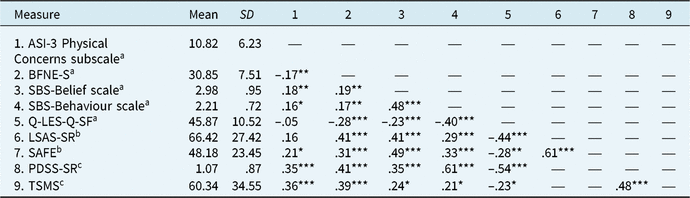
Zero-order correlations between the SBS scales and the Q-LES-Q-SF, LSAS-SR, SAFE, PDSS-SR and TSMS provided preliminary support for the convergent validity of the SBS. Means, standard deviations and correlations between all study measures are given in Table 3. Hypotheses regarding correlations between the SBS scales and study measures were supported. Across the total sample, higher scores on the SBS-Behaviour scale and SBS-Belief scale were significantly associated with lower quality of life. Within the social anxiety group, higher scores on the SBS-Behaviour scale and SBS-Belief scale were significantly associated with more severe social anxiety symptoms and greater safety behaviour use as measured by the SAFE. Within the anxiety sensitivity group, higher scores on the SBS-Behaviour scale and SBS-Belief scale were significantly associated with more severe panic disorder symptoms and greater safety behaviour use as measured by the TSMS. Within the social anxiety group, the SAFE demonstrated a significantly stronger correlation with the SBS-Belief scale (r = .49) than with the SBS-Behaviour scale (r = .33; t = 2.13, p = .035). Within the anxiety sensitivity group, the correlation between the TSMS and the SBS-Belief scale (r = .24) was stronger than the correlation between the TSMS and the SBS-Behaviour scale (r = .20) but this difference was not significant (t = .44, p = .661).
Descriptive statistics and zero-order correlations between study variables
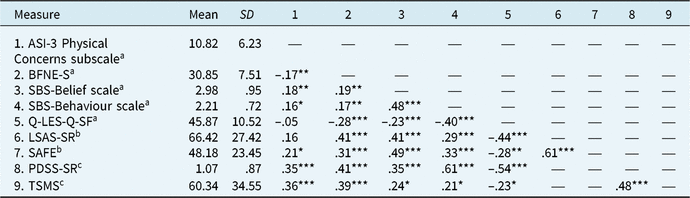
*p < .05; **p < .01; ***p < .001. ASI-3, Anxiety Sensitivity Index-3; BFNE-S, Brief Fear of Negative Evaluation – Straightforward; SBS, Safety Behaviour Scale; Q-LES-Q-F, Quality of Life Enjoyment and Satisfaction Questionnaire – Short Form; LSAS-SR, Liebowitz Social Anxiety Scale – Self Report; SAFE, Subtle Avoidance Frequency Examination; PDSS-SR, Panic Disorder Severity Scale – Self Report; TSMS, Texas Safety Maneuver Scale. aAdministered to all participants (N = 254); badministered only to the social anxiety group (n = 145); cadministered only to the anxiety sensitivity group (n = 109).
General beliefs about safety behaviours in the prediction of safety behaviour use
First, to assess the association between beliefs about safety behaviours and safety behaviour use, zero-order correlations between the SBS scales were calculated, yielding similar correlations within the social anxiety group (r = .49, p < .001) and the anxiety sensitivity group (r = .46, p < .001). Next, in order to test the hypothesis that positive beliefs about safety behaviours would significantly predict safety behaviour use even when controlling for anxiety severity, a multiple regression was conducted within each of the social anxiety and anxiety sensitivity groups, controlling for social anxiety severity (LSAS-SR) and panic disorder severity (PDSS-SR), respectively. Anxiety severity, which has been shown to be strongly related to safety behaviour use (Deacon and Maack, Reference Deacon and Maack2008; Olatunji et al., Reference Olatunji, Etzel, Tomarken, Ciesielski and Deacon2011), was entered as a predictor variable so that the unique impact of beliefs about safety behaviours on safety behaviour frequency could be assessed. Predictor variables were simultaneously entered and included the anxiety severity measure and the SBS-Belief scale. The dependent variable in both analyses was the SBS-Behaviour scale. After controlling for anxiety severity, beliefs about safety behaviours accounted for a significant amount of the variance in safety behaviour use within both the social anxiety group (sr 2 = .16, p < .001) and the anxiety sensitivity group (sr 2 = .07, p < .001). Results from these multiple regressions support the hypothesis that beliefs about safety behaviours predict safety behaviour use even when controlling for anxiety severity.
Specific beliefs about safety behaviours in the prediction of safety behaviour use
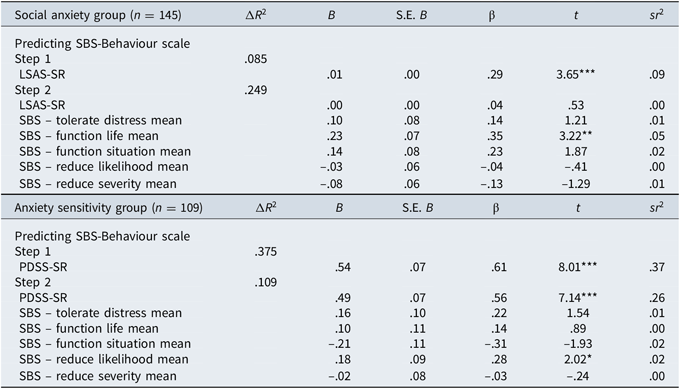
Two hierarchical multiple regressions were conducted to determine whether any belief(s) about safety behaviours would significantly predict any unique variance in safety behaviour use within each clinical analogue group. Authors agreed that creating belief items by averaging each pair of corresponding belief items – one from the preventive safety behaviour section and the other from the restorative safety behaviour section of the SBS – would be more interpretable than conducting ten separate regression analyses for each of the ten belief items. This process yielded five belief items created from the following SBS item pairs: 3 and 10, 4 and 11, 5 and 12, 6 and 13, and 7 and 14. Correlations between each of the items pairs were significant (r ≥ .59, p < .001). Once again, analyses were conducted separately within the social anxiety and anxiety sensitivity groups, controlling for social anxiety (LSAS-SR) and panic disorder (PDSS-SR) severity. Anxiety severity measures were entered into the first block, and the five belief items were entered into the second block. Results for the hierarchical multiple regressions are given in Table 4.
Specific beliefs about safety behaviours in predicting safety behaviour use

*p < .05; **p < .01; ***p < .001. SBS, Safety Behaviour Scale; LSAS-SR, Liebowitz Social Anxiety Scale – Self Report; PDSS-SR, Panic Disorder Severity Scale – Self Report.
Within step 1, anxiety severity predicted a significant amount of variance in safety behaviour use for both the social anxiety group (R 2 = .09, p < .001) and anxiety sensitivity group (R 2 = .38, p < .001). Step 2, containing the five belief items, accounted for significant additional variance in safety behaviour use in both the social anxiety group (ΔR 2 = .25, p < .001) and the anxiety sensitivity group (ΔR 2 = .11, p = .001). Within each group, only one specific belief emerged as a significant unique predictor of safety behaviour use. For the social anxiety group, it was the belief that safety behaviours are necessary to function adequately in everyday life (sr 2 = .05, p = .002). For the anxiety sensitivity group, it was the belief that safety behaviours are necessary to reduce the likelihood that your most feared outcome will occur (sr 2 = .02, p = .046). The final model predicted 33.4% of the variance in safety behaviour use within the social anxiety group (p < .001) and 48.3% of the variance in safety behaviour use within the anxiety sensitivity group (p = .001).
Results from these hierarchical multiple regressions provide additional support for the hypothesis that beliefs about safety behaviours predict safety behaviour use when controlling for anxiety severity. Furthermore, these results indicate that certain beliefs about safety behaviours seem to be particularly relevant in predicting safety behaviour use, depending on the type of anxiety problem.
Discussion
The aim of this study was to examine the predictive relationship between beliefs about safety behaviours and safety behaviour use while controlling for anxiety severity. To accomplish this, the SBS was created to assess safety behaviour use (SBS-Behaviour scale) and positive beliefs about safety behaviours (SBS-Belief scale). A sample of adults with elevated social anxiety and/or anxiety sensitivity completed measures of quality of life, safety behaviour use, beliefs about safety behaviours, and anxiety severity.
In accordance with hypotheses, both scales demonstrated good item-level psychometric properties and correlations in expected directions with study measures. Hypotheses regarding the ability of beliefs about safety behaviours to predict safety behaviour use were supported in both clinical analogue groups, even after controlling for anxiety severity. Specifically, safety behaviour use was significantly predicted by the belief that safety behaviours are necessary to function adequately in everyday life for the social anxiety group. For the anxiety sensitivity group, safety behaviour use was significantly predicted by the belief that safety behaviours are necessary to reduce the likelihood that a most feared outcome will occur.
Medium-to-large correlations in hypothesized directions between the SBS scales and study measures provide preliminary support for the convergent validity of the SBS. Correlations with existing measures of safety behaviour use (SAFE, TSMS) were stronger for the SBS-Belief scale than for the SBS-Behaviour scale. It is likely that the SBS-Behaviour scale was less strongly correlated with existing measures of safety behaviour use than may have been expected due to the unique way in which safety behaviour use is assessed on the SBS-Behaviour scale. Whereas the SAFE and TSMS assess the frequency of each safety behaviour, the SBS-Behaviour scale assesses the frequency and duration of safety behaviour use across all preventive safety behaviours and across all restorative safety behaviours, as it was designed to be as concise as possible to maximize clinical utility. Thus, the SBS-Behaviour scale should be used as a quick, clinically useful measure of broad safety behaviour use rather than an in-depth assessment of individual safety behaviour use.
It was hypothesized that beliefs about safety behaviours would predict safety behaviour use when controlling for anxiety severity. This hypothesis was fully supported, as beliefs about safety behaviours significantly predicted safety behaviour use when controlling for anxiety levels in both groups. More specifically, safety behaviour use in the social anxiety group was uniquely predicted by the belief that safety behaviours are necessary to function adequately in everyday life. Within the anxiety sensitivity group, safety behaviour use was uniquely predicted by the belief that safety behaviours are necessary to reduce the likelihood that their most feared outcome will occur. Theoretical and clinical implications emerge when considering these findings. First, findings support the core theory of CBT, which posits that beliefs are directly related to behaviour (Abramowitz, Reference Abramowitz2013). Second, results indicate that when treating anxious clients, clinicians may consider identifying and modifying the maladaptive beliefs clients have regarding safety behaviours in an effort to reduce safety behaviour use. Third, results from the multiple regression analyses suggest that individuals may have positive beliefs about safety behaviours for reasons other than their perceived impact on threat and anxiety tolerability and that these beliefs may differ depending on the type of anxiety problem the client has. Relatedly, results bring into question how safety behaviours are defined. Traditionally, safety behaviours have been defined according to their function, which involves mitigating threat and tolerating anxiety (Helbig-Lang and Petermann, Reference Helbig-Lang and Petermann2010; Telch and Lancaster, Reference Telch, Lancaster, Neudeck and Wittchen2012). However, the present study has found that this definition may not be fully comprehensive, as it omits safety behaviours performed based on their perceived impact on functioning. As such, it may be more helpful to define safety behaviours based on context rather than function – as unnecessary behaviours performed in relation to excessive or exaggerated anxiety.
This study has several strengths, including its relatively large sample size and its contribution of a novel measure assessing safety behaviour use and beliefs about safety behaviours across anxiety disorders. This measure includes transdiagnostic checklists of preventive and restorative safety behaviours that clinicians may find helpful in identifying a client’s full repertoire of safety behaviours. Clinicians may also find the checklists helpful in assisting the client to distinguish between safety behaviours and adaptive coping behaviours. Further, by utilizing Amazon’s MTurk for recruitment in combination with attention checks, data from the present study are likely to be of high quality (Buhrmester et al., Reference Buhrmester, Kwang and Gosling2011; Casler et al., Reference Casler, Bickel and Hackett2013; Shapiro et al., Reference Shapiro, Chandler and Mueller2013).
A number of limitations of this study should also be acknowledged. Firstly, the cross-sectional nature of the data prevents conclusions from being drawn regarding an aetiological relationship between study variables. Secondly, as data consisted of self-report measures completed online, the diagnostic statuses of participants could not be confirmed. As such, the ecological validity of findings is limited and results may not be generalizable to clinical samples. Thirdly, although this study provided some basic, preliminary information regarding the SBS, certain psychometric qualities (e.g. discriminant validity) were unable to be assessed. Lastly, 108 participants from Part 1 who exhibited both elevated anxiety sensitivity and social anxiety were randomly allocated at a 2:1 ratio to the anxiety sensitivity and social anxiety groups, respectively. Distributing these participants in this way resulted in similar sample sizes for the anxiety sensitivity and social anxiety groups, thereby facilitating group comparisons. However, this process may also have reduced the distinction between these two clinical analogue groups, as both groups contained individuals with similar clinical profiles. Future research should aim to address these concerns by recruiting large samples of individuals formally diagnosed with anxiety disorders, administering clinician-rated measures in addition to self-report measures, and utilizing longitudinal designs and behavioural paradigms to assess the psychometric quality of the SBS as well as beliefs about safety behaviours and their relationship with safety behaviour use.
Beyond the methodological limitations of the present study, the limitations of the SBS itself should be noted. Firstly, as safety behaviours are highly idiosyncratic, it is possible that an anxious individual may engage in a safety behaviour that is not captured by the SBS. However, authors went to great lengths to maximize the comprehensiveness of the safety behaviour categories by ensuring specific safety behaviours identified in the literature (e.g. items on disorder-specific measures of safety behaviours) and safety behaviours observed during clinical experience were all encompassed by one of the safety behaviour categories on the SBS. Secondly, as the SBS was designed to be as concise and clinically useful as possible, items are answered based on all preventive safety behaviours combined and all restorative safety behaviours combined, rather than based on each of the 20 safety behaviour types. Although grouping preventive and restorative safety behaviours improves the brevity of the SBS, it prohibits information regarding the frequency of, duration of, and beliefs regarding specific safety behaviours.
In summary, the present study demonstrates that beliefs about safety behaviours predict safety behaviour use within individuals high in social anxiety and anxiety sensitivity, even when controlling for anxiety severity. Accordingly, efforts to decrease safety behaviour use within anxiety treatment might involve the clinician identifying and modifying maladaptive beliefs about safety behaviours. Specifically, clinicians might directly address the belief that safety behaviours are necessary to function adequately in everyday life for individuals high in social anxiety, and the belief that safety behaviours are necessary to reduce the likelihood that a most feared outcome will occur for individuals high in anxiety sensitivity. This study also introduced a novel measure of safety behaviour use and beliefs about safety behaviours, the SBS. It is hoped that clinicians of anxious individuals will find the SBS helpful in assessing and monitoring anxious individuals’ repertoire of preventive and restorative safety behaviours, safety behaviour use, and beliefs about safety behaviours throughout treatment. Future research should identify optimal methods of modifying maladaptive beliefs about safety behaviours. For example, clinicians may provide thorough psychoeducation by way of hand-outs and didactic instruction regarding the necessity of safety behaviours (Telch and Lancaster, Reference Telch, Lancaster, Neudeck and Wittchen2012). Alternatively, as exposure-based CBT for anxiety involves exposure to feared stimuli with the goal of acquiring new, more accurate information regarding the likelihood and severity of threat (Abramowitz et al., Reference Abramowitz, Deacon and Whiteside2012), perhaps another goal of exposure to feared stimuli could be to acquire new, more accurate information regarding the necessity of safety behaviours.
Supplementary material
To view supplementary material for this article, please visit http://dx.doi.org/10.1017/S1352465819000298
Author ORCID
Johanna M. Meyer, 0000-0002-4693-9000
Acknowledgments
The authors would like to acknowledge and express their gratitude to the participants who gave up their time to take part in the study.
Financial support
This research has been conducted with the support of the Australian Government Research Training Program Scholarship.
Conflicts of interest
The authors have no conflicts of interest with respect to this publication.
Ethical statement
The authors assert that all procedures contributing to this work comply with the Ethical Principles of Psychologists and Codes of Conduct as set forth by the APA. This study was reviewed and approved by the Social Sciences Human Research Ethics Committee at the University of Wollongong (ethics number: 2016/389).





Comments
No Comments have been published for this article.