1. Introduction
The literature argues that lax environmental regulation is a factor attracting foreign direct investment (FDI) in high-polluting industries, which is known as the pollution haven hypothesis (PHH). An immediate corollary of the PHH is that stringent environmental regulations can abate regional pollution by removing high-polluting FDI. However, we observe that in China, the policy goals of stringent environmental regulations in highly polluted cities have been met without stopping the deterioration of China's overall air quality. In understanding this puzzling fact, we re-examine the PHH by taking environmental regulation in ambient regions as a critical determinant in FDI allocation and exploiting the marked variations in the stringency of environmental regulations across China.
Our results indicate that it is crucial to include ambient regions as a major factor in testing the PHH, especially when applied to large economies with spatial variation in environmental regulations, such as China. The omission of this ambient-region spillover could lead to incomplete or even biased results. Enhanced by spatial spillover from ambient regions, our results principally support the PHH and explain the puzzle in China, contributing to the empirical literature on the debate regarding the PHH (see the excellent survey by Copeland (Reference Copeland2008)). At the heart of our results, we find that in a large developing economy with considerable policy differences over a vast geographical space, such as China, stringent regional environmental regulation reduces high-polluting FDI locally but incidentally increases FDI to ambient regions with lax regulations.Footnote 1 Consequentially, pollutants spread back from ambient regions, and overall air quality worsens despite realized local regulation goals. Briefly, region-based regulation policy redistributes instead of removing high-polluting FDI and accompanying pollutants.
We are not the first to take account of ambient regions in examining the PHH. Indeed, we follow Millimet and Roy (Reference Millimet and Roy2016) method to quantify the spillover effects from the ambient regions. Millimet and Roy (Reference Millimet and Roy2016) explicitly state that existing studies of the PHH fall short of treating geographic spillover adequately. As such, they incorporate neighboring environmental regulations into their investigation mainly to remedy omitted-variable bias. However, their evidence indicates that neighboring environmental regulation is not a significant determinant of FDI location, and the inclusion of spatial spillover has little effect on the estimates of own regulation's effect (see Millimet and Roy, Reference Millimet and Roy2016: 654, 665, 668). In contrast, the focus of the current paper is to estimate how regulations from ambient regions could offset the direct policy effect in a region. We provide consistent evidence indicating that geographic spillover from ambient regions has economically significant effects on FDI allocation and pollution redistribution.
China has continuously strengthened and upgraded its environmental regulatory policies in the last decades. According to the Ministry of Environmental Protection of China's annual report, national sulfur dioxide emissions in 2010 were 2.2 million tons, decreasing by 14.29 per cent relative to 2005, which surpasses the 10 per cent national target set by China's 11$^{th}$ Five-Year Plan. In 2015, sulfur dioxide and nitrogen oxide emissions decreased by 18 and 18.6 per cent respectively, exceeding the 10 per cent targets of the 12th Five-Year Plan. Paradoxically, although national reduction targets were over-fulfilled, the air quality was deteriorating during that period. The number of cities where air pollution exceeded the national standard remained high, and the incidence of severely polluted days was surging. Regional pollution incidents occurred more frequently than a decade before. It seems that increasingly strict environmental regulations have been unable to alleviate the pollution issues in China.
Despite some prima facie evidence, the PHH remains highly controversial, especially with conflicting results in the empirical literature. On the one hand, List and Co (Reference List and Co2000) and Keller and Levinson (Reference Keller and Levinson2002) find that the locations of multinational companies’ factories are directly affected by state-level environmental regulations, using FDI data in the US. Supporting evidence comes from developed economies such as Germany (Wagner and Timmins, Reference Wagner and Timmins2009), and France (Kheder and Zugravu, Reference Kheder and Zugravu2012), and emerging economies, particularly China (Cai et al., Reference Cai, Lu, Wu and Yu2016). On the other hand, some researchers reject the PHH as they find no significant association between environmental regulations and FDI location (e.g., Jaffe et al., Reference Jaffe, Peterson, Portney and Stavins1995; Wheeler, Reference Wheeler2001; Raspiller and Riedinger, Reference Raspiller and Riedinger2008).
Cai et al. (Reference Cai, Lu, Wu and Yu2016) and Millimet and Roy (Reference Millimet and Roy2016) argue that the inadequate treatment of environmental regulations’ endogeneity explains most of the conflicting evidence on the PHH. Reverse causality is the first concern. FDI inflows could have a reverse effect on environmental regulation policies. Besides, the missing variable is another critical issue. Most notably, Millimet and Roy (Reference Millimet and Roy2016) emphasize the potential importance of spillover effects from neighboring regions. They incorporate regional spillover to correct for omitted-variable bias but find neighboring regulation is not an important determinant of FDI location. Departing from Millimet and Roy (Reference Millimet and Roy2016), we exploit a quasi-natural experiment in China to re-examine the PHH by investigating how the neighboring spillover could affect FDI inflows to regulated and unregulated regions. More importantly, our evidence indicates that spatial spillover plays a crucial role in high-polluting FDI allocation and pollution redistribution. That is, geographic spillover constitutes an essential component in parallel with own regulation in the PHH.
Recent studies have sought to address the inherent endogeneity in testing the PHH using an instrument-variable approach and quasi-natural experiments. Keller and Levinson (Reference Keller and Levinson2002) use lagged FDI as instruments, while Cole et al. (Reference Cole, Elliott and Shimamoto2005) and Jug and Mirza (Reference Jug and Mirza2005) use lagged environmental regulations, and Cole et al. (Reference Cole, Elliott and Shimamoto2005) and Levinson and Taylor (Reference Levinson and Taylor2008) use geographical distributions of industries. Since valid instruments should be uncorrelated with the error term and satisfy the exogeneity conditions (Brunel and Levinson, Reference Brunel and Levinson2016; Millimet and Roy, Reference Millimet and Roy2016), finding a suitable instrument is always challenging in practice. An alternative empirical approach exploits policy shocks as quasi-natural experiments. It estimates the treatment effects of policies with difference-in-differences type strategies (e.g., Hering and Poncet, Reference Hering and Poncet2014; Tanaka, Reference Tanaka2015; Cai et al., Reference Cai, Lu, Wu and Yu2016). These empirical strategies rely on different assumptions from instrument variables, such as the parallel trend assumption and the stable unit treatment value assumption.
This paper takes the latter approach and exploits the Two Control Zones (TCZ) policy in China as a quasi-natural experiment to investigate the impacts of environmental regulations on FDI inflows and their environmental consequences. The Chinese central government introduced the TCZ policy in 1998 to alleviate sulfur dioxide (SO$_{2}$ ) and acid rain, and this policy targets cities with SO$_{2}$
 and acid rainfall that exceeds national standards. A total of 175 cities across 27 provinces are designated TCZ cities and mandated strict environmental regulations.
Our primary strategy to counter endogeneity exploits variations in the TCZ policy's impacts on FDI inflows to isolate regulation-related causal effects. The TCZ policy requires coal-based power plants in TCZ cities to phase out the high-polluting technology and retrofit the coal-burning process by installing sulfur reduction equipment. Production cost hence increases, and so does the energy price in TCZ cities. The levy of SO$_{2}$ emission fees further aggravates the cost disadvantage of the manufacturing enterprises burning coal. Moreover, the TCZ cities’ governments are reluctant to approve new land or provide funding supports for high-polluting industries. In combination, TCZ cities lose attractiveness to FDI when ambient non-TCZ cities implement lax environmental policies. FDI hence reallocates over to the ambient regions. Methodologically, we follow Millimet and Roy (Reference Millimet and Roy2016) to measure the spillover effects from ambient regions.
We present two sets of results. First, we find supportive evidence of the spillover effect on FDI of the ambient regions. A non-TCZ city attracts more FDI in high-polluting industries when TCZ cities more densely surround the city. However, FDI in low-polluting industries is not subject to the spillover effect. Thus, we find that stringent environmental regulation reallocates rather than removes FDI in high-polluting industries, as ambient regions with lax regulations attract high-polluting FDI. In outlining where high-polluting FDI moves when facing strict supervision, we provide empirical evidence for the PHH from environmental regulations in ambient regions.
Second, the reallocation of high-polluting FDI results in a redistribution of pollutant emissions. The previously low-polluted non-TCZ areas become new centers of pollutant emissions. More importantly, we find strong evidence that the denser a city that high-polluting FDI surrounds, whether a TCZ or non-TCZ city, the more the pollutant emissions spread over to the city. Thus, the pollution spillover applies to both TCZ and non-TCZ cities. An environmental consequence of the non-TCZ ambient cities carrying on high-polluting FDI is the possible spreading of emissions back to TCZ cities. The backfiring of the reallocated high-polluting FDI enriches the PHH by showing the importance of environmental regulations from ambient regions, and helps explain China's puzzle as described at the beginning of the paper. When high-polluting FDI moves out of TCZ cities, the cities attain their emission-cut goals set by regulations. At the same time, high-polluting FDI increases in the ambient non-TCZ cities within China; thus, overall air pollution remains and even worsens.
In sum, our empirical evidence demonstrates that ambient regions play a crucial role in locating high-polluting FDI and redistributing pollutant emissions. In other words, spatial spillover constitutes an essential factor concurrent with own regulation when applying the PHH to large economies. Omission of this determinant could render incomplete or even biased evidence.
The remainder of this paper is organized as follows. Section 2 provides the background of TCZ policy. Section 3 describes the data and empirical models. Section 4 presents our empirical findings and robustness checks. Section 5 provides our conclusions and final remarks.
2. The background
Since the mid-1980s, the Chinese government has implemented a series of regulatory policies to cope with the increasingly serious problems of SO$_{2}$ emissions and acid rainfall. In January 1998, the Chinese government promulgated the TCZ policy, modeled on the emission quota allocation in the Clean Air Act of the United States, to reduce SO$_{2}$
 emissions and acid rainfall in heavily polluted areas. According to this policy, cities in northern China with annual SO$_{2}$
 concentration exceeding the national Class II standard (i.e., 0.06 mg/m$^{3}$
 ) or daily concentration exceeding the national Class III standard (i.e., 0.25 mg/m$^{3}$
 ) were classified as an SO$_{2}$
 pollution control zone, while cities in southern China with an annual average PH value of precipitation less than 4.5 were classified as an acid rain control zone. However, cities with particularly serious SO$_{2}$
 or acid rain pollution incidents could be designated as the control zone, even though they do not meet the above criteria. By the end of 1998, 175 cities had been identified as TCZ cities by the State Council of China. These cities accounted for 11.4 per cent of the nation's territory, 39 per cent of the population, 67 per cent of GDP, and 66 per cent of total SO$_{2}$
 emissions in 2000.
The first phase of the TCZ policy aimed to reduce SO$_{2}$ emission concentration to reach the national Class II standard by the year 2000. It turned out that 70 per cent of the TCZ cities fulfilled this target. In the second phase, China's 10th Five-Year Plan called for TCZ cities to continue to reduce SO$_{2}$
 emissions, intending to reduce emissions by another 20 per cent from 2000 levels. Besides, the 10th Five-Year Plan also requires at least 80 per cent of the TCZ cities to meet the national Class II standard for SO$_{2}$
 emissions by 2005. However, both targets failed in this round. Almost all the TCZ cities failed to meet the reduction target this time. The SO$_{2}$
 emissions of the TCZ cities increased instead of decreasing during the 10th Five-Year Plan period. By 2005, the SO$_{2}$
 concentration of the TCZ cities was 20 per cent higher than in 2000. This happened mainly because of the extraordinary demand for energy brought about by the ultra-rapid growth of China's economy during this period, at an average annual rate of over 9 per cent.
Consequently, the policy target was replaced by a less ambitious one in the subsequent 11th Five-Year Plan, which instructs the TCZ cities to reduce their SO$_{2}$ emissions by 10 per cent by 2010. Not surprisingly, the goals of this round were successfully achieved, even over-fulfilled by almost all TCZ cities. Moreover, around 95 per cent of the TCZ cities were able to meet the Class II standard for SO$_{2}$
 concentration by 2010.
The TCZ policy stipulates specific emission reduction measures. New collieries can only be approved when the sulfur content of the coal is less than 3 per cent. The existing collieries, with sulfur content exceeding the 3 per cent level, are asked to taper off production until they close. Collieries with sulfur content between 1.5 and 3 per cent must install sulfur reduction equipment to comply with policy requirements. Moreover, TCZ cities are barred from building new coal-burning thermal power plants in the city proper and suburbs, except for co-generation plants for heating supply. The existing thermal power plants must install sulfur-scrubbers or adopt other sulfur reduction measures unless the coal they use has a sulfur content of less than 1.5 per cent. Industries such as chemical engineering, metallurgy, and nonferrous metals are required to replace heavy-polluting production technology and equipment with green technology. Mitigation measures include switching to low-sulfur coal, modifying boilers and kilns, and so on.
After the end of the 10th Five-Year Plan, stricter policy measures were enforced in response to the earlier failure to fulfill reduction targets. Arguably the most binding among these measures was the incorporation of SO$_{2}$ emissions and acid rainfall standards into the local government officials' performance evaluations. The Ministry of Environmental Protection and the State Council evaluated TCZ cities annually on their SO$_{2}$
 emissions and acid rainfall reductions.
Two concrete measures have direct impacts on the inflows of FDI. First, the TCZ cities imposed SO$_{2}$ emission fees, which were sometimes heavy, on the major sulfur emitters. This resulted in the increased energy prices and hence added costs for the enterprises operated in the TCZ cities. The increase in energy price makes TCZ cities less attractive to FDI than the ambient non-TCZ cities. Second, high-polluting and energy-consuming industries located in the TCZ cities lose land use and financing supporting incentives from the local governments. Approval of new land and financing supports for those industries in the TCZ cities was prohibited.
Additionally, for high-pollution projects to be approved in TCZ cities, they must commit to the corresponding SO$_{2}$ emission reduction targets. The burden of these environmental responsibilities further weakened the attractiveness of TZC cities to foreign investments. In contrast, the ambient non-TCZ cities are not subject to these regulations and enforce relatively lax environmental policies. With the above factors working in combination, FDI redistributes away from the TCZ cities towards the ambient non-TCZ cities.
3. Data and empirical methodology
3.1. Data
We exploit the TCZ policy as a quasi-natural experiment to examine the PHH in two aspects. First, we investigate how environmental regulations affect inbound FDI, and second, we study the impact of the reallocated FDI on environmental pollution.
We obtain the list of the TCZ cities from the official documents of the State Council of China. Our sample consists of 149 TCZ cities and 110 non-TCZ cities. There are 26 TCZ cities excluded from our sample due to missing values of crucial variables. The data cover the period from 1996 to 2008.
The industry-level data of SO$_{2}$ emissions are from the China Statistical Yearbook. We classify industries into high-pollution and low-pollution categories based on industry total emissions in 1997, namely the year before the start of the TCZ policy. The high-polluting (low-polluting) industries are the industries with annual SO$_{2}$
 emissions above (below) the median emissions.
The data on the city's FDI in aggregation is collected from the China City Statistical Yearbook. Unfortunately, industry-specific FDI data for cities is not available in the statistical yearbook, but exploiting the variance of environment regulatory effects between high- and low-polluting industries lies at the heart of our empirical analysis. To accommodate this issue, we utilize a firm-level dataset to gauge the city-industry FDI. This dataset comes from China's National Bureau of Statistics’ annual survey of manufacturing companies. We use ownership information to identify the newly-established foreign enterprises each year. We then use address and two-digit industry code information to determine the industry category and city-location of these new enterprises. This yields numbers of newly established foreign enterprises at the industry-city-year level, which measures the extensive margin of FDI activities.
Moreover, we aggregate the registered foreign capital of all newly-established firms yearly in the survey, regardless of their types of ownership, by city, to obtain the intensive margin of FDI activities at the industry-city-year level.
A caveat to the above calculation would erroneously classify a new foreign enterprise provided that an established one changed its name or ID in the survey, and leads to the upward bias of the extensive and intensive margin results. To reduce this measurement bias, we follow the procedures that Brandt et al. (Reference Brandt, Van Biesebroeck and Zhang2012) suggest, using comprehensive information (e.g., firm IDs, names, legal person representatives, phone numbers, region, and industry codes) and cross-checking the identification of newly-established foreign enterprises.
We use the satellite data of SO$_{2}$ , PM$_{2.5}$
 , and dust concentrations from NASA to measure pollution at the city-year level. NASA provides monthly data of air pollutant concentrations over the world reported in grids of 50 by 60 kilometers. We match each city with the nearest grids by the city's coordinates and calculate the annual average of pollutant concentrations of the nearest grids to measure the city's pollution.Footnote 2 The advantage of our NASA-based method lies in its objectivity. It does not allow local governments to manipulate the data for political purposes, nor does it remove local pollution caused by spillovers from neighboring areas.
Following the literature on China's FDI inflows, we employ the following controls: city's GDP per capita (Percap), the ratio of secondary-sector output to GDP (Seratio), the number of college students (Educ), and the freight volume of highways and railroads (Traffic). The information on control variables is all gathered from the respective city's or province's statistical yearbooks.
Table 1 presents the summary statistics of the variables by TCZ and non-TCZ city groups. TCZ group notably attracts more FDI and is more affluent than the non-TCZ group. Meanwhile, TCZ cities emit more air pollutants and have higher pollutant concentrations than non-TCZ cities, suggesting that air pollution is more severe in TCZ cities.
Summary statistics by city

3.2. Empirical strategy
We employ a difference-in-difference (DID) design to examine the PHH by comparing the outcomes of China's TCZ and non-TCZ cities before and after the adoption of the TCZ policy in 1998. The TCZ cities constitute the treatment group, while non-TCZ cities compose the control group. We depart from previous literature on the effects of environmental regulations using natural experiments (e.g., Hanna, Reference Hanna2010; Hering and Poncet, Reference Hering and Poncet2014; Tanaka, Reference Tanaka2015) by incorporating the spillover effects of environmental regulations from neighboring regions. We follow Millimet and Roy (Reference Millimet and Roy2016) to construct a distance-weighted index to measure the spillover effects:

where $d_{ij}$ is the distance from city $i$
 to $j$
 , and $TCZ_{j}$
 is a dummy variable denoting whether city $j$
 is a TCZ city. $SP_{i}$
 measures how densely a specific city $i$
 is surrounded by TCZ cities, represented by the distance-weighted number of TCZ cities around the city $i$
 . The higher the value of $SP_{i}$
 , the larger the number of TCZ cities around the city $i$
 . In other words, city $i$
 faces a more strictly regulated neighborhood, which will eventually be reflected in a more substantial pollution spillover effect into city $i$
 .
Our DID estimation is specified as follows:

where the dependent variable $Y_{it}$ represents the three measures of FDI activities. $Post_{t}$
 is a dummy variable which equals 1 if $t>1998$
 . $X_{it}$
 is the vector of control variables at city-year level. $\delta _{t}$
 and $\lambda _{i}$
 capture the year and city fixed effects, respectively.
The coefficients of central interest to us are $\alpha _{1}$ and $\alpha _{2}$
 , which capture the effects of environmental regulations and their spillovers on FDI activities, respectively. The previous literature examining the economic impacts of environmental regulations employing natural experiments (e.g., Hanna, Reference Hanna2010; Hering and Poncet, Reference Hering and Poncet2014; Tanaka, Reference Tanaka2015) overlooks the spillover effects from ambient regions and may lead to biased inference (Millimet and Roy, Reference Millimet and Roy2016). In our setting, this omitted variable could further result in a substantial bias in the estimate of $\alpha _{1}$
 because China's TCZ policy would necessarily beget spatially-correlated regulation effects. As such, it is essential to treat spatial spillover from ambient regions as a determinant in the estimation.
Furthermore, we re-estimate equation (2) with the city's high-and low-polluting industries separately, as the pollution haven hypothesis postulates that developed countries transfer high-polluting industries to developing countries.
We further augment equation (2) with a TCZ-specific spillover effect term, $TCZ_{i}\times SP_{i}\times Post_{t}$ , as follows:

where $\alpha _{2}$ represents the spillover effects on non-TCZ cities, and $\alpha _{2}+\alpha _{3}$
 captures the net spillover effects on TCZ cities. Presumably, $\alpha _{2}$
 and $\alpha _{3}$
 have opposite signs, portraying the counterbalancing between the curbing effect of local regulation and spillover effect from ambient regions.
We aim to highlight the heterogeneous spillover effects between TCZ and non-TCZ cities by adding a TCZ-specific spillover term. The implementation of environmental regulation policies in TCZ cities is less affected by the degree of regulatory stringency in the neighborhood, since the government mandates that TCZ cities implement these policies. In contrast, the spillover effect on non-TCZ cities is more prominent. The more stringent the environmental regulations in the vicinity of non-TCZ cities, the more FDI would be attracted to non-TCZ cities, which become low-cost enclaves.
Our second set of tests focuses on the impact of environmental regulatory policies on pollution. Given that non-TCZ cities could attract more FDI with the TCZ policy's implementation, especially high-polluting FDI, we should be able to observe increased pollution in non-TCZ cities subsequently. Again, we exploit the TCZ policy as a quasi-natural experiment to estimate how regulation-induced reallocation of FDI affects air pollution as follows:

where the dependent variable $P_{it}$ measures pollution in terms of SO$_{2}$
 , dust and waste gas emissions and concentration. The coefficient $\alpha _{1}$
 measures the reallocating effect of TCZ policy on pollution. Specifically, $\alpha _{1}$
 quantifies how air pollution in TCZ cities attributable to FDI decreases relative to that of non-TCZ cities.
To capture the spillover effect in pollution, we construct an index of FDI in neighborhood, $SFDI_{it}$ , similar to $SP_{i}$
 . We replace $TCZ_{i}$
 with $FDI_{it}$
 in equation (1) to generate $SFDI_{it}$
 :

Hence, we estimate

where $\alpha _{2}$ captures the spillover effects of FDI on air pollution. Specifically, $\alpha _{2}$
 measures how neighboring cities’ FDI increases/decreases TCZ cities’ air quality after the TCZ policy is implemented, relative to non-TCZ cities.
4. Empirical results
4.1. Environmental regulations and FDI activities
Table 2 presents the estimation results of equation (2). The dependent variable in column (1) is the city's FDI in aggregation. The coefficient of $TCZ_{i}\times Post_{t}$ is negative and significant at the 1 per cent level, which suggests that TCZ cities experience more FDI reduction relative to non-TCZ cities after the shock of the implementation of TCZ policy. This result is consistent with the PHH, which postulates that the strict environmental regulations of TCZ cities deter the inbound FDI inflows. Economically, the TCZ policy reduces the FDI inflows to the TCZ cities by 17.6 per cent on average, which is sizable.
Environmental regulation and its spillover effects on FDI

More importantly, our evidence supports the spillover effect of environmental regulations in the neighborhood. The coefficient of $SP_{i}\times Post_{t}$ is significantly positive. This central result indicates that the more TCZ cities there are in the neighborhood, the more FDI will be attracted to the city. In other words, both the effect of the local environmental regulation and the spillover effect of peripheral environmental regulations affect FDI location concurrently. The coefficient of $SP_{i}\times Post_{t}$
 is 0.588 and the mean of $SP_{i}$
 is 0.306. As a result, the spillover effects from ambient regions can achieve an average 18 per cent increase in FDI inflows, which partly offsets the curbing effects of local regulation. Presumably, a region could even receive more FDI when the spillover effect exceeds the effect of local regulation.
Columns (2) and (3) of table 2 present similar results using the extensive and intensive margins of FDI activities as the dependent variable, respectively. The coefficients of $TCZ_{i}\times Post_{t}$ and $SP_{i}\times Post_{t}$
 remain significantly negative and positive, in turn, as in column (1).
In summary, a city's FDI inflows depend not only on the environmental regulation of the city per se, but also on the spillover effect of environmental regulations in neighboring regions, and the two effects may counter each other in some cases. At this point, two further questions arise. First, are these two effects only significant for FDI in high-polluting industries? Second, are both TCZ and non-TCZ cities subject to the spillover effect? We will answer these two questions later in this section after turning to the results of controls.
For the control variables, the coefficients of $Percap$ (GDP per capita) are positive, which reflects that the affluence of a region positively correlates with the inflows of FDI. The share of the industrial sector is also positively correlated with the inflows of FDI, suggested by the positive coefficients on $Seratio$
 (Sector ratio). In columns (2) and (3), the coefficients of $Traffic$
 are significantly positive, which indicates that better traffic infrastructure is more attractive to FDI.
Are the direct and spillover effects of environmental regulations only significant for FDI in high-polluting industries? Table 3 presents estimation results of equation (2) by high- and low-polluting industries respectively. We find that the coefficients of $TCZ_{i}\times Post_{t}$ and $SP_{i}\times Post_{t}$
 are significant in the case of extensive and intensive margins of high-polluting industries. Also, the signs of both coefficients are consistent with table 2. As $TCZ$
 is a dummy variable, the coefficients of $TCZ\times Post$
 measure the direct curbing effects of own regulation, that is, -36 and -41 per cent for the two margins, respectively. Meanwhile, the average spillover effects are calculated by the coefficients of $SP\times Post$
 times the mean of $SP_{i}$
 (0.306), i.e., 15 per cent ($=0.488\times 0.306$
 ) and 21 per cent ($=0.696\times 0.306$
 ) corresponding to the two margins in turn. Thus, the spillover effects are not large enough to cancel out the direct curbing effects. In sum, the net impact reduces high-polluting FDI inflows to regulated cities. Meanwhile, the two coefficients are insignificant in low-polluting industries. Indeed, the direct and spillover effects of environmental regulations on FDI are only significant in high-polluting industries.
Environmental regulation and its spillover effects on FDI: by industry

Are both TCZ and non-TCZ cities subject to the spillover effect? Table 4 reports the estimation results of the decomposition model of (3). The coefficients of $SP_{i}\times Post_{t}$ are significantly positive and sizable in high-polluting industries and overall cases. Hence, the spillover effect is evident in non-TCZ cities. However, such an effect wanes in TCZ cities. The coefficient of $TCZ_{i}\times SP_{i}\times Post_{t}$
 plus that of $SP_{i}\times Post_{t}$
 estimates the net spillover effect on the TCZ cities. The coefficients of $TCZ_{i}\times SP_{i}\times Post_{t}$
 are significantly negative and sizable in all columns except low-polluting extensive. The coefficients of $SP_{i}\times Post_{t}$
 are 0.897 and 1.168 for the extensive and intensive of high-polluting FDI, respectively. And the corresponding coefficients of $TCZ_{i}\times SP_{i}\times Post_{t}$
 are $-0.631$
 and $-0.713$
 in turn. Thus, the curbing effects cancel out the spillover effects to the extent of 70 per cent ($=0.631/0.897$
 ) and 61 per cent ($=0.713/1.168$
 ) on average for the extensive and intensive margins in sequence. As TCZ cities have the highest additional costs associated with stringent environmental regulations, high-polluting FDI from neighboring cities is less likely to be attracted to TCZ cities, just as the tallest dam holds back the flow-in tide. In this sense, we term this result “the dike effect” of the TCZ cities on environmental regulation spillovers. This dike effect has even spread to low-polluting industries. Table 4 finds the coefficient of $TCZ_{i}\times SP_{i}\times Post_{t}$
 is also significantly negative in the intensive of low-polluting FDI, albeit on a much smaller scale relative to the high-polluting case.
Do spillover effects on FDI only apply to non-TCZ cities?

4.2. The impacts of reallocated FDI activities on pollution
Our evidence clearly indicates that environmental regulations play a crucial role in reallocating FDI spatially. Could this reallocation of FDI, in turn, change pollution across cities?
Table 5 reports the estimation results of equation (4). The dependent variables in columns (1)–(3) are SO$_{2}$ , dust, and waste gas emissions, in turn. We follow Frankel and Rose (Reference Frankel and Rose2005) to add more control variables, including the logarithm of per capita land area (Area), the ratio of provincial exports and imports to GDP (Openness), the square of GDP per capita (Percap2). Frankel and Rose (Reference Frankel and Rose2005) estimate a gravity model using aggregate geographical information of trading partners as instrument for the Openness variable. This approach is not applicable here because all provinces in China are mutually connected trading partners. Furthermore, bilateral trade information between provinces is not available in the early years of our sample period. To deal with the potential endogeneity in control variables, we take the second approach by Frankel and Rose (Reference Frankel and Rose2005) to use one-year lagged control variables instead.
FDI reallocating and industrial pollutant emissions

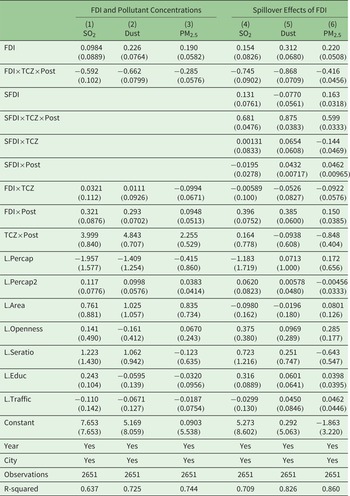
The coefficients of $FDI_{it}\times TCZ_{i}\times Post_{t}$ are negative and significant at the 1 per cent level in all cases, which suggests that the non-TCZ cities’ FDI accrues larger pollutant emissions than TCZ cities, after the implementation of TCZ policy. The coefficients are -0.553, $-0.602$
 , and $-0.476$
 in columns (1) to (3) in sequence. They suggest that a 1 per cent increase in FDI contributes fewer SO$_{2}$
 , dust, and waste gas emissions in regulated cities than non-regulated cities by 0.553, 0.602 and 0.476 per cent on average, in turn. This result is consistent with the preceding section's main findings, which indicate that mainly non-TCZ cities and the FDI in the high-polluting industries are subject to the spillover effect. Taken together, compared to TCZ cities, non-TCZ cities experience more FDI increase (smaller FDI decrease) in highly polluting industries after implementing TCZ policy, thus increasing their industrial pollutant emissions.
To circumvent the possible manipulation of pollution data from the city's yearbooks, we further use satellite data to examine more closely the impact of FDI redistribution on pollution. Table 6 reports the estimation results. The dependent variables are pollutant concentrations. Consistent with the estimation results of pollutant emissions, columns (1)-(3) of table 6 find that the coefficients of $FDI_{it}\times TCZ_{i}\times Post_{t}$ are all significantly negative. This result suggests air quality worsens in non-TCZ cities not only in terms of emission volume but also in the concentration of SO$_{2}$
 , dust, and PM$_{2.5}$
 . Coefficients of $FDI_{it}\times TCZ_{i}\times Post_{t}$
 for SO$_{2}$
 and dust in tables 6 and 5 are similar in scale (-0.592 vs. -0.553 for SO$_{2}$
 ; -0.662 vs. -0.602 for dust), which excludes the concern of data manipulation in the official yearbooks to some extent.
FDI and air quality

Columns of (4)–(6) of table 6 report the estimation results of equation (5) with an emphasis on exposing the neighboring effect of FDI on pollution. The coefficient of $SFDI_{it}\times TCZ_{i}\times Post_{t}$ is our focus, which is positive and significant at the 1 per cent level. The coefficient of $FDI_{it}\times TCZ_{i}\times Post_{t}$
 remains negative. Note that the index $SFDI_{it}$
 measures how densely FDI encircles a city. Therefore, the neighboring (or spillover) effect of FDI on pollution is true of the TCZ cities. Recall the results in the preceding section: the spillover effect of environmental regulations does not apply to TCZ cities due to what we called “the dike effect of cost.” However, pollutants emitted into the ambient city's air cannot stop their spreading into the proximity, which could include TCZ cities. FDIs have geographical boundaries, but air pollution does not. Size comparison of the coefficients of $FDI_{it}\times TCZ_{i}\times Post_{t}$
 and $SFDI_{it}\times TCZ_{i}\times Post_{t}$
 indicates that the spillover effect from ambient regions’ FDI overtakes the local reduction effect in the case of PM$_{2.5}$
 . In contrast, the net effect nearly neutralizes for SO$_{2}$
 and dust.
Our main results help explain a seeming puzzle: China's emission reduction targets were over-fulfilled, but its air pollution continued to deteriorate. The TCZ cities attained their emission reduction goals when high-pollution industries shifted to ambient non-TCZ cities. Therefore, industrial production was reallocated to non-regulated regions, and the pollution did not go away. These results project meaningful policy implications for developing countries. The key lesson we learn is that the goal of environmental pollution control should be anchored at the aggregate level of the entire region rather than targeted at highly polluting areas separately. Otherwise, high-polluting industries will be reallocated with pollution redistributed but not reduced.
4.3. Robustness checks
To ensure the validity of DID estimations, we need to justify no systematic difference between the pre-existing time trends of TCZ and non-TCZ cities. One reason may concern other policy shocks coinciding with the TCZ policy. Such a coincidence could cause non-parallel time trends and introduce biases for DID estimations. The sample period in the main results is from 1996 to 2008, leaving only two years before the start of the TCZ policy. To examine the parallel trend assumption more convincingly, we extend the city-level FDI data to 1985 from the China City Statistical Yearbook, and use the years before 1990 as the base years and include all other lags and leads of the TCZ policy and its spillover effects:

where $Year_{t}$ is the dummy for year $t$
 . $\alpha _{1,t}$
 captures lags and leads of the TCZ policy, and $\alpha _{2,t}$
 gauges lags or leads of the TCZ policy's spillover effects.
Figure 1 plots the corresponding 90 per cent confidence intervals of $\alpha _{1,t}$ and $\alpha _{2,t}$
 . Most estimates on $TCZ_{i}\times Year_{t}$
 before 1998 are not statistically different from 0, and the estimates become significantly negative after 1998. Similarly, most pre-event estimates on $SP_{i}\times Year_{t}$
 are not statistically significant, while most post-event estimates are significant at least at the 10 per cent level. In sum, we have the results suggesting the time trends of TCZ and non-TCZ cities have no systematic difference.
Validity test: DID coefficients of TCZ(SP) $\times$ year dummy, (a) Estimated coefficients of TCZ$\times$
 Year Dummy with 90% confidence regions, (b) Estimated coefficients of SP$\times$
 Year Dummy with 90% confidence regions.

One may be concerned that confounding regional policies could undermine our main results. It is possible that certain provincial or mega-regional policies may affect FDI location choices, and that these policies coincide with the reallocation of FDI to ambient regions. To exclude this concern, in table A1 (in the online appendix) we control for province-year fixed effects, which can absorb time-varying variations at province and mega-region levels. Columns (1)–(3) show that the coefficients of TCZ and SP remain statistically and economically significant, except for the coefficient of SP on FDI_Intensive in column (3). This suggests that after controlling for potential confounding provincial policies, the TCZ policy and the spillover in surrounding cities still have significant impacts on the location choices of FDI.
Furthermore, the within-province difference could introduce bias into our results, as surrounding cities may belong to more than one province. In addressing this issue, we refine our construction of the spillover index by defining two measures, $SP^{within}$ and $SP^{OT}$
 , as follows:

where $\mathcal {I}\{Prov_{i}=Prov_{j}\}$ is an indication function that equals one if city $i$
 and city $j$
 are in the same province, and otherwise zero.
We re-estimate equation (2) by replacing $SP$ with $SP^{within}$
 and $SP^{OT}$
 and report the estimation results in column (4)–(6) of table A1. We find that the coefficients of $SP^{within}\times Post$
 are significantly positive. Therefore, our main results are sound after controlling for the surrounding cities’ province heterogeneity.
We next check the robustness of our main results by employing an alternative estimation method. We use the logarithm of the newly-established foreign firms’ numbers as the extensive margin measure in obtaining our main results. Here we employ Poisson regression for count data using the numbers directly as the dependent variable. Table A2 (online appendix) reports the estimation results. The coefficients of $TCZ\times Post$ and $SP\times Post$
 remain significantly negative and positive, respectively, as in our main results. Columns (2) and (4) present estimation results using the data of high-polluting foreign firms. Consistent with our main results, the coefficients of $TCZ\times Post$
 and $SP\times Post$
 increase in size relative to column (1) while maintaining the same sign and significance.
Moreover, the coefficient of $NTCZ\times SP\times Post$ is significantly positive and much larger than the coefficient of $TCZ\times SP\times Post$
 . Columns (3) and (5) of table A2 present estimation results using the data of low-polluting foreign firms. In this case, all the coefficients of spillover effects are rendered insignificant. Put together, the Poisson regression results reaffirm our main results.
It is worth noting that the relative SO$_2$ emissions by industries saw little change from 1995 to 1997 in China. We use SO$_{2}$
 emissions in the year before the start of the TCZ policy (1998) to classify industries into high-pollution and low-pollution categories. Alternatively, one may use the year before the first year of our sample (1996) to classify industries. The largest 15 SO$_2$
 -emitting sectors overlap in the two chosen base years. Indeed, the two methods produce the same classification.
Table A3 (online appendix) checks the robustness of our results at the more nuanced city industry level. Results in columns (1)–(2) indicate that the coefficients of $TCZ_{i}\times Post_{t}$ and $SP_{i}\times Post_{t}$
 are significantly negative and positive, respectively, which is consistent with our main results. Furthermore, we estimate a difference-in-difference-in-differences (DDD) model which interacts $TCZ_{i}\times Post_{t}$
 and $SP_{i}\times Post_{t}$
 with the industry-level SO$_{2}$
 intensity (the ratio of SO$_{2}$
 emissions to industrial value-added) and coal intensity (the ratio of coal consumption to industrial value-added). This more nuanced model controls the time-varying city and industry characteristics to reduce the possible bias of estimations in the DID model at the city's industry level. Columns (3)-(6) report the DDD estimation results. The coefficient of $SO_{2s}\times TCZ_{i}\times Post_{t}$
 is significantly negative while the coefficient of $SO_{2s}\times SP_{i}\times Post_{t}$
 is significantly positive. The results indicate that TCZ policy reduces FDI activities, especially for the sectors with high SO$_{2}$
 emissions, but the spillover effects from ambient regions increase the FDI activities. Similar results apply to the coal intensity. Thus, our main conclusions hold after controlling the sector-varying city and year characteristics.
We further reaffirm our results on pollution consequences of the reallocated FDI at the industry-city-year level. Specifically, we decompose the data of city-year level pollutant emissions into industry-city-year level by using industry-city-year level output and industry-year level energy intensity. First, we construct the share of emissions from sector $k$ in city $i$
 by the output share $Q_{ikt}/Q_{it}$
 adjusted by sector $k$
 's energy intensity $\theta _{kt}$
 :

where $Q_{ikt}$ and $Q_{it}$
 are output of industry $k$
 in city $i$
 and output of city $i$
 at year $t$
 , respectively. We then normalize $\alpha _{ikt}$
 , so that $\sum _{k}\alpha _{ikt}=1$
 and $\alpha _{ikt}$
 represents the contribution from sector $k$
 to pollutant emissions of city $i$
 . Therefore, the city's industry-year level pollutant emissions can be decomposed from pollutant emissions of city $i$
 at year $t$
 ($P_{it}$
 ) as $P_{ikt}=\alpha _{ikt}P_{it}$
 .
Equipped with the city's industry-level pollutant emissions, we re-estimate the following equation to examine the effect of FDI on pollutant emissions at this more nuanced level:

where $FDI_{ikt}$ is measured by the extensive and intensive industry-city-year level FDI.
Table A4 in the online appendix reports the estimation results. The coefficient $\beta _{2}$ of $FDI_{ikt}\times TCZ_{i}\times Post_{t}$
 is significantly negative, suggesting that the FDI in TCZ cities generates a smaller increase in pollutant emissions than the non-TCZ cities, after the implementation of TCZ policy. Therefore, this more nuanced estimate confirms our main results.
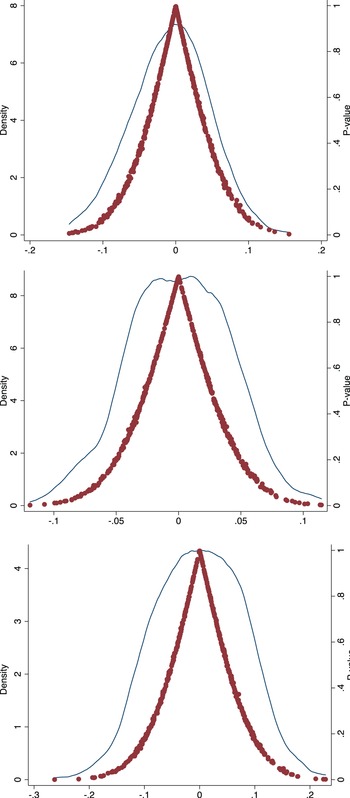
Online appendix table A5 reports the results of a placebo test by assigning TCZ status randomly. From the 149 cities in our dataset, we randomly label TCZ cities. Accordingly, equation (1) is re-calculated. We then re-estimate equations (2) and (3). We run this random assignment experiment 500 times to avoid outliers. Table A5 reports the mean values of the estimates of the 500 experiments. We find that this placebo test does not generate any significant estimates for the coefficients of the interaction terms, which are of interest to us. The magnitude of the mean coefficient of $TCZ_{i}\times Post_{t}$ is as small as nearly zero. Figure 2 plots the distribution of the coefficient of $TCZ_{i}\times Post_{t}$
 and the associated P-values. The distribution ranges from -0.3 to 0.3, centering around zero, and the P-values are almost all greater than 0.1, suggesting very few estimates are statistically significant. This result excludes that our results are derived from random shocks.
Random assignment of TCZ cities. (a) Distribution of the estimated coefficients of TCZ$\times$ Post on total FDI, (b) Distribution of the estimated coefficients of TCZ$\times$
 Post on FDI (Extensive Margin), (c) Distribution of the estimated coefficients of TCZ$\times$
 Post on FDI (Intensive Margin).

5. Conclusion
Exploiting the TCZ policy in China as a quasi-natural experiment, this paper re-examines the PHH, taking spillover effects from ambient regions as an additional determinant along with environmental regulation. We find that stringent environmental regulation in heavily polluted cities results in the influx of high-polluting FDI into ambient cities with lax regulations. More importantly, the reallocated high-polluting FDI emits pollutants into the air, spreading back to the stringently regulated cities. In combination, our results can explain why the over-fulfillment of environmental regulation policy targets has not stopped China's air quality deterioration. FDI in high-polluting industries can decrease in the stringently regulated cities, enabling them to fulfill the policy targets of cutting emissions. However, high-polluting FDI recipient cities, usually neighboring stringently regulated cities, become new emissions centers. Thus, reallocation cannot cure the issue of overall air quality across the country.
Our evidence suggests that ambient regions constitute an essential element of the PHH when applied to a large developing economy. The absence of this determinant could make the empirical results incomplete or even biased. However, the previous PHH literature pays insufficient attention to the crucial role of ambient regions than its due. To make up for this inadequacy to some extent, we present enriched evidence by taking the ambient region's effects into account. Our evidence principally supports the PHH in the context of China.
Moreover, our results shed light on environmental policy scheming. The central lesson we learn is that a nationally coordinated policy, coupled with the central-level planning and local-level enforcement (Zheng, Reference Zheng2007), could work more effectively than mandating stringent regulations on separate areas without a unified goal. This lesson is borne out by the significant air quality improvement in Beijing during recent years when anti-pollution policies began to target not only Beijing but also ambient provinces such as Shanxi, Hebei and Henan. The coordinated environmental regulation led by the central government, like the federal regulation in the US, could be more effective because of the resultant regulatory competition and the improved policy enforcement (Fredriksson and Millimet, Reference Fredriksson and Millimet2002; Konisky, Reference Konisky2007). The more recent evidence from Zhang et al. (Reference Zhang, Chen and Guo2018) also suggests that supervision designed at the central government level can effectively curb pollutant emissions from industrial firms, while local governments may exhibit strategic behavior to achieve their own targets (Cao et al., Reference Cao, Weng, Xu and Zhou2021; Yang et al., Reference Yang, Lin, Wang and Peng2021).
Supplementary material
The supplementary material for this article can be found at https://doi.org/10.1017/S1355770X22000158.
Acknowledgments
This work is financially supported by the Key Program of the National Social Science Fund of China (Grant No. 21AZD028) and the National Natural Science Foundation of China (No.71673281). We are indebted to our editor, Prof. E. Somanathan, and two anonymous referees for their guidance and helpful comments and suggestions. All remaining errors are our own.