Owing to the advancement in the diagnostic techniques and medical treatment of congenital heart disease, over 90% of this population reaches adulthood successfully.Reference Warnes 1 Many adult patients with this condition, however, face potential medical complicationsReference Oechslin, Harrison, Connelly, Webb and Siu 2 and psychosocial difficulties.Reference Kovacs, Silversides, Saidi and Sears 3
The literature on psychological problems and the life experiences of this population outlines that the patients’ most difficult moments can occur during hospitalisation.Reference Kools, Tong and Hughes 4 , Reference Verstappen, Pearson and Kovacs 5 However, the ratings of the patients’ psychological state are often recorded after the patient is discharged from the hospital. It is important to assess the patients’ psychological state before surgical and procedural interventions and investigate the possible factors that could influence it.
In addition, several authors have reported that this population is undertreated in terms of psychological support;Reference Bromberg, Beasley, D'Angelo, Landzberg and DeMaso 6 – Reference Kovacs, Saidi and Kuhl 8 therefore, it is crucial to monitor their psychological well-being during a period that could be distressing. Further knowledge on their psychological state during this period and on which patients are at greater risk for psychological distress could give some indications on how to improve hospitalisation of the patients.
It is often assumed that psychological problems are related to the severity of the cardiac condition. Several studies in this field, however, did not indicate a relationship between the medical parameters and psychological functioning in adult patients with congenital heart disease.Reference Kovacs, Saidi and Kuhl 8 – Reference Utens, Verhulst and Erdman 10 Only a few studies showed a relationship of specific medical variables with cardiac disease;Reference Bromberg, Beasley, D'Angelo, Landzberg and DeMaso 6 , Reference Popelova, Slavik and Skovranek 11 , Reference van Rijen, Utens and Roos-Hesselink 12 however, they had limited or specific samples or they did not confirm this trend in later studies.
Given the fact that previous studies have investigated the relationship between different types of disease classifications using different samples and different psychological instruments, the impact of the objective medical parameters pertaining to congenital heart disease on the psychological functioning of these patients is still unclear.Reference Kovacs, Sears and Saidi 13 Overall, the present evidence seems to indicate that medical parameters relating to the severity of congenital heart disease are not related to psychological distress.
When trying to explain why objective disease severity did not seem to have an effect on the psychological functioning of different cardiac diagnostic groups, it was suggested that denial and high achievement motivation could inflate the scores on the self-report data.Reference Utens, Verhulst and Erdman 10 , Reference van Rijen, Utens and Roos-Hesselink 14
Disease severity in congenital heart disease is difficult to conceptualise and rate because it depends on many factors such as initial diagnosis, functional status, number of invasive procedures, etc.Reference Moons, Van Deyk, De Geest, Gewillig and Budts 15 Considering these difficulties, discrepancies between the objective medical parameters and the subjective patients’ rating of disease severity of congenital heart disease can be expected, and these have also been outlined in the literature.Reference Chessa, De Rosa and Pardeo 16 , Reference Gratz, Hess and Hager 17
The present study aims to verify whether there is a relation between the patient's disease severity rating and/or objective medical parameters, and psychological distress and illness behavior during the important pre-operative phase.
Patients
Study design and population
In this descriptive study, the following inclusion criteria were applied:
-
• hospitalisation to undergo a catheter intervention or cardiac surgery because of congenital heart disease;
-
• age ≥16 years;
-
• informed consent.
The exclusion criteria were: verified learning disabilities and genetic syndromes such as Trisomy 21 – Down syndrome; DiGeorge syndrome (CATCH 22); and Williams syndrome.
Patients were informed about the purpose and procedure of this study during their admission. After having obtained informed consent, the psychologist instructed the patients on how to fill in the questionnaires. This study was approved by the locally appointed ethics committee.
The questionnaires were administered to a total of 181 eligible, Italian-speaking patients, aged 16–73 years, on their admission, 1 day before their cardiac procedure.
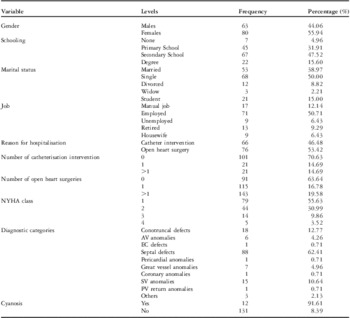
All the patients consented to fill in the questionnaires. In all, 24 patients could not complete the questionnaire because of practical reasons, mainly lack of time due to surgical/interventional preparation. A total of 14 questionnaires could not be utilised because of too many missing items. These 38 patients did not differ from the rest of the sample and their questionnaires were not included solely for the reasons specified. The sample consisted of 143 patients. Table 1 illustrates the number of patients belonging to each diagnostic group.
Sociodemographic and clinical characteristics.

AV = atrioventricular valve; EC = endocardial cushion; NYHA = New York Heart Association; PV = pulmonary venous; SV = semilunar valve
Methods
Data collection
Biographical and medical data
Biographical data including age, gender, education, and marital status and data on medical variables including cardiac diagnosis and concomitant cardiac anomalies, previous cardiac interventions – both interventional and surgical – cyanosis, and the New York Heart Association classification were collected.
The reason for hospitalisation, classified as being a catheter intervention or an open heart surgery, was also included. Years of disease awareness was operationalised by the question: “How old were you when you became aware that you had your cardiac condition?”
Disease severity rating
A numerical rating scale was used to rate the patient's perception of the severity of the cardiac condition ranging from 0 to 100 (See Appendix). The scale was presented to the patients vertically on the right side of a page. The instructions were written on the left side of the page, specifying that a score of 100 indicated the most severe cardiac condition possible and that 0 indicated the least severe cardiac condition possible. The patient was asked to indicate on the scale the severity of the cardiac condition.
A similar scale is utilised as part of the EuroQol instrument, known as the ED-5D thermometer, in which a scale from 0 to 100 is used to measure the perceived health status.Reference Badia, Monserrat, Roset and Herdman 18 The satisfactory validity and reliability of this scale to assess both perceived health status and quality of life, specifically in the adult congenital heart disease population, have been described by Moons et al.Reference Moons, Van Deyk and De Bleser 19
Psychological General Well-Being Index
The Italian version of the Psychological General Well-Being Index questionnaire was used. This index has been extensively applied in clinical trials and epidemiological research.Reference Grossi, Mosconi, Groth, Niero and Apolone 20
This questionnaire consists of 22 self-administered items rated on a six-point Likert scale assessing the psychological and general well-being in six domains, namely, anxiety, depression, positive well-being, self-control, general health, and vitality. A total score of “well-being” ranging from 0 to 110 points is computed on the basis of the scores on the six domains. The total score has been dichotomised with scores ≤60 indicating severe distress and those ≥60 indicating the absence of severe distress in line with the instructions provided in the questionnaire's manual.
Illness Behavior Questionnaire
The Italian version of Pilowsky and Spence's Illness Behavior QuestionnaireReference Fava, Bernardi, Pilowsky and Spence 21 was used in the study to evaluate “abnormal” illness behavior. The Illness Behavior Questionnaire reflects how individuals react to their own physical functioning. The 62 items on the questionnaire explore the attitudes and feelings of the patients with respect to illness, their perception, and the reactions of their significant others, including the doctor in charge, and their view of their psychosocial situation.
The Illness Behavior Questionnaire contains seven scales: general hypochondriasis, disease conviction, psychological versus somatic focussing, affective inhibition, affective disturbance, denial, and irritability.
Statistical methods
The continuous sociodemographic and clinical variables and the psychological scores, according to the Psychological General Well-Being Index and Illness Behavior Questionnaire domains and the overall additive scores, were defined on the basis of location – mean, median, first, and third quartiles – and dispersion indices – standard deviation – whereas the non-continuous variables were defined in terms of frequencies and percentages (Tables 1 and 2).
To account for the skewness of the variables, the BlomReference Blom 22 transformation was applied for the psychological scores, producing normal distributed scores. The relations between the scores were investigated using Spearman correlation coefficients, and the 95% confidence limits were determined using Fisher's Z transformation.Reference Fisher 23 , Reference Fisher 24
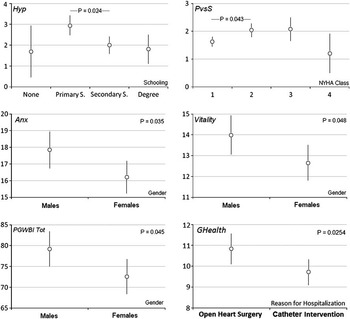
Effects of the sociodemographic and clinical variables on the psychological scores were investigated by comparing the groups with adequate sample sizes using the generalized linear model analysis of variance; the least square mean estimates and 95% confidence intervals were calculated from the normal distributed scores and reported onto graphs for determination of statistically significant effects (Fig 1). To account for the multiple comparison effects, the Tukey–KramerReference Kramer 25 adjustment for unequal number of observations was used.
Significant associations between the PGWBI and IBQ scores. Anx = Anxiety; GHealth = General Health; IBQ = Illness Behavior Questionnaire; PGWBI = Psychological General Well-Being Index; PvsS = psychological versus somatic focussing.

All statistical evaluations were carried out using the Statistical Analysis System 26 software package version 9.1.3., an α value of 0.05 was considered significant. Among all the covariates considered, the ones resulting in a statistically significant effect were reported and discussed, whereas others that did not have any significant effects were not reported.
The authors of this manuscript have certified that they comply with the Principles of Ethical Publishing in the International Journal of Cardiology.Reference Shewan and Coats 27
Results
The mean age of the studied patients was 39.14 (median = 39, Q1 = 26, Q3 = 48 and standard deviation = 14.56), of which 44.06% were male.
Years of disease awareness were skewed, having a mean of 13.85 and a median of 5, and there was an extensive range of variability in the number of years (Q1 = 1, Q3 = 23, standard deviation = 16.08).
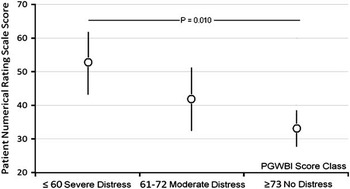
A significant association was found between the Psychological General Well-Being Index total scores and the patient numerical rating scale scores (p < 0.001; see Fig 2), showing that an increasing score on the patient numerical rating scale corresponds to higher levels of psychological distress.
PGWBI total scores and patient numerical rating scale scores. PGWBI = Psychological General Well-Being Index.

Overall, the analysis of variance showed weak, non-significant relations between the objective medical variables – New York Heart Association Index, diagnostic category, presence of cyanosis, and reason for hospitalisation – and the scores on both psychological questionnaires.
Few statistically significant relationships were found, namely, between gender and anxiety, vitality, and the total score on the Psychological General Well-Being Index; between the level of schooling and that of hypochondria; between the reason for hospitalisation and the general health score on the Psychological General Well-Being Index; and between the New York Heart Association class and the psychosomatic perception on the Illness Behavior Questionnaire (Fig 1).
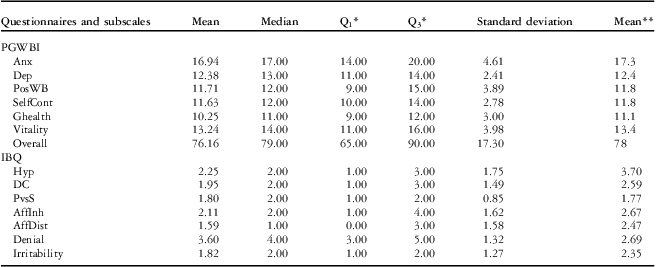
The psychological scores (Table 2) were comparable to the reference values from the Italian population on the Illness Behavior Questionnaire, except for the Denial scores, which were higher compared with reference data, and the Hypochondria scores, which were lower compared with reference data.
Means and statistical descriptives on psychological questionnaires of the patient sample and normative Italian data.

AffDist = affective disturbance; AffInh = affective inhibition; Anx = anxiety; DC = disease conviction; Dep = depression; GHealth = general health; Hyp = hypochondria; IBQ = Illness Behavior Questionnaire; PGWBI = Psychological General Well-Being Index; PosWB = positive well-being; PvsS = psychological versus somatic focusing; SelfCont = self-control
*Q1 and Q3 represent the first and third quartiles
**Represents the mean of the Italian healthy population
The Spearman correlation coefficients between the Psychological General Well-Being Index score subscales were generally high and positive, ranging from 0.51 to 0.81 (p < 0.001), whereas correlation coefficients between the Illness Behavior Questionnaire subscales were not statistically significant. Correlations between the Psychological General Well-Being Index score subscales and Illness Behavior Questionnaire subscales were negative and not statistically significant, ranging from −0.4 to −0.1.
Discussion
In the present study, a significant relationship was found between the subjective disease severity rating carried out by the patients and their pre-operative level of psychological distress. The more severely ill the patients rated themselves to be, the more pre-operative psychological distress was reported.
In line with previous studies, this study confirms that there is no relationship between the physical functionality, diagnostic category, and presence of cyanosis and psychological functioning in adult patients with congenital heart disease, even during the pre-operative period.
Brandhagen et alReference Brandhagen, Feldt and Williams 9 found that patients with congenital heart disease (n = 168) seemed to be more distressed compared with their healthy counterparts. These authors stated that the overall psychological “stress” – measured using the Symptom Checklist-90-Revised inventory and the dependency scale of the Minnesota Multiphasic Personality Inventory – was not related to the clinical severity of the cardiac defect. The medical parameters in their study were: the type of congenital defect – isolated ventricular septal defects, tetralogy of Fallot, atrial septal defects, aortic stenosis, complete transposition, pulmonary stenosis, patent ductus arteriosus, coarction of the aorta, and atrioventricular defects – presence of cyanosis, the New York Heart Association Index classification, cardiac medication, and the presence of other associated cardiovascular problems.
In a study by Utens et al,Reference Utens, Verhulst and Erdman 10 adult congenital heart disease patients (n = 288) were grouped into six diagnostic groups, namely, atrial septal defect type II, ventricular septal defect, tetralogy of Fallot, transposition of the great arteries, pulmonary stenosis, and a miscellaneous group. Overall, no significant differences were found between the mean scores of these different cardiac diagnostic groups on hostility, neuroticism, self-esteem, and leisure time activities. Furthermore, in another study on the same diagnostic groups, but excluding the miscellaneous group, these authors did not find a relationship between the cardiac diagnosis and psychopathological symptoms in congenital heart disease adults.Reference Utens, Verhulst and Erdman 10
In a study by Kovacs et alReference Kovacs, Saidi and Kuhl 8 (n = 280), disease severity and functional class did not predict mood or anxiety symptoms. Disease severity was classified according to the classification of cardiac diagnosis into the three main categories indicated by the 32nd Bethesda Conference – simple defects, defects of moderate complexity, and defects of great complexity.Reference Webb and Williams 28
As stated in the introduction, a few previous studies did confirm a connection between disease severity and psychological functioning.Reference Bromberg, Beasley, D'Angelo, Landzberg and DeMaso 6 , Reference Popelova, Slavik and Skovranek 11 , Reference van Rijen, Utens and Roos-Hesselink 12 A pilot study by Bromberg et alReference Bromberg, Beasley, D'Angelo, Landzberg and DeMaso 6 (n = 22) reported a significant association between the patient's medical severity as assessed by the Cardiologist's Perception of Medical Severity ScaleReference DeMaso, Gonzalez-Heydrich, Erickson, Grimes and Strohecker 29 and DSM-IV Diagnosis of depression and between the Brief Symptom Inventory Index total score and depression subscale.
Popelova et alReference Popelova, Slavik and Skovranek 11 investigated the presence of depression in cyanosed adults with congenital heart disease (n = 76). They found that depression was associated to worse functional state in the classification of the New York Heart Association Index, but depression was not associated to the severity of cyanosis, the level of haematocrit and the saturation of oxygen, or previous surgical treatment.
Finally, in a study by Van Rijen et al,Reference van Rijen, Utens and Roos-Hesselink 12 patients who underwent surgery for ventricular septal defect (n = 92) and transposition of the great arteries (n = 55) had a higher risk of developing externalising problems compared with patients with atrial septal defect (n = 93). The relationship between these two cardiac diagnoses and psychopathology, however, was not confirmed in a study (n = 251) carried out on the same group during the following year.Reference van Rijen, Utens and Roos-Hesselink 30
Both the studies of Bromberg et al and Popelova et al also had a limited sample size.Reference Bromberg, Beasley, D'Angelo, Landzberg and DeMaso 6 , Reference Popelova, Slavik and Skovranek 11 Furthermore, the study by Popelova et al also reported that the majority of the medical parameters related to congenital heart disease were not related to psychological distress.
The reason for hospitalisation was not related to psychological well-being; however, it was related significantly to general health. The general health questions on the Psychological General Well-Being Index refer to how concerned the patients are with respect to their symptoms and their health, and how healthy they feel in carrying out the things they usually do. The patients hospitalised for an open heart surgery resulted as having better general health than the ones hospitalised for a catheter intervention; this could be seen as being surprising, however, one needs to keep in mind that also patients with very severe conditions need to undergo numerous catheter interventions.
Given that the perception of one's severity, and not one's actual condition, is related to pre-operative psychological well-being and that the literature outlines that there are difficulties in understanding one's condition in this population,Reference Chessa, De Rosa and Pardeo 16 , Reference Gratz, Hess and Hager 17 it could be advised for medical professionals to pay particular attention to patients’ knowledge about their condition.
Most of our patients who did not have any distress belonged to the New York Heart Association Class I (p = 0.0981, Fisher's exact test), even though there was no significant relationship between the New York Heart Association class and psychological well-being, which is in line with Kovacs’ study.Reference Kovacs, Saidi and Kuhl 8
Although no relationship was found between the New York Heart Association class and psychological well-being, a statistically significant relationship between the New York Heart Association class and perception of disease severity was, however, verified, even though the literature outlines that there could be significant gaps in patients’ disease severity knowledge and rating.Reference Chessa, De Rosa and Pardeo 16 , Reference Gratz, Hess and Hager 17 It seems that the physical limitations and restrictions that occur in the New York Heart Association Class III and IV could significantly impact how patients view themselves with regard to the severity of their illness.
On the Psychological General Well-Being Index scores, the present hospitalised patient population obtained scores similar to the general Italian population. Although it did not reach pathological levels, denial was significantly higher in this patient population compared with other Italian hospitalised populations. This could be an explanation of the absence of a relationship between the perceived severity and psychological well-being, as outlined by other authors.
Denial could also influence hypochondria, which is lower in this patient population compared with other Italian hospitalised populations; the patients who obtained scores closest to the mean denial were the ones with a lower education. It is difficult to assess the amount of denial present, as the lack of knowledge about one's condition could be mistaken for being in denial about one's condition. One of the possible ways to cope with the condition could be to engage in behaviors that avoid attaining more knowledge about one's condition. The relationship of denial and knowledge about the disease condition should be further explored in this population.
Study limitations
The generic instruments utilised were targeted for a healthy Italian population and an Italian hospitalised population. Owing to the fact that no disease-specific congenital heart disease instrument was available in Italy, some important issues specific to this population may have been overlooked.
Conclusion
In conclusion, this study strengthens the hypothesis that the way the patients perceive themselves, and not their actual severity, influences pre-operative psychological distress. Their perception of the severity during the pre-operative period, and not actual medical parameters related to the cardiac condition, resulted as being significantly related to their pre-operative psychological status.
This study further outlines the importance of paying more attention to the patients’ rating and knowledge of their condition and including psychosocial interventions, such as counselling or psychoeducation, in order to reduce levels of severe distress during hospitalisation.
Among the clinical strategies suggested to maximise psychosocial care, Kovacs et alReference Kovacs, Sears and Saidi 13 highlight the increased psychosocial awareness of cardiologists working with this population. In line with this suggestion, the results of this study highlight the importance of paying attention to this aspect, especially with regard to doubts relating to their condition. It is also important to pay particular attention to the necessity of psychological treatment, not on the basis of the actual severity of the patients but on their subjective perception and concurrent state of mind.
Acknowledgement
We declare that we have no conflicts of interest.