INTRODUCTION
Spirituality can be defined as “a dynamic and intrinsic aspect of humanity through which persons seek ultimate meaning, purpose, and transcendence, and experience relationship to self, family, others, community, society, nature, and the significant or sacred” (Puchalski et al., Reference Puchalski, Vitillo and Hull2014). Spiritual care is a vital part of palliative care for patients with a serious illness and their families. The process of providing spiritual care may include asking about spiritual issues, fostering hope and meaning in the midst of their illness, and offering comfort (Hanson et al., Reference Hanson, Dobbs and Usher2008; Epstein-Peterson et al., Reference Epstein-Peterson, Sullivan and Enzinger2014). In a study of patients with advanced cancer, the provision of spiritual care was associated with a better quality of life (QoL) when near death and increased hospice use at the end of life (Balboni et al., Reference Balboni, Paulk and Balboni2010). Receiving high levels of spiritual support, as reported by patients, was also associated with lower medical costs at the end of life compared to those with low spiritual support (Balboni et al., Reference Balboni, Balboni and Paulk2011). Furthermore, better spiritual well-being was found to be related to such other aspects of quality of life as psychological well-being and fatigue (Vallurupalli et al., Reference Vallurupalli, Lauderdale and Balboni2012; Winkelman et al., Reference Winkelman, Lauderdale and Balboni2011; Lewis et al., Reference Lewis, Salins and Rao2014).
Provision of spiritual care is infrequent, even though both patients and healthcare professionals agree that such care is important (Balboni et al., Reference Balboni, Paulk and Balboni2010; Reference Balboni, Vanderwerker and Block2007; Phelps et al., Reference Phelps, Lauderdale and Alcorn2012; Best et al., Reference Best, Butow and Olver2016). The reasons behind this infrequency of application of spiritual care by physicians and nurses have been explored, and one of them might be inadequate training as opposed to self-reported barriers (e.g., lack of time or private space) (Balboni et al., Reference Balboni, Sullivan and Enzinger2014; Reference Balboni, Sullivan and Amobi2013).
The training that is required for healthcare professionals to achieve appropriate spiritual care competency was articulated within a four-level competency-based framework developed by Marie Curie Cancer Care in the United Kingdom, within which healthcare professionals should be able to perform an assessment of spiritual needs (Marie Curie Cancer Care, 2003; Gordon & Mitchell, Reference Gordon and Mitchell2004). Within this framework, palliative care nurses and doctors should be able to take a spiritual history and identify spiritual problems that require referral to a spiritual care provider (Puchalski & Romer, Reference Puchalski and Romer2000).
Various forms of training programs and tools have been described and shown to be effective in improving knowledge, enhancing attitudes, and bolstering self-rated competencies in spiritual care (Smith & Gordon, Reference Smith and Gordon2009; Vlasblom et al., Reference Vlasblom, van der Steen and Knol2011; Meredith et al., Reference Meredith, Murray and Wilson2012; Henoch et al., Reference Henoch, Danielson and Strang2013; Attard et al., Reference Attard, Baldacchino and Camilleri2014; Gomez-Castillo et al., Reference Gomez-Castillo, Hirsch and Groninger2015). The Faith, Importance/Influence, Community, and Address (FICA) Spiritual History Tool is a guide for conversations in a clinical setting to assess spiritual issues and spiritual resources (Puchalski, Reference Puchalski2014; Borneman et al., Reference Borneman, Ferrell and Puchalski2010). However, there are limited data on whether spiritual care training interventions can translate into improved patient outcomes (Candy et al., Reference Candy, Jones and Varagunam2012). Therefore, the aim of our study was to determine if a spiritual care training program for palliative care healthcare professionals could have any effect on patient QoL and spiritual well-being.
METHODS
Study Setting and Participants
The study took place at two organizations in Singapore: the Division of Palliative Medicine (DPM) at the National Cancer Centre–Singapore, which provides an inpatient palliative care consultation service to a 1,500-bed tertiary hospital, and HCA Hospice Care (HCA), which provides a home palliative care service to an average of 3,500 patients annually. Eligible patients were aged 21 years or older; newly referred to either the DPM or HCA with less than five visits by palliative care healthcare professionals (doctor, nurse, or medical social worker); had an estimated survival of more than one month (assessed by their main palliative care doctor or nurse); and were aware of their diagnosis and prognosis. The exclusion criteria were insufficient language skills in English or Chinese to complete questionnaires and an inability to complete questionnaires with the help of a nurse or doctor (interviewer administration). Possible reasons for not being able to complete the questionnaires included confusion and fatigue.
The study was approved by the Singhealth Centralised Institutional Review Board. Patients were required to provide written informed consent forms in order to participate.
Study Design
The HCA home palliative care service comprises five clinical teams organized to cover well-defined geographical areas. Patients are assigned to the respective clinical teams based on where they reside and receive care. In the hospital setting, newly referred patients are assigned arbitrarily to the two clinical teams in the DPM providing consult coverage within the hospital.
In our cluster-controlled trial, clinical teams were units of allocation to intervention versus control groups, and patients were units of inference. Four teams were allocated to the control group (3 HCA, 1 DPM) and three teams to the intervention group (2 HCA, 1 DPM). Each clinical team comprised around four to seven healthcare professionals—doctors and nurses who worked independent of from other teams.
Control Group
The control group provided usual care. This included performing a comprehensive assessment of physical and psychosocial issues, making treatment recommendations, and initiating further measures needed to address identified problems.
Intervention Group
In the intervention group, palliative care nurses and doctors were given a 30-minute training session on spirituality. The session was conducted by a palliative medicine physician who covered the following topics: taking a spiritual history, identifying spiritual problems, and knowing when to refer to a spiritual care professional. As part of the training, nurses and doctors were introduced to the FICA Spiritual History Tool, which helps healthcare professionals to structure questions when taking a spiritual history (Puchalski, Reference Puchalski2014). In addition to usual care, nurses and doctors in the intervention group were taught to use the FICA tool to perform an assessment for spiritual problems, as part of their comprehensive assessment of newly referred patients.
In both the control and intervention groups, if the palliative care team identified any spiritual problems, the patient was referred to a medical social worker (MSW) for further management. In the absence of chaplains or specific spiritual care providers in our healthcare setting, this constitutes usual care. To standardize spiritual care and interventions, all MSWs belonging to both services received a training session on how to address spiritual issues, including available interventions and resources. The training was conducted by the lead MSW at the National Cancer Centre–Singapore, and it took the format of mutual sharing of experiences rather than didactic teaching. These MSWs subsequently provided psychosocial and spiritual care to all patients, regardless of their allocation to the intervention or control group.
Study Measures
The Functional Assessment of Chronic Illness Therapy–Spiritual Well-Being (FACIT–Sp) scale includes the Functional Assessment of Cancer Therapy–General (FACT–G) and an additional 12-item spiritual well-being domain. This was chosen because it is a well-validated measure with good discriminative ability in our local setting (Cheung et al., Reference Cheung, Goh and Thumboo2005). FACT–G covers four QoL domains: physical well-being (PWB, 7 items); social/family well-being (SWB, 7 items); emotional well-being (EWB, 6 items); and functional well-being (FWB, 7 items). Each item has response choices on a 5-point Likert-type scale. We adopted the official scoring method, which is part of the validated instrument: the domain score was obtained by summing individual item scores within each domain, subject to imputation for item nonresponse by the “half rule.” Total FACT–G score was computed by summing the four domain scores (PWB, SWB, EWB, FWB). The spiritual well-being score was reported separately (Peterman et al., Reference Peterman, Fitchett and Brady2002; Webster et al., Reference Webster, Cella and Yost2003).
The FACIT–Sp questionnaire was completed by patients at two timepoints (T1 and T2). T1 was within the first five clinical visits of being referred to either the DPM or HCA, and T2 was three clinical visits after T1. We chose to use three clinical visits as the time interval between T1 and T2 because we found in our retrospective audit that the initial spiritual assessment and spiritual care for newly referred patients were completed within three clinical visits (Lee et al., Reference Lee, Tai and Yang2015).
Patients completed the questionnaire by self-administration, if this was feasible. Otherwise, the questionnaire was administered by a doctor or nurse trained in interviewer administration. During data collection, if the patient showed any signs of distress, the doctor or nurse would assess the situation and manage appropriately. The patient could withdraw from the study at any time and subsequently be referred to an MSW or another healthcare professional for follow-up if needed.
Statistical Analysis
Although this was a cluster-controlled trial, assigning the intervention program by teams, the clustering effect was negligible. The ANOVA revealed no significant difference between clusters in the mean of any of the FACT–G and spiritual well-being domain scores analyzed (each p > 0.40); the ANOVA estimator of the intraclass correlation coefficient consistently showed that the value of this coefficient due to clustering was zero (Fayers & Machin, Reference Fayers and Machin2007). This demonstrates that within each cluster there was a lot of heterogeneity, while there was little between clusters. Hence, the data were analyzed as individual data. A sample size of 64 per group offered 80% power and a 5% two-sided type I error rate, to detect an effect size of 0.5SD.
For comparison of baseline characteristics between groups, categorical variables were presented as counts (percentages) and were analyzed using Fisher's exact test. Continuous variables were presented as means (standard deviations) and were analyzed using the t test.
To estimate the between-group difference in magnitude of change in FACT–G and spiritual well-being scores, we employed multivariable least-squares regression analyses to study the change scores between two timepoints (T2 minus T1), with statistical adjustment for age and place of recruitment, which were not balanced between the two trial arms (see the Results section for details). Baseline PWB scores (one of the four domains in the FACT–G) were slightly unbalanced between groups, so that the model further adjusted for this baseline score (T1).
Association between intervention and intermediate variables was examined by multivariate logistic regression analyses for binary outcomes (e.g., referral to MSW, psychological interventions, and mortality), and multivariable multinomial logistic regression analyses were conducted for nominal outcomes (e.g., place of death).
RESULTS
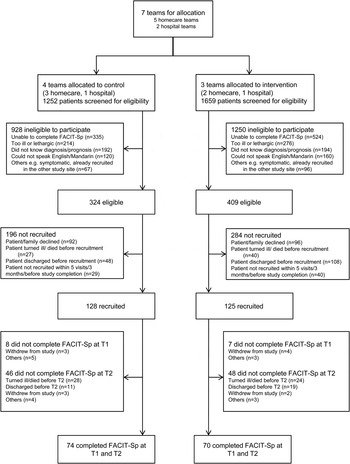
There were 733 eligible patients, and 253 patients were recruited: 128 were in the control group and 125 in the intervention group. Figure 1 shows the reasons for non-recruitment. The FACIT–Sp questionnaire (comprising the FACT–G and the additional spiritual well-being items) was completed at both timepoints by 144 patients—74 in the control group and 70 in the intervention group.
Flowchart of reasons for non-recruitment.

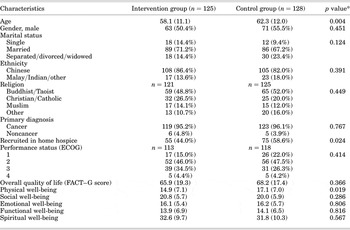
The two patient groups were mostly similar in terms of demographics, clinical status, and quality of life at T1 (each p > 0.05); the exceptions were age, site of recruitment (HCA or DPM), and PWB scores. Patients in the intervention group were younger, and more patients in the control group were recruited from HCA (Table 1). Patients in the intervention group also had worse PWB scores at baseline compared to controls.
Baseline characteristics of participants (n = 253)

ECOG = Eastern Cooperative Oncology Group; FACT–G = Functional Assessment of Cancer Therapy–General.
* Value of p calculated by Fisher's exact test for categorical variables and by simple t test for continuous variables.
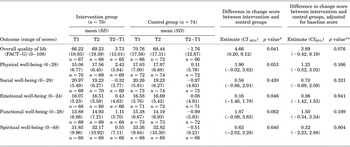
There was no significant difference in terms of mode of administration of the FACIT–Sp questionnaire at T1 and T2 (see Appendix I). Overall FACT–G scores improved in the intervention group and worsened in the control group (mean scores changes: intervention group, +3.73 [SD = 13.01]; control group, –1.76 [SD = 12.87]) (Table 2). After statistical adjustment for age and site of recruitment, the difference in change scores between groups was 4.66 (CI 95% = 0.20 to 9.12, p = 0.041). After further adjustment for baseline scores at T1, the difference in change scores for FACT–G score was 3.89 (CI 95% = –0.42 to 8.19, p = 0.076).
Quality of life and spiritual well-being of participants with and without intervention (N = 144)

FACT–G = Functional Assessment of Cancer Therapy–General.
* Value of p calculated by linear model adjusted for age and place of recruitment.
** Value of p calculated by linear model adjusted for age, place of recruitment, and respective baseline score.
Whether or not there was a difference in change scores for the four individual domains in the FACT–G and spiritual well-being domains is inconclusive (Table 2). For example, the change in functional well-being (FWB) scores was +1.11 in the intervention group and –0.99 in the control group. After statistical adjustment for age and recruitment site, the difference in change scores between groups was 1.87 (CI 95% = –0.09 to 3.83, p = 0.062). The adjusted difference between the intervention and control groups for change in spiritual well-being (change in spiritual well-being score) was 0.63 (CI 95% = –2.02 to 3.28, p = 0.640).
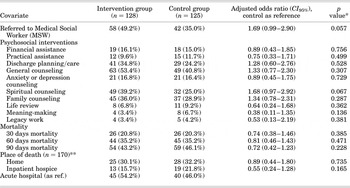
Table 3 shows the association between the intervention and covariates. There was a trend toward a higher rate of referral to a medical social worker (MSW) in the intervention group (49.2% in the intervention group vs. 35.0% in the control group, p = 0.057). Therefore, we further adjusted for referral to an MSW to explore its role as an intermediate variable, in addition to the adjustment for age, place of recruitment, and baseline scores at T1. After this statistical adjustment, the intervention group still had a higher change in FACT–G scores compared to the control group: the difference in mean change scores was 4.19 (CI 95% = –0.23 to 8.61; p = 0.063).
Association between intervention and covariates (all analyzable patients)

& Value of p calculated by logistic regression model adjusted for age and place of recruitment.
** Value of p calculated by multinomial logistic regression model adjusted for age and place of recruitment.
We performed a stratified analysis of patients referred and those not referred to an MSW. There was no significant difference in baseline FACT–G and spiritual well-being scores between the two groups. The mean baseline FACT–G score was 65.3 (SD = 18.1) in patients referred to an MSW versus 70.5 (SD = 18.2) in patients not referred to an MSW (p = 0.134). The mean baseline spiritual well-being score was 31.8 (SD = 9.8) in those referred to an MSW and 33.0 (SD = 10.0) in those not referred to an MSW (p = 0.435).
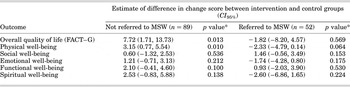
Table 4 shows the differences in change scores for total FACT–G as well as its four subdomains (PWB, SWB, EWB, and FWB) and the spiritual well-being domain. There was a significant difference in FACT–G change scores between the intervention and control groups for patients not referred to an MSW (mean difference = 7.72, CI 95% = 1.71 to 13.73, p = 0.013). In contrast, there was no significant difference in FACT–G change scores between intervention and control groups for patients referred to an MSW (mean difference = –1.82, CI 95% = –8.20 to 4.57, p = 0.569).
Difference in change scores for participants who were referred and not referred to an MSW

FACT–G = Functional Assessment of Cancer Therapy–General.
* Value of p calculated by linear model adjusted for age, place of recruitment, and corresponding baseline score.
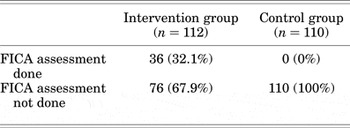
In order to explore whether patients in the intervention group had a higher rate of spirituality assessments, we conducted a medical record review of recruited patients. Some 222 of the 253 recruited patients had case notes that were available for audit. In the intervention group (n = 112), 36 (32.1%) had a spirituality assessment in all four domains of the FICA tool, and 93 (83%) had a spirituality assessment beyond the documentation of the patient's religion but not in all the domains of the FICA tool. In the control group (n = 110), none had an assessment in all four domains of the FICA tool, while 40 (36.4%) had a spirituality assessment beyond religion. The between-group differences in rates of spirituality assessment were significant (Table 5).
Results of medical record review FICA (Faith, Importance/Influence, Community Action, Address)—all four domains assessed

Fisher's exact test, p < 0.0001.
Spirituality assessed (other than documentation of religion as a demographic data)

Fisher's exact test, p < 0.0001.
DISCUSSION
Ours was a study of patients who were newly referred to either a hospital palliative medicine consultation service (DPM) or a home hospice service (HCA) in Singapore. Regardless of whether they were in the intervention or control group, all patients found to have spiritual problems were referred to MSWs, who all had the same training on how to address spiritual issues. The difference between the intervention and control groups was that palliative care doctors and nurses in the intervention group had a training session on spirituality and on how to use the FICA tool to assess for spiritual problems, and our study evaluated the effect of this training session. This was to address the gap in evidence for the effect of spiritual care training on patient outcomes.
Our results show a trend toward improved overall QoL for patients in the intervention group compared to controls—by about 4 points in terms of FACT–G scores—that was previously established to be clinically significant (Cella et al., Reference Cella, Eton and Lai2002). This difference between groups was statistically significant after adjustment for age and site of recruitment. However, as the baseline scores were unbalanced, we further adjusted for baseline scores to eliminate the effect of regression to the mean, after which the estimated between-group difference and its statistical significance (p = 0.076) weakened. There was no significant difference in spiritual well-being scores between groups.
Our findings provide tentative evidence that spiritual care training for palliative care doctors and nurses may lead to improved patient outcomes. This is consistent with the study conducted by Vlasblom et al. (Reference Vlasblom, van der Steen and Knol2011), which showed that spirituality training for nurses can improve the subsequent outcome of patients experiencing more receptiveness and support while asking questions about illness and meaning. Most of the existing literature has focused on how spirituality training results in improved staff outcomes (e.g., knowledge, competence, and attitudes). Our results add to the current evidence base by showing that spirituality training may also improve the patient-centered outcome of QoL.
Our initial hypothesis of the causative mechanism of this effect was that training in spirituality and taking a spiritual history would result in a higher rate of identification of spiritual problems, and hence increased referrals to MSWs. This would in turn result in more psychosocial interventions, which would address these problems and improve QoL. Indeed, we found a trend toward a higher rate of MSW referrals and spiritual counseling in the intervention group. However, stratified analysis by referral to an MSW showed that for those not referred to MSW the change in FACT–G score was 7.72 (CI 95% = 1.71 to 13.73, p = 0.013) points higher in the intervention group compared to the control group (see Table 4). This suggests that other explanatory mechanisms may be at work.
An alternative hypothesis is that the process of a palliative care nurse or doctor taking a spiritual history can help a patient talk through various aspects of their concerns and that that in itself is helpful for the patient. This phenomenon was suggested by Vivat et al. (Reference Vivat, Young and Efficace2013) in their experience of developing a tool to measure spiritual well-being. Even though the aim was not to conduct an intervention, more than a third of their respondents used participation as an opening for discussing spiritual issues and expressed their appreciation for being able to talk about these matters (Vivat et al., Reference Vivat, Young and Efficace2013). This suggests that an assessment tool could possibly also function concurrently as an intervention tool to improve patient QoL.
It is also possible that spiritual care training resulted in a more holistic approach to patient care, and it was this general effect that resulted in improved patient QoL. Our finding of a significant difference in FACT–G score change (between the intervention and control groups) for patients not referred to MSWs supports these possibilities.
Our results should be interpreted in the context of the study design. First, we studied patients who had been referred to a palliative care service, many of whom were fatigued or experiencing significant symptoms as a result of their medical condition. This contributed to a low recruitment rate, and the final sample of recruited patients may not be representative of the full cohort of patients who were referred within the study period.
Second, the groups were not randomized for practical reasons. However, the baseline characteristics of patients in the intervention and control groups were mostly similar, including FACT–G and spiritual well-being scores at baseline. Despite the cluster trial design, the estimate of the intraclass correlation coefficient was zero, allowing simplified analysis in this case. We also employed multivariate regression methods to control for unbalanced baseline covariates.
In addition, as this is a “complex intervention” with several interacting components, it may be difficult to attribute the intervention as resulting in measured outcomes (Craig et al., Reference Craig, Dieppe and Macintyre2008). For instance, it is unclear if the effects on patient QoL and spiritual well-being were due to increased spiritual assessments being done or an increase in referrals to MSWs. We have tried to address this by reviewing the documentation of a spiritual care assessment and by performing a stratified analysis by MSW referral. However, a follow-up study focusing on modifications to the training session may be needed to better answer the question of attribution.
In conclusion, our study suggests that a spiritual care training program on spirituality and spiritual assessment could possibly result in improved global patient QoL, but the effect on patients' spiritual well-being is not as evident. Further studies with larger sample sizes are needed in order for more definite conclusions to be made. Nonetheless, it may still be worthwhile for palliative care staff to perform a spirituality assessment in clinical practice, perhaps using the FICA Spiritual History Tool, as it is inexpensive and unlikely to cause harm.
ACKNOWLEDGMENTS
We would like to thank Dr. Christina Puchalski and The George Washington Institute of Spirituality & Health for granting us permission to use the FICA tool. More information and educational materials about FICA are available at http://www.gwish.org/. Our research project was supported by a research grant from the Singapore Cancer Society.
APPENDIX I
Modes of Administration for the FACIT–Sp Questionnaire