In his review of Southeast Asia in the Age of Commerce, 1450–1860: Expansion and Crisis, Victor Lieberman plied the margins of Anthony Reid's (Reference Reid1995) portrayal of early modern Southeast Asia and objected with purpose: “critical cultural and political transformations on the mainland without close archipelagic analogy receive little or no attention” (Lieberman Reference Lieberman1995, 799). Where connections and crossings characterize historic social formation in insular Southeast Asia, Lieberman focused on a different shore – territorial consolidation of kingdoms in mainland Southeast Asia, from over 20 in the pre-modern era to only three major empires, Burma, Thailand and Vietnam, by the end of the seventeenth century. Yet Reid's two-volume work was exquisitely timed with the theoretical pulses of globalization and their keywords of crossings – diasporas, flows, linkages, mobilities, networks, routes and travels. Closely related to the poststructural theoretical shift, these themes have guided new area studies and are likely to prevail in international scholarship for some time to come.
Lieberman's (Reference Lieberman2003, 2008, 2009, 2011) project charts a different course, based in processes of territorialization and continental state formation over the longue durée. His concept of parallel integrations, “the lurching, thousand-year pattern by which political and cultural isolates cohere to form larger, more cohesive units,” (Lieberman Reference Lieberman2011, 2) extends his observations of mainland Southeast Asia to Western Europe, Russia and across the continent to Japan. The particular characteristics of state formation differ broadly and Lieberman holds out China, South Asia and Southwest Asia as the exposed zone, where “India and China in particular faced challenges of territorial and demographic scale… [where] Manchus and Mughals…promoted systems of ethnic, linguistic and religious segmentation that had no close counterpart…” (ibid., 4–5). These findings contrast with conditions in the lands below the winds of Southeast Asia, and point to questions about the epistemological foundations of comparative regional analysis and understanding Asian Studies through regions – their physical and cultural conditions and the nature of processes that drive regional change. Here, my perspective does not propose a plea for the geographical; rather, it asks what we might learn by comparing geographical epistemologies implicated in the scholarship of globalization studies with emerging approaches to territorialization.
In the ways that understanding realities of globalization propelled the intellectual shift to poststructural and postcolonial theory, some political realities in the contemporary world point to renewed significance of processes of territorialization. In the decade since September 11, 2001, national responses to the new terrorism have curtailed the three-decade trend of decreasing controls on mobility under late capitalism. The increasing proliferation of surveillance systems has multiplied information for state territorial interests. In China, uneven and capricious controls on population mobility intensify continuing authoritarian state policy in regional development. In tandem with these realities, and not unlike problems of handling ideas about postmodernism in the context of enduring modernities, the language of the unmoored has also arguably reached its limits. Ideas about deterritorialization, drawn from the biologically poetic language of Deleuze and Guattari, have renewed the narrative of ‘flows’ with the effect of simultaneously bracketing – and exposing – problems of explaining social change outside the realities of grounded political-territorial dynamics (cf. Ong Reference Ong2006; Brenner, Peck and Theodore Reference Brenner, Peck and Theodore2010). By apparently doing the emancipatory work of unfixing the subject from the nation-state, a deterritorialized approach in the language of motion and assemblage may dislodge social and cultural change from actual places and political economic processes, and research on the ground.
We can locate another perspective on territorialization in David Ludden's AAS Presidential Address, “Maps of the Mind and the Mobility of Asia.” Observing how “spaces that elude national maps have mostly disappeared from our intellectual life,” and “habits of mapping expunge dissonance from our geographical imagination by invisibly burying disorderly space under neat graphics of national order” (Ludden Reference Ludden2003, 1058), Ludden locates “very old histories of mobility” (ibid., 1061) and their transactions with territorialism inside dynamic national cartographies. Thus by contrast to assumptions about equating territory with the national scale, variable and discrete territorial formations emerge in the process of state formation. In colonial India, for example, the British redrew provinces in Eastern Bengal and Assam in “an ongoing process of spatial redesign” (Ludden Reference Ludden2010, 15) to replace territorial order in the interests of British Imperial power and capital accumulation. In such scaled-down contexts within the regions, contexts of discrete territoriality confirm and contend with imperial and pre-national space. The suggestion that historic mobility traces dynamic territorial formations at local and regional scales marks the potential for a different kind of comparative regional study.
Yet the problem of understanding the comparative basis of new area studies via regionality endures in multiple understandings of the term: natural regions (the Mekong basin, the Deccan plateau), continental or world regions (Asia), the empire or nation as region (China), discontinuous cultural regions (Buddhist Asia), transboundary economic regions in natural regions (the Pearl River delta), supranational institutional regions (ASEAN), in addition to the problem of regions that may be precisely mapped in their contemporary political-territorial formations (Xinjiang) or because they correspond to physical features (Luzon), compared to those that cannot be only schematically portrayed (Inner China and Outer China). The common parlance of regions names subnational and subprovincial areas of cultural and political identity (Kashmir, East Turkestan), which exist powerfully in geographical imaginations while their political-territorial boundaries have been contended by different regimes. This problem of regions – of different types, occupying different scales, changing over time, and transcending or following political boundaries – is its awkwardness and its elegance: ‘region’ is a meta-geographical concept and a synecdochic trope that contains its variations.
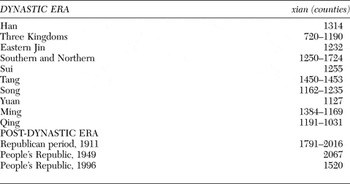
Do differences in understanding regionality conceptually and on the ground characterize Lieberman's work, or do his analyses lead to conventional articulations of state formation through hegemonic territorialization? Lieberman's careful sifting of the comparative historiography demonstrates that he is ‘onto something’ much more significant than undifferentiated state power or understanding state formation through closing of the frontiers. In the case of China, we find Lieberman's comparative treatment of different regional formations and different processes of territorialization in his objections to William Skinner's arguments about understanding the size of the Chinese Imperial administration (Lieberman Reference Lieberman2008, 709–711: 2009, 605–609). In Imperial China, the local administrative system maintained with relative consistency in association with increasing population over the longue durée. (Table 1) The xian, county, administrative level is arguably the most stable institution in Chinese history. To explain these conditions, Skinner postulated that the central government did not expand the number of administrative units because it could not have controlled a larger administration, whose tax base would have been dangerously onerous. Skinner's parallel construction of regionality emerged in the ‘macroregion’ or subnational regional economies based on networked market towns in the regional space of natural watersheds, rather than in centers of government (Cartier, Reference Cartier2002). By holding constant the role of local government, his market-oriented perspective bracketed the dynamics of state formation in Chinese history.
Number of xian (counties) in China since the Han dynasty (206 BC – 220 AD).

Source: 刘君德 (Liu Junde) et al. (1997) 中国政区地理 (China's Administrative Area Geography), Beijing: Sciences Press.
Lieberman objects to Skinner's assumption about declining influence of the local state, based on territorial processes in China and changes in local political geography. Where Skinner assumed that the role of the state decreased relative to population growth and economic activity, Lieberman finds that the state adapted and extended through a range of efficient territorial practices. These include enlargement of the local state through extension of bureaucratic functions, and increased governing capacity below the level of the xian. Since Skinner assumed a relatively static role or contraction of government with increased economic activity, in what body of economic thought do such assumptions prevail? In the way that ideas reflect their eras, is Skinner's model based on mid-twentieth century geopolitics from perspectives of analysis related to modernization theory? Answering this question requires a longer discussion, while at this juncture, we know that the opposite is true: neoliberal economies display strong state power and effective governance. Advancing markets do not roll back the state; on the contrary, with advancing markets, the neoliberal state restructures to promote and protect the market. As Lieberman (Reference Lieberman2009, 607) continues, economic activity inside a territorial system often has the result of tightening state administration.
With interests in regionality and territorialization, Lieberman (Reference Lieberman2009) analyzes how state formation in China and South Asia accelerated territorial integration, enhanced administrative efficiency, and articulated ethnic and cultural differences. These observations point to dynamic and variable and territorial practices, which suggest how regional territorial analysis may provide a basis for comparative study of state formation and state-society relations. These regional worlds are not nation-states as building blocks of East, South or Southeast Asia, i.e. in Westphalian territorial norms, but rather the regions of indigenous and imperial territorial systems in local territories and their dynamic formation before the national map. To look inside at indigenous domestic geographies is not to look at the interstitial zone between states, or at national borders, but at the different conditions and systems of territorialization within states, and within states that have cohered over the longue durée.
With this realization, we look again at Table 1 and, rather than assume the xian did not change, we see that the number of xian capitals changed somewhat during the Imperial era and changed significantly during the twentieth century. Why did these territorial transformations take place, and what were their outcomes? Since resilience is typically not a condition of inactive government, what dynamics explain the existence of the xian over the longue durée? Only by investigating their conditions can we make conclusions about local state administration. To consider the transhistorical relevance of a territorial approach, we turn to contemporary China to learn how territorial dynamics characterize the ongoing process of urbanization. In China under reform, the territorial administrative hierarchy – the spatial administrative system of provinces, prefectures, cities, counties, and towns – has been changing substantially in favor of new cities. As a sub-national level of government, the shi or city has increased in numbers from around 100 to over 650 since the 1980s, including different types of cities at different levels in the administrative hierarchy (Chung, Reference Chung and Chung2010). In this process, urban growth is not just a matter of land expansion but also a process of territorial redistricting in which many xian have become urban qu, districts of cities, among other changes.
These examples are just a few among many dynamic territorial conditions that characterize Asia's political geography. Historic and contemporary, such subnational regional territorial formations are alive in the contemporary landscape. Their continued existence draws on historic legitimacy while their contemporary territorialization reflects conjunctions between state power, globalizing state-capital relations and the dynamics of urbanization. Such territorial processes have likely too often been ignored for their most obvious effects as boundary re-jigging exercises, when in reality they index state-society relations on regional terms. Perspectives on regional territoriality may provide a basis for comparative research within state formations that are otherwise often still held at a distance, such as among China, India and Iran. In this trio – paralleling Lieberman's regional arc from China to South Asia and Southwest Asia – we may engage and challenge directions in globalizing scholarship and locate new possibilities for crossing borders.