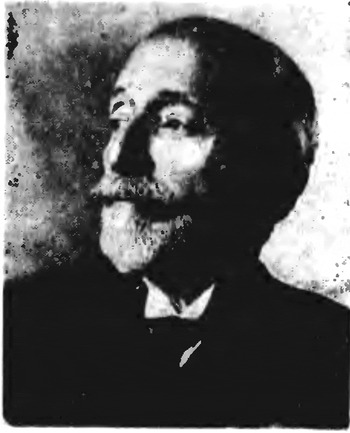
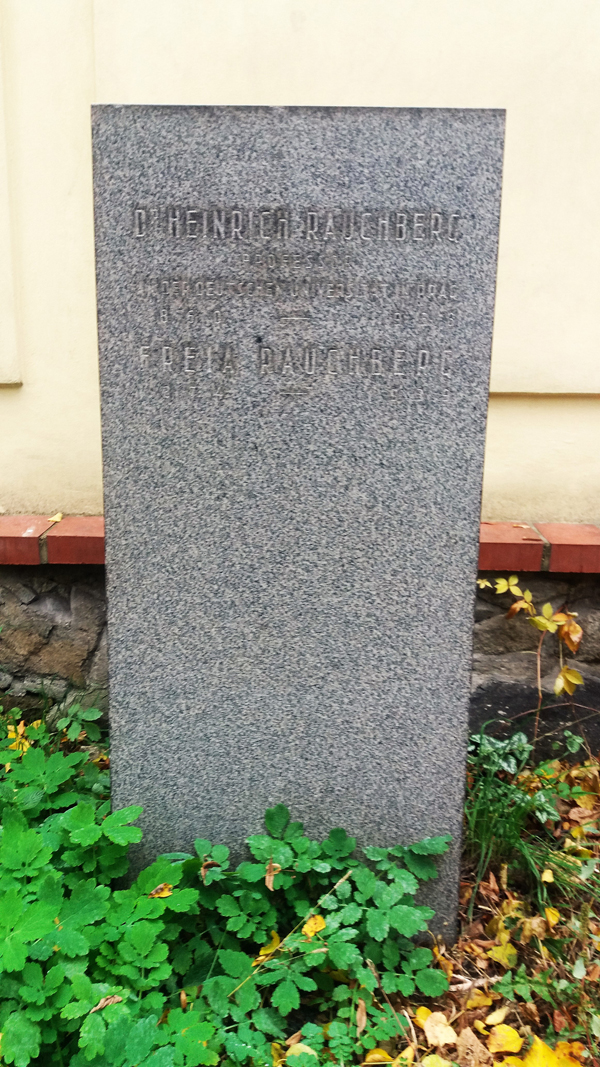
In the small, idyllic German Evangelical Cemetery in Prague-Strašnice, a simple tombstone stands in the back row of graves, dedicated to the memory of “Dr. Heinrich Rauchberg, Professor at the German University in Prague, 1860–1938” and his wife Freia (1874–1939) (see Figures 1 and 2). When the Viennese-born demographer passed away, he left behind him an impressive professional career in the Habsburg monarchy and later in Czechoslovakia: he published a massive body of professional studies in population statistics and was an important figure at the German University in Prague, where he founded the Institute of Political Science in 1898 and served as dean of the Faculty of Law (1902–3, 1916–17, and 1926–27) and as university rector (1911–12).Footnote 1 Outside the academic realm, Rauchberg was also involved in a broad range of activities. In 1890, for instance, he headed the Austrian census, in which the Hollerith electric counting machine was employed for the first time in Europe; Franz Kafka, his student in 1905, would later craft a literary monument to Rauchberg, the machine expert, in the short story “In the Penal Colony.”Footnote 2 Especially after the establishment of the Czechoslovak Republic in 1918, Rauchberg became a familiar figure among the local German minority, particularly because of his radio broadcasts on legal questions; his frequent articles in the German-speaking press on current issues; his numerous public lectures on social topics; his tireless engagement with housing assistance, tenant protection, and social insurance; and his involvement in the German League of Nations Union in the Czechoslovak Republic, which he cofounded in 1922.Footnote 3 In short, he was a scholar very much in the public eye.
Heinrich Rauchberg, Deutsche Zeitung Bohemia, 27 Sept. 1938, p. 5.

Tombstone of Heinrich and Freia Rauchberg at the German Evangelical Cemetery in Prague-Strašnice. Photo taken by Iris Nachum.

Rauchberg's academic oeuvre is today an important source for historical research on the Bohemian Lands, although it was then, and still is, not without controversy. Nevertheless, there have been few publications that provide an overview of his life and trace the evolution of his scientific and political thought.Footnote 4 This article seeks to close this gap while emphasizing in particular one aspect of his biography that is often overlooked: Rauchberg was a son of Jewish parents who converted to Christianity as an adult. Indeed, after 1945, Rauchberg's Jewish background was scarcely ever mentioned (nor was the fact that he was Viennese).Footnote 5 I argue that taking the demographer's Jewish origin into account sheds a fresh light on the reception of his person and work by his contemporaries. After all, Rauchberg's career took shape amid continual tension between social acceptance and rejection. In this respect, he exemplifies many other scientists of Jewish background in Central Europe in the nineteenth and twentieth centuries: on the one hand, they often reached the pinnacle of research in their fields, thus making an important contribution to society; on the other, they saw themselves exposed to incessant attacks from antisemites agitating against the purported “Judaizing” (Verjudung) of science and scholarship.Footnote 6 In light of those historical studies that hint at Rauchberg's supposed latent antisemitism, the thematization of his Jewish roots becomes all the more significant.Footnote 7
The aim of the present study is to describe and analyze Rauchberg's precarious position as a “baptized Jew” in the Habsburg monarchy in the second half of the nineteenth century and in Czechoslovakia in the interwar period. The focus is on how the multicultural environment perceived him and his oeuvre, and on how he navigated this environment to espouse a German nationalist stance. To this end, the article is divided into five parts. The first part is dedicated to the academic controversy that Rauchberg's magnum opus aroused among both contemporary and present-day readers. Rauchberg's life in Vienna before his relocation to Prague in 1896 is discussed in the second part. The third part deals with his image in Bohemia: How did he position himself in relation to his German, Czech, and Jewish contemporaries? How did they perceive him and his work? The fourth part examines Rauchberg's viewpoint in the heated debate on the location of the German University in Bohemia—a debate that originated in the late Habsburg period and extended throughout the interwar era. The final part of the article examines Rauchberg's activities in his last decade, as Nazism took over German nationalist discourse.
The National Property in Bohemia (1905)
As his obituary affirmed, Rauchberg possessed the “gift of breathing life into the dry numbers of statistics.”Footnote 8 Perhaps this was among the reasons that, in 1900, the head of the Society for the Advancement of German Science, Art, and Literature in Bohemia, Friedrich Freiherr von Wieser, approached him regarding an urgent matter: the demographer was to determine once and for all the relative demographic and economic strength of the Germans and Czechs in Bohemia. Above all, he was to find out whether the German Bohemian “national property,” that is the territory populated by German speakers in Bohemia as well as their material and cultural property, was shrinking in comparison with that of the Czechs.Footnote 9 Five years later, Rauchberg published his findings in his three-volume magnum opus titled Der nationale Besitzstand in Böhmen (The national property in Bohemia).Footnote 10 In it, he argued that the national agitation of Germans and Czechs along the multicultural “language border” in Bohemia was, by and large, ineffectual because key demographic changes were taking place in compact German and Czech settlements in the Bohemian hinterland (geschlossene Sprachgebiete).Footnote 11 The book concluded “that the numerical proportion of Germans and Czechs has not changed for more than a century.” Thus, even if German national propaganda asserted the opposite, the statistics showed that the so-called national property of the Germans was not threatened with extinction.Footnote 12 In this study, Rauchberg also presented his solution to the national conflict in Bohemia. He advocated the partition of Bohemia into a German and a Czech language area, and the assimilation of the Czech speakers living in the German region to the German majority population. In addition, he supported a “close linkage” (enger Anschluß) of the German Austrians to the German Reich.Footnote 13 Following his example, several other German-conscious statisticians throughout Austria assumed the existence of a German “national property” and investigated its supposed strength. Of particular note is Hugo Herz, the Moravian statistician and national economist of Jewish origin, who explored the German and Czech “national properties” in Moravia and Austria-Silesia.Footnote 14
Despite his influence on German demography, contemporary experts disagreed about Rauchberg's study. The American economist and later Nobel Peace Prize laureate Emily Greene Balch reviewed it rather positively: “But though Dr. Rauchberg is here, as elsewhere, frankly pro-German, and though this inevitably determines his point of view, the book is a solid piece of scholarly work.”Footnote 15 By contrast, the economist Heinrich Herkner, based at the University of Zurich, harshly criticized Rauchberg's publication. In his view, the work “should not be judged solely from the scientific standpoint alone.” It was, he argued, “heavily influenced” by national “sentimental values,” making it impossible to “speak about findings that were exact.”Footnote 16 Czech critics not only brusquely rejected Rauchberg's interpretation of the sources, which they deemed slanted and tinged with his own national views, but also expressed grave doubts about the validity of the census statistics he utilized.Footnote 17 Since 1880, the Austrian census did not inquire about nationalities, but asked, for administrative purposes, about the everyday languages spoken by the respondents. However, contrary to the official policy of the Austrian government, which distinguished between “nationality” and “language of daily use,” many German and Czech contemporaries saw the censuses as referendum on nationalist commitment and strength.Footnote 18 For this reason, Jan Srb, the Czech director of the Municipal Statistical Office in Prague, firmly dismissed Rauchberg's thesis on the bilingual Jews in Prague. In Rauchberg's opinion, the quantitative decline of the German nationality in Prague was largely attributable to a substantial number of Jews in the city who preferred to declare in the 1900 census that Czech, rather than German, was their language of daily use. According to Rauchberg, the fact that the majority of the Jews in Prague educated their children in the German language and culture was striking proof that, regardless of their daily language, they should be classified as having German nationality. Srb countered that those Prague Jews who had reported Czech as their language of daily use had wished to do so to express their authentic attachment to the Czech nationality.Footnote 19
In Rauchberg's views on the Prague bilingual Jews, some present-day historians have found evidence of latent antisemitic tendencies. According to Dimitry Shumsky, for instance, Rauchberg's book had no explicit “antisemitic barbs whatsoever,” but it implicitly propagated the old stereotype of the opportunistic Jews, who change their position to suit their own advantage.Footnote 20 It is important to note, however, that Rauchberg's talk about Jewish opportunism did not necessarily spring from any antisemitic motives. In fact, as Peter Pulzer notes, “No doubt there was an element of opportunism in these census declarations [of the Prague Jews in 1900]; but there was not much future in being inopportunistic.”Footnote 21 Zionist spokespeople before 1918 argued along similar lines: “If in the compact Czech language area, they [the bilingual Jews] identify with the language of daily use of the majority, then that is both right and intelligent, no matter whether it springs from considerations of opportunism or conviction.”Footnote 22 In Shumsky's opinion, Rauchberg avoided taking an explicitly antisemitic position in his study only to be able to assign as many Prague Jews as possible to his own German camp.Footnote 23 Emil Brix similarly argues that Rauchberg spoke out against antisemitism merely “due to pragmatic national-political considerations” and “for opportunistic reasons.”Footnote 24 Thus, both historians agree that Rauchberg was not abusively antisemitic in his book not as a matter of principle but rather to avoid antagonizing the bilingual Jews in Prague.
Indeed, if in the first half of the twentieth century it was primarily social scientists who analyzed and critically appraised Rauchberg's Der nationale Besitzstand in Böhmen, since then, historians in particular have dealt with the work and its author. Strikingly, while in the 1990s most historians sketched a moderate and conciliatory image of the demographer, in recent years he has increasingly been portrayed as a radical nationalist. In an article published in 1994 by Mark Cornwall, Rauchberg is described as a scientist who sought in vain to mollify the prevailing national tensions between German and Czech nationalists.Footnote 25 Catherine Albrecht sums up her view of Rauchberg along similar lines: “German liberals such as Heinrich Rauchberg took a moderate approach, advocating [Czech] assimilation to German culture.”Footnote 26 Writing in 2010, Peter Haslinger sketches a more ambiguous portrait of the demographer. He observes that Rauchberg “tried in his analysis to distance himself from nationalistic interpretations,” but clearly defended “the German standpoint regarding an indisputable existence of compact language areas,” and in that connection constructed anti-Czech “scenarios of threat” using “military diction.”Footnote 27 Pieter Judson asserts that Rauchberg belonged to the ranks of “German nationalists” and contends that his work, even if this was not necessarily his intention, had an “extremely influential” impact on German-national activists, who often quoted passages from his book to defend the notion of a “language border.”Footnote 28 In Tara Zahra's 2008 study Kidnapped Souls, Rauchberg has mutated into “a rabid German nationalist,” and recently Jason Hansen includes the demographer among the group of “radical Germans” in the Habsburg monarchy.Footnote 29
All in all, both contemporary and later experts have debated to what extent (and not whether) Rauchberg's research was guided by ideology. Depending on the answer to that, he has been characterized either as a moderate liberal or as an extreme nationalist, whose intended or actual impact was either to pacify or to incite the Czech-German national conflict. Irrespective of the controversy-ridden views on Rauchberg in the scholarly literature, it must be noted that in neither the past nor the present have his qualifications as a knowledgeable statistician and demographer ever been called into question. In fact, Der nationale Besitzstand in Böhmen has become the standard work in historical research on the Bohemian Lands. It is generally considered to be a reliable statistical source.Footnote 30
Rauchberg in Vienna: Jewish Parents, Protestant Career
Rauchberg's family originally came from Galicia. His father, Josef Rauchberg, was born on 22 March 1830 in the shtetl Klasno near Cracow and later moved to Vienna and opened a silk factory. His mother, Ernestine (Ettel, née Schilder) was born in 1832 in L'viv (Lemberg). Josef and Ernestine were married on 19 June 1859 in the Vienna Stadttempel synagogue.Footnote 31 Heinrich was born on 12 April 1860. On the eighth day, according to Jewish tradition, he was circumcised and given the additional name of Hirsch.Footnote 32 Four sisters followed. Helene, his youngest sister, was later active as a pacifist, school reformer, and feminist.Footnote 33 The marriage and the birth of the children took place at a time of considerable change. In 1859–60, the Habsburg monarchy eliminated anti-Jewish trade regulations, and in 1867 granted Jews full civil equality.Footnote 34 Against this backdrop, Josef Rauchberg's factory, which was located in a textile center on the Bohemian-Moravian border, was legally registered on 24 July 1865.Footnote 35 By the time a wave of penniless Galician Jews arrived in Vienna in the 1870s, the Rauchberg family, resident in the middle-class municipal district Neubau, was long established in the Germanized Jewish bourgeoisie.Footnote 36 Heinrich Rauchberg's parents died in Vienna and were laid to rest in the Jewish part of the Central Cemetery.Footnote 37
Contrary to the express wishes of his father, who envisioned for his only son a career in business, the young Rauchberg, feeling a strong “urge to devote himself to science,” registered in the fall of 1878 as a student in the Faculty of Law and Government at the University of Vienna, which also taught statistics and economics.Footnote 38 No less a figure than Theodor Herzl, the founder of modern Zionism, was among his fellow students.Footnote 39 Like Herzl and Rauchberg, many other Jewish high school graduates in the Habsburg monarchy decided to become university students. Often, they were no longer satisfied to follow in their fathers’ footsteps and to become members of the propertied middle class, a social stratum that in their eyes was too materialistic. They thirsted for academic achievement and entry into the educated elite, which until then had been largely closed and inaccessible to Jews. The numbers manifest this drive for education: at the turn of the century, Jews comprised some 25 percent of the student body at the University of Vienna and 27 percent at the German University in Prague.Footnote 40 At the Viennese Faculty of Law, 22 percent of registered students were of Jewish origin in the academic year 1889–90.Footnote 41 Notwithstanding their numerical strength, Jewish students had to grapple with a series of discriminatory measures. For instance, in the winter semester 1878–79, when Rauchberg started his higher education, the student fraternity Libertas introduced into its statues the “Aryan paragraph,” denying Jewish students membership on the grounds that “Jews cannot be regarded as Germans, and not even when they are baptised.”Footnote 42 Just as Rauchberg began his student life, open, racial antisemitism thus entered upon the stage in the Viennese academic milieu.
In the course of his studies, Rauchberg discovered a budding interest in statistics.Footnote 43 A scholar who exercised an important influence on him was Karl Theodor von Inama-Sternegg, who, in 1881, was appointed honorary professor of statistics at the University of Vienna and nominated president of the Royal Statistical Central Commission three years later. From the winter of 1880 until his relocation to Vienna in 1881, Inama-Sternegg taught political economy in Prague. Although he stayed there for only a short time, the city became for him an important “school of high politics.”Footnote 44 In an obituary for his venerated professor, Rauchberg noted that, for Inama-Sternegg, the Czech-German national conflict in the city was not a “dispute of solely local significance.” Inama-Sternegg realized that there was an ongoing struggle in Prague, “not only for the continuing national existence of the German Bohemians, but also for the future of Austria.”Footnote 45 It can be assumed that Rauchberg's interest in population statistics, in the nationalities’ conflict in Bohemia, and in the city of Prague was awakened or at least deepened by Inama-Sternegg.
After earning his juris doctorate on 22 December 1883, Rauchberg completed a traineeship in court practice and then assumed a position as project assistant (Konzeptspraktikant) in the Royal Statistical Central Commission, where he would remain active until 1896. At the same time, he taught as a private lecturer (Privatdozent) at the University of Vienna.Footnote 46 The young jurist can thus be reckoned among the growing group of Viennese Jews who grasped the opportunities offered them by emancipation, not just to satisfy their intellectual curiosity by embarking on university studies but also to achieve success in academic professions. Indeed, Rauchberg's life until shortly after his first foray into the world of work was not atypical of an ambitious and gifted young man from the Jewish middle class in fin-de-siècle Vienna. Yet, although Jews had been granted full civil rights in 1867, the door to a post in the higher ranks of civil service remained blocked to Jewish university graduates, particularly those who had majored in law. Their advancement into higher positions at the university likewise progressed at an extremely sluggish pace, if at all. To break through that “glass ceiling,” some chose the path of baptism.Footnote 47
On 2 April 1884, just before his twenty-fourth birthday, Rauchberg formally left Judaism. He converted three days later to the Protestant faith of the Augsburg Confession.Footnote 48 In Roman Catholic Austria, Jews from the upper middle class who converted frequently preferred to be baptized Protestant. In so doing, they often expressed their loyalty to German liberal values, since liberals regarded the Roman Catholic Church as the epitome of hostility to enlightenment. In contrast, Protestantism with a Prussian imprint was admired as a pillar of progress and Bildung.Footnote 49 Regardless, whether as a Catholic or Protestant, without a baptismal certificate, Rauchberg would have had scarcely any opportunity to work his way up so “extremely rapidly” into the higher echelons of civil service.Footnote 50 Indeed, after being appointed in 1887 as project manager (Hofkonzipist), he advanced to the post of head of the Austrian census in 1890.Footnote 51
Under Rauchberg's direction, the electric counting machine was employed for the very first time anywhere in a European census. His fascination with the machine, its “unsurpassable efficiency” and “absolute technical superiority,” revealed his unwavering bourgeois belief in technology and progress.Footnote 52 In May 1891, Emperor Francis Joseph I, accompanied by Prime Minister Count Eduard von Taaffe, honored the Royal Statistical Central Commission with a visit, during which Rauchberg demonstrated and explained the miraculous machine. In the course of the imperial visit, Rauchberg was awarded the Golden Distinguished Service Cross with Crown, and three years later he was promoted to court secretary (Hofsekretär).Footnote 53 A heavy blow, however, came to overshadow his career, when his non-Jewish wife, Marie, whom he had married in 1888, died at the age of twenty-five on 16 January 1891. The marriage had been childless.Footnote 54 In the year his wife died, Rauchberg, living in an elegant embassy quarter in Vienna, completed his habilitation thesis in the field of statistics at the University of Vienna.Footnote 55
Rauchberg in Prague: Under Fire from Antisemites and Zionists
In the winter semester 1896–97, a new chapter began in Rauchberg's life when he moved to the Faculty of Law and Government at the German University in Prague as professor of statistics, public administration, and Austrian administrative law; later he was assigned teaching duties for Austrian financial law and international law as well.Footnote 56 Until his retirement in 1930 and beyond, he was thus affiliated with an academic institution that emerged as a bastion of antisemitism in Central Europe. It was mainly students from the “Sudentenland” who promoted racial antisemitism there since the late nineteenth century.Footnote 57 Nevertheless, the university had a relatively high proportion of Jewish students and professors, especially in comparison with the Czech University in Prague. Indeed, the widely held notion among Central European Jews that only German academic education was worthwhile could hardly be shaken.Footnote 58 However, while in the 1920s, the Faculty of Law at the German University in Prague was still considered “half-Jewish,” in the face of evermore virulent antisemitism, the number of Jewish students declined notably in the 1930s.Footnote 59
Two years after settling in Prague, Rauchberg married Freia Vitzthum, who came from a non-Jewish family in Frankfurt and belonged, like him, to the German Protestant Church. They had three children, Gertrud (1899–1972), Hildegard (1900–52), and Herbert (1904–87).Footnote 60 The Rauchbergs were well integrated into the Prague German community. The family resided in the middle-class suburb of Královské Vinohrady (Royal Vineyards) with a high percentage of Germans. Freia was active in the local German Organization of Housewives, and the couple attended German balls and donated to the German School Association, which supported German minority schools in ethnically mixed regions in Austria.Footnote 61 That Rauchberg dedicated both his private life and his academic work to the German national cause is further illustrated by the 1900 census. In line with his scientific-assimilationist view that Czech speakers living in a German environment have German as their everyday language, he registered the family's two Czech maids with German as their language of daily use, even though they had hardly mastered this language.Footnote 62 The incident exemplifies Rauchberg's two main theoretical assumptions regarding everyday language. First, in his view, the language of daily use constitutes merely a “lingual-territorial” factor, while the mother tongue is the only objective and “statistically knowable feature of nationality.”Footnote 63 Second, the language of daily use is not an individual but a collective property, generated by its national environment.Footnote 64 Strikingly, he applied this theoretical understanding only to Czechs. While advocating for their integration into the German community, he promoted the nonassimilation of German speakers within Czech society, arguing that the “affluent and well-educated can more easily preserve their nationhood [Volkstum] in a foreign national environment than the have-nots and uneducated.”Footnote 65
At the German University in Prague, Rauchberg's academic career enjoyed a meteoric rise. As mentioned, he founded the Institute of Political Science there and also served several times as dean of the Faculty of Law. In recognition of his accomplishments, he was honored with the title of court councilor (Hofrat) in 1909.Footnote 66 In addition, in the academic year 1911–12, he acted as university rector. Initially, his Jewish colleague Robert Zuckerkandl was scheduled pro forma to be appointed to this role.Footnote 67 But Zuckerkandl, in keeping with the antisemitic Habsburg custom that a “non-baptized Jew” must not accept the position, announced that “due to a deadline for scientific papers that could not be postponed,” he could not assume this office.Footnote 68 Rauchberg was then appointed to the post.Footnote 69 His appointment as rector was commented on by the Zionist paper Die Welt in an article titled “The Baptized Rector” in a harsh sardonic tone: “But the baptized personage [Täufling], Dr. Rauchberg, was permitted to become rector, and since now he is the rector, at every opportunity he shouts a tumultuous ‘Heil’ and is antisemitic to the bone.”Footnote 70
Indeed, during Rauchberg's rectorship, his seemingly tolerant attitude toward antisemites emerged especially glaringly. When, for instance, in June 1912, the student fraternity Germania, which had included the “Aryan paragraph” in its statutes, organized a sports festival “for Aryans only,” it explained to its incensed critics that Rector Rauchberg had issued the permit for this event.Footnote 71 The Vienna-based Zionist paper Jüdische Volkstimme seized on the affair to voice its extraordinarily strong and biting criticism against Rauchberg as a person: “Things have already reached this point in Prague. The rector is conspiring not just in secret with the antisemites but has openly joined their side, and is sponsoring festivals from which the majority of his students are excluded. Yes, events which he himself would be banned from attending were he not by chance the rector. This groveling behavior, this desperate search for a small spot in a certain part of the anatomy of the radicals that otherwise merely belongs in a person's pants, is, by the way, the most outstanding characteristic of the entire incumbency of Rektor Rauchberg.”Footnote 72 In 1912, on the occasion of an antisemitic publication, the paper wrote cynically: “That really should not surprise us, because a publication for which a Hofrat Rauchberg writes the preface is right from the word go immune to any accusation of being friendly toward Jews.”Footnote 73 And, when Rauchberg gave the green light to put up an antisemitic poster in the university auditorium, the Montagsblatt aus Böhmen, a weekly published by Oskar Kuh, a journalist of Jewish origin, complained about the “progress that academic antisemitism has made specifically under the rectorship of Hofrat Rauchberg.”Footnote 74 The Jüdische Volksstimme concurred, stating, “Over the entire incumbency, Rektor Rauchberg has shown that he prefers the goodwill of the antisemites to the favorable opinion that decent people could have of him.… Rektor Rauchberg's incumbency will remain a stain of disgrace in the annals of the Prague German University.”Footnote 75 In short, Rauchberg was a bête noire of Jewish nationals. While they, proudly and self-confidently, held high the banner of Judaism, Rauchberg had apparently cast aside his Jewish roots for German-national causes. Instead of at least presenting himself as neutral on Jewish affairs, he behaved, in the eyes of the Zionists, as a great enemy of the Jews, no less so than Christian-born antisemites.
The Zionists’ animosity toward Rauchberg was further fueled by the fact that, while they championed recognition of Jews as a national group, he denied the existence of a Jewish nation for decades. That is why it was not so much the notion of “Jewish opportunism” that the Zionists had disliked in Rauchberg's Der nationale Besitzstand in Böhmen, but the fact that the demographer “totally excludes the Jewish national movement from his calculations and recognizes only Germans and Czechs in his national scheme.”Footnote 76 Indeed, when Rauchberg spoke about “the Jews,” he meant them as a religious, not a national, community. He negated the existence of a Jewish nation, because his definition of nationality was based “on a living language,” and according to him, this did not apply to either Yiddish or Hebrew.Footnote 77 Consequently, during his rectorship, Rauchberg justified the exclusion of Zionist students from the German University Housing Committee by emphasizing that “there is no Jewish nation, no recognized Jewish national student body, and therefore these students could not have any representatives [on the committee].”Footnote 78 What the Zionists deemed to be yet another antisemitic statement by Rauchberg was, however, official policy in Austria. The Habsburg monarchy did not recognize Jews as a separate nationality, nor was Yiddish (or Hebrew) admitted in the census as a language of daily use.Footnote 79 From an official perspective then, there was no Jewish nationality but solely a Jewish faith (israelitische Konfession). When Rauchberg ignored the Jewish national movement in his study and refused to accept representation for Zionist students on a university committee, he was thus in step with the logic of the Austrian administrative apparatus.
Much to Rauchberg's disappointment, and contrary to the old Austrian usage, the Czechoslovak state that came into existence in 1918 formally recognized Jews as a national group. In response, the demographer became a strident spokesperson against the supposedly pro-Zionist line of Czechoslovakia.Footnote 80 Believing that Jews who spoke German as their mother tongue were in fact Germans, he feared that the creation of a separate Jewish category in the Czechoslovak census might “mislead” German-speaking Jews into not declaring in the census that they belonged to the German nationality, and that this would ultimately contribute to a quantitative weakening of the German minority in the state. This is why he considered the acceptance of the Jewish nationality in the 1921 census “a grave error.”Footnote 81 In an exaggerated tone, he lamented that now “it is not known how many of those who had declared they belonged to the ‘Jewish nationality’ are German and how many are Czechs. Consequently, it is also not known how many Germans and how many Czechs there actually are overall in the country.”Footnote 82
Again in the run-up to the census of 1930, Rauchberg, as a member of the Statistical State Council, strongly opposed the “construct of Jewish nationality.”Footnote 83 Once again he mustered the argument of language as a criterion: “The Hebrew language is dead and the so-called jargon [Yiddish] is a dialect of German, not a separate language.”Footnote 84 Rauchberg insisted on the Habsburg convention of grouping Yiddish together with German. When it was pointed out to him in the Statistical State Council that Yiddish was spoken by many Jews as a mother tongue, he grudgingly declared that he was prepared to see the speakers of Yiddish as part of a Jewish nationality.Footnote 85 With marked reluctance, he then noted in the daily paper Prager Tagblatt that, in the upcoming census, “the entry of the Hebrew and the ‘Yiddish’ language is to be allowed where that is in keeping with the facts, such as may frequently be the case in Carpathian Ruthenia and in Slovakia.”Footnote 86
In a nutshell, Rauchberg's pro-German activism was diametrically opposed to Jewish national interests. Notwithstanding his anti-Zionism, Rauchberg was not always ill-disposed toward Jewish nationals. In 1975, the journalist Robert Weltsch, who had served as chair of the Zionist student association in 1911–12 and had received his juris doctorate at the German University in Prague in 1914, reflected: “The most interesting of my examiners was Hofrat Rauchberg, a baptized Jew, who strongly urged me during my doctoral defense that I should consider doing a habilitation degree in international law. I had impressed him with talk about Kant (On Perpetual Peace) and other more philosophical literature, something he apparently had never experienced before. I told him that as a Jew I had no prospects whatsoever, which evidently left him somewhat taken aback. But he gave me a grade of ‘excellent.’”Footnote 87 Despite Rauchberg's behavior here, as though he were unaware of the academic “glass ceiling” for Jews, and despite his apparent acceptance of anti-Jewish activities in the university, the demographer did not escape the notice of German and Czech antisemites: in the course of discussions on an academic appointment in 1904, the ailing economist Alfred Weber requested that Carl Grünberg be appointed to the university in preference to Weber himself.Footnote 88 Grünberg, who was teaching economics in Vienna, had left Judaism in 1891 and a year later converted to Roman Catholicism.Footnote 89 The responsible ministry rejected Weber's request; to appoint Grünberg in Prague was “impossible, since Zuckerkandl and Rauchberg also were Jews (by birth).” It was argued that, to avoid giving Jews at the Faculty of Law too much importance, only a “non-Jew” could be considered for the post.Footnote 90 In other words, in the logic of the ministry and the university, Rauchberg indeed “advanced” from a Jew to a “baptized Jew” but could never become a non-Jew. The episode points to the limited social impact of baptism in the academy and bureaucracy in the Habsburg monarchy.
Rauchberg apparently had no interest in promoting Grünberg's candidacy. In a letter to his brother Max, Alfred Weber wrote that the statistician had “mainly worked against Grünberg.” He did not know whether this was for “personal reasons” or “objective considerations.” Weber continued, “It will be necessary after this whole business to look more closely at Rauchberg, when it comes to having personal contacts with him. I would not rule out, though, that he is nevertheless decent and he probably lacks the ‘courage of race.’ It's of course also possible that given the rampant antisemitism, Grünberg indeed might actually have been a disservice to the university.”Footnote 91 In 1906, the Czech journalist, Catholic priest, and antiliberal economist Rudolf Vrba published an inflammatory anti-Jewish book in German titled Die Revolution in Russland: Statistische und sozialpolitische Studien (The revolution in Russia: Statistical and social-political studies). In the book, which circulated particularly in antisemitic circles in Vienna, Vrba railed against Rauchberg and his study Der nationale Besitzstand in Böhmen, which had appeared a year earlier: “This ‘statistical’ work, in which the Bohemian [i.e., Czech] people is presented as a nation of beggars, and showered with scorn and derision, was amply lauded in the German-national press. In contrast, the book was branded by serious papers as a flawed Jewish concoction. Evil tongues maintain that Rauchberg is circumcised and is strictly observant on Yom Kippur. Whether he is an orthodox or a lax or a baptized Jew, that we do not know.”Footnote 92 Rauchberg was thus, against his will, ascribed a Jewish identity by German and Czech antisemites. The general German and Czech public, however, did not perceive him as a Jew but rather as a Christian lobbyist for the German camp. For instance, Rauchberg's candidacy to become head of the Statistical State Commission of the Kingdom Bohemia in 1906 failed due to his untiring advocacy on behalf of German-national interests.Footnote 93 The Czech representatives in the commission found fault with the fact that he had a weak command of the Czech language, that he “dealt with statistical data from a one-sidedly national slant,” and that his election as head “would spark the greatest commotion within the Czech people.” The German commission members stressed that Rauchberg had “sufficient” proficiency in Czech, had “such moderate views on national questions that at times he generated more contradiction on the German than the Czech side,” and that his failure to be elected would “call forth on the German side a far greater storm of indignation.”Footnote 94 The Bohemia, a Prague-based, German-language newspaper, commented that “since the applicant [Rauchberg] is a German, one had to reckon with the most decisive opposition” of the Czech representatives.Footnote 95
Rauchberg was ever concerned to maintain and nurture his image as a scholar who promoted Germandom. In 1912, for instance, he severely reprimanded a Czech keynote speaker at a university event, telling him “at a German festivity not to speak Czech.”Footnote 96 When, at a doctoral award ceremony in 1914, a candidate spoke in favor of the “internationality of science” and against the “nationalism of the Prague German University,” Rauchberg, together with the other professors, was incensed and stormed out of the hall.Footnote 97 Moreover, Rauchberg consistently propagated the idea of a greater German nation in Central Europe. In his book Der nationale Besitzstand in Böhmen, he declared, for example, “By virtue of the commonality of shared blood and history, the intellectual interactions and political interests, the Germans in the German Reich and in Austria comprise an organic whole.”Footnote 98 In 1908, he gave a talk in Germany emphasizing that this organic whole was grounded on a common German community (Volksgemeinschaft).Footnote 99 Shortly before the end of World War I, he envisioned a partnership between Austria and Germany, stressing that “the struggle of the Germans of Austria over their place in the state [i.e., Austria] and the re-formation of the state after the war is at the same time the struggle for the alliance with the German Reich.”Footnote 100 In contrast with radical German nationals, however, he did not espouse dismantling the Habsburg monarchy and incorporating the German-Austrian lands into the German Reich. When, after the end of the war, the Sudetenland was allotted to the newly created Czechoslovakia, and the Germans living there were suddenly transformed into a national minority, Rauchberg called for German territorial autonomy within the state.Footnote 101
In sum, the sources reveal a complex picture of Rauchberg's academic and nonacademic activities in Prague. He positioned himself as a scholar who placed his work in the service of the German national struggle and was perceived as such by his environment. He denied the existence of a Jewish nation, believing that German-speaking Jews were indeed Germans, and, during his incumbency as university rector, apparently abetted antisemitism. For these reasons he was disdained by Zionists, and this despite the fact that he was a target of antisemitic attacks. The aim of the next section is to analyze more in detail Rauchberg's precarious position as a “baptized Jew” in a German society that was increasingly embracing racial antisemitism.
Prague or Reichenberg?
In 1897, in response to attacks of Czech nationalists on German students in Prague, the Reichenberger Zeitung, a daily paper published in the German-speaking Bohemian periphery, proposed that the German University be transferred to a “German city” in Bohemia.Footnote 102 Afterward, the slogan “Away from Prague!” was proclaimed by those who advocated relocating the university, preferably to Liberec (Reichenberg).Footnote 103 During his tenure as rector, Rauchberg employed sharply negative rhetoric to protest this plan: “The call we have heard recently, ‘Away from Prague!,’ the idea to relocate the oldest German university from the place of its establishment and flowering, must be rejected with maximum resoluteness qua national high treason. Whoever toys with such ideas is ignorant about the essence and existential conditions of a great university, ignorant about the importance of Prague as a cultural center.”Footnote 104 Indeed, Prague had for Rauchberg a symbolic character. In Der nationale Besitzstand in Böhmen, he ascribed a double function to the multicultural city: as the epicenter of the political and cultural life of German Bohemians and as a stronghold against the alleged expansion of the Czech sphere of influence. This is the reason he initially criticized the “Away from Prague!” movement.Footnote 105 Before the outbreak of World War I, prorelocation activists were in the minority, but after the war's end and the establishment of Czechoslovakia, German opinion shifted in favor of moving the university away from the Czechoslovak capital. In this spirit, the new university rector, August Naegle, announced on the university bulletin board in December 1918: “Our university [must] leave Prague, where the Czech people are becoming an ever greater obstacle to the unfolding of German life, and should be relocated into the German-Bohemian area. The rector and professors will do everything in their power in order to guide our university toward a new era of efflorescence after its relocation onto German soil.”Footnote 106
Ultimately, the plan failed because of opposition from the Czechoslovak government, which feared that, along with high financial costs, relocating the university would help to bring about the territorial autonomy that many Germans in Czechoslovakia were calling for. Nonetheless, Naegle's reference to “German life” invigorated the debate. Around the turn of the century, the concept of “life” (Leben) had developed into an emphatic keyword in the German public discourse in Central Europe. “Life” here did not refer, as still common in the nineteenth century, to middle-class normality—property, education, family—but rather to “authentic experiences” associated with “dynamism, creativity, immediacy, youth.”Footnote 107 This understanding of life was, among others, reflected in the German life philosophy (Lebensphilosophie) movement, whose advocates often urged university professors to escape the ivory tower and to intensify and celebrate their unity with “life” and “the people” (Volk).Footnote 108 Champions of “Away from Prague!” adopted this rhetoric. For instance, on 6 January 1921, the Student Committee Reichenberg organized a prorelocation event using the motto “Unity of the student with the people!”Footnote 109 None other than Heinrich Rauchberg appeared at the event as a keynote speaker. Although back in 1905 he had vilified the “Away from Prague!” movement as the epitome of “political folly,” and in 1912 had branded the idea of withdrawing the university from Prague an act of “national high treason” and “political suicide,” now he took a very different stance.Footnote 110 Using the rhetoric of “life,” Rauchberg clarified that the reasons for the transfer of the university
lay in the necessary linking and interaction between the university and the German Volk. We have been told that the people have need of its universities, but I can say: also the university needs constant contact with the life of the people (Volksleben). We [German professors] too are aware that our work is not only for the good of science, but serves above all else the people to which we belong. It is completely misguided to believe that science and life are separated by an abyss. No, all science is drawn from life, and science derives its moral value from serving life and from helping us to raise the people to a higher level of intellectual and moral development.Footnote 111
Amidst a “prolonged storm of applause” from the audience (as the Reichenberger Zeitung described the mood of the event), he concluded his speech with a warning: “If an entire people desires something, then that will is an irresistible force.”Footnote 112 In a report to the Foreign Office in Berlin, the envoy of the German Reich in Prague, Samuel Saenger, stressed that “Herr Rauchberg is a born small-scale opportunist. Naturally he still has not abandoned his standpoint he so vociferously proclaimed in Prague and particularly in the province, namely that the German university belongs in the German area of language and culture.”Footnote 113 Rauchberg's volatility in the location debate—first against, then in favor of the transfer—does indeed smack of opportunism. Yet, according to Michel Foucault, the father of discourse analysis, “it is always possible one could speak the truth in a void; one would only be in the true” (dans le vrai), however, if one follows the rules that constitute the discourse.Footnote 114 A person who does not obey these rules will find it difficult to be heard.Footnote 115 Thus, to stay “in the true,” that is, to find sympathetic ears and social acceptance as an authoritative speaker among the German public, Rauchberg had to continuously adopt to changing discourse rules and patterns of argumentation. At the beginning of the 1920s, Nazism had not yet caught on in the Sudetenland, and so in 1921 in Reichenberg, it was still possible for him, the “baptized Jew,” both to speak of himself as member of the German Volk and to remain recognized by the German audience as an esteemed and respected person—to the extent that he adhered strictly to the then popular völkisch life discourse. The fact that he was successful in embracing this strategy is reflected in the fact that, in the academic year 1926–27, he was still deemed suitable for appointment as dean of the Faculty of Law.Footnote 116
The 1930s: Rauchberg's Last Decade
Rauchberg retired from the university in October 1930, yet, as no suitable successor could be found for the courses he was teaching, he remained just as active as before.Footnote 117 The heads of the university explained his continued teaching by noting that he was an “expert of international reputation” in statistics and that they had “no lecturer … with equal authority and experience” available in this field as well as in civics.Footnote 118 In the last decade of his life, Rauchberg increasingly moved away from German nationalist discourse and adopted democratic internationalist rhetoric. In 1931, he warned explicitly of the “destruction and atrocities of a new war, which will likely surpass the World War, just as this war had exceeded all earlier wars.” He harbored hopes that the international disarmament conference convened under the umbrella of the League of Nations would avert the risk of a new total war.Footnote 119 Especially in the face of “persecutions of Jews in Germany,” Rauchberg pleaded in 1933 for the “international recognition of human rights,” endorsing the principle of “humanitarian interventions.”Footnote 120 With respect to this point, Rauchberg may have spoken the truth, yet he long since had departed from the realm of being within the true in Foucault's sense. Indeed, given the “rapid auto-Nazification of the Sudeten German society” in the second half of the 1930s, liberal-democratic concerns were listened to by ever-fewer people.Footnote 121 However, if Rauchberg wished not to compromise himself and his family, he, the “baptized Jew,” could not join in on the now-flowering racial antisemitic and anti-democratic German discourse rules.Footnote 122
In 1935, Rauchberg was reelected to the executive board of the German League of Nations Union in the Czechoslovak Republic, a body now infiltrated by members of the Sudeten German Party.Footnote 123 Subsequently, in 1936, he expressed concern about what he perceived as “national radicalization” of the new generation of Sudeten German representatives to the European Nationalities Congress.Footnote 124 While these völkisch-minded Sudeten German nationalists gravitated toward the Nazi agenda, Rauchberg took a moderate stance and showed a willingness to make concessions on national issues.Footnote 125 He strongly advocated the democratic improvement of Czechoslovak minority protection laws as well as the strengthening of the League of Nations to preserve world peace.Footnote 126 Thus, the more the German public embraced Nazism, the more Rauchberg articulated democratic and liberal-cosmopolitan beliefs. At this point, Rauchberg and the German public drifted ever-further apart. When Rauchberg passed away on 26 September 1938, at the age of 78, his death was ignored by the already “gleichgeschaltet” (coordinated with Nazi policy) German press in the Bohemian province.
Conclusion
This article portrayed Heinrich Rauchberg as representative of a generation of Central European scholars of Jewish origin who were caught between social recognition and censure. On the one hand, the demographer was appreciated as a German “expert of international reputation” and, on the other hand, in the eyes of antisemites, he was a Jew and could never become a German. In addition, the article showed that the promotion of Germandom was a common thread running through his personal and professional life. So, then, should Rauchberg be reckoned among the liberal-moderate German scholars in fin-de-siècle and interwar Central Europe, or among the extreme nationalists? Based on discourse analysis, the present study concludes that the answer is both. To preserve the goodwill and attention of the German public, he had to adapt his speech and deeds to ever-changing, pro-German discourse rules. Thus, he converted specifically to Protestantism; in his function as rector he seemingly tolerated antisemitism; he refused to recognize the existence of a Jewish nationality; and, using the rhetoric of German Lebensphilosophie, he changed his expressed opinion on the location of the German University in Bohemia. His pro-German attitude was also manifest in his support for partitioning Bohemia into a German and Czech area before 1918 and the establishment of German autonomy in Czechoslovakia after 1918. As long as German public discourse was not permeated by Nazism, Rauchberg, qua “baptized Jew,” was able to assert his discursive authority. This led to a situation in which he was viewed by both Czechs and Zionists as a rabid pro-German nationalist. In the 1930s, the dynamics of discourse shifted: when the Sudeten German society increasingly welcomed Nazism and German nationalist discourse became overtly völkisch and racist, Rauchberg moved away from German nationalism and propagated liberal and cosmopolitan ideas.
In the end, Rauchberg's political journey from German liberal nationalism through völkisch nationalism to democratic cosmopolitanism in the 1930s was not so unusual for a German-minded Central European bourgeois of Jewish origin. Affiliating themselves in the second half of the nineteenth century with German liberalism out of gratitude for its role in granting full civil equality to the Austrian Jews in 1867, some Bohemian Jews expressed their unabated devotion to the German nation after the end of World War I by taking an even more radical-chauvinistic approach against the Czech nation, only to discover subsequently that they were unwelcome as members of German society when Nazism was on the rise. Often, they then adopted a conciliatory approach, supporting democratic cooperation with the Czechoslovak government.Footnote 127
A few days after Rauchberg's death, Germany annexed the Sudetenland and, on 15 March 1939, the Wehrmacht marched into Prague. Posthumously, Rauchberg was defined by the Nazis as a “full Jew” (Volljude) and included in the Verzeichnis jüdischer Autoren (Register of Jewish authors).Footnote 128 His three children—Gertrud, Herbert, and Hildegard—were classified as “mixed-bloods (Mischlinge) of the first degree.”Footnote 129 It is said that Gertrud, who was married to a member of the Nazi Party, carried a capsule of poison with her in case she was arrested. Herbert spent part of those years in hiding in Germany. Hildegard lived in Prague and relocated after the end of World War II to Germany.Footnote 130 She suffered afterward from “serious nerve damage as a consequence of National Socialist injustice.”Footnote 131 Rauchberg's sister Helene was deported from Vienna to Riga on 3 December 1941. She did not survive the Holocaust.Footnote 132
Acknowledgements
I would like to thank José Brunner, Mark Cornwall, Iris Rachamimov, Samuel Salzborn; the participants of the international workshop Loyalties and Disloyalties—Current Research on the Danube Monarchy at the Herder Institute for Historical Research on East Central Europe, Marburg, January 2016; and the two anonymous reviewers for their comments on an earlier version of my argument. I am also grateful to William Templer for translating an earlier version of this article from German into English. Finally, I wish to express my thanks to Heinrich Rauchberg's great-grandson Bertrand Wägenbaur for extensive background information on Rauchberg's private life.