Introduction
Cosmopolitanism has been frequently put forward as the political ideology that should underpin peacebuilding missions. There are a number of reasons for this claim, of which the most important is the connection that is made between the tolerance and universalism of cosmopolitanism on the one hand, and the idea of peace as reconciliation and justice in war-torn societies on the other.Footnote 1 In order to build cosmopolitan societies, civilian peacebuilders, too, should be cosmopolitans, so the idea, both aspects being part of the general project of constructing global governance on the ideas of democracy, human rights, and justice.
As for other professionals in the aid, volunteering, and expat industries, civilian peacebuilders are expected to be open-minded, tolerant, flexible, polyglot with a living experience in several countries and to adjust easily to strange environments.Footnote 2 Furthermore, they should, professionalism oblige, subscribe to the goals and values of the United Nations, particularly human rights and the idea of achieving peace through justice. These are not only professional requirements with the rationale to make individuals adapt well into difficult environments. They also underlie the argument that peacebuilding has to create cosmopolitan societies: only cosmopolitans have the tolerance, open-mindedness, and justice-orientation to rebuild societies after conflict.Footnote 3
Although cosmopolitanism is thus a crucial requirement for civilian peacebuilding staff, it has, up to now, not constituted a research area in its own right, maybe because this requirement appears so common-sensical and straightforward. This article, by contrast, is based on the assumption that more detailed studies of peacebuilders' dispositions are crucial for our understanding of peacebuilding, because mind frames, attitudes, ideas, and worldviews matter, even if the official discourse of the United Nations and other international organisations declares that civilian staff in interim administrations are ‘merely’ civil servants. As Sévérine Autesserre and others have shown, mind frames filter and structure perceptions, evaluations and narrations of a mission, thus ultimately influencing the repertoires of legitimate action.Footnote 4
In this article, we seek to contribute to a deeper understanding of peacebuilding culture by analysing the neglected field of staff's dispositions. We ask whether peacebuilders hold cosmopolitan worldviews, and if so, which kind of cosmopolitanism they represent. The second, and more important, part of our research question regarding the types of cosmopolitanism only makes sense in a sociological understanding of the concept. We argue that in order to study cosmopolitanism as mind frame, we need to distinguish two fundamentally different approaches in cosmopolitanism research: first, a theoretical approach that establishes cosmopolitanism as a liberal-universalist concept and, second, sociological-empirical analyses, which trace cosmopolitanism back to its enabling social conditions. It is through the lens of the latter that we can bring to light the limits of liberal-universalist cosmopolitanism when it comes to analysing cosmopolitanism in peacebuilding practice.
In our discussion of sociological approaches to cosmopolitanism, we show that the theoretically assumed link between cosmopolitanism and peacebuilding fits well for only one particular form, namely localisable cosmopolitanism, which is deeply rooted in local society and culture. This is supported by two strands of research on peacebuilding, which in the past decade have emphasised the need for ‘localised’ or, as it is sometimes called, ‘hybrid’ peacebuilding. On the one hand, many analyses of peacebuilding, which look at its international implementation and the resulting problems in terms of practice and legitimacy, have concluded that one crucial element missing in the current policy mix of peacebuilding and statebuilding is a deep engagement with local politics, the local economy and local actors.Footnote 5 These authors have therefore concluded that this lack is probably one major cause of the limited political success of post-conflict peacebuilding as it is the most likely cause for its lack of local legitimacy. The crucial aspect of localising peacebuilding is exactly the question of legitimacy. It is not enough to promote ‘local ownership’ as it has been done in many peace missions. As Caroline Hughes and Vanessa Pupavac have pointed out early on in the debate, one major risk of ‘local ownership’ is that it becomes shorthand for the local execution of policies, which are defined elsewhere. Such local ownership does not solve the legitimacy problem with which peacebuilding is confronted; it risks undermining local politics even more.Footnote 6 Localising peacebuilding therefore has its own challenges. It must neither romanticise the local nor should it become the mere fig leaf of intervention, as Kristoffer Lidén points out.Footnote 7 Timothy Donais, for instance, argues for ‘negotiated hybridity’, ‘which is achieved through a process of consensus-building not only along a horizontal axis among the wide range of relevant local actors but also along a vertical axis spanning grassroots civil society, the national government, and the broader international community’.Footnote 8 A second direction of ground-oriented research, particularly in conflict resolution research, has furthermore shown that local initiatives have often an amazingly positive impact.Footnote 9 This research confirms the assumption of critical peacebuilding literature that local conditions can produce peace despite violent conflict. Consequently, it is now a relatively wide-held axiom that localised or ‘hybrid’ peacebuilding is the only form suited to help anchor peacebuilding in the local societies.Footnote 10
By setting out to study cosmopolitanism as a mind frame and worldview of peacebuilders, this article explores entirely uncharted terrain. It starts by discussing the two main strands of cosmopolitanism scholarship and their connection with peacebuilding: the theoretical argument of liberal-universalist cosmopolitanism and three empirical-sociological contestations of the universalist view, namely elite, glocal, and localised cosmopolitanism. The discussion concludes that the sociological findings on cosmopolitanism render the idea of its universality an illusion; rather, studies of empirical cosmopolitanism hint at varying degrees to which cosmopolitanism is a suitable worldview for peacebuilders, with the localisable variant the most suited. In the second part, the article then turns to the question of how to study peacebuilders' cosmopolitanism empirically. Given the exploratory, novel nature of our research, we discuss in detail the research and questionnaire designs and analytical indicators of our study of peacebuilders' cosmopolitanism in the case of the international mission in Kosovo. We devote a large section to the methodological discussion exactly because up to now there has been no systematic sociological research on the peacebuilders. This might be in part because investigating their attitudes, worldviews, and habitus poses particular methodological challenges, which will be discussed in detail in this second section. Specifically, we introduce the purposive sampling method and combine it with a mixed-methods approach to address topic-specific challenges of determining a research sample in the ever-changing environment of international interventions and of capturing the multilayered cognitive schemes, which represent worldviews. In the third part, we then present core findings of our interviews with peacebuilders in Kosovo, establishing, that peacebuilders in Kosovo are cosmopolitans and then turning to the question of which type of cosmopolitanism they represent. As our findings show, our interviewees display a mixture of elite and glocal cosmopolitanism, with a strong tendency towards the elite type; the localised variant, by contrast, is not present at all. Finally, we discuss the validity and generalisability of our findings, before turning to some more general conclusions of our study for peacebuilding research and, more importantly, practice.
Cosmopolitanism and peacebuilding
Cosmopolitanism and peacebuilding have been associated most commonly on the basis of a particular analysis of the conflicts that have taken place in the past twenty years. In this analysis, one of the major causes of conflict is the diverging lives and identities of populations, which are confronted with rapid, modernising changes. Whether this conflict analysis is correct or not is not up for discussion in this article. What we are interested in is the argument that infers from this analysis, namely that cosmopolitanism is essential to rebuild conflict societies after war. Mary Kaldor was probably the first and the most outspoken proponent of this view. According to her, the new wars are paramount to violent clashes of identities:
The political goals of the new wars are about the claim to power on the basis of seemingly traditional identities – nation, tribe, religion. Yet the upsurge in the politics of particularistic identities cannot be understood in traditional terms. It has to be explained in the context of growing cultural dissonance between those who participate in transnational networks, which communicate through email, faxes, telephone and air travel, and those who are excluded from global processes and are tied to localities, even though their lives may be profoundly shaped by those same processes.Footnote 11
According to this conflict analysis, peace can be restored and maintained if such particularistic identity fissures can be overcome, and to do so requires cosmopolitan attitudes, which post-conflict reconstruction projects have to create and foster.Footnote 12
As we will argue in the following two sections, however, the ‘perfect match’ between cosmopolitanism and peacebuilding is only plausible when it comes to cosmopolitanism theory, which is blind for the social conditions that enable cosmopolitan attitudes to develop in the first place. This under-specification of the social conditions of cosmopolitanism is the main critique out of which sociological-empirical schools of thought on cosmopolitanism have developed.Footnote 13 In recent research, cosmopolitanism has been understood in various ways: as democratic theory, as normative or even utopian project, as an individual disposition or as a or the sociological condition of globalisation. These different perspectives are interrelated as they draw on a set of shared assumptions, namely that the age of globalisation requires a specific ‘worldview’ of openness, tolerance, and non-nationalist solidarity. These three precepts also underscore the link some authors establish between peacebuilding and cosmopolitanism. However, analytically the intermeshing of these different perspectives makes cosmopolitanism a rather elusive concept. Gavin Kendall, Ian Woodward, and Zlatko Skrbis argue therefore that the concept needs to be anchored in sociological analysis: ‘the concept of cosmopolitanism has no sociological usefulness – no reality – if it can not be linked to empirically observable processes’,Footnote 14 because we cannot think of any values, ideas, or worldviews which form in non-social spaces. Even if we wanted to understand cosmopolitanism in purely ideational terms, we would have to acknowledge that it is a socially constructed worldview. Analytically, we have to turn our attention therefore to the social conditions of its existence.
In the following section, we first briefly discuss the theoretical cosmopolitan argument. Then, we identify three types of understanding cosmopolitanism as a socially conditioned worldview – the elite, the glocal, and the localisable cosmopolitanism – and discuss what their findings tell us about social conditions and possibilities of cosmopolitan peacebuilding.
The theoretical argument: liberal-universalist cosmopolitanism
Kaldor's concept of cosmopolitanism belongs to the universal and liberal form of cosmopolitanism and is similar to the concepts of David Held or Daniele Archibugi.Footnote 15 Universal cosmopolitanism fits perfectly well into the overall framework of the liberal peace as it was identified by Roland Paris,Footnote 16 and it underpins discourses on humanitarian intervention, the R2P concept and peacebuilding projects.Footnote 17
Held and Garret W. Brown point to ‘three corresponding moral and normative commitments’, which are central to universalist cosmopolitanism as political theory:
cosmopolitans believe that the primary units of moral concern are individual human beings, not states or other forms of communitarian or political association. Although this does not rule out localised obligations … [A] cosmopolitan commitment to the individual translates into an impartial commitment that can respect all human beings equally … cosmopolitanism is universal in its scope, … as if we are all citizens of the world.Footnote 18
Held and Brown clearly claim the liberal pedigree of the concept and argue that liberal democracy is a practical and institutional solution for almost any kind of problem we encounter in the process of globalisation. Martha Nussbaum and Robert Fine who also advocate a universal cosmopolitanism as a remedy against violence, conflict, and barbarism second them.Footnote 19
This kind of cosmopolitanism is entirely theoretical. Neither Kaldor nor Nussbaum or Held specify which kind of people can be or are already cosmopolitans, nor are they concerned with the conditions of possibility of such a universal cosmopolitanism. The only concession in this direction might be Nussbaum's plea for liberal arts education; yet here too, she emphasises that cosmopolitanism is a state of mind that can be achieved through various means of which classical philosophy is but one.Footnote 20 In Nussbaum's account the cosmopolitan identity will add onto other particular identities (national or race or gender), yet, it should be the one that counts when it comes to encounters with ‘the stranger’. How this is to be translated into practical terms remains largely unclear.
The positive relationship between cosmopolitanism and peacebuilding, which Kaldor originally formulated, incorporated the idea that such a cosmopolitan standpoint would be neutral and that it was exactly this outsider standpoint that would be beneficial to peacebuilding. As they are detached and removed from the everyday identity haggling, external peacebuilders can adjudicate principles of good governance in post-conflict societies. They are not involved in the past conflicts and they are not concerned by parochial interests and identities because they are cosmopolitans. According to Kaldor (and others like Held or Archibugi), the best mind frame for a peacebuilder to hold is therefore universal cosmopolitanism.
Sociological-empirical contestations: elite, glocal, and localisable cosmopolitanism
Universal cosmopolitanism has been accused by other strands of the cosmopolitanism literature of being too abstract to be meaningful and without respect for the culturally specific ways in which localities give meaning to cosmopolitanism. The three alternative interpretations discussed below all refer to cosmopolitanism simultaneously as an individual attitude and a way to live, and as a collective social and political project. Based on the social conditions they deem crucial for cosmopolitanism to develop, however, these interpretations vary in the degree to which cosmopolitanism is seen to be exclusive/inclusive and superficial/central in the identities and mind frames of individuals. As we will show, the social conditions discussed by these contenders of the universalist view have a major effect on the possibility of realising the universalist normative aspirations Kaldor, Held, and others have expressed for cosmopolitanism. And they also articulate the relationship between cosmopolitans and locals very differently, making cosmopolitanism appear more or less suitable for the promotion of a ‘cosmopolitan peace’ in a post-conflict society.
The first of these competing interpretations, elite cosmopolitanism, contests the existence of a class-unspecific cosmopolitanism. According to this view, cosmopolitanism is rooted in class-specific practices and biographical itineraries, and that it is exactly the class character that makes this bundle of attitudes and lifestyles cosmopolitan. Craig Calhoun, as a main proponent of this view, argues that cosmopolitanism itself is particular as it reflects one specific type of Western, liberal elite culture.Footnote 21 Being a cosmopolitan means, according to Calhoun, belonging to a specific social class, namely the educated, urban, upper-middle class of Western countries, and to advocate ideas and values which are particular and cherished in Western culture such as individualism, freedom, and rights. He furthermore contends that these values, because they are historically, socially, and institutionally rooted in Western nations, are particular national values.Footnote 22 Merely eating curry and practicing yoga are not enough to overcome the specifically Western character of cosmopolitanism, all the more these practices have been ‘Westernised’ rather than the Westerners having been ‘orientalised’.Footnote 23
Calhoun specifically discusses the education necessary for cosmopolitanism and identifies this as the key characteristic that makes cosmopolitanism particularly western. He points out that the education itself, its content and associated values matter but also the institution in which the education was received. According to Calhoun, it is a specific class of Western educational institutions, like ‘Oxbridge’ in the UK or the Ivy League in the US, which produce cosmopolitans and the social networks through which cosmopolitans globalise and socialise.Footnote 24 It is through this institutional moment that cosmopolitanism becomes exclusive and is exactly not universal.
As with regard to peacebuilding, cosmopolitanism in this reading does not appear to be a ‘better’ or ‘more suitable’ mind frame for peacebuilders than any other political attitude or worldview. While in its discourse and worldviews elite cosmopolitanism does not differ from universal cosmopolitanism, it is not unspecific as to the social background of the people who hold cosmopolitan ideas: elite cosmopolitanism is, by definition, exclusive, as becoming a cosmopolitan requires passing through a very specific set of educational and social institutions. If Calhoun's assumptions are true, then creating cosmopolitan societies through peacebuilding, however desirable in theory, is in practice an impossible task.
In terms of empirical manifestation among peacebuilders, elite cosmopolitans would be expected to share the normative expressions of universal cosmopolitanism, but with a clearly recognisable sociological background of Western, highly educated, urban, and middle-class origin shared by the large majority of peacebuilders. Furthermore, discourses of ‘Westernising’ the world would be part of the observation, that is, the integration of non-Western symbols, narratives, events and figures as if they were Western and with a strictly Western interpretation, as exemplified by the iconic character of images such as of Che Guevara, which bear little resemblance to the real existing, historical figure.Footnote 25
Glocal cosmopolitanism, a second strand of empirical-sociological research that contests the liberal-universalist view, concurs with the elite variant in its understanding of cosmopolitanism as socially embedded; yet it is much less elite-centred and exclusive. Its proponents see cosmopolitanism as an attitude of tolerance and a cross-cultural competence that results from professional encounters with globalisation and that can be found in some form or another among various social classes.
Based on empirical research on cosmopolitan attitudes of populations confronted with increasing globalisation demands or immigration, several studies have found that cosmopolitanism commonly correlates to education and profession. Vertovec, for instance, draws attention to the large variety of forms of assimilation which migrants experience and how these feed into new forms of cosmopolitan spaces.Footnote 26 In a similar vein, Roudometof argues that the large diversity of transnational flows and connections creates a variety of local-global relationships. This variety of cosmopolitanisms can be analysed along a continuum from thin cosmopolitanism to thick. He assumes that experiences of transnationalism and worldliness merge. The degree to which people participate in transnational practices and develop on their grounds attitudes of tolerance makes them develop cosmopolitan attitudes of varying ‘thickness’.Footnote 27
Steffen Mau et al. have found that intensified cross-border communication and travel increase the acceptance of globalisation, yet the openness to strangers and foreign cultures is more significantly determined by the level of education of their respondents.Footnote 28 Skrbis et al. and Woodward et al. find a more ambiguous relation between globalisation, cosmopolitanism, and the acceptance of strange cultures. In their review of empirical research, they find high levels of adaptation to the requirements and challenges of globalisation in many different social classes, even if these requirements are not directly experienced but mediated.Footnote 29 They label people who show such ‘cosmopolitan dispositions’ by mediation ‘sedentary glocals’.Footnote 30
What all these studies underline is that much of cosmopolitan openness results from adaptive behaviour to the requirements of a globalising professional world. Furthermore, they all interpret cosmopolitanism as an attitude and a lifestyle through which people integrate the larger world beyond their national borders into their daily lives. Ulrich Beck has called this form of mixing local and ‘foreign’ cultures through daily practices and in daily lives ‘glocalism’; he argues that it is the oscillation between a large variety of cultures in the daily multicultural lives of modern citizens that allows for a particular tolerant move beyond national and parochial cultures.Footnote 31
In glocal cosmopolitanism the openness and tolerance of the universal cosmopolitanism is translated practically into a mix-and-match assemblage of various cultural elements, none of which being necessarily and particularly national-specific elements, but more centred around professional imperatives and educational competences. It is noteworthy that Beck's analysis and also that of other proponents of glocal cosmopolitanism largely refers to urban settings. Glocal cosmopolitanism is said to exist particularly in what Saskia Sassen has called global cities.Footnote 32 Global cities provide the economic environment in which people from all over the world meet in professional exchange and also in, albeit very selectively structured, living spaces. The amalgam of lifestyles in world cities diffuses cosmopolitanism as lifestyle as well as an attitude of openness, tolerance and melange on all cultural levels, whether in high culture (for example, theatre or literature) or in popular culture (popular music, fashion, etc.).Footnote 33 Unlike elite cosmopolitanism, glocal cosmopolitanism can, to a certain extent, be considered as being malleable to local particularities. Yet, in this case the localisation results rather coincidentally from contingent encounters (people have to live together) and the educational baggage of cosmopolitans to understand other cultures.
In the case of peacebuilding, we would expect this form of cosmopolitanism to emerge in the course of an intervention through the sharing of work practices and daily lives, rather than at its outset, as the liberal-universalist model assumes. Yet empirically, glocal cosmopolitanism among peacebuilders would need a predisposition for such an encounter. A glocal cosmopolitan mind frame would be one of a person who is used to multicultural encounters on many different levels and who has been socialised into easily assimilating cultural differences. First, such cosmopolitan attitudes would be articulated mainly around professional questions of the specific mission or the UN job in general. Peacebuilders would continue to mark clear instances of distinguishing ‘home’ and ‘abroad’, showing an element of comparison, yet they would also emphasise their own assimilation to this foreign culture. In their way of presenting themselves they would mention a large variety of references drawn from both local and global cultures. In terms of sociological features, we would expect a large variety of geographical, educational, and social backgrounds as glocalism emerges with the professional life and the experience of abroad (immigrating or emigrating) rather than being anchored in elitist types of education or educational institutions. However, we would also expect the respondents to have grown up in metropolitan environments in which they have become socialised to the multiculturalism that characterises glocal cosmopolitanism.
The third variant of contestation to the liberal-universalist view, localisable cosmopolitanism, explicitly thematises the possibility (and political necessity) of a locally rooted cosmopolitanism. David Harvey, as major proponent of this variant, focuses on indigenous social movements and the way local populations deal with their encounter of globalising forces.Footnote 34 In some agreement with Calhoun, Harvey argues that cosmopolitanism is a particular culture, yet it is merely one culture among others and one which cannot be universal as its conceptions of rights, justice, fairness, etc. necessarily contradict local practices; local practices are, on the other hand, always particular and strange to the outsider. Harvey insists that there might be other forms of cosmopolitanisms but locally rooted ones, and this is what only experience on the ground can tell. Yet, in order to allow for such experience, cosmopolitanism has to be alert and sensitive to local particularities, something that concepts of universal cosmopolitanism cannot offer.
There is … something oppressive about the ethereal and abstracted universalism that typically lies at the heart of any purely moral discourse. How can cosmopolitanism account for, let alone be sympathetic to, a world characterized by class divisions, multicultural diversity, movements for national or ethnic liberation, multiple forms of identity politics, and all manner of other anthropological, ecological, and geographical differences?Footnote 35
Harvey's scepticism casts doubts on the benefits of universal cosmopolitanism as foundation for global activism. According to Harvey, meaningful political action has to be based on local knowledge and exactly the ‘familiarity’ that results from deep roots in a given locality.Footnote 36 Harvey disputes that universalism is an appropriate attitude towards the specific and the local; cosmopolitanism has to be localised. Universalism must not be expressed by uniform inputs into specific cultures, territories and people but has to be articulated centrally within these spaces and their cultures, norms and histories. In this sense, glocal cosmopolitanism can, but does not have to, add up to localisable cosmopolitanism. Contrary to glocal cosmopolitanism, localisable cosmopolitanism is not a multicultural amalgam, a sort of metropolitan culture of its own, but a world openness that is born out of deep knowledge of and customariness with the local world.
Yet Harvey's criticism of universal cosmopolitanism goes further: he points out that it might be more part of the problem of external interventions in local events (like peacebuilding) than its solution. He is particularly critical of the idea that a standard of cosmopolitanism would already exist against which the degree of cosmopolitanism of people could be measured:
There is, however, an odd tendency in much of the new cosmopolitanism to assume that more or less adequate models of democracy have already been constructed within the framework of the leading nation-states and that the only problem remaining is to find ways to extend these models across all jurisdictions.Footnote 37
By ‘new cosmopolitanism’ he means mainly Held and Nussbaum, but Kaldor's cosmopolitanism also fits the description. Harvey bases this critique on two observations, namely that a number of cosmopolitan projects in the West, like the European integration process, are not achieving entirely the democratic participation they aspire to; and that much of the globalisation we observe follows rather a capitalist, market-induced, and he would say ‘neoliberal’ impetus than an emancipatory, humanist project. He sees therefore, if the emancipatory, humanist aspect of cosmopolitanism is to be preserved, a necessity for opportunities of local resistance and resilience against this kind of universal ‘new’ cosmopolitanism.
Harvey's call for an emancipatory cosmopolitanism is mirrored by recent literature on emancipatory approaches to peacebuilding. There has been a lot of research into the causes for the very limited success of peacebuilding over the past twenty years.Footnote 38 One central finding is that peacebuilding creates situations of hybrid peace where the externally imposed institutions are at least formally accepted, yet where local populations also resist, openly or in subverted forms, these same institutions and where alternative, local (or localised) forms of institutions persist.Footnote 39
Consequently, a meanwhile common recommendation is to allow for genuine local ownership and to root the power over peacebuilding in the local population, that is, to establish an emancipatory or post-liberal peace.Footnote 40 By post-liberal peace Richmond and Franks, for instance, mean a ‘liberal peace but in a localised, contextual and hybridised form’, which is built, among other things, on ‘a detailed understanding (rather than co-option or ‘tolerance’) of local culture, traditions and ontology and
should result in a process whereby a hybrid, possibly indigenous peace is installed that includes a version of human rights, rule of law, and a representative political process that reflects the local groupings and their agency and ability to create consensus, as well as broader international expectations for peace (but not alien ‘national’ interests).Footnote 41
Although the localising approach is often accused of being at risk of ‘romanticising’ the local,Footnote 42 there is widespread agreement that at least local elites have to be integrated in peacebuilding efforts, if they are to be sustainable.Footnote 43 The finding that local initiatives might work much better than global approaches to peace finds confirmation in a number of local peace and reconciliation projects.Footnote 44
If we follow this newer literature on peacebuilding and combine it with our discussion of cosmopolitanism, then localisable cosmopolitanism seems the most appropriate mind frame allowing peacebuilders to interact meaningfully with local populations and to identify possibilities and conditions of local ownership of the peacebuilding process. Localisable cosmopolitanism is best characterised by what many observers would call ‘going native’. In terms of empirical manifestation, we would expect that peacebuilders show good knowledge of local circumstances, maybe speak local languages, and that they refer frequently and colloquially to local events, people, locations, idioms, etc. World images would reflect a mixture of culturally specific values and ideas with universal and Western discourses. Ideational and political references would be drawn from local circumstances rather than from home or global experiences.
The conceptual discussion above suggests that the social conditions that give birth to (variants of) cosmopolitanism are of essential importance, if we are to argue that cosmopolitanism contributes to peacebuilding. Evidently, this only becomes a problem, if it is accepted that cosmopolitanism is not, in reality, universal and uniform among all cosmopolitans. Indeed, the inherent ideas of communication and dialogue are very different in the various forms of cosmopolitanism and therefore imply varying effects on the local-international relationship. With the question in mind whether cosmopolitanism can promote emancipatory or post-liberal peace, we need to carefully distinguish the possibilities for inclusive and context-sensitive relations between internationals and locals that result from elite cosmopolitanism, glocal cosmopolitanism, and localisable cosmopolitanism respectively.
Elite cosmopolitanism is least likely to contribute to cosmopolitan peace, as it is based on peacebuilders' exclusive social background, rendering the idea of universalism an illusion. Being firmly rooted in Western values, elite cosmopolitanism is just as ‘good’ or ‘bad’ a disposition for peacebuilding as any other attitude or worldview. Peacebuilders whose cosmopolitanism is predominantly of the elite type are thus not more suited than non-cosmopolitans to support locally owned peace processes. Glocal cosmopolitanism, by contrast, is much more open with regard to social backgrounds and is determined by education and, more importantly, a globalising professional world, which does not only affect the elite of global managers but also poor labour migrants. While glocal cosmopolitanism can be malleable to local particularities, for example as an effect of interactions between local and international counterparts in UN missions, such localisation would rather result coincidentally and does thus not constitute a ‘recipe’ for locally sensitive peacebuilding. It is only the third type, localisable cosmopolitanism, which explicitly looks for possibilities of marrying the aim of, in this case, peacebuilding with the local world.
Investigating peacebuilders' cosmopolitanism empirically
The question that is empirically at the centre in this article is which kind of cosmopolitanism is represented by peacebuilders. Based on previous studies on UN personnel and on professionals in similar globalised jobs we could safely assume that the majority of people working in international organisations and in post-conflict environments share cosmopolitan attitudes – if we take the base definition of worldly openness, tolerance, and non-national solidarity. Magdalena Nowicka particularly has investigated cosmopolitan dispositions among UN staff.Footnote 45 Thomas Weiss et al. present a large range of biographies of high UN executive staff in their book UN Voices, and although the question of cosmopolitanism is not at the foreground of their investigation, it transpires all accounts.Footnote 46 Also, in a survey undertaken by the UN employee magazine UN Special in 2002 a large percentage of UN employees declared having joined the UN for ‘idealistic reasons/beliefs in the United Nations’.Footnote 47 This pattern is similar to other globalised professions such as foreign newspaper correspondents,Footnote 48 humanitarian or other volunteer overseas workers,Footnote 49 the ‘pioneers’ of global NGOs,Footnote 50 or expatriate academicsFootnote 51.
However, as argued above, it is the type of cosmopolitanism that makes a difference, as not all types will actually enhance the possibilities for context-sensitive and inclusive international-local relations in peacebuilding. For this analysis we therefore expected a basic cosmopolitan disposition without, however, pre-empting one. It remained an empirical question to explore if and in how far the cosmopolitan disposition was indeed present. Yet, in the context of this study the more detailed question to explore was, going even further, which type of cosmopolitanism, if any, the respondents represented.
The research design
In order to answer our research question, we are using data that was generated in the research project, ‘Who governs? A sociological analysis of UNMIK’.Footnote 52 The aim of this research project was twofold: first, to identify the social conditions for a career in the United Nations Mission in Kosovo and, second, to analyse more broadly the worldviews associated with these careers. The present research question is considered to be part of the second objective.
The careers and worldviews of international organisations' staff is generally an understudied field and this is particularly so if specific policy areas are considered. In the case of peacebuilding, the research project ‘Who governs?’ explored entirely uncharted terrain. One reason for this might be the quite daunting methodological challenges that an ideational-sociological analysis of peacebuilding throws up.
The phenomenon of peacebuilding is inherently unbound. Disputes exist already about the definition of peacebuilding, its activities and the number and kind of actors involved.Footnote 53 Given the arbitrariness of peacebuilding's boundaries, any research on the practice of peacebuilding will be, naturally, drawing arbitrary lines. This is particularly so because it is impossible to obtain a statistically proper sample of this population for the very simple reason that the base population from which such a sample would be drawn is not determinate. The boundaries of the peacebuilding population are ill-defined for two reasons: first, various organisations are involved in peacebuilding, and, second, organisations as well as staff move constantly into and out of the field. The other possibility of obtaining statistically valid data would have been a complete inventory count at any given point in time. Yet, when asked, the UN refused to authorise a census survey under the pretext that such a project would be ‘politically sensitive’ (without, however, specifying if this would be the case with respect to the situation in Kosovo or the internal politics of the UN).Footnote 54
Consequently, the first decision taken in the research project ‘Who governs?’ was to undertake an exploration of the field with a judgment sample.Footnote 55 Judgment sampling, also known as snowball sampling, purposive or targeted sampling, is a cost-economic and time-convenient way of reaching hard-to-access populations.Footnote 56 It is often counted among qualitative research methods, as it does not allow statistical inferences grounded in stochastic assumptions of representativity. However, it is an expedient method of data collection, and in cases of indeterminate populations it is often the only feasible one.Footnote 57
Although judgment sampling is a very practical method to obtain data, its non-stochastic nature risks introducing important biases. This poses obvious problems of validity. The researcher therefore has to be fully aware that the findings of a survey with purposive sampling can only be explorative and need to await further confirmation by other methods.Footnote 58 Yet, a number of precautions in the research design and a mixed-method approach as well as a reflexive epistemology to the research can alleviate the limitations of purposive sampling.Footnote 59
For the current discussion of cosmopolitanism and peacebuilding, this article will focus on the presentation of the research design that integrated a mixed-method approach. The first step of sampling was to establish a profile of the sample. This was done using various sources: documentation on staffing by UN agencies, particularly those related to peacebuilding, NGOs, and associated international agencies; secondary literature;Footnote 60 expert interviews; explorative interviews with current or former UN staff; own observations of the principal investigator and the research assistants from prior research projects.
From these sources a profile was established that postulated the following criteria for the purposive sample: slightly more male than female interviewees (although overall the gender ratio of the United Nations is 30/70, all experts and explorative interviewees agreed that in the case of UNMIK the gender ratio was rather 50/50); a mix of staff from the UN, the OSCE, and the EU as the three main agencies active within UNMIK; a broad mix of nationalities and, if possible, multinationals in order to provide ‘material’ for our questions about transcultural issues, including cosmopolitanism; a disregard for political affiliation as there was general agreement among experts and former staff that these are extremely difficult to assess (particularly as most do not vote regularly); a preponderance of the age group 25–40 years old as this group was considered the most dominant by all experts and by the explorative interviews.
Two further decisions on sampling concerned the professional status of the interviewees. Within the staff of these organisations, only civilian staff would be interviewed as we cannot assume that military staff who are tied into command structures participated in peacekeeping out of their own will. Another restriction was the focus on professional groups as we assumed that these are more involved in decision-making and policy formulation than technical or administrative staff. Ultimately, the research wants to contribute to a better understanding of peacebuilding; hence, a focus on what could be labelled the policymakers within the organisation seemed more appropriate.
The profile was crucial for the selection of participants, yet in order to avoid a selection bias through too strict rigidity of the profile, the principal investigator and researcher discussed the selection at various intervals of the process. As Janice M. Morse et al. argue, responsiveness of the researcher is an important means to avoid that the inherent targeting of purposive sampling becomes a researcher bias.Footnote 61 The research design did not define a top-limit of the sample but interviews were solicited until a saturation effect settled in, until it appeared to the researchers that no fundamentally different answers were obtained from new participants.
The questionnaire design
Particular attention was given to the questionnaire design and the actual interview. Given that purposive sampling does not allow fully exploiting data stochastically, and that it should be rather considered a qualitative method, the questionnaire and interview had to provide deep insights. Charles Ragin points out that studies using single or small-n number of cases have to provide deep knowledge in order to produce insights that allow the abstraction necessary to construct categories that allow further large-n analysis.Footnote 62
In the current study, the aim of the interviews was twofold: to produce deep insights into the worldviews and sociological background of people working in peacebuilding missions, and, second, to do so in order to compare them among themselves and eventually with other professional groups. In order to allow for comparability and, at least, descriptive frequency analysis as well as explorative analysis the questionnaire had to follow a minimally standardised format. It consisted therefore of a mix of open questions, scaled evaluations, and batteries of items (the latter was preferred over single-item questions in order to impress a time-economic approach on the interviewees).
The rationale of the questionnaire structure was first to follow the three parts of the research question: (a) to ask for information on the personal, family and educational background; (b) to ask for worldviews; and (c) to ask more precisely for working routines and career trajectories. Consequently, the questionnaire consisted of three parts. The second section is the most important for the results discussed here.
Two examples of successful scrutiny for worldviews guided the questionnaire design: Pierre Bourdieu's study on ‘taste’ and ‘academic excellence’,Footnote 63 and the more mundane, nevertheless very successful ‘Marcel Proust’ questionnaire that the German newspaper Frankfurter Allgemeine Zeitung, among others, is submitting weekly to a German figure of public life.Footnote 64 These studies all share the commonality that they piece together the worldviews (or dispositions as Bourdieu would rather say) like a mosaic, combining appreciations of art, literature, and music. A similar approach was used in this questionnaire. Worldviews are rarely represented by consistent sets of values and they are context dependent. Worldviews are not precise, factual, or rational accounts of the world. They should rather be understood as cognitive schemes through which people perceive something to be right or wrong. They are partly intuitive as they are formed from a large variety of sources over long socialisation processes in family, professions, educational institutions, etc. Because worldviews are complex, intuitive and often contradictory, simply asking people ‘What is your worldview?’ would barely have produced any results.Footnote 65
Consequently, the concept of worldview had to be broken down into its smaller units.Footnote 66 In a first step it was assumed (in line with Bourdieu's work) that worldviews are not independent from the social status a person has within a given social field, as the material conditions of an upbringing determine very much the terms of socialisation (for example, a child from a working-class family is unlikely to have access to a school that teaches ancient Greek and therefore unlikely to experience discussing Aristotle's ethics). The first section of the interview asking for family background and education served the purpose of locating the social position of the respondents. This was furthermore important as a distinguishing factor between different empirical-sociological cosmopolitanism types, especially to differentiate between the elite and glocal variants.
In a second step, the concept of worldviews was distinguished as meaning primarily worldviews concerning the polity. ‘Politics’ or ‘political’ is, in this context, writ large as it is not limited to partisanship or voting behaviour but rather refers to ideas, values, and concepts about the way a political community (polity) should be organised. The ideal of a political community was then approached by various means. The questionnaire contained questions that directly asked for political values in a battery (for example, ‘individual freedom’, ‘solidarity’, ‘fairness’, etc.). It also contained open questions asking for historical examples and figures the respondents thought would represent good or bad politics and how the respondents would ideally imagine good politics. The central theme of all questions remained throughout the vision of an ‘ideal polity’ that would reflect ideas of peace and good politics. In line with current research on values and identity,Footnote 67 the assumption here was that responses to questions about values, ideas, and statements on various matters related to peacebuilding allow inferences about worldviews.Footnote 68
This excluded a linear approach as most previous studies on cosmopolitanism have for instance used. They have investigated cosmopolitan profiles along polarised continuums.Footnote 69 Here, the questions were rather designed to provide various elements that allowed constituting multivariate profiles through a factor analysis. Similar to the assumption of grey zones that underlies the continuum approach, we did not assume that it was possible to define clear-cut, distinctive profiles but that it was rather likely that profiles would overlap strongly and distinction would exist in nuances but not in principle. However, the assumption was that such overlaps are more complex than what can be captured by a uni-dimensional continuum approach.Footnote 70 In order to test for extremes, however, several question items contained answers that were taken from right-wing or left-wing extreme discourses (for example, advocating the ‘abolishment of private property’).
In order to stay true to the qualitative research character of this small-n study, the interviews were conducted in person and face-to-face. This allowed discussions around the question items, clarifications of meanings and the addition of further information respondents wished to convey. The questionnaire was tested in a pilot run on five former members of UNMIK, all English non-native speakers, and presented at one international conference as well as one university workshop on survey design. Feedback from all sources was sequentially integrated into the questionnaire design and led to the reformulation of a large number of questions.
In summary, the research design integrates various methods, which are commonly used separately. Mixing methods of data collection serves the purpose of making it more likely that the results obtained reflect the ‘reality out there’. As judgment samples do not allow stochastic validation, validity and reliability of results have to be obtained by other means. Mixing methods of data collection is one,Footnote 71 yet it is not sufficient. The design also included several steps of verifying the conceptual fit between the questionnaire and the prior theoretical assumptions. Investigator responsiveness to the sampling population and cross-checking between the principal investigator at home and the researcher on the ground reduced the likelihood that the targeting procedure of purposive sampling degenerates into a researcher bias.Footnote 72
Developing indicators: what did we expect to find?
The validity of findings depends in first instance on the accuracy of the indicators used for classifying and eventually quantifying the information obtained in the questionnaire-guided interviews. Robert Adcock and David Collier propose a model of four levels of conceptualisation and measurement:Footnote 73 on the first level the thorough elaboration of the meaning(s) of the main concept allows the conceptualisation of systematic definitions on a second level. These serve in turn to develop indicators (third level), which allow constructing scores to measure the phenomenon (fourth level). Following this model, we differentiated the general concept ‘cosmopolitanism’ into four different variants: universalist cosmopolitanism, elite cosmopolitanism, glocal cosmopolitanism, and localisable cosmopolitanism. What are the indicators for either?
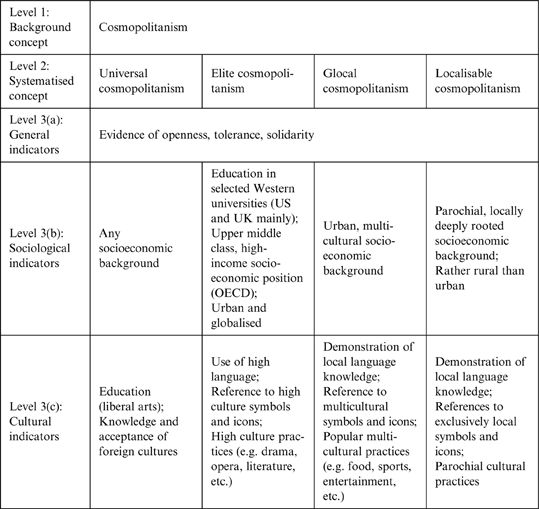
All four variants of cosmopolitanism have a common basis, namely a postulate of openness, tolerance, and solidarity across national, ethnic, or religious divides. Yet, the social conditions are varying as well as the manifestation of the cosmopolitanism (see Table 1). In terms of social conditions, elite cosmopolitanism presupposes not only high education but high education in highly reputed universities and a family background with relatively high social positions, whereas glocal and localisable cosmopolitanism postulate, on the contrary, much more variety in the educational as well as socio-professional background of the cosmopolitans. Universal and elite cosmopolitanism are also worldviews and attitudes that are postulated to exist additional to others. We can therefore expect them to be not expressed in hybrid but in rather pure terms. Practically, this means for instance that people will talk in ‘high’ languages, refer to high culture icons and symbols, be active in high culture activities (for example, rather theatre visits than football playing), etc. Hybridisation will, however, be the marker of glocal and localisable cosmopolitanism. Practically, we expect to find that people will use multiple references to local popular culture, engagement in glocal or localisable activities which do not require high culture but parochial cultural capital (for example, playing Preferans, a local card game, rather than theatre visits), etc. Glocal and localisable cosmopolitanism are different, however, in two respects. First in the intensity of the parochialism: glocal cosmopolitanism represents a rather superficial form of hybridisation of the global and local, whereas localisable cosmopolitanism arises where local familiarity is deeply rooted (see theoretical discussion above). Second, both are assumed to differ in their social conditions, too. Glocal cosmopolitanism has been formulated to develop in urban multicultural and multinational centres, in the so-called world cities.Footnote 74 It is in many respects compatible with elite cosmopolitanism as much of the ‘local’ appears in form of highly stylised and scripted forms such as the knowledge of Gandhi or the practice of Yoga. Localisable cosmopolitanism, on the other hand, describes the encounter of deeply parochial populations with globalisation which are likely to be rural and sedentary cultures, and exactly unlikely to become part of ‘high cultures’.Footnote 75
Conceptualisation and measurement of cosmopolitanism following the model by Adcock and Collier
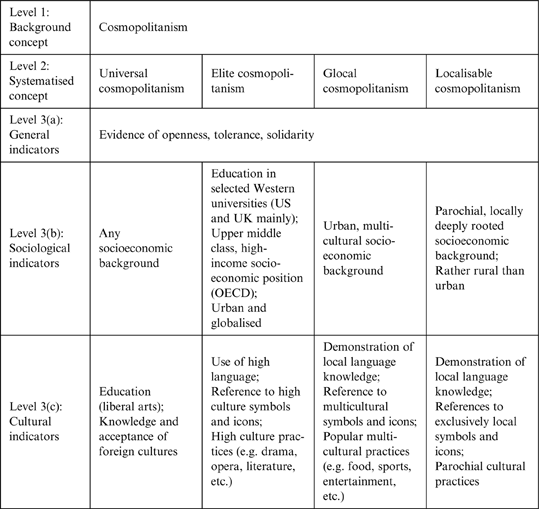
For all four types of cosmopolitanism, two types of indicators can be distinguished: sociological indicators as well as cultural indicators. The former encompasses education and socioeconomic background, whereas the latter refers to cultural activities and references (see Table 1).
On a fourth level, Adcock and Collier situate the validation of the measurement scores. This level corresponds to the traditional understanding of validity in which the concept designates the degree to which the measurement actually measures what the indicators and concept require them to measure.Footnote 76
Findings of the interviews
The interview sample consisted of 52 civilian staff of UNMIK, as well as 14 interviewees at the UN headquarters in New York. Contrary to our goal we had more female respondents in our sample than male (57:43 per cent). Yet, the age distribution corresponded to the prior established profile with the age group 25–45 years represented in the majority. In total, we interviewed nationals from 25 different countries.
Thinking like a cosmopolitan
The first aim of this explorative study was to establish worldview profiles of the respondents. As discussed earlier, worldviews are not clear-cut distinguishable. The fourth level of Adcock and Collier's model refers to the scores obtained in the research. Seeking validity of scores means that the researcher needs to make sure that the measure instruments measure what needs to be measured to validate the concepts used.Footnote 77 In this case, the research was explorative as it was charting entirely new terrain and it was therefore necessary to first validate the conceptual chain as developed above (levels 1 and 2). As we were assuming that the four forms of cosmopolitanism are variants of the overarching base cosmopolitanism, a common factor model was used to establish worldview profiles. As Brown points out, ‘The fundamental intent of factor analysis is to determine the number and nature of latent variables or factors that account for the variation and covariation among a set of observed measures.’Footnote 78 As we had not established what kind of pattern we expected for different worldviews (given that there was no prior research to draw upon), we specifically used an exploratory factor analysis to establish those worldview profiles.
The factor analysis notably allows exploring if cosmopolitanism is an important worldview among peacebuilders or not.Footnote 79 Once this is confirmed, we can proceed in a second step to the analysis of the kind of cosmopolitanism prevalent.
The question used for the factor analysis was: ‘Which of the following are values you think should be present and promoted in a political community?’ The respondents were then presented with a list of values and a seven-step scaled answer ranging from 1 (‘should be very much promoted’) to 7 (‘should not be promoted at all’). A principal component analysis was then run with all values presented in the list. Consecutively, values were eliminated from the list as they did not seem to bundle with any other value in a clear form. In the end, the principal component analysis established four profiles – ‘cosmopolitan’, ‘liberal’, ‘libertarian’, and ‘conservative’ – with the following values (see Table 2):
Profiles with values

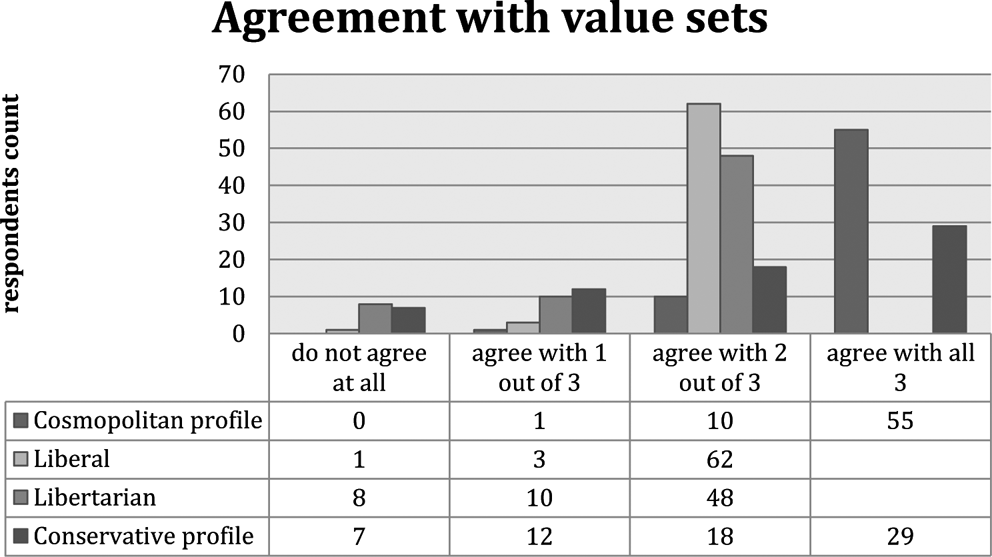
In a second step, adherence to the profiles was tested by creating a dummy variable agree/not agree for each value that had remained from the list after the principal factor analysis and to count the adherence to each value individually and to the set of values. This frequency analysis showed that the cosmopolitan profile, consisting of the values tolerance, equality and solidarity, is almost consensual as all these three values score highly among the respondents. It applied in total or large parts to 97 per cent of all respondents (see Graph 1). Additionally, the values of the liberal profile are equally quasi-unanimously accepted. The principal factor analysis enhanced the confidence with which we can assume that the very large majority of respondents assimilated general cosmopolitan values and it validated hence the construction of the concept on the first level.
Agreement of respondents with sets of values of four profiles

The profiling analysis on the basis of the value list allows the conclusion that the distinctions between the four profiles are nuanced and centre on cosmopolitan-liberal values. Although the libertarian and conservative profiles are more polarising, the question about political values and the resulting principal component factor analysis already confirm the initial expectation that cosmopolitanism is a dominant worldview among peacebuilders. We need to ask furthermore what kind of cosmopolitanism is dominant. As we have used the indicator of the evidence of the values of tolerance, openness, and solidarity to underscore the assumption of cosmopolitanism, we need to use different indicators (and hence, scores) to assess the specific form of cosmopolitanism.Footnote 80
As proposed in Table 1 above, the distinctions between elite cosmopolitanism, glocal cosmopolitanism and localisable cosmopolitanism can be teased out by two types of indicators: those indicators, which relate to the cultural frames of the peacebuilders and those, which evaluate their social status.
In terms of cultural references, the questionnaire asked a number of open questions which sought to explore respondents' cultural and historical imagery. The variance sought after concerned the question whether such references would refer to a domestic (respondent's country of origin), local/parochial (in this case Kosovar/Balkans) or world context.
Three questions were particularly designed to carve out the respondent's cultural imagery. The first one asked for the respondent's most admired political personalities, the two others for historical events. Politics and political thinking is often strongly associated with particular historical or contemporary figures. The extreme case is the labelling of any political foe as ‘Hitler’ or ‘Mussolini’, but also in more moderate discussions certain names are used to flag up political ideas. Particularly, in conflict situations certain persons become shorthand for the party the respondent has chosen. Name-dropping is furthermore an indicator of a specific cultural affiliation; it is bow of subordination to the magic of that name and the words and deeds of that person. When mentioning a specific name, the speaker expects recognition from the audience for his knowledge of that exact person.Footnote 81 Hence, in several ways, naming personalities invokes adherence to a specific group and in a wider sense to a specific worldview.Footnote 82
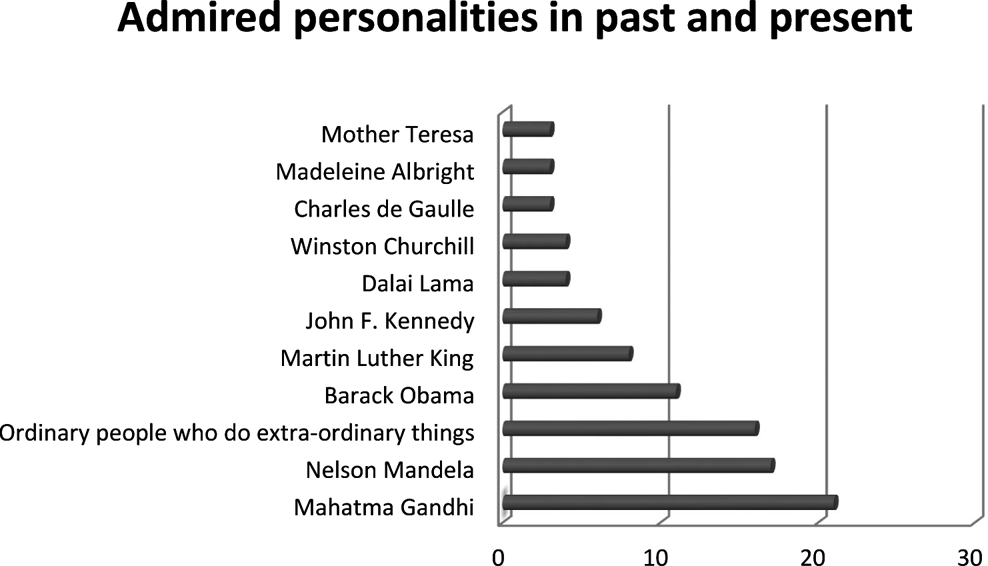
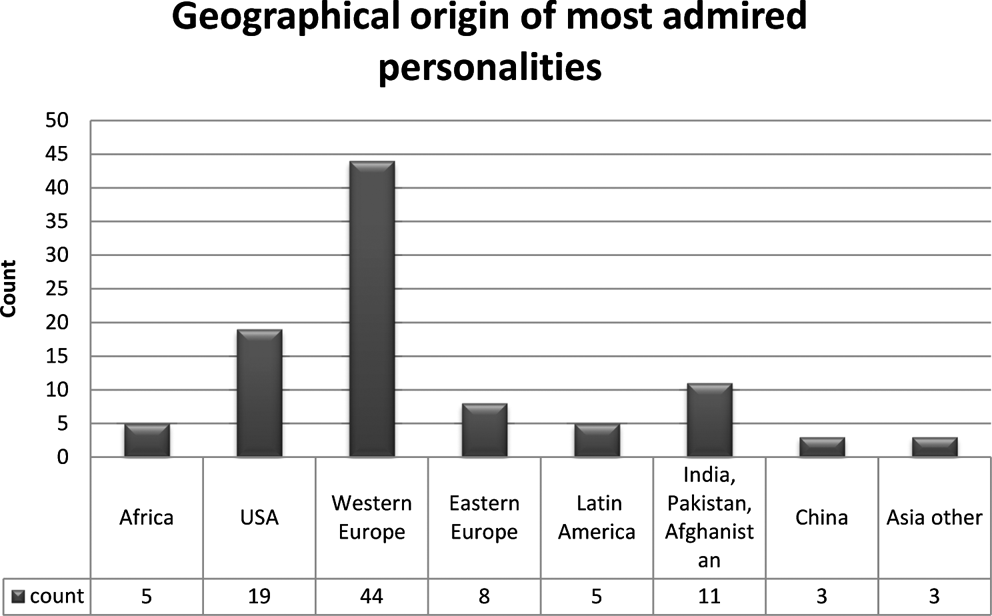
Three open questions asked in different ways which political personalities the respondents admired. The responses to these questions showed, at first sight, the existence of clearly non-Western iconic figures. A non-Western figure, namely Mahatma Gandhi, takes the head in the overall ‘hit list’ of heroes (see Graph 2). Among the ‘top four’, Nelson Mandela is the second non-Western reference; he is also incidentally the second most often mentioned personality. Yet, the majority, over 70 per cent, of personalities mentioned by the respondents were from Europe or the US (see Graph 3). Sorted by ‘political colour’, the heroes of the respondents were either mainstream democratic-liberal or conservative figures, or figures from civil society such as Mandela, Martin Luther King, or other leaders outside the institutionalised political system. Prominent revolutionary leaders or communists were very rarely mentioned; fascist figures not at all. In the category ‘anti-colonial struggle’ the highest percentage of responses concentrates almost entirely on Mahatma Gandhi. The non-West existed therefore mainly in the persons of two extremely iconic figures.
List of ‘heroes’
Geographic origin of admired personalities

This iconisation consists above all in their reduction to dehistoricised symbols of non-violent human rights struggle. Gandhi, for example, was selected by Time Magazine in 1999 as one of the three personalities who had shaped most the twentieth century. Richard Attenborough drew a flattering portrait of the Indian politician in his 1989 film ‘Gandhi’.
Diffusion processes of ideas are complex processes. In the case of Gandhi, Sean Chabot and Jan Willem Duyvendak have retraced how this process took place.Footnote 83 First, the civic rights movements integrated the Gandhian action repertoire. The success of the civic rights movement then added legitimacy to the interpretation that the movement had made of Gandhian practices. This interpretation of specific communities entered mainstream popular culture via media diffusion. Time Magazine's selection, hence, marks the endpoint of a long diffusion process of one specific interpretation of Gandhi's politics and life. It shows that Gandhian political practices have been fully integrated into the referential system of Western political communities. Although not a Western personality, Gandhi certainly has become a cult Western figure.
The other iconic figure mentioned, Nelson Mandela, is closely associated with Gandhi. Gandhi developed some of his ideas on non-violent resistance during his stay in South Africa (1913–14) and Mandela integrated forty years later the Gandhian action repertoire into the ANC's struggle against apartheid. Mandela received the International Gandhi Peace Prize in 2001 as well as the Gandhi/King award for non-violence in 1999. Mandela is certainly as much a contemporary icon of non-violence as Gandhi. As one biographer puts it: ‘He is a universal symbol of social justice certainly, an exemplary figure connoting non-racialism and democracy, a moral giant.’Footnote 84 Just as in the case of Gandhi, Mandela's image in the West has been widely diffused to popular audiences through media and, among others, Richard Attenborough's film ‘Cry Freedom’ on South African apartheid.Footnote 85
Both, Gandhi and Mandela are interesting references in the context of this study as both are important icons of the United Nations. Every 2 October, on Gandhi's birthday, the United Nations celebrate the International Day of Non-Violence and on every 18 July, the United Nations celebrates Nelson Mandela Day asking people around the world to sacrifice one minute per day for the service to others. The UN released stamps of both. UN Secretaries General, particularly Kofi Annan, frequently referred to both. Both figures are strongly scripted as global heroes for humanity. They therefore represent rather global than glocalised and certainly not localised icons.
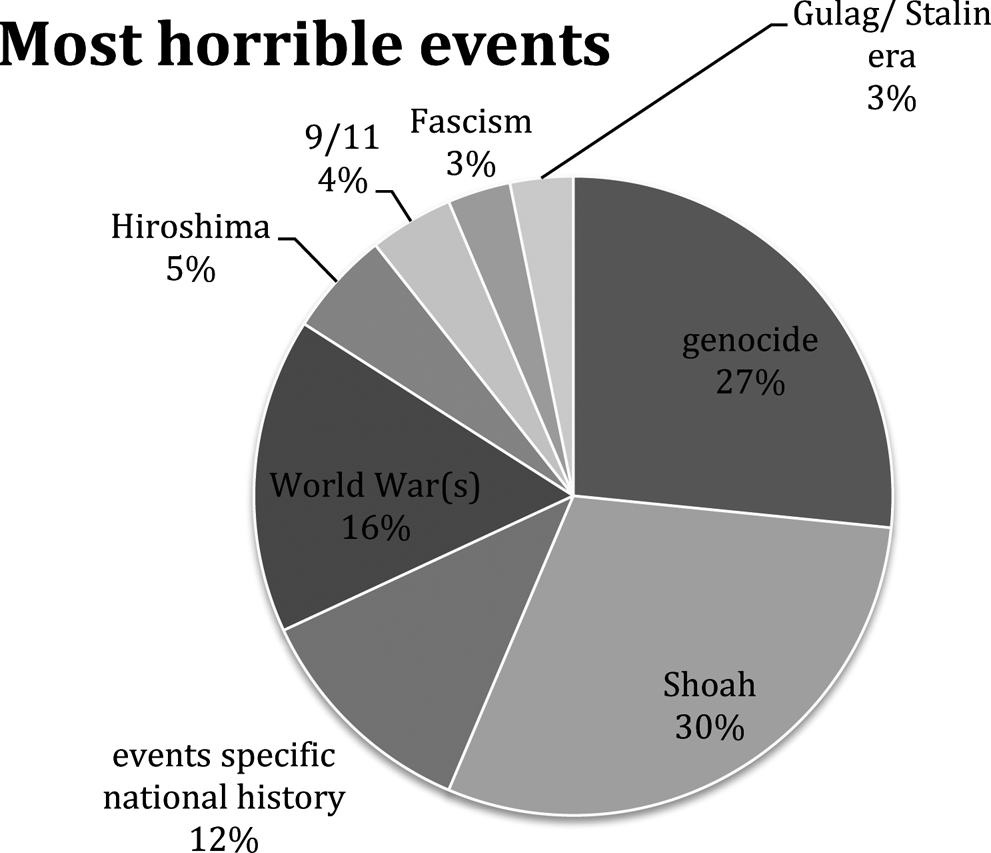
The second question aimed at identifying cultural references asked the following question: ‘Which event constitutes for you the most horrible historical event?’ The question belongs together with its mirror: ‘Which historical event has left the strongest impression on you?’ Contrary to the Westernisation of the political personalities, the answers of the most horrible event that has marked human history as well as the historical event interviewees could remember the best show per se a distinctly Western character. The most horrible events were clearly the Shoah and the two World Wars. Respondents nearly unanimously condemned the collective violence represented by wars, genocide, and concentration camps (see Graph 4). Particularly the Holocaust was often mentioned, confirming its status as ‘moral universal’.Footnote 86 This status, however, is far from being self-evident. As Alexander points out, it has been carefully constructed in the post-World War II period, and its acceptance as ethical basis for a universal law can only be understood on the grounds of this cultural and social construction process.Footnote 87
Answers to the question ‘Which was, according to you, the most horrible event in history?’
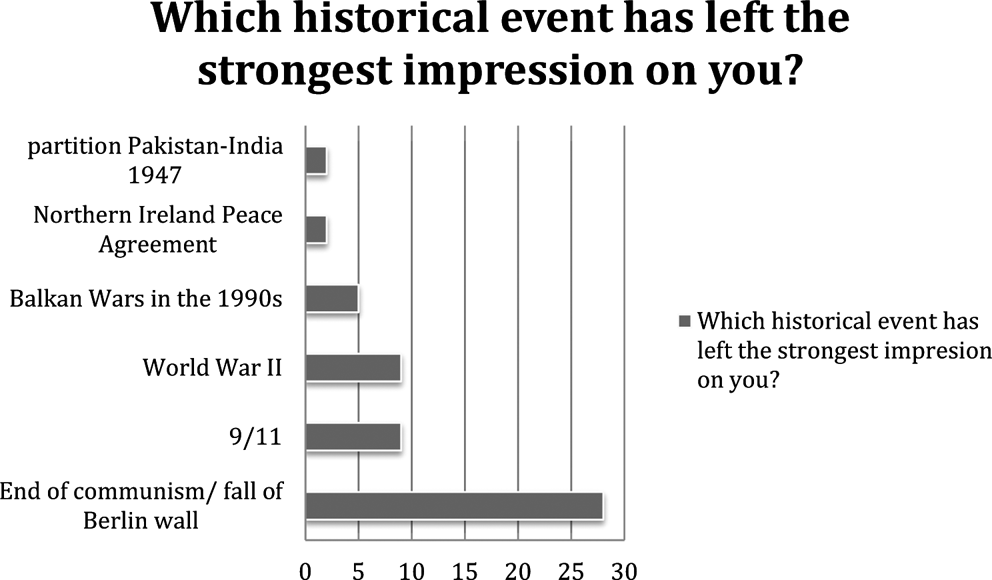
On the other hand, respondents almost as unanimously welcomed the triumph of liberalism represented by the fall of the Berlin Wall, which was voted by most the most significant historical event of the recent past (see Graph 5). These responses all indicate the ‘no more war, no more violence’ attitude of the interviewees, yet it does so with a clear focus on events that have happened in Western countries. The lack of discussion of colonialism and non-Western history in general is as striking as is the adherence of non-Western respondents to these narratives. At the same time, there was no evidence for the existence of the localisable type of cosmopolitanism in our survey results as there was literally no reference at all to local history, personalities, or culture. The most probable explanation for this homogeneity in historical and cultural references is that respondents' cosmopolitan worldview is deeply rooted in a shared background of formation in (Western) high culture – an argument we develop further below.
Answers to the question ‘Which historical event has left the strongest impression on you?’
The three questions about ‘heroes’ and historical events do not allow the conclusion of local or even parochial cultural references. Rather, the references given were strong indicators of Western-led and Western-interpreted globalisation. This points to the conclusion that, in terms of cultural references, the respondents were rather elite or glocal cosmopolitans, however, not localised. Yet, in order to further differentiate between different cosmopolitanism types, it is necessary to also take respondents' social backgrounds into consideration.
Being a cosmopolitan
The other part of the survey sought to analyse whether civilian peacekeepers in Kosovo share specific characteristics with respect to their social and educational background as well as lifestyles, which could be seen as basic conditions for, and expressions of, their (type of) cosmopolitanism. Regarding the social backgrounds of peacebuilders, our survey shows that, regardless of nationality, international staff was predominantly from high-income countries and of urban origin. 84 per cent of respondents originated from high-income countries as categorised by the World Bank (mostly OECD plus a few non-OECD), and 79 per cent were brought up in high-income countries. Due to the mainly West-European and Anglo-Saxon origin of UNMIK, OSCE, and EULEX staff this is little surprising. More striking is the similarly marked preponderance of urban origins among interviewees: the overwhelming majority, 88 per cent, come from urban or urban-rural settings, while only 12 per cent of the respondents grew up in rural areas. A further interesting observation regarding the geographical background of respondents' origins and upbringing was that their families' mobility during childhood years was relatively high: the percentage of interviewees who had grown up in other countries than those of their origin was 21 per cent.
This observation is linked to the family backgrounds of the peacebuilders in Kosovo. Here again, respondents showed strong similarities. Apart from some single cases, interviewees came from upper middle-class households with engineering and the sciences (22.2 per cent), liberal professions (9.5 per cent), or education (9.5 per cent) as the most frequent paternal employments.Footnote 88 Only about 15 per cent of the respondents' fathers had worked in jobs of low qualification like manual labour, agriculture, or small shop clerks. Science and engineering were by far the most typical professions of fathers, also explaining the high rate of childhood mobility as these jobs are often attached to working abroad. Mothers are/were typically teachers (30.3 per cent) or housewives (25.8 per cent), and only 6 per cent and 1.3 per cent worked in liberal professions or corporate business management respectively.
Regarding their educational backgrounds, the interviewed UNMIK staff also showed striking homogeneity. As higher education is one of the access criteria to civil service jobs at the UN, it is not surprising that all respondents had university educations. Yet, less unsurprisingly, many of them also had a post-graduate education. Five persons were holders of a BA degree only, while 50 interviewees held an MA and nine a PhD. Interestingly, almost all post-graduate education had been taken in high income countries even if the individuals were not born and did not grow up there. 95 per cent had studied in a high-income country, 5 per cent in an upper or lower middle-income country, and no one in a low-income country.
The first part of the survey also provided data to evaluate cosmopolitan lifestyle, most importantly the respondents' mobility and language skills as indicators of curiosity and tolerance towards foreign cultures and people. The survey showed that mobility was high among peacebuilders. About one-fifth of the sample was brought up in one or more countries other than that of their national origin. 67.7 per cent had studied at least partly in foreign countries, and about 70 per cent had experienced several stays abroad of more than three months. The reasons for longer expatriation were usually work or studies; however, tourism was also a major reason mentioned. The indicators for language skills among staff were also strong. All but the majority of the English native speakers were at least bilingual, and two thirds of all respondents had studied in a foreign language.
With regard to the three sociological types of cosmopolitanism discussed above, the findings allow several interpretations. Respondents' social backgrounds in high-income countries, mostly urban settings, and wealthy and highly-educated families hint at certain basic conditions which confirm the assumptions of elite cosmopolitanism. Yet, especially with regard to the geographical origins of peacebuilders, who in the case of Kosovo were explicitly recruited from West European countries and the US, further surveys in other cases of peacebuilding would be necessary to substantiate this claim. The urban and family backgrounds, however, are strikingly similar, plausibly confirming both, the glocal and the elite cosmopolitanism profile. The almost exclusive education in Western universities, furthermore, points towards elite cosmopolitanism.Footnote 89 Additionally, another hint at elite cosmopolitanism among peacebuilders is the high prevalence of post-graduate education. In terms of education, it is therefore more appropriate to assume elite rather than glocal cosmopolitanism.
The high mobility of respondents, both during childhood (due to fathers' professions) and in connection with their own educational and professional careers, also reflects elite cosmopolitanism as in many cases these expatriations have to be seen as rather privileged encounters with foreign countries and cultures. This interpretation results from the descriptions given of these expatriations in the interviews as well as from the fact that most of these were of relatively short duration and in almost all cases due to ‘missions’, not migration which would call for integration into local societies.
Glocal cosmopolitanism has been described as arising from the whole range of possible professional encounters, not only on the expatriate high-professional level, and mainly through migration, and within a shared local anchoring, that is, the big city. Indeed, Beck theoretically rejects elite cosmopolitanism and Robert Holton and Timothy Phillips describe glocal cosmopolitanism across all professional levels.Footnote 90 Our findings suggest that there is a strong connection between the professional imperatives of globalisation that have shaped peacebuilders' careers and the cosmopolitan culture they represent, yet that their mobility seems to have rather prevented deep encounters with the local than having encouraged them. None of the findings hint at local anchors and hence, neither glocal nor localisable cosmopolitanism seems to be the likely description of the peacebuilders' cosmopolitanism.
Validity and reliability of findings
Given the small sample studies here, the question arises how valid and reliable these findings are and if they can be generalised. In terms of validity, two aspects need to be distinguished. First, validity refers to the consistency of the conceptual development with the ‘measurement’, that is, the question whether the general concept, the specified concepts, and the indicators are consistent. Second, validity refers to the ‘measurement instrument’ per se, whether the questionnaire allowed obtaining answers that can support our argument or not. Although commonly distinguished in analytical terms, these two aspects practically come together in the question whether ‘the relationship between the account and … the phenomena that the account is about’ is sound.Footnote 91
As far as the validity of the conceptual framework is concerned, our explorative factor analysis showed, in a first step, the existence of a distinct cosmopolitan profile among the respondents. In a second step, more specific questions on cultural references allowed to specify this profile. Our indicators allowed excluding one option – localisable cosmopolitanism – and allowed accumulating evidence that made elite cosmopolitanism the more likely form to be found than glocal cosmopolitanism. The questions about the socioeconomic background of the respondents, particularly the questions about education and travelling, amassed evidence that the peacebuilders' cosmopolitanism was of the elite kind. Both indicators together, hence, allowed assessing the specified concepts of cosmopolitanism. Yet, the current findings also show that a more precise distinguishing line needs to be drawn between glocal and elite cosmopolitanism in terms of the cross-cultural encounters that will provide local anchoring and such that will not.
As far as the accuracy is concerned with which our findings reflect reality, there is no stochastic way of assessing their validity. However, one can argue that the careful research and questionnaire design, as well as the continuous control process of the interviewing and sampling procedure, all contributed to exclude possible bias. Arguing with Johnson, we can therefore assume that all precautions have been taken to avoid research bias and that, hence, the study has reached a high level of descriptive and interpretative validity.Footnote 92
Accordingly, one can assume that the findings of this study would apply to a structurally similar sample at a different point in time and populated by different respondents. Certainly, these results are not representative in the statistical sense of the term but ‘we can generalize to other people, settings, and times to the degree that they are similar to the people, settings, and times in the original study’.Footnote 93 Future studies in other cases of UN peacebuilding missions will thus need to discuss in how far the basic characteristics of the sample are comparable to the ones of the Kosovo case, or in how far potential differences in findings can be explained by differences in these characteristics respectively. There is strong evidence that other peacebuilding missions are structurally very similar to the Kosovo one even if they are taking place in different countries and at different times. Past research on peacebuilding has, in fact, pointed out that much of the structural similarities of peacebuilding missions is due to the headquarter constraints, and that peacebuilding missions are more characterised by organisational features than by local and particular features.Footnote 94
This means that the findings do not allow yet the formulation of axiomatic causal mechanisms. Rather it is necessary to reiterate this study with other groups before more firm inferences can be drawn. Yet, it allows drawing conclusions for this sample and carefully extrapolating these findings to structurally similar groups. This is all the more the case as the study found a very high level of homogeneity in the answers. In this sample, the findings are very little scattered and it is therefore likely that a bigger sample would not have found larger deviations either.
Conclusion
In summary, the results of our survey exploring the nature of cosmopolitan culture among civilian peacebuilders allow for a couple of carefully concluding interpretations. On the one hand, the vast majority of respondents showed general characteristics of universalist-liberal cosmopolitans regarding their values and worldviews, which were highly uniform and also confirmed the assumption of universalist cosmopolitanism's liberal pedigree, as claimed by Brown and Held. At the same time, the study clearly showed the analytical limits of the liberal-universalist theory of cosmopolitanism, which tells us nothing about the enabling social conditions of cosmopolitanism. Making use of three strands of sociological-empirical critique on this concept, namely the concepts of glocal, elite, and localisable cosmopolitanism, we were able to show nuances in the type of cosmopolitanism displayed by civilian peacebuilders in Kosovo, which the liberal-universalist concept cannot account for.
There was some evidence that peacebuilders' cosmopolitanism was connected to their education and to professional globalisation imperatives, as claimed by proponents of glocal cosmopolitanism. In this reading, peacebuilders' cosmopolitanism would be an effect of their internationalised study and working environments and their high mobility in both professional and recreational terms. Most findings, however, hinted at a higher degree of social particularity or exclusivity of peacebuilders' cosmopolitanism, pointing in the direction of Calhoun's observation that universal-liberal cosmopolitanism is conditioned by the particular culture of a Western elite. Thus while it is possible that some expressions of cosmopolitanism we found among our interviewees resulted from their international working environment (for instance, the frequent reference to Gandhi and Mandela, who are central figures in UN culture), we did neither find the social variety nor the mix-and-match assemblages including local cultural elements typical for glocal cosmopolitanism. Rather evidence for a much more exclusive rooting of peacebuilders' cosmopolitan disposition abounded and became most visible in the scarce variation we found with regard to social backgrounds and the lack of reference of local (in this case, Kosovar or Balkans) culture. The dominant form of cosmopolitanism found among UN peacebuilders in Kosovo in this study can thus be subsumed under the elite type.
With respect to the type of localisable cosmopolitanism, which in our theoretical discussion emerged as most appropriate form of cosmopolitanism in the sense of a basis of external actors' context-sensitive and inclusive assistance in local peace processes, the findings were disillusioning. There were few hints that civilian peacebuilders in Kosovo represented this type of cosmopolitan culture or that there were emerging links between international peacebuilders and local actors and culture in this sense. Only very few respondents showed signs of a space-conscious cosmopolitanism in Harvey's sense. Rather, they tended to be neither rooted in their home culture nor specifically aware of the host country's culture, but rather displaying a global culture evolving around Western(ised) symbols and values.
If the emancipatory or post-liberal concepts of peacebuilding discussed above are right, the only way out of the ‘cosmopolitan peace dilemma’ is a peacebuilding practice that is rooted in and tolerant of local knowledge and society; yet such a practice cannot be expected on the basis of our findings about current peacebuilding staff. It is the task of further research to explore ways that the local can be more firmly rooted in peacebuilding.
The next necessary research step is to repeat our study with other (possibly bigger) samples of UN peacebuilders, both to test our general findings about UN peacebuilders' cosmopolitanism and also to find out in how far our findings represent the specifics of one particular case of intervention, namely the UN Mission in Kosovo. Another way of broadening the research would be to include the staff of other than UN peacebuilding agencies in order to account for different organisational cultures and to study whether this has an effect on cosmopolitan dispositions. Given the exploratory nature of this research, which is due to the fact that it is the first study of this nature, future research projects are invited to use and refine our methodological approach, which we see as a qualitative study. The vocabulary of quantitative studies (validity, reliability, errors, representativity, indicators, variables, etc.) that we use as descriptive tools has a distinctively different meaning in our study. Most importantly, validity is not seen in terms of standard error testing but as internal validity of the research design and external validity as expression of the confidence with which we assume that the findings of this exploratory study can be used for further explorations of the sociology of peacebuilding or international organisations. Based on our discussion, we do not expect fundamentally adverse findings from such studies, but rather subtle differences deriving from specifics of each case.
Our findings also hint at the necessity to rethink UN peacebuilding practice. Although it is not completely ruled out that current peacebuilders develop a form of localisable cosmopolitan disposition by ‘going native’, our findings rather indicate that in order to enable locally owned forms of peacebuilding it might be necessary for international agencies to thoroughly reflect on and fundamentally change their internal organisational recruitment, career, and reward procedures in order to encourage localisation.
International agencies, particularly the UN, have up to now resisted such calls, commonly insisting on the ideal of the ‘international civil servant’. Yet, this ideal which dates back to the days of the second Secretary General, Dag Hammarskjöld,Footnote 95 was certainly an appropriate model to guarantee neutrality in times of Cold War peacekeeping but it might not be suitable for present day peacebuilding within conflict-torn societies. Indeed, it is the habitual concept of neutrality that is at stake and which requires rethinking.Footnote 96 From the perspective of localisable cosmopolitanism, real neutrality can only be achieved in combining deep local knowledge with cosmopolitan openness, tolerance, and universal solidarity. But this requires, first of all, deep engagement of the global with the local.
There are various ways international agencies could explore localising staff: Recruiting local staff, giving preference to locally knowledgeable candidates over those trained in prestigious but Western institutions, encouraging institutionally the immersion of staff in local contexts through longer contracts, etc. Any such measures, however, would have to go hand-in-hand with reforms of organisational training, accountability and culture in order to assure that ‘going native’ does not have the undesirable effect of becoming partisan to one side of the conflict. Yet, no matter which strategy was chosen, the potential tension between the traditional understanding of the organisation's neutrality and the need for localisation is, by any account, the greatest challenge to overcome if localisable cosmopolitanism ought to be the basis for peacebuilding.
Future research should thus concentrate even more on local initiatives of peacebuilding, trying to single out what made them ‘successful’ in the eyes of local conflict parties and, as a part of this, how localisable cosmopolitanism developed in these cases. It should also explore in how far the findings could be transferred, if at all, to other places and how external actors could assist, if at all, in initiating or supporting such local processes. This presupposes a huge step away from the liberal definition of peace, which is still the basis of much research on peacebuilding, and towards a locally derived definition of ‘peace’ or ‘success’, which renders a conflict solution locally legitimate.