Introduction
The Upper Muschelkalk deposits of NE Iberian Peninsula have been historically and largely studied. Paleontological, sedimentological, and chronostratigraphic research conducted, particularly in the Catalan Basin, have been crucial to understanding the evolution of the basin and its ecosystems during this time range (e.g., Verneuil, Reference Verneuil1854; Wurm, Reference Wurm1913; Schmidt, Reference Schmidt1935; Virgili, Reference Virgili1958; Hemleben and Freels, Reference Hemleben and Freels1977; Via-Boada et al., Reference Via-Boada, Villalta and Esteban-Cerdá1977; Calvet et al., Reference Calvet, March and Pedrosa1987, Reference Calvet, Tucker, Henton, Tucker, Wilson, Crevello, Sarg and Read1990, Reference Calvet, Anglada, Salvany and Vera2004; Calvet and Tucker, Reference Calvet and Tucker1988; Calvet and Marzo, Reference Calvet and Marzo1994; Fortuny et al., Reference Fortuny, Bolet, Sellés, Cartanyà and Galobart2011; Mercedes-Martín et al., Reference Mercedes-Martín, Salas and Arenas2013, Reference Mercedes-Martín, Salas and Arenas2014a, Reference Mercedes-Martín, Arenas and Salasb; Escudero-Mozo et al., Reference Escudero-Mozo, Márquez-Aliaga, Goy, Martín-Chivelet, López-Gómez, Márquez, Arche, Plasencia, Pla, Marzo and Sánchez-Fernández2015; López-Gómez et al., Reference López-Gómez, Alonso-Azcárate, Arche, Arribas, Barrenechea, Borruel-Abadía, Díez, Quesada and Oliveira2019; García-Ávila et al., Reference García-Ávila, Mercedes-Martín, Juncal and Diez2020, and references therein).
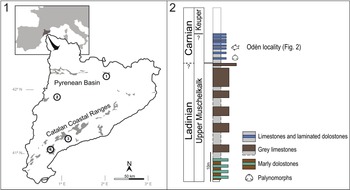
Some of the most relevant Upper Muschelkalk fossils have been recovered in the classical localities of Mont-ral and Alcover (Catalan Coastal Ranges) (e.g., Beltan, Reference Beltan1972, Reference Beltan1975; Via-Boada et al., Reference Via-Boada, Villalta and Esteban-Cerdá1977; Cartanyà, Reference Cartanyà, Arratia and Schultze1999; Cartanyà et al., Reference Cartanyà, Fortuny, Bolet and Mutter2015). More-recently discovered fossil-bearing sites in adjacent areas such as Mora d'Ebre-Camposines have fueled a renewed interest in the paleontological study of their macrofaunal and ichnofossil assemblages (Fortuny et al., Reference Fortuny, Bolet, Sellés, Cartanyà and Galobart2011; Cartanyà et al., Reference Cartanyà, Fortuny, Bolet and Garcia-Artigas2019; Mercedes-Martín and Buatois, Reference Mercedes-Martín and Buatois2021) (Fig. 1). The Upper Muschelkalk deposits are represented by extensive marine carbonate units of Ladinian (Middle Triassic) and potentially earliest Carnian age according to recent palynological studies (García-Ávila et al., Reference García-Ávila, Mercedes-Martín, Juncal and Diez2020). Faunas recovered at the Mont-ral–Alcover and Mora d'Ebre-Camposines outcrops have been referred to the late Ladinian (Middle Triassic) by Cartanyà et al. (Reference Cartanyà, Fortuny, Bolet and Garcia-Artigas2019).
(1) Location of the Middle Triassic Pyrenean basin in Catalonia (NE Iberian Peninsula, Spain) with the localities mentioned in the text: 1, Odèn; 2, Vilanova de la Sal; 3, Mont-ral–Alcover; 4, Mora d'Ebre - Camposines. (2) Synthetic stratigraphic section for Odèn locality (modified from Calvet et al., Reference Calvet, Solé de Porta and Salvany1993).

In this work, a detailed analysis of coeval Middle Triassic carbonate successions has been performed in the nearby Pyrenean basin (NE Iberian Peninsula) (Fig. 1). The corresponding sites have been inadequately studied compared with their equivalent counterparts in the Catalan Coastal Ranges (Lehman, Reference Lehman1964; Fréchengues et al., Reference Fréchengues, Martim, Peybernès and Zaninetti1990; Fréchengues and Peybernès, Reference Fréchengues and Peybernès1991a, b; Calvet et al., Reference Calvet, Solé de Porta and Salvany1993, Reference Calvet, Anglada, Salvany and Vera2004; Cartanyà et al., Reference Cartanyà, Fortuny, Sellés, Bolet, Petruzzelli, Solà, Sagarra and Galobart2011, Reference Cartanyà, Fortuny, Bolet and Mutter2015; Fortuny et al., Reference Fortuny, Bolet, Sellés, Cartanyà and Galobart2011).
In the Pyrenean basin, fossil fishes are poorly known from only two localities (Fig. 1): (1) Vilanova de la Sal, with reports of an actinopterygian fauna not described in detail (Fortuny et al., Reference Fortuny, Bolet, Sellés, Cartanyà and Galobart2011), and (2) Odèn, with abundant actinopterygian remains. The Odèn locality was first reported by Lehman (Reference Lehman1964), who described postcranial remains assigned to Acidorhynchus, a genus currently considered a subjective junior synonym of Saurichthys (Wu et al., Reference Wu, Sun, Xu, Hao, Jiang and Sun2011). Later, additional specimens referred to Saurichthys, as well as to Peltopleuridae, Halecomorpha, and the large-bodied Colobodus, were reported from this site (Cartanyà et al., Reference Cartanyà, Fortuny, Sellés, Bolet, Petruzzelli, Solà, Sagarra and Galobart2011, Reference Cartanyà, Fortuny, Bolet and Mutter2015; Fortuny et al., Reference Fortuny, Bolet, Sellés, Cartanyà and Galobart2011).
The purpose of this work is twofold: (1) to update and summarize the composition of the diverse faunal assemblage from the Ladinian–Carnian transition at the Odèn locality to date, including the description of the most abundant actinopterygian taxon, and (2) discuss the paleontological, chronostratigraphical, and paleoenvironmental implications of this faunal assemblage in the context of adjoining Middle Triassic basins of the Tethys region.
Geological setting
On the Iberian Peninsula, the Triassic stratigraphic record can be subdivided into three parts, from the base to the top: Buntsandstein facies (continental clastic sediments forming red beds), Muschelkalk facies (marine carbonates, evaporites, and red beds), and Keuper facies (tidal and sabkha deposits) (Virgili et al., Reference Virgili, Sopena, Arche, Ramos and Hernando1983; Salvany and Ortí, Reference Salvany and Ortí1987 Calvet et al., Reference Calvet, Tucker, Henton, Tucker, Wilson, Crevello, Sarg and Read1990). From a tectonostratigraphic point of view, the evolution of the Iberian Peninsula during the upper Permian and Mesozoic can be divided into three rifts and their corresponding post-rift stages, which controlled the sedimentation styles. The rift cycle corresponding to the late Permian–Triassic affected mainly the eastern part of the Iberian plate, giving rise to basins that were filled with sediments attributed to the Germanic facies during the late Permian and Triassic (Salas and Casas, Reference Salas and Casas1993; Ramos et al., Reference Ramos, Sopeña, Sánchez-Moya and Muñoz1996; Salas et al., Reference Salas, Guimerà, Mas, Martín-Closas, Meléndez and Alonso2001).
In the South Pyrenean sector (Les Nogueres-Cadí), the Muschelkalk facies lies on top of the Buntsandstein facies (Anisian), which is composed of sandstones, conglomerates, and clay deposits. The Upper Muschelkalk of the South Pyrenean sector is represented by several limestone–marl–dolostone units of Anisian to Ladinian age (Fréchengues et al., Reference Fréchengues, Martim, Peybernès and Zaninetti1990, Reference Fréchengues, Peybernès, Thiébaut, Durand-Wackenheim, Fournier-Vinas and Lucas1991, Reference Fréchengues, Peybernès, Lucas and Souquet1992; Fréchengues and Peybernès, Reference Fréchengues and Peybernès1991a, Reference Fréchengues and Peybernèsb; Calvet et al., Reference Calvet, Solé de Porta and Salvany1993). From base to top, the Upper Muschelkalk is an assemblage of marly dolostones, gray limestones, and limestones with laminated dolostones (Fig. 1) deposited in laterally restricted carbonate ramp intertidal to subtidal environments potentially equivalent to those in the Catalan Coastal Ranges. The total thickness of the Upper Muschelkalk facies in the South Pyrenean region ranges between 37 and 108 meters according to Calvet et al. (Reference Calvet, Solé de Porta and Salvany1993). In this subbasin, the Muschelkalk facies can be subdivided into three lithological units from bottom to top: marly dolomites unit (2 to 8 meters thick), gray limestone unit (20 to 70 meters thick), and laminated limestone and/or dolomites unit (15 to 30 meters thick) (Calvet et al., Reference Calvet, Anglada, Salvany and Vera2004) (see Fig. 1).
The studied outcrops at the Odèn locality can be broadly assigned to the laminated limestone and/or dolomites unit of Calvet et al. (Reference Calvet, Solé de Porta and Salvany1993), who proposed a late Ladinian–middle Carnian age for these units on the basis of palynological data.
Materials and methods
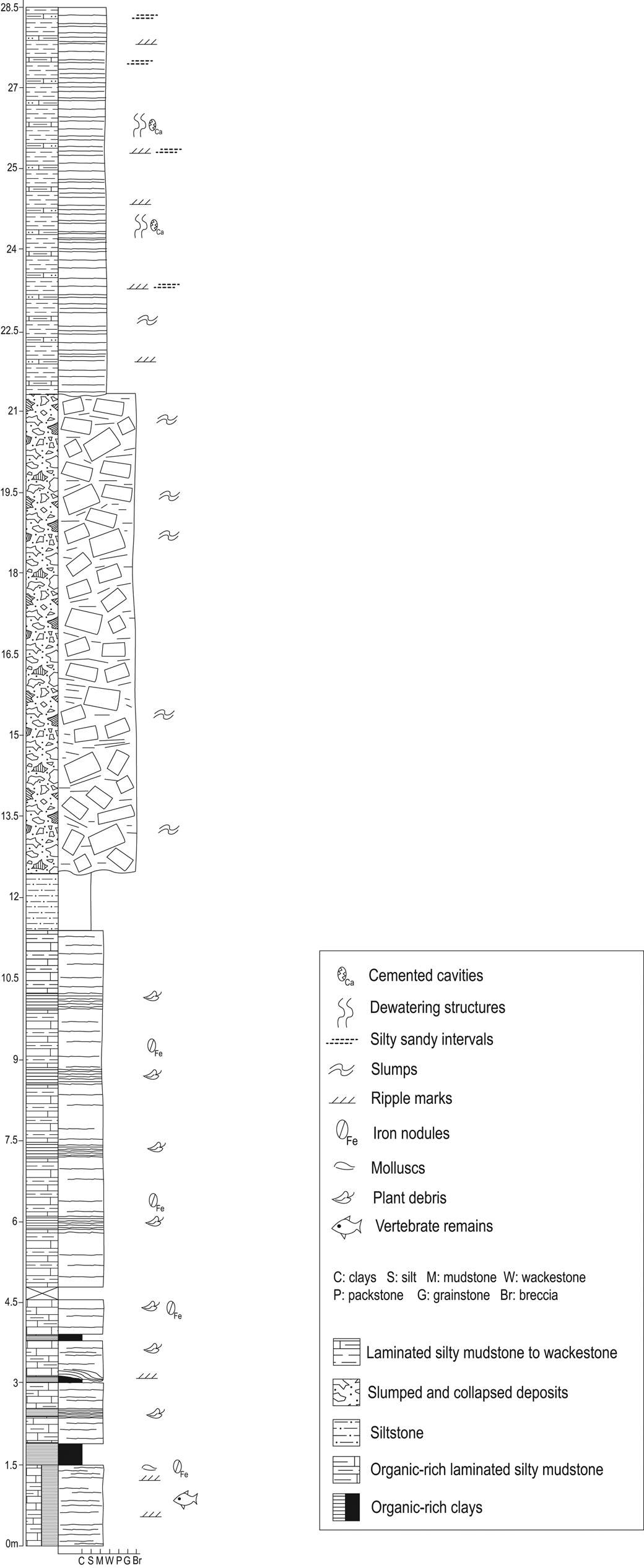
A 28.5 meter long composite sedimentary section was logged at the Odèn locality. The base of the section can be found in the kilometric point 29 of L-401 road, between the villages of Coll de Nargó and Odèn (Figs. 1, 2). Thirteen rock samples were collected for thin-section analyses. Sedimentary textural descriptions were carried out with a Nikon Eclipse 8400 optical microscope, and photomicrographs were taken with an attached Nikon Microphot FX camera. The material studied here was collected starting in 2009 and followed by some additional paleontological excavations in 2010, 2016, and 2020, yielding a total of 450 specimens (see Results section). All field campaigns were performed under legal permits issued by Departament de Cultura of the Generalitat de Catalunya (Catalan local government). Nine actinopterygian specimens (genus Peltopleurus) are described in detail for the first time in this work (IPS85811, IPS86048, IPS106902, IPS106957, IPS106977, IPS122561, IPS107023, IPS85919, and IPS106909). All actinopterygian specimens underwent chemical and mechanical preparation. The chemical preparation included swabbing the pieces with formic acid (5%) and mechanically removing the matrix surrounding or covering the skeleton using a thin needle under a stereomicroscope. The specimens were imaged by using a binocular Leica MZ 16A, and line drawings were made with Corel Draw software.
Sedimentary log in Odèn outcrop. Fossil-bearing units are referred to the bottom units.

Repository and institutional abbreviation
All specimens examined in this study are deposited in the Institut Català de Paleontologia Miquel Crusafont (Sabadell, Spain) and are labelled using the acronym IPS.
Systematic paleontology
Subclass Actinopterygii Cope, Reference Cope1887
Order Peltopleuriformes Gardiner, Reference Gardiner1967
Family Peltopleuridae Brough, Reference Brough1939
Genus Peltopleurus Kner, Reference Kner1866
Type species
Peltopleurus splendens Kner, Reference Kner1866. Its type locality is Raibl, Carinthia, which is in a Julian marine limestone in Italy.
Peltopleurus cf. P. nuptialis Lombardo, Reference Lombardo1999
Figures 3–9
Occurrence
Lower levels of organic-rich laminated mudstones from the facies association 1 (organic-rich laminated silty mudstone). Laminated limestone and/or dolomites unit of Calvet et al. (Reference Calvet, Solé de Porta and Salvany1993).
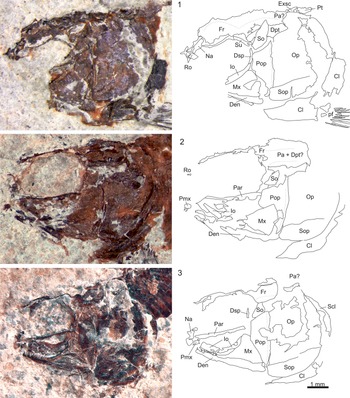
Peltopleurus cf. P. nuptialis. Nearly complete skulls with a drawing of the identified bones. The dotted lines represent sensory canals. (1) IPS106977. (2) IPS122561. (3) IPS107023. Cl = cleithrum; Den = dentary bone; Dpt = dermopterotic; Dsp = dermosphenotic; Exsc = extrascapular; Fr = frontal; Io = infraorbital; Mx = maxilla; Na = nasal; Op = operculum; Pa = parietal; Par = Parasphenoid; pf = pectoral fin; Pmx = premaxilla; Pop = preoperculum; Pt = posttemporal; Ro = rostral; Scl = supracleithrum; So = suborbital; Sop = suboperculum; Su = supraorbital.

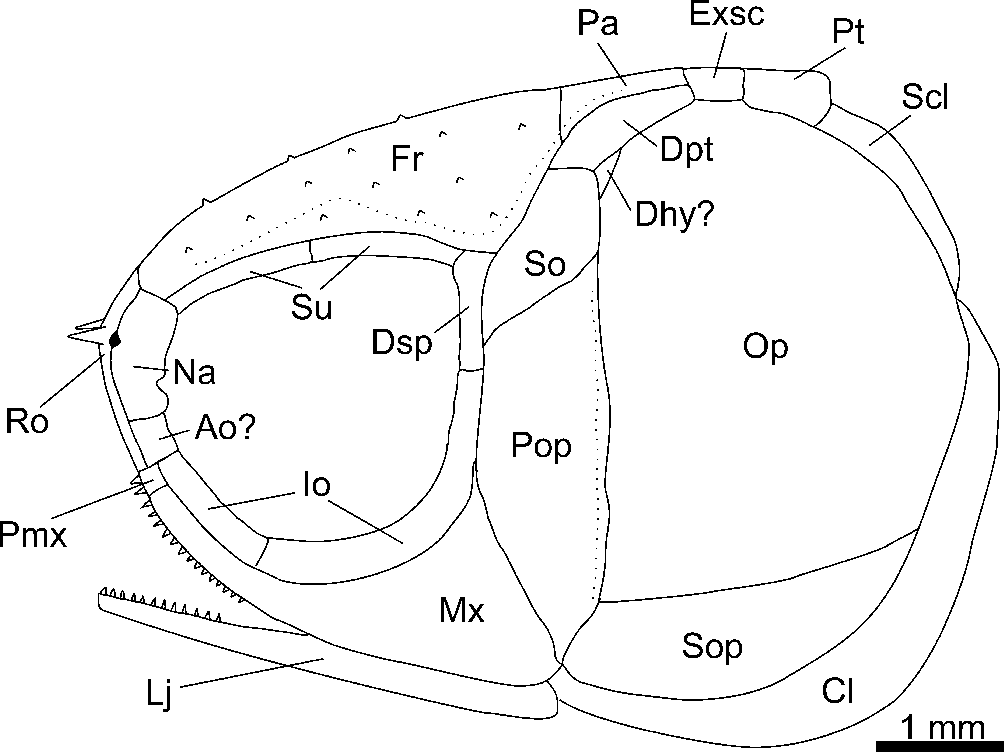
Peltopleurus cf. P. nuptialis. Idealized reconstruction of the skull based on the combined observations of the specimens studied. Ao = antorbital; Cl = cleithrum; Dhy = dermohyal; Dpt = dermopterotic; Dsp = dermosphenotic; Exsc = extrascapular; Fr = frontal; Io = infraorbital; Lj = lower jaw; Mx = maxilla; Na = nasal; Op = operculum; Pa = parietal; Pmx = premaxilla; Pop = preoperculum; Pt = posttemporal; Ro = rostral; Scl = supracleithrum; So = suborbital; Sop = suboperculum; Su = supraorbital.

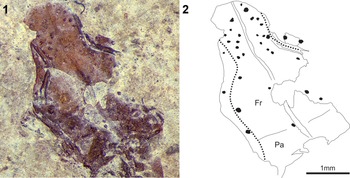
Peltopleurus cf. P. nuptialis. Skull roof of specimen IPS85811 showing the small conical tubercles randomly arranged on the frontal bone (black dots) and the supraorbital sensory canal (dotted lines). (1) Photograph. (2) Interpretative drawing. Fr = frontal; Pa = parietal.

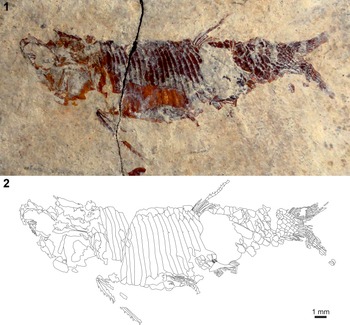
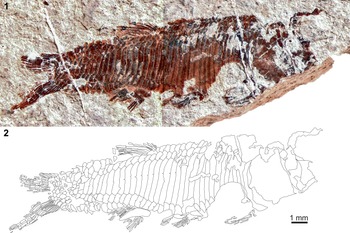
Peltopleurus cf. P. nuptialis. IPS86048, a nearly complete body with its skull disarticulated. (1) Photograph. (2) Interpretative drawing. In this morphotype B specimen it is possible to identify the long dorsal and pectoral fins with their hooks, the pelvic fin with its hooks, the anal fin partially covered by the scute, and the caudal fin.

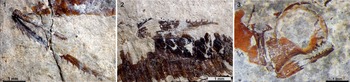
Peltopleurus cf. P. nuptialis. (1, 2) Detail of the long pectoral and dorsal fins with their hook structures on the anterior margin of the segments: (1) IPS86048; (2) IPS85919. (3) IPS106909, detail of the skull showing the lines of flattened oval teeth.

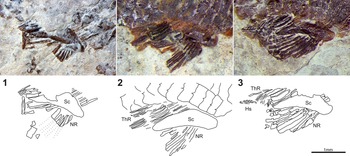
Peltopleurus cf. P. nuptialis. Morphotype B anal fins showing the described structure composed by normal rays (NR) bearing hooks on each segment, a series of thin rays (ThR) ending in small sharp hooks (Hs), and a triangular scute (Sc) covering the fin. (1) IPS86048. (2) IPS106957. (3) IPS106902.

Peltopleurus cf. P. nuptialis. IPS106957, a nearly complete body missing the anterior portion. This morphotype B specimen shows the main features of the squamation. (1) Photograph. (2) Interpretative drawing.

Description
In terms of general morphology, Peltopleurus cf. P. nuptialis has a fusiform body with a forked caudal fin and presents general features that all the species of Peltopleurus share (see the following). This taxon has two distinct morphotypes (herein named morphotypes A and B) with differences in the pectoral, pelvic, anal, and dorsal fins and in the rostral bone. Its maximum standard length is 25 mm, with a total length of 29 mm and a head length constituting around 34% of the standard length.
Snout
The rostral bone has a rounded convex shape with differences representing two morphotypes. In morphotype A, this bone presents a smoothed surface; morphotype B specimens show at least two prominent conical tubercles with a maximum height of 0.3 mm (Figs. 3.1, 3.2, 4). The nasal bone has a convex shape with a small notch for the anterior nostril on its anterior margin (Figs. 3.3, 4). It contacts the rostral bone. These two elements are in contact with the frontal, the premaxilla, and possibly with the antorbital. However, this character cannot be discerned with confidence in any recovered specimen. The premaxilla is rectangular, bearing two big conical teeth on its oral margin (Figs. 3.2, 4).
Skull roof
The frontal bone is broad and expanded in its posterior part and narrower anteriorly. The surface of the frontal bone has at least 16 small conical tubercles randomly arranged (Figs. 4, 5). The parietal bone has a smooth surface, and its contact with the frontal bone is straight (Figs. 4, 5). Parallel to the orbital margin of the frontal and parietal bones is a ridge identified as the supraorbital sensory canal. The subrectangular dermopterotic (Fig. 3.1) is placed in contact with the frontal, the parietal, the extrascapular, and the suborbital (Figs. 3, 4). The extrascapular and the posttemporal are not well preserved due to the disarticulation of the skulls.
Circumorbital series
There are two infraorbitals (Figs. 3, 4). The first infraorbital is in contact with the antorbital, the premaxilla, and the distal part of the maxilla; the second infraorbital is the largest one, being in contact with the rest of the maxilla and half of the preoperculum. The dermosphenotic is similar in size to the first infraorbital, being in contact with the second infraorbital, the rest of the preoperculum and the suborbital, the frontal, and one supraorbital. No dermohyal is observed for preservational reasons. The supraorbitals are not well preserved in any recovered specimens due to the state of preservation. However, in one specimen (Fig. 3.1), it is possible to discern a potential supraorbital.
Cheek bones
The suborbital is large and triangular with rounded edges; it contacts the preoperculum, the operculum, the dermopterotic, and the skull roof bones (Figs. 3, 4).
The preoperculum is trapezoidal, with its upper and lower margins narrower than the central portion. Its anterior margin is in contact with the infraorbitals 2 and 3. Its posterior margin is in contact mainly with the operculum but also with the suboperculum. On its lower margin, the preoperculum is in contact with the maxilla, and its upper margin is in contact with the suborbital (Figs. 3, 4). The posterior margin shows a ridge parallel to the margin identified as the preoperculum sensory canal.
The maxilla shows a thin anterior part and a broad rounded posterior one. The oral margin bears at least 14 sharp conical teeth of different heights (Figs. 3, 4). The anterior margin is in contact with the premaxilla, and the posterior part of the maxilla is in contact with the preoperculum and the cleithrum. The palatal bones bear several rows of flattened oval teeth hinting at a semidurophagous diet (Fig. 7.3).
Opercular series
The operculum and the suboperculum bones are D-shaped. The operculum is large and in contact with the preoperculum and the suborbital on its anterior margin and the cleithrum on its posterior margin (Figs. 3, 4). The suboperculum has a straight contact with the operculum. This suboperculum is significantly smaller and in contact with the maxilla on its anterior margin.
Lower jaw
The dentary bone shows a narrow anterior portion and an expanded posterior end, with at least one small notch on its middle part (Figs. 3.3, 4). The oral margin bears at least 16 sharp conical teeth of different heights and slightly larger than those of the maxilla.
Girdles and paired fins
The shoulder girdle is composed of a robust cleithrum. It is sickle shaped, with an irregular surface and a shorter supracleithrum (Figs. 3, 4). The cleithrum is in contact with the posterior margin of the operculum and suboperculum (Figs. 3.1, 4). The branchiostegal rays are not preserved in any specimen due to the fragility of these bones and the poor preservation of this area of the skull.
The pectoral fin is long and made of at least seven distally segmented rays. On the specimens referred to morphotype B, these rays consist of a long proximal segment and at least seven shorter segments (Figs. 6, 7.1). The unsegmented anterior ray bears six sharp hooks on its anterior margin, followed by the first segmented ray showing at least seven hooks along its anterior margin. The rest of these segmented rays show a single hook on the distal margin. Specimens referred to morphotype A present a shorter fin, with the same structure but without hooks. The pelvic fin is smaller than the pectoral fin, composed of at least eight rays and showing the same structure of rays and hooks as on the pectoral fin (Fig. 6).
Median fins
The dorsal fin is made of long lepidotrichia, composed of at least 10 distally segmented rays and four basal fulcra (Fig. 7.2). On morphotype B, the segments from the anterior ray show a sharp hook on each fragment; in morphotype A, these rays are shorter and without any hook.
The anal fin shows two different patterns. In morphotype B, this anal fin is made of at least eight rays with a minimum of five segments bearing hooks. Above these rays are an indeterminate number of very thin rays ending in small sharp hooks. This fin is partially covered by a triangular scute (Fig. 8). In morphotype A, this anal fin is formed of at least 14 rays with a minimum of five segments missing the hooks and the scute.
The caudal fin is hemiheterocercal with a forked profile and composed of 24 principal rays made up of a minimum of eight segments (Figs. 6, 9). There are four basal fulcra on each lobe and four or five epaxial rays on the upper lobe. However, the state of preservation precludes distinguishing more details of the caudal fin as the fringing fulcra and procurrent rays.
Squamation
The scale covering is made up of 35 or 36 vertical smooth scales in rows along the lateral line of the body (Figs. 6, 9). The lateral-line scales are sigmoidal; they increase in depth on the anterior part of the body and decrease in size to the posterior part. There are two rows of rectangular scales on the dorsal margin above the lateral-line scales and one row on the ventral margin below the lateral line scales (Fig. 9). All the scales have a small spine on the posterior margin (Fig. 9). The caudal region is made up of five triangular scale rows.
Materials
IPS106977, anterior part of the body. IPS106957, a complete body missing the anterior part of the skull. IPS107023, a poorly preserved body including the skull. IPS86048, a nearly complete body with its disarticulated skull and all the fins. IPS85811, a partially disarticulated body showing some cranial features. IPS106902, a partially disarticulated body with good preservation of some fin characters. IPS122561, anterior part of the body preserving most of the cranial bones. IPS85919, a partially disarticulated body showing some features of the fins. IPS106909, a poorly preserved body showing some cranial features.
Remarks
The small size of the body and the presence of a big operculum, a tall preoperculum, and a hemiheterocercal caudal fin are diagnostic characters of Peltopleuriformes (Gardiner, Reference Gardiner1967). Recently, Xu and Ma (Reference Xu and Ma2016) defined Peltopleuriformes sensu stricto including only Peltopleuridae and Thoracopteridae. The monophyly of these clades, according to the analyses by Xu and Ma (Reference Xu and Ma2016), is well supported by five synapomorphies: supraorbital sensory canal ending in the frontal, absence of a preoperculum/dermopterotic contact, presence of a postpiracle, presence of dense brush-like rays articulating proximally with several stout segments in the male anal fin, and presence of enlarged lateral scutes associated with the anal fins. All these characters are identified on the Odèn specimens, except the presence of a postpiracle, probably for preservation reasons.
Regarding Peltopleuridae, the original diagnosis of this group provided by Brough (Reference Brough1939) includes as diagnostic characters the small size of the body, large orbits, fins of small to moderate size, hemiheterocercal forked tail, deep flank scales, frontals large and elongated, rectangular parietals, long and narrow supratemporals, wide preoperculum attached to the maxilla, large operculum, small suboperculum, and few branchiostegal rays. All these characters are identified on the Odèn specimens except the branchiostegal rays, which are not preserved. Brough (Reference Brough1939) marked as a diagnostic character a weak dentition with minute teeth on the maxilla or no teeth at all. However, Lombardo (Reference Lombardo1999) noted that this character is not diagnostic for Peltopleuridae due to the strong dentition present in Peltopleurus notocephalus Bürgin, Reference Bürgin1992 and Peltopleurus nuptialis (Bürgin, Reference Bürgin1992; Lombardo, Reference Lombardo1999). For this reason, Lombardo (Reference Lombardo1999) questioned the diagnosis of Brough (Reference Brough1939), but she did not present an emended diagnosis of this family.
Peltopleurus is a genus included within the clade Peltopleuridae, including 12 species, from Middle to Upper Triassic. This genus has been recovered from Austria, Italy, Spain, Switzerland, and South China (Kner, Reference Kner1866; Brough, Reference Brough1939; Beltan, Reference Beltan1972, Reference Beltan1975; Bürgin, Reference Bürgin1992; Cartanyà, Reference Cartanyà, Arratia and Schultze1999; Lombardo, Reference Lombardo1999; Xu and Ma, Reference Xu and Ma2016; Xu et al., Reference Xu, Ma and Zhao2018). It was erected on the basis of a unique combination of characters (Kner, Reference Kner1866): (1) a small fish with a fusiform body, in agreement with the Odèn specimens with an average ratio of total length to maximum body depth of 3.89; (2) a flank with a longitudinal row of tall scales; the specimens from Odèn show that longitudinal row of deep scales; (3) a vertical preoperculum and a maxilla with a narrow anterior region and an expanded postorbital; this vertical preoperculum and this narrow morphology on its anterior part and expanded on its posterior maxilla are also present on the specimens from Odèn; (4) the presence of a wide and semicircular opercular region; the opercular region in the specimens from Odèn is broad and D-shaped, matching the description for this genus; (5) caudal fin externally symmetrical, as present on the Odèn specimens; (6) a short axial body lobe with at least six epaxial rays. On the specimens reported here, the axial body is short and there are at least four or five epaxial rays. All these characters support the attribution of reported specimens from the Odèn site to the genus Peltopleurus.
Differences on the pectoral, pelvic, anal, and dorsal fins as well as the rostral bone reveal the presence of dimorphism in the Odèn taxon. Morphotype A has a pectoral fin made of at least seven rays distally segmented, a pelvic fin with at least eight rays distally segmented, an anal fin composed of at least 14 rays distally segmented, a dorsal fin composed of at least 10 rays distally segmented, and the rostral bone being rounded and smoothed. Morphotype B has a pectoral fin made of at least seven rays distally segmented and much longer than those of morphotype A; moreover, morphotype B presents the following characters: the anterior unsegmented ray bears on its anterior margin six sharp hooks, followed by the first segmented ray bearing at least seven hooks along its anterior margin. The rest of these segmented rays show a single hook on the distal margin and a pelvic fin with at least eight rays distally segmented with the same hook structure as the pectoral fin and an anal fin made of at least eight rays composed of a minimum of five segments bearing hooks. Above these rays are an indeterminate number of very thin rays ending in small sharp hooks. The anal fin is partially covered by a triangular scute. The dorsal fin is composed of at least 10 rays distally segmented; the segments from the anterior ray show a sharp hook on each fragment and the rostral bone is rounded and has a prominent tubercle.
The presence of two morphotypes with differences related mainly to fin morphology is known from Peltopleurus species such as P. nuptialis, where what would correspond to our morphotype A is assumed to be a female and morphotype B would represent the male as shown by the presence of hook structures as discussed by Lombardo (Reference Lombardo1999).
The specimens herein described present similarities to the specimens referred by Lombardo (Reference Lombardo1999) to Peltopleurus nuptialis, erected on the basis of the following combination of features. (1) Small species of Peltopleurus, up to 25 mm standard length with 32 vertical scale rows. Our specimens share this standard length but with 35 or 36 scale rows. Two scale rows are dorsal to the deepened flank scales, and one is ventral. The specimens recovered in the Pyrenees show the same squamation pattern. (2) Posterior margin of all scales with one to three small spines. The specimens herein described show only one spine on the posterior margin of all scales. (3) All fins, except for the caudal one, have anterior margins bearing a series of hook-like structures. These hook structures are identified in our specimens on all the fins except the caudal one. (4) There is distinct sexual dimorphism.
Despite the similarities between P. nuptialis and the specimens herein described, some differences are worth highlighting. The pectoral fin in the Odèn specimens seems to be significantly longer than the pectoral fin on P. nuptialis. The frontal bones in the specimens from Odèn have at least 16 small conical tubercles randomly arranged, a feature not identified on P. nuptialis. The cleithrum on the Odèn specimens seems to be longer than that described in P. nuptialis. Considering the state of preservation of the specimens described herein, we decided to keep a conservative taxonomic assignation, and although differences from P. nuptialis are subtle, we prefer to assign these specimens to Peltopleurus cf. P. nuptialis. Some characters are not well preserved in the Odèn specimens, and additional data are required to assess with confidence the taxonomical assignment of this material.
Results
Following are the macrofaunal assemblages and facies description, with details on each facies association present at the Odèn site.
Summary of macrofaunal assemblages at Odèn locality
The first fossil recovered from Odèn consisted of postcranial remains referred to Saurichthys sp. by Lehman (Reference Lehman1964). Calzada and Magrans (Reference Calzada and Magrans1997) reported a lingulate brachiopod. A second specimen of Saurichthys, a lower jaw, was described by Cartanyà et al. (Reference Cartanyà, Fortuny, Sellés, Bolet, Petruzzelli, Solà, Sagarra and Galobart2011). Finally, a skull of the large-bodied colobodontid Colobodus giganteus (Beltan, Reference Beltan1972) was also recovered and described in detail by Cartanyà et al. (Reference Cartanyà, Fortuny, Bolet and Mutter2015).
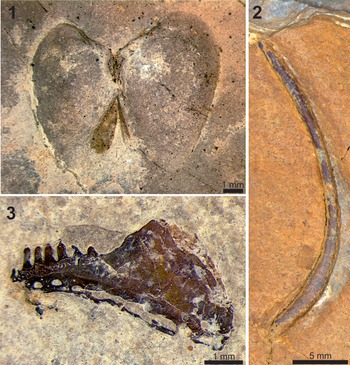
More than 90% of the body fossils recovered during the last field campaigns (see Materials and methods for further details) belong to vertebrates, and only about 10 invertebrate specimens are referred to the bivalve Pseudocorbula gregaria (Münster in Goldfuss, Reference Goldfuss1838) (Fig. 10.1); among the vertebrate fossils, almost 60% belong to Peltopleurus, around 15% belong to indeterminate actinopterygians (Fig. 10.3), and 20 specimens are referred to Saurichthys (representing almost 10% of the total samples, representing mostly lower jaws and, to a lesser extent, cranial bones). Around 20 specimens (representing almost 10% of the total samples) have been tentatively referred to an undetermined halecomorph actinopterygian; a few additional poorly preserved colobodontid remains have also been discovered. In addition, there are 10 ribs and teeth tentatively referred to sauropterygian reptiles (Fig. 10.2).
Additional faunas recovered from the studied section. (1) Pseudocorbula gregaria (IPS86018). (2) Sauropterygian rib (IPS 86018). (3) Small robust dentary from an unidentified actinopterygian (IPS122539).

Facies description
Three facies associations were identified on the basis of depositional texture, skeletal and nonskeletal components, sedimentary features, and lateral relationships (Figs. 11–13). The recognition of facies heterogeneities across the studied area enabled the identification of the sedimentary environments.
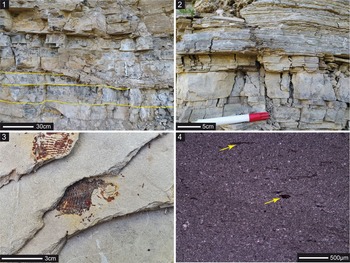
Organic-rich laminated silty mudstone (facies association 1). (1) Massive tabular beds showing channel fill with cross-bedded bundles over erosional surfaces. (2) Massive beds alternate with finely laminated, fossil-bearing mudstones (top). (3) Actinopterygian remains in the top laminae of the finely laminated facies. (4) Photomicrograph of organic-rich micritic mudstone with floral remains (arrows).

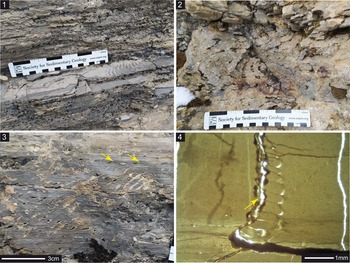
Laminated silty mudstone to wackestone (facies association 2). (1) Laminated mudstone to wackestone units showing wave ripple structures with straight, symmetrical, and parallel crests. Note silt-rich intervals in pale brown color. (2) Dewatering structures tend to form open conduits producing vertically folded structures. (3) Waterscape conduits can be at 45°–80° from ripple planes (arrows), which are partially filled by silt or cement. (4) Photomicrograph of dewatering flame structures filled by calcite cement.

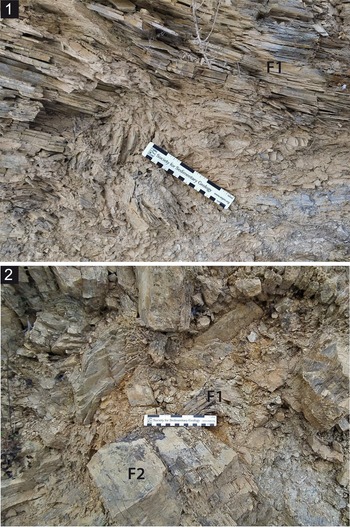
Slumped and contorted breccia deposits (facies association 3). (1) Detail of slumped organic-rich laminated facies (facies association 1, F1), (2) In some settings, slumped and collapsed beds are dominated by poorly sorted, mostly clast-supported breccia and blocks of facies association 2 (F2).

Facies association 1: Organic-rich laminated silty mudstone.—This facies consists of an up to 11.5 m thick, laterally restricted alternation of 30 to 80 cm thick dark gray to pale brown, fetid, and organic-rich finely laminated silty mudstones with up to 2 m thick massive and organic-rich mudstone (Fig. 11.1, 11.2). Most massive layers show planar to slightly undulated bottom contacts. Rare intervals exhibit channel-fill structures with fining-upward cross-bedded bundles over erosional, sharp bases (Fig. 11.1). In places, up to 10 cm thick intraclastic packstone, or up to 40 cm thick brown marly clay intervals are interbedded within the finely laminated units. Some metric-scale slumped and fractured beds are recognized in the massive intervals. The major allochems are carbonaceous intraclasts (up to 1 mm wide), plant remains (up to 1 cm wide), fish coprolites (up to 1 cm wide), fish scales, peloids, thin-shelled bivalve intraclasts, and unidentified microfossil remains (Fig. 11.3, 11.4). Trace fossils are absent, but the organic-rich mudstone component of this facies yielded a fish assemblage comprising at least four taxa (see the following), scarce tetrapod remains assigned to marine reptiles (sauropterygians), bivalves (Pseudocorbula gregaria), and brachiopods (Lingula sp.). Most actinopterygians referred to Peltopleurus were found in the laminated lower levels; the halecomorph specimens were recovered from the upper horizons. By contrast, Saurichthys specimens were regularly found throughout the entire facies (Fig. 14).
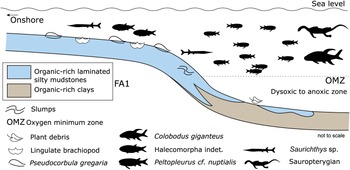
Schematic paleoenvironmental reconstruction of facies association 1 (FA1), which contains the macrofauna studied in this work.

The thin lamination, absence of bioturbation, good preservation of the actinopterygian remains (retaining organic matter and remaining articulated), and scarcity of in situ benthonic fossils suggest anoxic/dysoxic conditions.
The depositional texture and sedimentary features of facies association 1 suggest deposition below the fair-weather wave base under relatively low-energy conditions in shallow subtidal marine environments episodically sourced by silt and clay. However, the presence of Pseudocorbula gregaria might indicate the proliferation of such bivalves during periods of limited terrigenous input (García-Gil, Reference García-Gil1991). The thinly bedded organic-rich and undisturbed mudstone laminae suggest both low-energy environments and recurrent oxygen deficiency at the sea bottom leading to anoxic to suboxic conditions that probably enhanced fossil fauna preservation. The diversity of vertebrate fauna encountered in this facies association suggests enough water depth to support nektonic lifestyles. Channel-fill structures over erosional bases suggest the circulation of sporadic sea-bottom currents (Fig. 14).
Facies association 2: Laminated silty mudstone to wackestone.—Facies association 2 is made up of 8 m thick, laterally continuous (up to 400 m wide), thinly bedded alternation of centimeter-thick silty pale gray mudstone to wackestone with millimeter-thick dark brown-gray silt to clay laminae (Fig. 12). The tops of the limestone-rich intervals exhibit persistent wave ripple structures with straight, symmetrical, and parallel crests (Fig. 12.1). Ripple marks range between 0.5 and 1 cm long and normally are 0.5 cm high. Interripple depressions are silt-rich, and in many cases dewatering structures occur (Fig. 12.2–12.4). Flame structures tend to leave open porosity conduits at 45° to 80° from ripple planes; conduits are partially filled by silt or cement (Fig. 12.3, 12.4). Convolute lamination is observed as slightly folded and unbroken layers (up to 15 cm high) with arcuate crests (Fig 12.2) laterally extending over 20 to 100 cm in outcrop. The siliciclastic proportion of this facies is slightly increased toward the eastern section of the outcrops where dewatering structures are growingly less evident.
The depositional texture and lateral stratigraphic distribution of this unit suggest sedimentation in shallow subtidal to intertidal mud flats with variable contributions of silt and clay in a coastal environment. The low frequency of the ripple bedforms and their elongated, parallel crests suggest low to moderate hydraulic conditions in wave-influenced settings.
Facies association 3: Slumped and collapsed breccia deposits.—This facies association consists of a between 2 and 8 m thick laterally restricted unit of slumped and contorted beds dominated by poorly sorted, mainly clast-supported breccia and blocks (5 to 60 cm in diameter) (Fig. 13). This unit is pinching out toward the eastern part of the outcrop. Most of the blocks are made up of subconsolidated silty mudstone to wackestone (facies association 2) and, to a lesser extent, of reworked organic-rich laminated silty mudstone (facies association 1) (Fig. 13.1, 13.2). The former is more abundant toward the western area of the outcrop.
According to the depositional texture and the stratigraphic relationships, this facies is interpreted as a restricted gravitational collapse formed by remobilization of the shallower facies association 2 on top of the deeper facies association 1. The lateral thickness variations of facies association 3 suggest rising water depths westward with an increase in deposition of reworked and contorted laminated silty mudstones toward such direction. Gravity-flow deposition could be triggered by storm events or syntectonic activity as identified in adjacent coeval Middle Triassic areas of the Catalan Basin (Mercedes-Martín and Buatois, Reference Mercedes-Martín and Buatois2021).
Discussion
Faunal assemblage is discussed for the Odèn site, deepening the comparison with potential coeval nearby sites. This is followed by chronostratigraphical implications as well as paleoenvironmental and paleogeographic implications.
Faunal assemblage
The macrofaunal assemblage recovered at the Odèn site includes two invertebrate taxa: a lingulate brachiopod and the bivalve Pseudocorbula gregaria. Aside from being less diverse, invertebrates are in appearance volumetrically less abundant than the fish assemblage present. In this assemblage, the genus Peltopleurus is highly dominant. Less common taxa are represented by the colobodontid Colobodus giganteus, the long-snouted Saurichthys, and an indeterminate halecomorph. Specimens of Saurichthys can be identified only at the genus level, in agreement with previous reports by Lehman (Reference Lehman1964), Cartanyà et al. (Reference Cartanyà, Fortuny, Sellés, Bolet, Petruzzelli, Solà, Sagarra and Galobart2011), and Fortuny et al. (Reference Fortuny, Bolet, Sellés, Cartanyà and Galobart2011).
The Odèn fish assemblage is comparable to that found at the coeval locality of Vilanova de la Sal (Fig. 1). This site is particularly known for the presence of a semiarticulated specimen of a pachypleurosaur sauropterygian (Fortuny et al., Reference Fortuny, Bolet, Sellés, Cartanyà and Galobart2011), as well as some fragmentary actinopterygian fossils, including Peltopleurus and Saurichthys, that have never been described in detail. Furthermore, the site yielded specimens tentatively attributed to the genus Eosemionotus (Fortuny et al., Reference Fortuny, Bolet, Sellés, Cartanyà and Galobart2011), a taxon unknown so far from the Odèn site. Colobodus, halecomorphs, and invertebrates are apparently absent in the Vilanova de la Sal outcrops; however, the site has been less extensively sampled. Additional taxonomic and sedimentological work as well as a more extensive sampling at the Vilanova de la Sal site and coeval locations in the neighboring subbasins are required to better reconstruct the Pyrenean paleoecosystems during the Middle–Late Triassic transition.
Although the fossil-bearing sites at Mora d'Ebre-Camposines and Mont-ral–Alcover are roughly coeval with the Pyrenean Odèn site (all of them are situated in Upper Muschelkalk facies), they are characterized by different faunal assemblages. For example, the Mora d'Ebre-Camposines site displays an important assemblage of invertebrates, particularly ammonoids (including Protachyceras hispanicum [Mojsisovics, Reference Mojsisovics1882], Eoprotrachyceras vilanovai [D'Archiac, Reference D'Archiac1860], Anolcites sp., and Iberites pradoi [Mojsisovics, Reference Mojsisovics1882]), thylacocephalans, and bivalves (dominated by Daonella) (Cartanyà et al., Reference Cartanyà, Fortuny, Bolet and Garcia-Artigas2019), none of which have been recovered at Odèn. This is consistent with the geological context of the Odèn site, located adjacent to more-restricted coastal mud flats compared with Mora d'Ebre-Camposines, which was likely situated in a more open marine setting. In addition, the Ladinian vertebrate fauna in Mora d'Ebre-Camposines is dominated by the perleidid actinopterygian Moradebrichthys vilasecae Cartanyà et al., Reference Cartanyà, Fortuny, Bolet and Garcia-Artigas2019, although Saurichthys is also present. Overall, the faunas and environments at Mora d'Ebre-Camposines and Odèn are clearly different and might correspond to slightly different ages, with the Odèn outcrops potentially slightly younger.
Mont-ral–Alcover record a greater number of invertebrate and vertebrate specimens. Nektonic and planktonic organisms are dominated by actinopterygians, sauropterygian reptiles, cephalopods, and swimming decapods, among others. Benthic forms such as reptant decapods, crinoids, limulids, holothurids, and brachiopods are present but not dominant (Via-Boada et al., Reference Via-Boada, Villalta and Esteban-Cerdá1977). Up to 13 families of actinopterygians are recorded in the Mont-ral–Alcover outcrops. Of particular interest, saurichthyids are abundant, including Saurichthys. However, Peltopleurus, Eosemionotus, Perleidus, and Colobodus are also present (Cartanyà, Reference Cartanyà, Arratia and Schultze1999).
Differences in faunal diversity between the Mont-ral–Alcover and Odèn sites are striking even though some taxa (e.g., Peltopleurus, Saurichthys, Colobodus, and marine reptiles) can be found in both assemblages. We acknowledge that taphonomic and sampling bias possibly exists, and future surveys will help to get a clearer picture of the faunal composition in these settings. Although the Catalan Coastal Ranges subbasin (Mont-ral–Alcover sites) and the Pyrenean subbasin (Odèn site) recorded peritidal to subtidal marine deposition during the Middle Triassic times, more work is required to further reconstruct the paleogeography and the degree of connectivity between both subbasins during the Ladinian–Carnian.
Chronostratigraphical implications
The age of the Odèn fossiliferous levels is difficult to constrain but potentially ranges from the ?late Ladinian to the early–middle Carnian. The possible oldest age (?late Ladinian) can be assumed on the basis of the presence of the actinopterygian genus Peltopleurus, which is also recovered from the late Ladinian of Mont-ral–Alcover (Cartanyà, Reference Cartanyà, Arratia and Schultze1999). Indeed, lateral equivalent carbonate units have a late Ladinian–early Carnian age according to palynomorph associations (see García-Ávila et al., Reference García-Ávila, Mercedes-Martín, Juncal and Diez2020). Nonetheless, it should be noted that Peltopleurus is also known from even older stratigraphic intervals (Anisian and Ladinian) at Monte San Giorgio (Lombardo, Reference Lombardo1999; Furrer et al., Reference Furrer, Schaltegger, Ovtcharova and Meister2008). Thus, a greater age cannot be completely ruled only on the basis of the presence of the actinopterygian Peltopleurus.
On the other hand, the palynological assemblage identified in the laminated limestone and/or dolomites unit in Odèn has been dated to the middle Carnian (Calvet et al., Reference Calvet, Solé de Porta and Salvany1993).
Paleonvironmental and paleogeographic implications
The Upper Muschelkalk carbonate sedimentation in the Triassic Catalan Basin (NW Spain) probably took place in extensive fault-block marine carbonate ramp settings during periods of rapid syn-rift subsidence (Calvet and Tucker, Reference Calvet and Tucker1988; Mercedes-Martín et al., Reference Mercedes-Martín, Arenas and Salas2014b). However, the sedimentological and paleogeographical setting of the co-eval deposits in the South Pyrenean basin (NE Spain) is less well resolved (Calvet et al., Reference Calvet, Solé de Porta and Salvany1993).
This work refines the sedimentary and paleoenvironmental context of the Upper Muschelkalk to Keuper facies transition outcropping at Odèn (Fig. 14). The study of lateral and vertical facies relationships has permitted the recognition of two types of sedimentary environments, from laterally extensive shallow subtidal–intertidal coastal mud flats to more-restricted and deeper subtidal settings. The occurrence of gravity-flow deposits (facies association 2) and syn-sedimentary slumped and contorted beds in facies association 1 suggest active fault-block instability likely involved in facies differentiation. The slightly steep paleoslope toward the west is thought to segregate the shallower coastal silty mud flat areas and the deeper subtidal and low-energy settings, where abundant vertebrate faunas proliferated. Rapid lateral facies shift suggests a strong degree of basin compartmentalization in the Pyrenean sector compared with the time-equivalent facies in settings of the Coastal Catalan Ranges (e.g., Gaia or Priorat domain, Mercedes-Martín et al., Reference Mercedes-Martín, Arenas and Salas2014b). In the former settings, sedimentary architectures of kilometer scale have been recognized with more-gradual facies lateral changes. Despite such differences, the tectonic compartmentalization of these marine basins is thought to have favored the preferred development of taphonomic traps in subtidal settings where enhanced faunal preservation occurred.
The predominance of silty and clay-rich carbonate facies in the Odèn outcrops contrasts with the conspicuous absence of terrigenous sediment portions in the Triassic Coastal Catalan Ranges. This suggests that the region of Odèn represents a land-attached setting where shallow subtidal–intertidal carbonate coastal deposition was influenced by silt/ clay sources, while in the Coastal Catalan Ranges, more open marine conditions prevailed.
Conclusions
Recent paleontological surveys in the Upper Muschelkalk to Keuper deposits at Odèn (Pyrenean basin) have provided new faunal data suggesting that this location can hold the key to better clarify the poorly known local ecosystem composition and shed light on the diversification among peltopleuriform actinopterygians during the Middle Triassic.
To date, the faunal assemblage includes, at least, four actinopterygian taxa: Peltopleurus cf. P. nuptialis; Saurichthys sp.; Colobodus giganteus, and an indeterminate halecomorph. A few disarticulated remains document the presence of sauropterygian reptiles (Fig. 14).
The age range of the organic-rich laminated silty mudstone fossil-bearing units is considered to be ?late Ladinian–middle Carnian according to palynomorph associations (Calvet et al., Reference Calvet, Solé de Porta and Salvany1993). The depositional environments where the faunas existed suggest sedimentation in shallow subtidal, low-energy coastal settings, below the fair-weather wave base and sourced by sporadic silt/clay. Deposition in organic-rich laminated silty mudstone intervals might have led to preservation of the vertebrate remains under anoxic conditions. The tectonically driven compartmentalization of these marine basins played a key role favoring subtidal settings as taphonomic traps for enhanced faunal preservation in the studied site and likely in other locations of the Tethys domain. Although the Catalan Coastal Ranges subbasin (Mont-ral–Alcover sites) and the Pyrenean subbasin (Odèn site) were dominated by peritidal to subtidal sedimentation during Middle Triassic times, more work is warranted to further reconstruct the paleogeography and the degree of connectivity between these subbasins and the Tethys sea during the Ladinian–Carnian interval.
Acknowledgments
Special thanks to E. Solà, A. Sagarra, A.G. Sellès, M. Petruzzelli, E. Mujal, M. Vilalta, A. Lecuona, M. Fernàndez-Coll, B. Vila, À. Galobart, and J. Marmi for fieldwork support. J. Gallemí and S. Calzada (Barcelona, Catalonia) are acknowledged for their contribution of relevant information about the site. I. Casanovas-Vilar (ICP) is acknowledged for imaging support. We acknowledge the logistic support of the Odèn town council and Centre de Natura d'Odèn. J.F. is a member of the consolidated research group (GRC) 2017 SGR 86. A.B. is supported by a Juan de la Cierva Incorporación Fellowship (IJC2018-037685-I, funded by Ministerio de Ciencia e Innovación of the Spanish Government). We acknowledge support from the CERCA program (ICP) from the Generalitat de Catalunya and the projects Vertebrats del Permià i el Triàsic de Catalunya i el seu context geologic (Ref 2010/70085), Evolució dels ecosistemes amb faunes de vertebrats del Permià i el Triàsic de Catalunya (ref. 2014/100606), and Evolució dels ecosistemes durant la transició Paleozoic–Mesozoic a Catalunya (ref. CLT009/18/00066), based at the ICP and financially supported by the Departament de Cultura (Generalitat de Catalunya). R.M.-M. acknowledges the Linnean Society of London for supporting this work through a Percy Sladen Memorial Fund Grant. An anonymous reviewer and the editor (H.-D. Sues) provided helpful comments and suggestions that greatly improved a previous version of the manuscript.