1 Introduction and main results
Understanding the relationship between the dynamics of homeomorphisms of closed oriented surfaces in the identity isotopy class and their (homological) rotation sets has been a very active field of research. Several results concerning these relations have been proved, probably starting with [Reference Franks14, Reference Llibre and Mackay20, Reference Misiurewicz and Ziemian23].
The aim of the present paper is to study this problem in the torus, mostly for another homotopy class, the so called Dehn twists. In this case, the rotation set is only one-dimensional (see [Reference Doeff12]) and, similarly to the identity class, it is convex. So, the only possibilities are a point or a non-degenerate closed interval. We will deal mostly with the second possibility. In the majority of our results, we assume an additional dynamical property, the twist condition. This means that if we consider a lift of the torus map to the plane, then the image of any vertical line projects injectively onto the horizontal coordinate.
This class of mappings has very rich dynamics, as it contains the well-known standard mapping,
 $S_M:\mathrm {T^2\rightarrow T^2,}$
which writes in flat coordinates as
 $$ \begin{align}S_M: \begin{cases} x^{\prime }=x+y+\dfrac k{2\pi }\sin (2\pi x) \text{ mod 1}, \\ y^{\prime }=y+\dfrac k{2\pi }\sin (2\pi x )\text{ mod 1}. \end{cases} \end{align} $$
More precisely, our aim is to study the following problems:
-
• for a
 $C^r$
-generic (for any
$r\geq 1$
) twist diffeomorphism of
$\mathrm { T^2,}$
what can we say about its rotation set? Is it locally constant (does mode-locking happen [Reference Addas-Zanata and Le Calvez9])? We also consider the same questions in the area-preserving world;
-
• find some property that, when satisfied, implies that a general twist diffeomorphism of T
$^2$
has a locally constant rotation set and, when it is not satisfied, show that the rotation set can be changed by arbitrarily small perturbations, in any differentiability.


Using the results obtained related to the above questions, we further study some dynamical consequences of locally constant extremes for the rotation set, in
 $C^r$
-genericity. We also present some consequences of the non-existence of periodic open disks, that is, of transitivity.
2 Notation and definitions
(1) Let
 $(x,y)$
denote coordinates in the flat torus

 $(\widehat {x}, \widehat {y})$
in the annulus
 and let
 $( \widetilde {x},\widetilde {y})$
denote coordinates in
 Let
 $p_1,p_2$
from
 $\mathrm {T^2}$
or
 or
 to
 be the standard projections, respectively in the horizontal and vertical coordinates, and let

 ,

 $\mathrm {T^2}$
and
 be the covering mappings.
(2) Define 
 $\widetilde {f}$
is a
 $C^r$
-diffeomorphism of the plane (
 $r\geq 0$
) such that for any pair of integers
 $ n,m$
,
 $\widetilde {f}(\widetilde {x}+n,\widetilde {y}+m)=\widetilde {f}( \widetilde {x},\widetilde {y})+(n+km,m)$
for all
 where k is an integer
 $\}$
.
(3) Similarly, let 
 $\widehat {f}$
is a
 $C^r$
-diffeomorphism (
 $r\geq 0$
) lifted by some element
 , and
 $\mathrm {Diff_k^r(T^2)=}$
 $\mathrm {\{\mathit {f}:T^2\rightarrow T^2:}$
f is a
 $C^r$
-diffeomorphism (
 $r\geq 0 $
) lifted by some element
 The union of
 $\mathrm {Diff_k^r(T^2)}$
for all
 $k\neq 0$
consists of the subset of torus
 $C^r$
-diffeomorphisms homotopic to Dehn twists, and
 $\mathrm {Diff_0^r(T^2)}$
is the set of torus
 $C^r$
-diffeomorphisms homotopic to the identity.
(4) For any 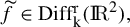
 $r\geq 1$
and
 $k\neq 0,$
if
 $k\times \partial _{\widetilde {y}}$
 $(p_1\circ \widetilde {f} (\widetilde {x},\widetilde {y}))>0$
everywhere, then we say that
 $\widetilde {f} $
is the lift of a torus (or annulus) twist map. Twist is to the right if
 $ k>0$
and to the left if
 $k<0.$
When
 $k\neq 0$
and only twist maps are considered in the previous subsets of diffeomorphisms, we add the letter

 and
 $\mathrm {Diff_{t,k}^r(T^2).}$
(5) For any 
 $ k\neq 0,$
and
 $z\in \mathrm {T^2,}$
we define the vertical rotation number of
 $ z$
as (when the limit exists)
 $$ \begin{align} \rho _V(z) = {\mathrel{\mathop{\lim}\limits_{n\rightarrow \infty}}} \frac{%p_2\circ \widehat{f}^n(\widehat{z})-p_2(\widehat{z})}n\quad\text{for any }\widehat{z}\in \tau^{-1}(z) \end{align} $$
and the vertical rotation interval of
 $\widehat {f}$
is given by

which is a closed interval, possibly a point. Initially, in [Reference Addas-Zanata4, Reference Doeff12], it was proved that all rational points
 $p/q$
in the interior of
 $\rho _V(\widehat {f})$
are realized by q-periodic orbits in the torus, similarly to the identity isotopy class. Moreover, in [Reference Doeff and Misiurewicz11], the function
 was shown to vary continuously (see also [Reference Addas-Zanata2]).
(6) For any integer k and  we say that
 $\widehat {f}$
satisfies the curve intersection property (C.I.P.) if
 $\widehat {f}(\gamma )\cap \gamma \neq \emptyset $
for all homotopically non-trivial simple closed curves

(7) Let
 $f:X\rightarrow X$
be a map from a metric space
 $(X,d)$
,
 $n>0$
be an integer, and
 $\varepsilon>0$
a fixed real number. A sequence
 $\{x_0,x_1,\ldots ,x_n\}\subset X$
is an
 $\varepsilon $
-pseudo orbit if
 $d(f(x_i),x_{i+1})<\varepsilon $
for all
 $i=0,1,\ldots ,n-1.$
(8) We say that D, an open subset of
 $\mathrm {T^2}$
, is essential if D contains an homotopically non-trivial simple closed curve in the torus. We say that D is fully essential if it contains two homotopically non-trivial simple closed curves which are not in the same homotopy class. In this case, D contains closed curves in all homotopy classes and
 $D^c$
is contained in a disjoint union of open disks. Moreover, we say that D is inessential if it is not essential.
(9) Given a closed subset K of
 $\mathrm {T^2}$
,
 $\mathrm {Filled}(K)$
is given by the union of K with all the connected components of its complement which are inessential.
Now we are ready to state our main results. The first one explains when the vertical rotation interval can or cannot change under perturbations.
Theorem 2.1. Let
 $k\neq 0$
and
 $r\geq 1$
be integers and
 The following assertions are equivalent:
-
•
has a local maximum at
$\widehat {f};$
-
•
$\rho _V^{+}(\widehat {f})$
is equal to some rational number
$p/q$
and
$\widehat {f} ^q(\bullet )-(0,p)$
is an annulus diffeomorphism which maps a homotopically non-trivial simple closed curve
$\gamma $
into
$\gamma ^{-},$
the connected component of
$\gamma ^c$
which is below
$\gamma $
.
 has a local maximum at


So, if  has a local maximum at
 $\widehat {f},$
it also has a local maximum at
 $\widehat {f}$
in

Corollary 2.2. Let
 $k\neq 0$
and
 $r\geq 1$
be integers, and
 If
 $\rho _V^{-}(\widehat {f})<\rho _V^{+}(\widehat {f})=p/q,$
then the following equivalences hold:
-
•
$\rho _V^{+}$
does not have a local maximum at
$\widehat {f};$
-
•
$\widehat {f}^q(\bullet )-(0,p)$
satisfies the curve intersection property (C.I.P.); -
•
$\rho _V^{+}(\widehat {f}+(0,t))>p/q$
for all
$t>0.$


Moreover, when C.I.P. holds, then
 $\widehat {f}^q(\bullet )-(0,p)$
has periodic orbits of all rational rotation numbers in the annulus.
Of course, analogous versions related to
 $\rho _V^{-}(\widehat {f})$
also hold.
The next lemma is an important tool in the proof of the above results. It is contained in [Reference Addas-Zanata3, Corollary 3] and [Reference Addas-Zanata2, Lemma 2 and Theorem 10]. The ideas behind its proof rely on the topological theory for twist maps developed by Le Calvez in [Reference Le Calvez19].
Lemma 2.3. Let
 $k\neq 0$
and
 $r\geq 1$
be integers, and
 The function
 $s \mapsto \rho _V^{+}(\widehat {f}+(0,s ))$
is continuous and non-decreasing. Moreover, if there exist maps
 arbitrarily
 $C^0$
-close to
 $ \widehat {f}$
such that
 $\rho _V^{+}(\widehat {h})>\rho _V^{+}(\widehat {f}),$
then for all
 $s>0$
,
 $\rho _V^{+}(\widehat {f}+(0,s))>\rho _V^{+}( \widehat {f}).$
Analogously, if there exist maps
 arbitrarily
 $C^0$
-close to
 $ \widehat {f}$
such that
 $\rho _V^{+}(\widehat {h})<\rho _V^{+}(\widehat {f}),$
then for all
 $s<0$
,
 $\rho _V^{+}(\widehat {f}+(0,s))<\rho _V^{+}( \widehat {f}).$
Remark 2.4. As above, an analogous statement holds for
 $\rho _V^{-}.$
In other words, given a twist diffeomorphism of the torus, for which one extreme of the vertical rotation interval is not locally constant, then it varies under arbitrarily small vertical translations of the diffeomorphism. Or equivalently, if
 $s\mapsto \rho _V^{+(-)}(\widehat {f}+(0,s))$
is locally constant in a neighborhood of zero, then
 $\rho _V^{+(-)}$
is locally constant in a
 $C^1$
-neighborhood of
 $\widehat {f},$
which implies by Theorem 2.1 that
 $\rho _V^{+(-)}(\widehat {f})$
is some rational number
 $p/q$
and the annulus diffeomorphism
 $\widehat {f}^q(\bullet )-(0,p)$
has a homotopically non-trivial free simple curve
 $\gamma ,$
that is, the image of
 $\gamma $
under
 $\widehat {f}^q(\bullet )-(0,p)$
is disjoint from
 $\gamma .$
Corollary 2.2 also says that, whenever for a one-parameter family of twist maps of the torus,
 $(f_t)_{t\in I},$
with
 $\rho _V^{-}( \widehat {f}_t)<\rho _V^{+}(\widehat {f}_t)$
for all
 $t\in I,$
if
 $\rho _V^{+}(\widehat {f}_{t^{*}})$
is a rational number
 $p/q$
and for all
 $t>t^{*},$
sufficiently close to
 $t^{*}$
,
 $\rho _V^{+}(\widehat {f}_t)>\rho _V^{+}(\widehat {f}_{t^{*}}),$
then
 $(\widehat {f}_{t^{*}})^q(\bullet )-(0,p) $
satisfies the C.I.P.
Then next two theorems describe vertical rotation intervals for
 $C^r$
-generic twist maps of the torus.
Theorem 2.5. Let
 $k\neq 0$
and
 $r\geq 1$
be integers. The set
 of maps
 , such that
 $\rho _V$
is constant in a neighborhood of
 $\widehat {f}$
, is open and dense. Furthermore, the endpoints of
 $\rho _V(\widehat {f})$
are rational and
 $\rho _V$
is constant in a neighborhood of

In other words, for twist maps,
 $C^r$
-generically, for any
 $r\geq 1,$
the vertical rotation interval is locally constant and its extremes are rational numbers. There is also an area-preserving version of the above theorem. Note that
 area- preserving elements of
 .
Theorem 2.6. Let
 $k\neq 0$
and
 $r\geq 1$
be integers. The set
 of maps
 , such that
 $\rho _V$
is constant in a neighborhood of
 $\widehat {f},$
is open and dense. Furthermore, the endpoints of
 $\rho _V(\widehat {f})$
are different rational numbers and
 $\rho _V$
is constant in a neighborhood of

The only difference between the general setting and the area-preserving is that in the last one,
 $C^r$
-generically, vertical rotation intervals have interior.
Theorems 2.1, 2.5, and 2.6 are the foundation on which our next results rely: a description of the attractor–repeller pair in the annulus that always exists in the
 $C^r$
-generic case.
Let
 $k\neq 0$
and
 $r\geq 1$
be integers and
 , or in the area-preserving case,
 the open and dense sets from Theorems 2.5 and 2.6 intersected with the residual sets
 $\chi ^r(\mathrm {T^2})$
and
 $\chi _{\mathrm {Leb}}^r(\mathrm {T^2})$
(from Theorem 3.14), which are contained in general Kupka–Smale, or in area-preserving Kupka–Smale
 $C^r$
-diffeomorphisms, respectively, for which closures of stable and unstable branches of hyperbolic periodic saddles and homoclinic and heteroclinic intersections vary continuously with perturbations of the diffeomorphisms. See [Reference Pixton24, pp. 370–372] for more information.
So,
 $\rho _V(\widehat {f})=[r/s,p/q]$
for rational numbers
 $ r/s\leq p/q$
and
 $\rho _V$
is locally constant in a neighborhood of
 $ \widehat {f}.$
From now on, we assume that
 $r/s<p/q$
(this is always the case for area-preserving generic twist diffeomorphisms).
Theorem 2.1 says that
 $\widehat {f}^q(\bullet )-(0,p)$
has a free homotopically non-trivial simple closed curve
 , such that
 $$ \begin{align*}\widehat{f}^q(\gamma _{p/q})-(0,p)\subset \gamma _{p/q}^{-}. \end{align*} $$
Something which implies the existence of an attractor–repeller pair for
 $ \widehat {f}^q(\bullet )-(0,p).$
The attractor
 $A_{p/q}$
is contained in
 $ \gamma _{p/q}^{-}$
and the repeller
 $R_{p/q}$
is contained in
 $\gamma _{p/q}^{+}.$
In the next result, we describe this pair (
 $f\in \mathrm { Diff_{t,k}^r(T^2)}$
is the torus map lifted by
 $\widehat {f}$
).
Theorem 2.7. Under the previous hypotheses, there exists a hyperbolic f-periodic saddle
 $z_{p/q}\in \mathrm {T^2}$
of vertical rotation number
 $p/q$
such that if
 is any lift of
 $z_{p/q}$
to the annulus, then
 $W^u(\widehat {z}_{p/q})$
is bounded from above as a subset of the annulus and unbounded from below,
 $W^s( \widehat {z}_{p/q})$
is unbounded from above and bounded from below. Moreover,
 $W^u(\widehat {z}_{p/q})$
has a transversal intersection with
 $W^s( \widehat {z}_{p/q}-(0,1)),$
and if
 $\widehat {z}_{p/q}$
and
 $\widehat {z} _{p/q}-(0,1)$
are both above
 $\gamma _{p/q},$
and
 $\widehat {z}_{p/q}-(0,2)$
is below, then
 $A_{p/q}$
is contained in
 $\overline {W^u(\widehat {z}_{p/q})}$
 $\cup (\overline {W^u(\widehat {z}_{p/q})}^{b.\mathrm{above}}),$
where the last set is the union of all (open) connected components of
 $(\overline {W^u(\widehat {z} _{p/q})})^c$
that are bounded from above. Moreover,
 $A_{p/q}\supseteq [ \overline {W^u(\widehat {z}_{p/q})}\cup (\overline {W^u(\widehat {z} _{p/q})}^{b.\mathrm{above}})] -(0,2).$
Similarly, if
 $\widehat {z}_{p/q}$
and
 $ \widehat {z}_{p/q}+(0,1)$
are both below
 $\gamma _{p/q},$
and
 $\widehat {z} _{p/q}+(0,2)$
is above, then
 $R_{p/q}$
is contained in
 $\overline {W^s( \widehat {z}_{p/q})}$
 $\cup (\overline {W^s(\widehat {z}_{p/q})}^{b.\mathrm{below}}),$
where the last set is the union of all connected components of
 $(\overline { W^s(\widehat {z}_{p/q})})^c$
that are bounded from below, and
 $ R_{p/q}\supseteq [ \overline {W^s(\widehat {z}_{p/q})}\cup (\overline { W^s( \widehat {z}_{p/q})}^{b.\mathrm{below}})] +(0,2)$
.
Our main interest in the previous result is to apply it in the case where
 $f:\mathrm { T^2\rightarrow T^2}$
is transitive. Ideally, we would like to understand if such a
 $C^r$
-generic twist diffeomorphism (for any
 $r\geq 1$
), mostly in the area-preserving case, could be transitive. Our hope is that for large
 $r,$
it cannot. This final result can be seen as an attempt to start a list of consequences of generic transitivity that, ultimately, would lead to a contradiction.
Corollary 2.8. Still under the previous theorem’s hypotheses, if we assume f to be transitive, then the following improvement holds:
-
• if
$\widehat {z}_{p/q}$
and
$\widehat {z}_{p/q}-(0,1)$
are both above
$ \gamma _{p/q},$
and
$\widehat {z}_{p/q}-(0,2)$
is below, then
$A_{p/q}$
is contained in
$\overline {W^u(\widehat {z}_{p/q})}$
and contains
$\overline { W^u( \widehat {z}_{p/q})}-(0,2);$
-
• similarly, if
$\widehat {z}_{p/q}$
and
$\widehat {z}_{p/q}+(0,1)$
are both below
$\gamma _{p/q},$
and
$\widehat {z}_{p/q}+(0,2)$
is above, then
$ R_{p/q}$
is contained in
$\overline {W^s(\widehat {z}_{p/q})}$
and contains
$ \overline {W^s(\widehat {z}_{p/q})}+(0,2).$


Moreover, both
 $\overline {W^u(\widehat {z}_{p/q})}$
and
 $\overline {W^s( \widehat {z}_{p/q})}$
have no interior points, and their complements are connected, although
 $\overline {W^u(z_{p/q})}=\overline {W^s(z_{p/q})}=\mathrm {T^2}$
.
3 Basic tools
3.1 Some results for twist maps
3.1.1 Le Calvez’s topological theory
The results below can be found in [Reference Le Calvez17, Reference Le Calvez18]. Let
 $k\neq 0$
be an integer,
 and
 be one of its lifts. For every pair of integers
 $(s,q)$
,
 $q>0,$
we define the following sets:

Then, we have the following lemma.
Lemma 3.1. The set
 $K(s,q)$
is compact and it has a unique connected component
 $ C(s,q)$
that separates the ends of the annulus.
Next, we define the following functions on
 $\mathrm {T^1}$
:
 $$ \begin{align*}\begin{array}{c} \mu ^{-}( \widehat{x})=\min \{p_2(\widehat{z})\text{: }\widehat{z}\in K(s,q)\text{ and }p_1(\widehat{z})=\widehat{x}\}, \\ \mu ^{+}(\widehat{x})=\max \{p_2(\widehat{ z})\text{: }\widehat{z}\in K(s,q)\text{ and }p_1(\widehat{z})=\widehat{x}\}. \end{array} \end{align*} $$
Additionally, similar functions for
 $\widehat {f}^q(K(s,q))$
:
 $$ \begin{align*}\begin{array}{c} \nu ^{-}( \widehat{x})=\min \{p_2(\widehat{z})\text{: }\widehat{z}\in \widehat{f} ^q\circ K(s,q)\text{ and }p_1(\widehat{z})=\widehat{x}\}, \\ \nu ^{+}( \widehat{x})=\max \{p_2(\widehat{z})\text{: }\widehat{z}\in \widehat{f} ^q\circ K(s,q)\text{ and }p_1(\widehat{z})=\widehat{x}\}. \end{array} \end{align*} $$
The following lemmas are very important in this theory.
Lemma 3.2. Defining
 $\mathrm {Graph}$
{
 $\mu ^{\pm }$
}={
 $(\widehat {x},\mu ^{\pm }(\widehat {x})):\widehat {x}\in \mathrm {T^1}$
}, we have
 $$ \begin{align*}\mathrm{Graph}\{\mu ^{-}\}\cup \mathrm{Graph}\{\mu ^{+}\}\subset C(s,q). \end{align*} $$
Lemma 3.3. The following equalities hold for all
 $\widehat {x}\in S^1:$
 $\widehat {f}^q(\widehat {x},\mu ^{-}(\widehat {x}))=(\widehat {x} ,\nu ^{+}(\widehat {x}))$
and
 $\widehat {f}^q(\widehat {x},\mu ^{+}(\widehat {x} ))=(\widehat {x},\nu ^{-}(\widehat {x})).$
Now, we recall ideas and results from [Reference Le Calvez19]. Fix some  and let
 $\widehat {f}$
be the annulus map lifted by
 $\widetilde {f}$
.
Given a triplet of integers
 $(s,p,q)$
with
 $q>0,$
if there is no point
 such that
 $\widetilde {f}^q(\widetilde {x},\widetilde {y})=( \widetilde {x}+s,\widetilde {y}+p),$
it can be proved that the sets
 $\widehat {f }^q\circ K(s,q)$
and
 ${K(s,q)+(0,p)}$
can be separated by the graph of a continuous function
 , essentially because from all the previous results, either one of the following inequalities must hold:
 $$ \begin{align} \nu ^{-}(\widehat{x})-\mu ^{+}(\widehat{x})>p, \end{align} $$
 $$ \begin{align} \nu ^{+}(\widehat{x})-\mu ^{-}(\widehat{x})<p \end{align} $$
for all
 $\widehat {x}\in \mathrm {T^1},$
where
 $\nu ^{+},\nu ^{-},\mu ^{+},\mu ^{-}$
were defined above.
Following Le Calvez [Reference Le Calvez19], we say that the triplet
 $(s,p,q)$
is positive (respectively negative) for
 $\widetilde {f}$
if
 $\widehat {f}^q\circ K(s,q)$
is above, equation (3.2) (respectively below, equation (3.3)) the graph of
 $\sigma. $
Recall that
 $$ \begin{align} \widetilde{f}(\widetilde{x},\widetilde{y})=(\widetilde{x} ^{\prime },\widetilde{y}^{\prime })\Leftrightarrow \widetilde{y}=g( \widetilde{x},\widetilde{x}^{\prime })\text{ and }\widetilde{y}^{\prime }=g^{\prime }(\widetilde{x},\widetilde{x}^{\prime }), \end{align} $$
where
 $g,g^{\prime }$
are mappings from
 to
 which satisfy
 $g^{\prime }(\widetilde {x},\widetilde {x}^{\prime })=p_2\circ \widetilde {f}(\widetilde {x},g(\widetilde {x},\widetilde {x}^{\prime })).$
Before stating the next proposition, we need some extra definitions and simple facts.
If we define
 $\widetilde {h}_t(\widetilde {x},\widetilde {y})=(\widetilde {x}, \widetilde {y}+t),$
it is easy to see that for all

 $\widetilde {h}_t(\widetilde {x},\widetilde {y})$
conjugates
 $( \widetilde {x},\widetilde {y})\mapsto \widetilde {f}(\widetilde {x}, \widetilde {y}+t)+(0,t)$
with
 $\widetilde {f}_t(\widetilde {x},\widetilde {y}) \stackrel {\mathrm{def.}}{=}\widetilde {f}(\widetilde {x},\widetilde {y})+(0,2t).$
Additionally, if we denote as
 $g_t(\widetilde {x},\widetilde {x}^{\prime })$
and
 $g_t^{\prime }( \widetilde {x},\widetilde {x}^{\prime })$
the mappings associated to
 $ \widetilde {f}(\widetilde {x},\widetilde {y}+t)+(0,t)$
in the way of equation (3.4), then
 $g_t(\widetilde {x},\widetilde {x}^{\prime })=g(\widetilde {x}, \widetilde {x}^{\prime })-t$
and
 $g_t^{\prime }(\widetilde {x},\widetilde {x} ^{\prime })=g^{\prime }(\widetilde {x},\widetilde {x}^{\prime })+t.$
Definitions 3.4. For  :
-
(1) we say that
$\widetilde {f}\leq \widetilde {f}^{*}$
if
$g^{*}\leq g$
and
$g^{\prime }\leq g^{*\prime }$
everywhere, where
$(g,g^{\prime })$
is associated to
$\widetilde {f}$
and
$(g^{*},g^{*\prime })$
is associated to
$ \widetilde {f}^{*},$
as in equation (3.4). Analogously, we say
$\widetilde {f} \ll \widetilde {f}^{*}$
if
$g^{*}<g$
and
$g^{\prime }<g^{*\prime }$
everywhere; -
(2) for all
$r\geq 1,$
given a
$C^r$
one-parameter family
$(\widetilde {f} _t)_{t\in [a,b]}$
such that for each
$a{\kern-1pt}\leq{\kern-1pt} t{\kern-1pt}\leq{\kern-1pt} b$
, we say the family is strongly increasing if
$\widetilde {f}_t\ll \widetilde {f}_{t^{\prime }}$
$\Leftrightarrow $
$t<t^{\prime }.$
We also say that a
$C^r$
one-parameter family
$(\widehat {f }_t)_{t\in [a,b]},$
such that for all
$t\in [a,b]$
, is strongly increasing if it has a
$C^r$
lift
$(\widetilde {f}_t)_{t\in [a,b]}$
which is strongly increasing.


 we say the family is strongly increasing if


 for all


So, the one-parameter family
 $\widetilde {f}( \widetilde {x},\widetilde {y}+t)+(0,t)$
is strongly increasing.
The next result explains why these partial orders are important.
Proposition 3.5. If
 $(s,p,q)$
is a positive (respectively negative) triplet for
 $ \widetilde {f}$
and if
 $\widetilde {f}\leq \widetilde {f}^{*}$
(respectively
 $ \widetilde {f}\geq \widetilde {f}^{*}$
), then
 $(s,p,q)$
is a positive (respectively negative) triplet for
 $\widetilde {f}^{*}.$
3.1.2 Some properties of the extremes of
$\rho _V(\widehat {f})$

The next results appeared in [Reference Addas-Zanata3].
Theorem 3.6. Let  be such that
 $\rho _V(\widehat {f})=[\rho _V^{-},p/q], $
with
 $p/q$
a rational number. Then, there exists a compact set
 such that
 ${\widehat {f}^q(\widehat {A}){\kern-1.5pt}-{\kern-1.5pt} (0,p){\kern-1.5pt}={\kern-1.5pt}\widehat {A}.}$
Remark 3.7. The subset
 $\widehat {A}$
can be chosen as a minimal set for
 $\widehat {f}^q(\bullet )-(0,p)$
, but it is not true that
 $\widehat {f}^q(\bullet )-(0,p)$
always has periodic points. Something that always holds for rational extreme points of the rotation set in the homotopic to the identity class.
Theorem 3.8. Let  be such that
 $\rho _V(\widehat {f}){\kern-1pt}={\kern-1pt}[\rho _V^{-},p/q], $
with
 ${\rho _V^{-}{\kern-1pt}<{\kern-1pt}p/q,}$
for some rational number
 $p/q.$
Then, assuming that the torus diffeomorphism f lifted by
 $\widehat {f}$
has no periodic point of vertical rotation number
 $p/q,$
for arbitrarily small chosen values of
 $t>0$
,
 $\widehat {f}+(0,t)$
is the lift of a torus diffeomorphism with an
 $nq$
-periodic orbit (for some
 $n\geq 1$
) of vertical rotation number
 $p/q.$
Moreover, for all
 $t<0,$
the following holds:
 $\rho _V^{+}(\widehat {f}+(0,t))<p/q.$
The above theorem implies that if  is such that
 $\rho _V(\widehat {f})=[\rho _V^{-},p/q],$
and f does not have periodic points with vertical rotation number
 $p/q,$
then
 $\widehat {f}$
belongs to the boundary of
 $(\rho _V^{+})^{-1}(p/q).$
Theorem 3.9. Let  be such that
 $\rho _V(\widehat {f})=[\rho _V^{-},\omega ],$
where
 $\omega $
is irrational. Then, for any
 $t\neq 0,$
we get that
 $\rho _V^{+}(\widehat {f}+(0,t))\neq \omega .$
Remark 3.10. To prove the above theorem, for all
 $\varepsilon>0$
, we found
 such that the mappings
 $(g^{*},g^{*\prime })$
associated to
 $ \widetilde {f}^{*}$
are
 $\varepsilon $
-
 $C^0$
-close to
 $(g,g^{\prime }),$
the mappings associated to
 $\widetilde {f},$
where
 $\widetilde {f}^{*}$
and
 $ \widetilde {f}$
are nearby planar lifts respectively of
 $\widehat {f}^{*}$
and
 $\widehat {f},$
and the upper vertical rotation number has grown, that is,
 $\rho _V^{+}(\widehat {f}^{*})>\omega .$
Thus, Proposition 3.5 implies that
 $\rho _V^{+}(\widehat {f}^{**})>\rho _V^{+}(\widehat {f})=\omega $
for any
 such that
 $\widehat {f}\ll \widehat {f}^{**}.$
3.2 Prime ends compactification of open disks
In this subsection, we present an informal discussion on prime ends, a subject that only appears in the proof of Theorem 4.4.
Assume D is an open topological disk of an oriented surface whose boundary
 $\partial D$
is not reduced to a point.
In the case where
 $\partial D$
is a Jordan curve and f is an orientation-preserving homeomorphism of that surface which satisfies
 $ f(D)=D,$
it is immediate to see that
 $f:\partial D\rightarrow \partial D$
is conjugate to a homeomorphism of the circle, and so a real number
 $\rho (D)=\mathit{rotation}$
 $\mathit{number}$
 $\mathit{of}$
 $f\mid _{\partial D}$
can be associated to this map (up to adding an integer). Recall that, if
 $\rho (D)$
is rational, then there exists a periodic point in
 $\partial D$
and if it is not, then there are no such points. This is known since Poincaré. The difficulties arise when we do not assume
 $\partial D$
to be a Jordan curve.
The prime ends compactification is a way to attach to D a circle called the circle of prime ends of
 $D,$
obtaining a space
 $D\sqcup \mathrm {T^1}$
with a topology that makes it homeomorphic to the closed unit disk. If, as above, we assume the existence of an orientation-preserving homeomorphism f such that
 $f(D)=D,$
then
 $f\mid _D$
extends to
 $D\sqcup \mathrm {T^1}.$
The prime ends rotation number of f in
 $D,$
still denoted
 $\rho (D),$
is the usual rotation number (which, as before, only exists up to adding integers) of the orientation-preserving homeomorphism induced on
 $\mathrm {T^1}$
by the extension of
 $f\mid _D$
. However, things may be quite different in this setting. In full generality, it is not true that when
 $\rho (D)$
is rational, there are periodic points in
 $\partial D$
and for some examples,
 $\rho (D)$
is irrational and
 $\partial D$
is not periodic point free. Here, we refer to [Reference Koropecki, Le Calvez and Nassiri16, Reference Mather21] for definitions, as well as to some important theorems.
3.3 On the existence of saddles with a full mesh
In this subsection, we present the main result of [Reference Addas-Zanata5].
Definitions 3.11. If
 $f:\mathrm {T^2\rightarrow T^2}$
is a diffeomorphism, either homotopic to the identity or to a Dehn twist, and
 $z\in \mathrm {T^2}$
is a periodic hyperbolic saddle, we say that z has a full mesh if for any
 $ \widetilde {z}\in p^{-1}(z)$
,
 $W^u(\widetilde {z})$
has a topologically transverse intersection with
 $W^s(\widetilde {z})+(a,b)$
for all pairs of integers
 $(a,b).$
Here,
 $W^u(\widetilde {z})$
and
 $W^s(\widetilde {z})$
are the connected components of
 $p^{-1}(W^u(z))$
and
 $p^{-1}(W^s(z))$
which contain
 $\widetilde {z}.$
We also say that z has a partial mesh if
 $W^u(\widetilde {z})$
has a topologically transverse intersection with
 $W^s(\widetilde {z})+(a,b)$
for at least two integer vectors
 $(a,b)$
which are not collinear (and thus, to infinitely many non-collinear pairs).
Remark 3.12. We say that a connected set K has a topologically transverse intersection with a stable manifold of a hyperbolic periodic saddle if there exists z in this stable manifold and
 $r>0$
such that the connected component of the stable manifold intersected with
 $B_r(z)$
which contains z divides
 $B_r(z)$
into two connected components
 $B_{+}$
and
 $ B_{-},$
and
 $K\cap \overline {B_r(z)}$
has a closed connected component which intersects both
 $B_{+}$
and
 $B_{-}$
(analogously for unstable manifolds). See for instance [Reference Addas-Zanata5, Reference Addas-Zanata6].
Theorem 3.13. Let  (for some integer
 $k\neq 0)$
and suppose
 $p/q\in \mathrm { interior}(\rho _V(\widehat {f})).$
Then, the torus diffeomorphism f lifted by
 $\widehat {f}$
has a periodic point of vertical rotation number
 $ p/q$
that is a hyperbolic saddle with a full mesh. In the homotopic to the identity case, if
 and
 $(p/q,r/q)\in \mathrm {interior}(\rho (\widetilde {f})),$
then, the torus diffeomorphism f lifted by
 $\widetilde {f}$
has a hyperbolic periodic saddle point of rotation vector
 $(p/q,r/q)$
with a full mesh.
If
 $z,w\in \mathrm {T^2}$
are periodic saddles, both with full or partial meshes, then the
 $C^0$
-
 $\lambda $
lemma (see for instance [Reference Addas-Zanata and Tal10, Proposition 1]) implies that
 $\overline {W^u(z)}=\overline {W^u(w)}$
and
 $\overline { W^s(z)}=\overline {W^s(w)}.$
This happens because
 $W^u(z)\cup W^s(z)$
and
 $ W^u(w)\cup W^s(w)$
both contain closed curves in all homotopy classes. So,
 $ W^u(z)$
has topologically transverse intersections with both
 $W^s(z)$
and
 $ W^s(w),$
the same for
 $W^u(w)$
with respect to
 $W^s(z)$
and
 $W^s(w).$
3.4 On a version of Pixton’s theorem to the torus
The next result was taken from [Reference Addas-Zanata and Koropecki8] and adapted to our notation.
Theorem 3.14. For every integers k and
 $r\geq 1,$
there exist residual subsets of
 $\mathrm {Diff_k^r(T^2),}$
or in the area-preserving case, of
 $\mathrm {Diff_{k,Leb}^r(T^2),}$
denoted respectively
 $\chi ^r(\mathrm {T^2})$
and
 $ \chi _{\mathrm {Leb}}^r(\mathrm {T^2}),$
such that whether f is homotopic to the identity, or to a Dehn twist, assuming
 $f\in \chi ^r(\mathrm {T^2})$
or
 $f\in \chi _{\mathrm {Leb}}^r(\mathrm {T^2})$
and f has a saddle z with a full mesh, if Y is a stable branch of a hyperbolic periodic saddle p and X is an unstable branch of a hyperbolic periodic saddle q, such that
 $\overline {X}$
intersects
 $Y,$
then there exists an integer i such that Y intersects
 $ f^i(X)$
 $C^1$
-transversely. Moreover, if p and q are in the same orbit, then one may choose
 $i=0$
.
Remarks 3.15.
-
(1) As explained in §1 after the statement of Theorem 2.6, the subsets
$\chi ^r(\mathrm {T^2})$
and
$\chi _{\mathrm {Leb}}^r(\mathrm {T^2})$
consist of residual sets contained in general Kupka–Smale, or in area-preserving Kupka–Smale
$C^r$
-diffeomorphisms, respectively, for which closures of stable and unstable branches of hyperbolic periodic saddles and homoclinic and heteroclinic intersections vary continuously with perturbations of the diffeomorphisms. See [Reference Pixton24, pp. 370–372]. -
(2) The above theorem appears in [Reference Addas-Zanata and Koropecki8, Theorem 15]. Although an area-preserving version does not exist in that paper (because it was not needed), as is explained in Pixton’s paper [Reference Pixton24], it is easily obtainable: More precisely, [Reference Addas-Zanata and Koropecki8, Theorem 8 and Lemma 9] are statements of results from [Reference Pixton24] that are true in the area-preserving world. This is all we need to obtain area-preserving versions of all the results in [Reference Addas-Zanata and Koropecki8, §3], culminating in Theorem 3.14 above.


3.5 Generic birth and death of periodic orbits
First, we quote [Reference Addas-Zanata and Koropecki8, Theorem 20], which, as explained in that reference, is essentially due to Brunovski, plus an idea of Sotomayor.
Theorem 3.16. For any
 $r\in \{2,3,\ldots ,\infty \},$
if
 $(f_t)_{t\in I}$
is a
 $C^r$
-generic one-parameter family of diffeomorphisms of a closed Riemmanian manifold, then periodic points are born from only two different types of bifurcations: saddle-nodes and period doubling. In the case of saddle-nodes, if the parameter changes, then the saddle-node unfolds into a saddle and a sink, or source, in one direction, and the periodic point disappears in the other direction. Moreover, at each fixed parameter, only one saddle-node can exist.
The next result is an area-preserving version of the above one, originally proved by Meyer [Reference Meyer22], with the exception of the local picture in a neighborhood of the saddle-elliptic point.
Theorem 3.17. If
 $(f_t)_{t\in I}$
is a
 $C^\infty $
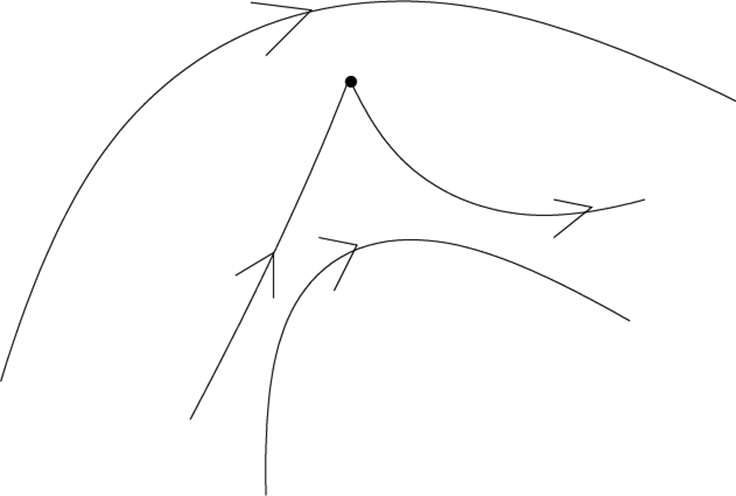
-generic one-parameter family of area-preserving diffeomorphisms of a closed oriented surface, then periodic points are born from only two different types of bifurcations: saddle-elliptic and period doubling. In the case of saddle-elliptic, if the parameter changes, then the point unfolds into a saddle and an elliptic point (one whose eigenvalues belong to the unit circle and are not real) in one direction and the periodic point disappears in the other direction. The dynamics in a neighborhood of the saddle-elliptic point is as in Figure 1.
Diagram showing the dynamics near a saddle-elliptic periodic point in the
 $C^\infty $
-generic case.

Remark 3.18. The part of the statement on the local dynamics near the saddle-elliptic bifurcations follows from two things:
-
(1) for
$C^\infty $
-generic one-parameter families of area-preserving surface diffeomorphisms, each periodic point is isolated among periodic points of the same period, and all of them satisfy a Lojaziewicz condition, (see [Reference Dumortier, Rodrigues and Roussarie13, p. 3], of the Summary); -
(2) if f is a
$C^\infty $
area-preserving surface diffeomorphism with an isolated fixed point p (isolated among the fixed point set of f), satisfying a Lojaziewicz condition, such that the topological index of f at p is zero, then both eigenvalues at p are equal to
$1$
and the local dynamics is as in Figure 1. A proof of this can be found in [Reference Addas-Zanata and Le Calvez9, §2].


4 Proofs
4.1 Proof of Theorem 2.1 and Corollary 2.2
Sketch of the proofs.
The main ideas used here are the following: either for every
 $\varepsilon>0$
,
 $ \widehat {f}^q(\bullet )-(0,p)$
has
 $\varepsilon $
-pseudo orbits that move vertically in the cylinder by arbitrarily large amounts, or not. In case for every
 $\varepsilon>0$
there are such
 $\varepsilon $
-pseudo orbits, we can find twist maps
 arbitrarily
 $C^0$
-close to
 $\widehat {f}$
such that
 $\rho _V^{+}(\widehat {h} _i)>p/q.$
This fact, together with Lemma 2.3, implies that
 $\rho _V^{+}(\widehat {f}+(0,t))>p/q$
for all
 $t>0.$
Additionally, in the case where for some
 $\varepsilon _0>0$
, there are no such
 $\varepsilon _0$
-pseudo orbits, then we use the following folklore result.
Proposition 4.1. Let  be an orientation and end-preserving homeomorphism. Assume that for some
 $a<b$
and
 $\varepsilon _0>0,$
there is no
 $\varepsilon _0$
-pseudo orbit starting at some point in
 $\mathrm { T^1\times ]{-}\infty } ,a]$
and ending at some point in
 $\mathrm {T^1\times } [b,+\infty [.$
Then, there exists a homotopically non-trivial simple closed curve
 such that
 $\widehat { h}(\gamma )\subset \gamma ^-.$
Proof. Consider the following set: 
 $\exists $
 $\varepsilon _0$
-pseudo orbit for
 $\widehat {h}$
starting at some point in
 $\mathrm {T^1\times ]{-}\infty } ,a]$
and ending at
 $\widehat {z}\}.$
The hypothesis of the proposition implies that the positively invariant, connected open set
 $U(\varepsilon _0)$
satisfies
 $ U(\varepsilon _0)\subset \mathrm {T^1\times ]{-}\infty },b[.$
Also, if
 $S>0$
is defined as
 $S=\sup _{\widehat {z}\in \mathrm {T^1\times }\{a\}\ }\mathrm {dist}(\widehat {h} ( \widehat {z}),\widehat {z}),$
then
 $U(\varepsilon _0)\supset \mathrm {T^1\times ]{-}\infty }, a-S+\varepsilon _0].$
Let us show that
 $$ \begin{align} \widehat{h}(\mathrm{closure}(U(\varepsilon _0)))\subset U(\varepsilon _0). \end{align} $$
To see that this concludes the proof, consider
 $\widehat {\Theta },$
the connected component of the complement of
 $\mathrm {closure}(U(\varepsilon _0))$
that contains
 $\mathrm {T^1\times } ]b,+\infty [.$
Clearly,
 $\widehat {\Theta } \subset \mathrm {T^1\times } ]a-S+\varepsilon _0,+\infty [$
and its (connected) boundary,
 $\partial \widehat {\Theta },$
separates the ends of the annulus and is disjoint from its image under
 $\widehat {h},$
because
 $\partial \widehat {\Theta }\subset \partial U(\varepsilon _0)$
and
 $\widehat {h}(\partial (U(\varepsilon _0)))\subset U(\varepsilon _0)$
(see equation (4.1)). So, any homotopically non-trivial simple closed curve
 $\gamma $
contained in the open annulus between
 $\partial \widehat {\Theta }$
and
 $\widehat {h} (\partial \widehat {\Theta })$
is free under
 $\widehat {h}$
and mapped into
 $\gamma ^{-}.$
Thus, we are left to show that equation (4.1) holds. Consider some
 $\widehat {w}\in \mathrm {closure} (U(\varepsilon _0)).$
Fix
 $\delta>0$
such that
 $ \widehat {h}(B_\delta (\widehat {w}))\subset B_{\varepsilon _0}(\widehat {h}( \widehat {w})),$
and pick a point
 $\widehat {w}^{*}\in B_\delta (\widehat {w})\cap U(\varepsilon _0).$
There exists an
 $\varepsilon _0$
-pseudo orbit
 $\{\widehat {z}_0,\widehat {z}_1,\ldots ,\widehat {z}_{n-1},\widehat {w}^{*}\}$
such that
 $\widehat {z}_0\in \mathrm {T^1\times } ]{-}\infty ,a]$
. As
 $\widehat {h}( \widehat {w}^{*})\in B_{\varepsilon _0}(\widehat {h}(\widehat {w})),$
the set
 $\{\widehat {z}_0,\widehat {z}_1,\ldots ,\widehat {z}_{n-1},\widehat {w}^{*},\widehat { h}(\widehat {w})\}$
is also an
 $\varepsilon _0$
-pseudo orbit. So,
 $\widehat {h}( \widehat {w})\in U(\varepsilon _0),$
something that implies that
 $\widehat {h}(\mathrm {closure} (U(\varepsilon _0)))\subset U(\varepsilon _0).$
These ideas, when put together properly, prove Theorem 2.1 and Corollary 2.2.
Back to the precise proof. As in the statements, let
 $k\neq 0$
be an integer which, without loss of generality, we assume to be positive,
 , for any
 $r\geq 1,$
and let
 be a lift of
 $\widehat {f}$
to the plane. Clearly,
 $$ \begin{align} \widetilde{f}(\widetilde{x},\widetilde{y})=(\widetilde{x}+k \widetilde{y}+\phi _1(\widetilde{x},\widetilde{y}),\widetilde{y}+\phi _2( \widetilde{x},\widetilde{y})), \end{align} $$
where
 $\phi _i$
is a
 $1$
-periodic function of
 $\widetilde {x}$
and
 $ \widetilde {y}$
for
 $i=1,2.$
Let us define the following constants,
 $k_{tw}>0$
,
 $A>0$
, and
 $B>0$
as follows:


The first assertion in the statement of the theorem implies that there exists a neighborhood of  such that for any
 $\widehat {h}$
in this neighborhood, we have
 $\rho _V^{+}(\widehat {h})\leq \rho _V^{+}(\widehat {f}).$
So Theorem 3.9 implies that
 $\rho _V^{+}(\widehat {f})=p/q$
for some rational number
 $p/q.$
Let us prove the following lemma.
Lemma 4.2. Under the previous hypotheses, there exists
 $\varepsilon _0>0$
such that there is no
 $\varepsilon _0$
-pseudo orbit for
 starting at a point below
 $\mathrm {T^1}\times \{0\}$
and ending at a point above
 $\mathrm {T^1}\times \{10+A+| p| +(10+B)/k_{tw}\}.$
Proof. By contradiction, assume that for all
 $\varepsilon>0,$
there exist
 $\varepsilon $
-pseudo orbits for
 $\widehat {f}^q(\bullet )-(0,p),$
starting at a point below
 $\mathrm {T^1}\times \{0\}$
and ending at a point above
 $\mathrm {T^1}\times \{10+A+| p| +(10+B)/k_{tw}\}.$
Denote such an
 $\varepsilon $
-pseudo orbit by
 $\{ \widehat {z}_0,\widehat {z}_1,\ldots ,\widehat {z}_n\},$
for
 $n\geq 1.$
From its choice,
 $p_2(\widehat {z}_0)<0$
and
 $p_2(\widehat {z}_n)>10+A+| p| +(10+B)/k_{tw}.$
To the above
 $\varepsilon $
-pseudo orbit for
 $\widehat {f}^q(\bullet )-(0,p),$
there corresponds the following
 $\varepsilon $
-pseudo orbit for
 $\widehat {f}:$
 $$ \begin{align} \{\widehat{z}_0,\widehat{f}(\widehat{z}_0),\ldots,\widehat{f} ^{q-1}(\widehat{z}_0),z_1+(0,p),\ldots,\widehat{f}^{q-1}(\widehat{z} _1)+(0,p),\ldots, \widehat{z}_n+(0,np)\}. \end{align} $$
Modifying the points in equation (4.5) in an arbitrarily small way, we can obtain another
 $\varepsilon $
-pseudo orbit for
 $\widehat {f}$
,
 $$ \begin{align*}\{\widehat{w}_0=(\widehat{x}_0,\widehat{y}_0),\widehat{w}_1=(\widehat{x}_1, \widehat{y}_1),\ldots,\widehat{w}_{qn}=(\widehat{x}_{qn},\widehat{y}_{qn})\}, \end{align*} $$
where the
 $\widehat {w}_i=(\widehat {x}_i,\widehat {y}_i)$
satisfy
 $\widehat {x} _i\neq \widehat {x}_j,$
for
 $i\neq j.$
Clearly,
 $p_2(\widehat {w}_0)<0$
and
 $ p_2(\widehat {w}_{qn})>p.n+10+A+| p| +(10+B)/k_{tw}.$
From equation (4.2), we get that
 $$ \begin{align*}D\widetilde{f}\mid _{(\widetilde{x},\widetilde{y})}=\left( \begin{array}{@{}cc@{}} 1+\dfrac{\partial \phi _1}{\partial \widetilde{x}}(\widetilde{x},\widetilde{y} ) & k+ \dfrac{\partial \phi _1}{\partial \widetilde{y}}(\widetilde{x},\widetilde{y}) \\ \frac{\partial \phi _2}{\partial \widetilde{x}}(\widetilde{x},\widetilde{y }) & 1+\dfrac{\partial \phi _2}{\partial \widetilde{y}}(\widetilde{x}, \widetilde{y}) \end{array} \right) \end{align*} $$
has uniformly bounded norm for all  the same holding for
 $\| D\widetilde {f}^{-1}\mid _{(\widetilde {x}, \widetilde {y})}\| .$
In
 denote this uniform bound for
 $\| D\widehat {f}\mid _{(\widehat {x},\widehat {y} )}\| $
and
 $\| D\widehat {f}^{-1}\mid _{(\widehat {x},\widehat {y} )}\| $
by
 $M>0.$
So, for all

 $$ \begin{align*}\mathrm{dist} (\widehat{f}^{\pm 1}(\widehat{x}_1,\widehat{y}_1),\widehat{f}^{\pm 1}( \widehat{x}_2,\widehat{y}_2)) <M.\mathrm{dist} ((\widehat{x}_1,\widehat{y}_1), (\widehat{x}_2,\widehat{y}_2)). \end{align*} $$
Our aim now is to find some twist map  and some of its lifts
 for which
 $$ \begin{align} \widetilde{f}^{*}(\widetilde{x},\widetilde{y})=(\widetilde{x} +k\widetilde{y}+\phi _1(\widetilde{x},\widetilde{y}),\widetilde{y}+\phi _2^{*}(\widetilde{x},\widetilde{y})), \end{align} $$
where
 $\phi _2^{*}$
is
 $((M+1)/k_{tw}+1)\varepsilon $
-
 $C^0$
-close to
 $\phi _2,$
and for some point

 $$ \begin{align*}p_2( (\widehat{f}^{*})^{nq}(\widehat{z})) -p_2(\widehat{z} )>p.n+9+A+| p| +(10+B)/k_{tw}. \end{align*} $$
As  for all
 $ 0<\varepsilon <((M+1)/k_{tw}+1)^{-1},$
we get from [Reference Addas-Zanata1, Lemma 8] that there exists a point
 such that one of the following possibilities holds:
 $$ \begin{align*}\begin{array}{c} p_2( ( \widehat{f}^{*})^{nq}(\widehat{z}^{\prime })) -p_2(\widehat{z}^{\prime })>p.n+2+| p|, \\p_1( (\widehat{f}^{*})^{nq}(\widehat{z} ^{\prime })) =p_1(\widehat{z}^{\prime }) \end{array} \end{align*} $$
or
 $$ \begin{align*}\begin{array}{c} p_2( ( \widehat{f}^{*})^{nq+1}(\widehat{z}^{\prime })) -p_2(\widehat{z} ^{\prime })>p.n+2+| p|, \\p_1( (\widehat{f}^{*})^{nq+1}( \widehat{z}^{\prime })) =p_1(\widehat{z}^{\prime }). \end{array} \end{align*} $$
So, either the torus map
 $f^{*}$
has periodic points of vertical rotation number equal to
 $( p.n+2+| p| ) /( nq) $
or to
 $( p.n+2+| p| ) /( nq+1) ,$
both numbers larger than
 $p/q,$
or for some integer
 $s,$
the triplet
 $(s,np+2+| p| ,nq)$
or the triplet
 $(s,np+2+| p| ,nq+1)$
is positive for
 $\widetilde {f}^{*}.$
However, this last possibility implies that
 $p/q<\rho _V^{-}(\widehat {f}^{*})\leq \rho _V^{+}(\widehat {f}^{*}).$
So, it is always the case that
 $p/q<\rho _V^{+}(\widehat {f}^{*}).$
As the functions
 $g^{*}(\widetilde {x},\widetilde {x}^{\prime })$
and
 $ g^{*\prime }(\widetilde {x},\widetilde {x}^{\prime })$
associated to
 $ \widetilde {f}^{*}$
will be shown to satisfy
 $g^{*}(\widetilde {x},\widetilde {x }^{\prime })=g(\widetilde {x},\widetilde {x}^{\prime })$
and
 $$ \begin{align} | g^{*\prime }(\widetilde{x},\widetilde{x}^{\prime })-g^{\prime }( \widetilde{x},\widetilde{x}^{\prime })| <C^{\prime }\varepsilon \quad\text{for }C^{\prime }=(M+1)/k_{tw}+1>0, \end{align} $$
we get from Proposition 3.5 and the comments right before it that
 $$ \begin{align*}\rho _V^{+}(\widehat{f}+(0,2C^{\prime }\varepsilon ))>p/q. \end{align*} $$
As we are assuming that
 $\rho _V^{+}(\widehat {h})\leq \rho _V^{+}(\widehat {f})=p/q$
for all
 sufficiently
 $C^r$
-close to
 $\widehat {f},$
we arrived at a contradiction because
 $\varepsilon>0$
could be arbitrarily small.
So, to conclude the proof of the present lemma, we are left to show the existence of
 $f^{*},\widehat {f}^{*},\widetilde {f}^{*}$
, as above.
Recall that we are assuming the existence of an
 $\varepsilon $
-pseudo orbit for
 $\widehat {f},$
denoted
 $$ \begin{align*}\{\widehat{w}_0=(\widehat{x}_0,\widehat{y}_0),\widehat{w}_1=(\widehat{x}_1, \widehat{y}_1),\ldots,\widehat{w}_{qn}=(\widehat{x}_{qn},\widehat{y}_{qn})\}, \end{align*} $$
where
 $\widehat {x}_i{\kern-1pt}\neq{\kern-1pt} \widehat {x}_j$
for
 $i{\kern-1pt}\neq{\kern-1pt} j$
and
 $p_2(\widehat {w} _0){\kern-1pt}<{\kern-1pt}0,$
 $p_2(\widehat {w}_{qn}){\kern-1pt}>{\kern-1pt}pn{\kern-1pt}+{\kern-1pt}10{\kern-1pt}+{\kern-1pt}A{\kern-1pt}+{\kern-1pt}| p| {\kern-1pt}+{\kern-1pt}(10{\kern-1pt}+{\kern-1pt}B)/k_{tw}.$
Clearly from the twist condition, in the vertical segment
 $\{\widehat {x} _{qn-1}\}\times [\widehat {y}_{qn-1}-\varepsilon /k_{tw}, \widehat {y} _{qn-1}+\varepsilon /k_{tw}]$
, there exists a point
 $\widehat {w}_{qn-1}^{\prime } $
such that
 $$ \begin{align*}p_1\circ \widehat{f}(\widehat{w}_{qn-1}^{\prime })=\widehat{x}_{qn}\quad\text{and}\quad\mathrm{dist}(\widehat{f}(\widehat{w}_{qn-1}^{\prime }),\widehat{w} _{qn})<(M/k_{tw}+1)\varepsilon. \end{align*} $$
Analogously, in the vertical segment
 $\{\widehat {x}_{qn-2}\}\times [\widehat { y}_{qn-2}-\varepsilon /k_{tw},\widehat {y}_{qn-2}+\varepsilon /k_{tw}]$
, there exists a point
 $\widehat {w}_{qn-2}^{\prime }$
such that
 $$ \begin{align*}p_1\circ \widehat{f}(\widehat{w}_{qn-2}^{\prime })=\widehat{x}_{qn-1}\quad\text{and}\quad\mathrm{dist}(\widehat{f}(\widehat{w}_{qn-2}^{\prime }),\widehat{w} _{qn-1}^{\prime })<((M+1)/k_{tw}+1)\varepsilon. \end{align*} $$
For
 $i=qn-3$
down to
 $0$
, the situation is analogous to
 $i=qn-2$
. In the vertical segment
 $\{\widehat {x}_{i}\}\times [\widehat { y}_{i}-\varepsilon /k_{tw},\widehat {y}_{i}+\varepsilon /k_{tw}]$
, there exists a point
 $\widehat {w}_{i}^{\prime }$
such that
 $$ \begin{align*}p_1\circ \widehat{f}(\widehat{w}_{i}^{\prime })=\widehat{x}_{i+1}\quad\text{and}\quad\mathrm{dist}(\widehat{f}(\widehat{w}_{i}^{\prime }),\widehat{w} _{i+1}^{\prime })<((M+1)/k_{tw}+1)\varepsilon. \end{align*} $$
So, we found a sequence of points
 $\widehat {w}_0^{\prime }=(\widehat {x}_0, \widehat {y}_0^{\prime }),\widehat {w}_1^{\prime }=(\widehat {x}_1,\widehat {y} _1^{\prime }),\ldots ,\widehat {w}_{qn-1}^{\prime } =(\widehat {x}_{qn-1},\widehat {y }_{qn-1}^{\prime })$
,
 $\widehat {w}_{qn}^{\prime }=\widehat {w}_{qn}=(\widehat { x}_{qn},\widehat {y}_{qn})$
such that, for all
 $i=0,1,\ldots ,qn-1$
:
-
•
$p_1\circ \widehat {f}(\widehat {w}_i^{\prime })=\widehat {x}_{i+1};$
-
•
$| \widehat {y}_i^{\prime }-\widehat {y}_i| <\varepsilon /k_{tw};$
-
•
$\mathrm {dist}(\widehat {f}(\widehat {w}_i^{\prime }),\widehat {w}_{i+1}^{\prime })=| p_2(\widehat {w}_{i+1}^{\prime })-p_2(\widehat {f}(\widehat {w} _i^{\prime }))| <((M+1)/k_{tw}+1)\varepsilon .$


With the above modification, we constructed an
 $((M+1)/k_{tw}+1)\varepsilon $
-pseudo orbit
 $\widehat {w}_0^{\prime },\widehat {w}_1^{\prime },\ldots ,\widehat {w }_{qn-1}^{\prime },\widehat {w}_{qn}^{\prime }=\widehat {w}_{qn}$
such that the image of each point is contained in the same vertical containing the next point. In other words, to turn this pseudo orbit into a real orbit for a
 $C^0$
-nearby homeomorphism, we just have to compose
 $\widehat {f}$
with a diffeomorphism
 of the following form:
 $$ \begin{align*}\widehat{T}(\widehat{x},\widehat{y})=(\widehat{x},\widehat{y}+\psi (\widehat{ x})), \end{align*} $$
where  is a
 $C^\infty $
function satisfying:
-
•
$\psi (\widehat {x}_i)=p_2(\widehat {w}_i^{\prime })-p_2(\widehat {f}( \widehat {w}_{i-1}^{\prime }))$
for
$i=1,2,\ldots ,qn;$
-
•
$\| \psi \| _0<((M+1)/k_{tw}+1)\varepsilon $
.


Denote by
 $T\in \mathrm {Diff_0^\infty (T^2)}$
the torus diffeomorphism induced by
 $\widehat {T}.$
Also, note that any lift of
 $\widehat {T}$
to the plane belongs to

If we define
 $f^{*}{\kern-1pt}={\kern-1pt}T{\kern-1pt}\circ{\kern-1pt} f$
,
 $\widehat {f}^{*}{\kern-1pt}={\kern-1pt}\widehat {T}{\kern-1pt}\circ{\kern-1pt} \widehat {f}$
and
 $\widetilde {f}^{*}{\kern-1pt}={\kern-1pt}\widetilde {T}{\kern-1pt}\circ{\kern-1pt} \widetilde {f},$
where
 $\widetilde {T }(\widetilde {x},\widetilde {y})=(\widetilde {x},\widetilde {y}+\widetilde {\psi } (\widetilde {x}))$
is a lift of
 $\widehat {T}$
to the plane, then
 $$ \begin{align*}\widetilde{f}^{*}(\widetilde{x},\widetilde{y})=(\widetilde{x}+k\widetilde{y} +\phi _1(\widetilde{x},\widetilde{y}),\widetilde{y}+\phi _2(\widetilde{x}, \widetilde{y})+\widetilde{\psi }(\widetilde{x}+k\widetilde{y}+\phi _1( \widetilde{x},\widetilde{y}))). \end{align*} $$
In the above expression,  is the
 $1$
-periodic
 $C^\infty $
function that lifts
 $\psi $
. So comparing the above to equation (4.6), we get that
 ${\| \phi _2^{*}{\kern-1pt}-{\kern-1pt}\phi _2\| _0{\kern-1pt}={\kern-1pt} \| \widetilde {\psi } \| _0{\kern-1pt}<{\kern-1pt}((M{\kern-1pt}+{\kern-1pt}1)/k_{tw}{\kern-1pt}+{\kern-1pt}1)\varepsilon ,}$
as was stated right after equation (4.6).
Moreover,
 $$ \begin{align*}g^{*}(\widetilde{x},\widetilde{x}^{\prime }){\kern-1pt}={\kern-1pt}g(\widetilde{x},\widetilde{x} ^{\prime })\quad\text{and}\quad g^{*\prime }(\widetilde{x},\widetilde{x}^{\prime }){\kern-1pt}={\kern-1pt}p_2\circ \widetilde{f}(\widetilde{x},g(\widetilde{x},\widetilde{x} ^{\prime }))+\widetilde{\psi }(\widetilde{x}^{\prime }){\kern-1pt}={\kern-1pt}g^{\prime }( \widetilde{x},\widetilde{x}^{\prime }){\kern-1pt}+{\kern-1pt}\widetilde{\psi }(\widetilde{x} ^{\prime }). \end{align*} $$
This implies that
 $C^{\prime }>0$
can be expressed as a function of
 $ \varepsilon>0$
exactly as in equation (4.7).
If
 $\varepsilon>0$
is small enough so that
 $((M+1)/k_{tw}+1)\varepsilon <1,$
then
 $$ \begin{align*}p_2( (\widehat{f}^{*})^{nq}(\widehat{w}_0^{\prime })) -p_2( \widehat{w}_0^{\prime })=\widehat{y}_{qn}-\widehat{y}_0^{\prime }>p.n+9+A+| p| +(10+B)/k_{tw}. \end{align*} $$
So, the point
 $\widehat {z}$
that appears right after equation (4.6) is
 $\widehat {w}_0^{\prime }.$
This concludes the proof of the lemma.
The above lemma implies that assuming the first assertion in the hypotheses of the theorem, there exists
 $ \varepsilon _0>0$
such that, defining

then
 $U(\varepsilon _0)$
is open, connected, contains
 $\mathrm {T^1}\times ]{-}\infty ,-qA-p]$
, and does not intersect
 $\mathrm {T^1}\times [10+A+| p| +(10+B)/k_{tw},+\infty [.$
So, Proposition 4.1 implies that there exists a
 $\widehat {f}^q(\bullet )-(0,p)$
free homotopically non-trivial simple closed curve
 such that
 $\widehat {f}^q( \widehat {\gamma })-(0,p)\subset \widehat {\gamma }^{-}.$
This proves that the first assertion in the statement of the theorem implies the second. For the other implication, note that the second assertion implies that for any continuous map
 $\widehat {f}_*$
in a
 $C^0$
-neighborhood of
 $\widehat {f}$
,
 $\widehat {f}_*^q(\widehat {\gamma })-(0,p)\subset \widehat {\gamma }_{-},$
and so in a
 $C^0$
-neighborhood of
 $\widehat {f}$
,
 $\rho _V^{+}$
is smaller or equal than
 $p/q.$
To prove Corollary 2.2, assume that
 $\rho _V^{-}(\widetilde {f} )<\rho _V^{+}(\widetilde {f})=p/q.$
If
 $\widehat {f}^q(\bullet )-(0,p)$
satisfies the C.I.P., then Proposition 4.1 and the proof of Lemma 4.2 imply that for all
 $t>0$
,
 $\rho _V^{+}(\widehat {f}+(0,t))>p/q,$
which implies that
 $\rho _V^{+}$
does not have a local maximum at
 $\widehat {f}.$
Additionally, if
 $\rho _V^{+}$
does not have a local maximum at
 $\widehat {f},$
then
 $ \widehat {f}^q(\bullet )-(0,p)$
does not have free homotopically non-trivial simple closed curves, so
 $\widehat {f}^q(\bullet )-(0,p)$
satisfies the C.I.P. This proves the equivalence in the statement of the corollary.
Finally, as
 $\widehat {f}^q(\bullet )-(0,p)$
is the lift to the annulus of a torus homeomorphism homotopic to a Dehn twist, if it satisfies the C.I.P., then [Reference Addas-Zanata4, Theorem 3] implies that it has periodic orbits of all rational rotation numbers in the annulus (with respect to the lift to the plane
 $\widetilde {f}^q(\bullet )-(0,p)$
).
4.2 Proof of Theorems 2.5 and 2.6
Let
 $k\neq 0$
and
 $r\geq 1$
be integers. The sets
 and
 that appear in the statements of Theorems 2.5 and 2.6, defined as the subsets of maps
 or
 , respectively, such that
 $\rho _V$
is constant in a neighborhood of
 $\widehat {f},$
are both open by definition. We need to show that they are also dense.
If we define  as the subset of maps
 such that
 $\rho _V^{+}$
is constant in a neighborhood of
 $ \widehat {h},$
analogously for
 with respect to
 $\rho _V^{-},$
as both sets are clearly open, we have the following.
Step 1. It is enough to show that  and
 are both dense (the same happening in the area-preserving case).
Proof. This step holds trivially, because

So, to conclude the proof, it remains to show that  and
 are both dense (the proofs in the case of
 $\rho _V^{-}$
are analogous).
Step 2. Let
 $(\widehat {f}_t)_{t\in [a,b]}$
be a continuous one-parameter family of elements of
 with the additional property that it is a strongly increasing family. Then, the map
 $t\mapsto \rho _V^{+}(\widehat {f}_t)$
is non-decreasing.
Proof. To prove the above statement, fix some continuous family  that lifts
 $\widehat {f}_t,$
and note that if
 $t<t^{\prime },$
then
 $ \widetilde {f}_{t}\ll \widetilde {f}_{t^{\prime }}.$
So, if some triplet
 $(s,p,q)$
is non-negative for
 $\widetilde {f}_t,$
then it is also non-negative for
 $ \widetilde {f}_{t^{\prime }}.$
This easily implies that
 $\rho _V^{+}(\widehat {f}_{t^{\prime }})\geq \rho _V^{+}(\widehat {f}_t).$
Step 3. Still under the hypothesis that
 $(\widehat{f}_t)_{t\in [a,b]}$
is a continuous one-parameter family of elements of
 which is a strongly increasing family, if
 $\omega $
is irrational, then
 $t\mapsto \rho _V^{+}( \widehat {f}_t)$
takes the value of
 $\omega $
at most once.
Proof. This proof is contained in the proof of Theorem 3.9 and the remark after its statement.
Step 4. For all t,
 $\widehat {f}(\widehat {x},\widehat {y}+t)+(0,t)$
is a strongly increasing family.
Proof. See the comment right before the statement of Proposition 3.5.
Now, let us recall that in the area-preserving case, a result by Zehnder [Reference Zehnder25] implies that
 $\mathrm {Diff_{t,k,Leb}^\infty (T^2)}$
is dense in
 $\mathrm {Diff_{t,k,Leb}^r(T^2)}$
for all
 $r\geq 1.$
In the general case, it is an easy fact that for all
 $r\geq 1$
,
 $\mathrm {Diff_{t,k}^{r+1}(T^2)}$
is dense in
 $\mathrm {Diff_{t,k}^{r}(T^2)};$
moreover,
 $\mathrm {Diff_{t,k}^\infty (T^2)}$
is also dense in
 $\mathrm {Diff_{t,k}^r(T^2)}$
.
From the above, fix some  or
 In the remainder of this proof, we will find a
 $C^\infty $
-small perturbation of
 $\widehat {f},$
which preserves area in the case where
 $\widehat {f}$
preserves area, such that
 $\rho _V^+$
is rational and constant in a
 $C^0$
-neighborhood of it, this neighborhood contained in
 .
Lemma 4.3. Applying a
 $C^\infty $
-small perturbation to
 $\widehat {f}$
if necessary, we can assume that
 $\rho _V(\widehat {f})$
is either a non-degenerate interval or a single rational number, and in this case, it is locally constant.
Proof. In [Reference Le Calvez19], it is proved that in the case where
 $f:\mathrm {T^2\rightarrow T^2 }$
(the torus map lifted by
 $\widehat {f})$
does not have periodic points, then for arbitrarily small values of t,
 $f+(0,t)$
has periodic points, say of vertical rotation number
 $r/s$
with respect to the lift
 $\widehat {f} +(0,t).$
In this case, by a
 $C^\infty $
-small perturbation applied to
 $f+(0,t),$
one of the previously obtained periodic orbits can be made topologically non-degenerate (such a perturbation is possible both in
 $\mathrm {Diff_{t,k}^\infty (T^2)}$
and in
 $\mathrm {Diff_{t,k,Leb}^\infty (T^2))}$
. This implies that if we denote the perturbed mapping as
 $f^{\#}$
and its lift which is close to
 $\widehat {f}+(0,t)$
as
 $\widehat {f}^{\#},$
then there exists a
 $C^0$
-small neighborhood of
 $\widehat {f}^{\#}$
in
 such that all mappings in this neighborhood induce torus maps with periodic orbits of vertical rotation number
 $r/s.$
To conclude, note that either
 $\rho _V$
is locally constant in a neighborhood of
 $\widehat {f}^{\#}$
consisting of the single rational number
 $ r/s,$
or for arbitrarily small values of
 $| s|$
,
 $\widehat {f}^{\#}+(0,s)$
has a non-degenerate vertical rotation interval, containing
 $r/s$
if
 $| s| $
is sufficiently small.
So, the above lemma implies that either Theorems 2.5 and 2.6 are proved (with the exception of the part of a non-degenerate vertical rotation interval in the area-preserving case), or we can assume that
 $\rho _V(\widehat {f})$
is a non-degenerate interval.
As we said before, we are left to show that both sets  and
 are dense. For this, fix some lift
 of
 $\widehat {f}.$
If
 $\rho _V^{+}(\widehat {f}+(0,t))$
is locally constant for t in a neighborhood of
 $0,$
then Lemma 2.3 and Theorems 2.1 and 3.8 imply that
 $\rho _V^{+}(\widehat {f})$
is equal to some rational number
 $p/q$
, f has topologically non-degenerate periodic orbits of vertical rotation number
 $p/q$
, and
 ${\widehat {f}^q(\bullet )-(0,p)}$
maps a homotopically non-trivial simple closed curve
 $\gamma $
into
 $\gamma ^{-}.$
So the work is done:
 $\widehat {f}$
already belongs to
 or to
 , and
 $\rho _V^{+}$
is constant and rational in a neighborhood of
 $\widehat {f}$
in

Assume now that
 $\rho _V^{+}(\widehat {f}+(0,t))$
is not locally constant in any neighborhood of
 $0.$
Fix some
 $\eta>0,$
an arbitrarily small number such that
 $\rho _V(\widehat {f}+(0,t))$
is a non-degenerate interval for all
 $ | t| <\eta $
(the
 $C^0$
-continuity of
 $\rho _V$
implies that this is possible). Either when f preserves area or not, for any
 $0<\eta _1<\eta $
and
 $\delta>0,$
we can find a
 $C^\infty $
-generic family
 $(\widehat {f}_t^{*})_{t\in [-\eta _1,\eta _1]},$
lifted by
 $\widetilde {f}_t^{*}$
,
 $\delta $
-
 $C^\infty $
-close to
 $\widehat {f}(\widehat {x},\widehat {y}+t/2)+(0,t/2)$
and
 ${\widetilde {f}( \widetilde {x},\widetilde {y}+t/2)+(0,t/2)}$
, respectively, for all
 $t\in [-\eta _1,\eta _1],$
satisfying some special properties, see Theorems 3.16 and 3.17.
Step 5. If
 $\delta>0$
is sufficiently small, then
 $(\widehat {f} _t^{*})_{t\in [-\eta _1,\eta _1]}$
is strongly increasing.
Proof. For each
 $t\in [-\eta _1,\eta _1]$
,
 $\widetilde {f}_t^{*}$
is
 $\delta $
-
 $C^\infty $
-close to
 $\widetilde {f}(\widetilde {x},\widetilde {y}+t/2)+(0,t/2).$
So the pair of mappings
 $(g_t^{*},g_t^{*\prime })$
associated to
 $\widetilde {f} _t^{*}$
satisfy the following inequalities:
 $$ \begin{align*}\bigg| \frac \partial {\partial t}g_t^{*}(\widetilde{x},\widetilde{x} ^{\prime })-(-1/2)\bigg| <C(\delta )\quad \text{and}\quad \bigg| \frac \partial {\partial t}g_t^{*\prime }(\widetilde{x},\widetilde{x}^{\prime })-1/2\bigg| <C(\delta ) \end{align*} $$
for all  and some constant
 $C(\delta )\rightarrow 0$
as
 $\delta \rightarrow 0.$
So, if
 $\delta>0$
is small enough,
 $ (\partial / {\partial t})g_t^{*}( \widetilde {x},\widetilde {x}^{\prime })<0$
and
 $(\partial / {\partial t})g_t^{*\prime }(\widetilde {x},\widetilde {x}^{\prime })>0$
for all
 that is,
 $(\widehat {f}_t^{*})_{t\in [-\eta _1,\eta _1]}$
is a strongly increasing family. We are using the fact that if the pair
 $(g,g^{\prime })$
is associated to
 $\widetilde {f},$
then
 $(g-t/2,g^{\prime }+t/2)$
is associated to
 $\widetilde {f}(\widetilde {x},\widetilde {y}+t/2)+(0,t/2).$
From our hypotheses, no matter the value of
 $\eta _1>0,$
 $\rho _V^{+}(\widehat {f}-(0,\eta _1))<\rho _V^{+}(\widehat {f}+(0,\eta _1)).$
Fix
 $0<\eta _1<\eta $
and
 $\delta>0$
small enough (among other requirements,
 $\delta <\eta _1 /4$
), so that
 $\rho _V^{+}(\widehat {f}_{-\eta _1}^{*})<\rho _V^{+}(\widehat {f}_{\eta _1}^{*}),$
 $\widehat {f}_t^{*}$
is
 $\eta $
-
 $C^r$
-close to
 $\widehat {f}$
for all
 $t\in [-\eta _1,\eta _1],$
 $( \widehat {f}_t^{*})_{t\in [-\eta _1,\eta _1]}$
is a strongly increasing family, and
 $\rho _V(\widehat {f}_t^{*})$
is a non-degenerate interval for all
 $t\in [-\eta _1,\eta _1].$
Pick a rational
 $\rho _V^{+}(\widehat {f} _{-\eta _1}^{*})<p/q<\rho _V^{+}(\widehat {f}_{\eta _1}^{*})$
and
 $t^{\prime }\in\, ]{-}\eta _1,\eta _1[$
such that
 $$ \begin{align*}t^{\prime }=\inf \{t\in [-\eta_1,\eta_1]:\rho _V^{+}(\widehat{f}_t^{*})\geq p/q\}. \end{align*} $$
Clearly,
 $-\eta _1<t^{\prime }<\eta _1$
,
 $\rho _V^{+}(\widehat {f} _{t^{\prime }}^{*})=p/q$
,
 $\rho _V^{+}(\widehat {f}_t^{*})\geq p/q$
for all
 $ t>t^{\prime },$
and for
 $t<t^{\prime }$
,
 $\rho _V^{+}(\widehat {f} _t^{*})<p/q. $
Theorem 3.8 implies that for some
 $t^{\prime \prime }\geq t^{\prime }$
,
 $\rho _V^{+}(\widehat {f}_{t^{\prime \prime }}^{*})=p/q$
and
 $f_{t^{\prime \prime }}^{*}$
has finitely many
 $nq$
-periodic points for some integer
 $n>0$
with vertical rotation number
 $p/q$
which are all degenerate: saddle-node in the general case or saddle-elliptic in the area-preserving case (this follows from Theorems 3.16 and 3.17). Moreover, we can assume, decreasing
 $t^{\prime \prime }$
if necessary, that
 $f_{t^{\prime \prime }}^{*}$
has no
 $iq$
-periodic points of vertical rotation number
 $p/q$
for
 $i=1,2,\ldots ,n-1.$
This follows from the fact that
 $(\widehat {f}_t^{*})_{t\in [-\eta _1,\eta _1]}$
is a strongly increasing family.
As the
 $nq$
-periodic points with vertical rotation number
 $p/q$
that exist for
 $f_{t^{\prime \prime }}$
are all degenerate, the choice of n implies that, for
 $t<t^{\prime \prime },$
 $f_t^{*}$
does not have periodic points of vertical rotation number
 $p/q$
and period smaller or equal to
 $nq,$
and for all
 $t-t^{\prime \prime }>0$
sufficiently small,
 $f_t^{*}$
has hyperbolic
 $nq$
-periodic saddles of vertical rotation number
 $p/q,$
as the degenerate
 $nq$
-periodic points for
 $f_{t^{\prime \prime }}^{*}$
bifurcate in the way explained in Theorems 3.16 and 3.17. In this way, for any
 $t-t^{\prime \prime }>0$
sufficiently small, there exists a
 $C^0$
-neighborhood V of
 $\widehat {f}_t^{*}$
in
 such that all
 $ \widehat {h}\in V$
are lifts of torus maps with
 $nq$
-periodic points of vertical rotation number
 $p/q,$
because saddle periodic points are topologically non-degenerate, they cannot be destroyed by
 $C^0$
-small perturbations. Thus, the upper extreme of the vertical rotation interval cannot decrease, that is,
 $\rho _V^{+}(\widehat {h})\geq p/q.$
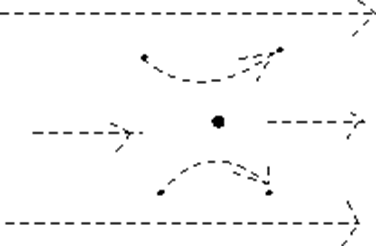
The local dynamics, either in the saddle-node or in the saddle-elliptic case, is what we called trivializable in [Reference Addas-Zanata and Le Calvez9, §3]. This means that there exists an isolating neighborhood of the
 $nq$
-periodic point in question, such that, after a local change of coordinates, all points in this neighborhood, with the exception of the periodic point itself, move to the right under iterations of the dynamics which are multiples of
 $nq,$
see Figure 2.
Diagram showing the dynamics in a neighborhood of a trivializable periodic point, after an appropriate coordinate change.

The proofs that saddle-node and saddle-elliptic periodic points are trivializable appear in Propositions 6 and 8 of that paper, respectively (although Proposition 8 asks for area-preservation and real analiticity, the generic family that comes from Theorem 3.17 satisfies everything needed there, namely, for each integer
 $n>0,$
there are finitely many n-periodic points, and each periodic point satisfies a Lojaziewicz condition).
Now, we conclude our proof using [Reference Addas-Zanata and Le Calvez9, Proposition 9]. Adapted to our setting, it says that there exists a
 $C^0$
-neighborhood W of
 $\widehat {f}_{t^{\prime \prime }}^{*}$
in
 such that for all
 $\widehat {h}\in W$
,
 $\rho _V^{+}(\widehat {h})\leq p/q.$
So, if we pick
 $t>t^{\prime \prime }$
such that
 $\widehat {f}_t^{*}\in W,$
we get that for all
 $\widehat {h}\in V\cap W$
,
 $\rho _V^{+}(\widehat {h} )=p/q.$
Although [Reference Addas-Zanata and Le Calvez9, Proposition 9] is stated for the homotopic to the identity class, it also holds for maps homotopic to Dehn twists.
Its proof is based on a series of local deformations and perturbations. To be more precise, if by contradiction, the adapted statement of the proposition did not hold, then there would be a deformation  of the map
 $\widehat {f}_{t^{\prime \prime }}^{*},$
such that
 ${\rho _V^{-}(\widehat {h})<p/q<\rho _V^{+}(\widehat {h}),}$
this deformation supported outside neighborhoods of all the
 $nq$
-periodic points of
 $f_{t^{\prime \prime }}^{*}$
with vertical rotation number
 $p/q.$
Moreover, if h is the torus map lifted by
 $\widehat {h}$
, then the set of h-periodic points with vertical rotation number
 $p/q$
and period smaller or equal to
 $nq$
is equal to the same set for
 $f_{t^{\prime \prime }}^{*},$
in other words, the only possible period is
 $nq.$
This cannot be achieved in general, the proof of [Reference Addas-Zanata and Le Calvez9, Proposition 9] strongly uses the fact that the dynamics is trivializable in neighborhoods of all the
 $nq$
-periodic points with vertical rotation number
 $p/q.$
The remaining part of the argument is to perturb h inside the trivializable neighborhoods to erase the
 $nq$
-periodic points of vertical rotation number
 $p/q.$
Denote this perturbation of h by
 $h^\prime $
.
The above construction is possible by the choice of n and
 $t^{\prime \prime }$
above, and the fact that it is very easy to destroy trivializable periodic points: any adequate arbitrarily
 $C^0$
-small local translation supported inside the trivializable neighborhoods will do the job. So, as
 $\rho _V$
varies continuously in the
 $C^0$
-topology,
 $p/q$
would still be an interior point of
 $\rho _V(\widehat {h}^\prime ),$
and
 $p/q$
would not be realized by a q-periodic orbit, as stated in [Reference Doeff12, Theorem 5.3]. This contradiction shows the existence of the open neighborhood
 of
 $ \widehat {f}_{t^{\prime \prime }}^{*}$
such that for all
 $\widehat {h}\in W$
,
 $ \rho _V^{+}(\widehat {h})\leq p/q,$
as explained above.
Summarizing, we found  or
 such that
 $\widehat {h}^{\#\#}$
equals
 $\widehat {f}$
in the case where
 $ \rho _V^{+}$
is locally constant in a neighborhood of
 $\widehat {f}$
or
 $\widehat {h}^{\#\#}$
equals
 $\widehat {f}_t^{*}$
if it is not, such that:
-
(1)
$\widehat {h}^{\#\#},\widetilde {h}^{\#\#}$
are
$\eta $
-
$C^r$
-close to
$\widehat {f},\widetilde {f}$
; -
(2)
$\rho _V^{+}(\widehat {h}^{\#\#})=p/q$
and
$\rho _V^{+}$
is locally constant in a
$C^0$
-neighborhood of
$\widehat {h}^{\#\#}$
in


We are left to show that, in the area-preserving case,
 $\rho _V^{-}<\rho _V^{+}.$
For this, just consider the vertical rotation number of the Lebesgue measure (i.e. area).
Namely, for a fixed  such that
 $\rho _V(\widehat {f})=[r/s,p/q]$
and the vertical rotation interval is locally constant in a neighborhood of
 $ \widehat {f},$
note that Lebesgue measure’s vertical rotation number of
 $ \widehat {f}+(0,s),$
denoted
 $\rho _{V,\mathrm {Leb}}(\widehat {f}+(0,s))$
, is equal to
 $\rho _{V,\mathrm {Leb}}(\widehat {f})+s$
(for all
 As
 $\rho _V(\widehat {f}+(0,s))=\rho _V(\widehat {f})=[r/s,p/q]$
for all
 $| s| $
sufficiently small, and
 $\rho _{V,\mathrm {Leb}}( \widehat {f}+(0,s))\in \rho _V(\widehat {f}+(0,s))=[r/s,p/q]$
also for
 $ | s| $
sufficiently small, it must be the case that
 $r/s<p/q.$
The proof is over.
4.3 A technical result on the existence of partial mashes
The next result, Theorems 4.4 and 4.4′, is the only one in this paper that also applies to the identity homotopy class. It is auxiliary to Theorem 2.7 and Corollary 2.8, but it has its own interest.
In [Reference Addas-Zanata6], we proved a version of Theorem 4.4 for area-preserving homotopic to the identity maps and, as a consequence, we showed that whenever the rotation set of a generic one-parameter family of area-preserving diffeomorphisms of the torus homotopic to the identity changes as the parameter changes, then certain homoclinic tangencies in the torus (heteroclinic in the plane) appear and unfold generically, giving rise to all phenomena associated to such an unfolding, birth of elliptic islands (infinitely many), etc.
Below, we present a simpler proof in the area-preserving case and also one that works in general. So Theorem 4.4 implies a version of the main result of [Reference Addas-Zanata6] to any generic one-parameter family of diffeomorphisms of the torus, either homotopic to Dehn twists or to the identity.
More precisely, whenever the rotation set (or vertical rotation interval, in the Dehn twist case) of a generic one-parameter family of diffeomorphisms of the torus changes as the parameter changes, then certain homoclinic tangencies unfold generically. These tangencies are between stable and unstable manifolds of hyperbolic periodic saddles of rational rotation vectors (or numbers) which are eaten by the rotation set as the parameter changes (by eaten, we mean that as the parameter changes, these points modify their status, from boundary to interior points).
Theorem 4.4. (Homotopic to Dehn twists version)
For any integers
 $k\neq 0$
and
 $r\geq 1,$
let
 $f\in \mathrm {Diff_k^r(T^2)\cap \chi ^r(T^2)}$
or
 $f\in \mathrm {Diff_{k,Leb}^r(T^2)\cap \chi _{Leb}^r(T^2)}$
be such that the vertical rotation interval
 $\rho _V(\widehat {f})$
has interior for some fixed lift
 of f. Then, for any rational number
 $\rho $
in the boundary of the vertical rotation interval such that f has
 $ \rho $
-periodic orbits, there exist
 $\rho $
-hyperbolic periodic saddles for f with a partial mesh.
Theorem 4.4′. (Homotopic to the identity version)
For any
 $r\geq 1,$
let
 $f\in \mathrm {Diff}_0^r(T^2)\cap \chi ^r(T^2)$
or
 $f\in \mathrm {Diff_{0,Leb}^r(T^2)\cap \chi _{Leb}^r(T^2)}$
be such that the rotation set
 $\rho (\widetilde {f})$
has interior for some fixed lift
 of f. Then, for any rational rotation vector
 $\rho $
in the boundary of the rotation set such that f has
 $\rho $
-periodic orbits, there exist
 $\rho $
-hyperbolic periodic saddles for f with a partial mesh.
Remarks 4.5.
-
• If the vertical rotation interval has interior for some lift of a homeomorphism of the torus homotopic to a Dehn twist, then it has interior for all lifts, same thing happening in the homotopic to the identity case.
-
• Recall that
$\chi ^r(\mathrm {T^2})$
and
$\chi _{\mathrm{Leb}}^r(\mathrm {T^2})$
come from Theorem 3.14. -
• By saying that f has a
$\rho $
-periodic orbit, we mean that it has a periodic orbit of vertical rotation number
$\rho $
(or rotation vector
$\rho ,$
in the case where
$k=0$
).


Proof. The proof is almost identical in the case where
 $k=0$
or
 $k\neq 0$
. We will assume that
 $k\neq 0$
in the writing and stress the differences when necessary.
If
 $r\geq 2,$
then Theorem 3.13 implies that for all
 $p/q\in \mathrm {interior}(\rho _V(\widehat {f})),$
there exists an f-periodic hyperbolic saddle in the torus whose vertical rotation number is
 $p/q,$
which has a full mesh. If
 $ r=1,$
recall that
 $\mathrm {Diff_k^2(T^2)}$
is dense in
 $\mathrm {Diff_k^1(T^2)}$
and
 $\mathrm {Diff_{k,Leb}^2(T^2)}$
is also dense in
 $\mathrm {Diff_{k,Leb}^1(T^2),}$
again see [Reference Zehnder25]. As we are assuming
 $C^r$
-generic conditions, topologically transverse intersections are just
 $C^1$
-transverse intersections, which are stable under
 $C^1$
-small perturbations. As the vertical rotation intervals vary continuously in the
 $C^0$
topology, there exist open and dense subsets,
 $O_{f.m.}^1\subset \{h\in \mathrm {Diff_k^1(T^2)}:\rho _V(\widehat {h})$
has interior for
 that lifts
 $h\}$
and
 $O_{\mathrm {Leb},f.m.}^1\subset \{h\in \mathrm { Diff_{k,Leb}^1(T^2)}:\rho _V(\widehat {h})$
has interior for
 that lifts
 $h\}$
such that every
 $h\in O_{f.m.}^1$
or
 $h\in O_{\mathrm {Leb},f.m.}^1$
has hyperbolic periodic saddles with full mesh. So, when
 $r=1,$
apart from what was explained in §2.4 on the definition of
 $\chi ^1(\mathrm {T^2})$
and
 $\chi _{\mathrm {Leb}}^1(\mathrm { T^2}),$
we also assume that
 $\chi ^1(\mathrm {T^2})\subset O_{f.m.}^1$
and
 $\chi _{\mathrm {Leb}}^1(\mathrm {T^2})\subset O_{\mathrm {Leb},f.m.}^1.$
An analogous situation holds for
 $k=0$
.
To prove the present result, assume that
 $p/q\in \partial \rho _V( \widehat {f})$
and the induced torus map f that belongs to
 $\mathrm { Diff_k^r(T^2)\cap \chi ^r(T^2)}$
or
 $\mathrm {Diff_{k,Leb}^r(T^2)\cap \chi _{Leb}^r(T^2)}$
has q-periodic orbits with vertical rotation number
 $p/q.$
As the Euler characteristic of
 $\mathrm {T^2}$
is zero, and in both the identity and the Dehn twist homotopy classes, both eigenvalues of the action of f on the first homology group of the torus are equal to
 $1,$
a Lefschetz–Nielsen type theorem (see [Reference Katok and Hasselblatt15]) implies that (when
 $k\neq 0$
)
 $$ \begin{align} \sum_{z\in \mathrm{Fix}(\widehat{f}^q(\bullet )-(0,p))}\mathrm{ind}(f^q\mid _z)=0, \end{align} $$
where
 $\mathrm {Fix}(\widehat {f}^q(\bullet )-(0,p))=\{z\in \mathrm {T^2:}$
 $f^q(z)=z$
and
 $ z$
has rot. number
 $p/q\},$
a similar condition holding in the homotopic to identity case.
As
 $f\in \chi ^r(\mathrm {T^2})$
or
 $f\in \chi _{\mathrm {Leb}}^r(\mathrm {T^2}),$
 $\mathrm {Fix}(\widehat {f}^q(\bullet )-(0,p))$
is finite (for any rational
 $p/q$
) and the topological index of
 $f^q$
on a q-periodic point only assumes the values
 $-1$
or
 $1.$
As
 $-1$
corresponds to hyperbolic saddles with positive eigenvalues, our hypotheses imply that
 $\mathrm {Fix}(\widehat {f}^q(\bullet )-(0,p))$
contains n (for some
 $n\geq 1$
) hyperbolic q-periodic orbits of saddle type, each one of topological index
 $-1$
(all of them with vertical rotation number
 $p/q),$
denoted
 $$ \begin{align} \{Q_1^1,Q_2^1,\ldots,Q_q^1\},\{Q_1^2,Q_2^2,\ldots,Q_q^2\},\ldots, \{Q_1^n,Q_2^n,\ldots,Q_q^n\}. \end{align} $$
Each
 $\{Q_1^i,Q_2^i,\ldots ,Q_q^i\}$
is a single q-periodic orbit.
If for some
 $Q_j^i,$
both
 $W^u(Q_j^i)$
and
 $W^s(Q_j^i)$
are unbounded when lifted to the plane (meaning that each connected component of their lifts to the plane is unbounded), then:
-
• for all
$1\leq l\leq q$
,
$W^u(Q_l^i)$
and
$W^s(Q_l^i)$
are unbounded when lifted to the plane; -
• as f has a saddle with a full mesh, we get that
$Q_l^i$
(for all
$ 1\leq l\leq q$
) has a partial mesh (a proof of this when
$k=0$
appears in [Reference Addas-Zanata6, §2.1] and works when
$k\neq 0$
as well).


So, all we need to show is that there exists
 $i\in \{1,\ldots ,n\}$
and
 $1\leq j\leq q$
such that both
 $W^u(Q_j^i)$
and
 $W^s(Q_j^i)$
are unbounded when lifted to the plane. As explained above, if this happens for some i and
 $ j, $
then it happens for all
 $Q_l^i$
,
 $1\leq l\leq q.$
By contradiction, suppose this is not the case. In other words, assume that for every
 $i\in \{1,\ldots ,n\}$
and all
 $1\leq l\leq q$
,
 $W^u(Q_l^i)$
or
 $ W^s(Q_l^i)$
is bounded when lifted to the plane. We will show that this violates equation (4.8).
Order the periodic orbits in equation (4.9) in the following way: for some
 $0\leq s^{*}\leq n,$
and for all
 $1\leq i\leq s^{*}$
,
 $W^u(Q_l^i)$
(for all
 $1\leq l\leq q)$
is bounded when lifted to the plane, and for all
 $ s^{*}+1\leq i\leq n,W^s(Q_l^i)$
(for all
 $1\leq l\leq q)$
is bounded when lifted to the plane and
 $W^u(Q_l^i)$
is not. In other words,
 $s^{*}<n$
implies that for all
 $s^{*}+1\leq i\leq n$
and
 $1\leq l\leq q$
,
 $W^u(Q_l^i)$
is unbounded when lifted to the plane; if for some periodic orbit in equation (4.9), both its stable and unstable manifolds are bounded when lifted to the plane, then its index i is smaller or equal to
 $s^{*}$
(clearly, if
 $ s^{*}=0,$
then for all
 $1\leq i\leq n$
and all
 $1\leq l\leq q$
,
 $W^u(Q_l^i)$
is unbounded when lifted to the plane).
The above assumption implies that the vertical rotation number of any point in the f-invariant, closed subset
 $\theta \subset \mathrm {T^2}$
given by
 $$ \begin{align} \theta =\bigg( \bigcup _{i=1}^{s^{*}}\bigcup _{l=1}^q\overline{ W^u(Q_l^i)}\bigg) \cup \bigg( \bigcup _{i=s^{*}+1}^n\bigcup _{l=1}^q\overline{ W^s(Q_l^i)}\bigg) \end{align} $$
is equal to
 $p/q.$
As we are assuming that the vertical rotation interval has interior, we get that the complement of
 $\mathrm {Filled}(\theta )$
is fully essential.
The proof of the present theorem in the area-preserving case is much easier and is concluded as follows. Let
 $M\subset \mathrm {T^2}$
be a connected component of
 $\mathrm {Filled}(\theta ).$
It is
 $f^q$
-invariant and
 $M^c$
is connected and fully essential. The prime ends rotation number of
 $f^q$
restricted to the boundary of M is irrational (and thus, different from zero), see [Reference Mather21]. So, the orbit of a point outside, but close to
 $M,$
is turning around it, and thus the topological index of
 $f^q$
restricted to any (contractible) simple closed curve
 $\alpha $
sufficiently close to
 $ \partial M$
in the Hausdorff topology,
 $\mathrm {interior}(\alpha )\supset M,$
is equal to
 $1.$
This means that
 $\sum _{z\in \mathrm{Fix}(\widehat {f}^q(\bullet )-(0,p))\cap M}\mathrm {ind}(f^q\mid _z)=1.$
As
 $\mathrm {Filled}(\theta )$
is non-empty and it contains all the periodic orbits in equation (4.9), the ones with negative topological indices, the proof in the area-preserving case is over: a contradiction with equation (4.8) was found.
From now on, assume
 $f\in \mathrm {Diff_k^r(T^2)\cap \chi ^r(T^2).}$
As in the area-preserving case, we are going to show that
 $$ \begin{align*}\sum_{z\in \mathrm{Fix}(\widehat{f}^q(\bullet )-(0,p))\cap \theta ^{\prime }}\mathrm{ind}(f^q\mid _z)>0 \end{align*} $$
for some subset
 $\theta ^{\prime }\supset \theta ,$
and thus, containing all periodic orbits in equation (4.9). As these are the totality of q -periodic points of vertical rotation number
 $p/q$
and topological index
 $-1,$
we again get a contradiction with equation (4.8).
An important remark is the following: for all
 $1\leq i,i^{\prime }\leq n$
and
 $1\leq l,l^{\prime }\leq q,$
Theorem 3.14 implies that if
 $ Q_{l^{\prime }}^{i^{\prime }}\in \overline {W^u(Q_l^i)},$
then
 $\overline { W^u(Q_{l^{\prime \prime }}^{i^{\prime }})}\subset \overline {W^u(Q_l^i)}$
for some
 $1\leq l^{\prime \prime }\leq q,$
an analogous result holding for the closure of stable manifolds.
Lemma 4.6. In the above setting, if
 $\bigcup _{l=1}^m\overline { W^u(Q_{j_l}^{i_l})}$
(for some integer
 $m\geq 1$
and sequences
 $1\leq i_l\leq s^{*}$
,
 $1\leq j_l\leq q)$
is connected, then
 $$ \begin{align*}\sum_{z\in \mathrm{Fix}(\widehat{f}^q(\bullet )-(0,p))\cap \mathrm{Filled}(\bigcup\limits _{l=1}^m \overline{W^u(Q_{j_l}^{i_l})})}\mathrm{ind}(f^q\mid _z)=1, \end{align*} $$
a similar result holding for stable manifolds whose union is connected and whose lifts to the plane are bounded.
Proof. From our hypotheses,
 $\mathrm {Filled}(\bigcup _{l=1}^m\overline {W^u(Q_{j_l}^{i_l})} )$
has a connected, fully essential complement. As we did in the area-preserving case, if the prime ends rotation number of
 $f^q$
restricted to the boundary of
 $\mathrm {Filled}(\bigcup _{l=1}^m\overline {W^u(Q_{j_l}^{i_l})})$
is non-zero, then the sum of topological indices that appear in the statement of the lemma must be
 $1.$
So, to finish the proof, we are left to understand what happens when the prime ends rotation number described above is zero. In this case, [Reference Addas-Zanata and Koropecki8, Theorem D] implies that
 $\mathrm {Filled}(\bigcup _{l=1}^m \overline {W^u(Q_{j_l}^{i_l})})$
is an attractor, that is, there exists a contractible simple closed curve
 $\gamma \subset \mathrm {T^2,}$
 $\mathrm {interior} (\gamma )\supset \mathrm {Filled}(\bigcup _{l=1}^m\overline {W^u(Q_{j_l}^{i_l})})$
such that
 $f^q(\gamma )\subset \mathrm {interior}(\gamma )$
and
 $\bigcap _{i=0}^{+\infty }f^{qi}(\mathrm {interior}(\gamma ))=\mathrm {Filled}(\bigcup _{l=1}^m \overline {W^u(Q_{j_l}^{i_l})}).$
So,
 $$ \begin{align*}\sum_{z\in \mathrm{Fix}(\widehat{f}^q(\bullet )-(0,p))\cap \mathrm{Filled}(\bigcup\limits _{l=1}^m \overline{W^u(Q_{j_l}^{i_l})})}\mathrm{ind}(f^q\mid _z)=\mathrm{ind}(f^q\mid _\gamma )=1, \end{align*} $$
and the proof is over.
Remark 4.7. In [Reference Addas-Zanata and Koropecki8, Theorem D], only the case where
 $m=1$
is considered, but the proof for the general case, as long as a CONNECTED set of the form
 $\bigcup _{l=1}^m\overline {W^u(Q_{j_l}^{i_l})}$
is considered, is exactly the same. This is a place where Theorem 3.14 of §3.4 is used: it is essential in the proof of [Reference Addas-Zanata and Koropecki8, Theorem D].
The above lemma implies that the theorem is proved when
 $s^{*}=0$
or
 $s^{*}=n.$
To see this, assume
 $s^{*}=n.$
In this case, each connected component of
 $\mathrm {Filled}(\theta )$
is of the form
 $\mathrm {Filled}(\bigcup _{l=1}^m \overline {W^u(Q_{j_l}^{i_l})})$
for some integer
 $m\geq 1$
and sequences
 $1\leq i_l\leq n$
,
 $1\leq j_l\leq q$
such that
 $\bigcup _{l=1}^m\overline {W^u(Q_{j_l}^{i_l})}$
is connected. So, the previous lemma implies that the sum of topological indices of
 $f^q$
at all points in
 $\mathrm {Fix}(\widehat {f}^q(\bullet )-(0,p))\cap \mathrm {Filled}(\theta )$
is positive, which is a contradiction as we already explained. The case where
 $s^{*}=0$
is analogous, one just has to consider stable manifolds instead.
Thus, suppose
 $0<s^{*}<n.$
Proposition 4.8. As in the statement of the above lemma, suppose that
 $\bigcup _{l=1}^m\overline {W^u(Q_{j_l}^{i_l})}$
(for some integer
 $m\geq 1$
and sequences
 $1\leq i_l\leq s^{*}$
,
 $1\leq j_l\leq q)$
is connected. Then, for any
 $s^{*}<i^{\prime }\leq n$
and
 $1\leq l^{\prime }\leq q$
,
 $ W^s(Q_{j^{\prime }}^{i^{\prime }})$
is contained in a single connected component of
 $(\bigcup _{l=1}^m\overline {W^u(Q_{j_l}^{i_l})})^c.$
Proof. Otherwise, for some
 $1\leq i\leq s^{*}$
and
 $1\leq j\leq q$
,
 $\overline { W^u(Q_j^i)}$
would intersect
 $W^s(Q_{j^{\prime }}^{i^{\prime }})$
and so, Theorem 3.14 would imply that
 $W^u(Q_j^i)$
intersects
 $ W^s(Q_{j^{\prime \prime }}^{i^{\prime }}),$
for some
 ${1\leq j^{\prime \prime }\leq ~q.}$
Thus, it accumulates on
 $W^u(Q_{j^{\prime \prime }}^{i^{\prime }}).$
This is a contradiction, since
 $W^u(Q_{j^{\prime \prime }}^{i^{\prime }})$
is unbounded when lifted to the plane and
 $W^u(Q_j^i)$
is not. In particular,
 $Q_{j^{\prime }}^{i^{\prime }}\notin \bigcup _{l=1}^m \overline {W^u(Q_{j_l}^{i_l})}.$
Remark 4.9. Similarly, if
 $\bigcup _{l=1}^{m^{\prime }}\overline { W^s(Q_{j_l^{\prime }}^{i_l^{\prime }})}$
(for some integer
 $m^{\prime }\geq 1 $
and sequences
 $s^{*}+1\leq i_l^{\prime }\leq n$
,
 $1\leq j_l^{\prime }\leq q)$
is connected, then for any
 $1\leq i\leq s^{*}$
and
 $1\leq j\leq q,$
 $W^u(Q_j^i)$
is contained in a single connected component of
 $(\bigcup _{l=1}^m \overline {W^s(Q_{j_l^{\prime }}^{i_l^{\prime }})})^c$
and, in particular,
 ${Q_j^i\notin \bigcup _{l=1}^m\overline {W^s(Q_{j_l^{\prime }}^{i_l^{\prime }}).}}$
Proposition 4.10. As above, let
 $\bigcup _{l=1}^m\overline {W^u(Q_{j_l}^{i_l})}$
and
 $\bigcup _{l=1}^{m^{\prime }}\overline {W^s(Q_{j_l^{\prime }}^{i_l^{\prime }})}$
be connected subsets for integers
 $m,m^{\prime }\geq 1$
and sequences
 $1\leq i_l\leq s^{*}<i_l^{\prime }\leq n$
,
 $1\leq j_l,j_l^{\prime }\leq q.$
In the case where
 $$ \begin{align*}\bigg(\mathrm{Filled}\bigg(\bigcup _{l=1}^m\overline{W^u(Q_{j_l}^{i_l})}\bigg)\bigg)^c\supset \bigcup _{l=1}^{m^{\prime }}W^s(Q_{j_l^{\prime }}^{i_l^{\prime }}) \end{align*} $$
and
 $$ \begin{align*}\bigg(\mathrm{Filled}\bigg(\bigcup _{l=1}^{m^{\prime }}\overline{W^s(Q_{j_l^{\prime }}^{i_l^{\prime }})}\bigg)\bigg)^c\supset \bigcup _{l=1}^mW^u(Q_{j_l}^{i_l}), \end{align*} $$
which means that
 $$ \begin{align*}\mathrm{Interior}\bigg( \mathrm{Filled}\bigg(\bigcup _{l=1}^{m^{\prime }}\overline{W^s(Q_{j_l^{\prime }}^{i_l^{\prime }})}\bigg)\bigg) \cap \mathrm{Interior}\bigg( \mathrm{Filled}\bigg(\bigcup _{l=1}^m\overline{W^u(Q_{j_l}^{i_l})}\bigg)\bigg) =\emptyset, \end{align*} $$
then the sum of topological indices of
 $f^q$
at all points in
 $$ \begin{align*}\mathrm {Fix}(\widehat {f}^q(\bullet )-(0,p))\cap \bigg( \mathrm {Filled}\bigg(\bigcup _{l=1}^m \overline {W^u(Q_{j_l}^{i_l})}\bigg)\cup \mathrm {Filled}\bigg(\bigcup _{l=1}^{m^{\prime }} \overline {W^s(Q_{j_l^{\prime }}^{i_l^{\prime }})}\bigg)\bigg)\ \mathrm{is}\ 2. \end{align*} $$
Proof. By contradiction, assume that the above sum of topological indices is less than
 $2.$
As Lemma 4.6 implies that the sum of topological indices of
 $f^q$
at all points in
 $\mathrm {Fix}(\widehat {f}^q(\bullet )-(0,p))\cap ( \mathrm {Filled}(\bigcup _{l=1}^m \overline {W^u(Q_{j_l}^{i_l})}))$
is equal to
 $1$
and the sum of topological indices of
 $f^q$
at all points in
 $\mathrm {Fix}(\widehat {f}^q(\bullet )-(0,p))\cap ( \mathrm {Filled}(\bigcup _{l=1}^{m^{\prime }} \overline {W^s(Q_{j_l^{\prime }}^{i_l^{\prime }})}))$
is also equal to
 $1,$
then there exists at least one point
 $w\in \mathrm {Fix}(\widehat {f}^q(\bullet )-(0,p)),$
of topological index
 $1,$
belonging to both
 $\bigcup _{l=1}^m\overline {W^u(Q_{j_l}^{i_l})}$
and
 $\bigcup _{l=1}^{m^{\prime }} \overline {W^s(Q_{j_l^{\prime }}^{i_l^{\prime }})}.$
As
 $f\in \chi ^r(\mathrm {T^2 })$
, w must be an orientation-reversing saddle, because it neither can be a sink or a source. As
 $w\in \overline {W^u(Q_j^i)}\cap \overline { W^s(Q_{j^{\prime }}^{i^{\prime }})},$
for some
 $1\leq i\leq s^{*}<i^{\prime }\leq n$
and
 $1\leq j,j^{\prime }\leq q,$
Theorem 3.14 implies that
 $W^u(Q_j^i)$
has a transversal intersection with
 $W^s(f^{j_1}(w))$
and
 $ W^u(f^{j_2}(w))$
has a transversal intersection with
 $W^s(Q_{j^{\prime }}^{i^{\prime }})$
for some
 $1\leq j_1,j_2\leq q.$
So, the
 $\lambda $
-lemma implies that
 $W^u(Q_j^i)$
accumulates on
 $W^u(Q_{j^{\prime \prime }}^{i^{\prime }}),$
for some
 $1\leq j^{\prime \prime }\leq q,$
which is a contradiction because
 $W^u(Q_j^i)$
is bounded when lifted to the plane and
 $ W^u(Q_{j^{\prime \prime }}^{i^{\prime }})$
is not.
Now, let us a consider a connected component of
 $\theta ,$
denoted
 $K,$
which can be decomposed as
 $K=( K_1^u\cup K_2^u\cup \cdots \cup K_{n_u}^u) \cup ( K_1^s\cup K_2^s\cup \cdots \cup K_{n_s}^s) ,$
where each
 $K_i^u$
is connected and given by the union of finitely many sets of the form
 $\overline {W^u(Q_l^i)}$
,
 $1\leq i\leq s^{*}$
, and
 $1\leq l\leq q,$
and analogously, each
 $K_i^s$
is connected and given by the union of finitely many sets of the form
 $\overline {W^s(Q_{l^{\prime }}^{i^{\prime }})} $
,
 $s^{*}<i^{\prime }\leq n$
and
 $1\leq l^{\prime }\leq q.$
The unstable union is pairwise disjoint (similarly for the stable), that is,
 $K_i^u\cap K_j^u=\emptyset $
and
 $K_i^s\cap K_j^s=\emptyset $
for
 $i\neq j.$
Clearly, either the unstable or the stable part of K could be empty.
Consider
 $\mathrm {Filled}(K_i^u)$
and
 $\mathrm {Filled}(K_j^u)$
for
 $i\neq j.$
The possibilities are:
-
•
$\mathrm {Filled}(K_i^u)\subset \mathrm {Filled}(K_j^u);$
-
•
$\mathrm {Filled}(K_i^u)\supset \mathrm {Filled}(K_j^u);$
-
•
$\mathrm {Filled}(K_i^u)\cap \mathrm {Filled}(K_j^u)=\emptyset .$


Analogously for the stable components.
So, the set
 $\mathrm {Filled}(K_1^u)\cup \cdots \cup \mathrm {Filled}(K_{n_u}^u)$
might not be a disjoint union anymore. However, it becomes so, after omitting some elements in the union, re-indexing the sets, and eventually decreasing the value of
 $n_u$
(an analogous construction can be performed for the stable union). Alternatively, any set of the form
 $W^s(Q_{l^{\prime }}^{i^{\prime }}), $
contained in the stable union
 $K_1^s\cup K_2^s\cup \cdots \cup K_{n_s}^s$
, is either contained in
 $\mathrm {Filled}(K_i^u)$
for some
 $ 1\leq i\leq n_u$
or it belongs to
 $( \mathrm {Filled}(K_1^u)\cup \cdots \cup \mathrm {Filled}(K_{n_u}^u)) ^c,$
see Proposition 4.8.
So we can remove from
 $K_1^s\cup K_2^s\cup \cdots \cup K_{n_s}^s$
all sets of the form
 $\overline {W^s(Q_{l^{\prime }}^{i^{\prime }})}$
that are contained in
 $\mathrm {Filled}(K_i^u)$
for some
 $1\leq i\leq n_u.$
Thus, there is a new stable union, still pairwise disjoint, denoted as
 $ K_1^{*s}\cup K_2^{*s}\cup \cdots \cup K_{n_s^{\prime }}^{*s},$
such that each
 $ K_i^{*s}$
is still connected and given by the union of finitely many sets of the form
 $\overline {W^s(Q_{l^{\prime }}^{i^{\prime }})}$
 $(s^{*}<i^{\prime }\leq n$
and
 $1\leq l^{\prime }\leq q),$
satisfying the additional property that each
 $\overline {W^s(Q_{l^{\prime }}^{i^{\prime }})}$
is contained in the closure of
 $( \mathrm {Filled}(K_1^u)\cup \cdots \cup \mathrm {Filled} (K_{n_u}^u)) ^c. $
It is still possible that
 $\mathrm {Filled} (K_j^{*s})\supset \mathrm {Filled}(K_i^u)$
for indices
 $1\leq j\leq n_s^{\prime } $
and
 $1\leq i\leq n_u.$
In this case, we just omit
 $K_i^u$
from the unstable union. After all these modifications, we end up with the following set:
 $$ \begin{align} \widehat{K}= [\mathrm{Filled}(K_1^u)\cup \cdots\cup \mathrm{Filled} (K_{n_u}^u)] \cup [\mathrm{Filled}(K_1^{*s})\cup \cdots\cup \mathrm{Filled} (K_{n_s^{\prime }}^{*s})] , \end{align} $$
satisfying the following conditions:
-
(1)
$\widehat {K}$
is closed, connected, and contains K; -
(2) its unstable components are still pairwise disjoint, as are the stable;
-
(3)
$\mathrm {interior}(\mathrm {Filled}(K_i^u))$
does not intersect
$\mathrm { interior}(\mathrm {Filled}(K_j^{*s}))$
; -
(4)
$\widehat {K}^c$
has a fully essential component.


Any connected component of
 $\theta $
(see equation (4.10)) is either contained in
 $\widehat {K}$
or is disjoint from it, because
 $\partial \widehat {K}\subset K\subset \theta $
.
Now, let M be a connected component of
 $\theta $
which is disjoint from
 $ \widehat {K}.$
We want to show that the set
 $\widehat {M},$
constructed from
 $ M $
exactly in the same way as
 $\widehat {K}$
was constructed from
 $K,$
satisfies either
 $\widehat {M}\cap \widehat {K}=\emptyset $
or
 $\widehat {M} \supset \widehat {K.}$
However, this is easy: if
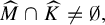 $\widehat {M}\cap \widehat {K}\neq \emptyset ,$
as we assumed that
 $M\cap \widehat {K}=\emptyset ,$
from the fact that
 $\partial \widehat {M}\subset M,$
we get that
 $\partial \widehat {M}$
avoids
 $\widehat {K}.$
So, as
 $\widehat {K}$
is connected,
 $\widehat {M}\supset \widehat {K}.$
Therefore, we can find finitely many disjoint connected closed sets of the form
 $\widehat {K}$
as above (see equation (4.11)), such that
 $ \theta $
is contained in their union and
 $$ \begin{align} \sum_{z\in \mathrm{Fix}(\widehat{f}^q(\bullet )-(0,p))\cap \widehat{K} }\mathrm{ind}(f^q\mid _z)=n_u+n_s^{\prime }. \end{align} $$
As each
 $\widehat {K}$
contains some connected component of
 $\theta $
,
 $ n_u+n_s^{\prime }\geq 1.$
To show that equation (4.12) holds, note that Lemma 4.6 implies that
 $$ \begin{align*}\sum_{z\in \mathrm{Fix}(\widehat{f}^q(\bullet )-(0,p))\cap \mathrm{Filled}(K_i^u)}\mathrm{ind}(f^q\mid _z)=1 \end{align*} $$
and
 $$ \begin{align*}\sum_{z\in \mathrm{Fix}(\widehat{f} ^q(\bullet )-(0,p))\cap \mathrm{Filled}(K_i^{*s})}\mathrm{ind}(f^q\mid _z)=1. \end{align*} $$
If the sum of topological indices in equation (4.12) were strictly less than
 $ n_u+n_s^{\prime },$
as unstable unions are pairwise disjoint (as are the stable ones), a contradiction with Proposition 4.10 would have been found.
So, from the fact that
 $\theta $
contains all q-periodic saddles of vertical rotation number
 $p/q$
and topological index
 $-1,$
this contradicts equation (4.8) and proves the theorem.
4.4 Proof of Theorem 2.7 and Corollary 2.8
From the introduction: let
 $k\neq 0$
be an integer and
 or
 the open and dense sets from Theorems 2.5 and 2.6 intersected with the generic sets from Theorem 3.14. So,
 $\rho _V(\widehat {f})=[r/s,p/q]$
for rational numbers
 $r/s\leq p/q$
and
 $\rho _V$
is locally constant in a neighborhood of
 $\widehat {f}.$
Assume that
 $r/s<p/q.$
Then,
 $ \widehat {f}^q(\bullet )-(0,p)$
has a free homotopically non-trivial simple closed curve
 , such that
 $$ \begin{align*}\widehat{f}^q(\gamma _{p/q})-(0,p)\subset \gamma _{p/q}^{-}. \end{align*} $$
Something which implies the existence of an attractor–repeller pair for
 $ \widehat {f}^q(\bullet )-(0,p).$
The attractor
 $A_{p/q}$
is contained in
 $ \gamma _{p/q}^{-}$
and the repeller
 $R_{p/q}$
is contained in
 $\gamma _{p/q}^{+}.$
The statements proved here are the following.
-
(1) Under the previous hypotheses, there exists a hyperbolic periodic saddle
$z_{p/q}\in \mathrm {T^2}$
of vertical rotation number
$p/q$
(and period
$nq$
for some
$n\geq 1$
) such that if is any lift of
$z_{p/q}$
to the annulus, then
$ W^u(\widehat {z}_{p/q})$
is bounded from above as a subset of the annulus and unbounded from below, and
$W^s(\widehat {z}_{p/q})$
is unbounded from above and bounded from below. Moreover,
$W^u(\widehat {z}_{p/q})$
has a transversal intersection with
$W^s(\widehat {z}_{p/q}-(0,1))=W^s(\widehat {z} _{p/q})-(0,1), $
and if
$\widehat {z}_{p/q}$
and
$\widehat {z}_{p/q}-(0,1)$
are both above
$\gamma _{p/q},$
and
$\widehat {z}_{p/q}-(0,2)$
is below, then where the last set is the union of all (open) connected components of
$$ \begin{align*}A_{p/q}\subset \overline{W^u(\widehat{z}_{p/q})}\cup (\overline{W^u(\widehat{ z}_{p/q})}^{b.\mathrm{above}}), \end{align*} $$
$( \overline {W^u(\widehat {z}_{p/q})})^c$
which are bounded from above.
Moreover,
$A_{p/q}\supseteq [ \overline {W^u(\widehat {z}_{p/q})}\cup ( \overline {W^u(\widehat {z}_{p/q})}^{b.\mathrm{above}})] -(0,2).$
Similarly, if
$\widehat {z}_{p/q}$
and
$\widehat {z}_{p/q}+(0,1)$
are both below
$\gamma _{p/q},$
and
$\widehat {z}_{p/q}+(0,2)$
is above, then where the last set is the union of all connected components of
$$ \begin{align*}R_{p/q}\subset \overline{W^s(\widehat{z}_{p/q})}\cup (\overline{W^s(\widehat{ z}_{p/q})}^{b.\mathrm{below}}), \end{align*} $$
$(\overline { W^s(\widehat {z}_{p/q})})^c$
which are bounded from below.
Analogously,
$R_{p/q}\supseteq [ \overline {W^s(\widehat {z}_{p/q})} \cup (\overline {W^s(\widehat {z}_{p/q})}^{b.\mathrm{below}})] +(0,2).$
-
(2) If f is transitive, then the following improvement holds:
-
(a) assuming that
$\widehat {z}_{p/q}$
and
$\widehat {z}_{p/q}-(0,1)$
are both above
$\gamma _{p/q},$
and
$\widehat {z}_{p/q}-(0,2)$
is below, then
$A_{p/q}$
is contained in
$\overline {W^u(\widehat {z}_{p/q})}$
and contains
$\overline { W^u(\widehat {z}_{p/q})}-(0,2);$
-
(b) similarly, if
$\widehat {z}_{p/q}$
and
$\widehat {z}_{p/q}+(0,1)$
are both below
$\gamma _{p/q},$
and
$\widehat {z}_{p/q}+(0,2)$
is above, then
$R_{p/q}$
is contained in
$\overline {W^s(\widehat {z}_{p/q})}$
and contains
$\overline { W^s(\widehat {z}_{p/q})}+(0,2);$
-
(c) moreover, both
$\overline {W^u(\widehat {z}_{p/q})}$
and
$\overline {W^s( \widehat {z}_{p/q})}$
have no interior points and their complements are connected. In the torus,
$\overline {W^u(z_{p/q})}=\overline {W^s(z_{p/q})}=\mathrm {T^2}.$
-


 is any lift of


Proof of statement (1)
As
 $\rho _V(\widehat {f})=[r/s,p/q]$
is locally constant in a
 $C^r$
-neighborhood of
 Theorem 3.8 implies that f has
 $nq$
-periodic points of vertical rotation number
 $p/q$
for some integer
 $n\geq 1.$
So, Theorem 4.4 implies the existence of an hyperbolic f-periodic saddle point
 $ z_{p/q}$
of vertical rotation number
 $p/q$
(and period
 $nq),$
with a partial mesh. Thus,
 $\widehat {f}^q(\bullet )-(0,p)$
has an n-periodic hyperbolic saddle point
 for which, as
 $\rho _V^{+}(\widehat {f})=p/q,$
[Reference Addas-Zanata, Garcia and Tal7, Corollary 1] implies that
 $W^u(\widehat {z}_{p/q})$
is bounded from above as a subset of the annulus and
 $W^s(\widehat {z}_{p/q})$
is bounded from below. Clearly, all integer vertical translates of
 $\widehat {z}_{p/q}$
are n -periodic for
 $\widehat {f}^q(\bullet )-(0,p)$
and satisfy the above properties.
Fact 4.11. The manifolds
 $W^u(\widehat {z}_{p/q})$
and
 $W^s(\widehat {z}_{p/q})-(0,1)$
intersect transversely.
Proof. To see this, note that as
 $z_{p/q}\in \mathrm {T^2}$
has a partial mesh and
 $\rho _V^{+}(\widehat {f})=p/q,$
one of the following possibilities holds (maybe both):
-
(1)
$W^u(\widehat {z}_{p/q})\cup W^s(\widehat {z}_{p/q})$
contains a homotopically non-trivial closed curve
$\kappa $
in the annulus; -
(2)
$W^u(\widehat {z}_{p/q})$
intersects
$W^s(\widehat {z}_{p/q})-(0,l)$
for integers
$l>0.$


These are the only possibilities, because if
 $W^u(\widehat {z}_{p/q})$
intersected
 $W^s(\widehat {z}_{p/q})+(0,i)$
for some integer
 $i>0,$
then
 $ \rho _V^{+}(\widehat {f})$
would be larger than
 $p/q,$
because such an intersection would imply the existence of a rotational horseshoe for
 $ \widehat {f}^q(\bullet )-(0,p)$
and this horseshoe would contain periodic points with positive vertical rotation number with respect to the map
 $ \widehat {f}^q(\bullet )-(0,p)$
, which is a contradiction.
In the first case above, if
 $\kappa $
and
 $\kappa -(0,1)$
intersect, as f is Kupka–Smale, then
 $\kappa \cap W^u(\widehat {z}_{p/q})$
must have a transversal intersection with
 $(\kappa -(0,1))\cap (W^s(\widehat {z} _{p/q})-(0,1))$
and we are done. If they do not intersect, as
 $\rho _V^{-}( \widehat {f})=r/s<\rho _V^{+}(\widehat {f})=p/q,$
then
 $$ \begin{align*}( \widehat{f}^{nq}(\bullet )-(0,np)) ^m(\kappa )\cap (\kappa -(0,1))\neq \emptyset \end{align*} $$
for some integer
 $m>0,$
and we get the same conclusion as before.
So let us assume by contradiction that
 $W^u(\widehat {z}_{p/q})$
intersects
 $ W^s(\widehat {z}_{p/q})-(0,l_0)$
for some integer
 $l_0>1$
and
 $W^u(\widehat {z} _{p/q})$
does not intersect
 $W^s(\widehat {z}_{p/q})-(0,i)$
for
 $ i=1,2,\ldots ,l_0-1.$
First, recall that from the choice of
 $f,$
it is homotopic to
 $$ \begin{align*}(x,y)\mapsto \left( \begin{array}{@{}cc@{}} 1 & k \\ 0 & 1 \end{array} \right) \left( \begin{array}{@{}c@{}} x \\ y \end{array} \right) (\mathrm{mod\ 1})^2. \end{align*} $$
From our assumption, if
 $\widetilde {z}_{p/q}$
is a lift of
 $z_{p/q}$
to the plane, then there exists an integer a and a simple arc
 $\widetilde {\zeta } , $
starting at
 $\widetilde {z}_{p/q}$
and ending at
 $\widetilde {z} _{p/q}-(a,l_0)$
made of two connected pieces: the first one,
 $\widetilde { \zeta }_1,$
is contained in
 $W^u(\widetilde {z}_{p/q}),$
starts at
 $ \widetilde {z}_{p/q}$
and ends at a point
 $\widetilde {w}\in W^u(\widetilde {z} _{p/q})\cap (W^s(\widetilde {z}_{p/q})-(a,l_0)),$
and the second one,
 $ \widetilde {\zeta }_2,$
is contained in
 $W^s(\widetilde {z}_{p/q})-(a,l_0),$
starts at
 $\widetilde {w}$
and ends at
 $\widetilde {z}_{p/q}-(a,l_0).$
Now, fixed some
 lift of
 $\widehat {f}$
to the plane, consider the image of
 $\widetilde {\zeta }$
under
 $\widetilde {f}^{nq}(\bullet )-(s^{\prime },np),$
where the integer
 $s^{\prime }$
was chosen so that
 $ \widetilde {z}_{p/q}$
is fixed:
 $\widetilde {f}^{nq}(\widetilde {\zeta } _1)-(s^{\prime },np)$
contains
 $\widetilde {\zeta }_1$
and
 $\widetilde {f} ^{nq}(\widetilde {\zeta }_2)-(s^{\prime },np)$
is contained in
 $\widetilde { \zeta }_2-(nqkl_0,0).$
So,
 $(\widetilde {f}^{nq}(\widetilde {\zeta } _1)-(s^{\prime },np))\cup \widetilde {\zeta }_2\cup (\widetilde {\zeta } _2-(nqkl_0,0))$
contains an arc connecting
 $\widetilde {z}_{p/q}-(a,l_0)$
to
 $ \widetilde {z}_{p/q}-(a+nqkl_0,l_0).$
Therefore,
 $W^u(\widehat {z}_{p/q})\cup (W^s(\widehat {z}_{p/q})-(0,l_0))$
contains a homotopically non-trivial simple closed curve
 $\mu $
(every homotopically non-trivial closed curve in the annulus contains a homotopically non-trivial SIMPLE closed curve). Let us consider the point
 $\widehat {z}_{p/q}-(0,1).$
As there are no saddle connections, it does not belong to
 $\mu .$
If it is below
 $\mu ,$
then as its stable manifold is unbounded from above, it must intersect
 $\mu ,$
and so
 $W^u(\widehat {z}_{p/q})$
intersects
 $W^s(\widehat {z}_{p/q})-(0,1),$
which is a contradiction. If
 $\widehat {z}_{p/q}-(0,1)$
is above
 $\mu ,$
then as its unstable manifold is unbounded from below, it must intersect
 $\mu ,$
and so
 $ W^u(\widehat {z}_{p/q})-(0,1)$
intersects
 $W^s(\widehat {z}_{p/q})-(0,l_0),$
which implies that
 $W^u(\widehat {z}_{p/q})$
intersects
 $W^s(\widehat {z} _{p/q})-(0,l_0-1),$
which is a contradiction with the choice of
 $l_0.$
As
 $\widehat {f}^{nq}(\bullet )-(0,np)$
fixes all integer vertical translates of
 $\widehat {z}_{p/q},$
and maps
 $\gamma _{p/q}$
into
 $\gamma _{p/q}^{-},$
the lower connected component of
 $\gamma _{p/q}^c,$
we get that for all integers i,
 $\widehat {z}_{p/q}+(0,i)$
does not belong to
 $\gamma _{p/q}.$
Suppose for some integer i,
 $\widehat {z}_{p/q}+(0,i)$
is below
 $\gamma _{p/q}.$
Then,
 $W^u(\widehat {z}_{p/q})+(0,i)$
is also contained in
 $\gamma _{p/q}^{-}.$
Otherwise, it would intersect
 $\gamma _{p/q}$
in a point
 $\widehat {z} ^{\prime }.$
The negative orbit of
 $\widehat {z}^{\prime }$
under
 $\widehat {f} ^{nq}(\bullet )-(0,np)$
converges to
 $\widehat {z}_{p/q}+(0,i),$
and is always above
 $\gamma _{p/q},$
so
 $\widehat {z}_{p/q}+(0,i)$
belongs to
 $ \gamma _{p/q}^{+},$
which is a contradiction with its choice. Similarly, if for some integer i,
 $\widehat {z}_{p/q}+(0,i)$
is above
 $\gamma _{p/q},$
then
 $W^s( \widehat {z}_{p/q})+(0,i)$
is also contained in
 $\gamma _{p/q}^{+}.$
The following two items describe how the integer vertical translates of
 $ \widehat {z}_{p/q}$
behave when compared with
 $\gamma _{p/q}$
:
-
• if for some integer i,
$\widehat {z}_{p/q}+(0,i)$
is above
$\gamma _{p/q},$
then for all integers
$j>i$
,
$\widehat {z}_{p/q}+(0,j)$
is also above
$\gamma _{p/q}.$


To see this, recall that for all integers l,
 $W^u(\widehat {z} _{p/q})+(0,l)$
intersects
 ${W^s(\widehat {z}_{p/q})+(0,l-1)}$
transversely. So, the
 $\lambda $
-lemma implies that
 $W^u(\widehat {z}_{p/q})+(0,l)$
intersects
 $ W^s(\widehat {z}_{p/q})+(0,l^{\prime })$
for all integers
 $l^{\prime }<l.$
Thus,
 $W^u(\widehat {z}_{p/q}+(0,l))=W^u(\widehat {z}_{p/q})+(0,l)$
accumulates on
 $W^u(\widehat {z}_{p/q})+(0,l^{\prime })$
for all
 $l^{\prime }<l.$
Therefore, if
 $\widehat {z}_{p/q}+(0,i)$
is above
 $\gamma _{p/q}$
and
 $ j>i$
,
 $W^u(\widehat {z}_{p/q})+(0,j)$
accumulates on
 $W^u(\widehat {z} _{p/q})+(0,i),$
something that implies that
 $W^u(\widehat {z}_{p/q})+(0,j)$
intersects
 $\gamma _{p/q}^{+}.$
So
 $\widehat {z}_{p/q}+(0,j)$
is not below
 $ \gamma _{p/q},$
and we are done;
-
• similarly, if for some integer i,
$\widehat {z}_{p/q}+(0,i)$
is below
$\gamma _{p/q},$
then for all integers
$j<i$
,
$\widehat {z}_{p/q}+(0,j)$
is also below
$\gamma _{p/q}.$


The proof is as above.
Summarizing, when considering integer vertical translates of
 $\widehat {z} _{p/q},$
there exists an integer
 $\overline {i}$
such that for all
 $i\leq \overline {i}$
,
 $\widehat {z}_{p/q}+(0,i)$
is below
 $\gamma _{p/q}$
and for all
 $i>\overline {i}$
,
 $\widehat {z}_{p/q}+(0,i)$
is above
 $\gamma _{p/q}.$
By re-indexing integer vertical translates of
 $\widehat {z}_{p/q},$
we can assume that
 $\widehat {z}_{p/q}$
and
 $\widehat {z}_{p/q}-(0,1)$
are both above
 $\gamma _{p/q}$
and
 $\widehat {z}_{p/q}-(0,2)$
is below. From the proof of Fact 4.11 stated above,
 $W^u(\widehat {z}_{p/q})\cup (W^s(\widehat {z}_{p/q})-(0,1))$
contains a homotopically non-trivial simple closed curve
 $\mu .$
For some large integer
 $m^{*}>0$
,
 $( \widehat {f}^{nq}(\bullet )-(0,np)) ^{-m^{*}}(\mu )$
is above
 $\gamma _{p/q}.$
To see this, recall that
 $\mu $
is contained in
 $W^u(\widehat {z} _{p/q})\cup (W^s(\widehat {z}_{p/q})-(0,1)).$
So, if
 $m>0$
is large enough,
 $$ \begin{align*}( \widehat{f}^{nq}(\bullet )-(0,np)) ^{-m}(\mu )\cap W^u(\widehat{ z}_{p/q}) \end{align*} $$
is contained in a small neighborhood of
 $\widehat {z}_{p/q},$
and thus, it is contained in
 $\gamma _{p/q}^+.$
As the whole
 $W^s(\widehat {z}_{p/q})-(0,1)$
is above
 $\gamma _{p/q},$
the result follows.
However, now, if we denote
 $( \widehat {f}^{nq}(\bullet )-(0,np)) ^{-m^{*}}(\mu )$
as
 $\mu _{*},$
then
 $\mu _{*}$
is a homotopically non-trivial simple closed curve such that
 $\mu _{*}^{-}\supset \gamma _{p/q}. $
So, for all integers
 $j\geq 0,$
 $$ \begin{align} A_{p/q}&:=\bigcap _{i=0}^{+\infty }( \widehat{f}^q(\bullet )-(0,p)) ^i(\gamma _{p/q}^{-})\subset ( \widehat{f}^{nq}(\bullet )-(0,np)) ^j(\gamma _{p/q}^{-})\subset \nonumber\\ &\quad \subset ( \widehat{f}^{nq}(\bullet )-(0,np)) ^j(\mu _{*}^{-}). \end{align} $$
Moreover, as
 $\widehat {z}_{p/q}-(0,2)$
belongs to
 $\gamma _{p/q}^{-}$
,
 $W^u( \widehat {z}_{p/q})-(0,2)$
is also contained in
 $\gamma _{p/q}^{-}.$
As
 $W^u( \widehat {z}_{p/q})-(0,2)$
is
 $( \widehat {f}^{nq}(\bullet )-(0,np)) $
-invariant, its closure is contained in the closed set
 $ A_{p/q}.$
Clearly, from the definition of
 $A_{p/q},$
as it contains
 $ \overline {W^u(\widehat {z}_{p/q})}-(0,2),$
then
 $A_{p/q}$
also contains
 $( \overline {W^u(\widehat {z}_{p/q})}^{b.\mathrm{above}})-(0,2),$
where
 $\overline {W^u( \widehat {z}_{p/q})}^{b.\mathrm{above}}$
was previously defined.
To finish the proof of statement (1), we are left to show that equation (4.13) implies that
 $\overline {W^u(\widehat {z}_{p/q})}\cup (\overline { W^u(\widehat {z}_{p/q})}^{b.\mathrm{above}})$
contains
 $A_{p/q}.$
It clearly implies that
 $$ \begin{align*}\bigcap _{i=0}^{+\infty }( \widehat{f}^{nq}(\bullet )-(0,np)) ^i( \mathrm{closure}(\mu _{*}^{-}))\supset A_{p/q}, \end{align*} $$
so let us show the following.
Fact 4.12. The set
 $\theta ^{*}:=\bigcap _{i=0}^{+\infty }( \widehat {f }^{nq}(\bullet )-(0,np)) ^i(\mathrm {closure}(\mu _{*}^{-}))$
is contained in
 $\overline {W^u(\widehat {z}_{p/q})}$
 $\cup (\overline {W^u(\widehat {z} _{p/q})}^{b.\mathrm{above}}).$
Proof. First, recall that
 $\mu _{*}\subset W^u(\widehat {z}_{p/q})\cup (W^s( \widehat {z}_{p/q})-(0,1))$
and pick some
 $\widehat {w}\in \theta ^{*}.$
Suppose it does not belong to
 $\overline {W^u(\widehat {z}_{p/q})}.$
Then it belongs to some connected component of
 $(\overline {W^u(\widehat {z}_{p/q})} )^c.$
If
 $\widehat {w}\notin \overline {W^u(\widehat {z}_{p/q})}^{b.\mathrm{above}},$
then
 $\widehat {w}$
belongs to a connected component of
 $(\overline {W^u( \widehat {z}_{p/q})})^c$
which is not bounded from above. As
 $\overline {W^u( \widehat {z}_{p/q})}$
is itself bounded from above, there is only one connected component of
 $(\overline {W^u(\widehat {z}_{p/q})})^c$
which is unbounded from above, denoted
 $Unb.$
Let a be a real number such that
 $ \mathrm {T^1}\times \{a\}\subset Unb$
and
 $\mathrm {T^1}\times \{a\}$
avoids
 $( \widehat {f} ^{nq}(\bullet )-(0,np)) ^j(\mu _{*})$
for all integers
 $j\geq 0.$
Let
 $ \psi \subset Unb$
be a simple arc connecting
 $\widehat {w}$
to some point above
 $\mathrm {T^1}\times \{a\}.$
As
 $\widehat {z}_{p/q}-(0,1)\in \overline {W^u(\widehat {z}_{p/q})},$
if
 $j>0$
is large enough, then
 $$ \begin{align} [ ( \widehat{f}^{nq}(\bullet )-(0,np)) ^j(\mu _{*})\cap ( W^s(\widehat{z}_{p/q})-(0,1)) ] \cap \psi =\emptyset. \end{align} $$
As
 $\widehat {w}\in \theta ^{*}$
and the other endpoint of
 $\psi $
is above
 $\mathrm {T^1}\times \{a\},$
we get that
 $\psi $
intersects
 $( \widehat {f} ^{nq}(\bullet )-(0,np)) ^j(\mu _{*})$
for all
 $j\geq 0.$
So, if
 $j>0$
is large enough, equation (4.14) implies that
 $( \widehat {f}^{nq}(\bullet )-(0,np)) ^j(\mu _{*})\cap \psi $
belongs to
 $ W^u(\widehat {z}_{p/q}),$
which is a contradiction with the choice of
 $\psi $
that finishes the proof.
Statement (1) is thus proved, in the case of the attractor
 $A_{p/q}.$
The proof for the repeller
 $R_{p/q}$
is analogous because
 $R_{p/q}$
is an attractor for
 $ ( \widehat {f}^q(\bullet )-(0,p)) ^{-1}.$
Proof of statement (2)
The first thing to prove is, in the case where
 $f:\mathrm {T^2\rightarrow T^2}$
is transitive, that both
 $W^u(z_{p/q})$
and
 $W^s(z_{p/q})$
are dense in
 $\mathrm {T^2.}$
This is already known when f preserves area, see for instance [Reference Addas-Zanata5]. Let us prove it in general. Suppose
 ${f\in \mathrm {Diff_{t,k}^r(T^2) \cap \chi ^r(T^2)}}$
and, for instance,
 $\overline {W^u(z_{p/q})}$
is not the whole torus. In this case, as
 $z_{p/q}$
has a partial mesh, any connected component of its complement is a topological open disk. Let us consider such a disk
 $D,$
which can be either periodic or wandering. If f is transitive, then D cannot be wandering. So, it is n-periodic for some integer
 $n>0.$
Moreover, D cannot have homotopically bounded diameter (that is, any connected component of
 $p^{-1}(D)$
has the same bounded diameter), because
 $\overline {D}\cup f(\overline {D})\cup \cdots \cup f^{n-1}( \overline {D})=\mathrm {T^2,}$
and if D has homotopically bounded diameter, then all points in
 $\mathrm {T^2}$
would have the same vertical rotation number (because points in the boundary of an homotopically bounded periodic disk have the same vertical rotation number as points in the disk), which is a contradiction with the assumption that
 $\rho _V(\widehat {f})$
is a non-degenerate interval. If D is homotopically unbounded, [Reference Addas-Zanata and Koropecki8, Proposition 24] shows that there exists a homotopically bounded open disk
 $D^{*}\subset D,$
such that
 $f^n(D^{*})\subset D^{*},$
where n is the period of
 $D.$
This again contradicts the transitivity of f and the assumption that
 $\rho _V(\widehat {f})$
is a non-degenerate interval.
Let  be any point in the fiber of
 $z_{p/q}.$
If by contradiction,
 $(\overline {W^u(\widehat {z} _{p/q})})^c$
is not connected, then it has a connected component
 $B^{+}$
which is bounded from above. So the whole orbit of
 $B^{+}$
under
 $\widehat {f} ^{nq}(\bullet )-(0,np)$
is bounded from above, because the boundary of any iterate of
 $B^{+}$
is contained in
 $\overline {W^u(\widehat {z}_{p/q})},$
which is itself bounded from above. As
 $W^u(z_{p/q})$
is dense in
 $\mathrm {T^2}$
, and
 $W^u(\widehat {z}_{p/q})$
is bounded from above and it has a transverse intersection with
 $W^s(\widehat {z}_{p/q})-(0,1),$
we get that for any sufficiently large integer
 $l>0$
,
 $W^u(\widehat {z}_{p/q})+(0,l)$
intersects
 $ B^{+}.$
So, for all sufficiently large
 $i>0$
,
 $( \widehat {f} ^{nq}(\bullet )-(0,np)) ^{-i}(B^{+})$
gets close to
 $\widehat {z} _{p/q}+(0,l)$
by less than one. As
 $l>0$
is arbitrarily large, this is a contradiction. So
 $(\overline {W^u(\widehat {z}_{p/q})})^c$
is connected, and an easy modification of this argument shows that
 $\overline {W^u(\widehat {z} _{p/q})}$
has no interior. Analogous results hold for the stable manifold. This proves sub-statements (a), (b), and (c).
Acknowledgments
I would like to warmly thank the referee for such a very careful reading of the paper, particularly for the suggestions concerning the proofs of Theorems 2.5 and 2.6. The clarity of the argument and the readability were greatly improved. I am also very thankful for all the other comments and remarks. It is not usual to see such a careful work. The author would like to thank FAPESP (project 2023/07076-4) for partial funding.