INTRODUCTION
Corals have always functioned as ‘microhabitats’ for a range of invertebrates (Bruce, Reference Bruce, Mukundan and Gopindha Pillai1969; McCloskey, Reference McCloskey1970; Bak et al., Reference Bak, Sybesma and Duyl1981; AIMS, 1996–2001; Stachowics & Hay, Reference Stachowics and Hay1998) and alga such as Halimeda (Lamouroux, 1812) (Hillis-Colinvaux, Reference Hillis-Colinvaux1980). These invertebrates and plants are usually restricted to dead areas of the coral colonies (Bak et al., Reference Bak, Sybesma and Duyl1981). Diplosoma virens (Hartemayer, 1909) is a small green didemnid ascidian found in the tropical Indo-West Pacific (Kott, Reference Kott1980) that harbours Prochloron (Lewin, Reference Lewin1977) and chlorophyll-d (Kühl et al., Reference Kühl, Chen, Ralph, Schreiber and Larkum2005). This didemnid can move on the substrate it occupies particularly in a vertical direction (Thinh et al., Reference Thinh, Griffiths and Ngan1981; Ryland, Reference Ryland1988). Halimeda (division: Chlorophyta) occurs commonly in many coral reefs. It is an integral plant component of the coral reef ecosystem contributing to primary productivity to reefal sediments (Drew & Abel, Reference Drew and Abel1988; Birkeland, Reference Birkeland1997). Ecologically, Halimeda forms a refuge habitat for small and cryptic fauna, which is facilitated by its calcified nature and structure (Hendler & Littman, Reference Hendler and Littman1986; Naim, Reference Naim1988; Jinendradasa & Ekaratne, 1980).
Both H. opuntia and D. virens were commonly observed in the Hikkaduwa Nature Park (HNP) reef lagoon located on the south-west coast of Sri Lanka. Halimeda opuntia has always been abundant at HNP (Mergner & Scheer, Reference Mergner and Scheer1974); however, an increase was observed more recently (De Silva & Rajasuriya, Reference De Silva and Rajasuriya1997). It was noted that both H. opuntia and D. virens lived in close association with Acropora formosa (Dana, 1846) at HNP. At times, these coral associates appeared to overgrow parts of the coral colony. However, since it was not possible to find any experimental evidence on how D. virens or H. opuntia affected the growth or survival of A. formosa, the current study was undertaken to test the following hypotheses:
Null hypothesis 1: the growth rate of A. formosa is not affected by the coral associates.
Null hypothesis 2: the coral associates do not cause mortality of the coral host.
MATERIALS AND METHODS
Study site
The HNP is situated along the south-west coast of Sri Lanka. The HNP consists of a shallow reef area of 29,500 m2 within a 100 ha demarcation. The HNP is the only protected area with the status of a marine park in the country at present and is protected by the Department of Wildlife Conservation. The study area consisted of a shallow reef lagoon and the immediate waters surrounding. Water depth varied from 0.5 to 10 m within the Park. This reef was predominantly a staghorn coral reef with Acropora formosa being the dominant species. This reef was, however, severely impacted in 1998 as a result of coral bleaching, and the composition has now changed with staghorn coral struggling to become re-established (Atapattu, Reference Atapattu2006).
Methodology
To test the hypotheses presented, five coral branches hosting the associate at the base of the coral branch were selected and tagged with a plastic marker. All five branches were selected from the same coral stand (stand area was approximately 9 m2). The colonies were selected on one side of the patch to ensure similar wave action and associated physico-chemical characteristics. The tagged corals were measured for growth by linear extension, while growth in the associate was measured using its vertical spread. Measurements were carried out in situ at monthly intervals over five months from December 1997 to April 1998 (coinciding with the non-monsoonal season). The measurements were taken using a plastic cable tie by placing it against the marker and measuring upwards using the nail of the finger as the upper limit mark. This was then drawn out on an underwater slate which was measured using a Vernier caliper back in the laboratory. Measurements taken in situ were performed by the same individual throughout the study to minimize measurement errors.
The length of the coral colony was measured as the distance from a marked point on the coral to its axial tip to determine the monthly linear growth increments of the coral. The vertical growth of the associate was determined by taking the distance from the top margin of the associate to the axial tip of the associated coral colony. This measurement was also carried out in situ similarly to the first. The vertical growth of the associate was calculated as the differences in monthly measurements, corrected for the growth of the coral branch. The linear growth rates of the corals harbouring the associate were compared with the rates of coral growth on the controls to determine if the associates had any impact on the growth of the coral. In order to maintain a sample size, new corals of similar criteria were tagged if there was a loss in coral colonies due to breakage.
Analysis of variance (ANOVA) was performed to look into any interaction between time (months) and the organisms on the coral growth rate and the spread of the organisms. The generalized linear model procedure of SAS was adopted to perform the ANOVA as the sample sizes were unequal. A correlation analysis was also performed to investigate any relationship between the coral growth rate and the change in the organism growth rate. All above analyses were carried out using SAS (version 9.13).
RESULTS
Growth rates
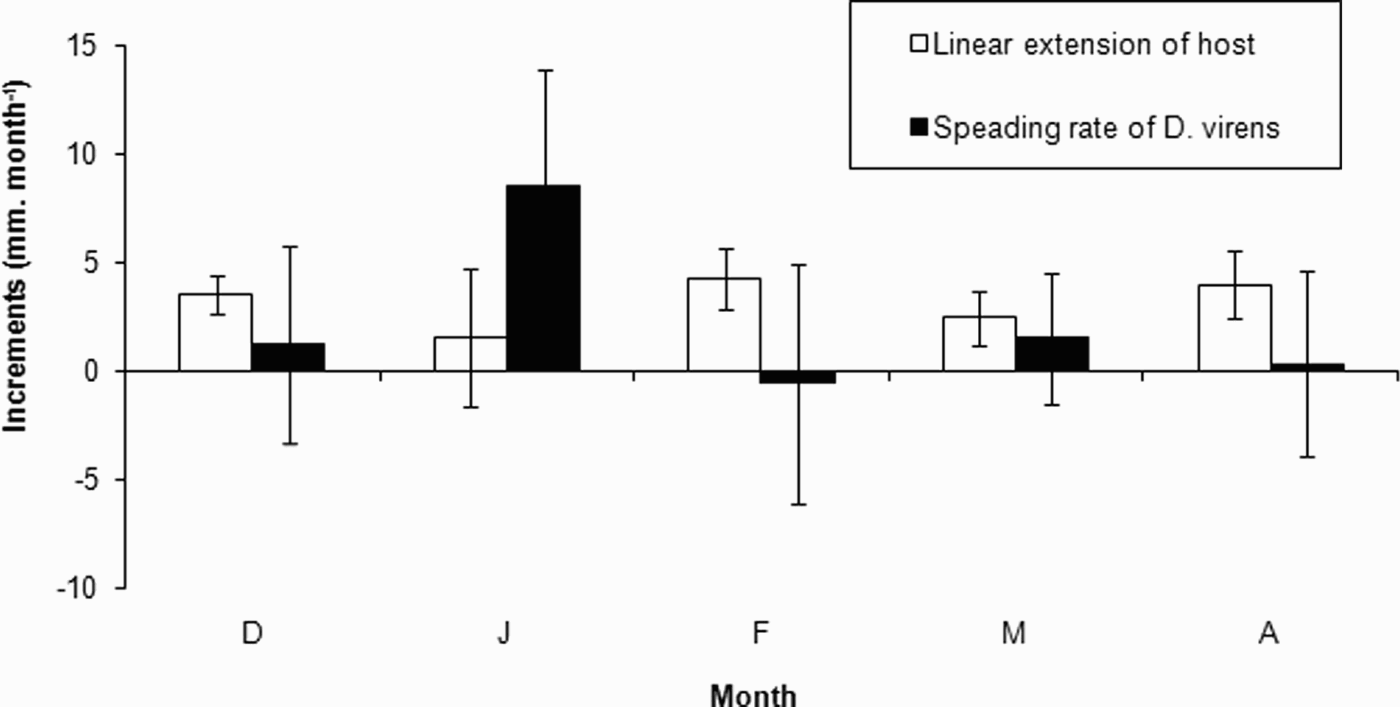
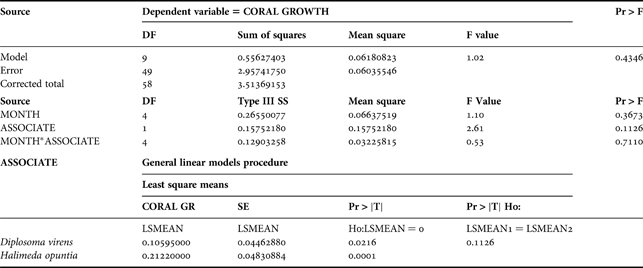
There was no statistically significant interaction between the type of associates and its growth rate, and coral growth with time (months) over the study period. However, the coral growth rate varied significantly with the two associates (Halimeda opuntia and Diplosoma virens) (P = 0.11) at 0.15 error level. Figure 1 shows coral growth trends and Table 1 gives the results of the analysis of variance carried out at 0.15 error level due to variability in sample size.
Coral growth rates and the spreading rate of Diplosoma virens at HNP over the study period.

Analysis of variance for interactions between the coral associates and host coral growth.

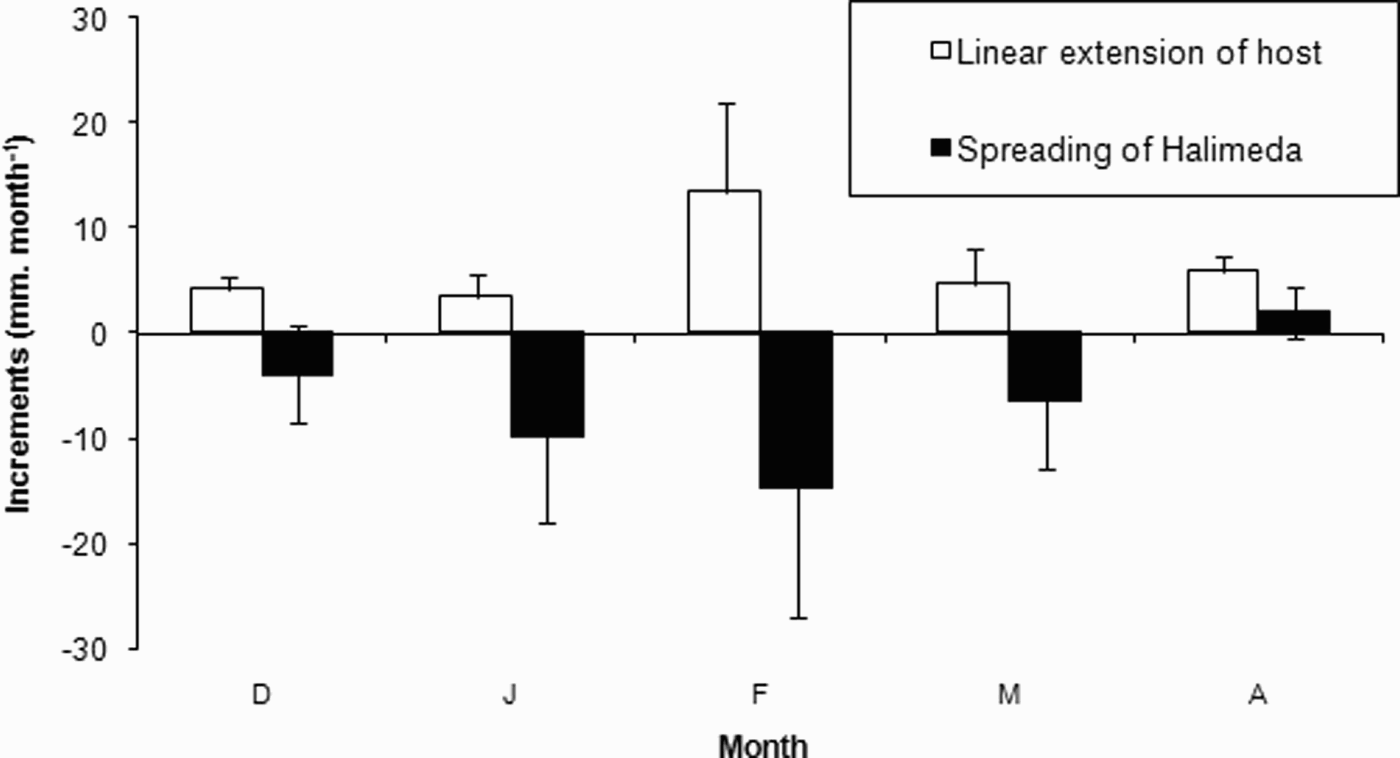
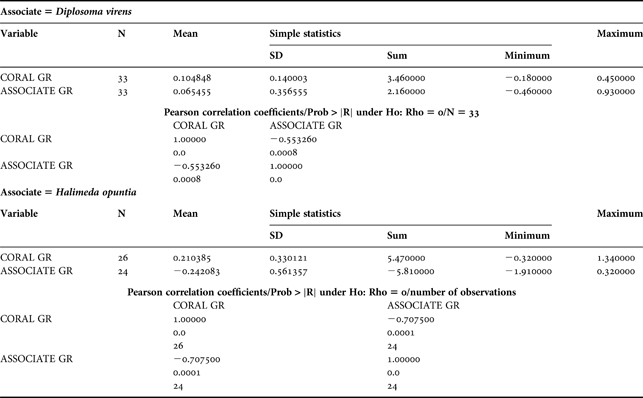
The associates spreading did not show any interaction with the months during which they were studied. However, the spread rate of these two organisms over the study period were significantly different (P = 0.03) at 0.05 error level with H. opuntia showing an overall negative spreading (receding) of 7.3±2.79 mm m−1 (mean±SE) (see Figure 2) whereas D. virens shows an overall positive spreading of 2.0±2.37 mm m−1 (mean±SE). There was a significant negative correlation between the organism spreading rate and the coral growth rates (see Table 2). Halimeda opuntia displayed the strongest negative correlation (−0.71, correlation analysis) as against D. virens (−0.55, correlation analysis).
Coral growth rates and the spread rate of Halimeda opuntia at HNP over the study period.

Correlation analysis for host coral growth and coral associate growth.

Survival and mortality
By the end of the study period, 62.5% of the coral branches did not have any H. opuntia, 25% of the coral branches were partially covered, and 12.5% (one branch) was completely covered. There was 100% survival of the corals associated with H. opuntia at the end of the study.
Diplosoma virens had spread to cover 40% of the coral branches studied within the five month period. All branches completely covered by the associate underwent 100% mortality. The remaining 60% of the branches that were partially covered by the associate had undergone mortality in the covered area while the uncovered areas remained alive.
DISCUSSION
The results of the present study show that the presence of the coral associates on the Acropora formosa branches affected the growth of the host coral, thus proving the null hypothesis wrong. This finding was further enhanced by comparing data from an earlier study (Jinendradasa & Ekaratne, 1974; Buddemeier & Kinzie, Reference Buddemeier and Kinzie1976; Suresh & Mathew, Reference Suresh and Mathew1993; Jinendradasa & Ekaratne, Reference Jinendradasa and Ekaratne2000b) and therefore requires further investigations.
The second hypothesis tested was proved correct for H. opuntia which did not cause mortality in the coral host. If the Halimeda plant populations increase and decrease from time to time and the corals do not experience immediate mortality, coral survival in the long term is not likely to be endangered by this associate. However, it induced a significant growth retardation of the A. formosa coral colonies. In the absence of a threat of mortality to corals, management measures in events of Halimeda blooms should be carried out cautiously, especially since Halimeda plays an important role in providing refuge to a range of organisms (Naim, Reference Naim1988; Jinendradasa & Ekaratne, 1978; AIMS, 1996–2001), under stressful conditions for corals (e.g. post bleaching increased grazing pressure, where there is a reduction of food for coralivorous fish), temporary Halimeda overgrowth may act as a protective mechanism. Further studies however, are required to determine the effects on the coral host of long term coral overgrowth by Halimeda.
Diplosoma virens proved the second hypothesis wrong as it caused immediate mortality of the associated coral, demonstrating that it causes mortality of A. formosa areas in both the long and short term. The fact that D. virens was unable to completely overgrow a higher percentage of host colonies suggests a competition between the associate and the live coral. Studies on the didemnid Trididemnum solidum reported overgrowth of live coral at a rate of 17 mm m−1 (Bak et al., Reference Bak, Brouns and Heys1977), much higher than that recorded for D. virens in the present study. It is, however, important to note that T. solidum is a much larger colony (diameter up to 33 cm—Bak et al., Reference Bak, Sybesma and Duyl1981), leading to much higher coral overgrowth than for D. virens, which is only about 1 cm in length (Lewin, Reference Lewin1977).
This study has demonstrated the consequences of two coral associates on their host. Though both species retarded growth of A. formosa stands significantly, D. virens alone caused mortality in this short-term study. Future studies need to be carried out to determine whether the increase in the D. virens population was a cyclical increase as has been reported at higher latitudes at locations such as Townsville (Thinh et al., Reference Thinh, Griffiths and Ngan1981). Should there be a heavy outbreak of this species, there would be potential for much damage to the live staghorn coral colonies which are major contributors to the reef framework (Wallace & Aw, Reference Wallace and Aw2000), and which support a large diversity of reef associated organisms (Bakus, Reference Bakus1990; Knowlton & Jackson, Reference Knowlton and Jackson1994). Longer-term studies should also be carried out on the effects of H. opuntia on the coral as the present study showed a stronger retardation of coral growth for this associate than for D. virens.
ACKNOWLEDGEMENTS
The support extended to me by the grants received by Professor S.U.K. Ekaratne from the McArthur Foundation, Biodiversity Support program, Global Environmental Facility and the Keidanren Nature Foundation of Japan are duly acknowledged. I also acknowledge the support and supervision extended to me by Professor S.U.K. Ekaratne of Colombo during my PhD work from which this paper stems. I acknowledge the Department of Wildlife Conservation for authorizing the work at Hikkaduwa Nature Park. Acknowledgements extend to Anputhas Markandu for help with the statistical analysis.