Introduction
The Ediacara biota is an assemblage of organisms from the late Ediacaran period (571–541 Ma; Pu et al. Reference Pu, Bowing, Ramezani, Myrow, Raub, Landing, Mills, Hodgin and Macdonald2016) that represents the world’s oldest abundant and globally distributed fossils of architecturally complex, megascopic organisms (Narbonne Reference Narbonne2005; Fedonkin et al. Reference Fedonkin, Gehling, Grey, Narbonne and Vickers-Rich2007; Xiao and Laflamme Reference Xiao and Laflamme2009; Erwin et al. Reference Erwin, Laflamme, Tweedt, Sperling, Pisani and Peterson2011). These soft-bodied organisms are typically preserved as impressions, primarily on the bottom surfaces of event beds of sandstone or volcanic ash (Narbonne Reference Narbonne2005: Kenchington and Wilby Reference Kenchington and Wilby2014), or less commonly within event beds (Grazhdankin and Seilacher Reference Grazhdankin and Seilacher2002; Narbonne et al. Reference Narbonne, Laflamme, Greentree and Trusler2009, Reference Narbonne, Laflamme, Trusler, Dalrymple and Greentree2014; Vickers-Rich et al. Reference Vickers-Rich, Ivantsov, Trusler, Narbonne, Hall, Wilson, Greentree, Fedonkin, Elliott, Hoffmann and Schneider2013; Ivantsov et al. Reference Ivantsov, Narbonne, Trusler, Greentree and Vickers-Rich2016), with multiple individuals revealing minute, millimeter-scale detail of their external morphology. These fossils capture a disparity of body forms and diversity of functions that belies their deceptively simplistic morphology (Erwin et al. Reference Erwin, Laflamme, Tweedt, Sperling, Pisani and Peterson2011; Laflamme et al. Reference Laflamme, Darroch, Tweedt, Peterson and Erwin2013). The relatively low diversity coupled with high morphological disparity (Erwin et al. Reference Erwin, Laflamme, Tweedt, Sperling, Pisani and Peterson2011) and a large number of monospecific genera (Fedonkin et al. Reference Fedonkin, Gehling, Grey, Narbonne and Vickers-Rich2007) lead to difficulties in isolating any visible hierarchy in the morphology and disagreements concerning homology statements between groupings (e.g., compare Laflamme et al. [Reference Laflamme, Darroch, Tweedt, Peterson and Erwin2013] with Budd and Jensen [Reference Budd and Jensen2015]).
The Ediacara biota immediately preceded the Cambrian “explosion” of animal diversity (Erwin and Valentine Reference Erwin and Valentine2013) and thus occupied a pivotal position in the early evolution of complex life. While metazoan taxa were present, including the purported stem-group mollusk Kimberella (Fedonkin and Waggoner Reference Fedonkin and Waggoner1997), they coexisted alongside organisms whose affinities and relationships to any living phyla remain unknown and controversial (Erwin et al. Reference Erwin, Laflamme, Tweedt, Sperling, Pisani and Peterson2011; Darroch et al. Reference Darroch, Sperling, Boag, Racicot, Mason, Morgan, Tweedt, Myrow, Johnston, Erwin and Laflamme2015; Droser and Gehling Reference Droser and Gehling2015). These uncertainties have hindered attempts to integrate these fossils into a broad-scale understanding of Neoproterozoic and Cambrian evolution (Erwin et al. Reference Erwin, Laflamme, Tweedt, Sperling, Pisani and Peterson2011). Current classification methods involve controversial linkages between Ediacaran taxa based on morphological similarity of a small number of key features (Erwin et al. Reference Erwin, Laflamme, Tweedt, Sperling, Pisani and Peterson2011) without any means of testing whether these characters are actually phylogenetically informative. In a significant overview of metazoan ancestry, Budd and Jensen (Reference Budd and Jensen2015) noted this lack of rigorously defined clade-specific autapomorphies and tested synapomorphies for any previously proposed Ediacaran clades. They argued that, in the absence of autapomorphically defined clades, it is impossible to make informed assertions about homology and homoplasy in the Ediacara biota and that any understanding of these organisms is correspondingly reduced.
These difficulties can be minimized by defining Ediacaran clades through uniquely derived traits (autapomorphies), similar to other branches of fossil and extant life. Previous attempts to cladistically define the specific groups within the Ediacara biota have been met with limitations—either in terms of alpha diversity studied or temporal and geographic ranges used (Brasier and Antcliffe Reference Brasier and Antcliffe2009)—or have mapped characters associated with individual Ediacaran taxa onto existing metazoan molecular phylogenies (Gold et al. Reference Gold, Runnegar, Gehling and Jacobs2015). Major organizational systems within and between groups of Ediacaran organisms have often been based on competing classification schemes that, at times, highlight specific a priori assumptions of how these organisms lived and grew (Pflug Reference Pflug1972; Narbonne Reference Narbonne2004; Erwin et al. Reference Erwin, Laflamme, Tweedt, Sperling, Pisani and Peterson2011; Brasier et al. Reference Brasier, Antcliffe and Liu2012; Grazhdankin Reference Grazhdankin2014). These previous groupings may be biased by features that are likely highly homoplastic (Laflamme and Narbonne Reference Laflamme and Narbonne2008) and have led to interpretations of the Ediacara biota in terms of functional analogues irrespective of phylogeny (Droser and Gehling Reference Droser and Gehling2015).
The present study represents the first analysis to propose autapomorphically defined Ediacaran clades identified by modern cladistic methods. Previous work has focused on using selected features of assumed greater evolutionary significance or general similarity of form to group organisms. This leaves open the possibility for convergence or mistaken homology assertion to artificially grouped organisms, which has led to the suggestion that our knowledge of the evolutionary history of these organisms is still at an early stage (Budd and Jensen Reference Budd and Jensen2015). Here we seek to create a chain of common ancestry linking organisms together using a character-based system to identify shared derived features and not a priori assumptions of trait importance. For the present study we focus on taxa from three purported Ediacaran groups previously recognized on the basis of morphology (Rangeomorpha, Erniettomorpha, and Arboreomorpha; see Laflamme and Narbonne [Reference Laflamme and Narbonne2008] and Erwin et al. [Reference Erwin, Laflamme, Tweedt, Sperling, Pisani and Peterson2011]; note that Grazhdankin [Reference Grazhdankin2014] recognizes similar taxonomic groups under different names), which we chose for our analysis because they are widespread, abundant, and occur through a significant time range.
Methods
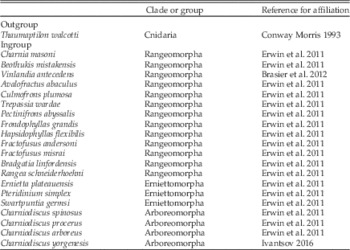
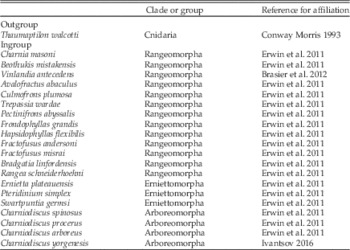
Our study aims to identify clade-level relationships and establish a series of strong synapomorphy-based definitions for each group. All ingroup taxa used herein have previously been assigned to one of three distinct groupings (Erwin et al. Reference Erwin, Laflamme, Tweedt, Sperling, Pisani and Peterson2011): the Rangeomorpha, the Erniettomorpha, or the Arboreomorpha. We included the majority of named and described members, minimally at the genus level, that are currently accepted in each of the major groupings (Table 1). Analysis within these groups was restricted to named taxa that are well described in the literature on the basis of multiple, well-preserved specimens. Our analysis includes all frondose and non-frondose taxa within these three groups that meet these criteria, thus providing critical insights into expressions of homology and homoplasy in the Ediacara biota, and encompasses the temporal, geographic, and bathymetric ranges for each of the reported groups (Narbonne Reference Narbonne2005; Boag et al. Reference Boag, Darroch and Laflamme2016). We did not synonymize the taxa based on a single criterion for character generation, as our data set encompasses multiple axes of variation, such as morphometric, growth patterning, and branching architecture, in an effort to encapsulate all the evolutionarily relevant information in these organisms.
Taxon list and preliminary group identification based on the literature for 21 terminal taxa examined for this study.
Due to the relative morphological simplicity (compared with the majority of metazoans) of the organisms investigated here, and their uncertain relationship to later clades, we chose not to use existing metazoan-based morphological character sets as the basis for this work. A novel data set consisting of 22 morphological characters (Supplementary Table 1, Supplementary Fig. 1) was constructed from descriptions and illustrations in the literature supplemented by our personal examination of multiple specimens, including the holotypes for all of the taxa except for the recently described Charniodiscus yorgensis (Ivantsov Reference Ivantsov2016).
Characters were sampled from all regions of the organisms and were specifically chosen to avoid restating previously proposed diagnostic features for a group (e.g., Laflamme and Narbonne Reference Laflamme and Narbonne2008). Instead, we critically examined all structural features and decomposed them into their constituent parts. Beyond guiding our taxonomic selection, existing classification schemes had no impact on the coding of morphological features or our analysis of these features. We added new characters and character states to document all sources of variation to ensure our data set was as encompassing as possible. These include characters of the holdfast beyond its presence or absence, in particular its position relative to the sediment–water interface; see Burzynski and Narbonne (Reference Burzynski and Narbonne2015) for a discussion on differentiation of this feature. This combination of new characters and detailed dissection of previously suggested significant features allows us to test existing classification schemes and to evaluate the validity of existing diagnostic morphologies.
Characters were further defined to avoid oversplitting by focusing on key aspects that are functionally independent of one another. This is pivotal, because a high degree of character dependence violates a key assumption of cladistic analyses by overweighting the strength of observed relationships (O’Keefe and Wagner Reference O’Keefe and Wagner2001). For example, the modularly repeating “rangeomorph element” (Narbonne Reference Narbonne2004) was decomposed into four new characters that address the presence/absence of modularity, the branching nature of the element, the shape of elements that compose the petalodium, and whether those elements are self-similar and repeated at multiple scales. Each of these characters and the states within them are potential independent sources of phylogenetic information that are subsumed in the simple statement of presence/absence of a rangeomorph element (e.g., Narbonne Reference Narbonne2004; Laflamme and Narbonne Reference Laflamme and Narbonne2008). The taxa examined here show several permutations of these four characters and their states (e.g., the modular, nonbranching, tubular, and nonfractal patterns in Erniettomorphs vs. the nonmodular, branching, but nonfractal pattern seen in Charniodiscus) (Supplementary Table 2). Splitting the “rangeomorph element” into its constituent parts further permits the scoring of potential intermediate morphologies (i.e., a nonmodular, nontubular, branching frond with some fractal elements) that are currently unknown.
The selection of an outgroup is likely to influence our understanding of evolutionary trends within theses organisms, however there is no universally agreed upon taxon or group to serve this purpose at this time. We chose the purported cnidarian Thaumaptilon (Conway Morris Reference Conway Morris1993) from the Burgess Shale (Cambrian) as the outgroup for our analysis. Thaumaptilon is well illustrated and characterized, and shares a similar body plan to Ediacaran fronds, but is believed to represent a distinct evolutionary lineage (Antcliffe and Brasier Reference Antcliffe and Brasier2007; Laflamme and Narbonne Reference Laflamme and Narbonne2008). Furthermore, we also ran the analysis using an artificially generated outgroup based on an undifferentiated yet nonmodular frond without stem or holdfast. All phylogenetic investigations were done using a heuristic search algorithm with default settings in PAUP, Version 4.0 (Swafford Reference Swafford2003). Bootstrap support, which is resampling with replacement of the character set to investigate the strength of the signal, and Bremer decay indices, which denote the number of extra steps need to collapse a node of interest, were taken as measures of nodal support. For bootstrapping analysis, 100 replications were done with the 100,000 trees kept per replication and only nodes above 50% support retained.
Results
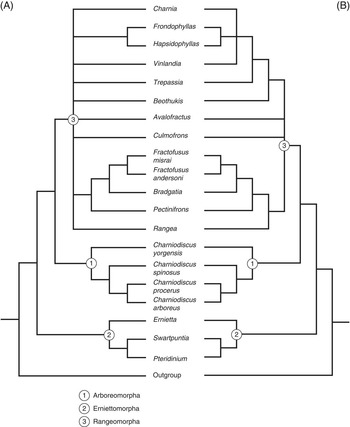
Heuristic search of the complete data set (Fig. 1) resulted in 12 most-parsimonious trees of length 49 with a consistency index (CI) of 0.673 (where 1.0 indicates no homoplasy of characters across the tree). Furthermore, a retention index (RI) denoting the character fit and proportion of informative states was high (0.83). From the trees, it was possible to assign autapomorphies that define each clade.
Phylogeny of Ediacaran fronds using Thaumaptilon as the outgroup to polarize the data. (A) Bootstrap consensus tree numbers by the node represent the Bremer support (above the branch) and bootstrap support (below the branch) for each node. (B) Strict consensus tree.

We find strong support for the Rangeomorpha, Arboreomorpha, and Erniettomorpha clades, whose membership mimics those proposed by Erwin et al. (Reference Erwin, Laflamme, Tweedt, Sperling, Pisani and Peterson2011), and a sister relationship between Rangeomorpha and Erniettomorpha. Arboreomorpha can be defined by their secondary branches, which are spherical or hemispherical in shape, with no lower subdivisions present. They also display differentiation along the coronal plane (i.e., the plane that subdivides the petalodium into a back/front or dorsal/ventral) and the lack of a modular petalodium, though this is also present in Thaumaptilon. The Rangeomorpha–Erniettomorpha clade is defined by having a petalodium composed of modular elements that do not show any differentiation in the coronal plane. Rangeomorpha, the most diverse and disparate of the three clades investigated, is defined by having a petalodium composed of branching, modular elements that display self-similar (fractal) morphology. Our analyses suggest that the ancestral condition was a single-sided petalodium, though the majority of taxa displaying this condition may be biasing this. Erniettomorphs are defined as having petalodia composed of undifferentiated, nonrepeating tubular modular elements that are uniform in width. The unique “bag-shaped” morphology of Ernietta is derived from the fusion of the two petaloids at their edge as marked by a major suture (Ivantsov et al. Reference Ivantsov, Narbonne, Trusler, Greentree and Vickers-Rich2016), and we scored this as such, even though the petaloids do not form the single, flat plane seen in most other fronds.
The consensus tree presents a semiresolved topology that broadly supports previous subdivisions within the Rangeomorpha, identifying a clear separation between single-sided and tightly constrained (undisplayed per Brasier et al. Reference Brasier, Antcliffe and Liu2012) “charnids” (Vinlandia, Charnia) and the double-sided primary- and secondary-branching (displayed and unfurled per Brasier et al. Reference Brasier, Antcliffe and Liu2012) “rangids” (Rangea, Fractofusus, Bradgatia). Beothukis, Culmofrons, and Trepassia are found notably outside the “charnid” subgrouping, forming possible transitional steps uniting the “charnids” with the “rangids.” Our whole-fossil analysis of Beothukis and Culmofrons does not support the recent suggestion that the two taxa may be synonymous at the genus level (Liu et al. Reference Liu, Matthews and McIlroy2016). Within the Erniettomorpha, Ernietta and Pteridinium form a sister relationship to the exclusion of Swartpuntia, though this may be due to the latter having a more classical “frond” appearance, including the presence of a stem and stalk. There is little resolution within the Arboreomorpha, which reflects the general similarity of all species in this clade and suggests that the alpha taxonomy of this clade requires more granular traits, such as segment count and frond shape (Laflamme et al. Reference Laflamme, Narbonne and Anderson2004), that are not appropriate for beta taxonomic-level analyses such as this.
Discussion
Focusing on a subset of Ediacaran taxa with a similar gross body plan (“fronds”) but significant structural and architectural variation avoids the issue of character inflation without adding resolution. Incorporating all 10 proposed groups from Erwin et al. (Reference Erwin, Laflamme, Tweedt, Sperling, Pisani and Peterson2011) would have required a character set that was unscorable across much of the taxon set. While missing data are not necessarily a hindrance to phylogenetic analyses (Wiens and Morrill Reference Wiens and Morrill2011), it is the nature of how those missing data are distributed that would be of concern (Wiens Reference Wiens2003). If the data are randomly distributed (i.e., if most columns are partially scored by taxon across the matrix), more characters (even if only partially scored) aid in phylogenetic resolution. However, this is not the case if the data are clustered into nonoverlapping partitions (i.e., most columns are empty; Wiens Reference Wiens2003) as found in an Ediacara biota–wide analysis. As such, the amount of missing data is not as troubling as the distribution of the missing data.
Another possible challenge for this taxon set is whether there is enough discernible morphology to create the valid characters and states necessary to establish a well-supported evolutionary tree. While large data sets are not a prerequisite (Simões et al. Reference Simões, Caldwell, Palci and Nydam2016), lower quantities of data limit resolution power (Bremer et al. Reference Bremer, Jansen, Oxelman, Backlund, Lantz and Kim1999). Our results show that there are enough distinct morphological data among Ediacaran fronds to generate a viable phylogenetic signal, even given our limited understanding of multiple aspects of the biology and physiology of these organisms.
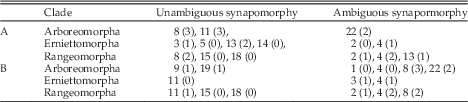
Fronds such as Charnia, Charniodiscus, and Rangea are abundant in Ediacaran assemblages worldwide and provide some of the most iconic images of the Ediacara biota. Early workers viewed the frondose morphology as representing a major division in Ediacaran taxonomy (Glaessner Reference Glaessner1979), but this has fallen out of favor as subsequent studies have increasingly concluded that Ediacaran fronds are polyphyletic (Laflamme and Narbonne Reference Laflamme and Narbonne2008; Erwin et al. Reference Erwin, Laflamme, Tweedt, Sperling, Pisani and Peterson2011; Grazhdankin Reference Grazhdankin2014). Our cladistic analysis confirms that Ediacaran fronds occur in multiple Ediacaran clades, two of which (Erniettomorpha and Rangeomorpha) also contain non-frondose taxa. This supports the view that fronds are an ecomorph Bauplan (i.e., taxa that are similar in morphology due to similar niche usage but may not be closely related phylogenetically; see Williams Reference Williams1972) found among unrelated Ediacaran groups (Laflamme and Narbonne Reference Laflamme and Narbonne2008). Our whole-organism analysis finds strong support for the three groupings (Arboreomorpha, Erniettomorpha, and Rangeomorpha) suggested by previous work based on major structural differences in the components of the petalodium (Laflamme and Narbonne Reference Laflamme and Narbonne2008; Erwin et al. Reference Erwin, Laflamme, Tweedt, Sperling, Pisani and Peterson2011). Our study also provides a set of synapomorphies to define each clade (Fig. 1, Table 2), building a framework to address issues of homology raised by Budd and Jensen (Reference Budd and Jensen2015).
Synapomorphies listed in terms of character (state) for the three major clades using both Thaumaptilon (A) and artificially generated outgroup (B) analyses. We note that the difference between unambiguous and ambiguous synapomorphies is dependent on the resolution of the node preceding that of interest. As selection of outgroup alters the sister-clade relationships (see Figs. 1 and 2), using only the unambiguous-synapomorphy list is an overly conservative estimate of the number of apomorphies per clade.

The artificially generated outgroup allowed us to test the robustness of our primary analysis topology (Fig. 2). This run (120 most-parsimonious trees of length 49, CI 0.667, RI 0.83) confirms the distinct nature of the three clades, though we find a different interrelationship between them. There is a shift in the positioning of the Arboreomorpha into a sister relationship with Rangeomorpha, uniting the two predominantly upright frondose clades. This topology further suggests that modularity is homoplastic among frondose organisms. While these results are intriguing, we do not place significant weight on the resulting trees, beyond the confirmation of the distinctness of the three clades, due to the hypothetical nature of this outgroup.
Phylogeny of Ediacaran fronds using artifically generated outgroup to polarize the data. (A) Strict consensus tree. (B) Majority rules consensus tree.

The precise and testable criteria used in constructing the evolutionary history of each clade allows for detailed examination of major growth and evolutionary patterning across these clades. One potential area of interest concerns growth process—either through insertion or inflationary models (Brasier et al. Reference Brasier, Antcliffe and Liu2012). Growth by insertion implies that new branches are added throughout life, at either or both poles, to increase the size of the organism. This is contrasted with inflationary growth, in which organisms attain their adult complement of sections/branches early in ontogeny and subsequent growth involves enlargement of existing sections/branches. We find preliminary support for an ancestral inflationary type of growth, which could have significantly influenced multiple aspects of the organism’s biology and has been suspected to be a major discriminating factor in Ediacaran phylogenetics (Antcliffe and Brasier Reference Antcliffe and Brasier2007; Brasier et al. Reference Brasier, Antcliffe and Liu2012). Differences in growth strategy are also suspected to influence maximum size due to the need to ensure a large surface area to volume ratio for effective osmotrophic feeding (Laflamme et al. Reference Laflamme, Xiao and Kowalewski2009). Both strategies (inflation vs. insertion) at either or both poles have been reported in Erniettomorpha and Rangeomorpha (Grazdankin and Seilacher 2002; Antcliffe and Brasier Reference Antcliffe and Brasier2007; Gehling and Narbonne Reference Gehling and Narbonne2007; Laflamme et al. Reference Laflamme, Xiao and Kowalewski2009, Reference Laflamme, Flude and Narbonne2012; Narbonne et al. Reference Narbonne, Laflamme, Greentree and Trusler2009; Ivantsov et al. Reference Ivantsov, Narbonne, Trusler, Greentree and Vickers-Rich2016), with additive growth seen in the oldest-known Rangeomorpha Trepassia. It is of interest that the terminal addition pattern is seen in charnids (Antcliffe and Brasier Reference Antcliffe and Brasier2007) and the erniettomorph Pteridinium. This pattern is similar to that reported in several bilaterian groups as well as the enigmatic Ediacaran fossil Dickinsonia and has been suggested to link them to basal Bilateria (Gold et al. Reference Gold, Runnegar, Gehling and Jacobs2015). The identification that this feature is homoplastic and evolved at least three times across Ediacaran groups urges caution in using growth strategies as a major classification criterion in this area of the tree of life. Within the Arboreomorpha we do not see variation in growth strategy, as all known taxa grew by branch inflation (Laflamme et al. Reference Laflamme, Narbonne and Anderson2004), with the number of branches a potential species-level diagnostic feature.
Within the Rangeomorpha the presence of additive growth is seen in two separate groups (Fig. 1B), the derived “charnids” (Trepassia, Charnia) and the multifoliate rangid Pectinifrons (Bamforth et al. Reference Bamforth, Narbonne and Anderson2008; Narbonne et al. Reference Narbonne, Laflamme, Greentree and Trusler2009). This suggests convergence of growth patterns between charnids and Pectinifrons, as Pectinifrons is nested within a clade with multiple members displaying inflationary growth. While it may at first seem unlikely that a major shift in growth strategy occurred multiple times within a clade, we know that the evolution of growth by insertion has occurred several times within eukaryotes (Gold et al. Reference Gold, Runnegar, Gehling and Jacobs2015). Furthermore, the exact nature of how inflation occurs seems to differ between charnids and Pectinifrons, implying that the developmental pathways may differ between the two. Pectinifrons employs insertion for the addition of struts along the pedicle, which is then followed by branch inflation for subsequent growth of primary branches (Bamforth et al. Reference Bamforth, Narbonne and Anderson2008). In contrast, charnids appear to grow either exclusively by primary addition (Trepassia) or by terminal primary addition with inflation of previously added primaries (Charnia) (Narbonne et al. Reference Narbonne, Laflamme, Greentree and Trusler2009). The insertion growth strategy seen in Pectinifrons and charnids may be paedomorphic, as other rangids are suspected to undergo branch addition to “adult” complement very early in ontogeny, with the inflationary growth model becoming dominant later in their life cycles (Gehling and Narbonne Reference Gehling and Narbonne2007).
The linking of Erniettomorpha and Rangeomorpha as sister clades is notable, though caution is advised due to the lack of resolution of this group using the artificially generated outgroup (Fig. 2). The proposed synapomorphies for this group include the lack of differentiation in the coronal plane and the modular construction of their petalodia (or in the case of some Erniettomorpha, the entire organism). Should the phylogeny prove valid, this may signal a common developmental system or be convergent, related to how they obtained nutrients through osmotrophy (Laflamme et al. Reference Laflamme, Xiao and Kowalewski2009). While it is tempting to accept this clade at face value and suggest that the lowest level of rangeomorph branching (which can resemble a tube) is homologous to the large tube of an erniettomorph, several factors suggest to us that modularity may be homoplastic. First is the nature of the modular elements. Within Erniettomorpha, the modules are uniform and tubular and possess no lower level of differentiation, which sharply contrasts with the repeated branching of the major elements in Rangeomorpha (Laflamme and Narbonne Reference Laflamme and Narbonne2008), which may have evolved to increase surface area as volume expands. Based on the results of this study, modular construction (Narbonne Reference Narbonne2004) appears to be a common morphological adaptation among Ediacaran clades to increase body size (see the discussion in Hoyal Cuthill and Conway Morris Reference Hoyal Cuthill and Conway Morris2014), with little homology in its developmental origins. The repeated evolution of modularization may be a function of the limited genetic tool kit available to these organisms (Narbonne Reference Narbonne2005; Hoyal Cuthill and Conway Morris Reference Hoyal Cuthill and Conway Morris2014).
Conclusions
Our cladistic analysis provides a clear and rigorously defined set of synapomorphies to establish monophyletic clades of Ediacaran organisms. We find strongly supported Rangeomorpha, Erniettomorpha, and Arboreomorpha that correspond to previously proposed groupings, lending strength to existing morpho-grouping schemes. We also find that growth strategies seem to have been somewhat plastic within these clades, as insertionary growth appears to have evolved multiple times within the fronds. Finally, while our analysis produces a sister-group relationship between the Rangeomorpha and the Erniettomorpha, the convergence on a modular body construction is not unique to these taxa and appears to have been widespread across the Ediacara biota. This framework can be extended to incorporate other members of the Ediacara biota such as the Dickinsoniomorpha and Triradialomorpha, and thus bring Ediacaran fossils into the age of cladistics.
Acknowledgments
We are grateful for funding through a William White Fellowship to T.A.D., NSERC Discovery Grants to G.M.N. and M.L., and a Queen’s Research Chair to G.M.N. We also thank C. Lablans and G. Burzynski for their help with photographing specimens and helpful discussions. Critical comments by C. Kenchington and an anonymous reviewer greatly improved the paper.
Supplementary Materials
Data available from the Dryad Digital Repository: http://dx.doi.org/10.5061/dryad.70917