Since the 1970s, the Fontan circulation has been created as corrective palliation for patients with various forms of functional univentricular hearts defects.Reference Fontan and Baudet1 During the last decades, several modifications have been designed in the circuit, which in combination with advances in postoperative management, have contributed to the improvement of the surgical results. The total cavopulmonary connection is probably the most widely used modification in current practice.Reference de Leval, Kilner, Gewillig and Bull2 Irrespective of type of the surgical technique, good ventricular function is mandatory for long-term survival in the palliated patients. Ventricular function, however, may deteriorate over time influenced by primary causes such as ventricular morphology and operative technique.
The use of brain natriuretic peptide as a marker of ventricular function has gained increased interest during recent years.Reference Bettencourt, Ferreira, Dias, Castro, Martins and Cerqueira-Gomes3–Reference Muders, Kromer and Griese7 Both pressure and volume overload of the heart has been reported to increase the level of this peptide in the plasma of children with congenitally malformed hearts,Reference Holmgren, Westerlind, Lundberg and Wahlander8 with the highest values reported in children with systolic ventricular dysfunction.Reference Westerlind, Wahlander, Lindstedt, Lundberg and Holmgren9 In children with functionally univentricular hearts, it has been shown that the volume overload of the systemic ventricle imposed by the first palliative step is paralleled by an increase in the levels of brain natriuretic peptide, while the second step, construction of a bi-directional Glenn anastomosis, which unloads the ventricle, normalises the levels of the peptide.Reference Wahlander, Westerlind1, Lindstedt, Lundberg and Holmgren10 Reports of the effect of maximal exercise on the levels in patients with the Fontan circulation, however, are lacking. We aimed, therefore, to evaluate the levels of the peptide in plasma as a marker of systolic ventricular function at long-term follow-up before and after maximal exercise in surgically palliated patients with functionally univentricular hearts, with apparently good ventricular function.
Patients and methods
Samples of brain natriuretic peptide in plasma were obtained before and after maximal exercise test from 15 patients with functionally univentricular heart, 6 having had construction of a total cavopulmonary connection at a median age of 4.5 years, with a range from 3.0 to 7.5 years, and with a median age of 14.6 years, the range being from 12.5 to 17.9 at the time of the investigation, and a median follow-up time of 10.2 years, with a range from 8.3 to 11.8 years. The other 9 patients had undergone a classical atriopulmonary Fontan connection, surgery being performed at a median age of 15.1 years, with a range from 4.2 to 35 years, and with a median age of 32.1 years, and range from 15.6 to 54.2 years at the time of the investigation, having been followed over a median time of 18.8 years, with a range from 11.1 to 20.3 years. No patient had undergone surgery with a fenestrated pathway.
The patients underwent routine echocardiographic examinations with an Acuson 128XP (Acuson, Mountain View, CA, USA) or ATL HDI 5000 (ATL, Bothell, Washington, USA) system. An arbitrary scale from 1, representing poor, to 4, considered excellent, was used to assess systolic ventricular function. A similar scale from 1, representing mild, to 4, considered very severe, was used to assess possible atrioventricular valvar regurgitation. Only patients with good systolic ventricular function or better, and mild or less atrioventricular valvar regurgitation, were included for further analysis. The echocardiographic evaluation was done with the examiner blinded to the results for measurement of brain natriuretic peptide.
Blood samples of 2 millilitres were drawn from a peripheral vein and collected into plastic tubes. The tubes were immediately taken to the laboratory, centrifuged at 4 degrees Celsius for the separation of plasma, and the plasma was then frozen and stored at −70 degrees Celsius until analysis. Analysis was performed using a Shionoria brain natriuretic peptide assay; Shionogi Co., Osaka, Japan. Reference values for our laboratory range from zero to 18.4 nanograms per litre.
Before the exercise test, an arterial catheter was inserted into a radial or brachial artery. The exercise tests were performed in the sitting position on an electrically braked bicycle ergometer (Medical Graphic Corporation 2000, St Paul, Minnesota, USA) with continuous measurement of uptake of oxygen, respiratory rate and ventilation, at a pedalling rate of 60 revolutions per minute, using a steady state protocol with increments in load every 6th minute.
All the variables were registered every 20 seconds, and heart rate was obtained by means of an electrocardiographic monitor connected to the system. Data was obtained at rest in the supine position, and during exercise in the sitting position, on workloads representing 0.5, 1.0 and 1.5 watts per kilogram. The values given for respiratory rate and heart rate are the mean of three 20-second readings taken during the last minute of each workload. Maximal exercise was defined as the highest uptake of oxygen achieved during the last minute at the highest load. Efforts were made for the patients to achieve a respiratory rate above 40 breaths per minute.
Cardiac output was determined with the dye-dilution technique twice at rest, and after 4 and 6 minutes of exercise at each workload. The methods for the exercise and cardiac output tests have been published in detail previously.Reference Stromvall-Larsson and Eriksson11
Samples for arterial blood saturation were obtained at rest, and at the end of each workload.
As a control group for the measurements, the peptide was analysed before and after maximal exercise in 8 healthy individuals, 5 girls and 3 boys, with a median age of 13.9 years, ranging from 12.8 to 14.2 years. The exercise test in the control group was performed in the sitting position on an electrically braked bicycle ergometer with an initial work load of 1.0 watts per kilogram, with an increment of 10 watts per kilogram every minute until maximal effort.
The study was approved by the Medical Ethics Committee at Göteborg University, and written informed consent was obtained from all the patients and their families.
Statistical analysis
Non-parametric tests were used for the statistical analysis: Wilcoxon’s rank sum test and the Mann-Whitney U-test for paired and unpaired data, respectively, Kruskal Wallis for three or more variables and Spearman’s rank correlation test for correlation (StatView for Windows, SAS Institute Inc, version 5.0.1). The results of the calculations are given as medians and range.
Results
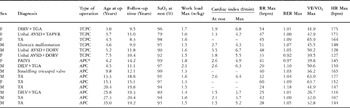
The age of the patients in the control group was the same as the age at examination in those with a total cavopulmonary connection (p = 0.25). The characteristics of the patients, workload, cardiac index, respiratory rate, respiratory exchange ratio, ventilatory equivalent for oxygen, and heart rate in the two groups of children with congenitally malformed hearts are shown in Table 1. The age at operation and at the time of investigation was higher, and the follow-up time longer, in those with an atriopulmonary connection compared to those having the total cavopulmonary connection (p=0.02, 0.003, and 0.002), respectively. Workload and cardiac index at rest and during maximal exercise were similar in both groups. Workload was calculated at a median of 1.4 watts per kilogram, with a range from 1.0 to 2.1 watts, in those with the atriopulmonary connection, and a median of 1.5 watts per kilogram, with a range from 1.0 to 1.7 watts in those with the total cavopulmonary connection. The respiratory exchange ratio, and a ventilatory equivalent for oxygen, in the total group of children with functionally univentricular hearts were 1.04, and 44.6, respectively, indicating that they had performed a maximal exercise test.
Patient characteristics, work load, cardiac index, respiratory rate and heart rate in the 15 patients with functionally univentricular hearts.

APC: atriopulmonary connection; bpm: beats per minute; brpm: breaths per minute; DILV: double inlet left ventricle; DIRV: double inlet right ventricle; DORV: double outlet right ventricle; F: female; HR: heart rate; M: male; Max: maximal exercise; PAIVS: pulmonary atresia and intact ventricular septum; RER: respiratory exchange ratio; RR: respiratory rate; SaO2: arterial blood saturation; TA: tricuspid atresia; TAPVR: total anomalous pulmonary venous return; TCPC: total cavopulmonary connection; TGA: discordant ventriculo-arterial connections; Unbal. AVSD: unbalanced atrio-ventricular septal defect; (*Reoperated from APC to TCPC); VE/VO2: ventilatory equivalent for oxygen.
Baseline cardiac index had a median of 2.3 litres per minute per square metre in those with the atriopulmonary connection, with a range from 1.5 to 2.6, and increased to a median of 4.7 litres per minute per square metre, with a range from 3.7 to 6.3 litres during maximal exercise. Corresponding values in those with the total cavopulmonary connection were a median of 1.9 litre per minute per square metre, and a range from 1.3 to 3.5 litres, and a median of 5.5 litre per minute per square metre, with a range from 4.2 to 6.8 litres, respectively. No significant differences were observed between the groups in saturations of arterial blood at rest, or saturations and heart rate at maximal work load (p=0.40, 0.26, and 0.33, respectively). No correlation was observed between the heart rate at maximal work load and maximal work load. The respiratory rate at maximal workload was slightly higher in those with the total cavopulmonary connection, with a median of 48 breaths per minute, and a range from 33 to 54, than in those with the atriopulmonary connection, in whom the median was 32 breaths per minute, and the range from 24 to 60 (p = 0.05).
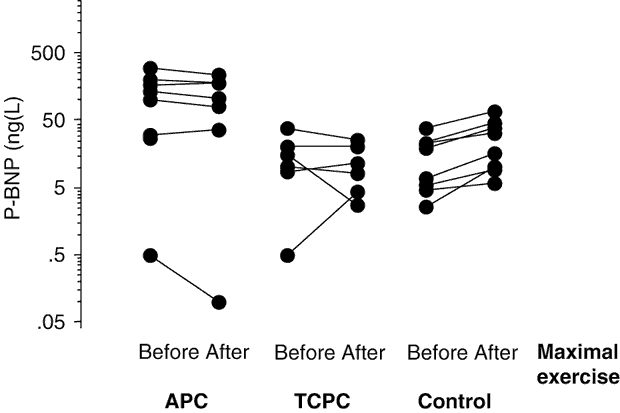
The maximal workload and heart rate in the control group were higher than for both groups of patients, with a median of 3.0 watts per kilogram, and a range from 2.3 to 3.8 watts (p = 0.0005), and a median of 187 beats per minute, with a range from 180 to 206 beats (p = 0.0004), respectively, while the maximal respiratory rate in the control group was the same as in those with the total cavopulmonary connection, at a median of 46 breaths per minute, and a range from 36 to 65 (p = 0.3), but higher than for those with the atriopulmonary connection (p = 0.04). The levels of brain natriuretic peptide measured in the plasma before and after exercise are illustrated in Figure 1.
Levels of brain natriuretic peptide (P-BNP) in the plasma before and after maximal exercise in the control group, those with an atriopulmonary connection (APC), and those with a total cavopulmonary connection (TCPC).
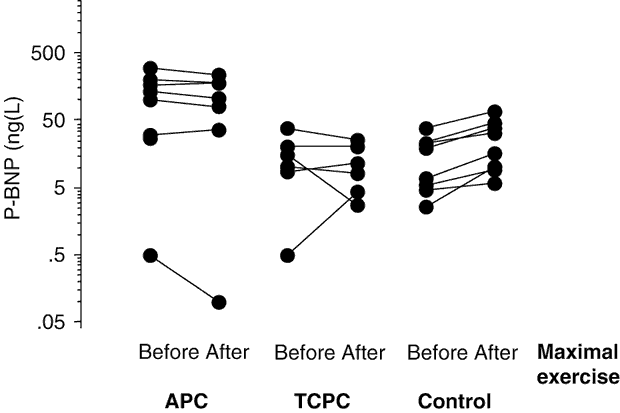
The values were significantly higher for those with the atriopulmonary connection, both before exercise, when the median was 131.8 nanograms per litre, and the range from 0.5 to 296.4, and after, when the median had fallen to 108.1, with the range being from 0.1 to 235.9 nanograms, when compared with the values for those with a total cavopulmonary connection, the median for this group being 12.8 before exercise, with a range from 0.5–39.1, and also for the controls, when the median prior to exercise was 13.1, with a range from 2.6 to 38.7 nanograms. After exercise, the values were a median of 9.7, with a range from 2.7 to 26.2 for those with the total cavopulmonary connection (p = 0.016), and a median of 24.1, with a range from 5.8 to 66.7 for the controls (p = 0.03). The change in levels of the peptide during maximal exercise was +5.9 nanograms per litre, with a range from −23.7 to +31.0, in those with the atriopulmonary connection (p = 0.96), and a median of −1.0 nanogram per litre, with a range from −12.0 to +3.9 for those with the total cavopulmonary connection (p > 0.99). In contrast to the groups of children with functionally univentricular hearts, the peptide increased in the plasma of the controls by 9.7 nanograms per litre, with a range from 1.2 to 28.0 (p = 0.008) during maximal exercise.
Discussion
Our main findings are the lack of increase in levels of brain natriuretic peptide in the plasma after maximal exercise in the patients with both atriopulmonary and total cavopulmonary connections, which may indicate that systolic ventricular function is not the only limiting factor for exercise capacity in patients with the Fontan circulation. The higher values observed in those with atriopulmonary connections, however, may indicate the increased cardiac load in this group, which could be explained by older age at surgical palliation, longer time of follow-up, or the type of surgical procedure itself. Higher levels of the peptide in patients having the classical Fontan procedure compared to a total cavopulmonary connection has previously been observed,Reference Ohuchi, Takasugi and Ohashi12 whereas others have reported significantly increased levels also in patients with a total cavopulmonary connection some years after the operation.Reference Hjortdal, Stenbog and Ravn13 It has been shown that late mortality after the Fontan procedure for patients with tricuspid atresia is significantly increased in those in whom the operation was performed at the age of 18 years or older.Reference Mair, Puga and Danielson14 On the other hand, conversion of an atriopulmonary to an extracardiac total covopulmonary connection has been reported to improve cardiopulmonary functionReference Giardini, Napoleone and Specchia15 The older age in our patients with an atriopulmonary connection, with 4 patients being over the age of 18 years at the time of their operation, may still have had an impact on their cardiac function. Complications after construction of an atriopulmonary connection, such as obstruction of the right pulmonary vein, increased pressure in the coronary sinus, slow central venous flow, thromboembolism, and atrial arrhythmias, are all related to the increased right atrial pressure and enlargement of the right atrium.Reference Puga, Chiavarelli and Hagler16, Reference Agnoletti, Borghi, Vignati and Crupi17 Supraventricular arrhythmias, and increased pressure in the coronary sinus, may both contribute to ventricular dysfunction in the long run,Reference Miura, Hiramatsu, Forbess and Mayer18 while atrial arrhythmias may themselves increase the levels of brain natriuretic peptide. The increased levels observed both before and after maximal exercise in our patients with an atriopulmonary connection, therefore, may be explained by a slightly reduced systolic ventricular function after all, in spite of visually good ventricular function on the echocardiographic examination. Furthermore, the right atrium is included in the cavo-pulmonary circuit in those with an atriopulmonary connection. Given that the pressure in the circuit will be higher than normal right atrial pressure, this may constitute an additional source of brain natriuretic peptide in these patients even when ventricular function is normal. Our present data, however, may not discriminate between these different mechanisms. Systolic ventricular dysfunction may also occur after construction of the total cavopulmonary connection. Thus, systolic ventricular dysfunction may explain the increase in the levels of the peptide in the group with total cavopulmonary connections reported by Hjortdal et al.,Reference Hjortdal, Stenbog and Ravn13 since 7 out of 20 of their patients were reported to have reduced ejection fractions. The low values observed in our patients with a total cavopulmonary connection, nonetheless, indicates that levels of the peptide can also be normal several years after the procedure in patients with functionally univentricular hearts in which the dominant ventricle is itself functioning well.
The fact that workload and cardiac index at rest and during exercise were the same in those with both the atriopulmonary and total cavopulmonary connections is in concordance with the results from serial studies of cardiorespiratory response to exercise after the Fontan operation as reported by Nir et al.Reference Nir, Driscoll and Mottram19 Previous studies have also shown that reduced exercise capacity is a well-known phenomenon in patients with the Fontan circulation.Reference Gewillig, Lundstrom, Bull, Wyse and Deanfield20, Reference Durongpistikul, Driscoll and Mahoney21 The cause is allegedly multifactorial, with factors such as lack of a pumping ventricle in the pulmonary circulation, chronotropic insufficiency, abnormal cardiac output, and systolic ventricular dysfunction being promoted as causal.Reference Gewillig, Lundstrom, Bull, Wyse and Deanfield20, Reference Driscoll, Danielsson, Puga, Shaff, Heise and Staats22 Interestingly enough, the levels of the brain peptide were unchanged immediately after maximal exercise in those with both an atriopulmonary and a total cavopulmonary connection in our series, whereas the value increased in all the controls. One might argue that the level of the peptide in our controls may not have been increased if they had stopped at half of their maximal work load, this being equivalent to the workload achieved by the children with functionally univentricular hearts. On the other hand, the respiratory exchange ratio, and the ventilatory equivalent for oxygen, as observed in the overall group of children with functionally univentricular hearts during exercise indicates that they truly performed a maximal exercise test. This is further supported by the observed high respiratory rate, which was comparable with the respiratory rate experienced in the controls at maximal exercise. If the reduced exercise capacity observed in those with the Fontan circulation were caused mainly by systolic ventricular dysfunction, it is reasonable to believe that the levels of brain natriuretic peptide would have increased after exercise.Reference Law, Keller, Feingold and Boyle23, Reference Law, Ettedgui, Beerman, Maisel and Tofovic24 Suppression of the secretion of the peptide has been reported after construction of the total cavopulmonary connection compared with definitive repair for tetralogy of Fallot,Reference Yoshimura, Yamaguchi and Oshima25 and was not correlated to central venous pressure. We may speculate, therefore, that the reduced volume load on the systemic ventricle may result in lower levels of brain natriuretic peptide. If this is true, the lack of increase in the values after maximal exercise observed in our patients with the Fontan circulation may be explained in terms of reduced volume load of the systemic ventricle as a result of passive and restricted flow of blood through the pulmonary circulation during exercise. Thus, insufficient flow of blood through the lungs during exercise may have contributed to the reduced exercise capacity observed in the setting of the Fontan circulation, rather than systolic ventricular dysfunction.
We conclude that patients with functionally univentricular hearts palliated by the classical Fontan procedure had increased levels of brain natriuretic peptide compared to those palliated with a total cavopulmonary connection, findings which may be explained by their older age at surgical palliation, longer follow-up, and the type of surgical procedure itself. Maximal exercise did not increase the levels of the peptide in those with either variant for construction of the Fontan circulation, which may indicate that systolic ventricular dysfunction is not the major cause of the observed decreased working capacity when the dominant ventricle is functioning well.
Acknowledgements
This study was supported by the Swedish Heart and Lung Foundation and The Ebba and Gustaf Ljunggren Memorial Foundation.