Introduction
Psychiatric patients present with a variety of kinds of difficulties. One way to coherently address this diversity is to recognize and use distinct methods of psychiatric reasoning for particular kinds of difficulties (McHugh & Slavney, Reference McHugh and Slavney1998; Ghaemi, Reference Ghaemi2003; McHugh, Reference McHugh2005). One of the most intuitive distinctions in reasoning is between that for psychiatric conditions that manifest primarily with involuntary symptoms and that for conditions that manifest primarily as dysfunctional behaviors.
‘Disease’ reasoning in psychiatry generally assumes some primary disruption in brain functioning; thus, as noted by McHugh & Slavney (Reference McHugh and Slavney1998), a disease is something a patient has. Some diseases with prominent psychiatric symptoms have a known histopathology (e.g. Alzheimer's disease), and some even a known etiology (e.g. Huntington's disease), whereas in other putative psychiatric diseases these characteristics are less clear. For example, psychiatrists routinely use disease reasoning in conceptualizing problems of patients with schizophrenia or mania; the spontaneous nature of the symptoms and their discontinuity from normal human experience suggest a primary disruption in brain functioning (McHugh & Slavney, Reference McHugh and Slavney1998). Disease logic is also often used in conceptualizing the emergence of depressive or anxiety syndromes (Sheehan, Reference Sheehan1983; McHugh & Slavney, Reference McHugh and Slavney1998).
By contrast, ‘behavioral’ reasoning assumes that patients are ill because of what they are doing (McHugh & Slavney, Reference McHugh and Slavney1998); thus, behavioral reasoning is strongly tied to individual choices, their antecedents, and their consequences. Some behavioral disorders, such as alcohol and drug use disorders, are usually construed as out-of-control motivated behaviors. Other behavioral disorders, such as anorexia nervosa, are usually construed as being shaped by culture and social learning (McHugh & Slavney, Reference McHugh and Slavney1998). Clinicians typically treat behavioral disorders by attempting to persuade patients to choose to alter their behaviors (with help in disrupting the physiologic drives and other factors that provoke and sustain the behaviors). Thus, behavioral reasoning, in particular, invokes learning principles.
A key distinction between these methods of reasoning is the role of volition. That is, symptoms of psychiatric diseases (memory disturbance, hallucinations and emotional disturbance) are typically understood as arising involuntarily. By contrast, behavioral disorders centrally involve voluntary control (though undoubtedly persons do not choose behavioral disorders). ‘Common sense’ might suggest that neurobiological and genetic factors should be especially influential in the genesis of psychiatric syndromes that are disease-like in their manifestations, whereas other forces might have greater impact on the genesis of syndromes that manifest with disturbed behaviors. Thus, common sense might suggest that any syndromes that centrally involve human decision making (Do I take this next drink? Do I eat this donut?) should be less genetically influenced than syndromes in which symptoms are unbidden. Such reasoning is consistent with the public's notion that behavioral disorders such as alcoholism are more ‘self-inflicted’ than schizophrenia, depression or Alzheimer's disease (Schomerus et al. Reference Schomerus, Matschinger and Angermeyer2006).
In recent years, genetic epidemiological studies of psychiatric syndromes have expanded to a sufficient degree to examine this issue empirically. We have reviewed the extant twin study literature to produce the best available estimates of the heritabilities of well-studied adult psychiatric syndromes, with the aim of answering the following simple question: are genetic influences consistently greater in disease-like psychiatric disorders than in syndromes of which the major manifestation is disordered behavior?
Method
For the purposes of this review, we drew upon recent quantitative summaries of the heritabilities of the disorders of interest, if available. To identify relevant studies of phenotypes not previously summarized, we performed PubMed searches [e.g. ‘Alzheimer Disease (MeSH Terms) AND twins (MeSH Terms)’] and we searched reference lists of source and review articles. We selected reports that met modern methodological standards for twin studies; that is, they used systematic ascertainment, data collection and diagnostic procedures, in addition to blinding to co-twin diagnostic status (and/or zygosity). In addition, we limited our focus to categorical phenotypes for which heritability had been estimated in at least three separate samples. If more than one study reported on identical participants, we only included the most informative with regard to heritability. We calculated mean heritability estimates, weighted by the number of pairs in which at least one twin was affected. If the number of pairs with an affected twin was not reported, we calculated mean heritability estimates weighted by the total number of affected twins in each study. As used in this study, heritability is the proportion of individual differences in liability to an illness (in a particular population) that results from genetic differences between individuals.
Results
Diseases
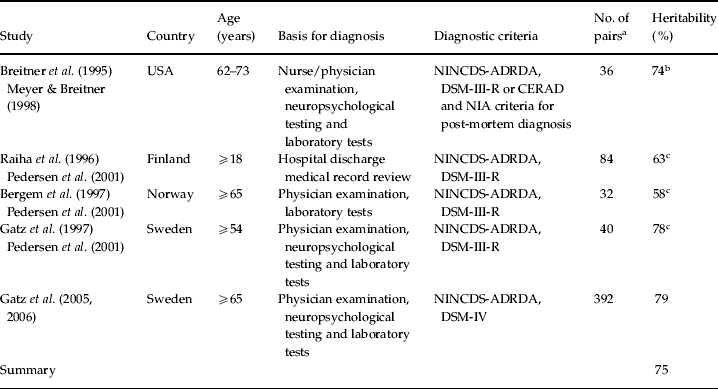
We know of no previous quantitative summary of the heritability of Alzheimer's disease. Table 1 lists the five studies that met our inclusion criteria (Breitner et al. Reference Breitner, Welsh, Gau, McDonald, Steffens, Saunders, Magruder, Helms, Plassman, Folstein, Brandt, Robinette and Page1995; Raiha et al. Reference Raiha, Kaprio, Koskenvuo, Rajala and Sourander1996; Bergem et al. Reference Bergem, Engedal and Kringlen1997; Gatz et al. Reference Gatz, Pedersen, Berg, Johansson, Johansson, Mortimer, Posner, Viitanen, Winblad and Ahlbom1997, Reference Gatz, Fratiglioni, Johansson, Berg, Mortimer, Reynolds, Fiske and Pedersen2005, Reference Gatz, Reynolds, Fratiglioni, Johansson, Mortimer, Berg, Fiske and Pedersen2006; Meyer & Breitner, Reference Meyer and Breitner1998). The most comprehensive investigation, with the largest number of affected twins, is based on the Swedish Twin Registry (Gatz et al. Reference Gatz, Fratiglioni, Johansson, Berg, Mortimer, Reynolds, Fiske and Pedersen2005, Reference Gatz, Reynolds, Fratiglioni, Johansson, Mortimer, Berg, Fiske and Pedersen2006). There was some overlap, in terms of affected subjects, with a smaller previous study based on that registry (Gatz et al. Reference Gatz, Pedersen, Berg, Johansson, Johansson, Mortimer, Posner, Viitanen, Winblad and Ahlbom1997). The weighted mean heritability estimate was 75%, whether or not we included the earlier study (Gatz et al. Reference Gatz, Pedersen, Berg, Johansson, Johansson, Mortimer, Posner, Viitanen, Winblad and Ahlbom1997).
Twin studies of Alzheimer's disease

NINCDS-ADRDA, National Institute of Neurological and Communicative Disorders and Stroke – Alzheimer's Disease and Related Disorders Association; CERAD, The Consortium to Establish a Registry for Alzheimer's Disease; NIA, National Institute on Aging.
a At least one twin affected.
b Best-fitting multiple-threshold (age at onset) model by Akaike's Information Criteria (note: models with no additive genetic component, only a shared environmental component, or a smaller additive genetic component plus a shared environmental component, fit almost as well). Models assumed that all subjects would develop Alzheimer's disease if subjects lived long enough.
c Estimated using a single-threshold model, not accounting for age (potentially inflates the estimate of a shared environmental component) (Pedersen et al. Reference Pedersen, Posner and Gatz2001).
Sullivan et al. (Reference Sullivan, Kendler and Neale2003s) performed a meta-analysis of published twin studies of schizophrenia, incorporating ascertainment corrections. Although only four of the 12 twin studies met modern methodological standards, the results did not vary significantly between studies that did and did not meet these standards. The point estimate of heritability was 81%.
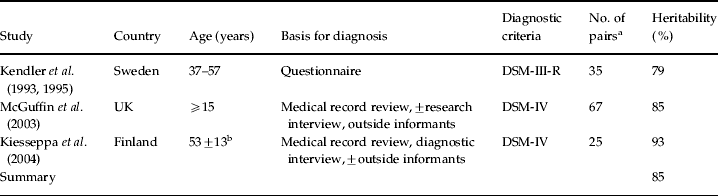
We know of no previous quantitative summary of the heritability of bipolar disorder using twin studies that meet modern methodological standards. Table 2 lists the three studies that met our inclusion criteria (Kendler et al. Reference Kendler, Pedersen, Johnson, Neale and Mathe1993, Reference Kendler, Pedersen, Neale and Mathe1995; McGuffin et al. Reference McGuffin, Rijsdijk, Andrew, Sham, Katz and Cardno2003; Kieseppa et al. Reference Kieseppa, Partonen, Haukka, Kaprio and Lonnqvist2004). Note that the affected subjects in the Maudsley study by Cardno et al. (Reference Cardno, Marshall, Coid, Macdonald, Ribchester, Davies, Venturi, Jones, Lewis, Sham, Gottesman, Farmer, McGuffin, Reveley and Murray1999) were included in the later study by McGuffin et al. (Reference McGuffin, Rijsdijk, Andrew, Sham, Katz and Cardno2003). The weighted mean heritability estimate was 85%.
Twin studies of bipolar disorder

a At least one twin affected.
b Mean±standard deviation.
Sullivan et al. (Reference Sullivan, Neale and Kendler2000) conducted a meta-analysis of published twin studies of major depressive disorder in 2000; five studies met inclusion criteria. The point estimate of heritability was 37%. In a more recent large Swedish twin study, Kendler et al. (Reference Kendler, Gatz, Gardner and Pedersen2006b) reported a similar heritability estimate for lifetime major depressive disorder (38%).
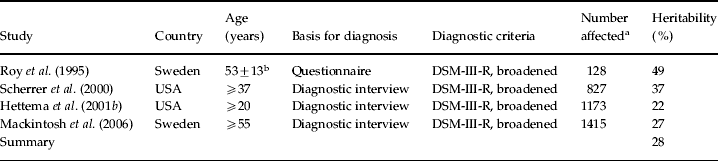
Hettema et al. (Reference Hettema, Neale and Kendler2001a) conducted a meta-analysis of published twin studies of panic disorder; three studies met inclusion criteria. The point estimate of heritability was 43%. Although two published twin studies of generalized anxiety disorder were meta-analyzed by Hettema et al. (Reference Hettema, Neale and Kendler2001a), the authors excluded one eligible study because of its complex ascertainment scheme (Roy et al. Reference Roy, Neale, Pedersen, Mathe and Kendler1995), and an additional eligible study has been published since the meta-analysis (Mackintosh et al. Reference Mackintosh, Gatz, Wetherell and Pedersen2006). Table 3 lists the four studies that met our inclusion criteria (Roy et al. Reference Roy, Neale, Pedersen, Mathe and Kendler1995; Scherrer et al. Reference Scherrer, True, Xian, Lyons, Eisen, Goldberg, Lin and Tsuang2000; Hettema et al. Reference Hettema, Prescott and Kendler2001b; Mackintosh et al. Reference Mackintosh, Gatz, Wetherell and Pedersen2006); one study only included males (Scherrer et al. Reference Scherrer, True, Xian, Lyons, Eisen, Goldberg, Lin and Tsuang2000). The weighted mean heritability estimate was 28%.
Twin studies of generalized anxiety disorder

a Among subjects in complete pairs, estimated.
b Mean±standard deviation.
Behavioral disorders
Goldman et al. (Reference Goldman, Oroszi and Ducci2005) reviewed large unselected twin studies of substance use disorders. Weighted mean heritability estimates were as follows: cannabis use disorder (abuse or dependence), 43% (five studies); sedative use disorder, 51% (three studies); stimulant use disorder, 40% (three studies); cocaine use disorder, 72% (three studies); and alcohol dependence, 56% (five studies). We identified one more recent eligible study of cannabis use disorder (Kendler et al. Reference Kendler, Aggen, Tambs and Reichborn-Kjennerud2006a), and in this study the heritability estimate was higher than most previous studies (77%); including it (total of six studies), the weighted mean heritability estimate was 48%.
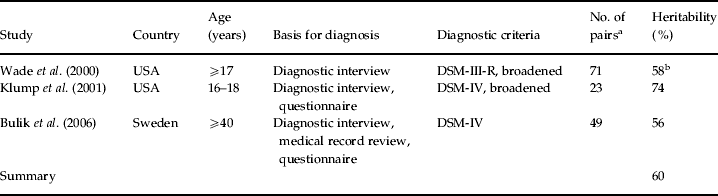
We know of no previous quantitative summary of the heritability of anorexia nervosa. Table 4 lists the three studies that met our inclusion criteria (Wade et al. Reference Wade, Bulik, Neale and Kendler2000; Klump et al. Reference Klump, Miller, Keel, McGue and Iacono2001; Bulik et al. Reference Bulik, Sullivan, Tozzi, Furberg, Lichtenstein and Pedersen2006); these studies only included women. The weighted mean heritability estimate was 60%.
Twin studies of anorexia nervosa

a At least one twin affected.
b Estimated in best-fitting bivariate model with major depressive disorder.
Summary
Fig. 1 shows heritability summary estimates for psychiatric diseases/disease-like conditions and behavioral disorders. Bipolar disorder, schizophrenia, Alzheimer's disease and cocaine use disorder had the highest heritabilities of the phenotypes addressed in this report: all ⩾70%. The phenotypes with the next highest heritabilities (40–60%) were anorexia nervosa, alcohol dependence, sedative use disorder, cannabis use disorder, panic disorder and stimulant use disorder. The least heritable phenotypes (heritabilities <40%) were major depressive disorder and generalized anxiety disorder.
Heritability summary estimates for psychiatric diseases/disease-like conditions (▪) and behavioral disorders (□).

Discussion
Our results do not strongly support the prediction that psychiatric ‘diseases’ are more heritable than behavioral disorders. On the one hand, Alzheimer's disease and two disease-like conditions, schizophrenia and bipolar disorder, have very high heritabilities. On the other hand, panic, major depressive and generalized anxiety disorders have substantially lower heritabilities, lower than those of most of the behavioral disorders examined. Thus, there is little indication of a systematic relationship between the disease-like character of a psychiatric disorder and its heritability. Indeed, idiopathic Parkinson's disease, another neuropsychiatric condition with a known histopathology, does not seem to be particularly heritable (Wirdefeldt et al. Reference Wirdefeldt, Gatz, Schalling and Pedersen2004).
It might be argued that major depression and anxiety disorders should not be considered ‘disease-like’, as these conditions are frequently accompanied by long-standing personality vulnerabilities (Roth et al. Reference Roth, Gurney, Garside and Kerr1972; Bienvenu et al. Reference Bienvenu, Samuels, Costa, Reti, Eaton and Nestadt2004, Reference Bienvenu, Stein, Samuels, Onyike, Eaton and Nestadt2009). Major depression is probably a heterogeneous condition, including a more disease-like ‘endogenous’ form and a less disease-like ‘neurotic’ form (Roth, Reference Roth2001; Shorter, Reference Shorter2009). Although some studies suggest that endogenous features are associated with higher heritability (Leckman et al. Reference Leckman, Caruso, Prusoff, Weissman, Merikangas and Pauls1984a, Reference Leckman, Weissman, Prusoff, Caruso, Merikangas, Pauls and Kiddb; McGuffin et al. Reference McGuffin, Katz, Watkins and Rutherford1996), aspects of depressive illness that are particularly salient for heritability include the related features recurrence, early onset, and perhaps short duration (Kendler et al. Reference Kendler, Gatz, Gardner and Pedersen2007). When adjusted for the latter features, endogenous symptoms do not uniquely predict heritability (Weissman et al. Reference Weissman, Merikangas, Wickramaratne, Kidd, Prusoff, Leckman and Pauls1986; Kendler et al. Reference Kendler, Neale, Kessler, Heath and Eaves1994; McGuffin et al. Reference McGuffin, Katz, Watkins and Rutherford1996). In addition, the presence of co-morbid anxiety disorders is found to increase, rather than decrease, the heritability of depressive illness (Weissman et al. Reference Weissman, Merikangas, Wickramaratne, Kidd, Prusoff, Leckman and Pauls1986; Kendler et al. Reference Kendler, Neale, Kessler, Heath and Eaves1994).
Our results are inconsistent with the notion that psychiatric problems can be divided accurately into those that are ‘biologically’ caused and involuntary versus those that involve choices. That is, our findings support the proposition that biological/genetic factors influence volitional behavior, although it seems unlikely that genes simply evoke particular problem behaviors. The mechanisms through which genetic factors influence behavior are probably numerous. For example, genes can alter the hedonic and/or adverse effects of cannabis (Lyons et al. Reference Lyons, Toomey, Meyer, Green, Eisen, Goldberg, True and Tsuang1997) and alcohol (Thomasson & Li, Reference Thomasson and Li1993), making it more or less pleasant to consume these substances. Genes can also influence levels of sensation-seeking (Agrawal et al. Reference Agrawal, Jacobson, Prescott and Kendler2004), making some individuals more prone to behaviors such as drug use that are rewarding in the short term but harmful in the long term. Other heritable temperamental traits may similarly influence the development of eating disorders (Wade et al. Reference Wade, Tiggemann, Bulik, Fairburn, Wray and Martin2008). Although personal decisions are no doubt important in behavioral disorders, genes clearly influence their development. Thus, genes do not respect the boundary between ‘free will’ and ‘determinism’.
One final implication of our findings is noteworthy. When we think about diseases in psychiatry, we often think not only about high heritability but also about low levels of personal responsibility and blame-worthiness. By contrast, when we consider behavioral disorders (especially substance use disorders), we sometimes think not only of reduced genetic influences but also of higher levels of personal responsibility and blame-worthiness. After all, because behavior is under at least partial voluntary control, it seems natural to assume that a behavioral disorder is ‘the patient's fault’. Indirectly, our findings challenge this assumption. Given the apparent lack of a consistent relationship between heritability and disease versus disturbed behavior, should we also re-examine our conception about the relationship between disease and disturbed behavior on the one hand and moral responsibility and blame-worthiness on the other? Our results emphasize the important distinction between stigmatizing destructive behaviors in a treatment context and stigmatizing patients in a social (especially medical) context. Unfortunately, persons with behavioral disorders such as alcoholism are stigmatized, and not just by the general public (Farrell & Lewis, Reference Farrell and Lewis1990; Schomerus et al. Reference Schomerus, Matschinger and Angermeyer2006; To & Vega, Reference To and Vega2006). Given that vulnerability to behavioral disorders is under substantial genetic control, our results emphasize the inappropriateness of libertarian attitudes towards these devastating conditions. That is, we humans do not seem to be equally free in our decisions.
Limitations
Three limitations deserve comment. First, it is important to recognize that the genetic influence on a phenotype (heritability) is not immutable; it is dependent upon the environment. Indeed, it is most accurate to characterize heritability of an illness in terms of a specific population at a particular point in time (Kendler, Reference Kendler2005). Because different environmental factors may be relevant for different psychiatric illnesses in particular populations, it is difficult to address this limitation effectively. Nevertheless, within cohorts, the pattern of results in Fig. 1 seems to be consistent. For example, in studies using Swedish Twin Registry data with the same or overlapping birth cohorts, heritability estimates were as follows: bipolar disorder, 79%; Alzheimer's disease, 78–79%; anorexia nervosa, 56%; major depressive disorder, 38%; and generalized anxiety disorder, 27% (Kendler et al. Reference Kendler, Pedersen, Neale and Mathe1995, Reference Kendler, Gatz, Gardner and Pedersen2006b; Gatz et al. Reference Gatz, Pedersen, Berg, Johansson, Johansson, Mortimer, Posner, Viitanen, Winblad and Ahlbom1997, Reference Gatz, Reynolds, Fratiglioni, Johansson, Mortimer, Berg, Fiske and Pedersen2006; Bulik et al. Reference Bulik, Sullivan, Tozzi, Furberg, Lichtenstein and Pedersen2006; Mackintosh et al. Reference Mackintosh, Gatz, Wetherell and Pedersen2006). Also, in studies using adult Virginia Twin Registry data, heritability estimates were as follows: drug use disorder, 66%; alcohol dependence, 49%; major depressive disorder, 39%; panic disorder, 37%; and generalized anxiety disorder, 22% (Kendler & Prescott, Reference Kendler and Prescott1999; Hettema et al. Reference Hettema, Prescott and Kendler2001b; Kendler et al. Reference Kendler, Gardner and Prescott2001, Reference Kendler, Prescott, Myers and Neale2003).
Second, unreliability, a form of measurement error, is confounded with unique environmental effects in twin models, and some diagnoses are more reliable than others in unselected samples. For example, in studies of adults using the Virginia Twin Registry, the reliabilities of lifetime diagnoses of panic, major depressive and generalized anxiety disorders tended to be lower (κ=0.34–0.56) than those of cocaine, sedative, cannabis and stimulant use disorders (κ=0.47–0.68) (Foley et al. Reference Foley, Neale and Kendler1998; Hettema et al. Reference Hettema, Prescott and Kendler2001b; Kendler et al. Reference Kendler, Karkowski, Neale and Prescott2000, Reference Kendler, Gardner and Prescott2001). As no psychiatric diagnosis is made with complete reliability, heritability estimates tend to be underestimates, but the heritabilities of the disease-like conditions above would be expected to be slightly more underestimated than those of the substance use disorders. Nevertheless, it is unlikely that correcting heritability estimates for unreliability would substantially reorder the results in Fig. 1. In fact, the reliability of cocaine dependence (κ=0.47) was slightly lower than that of panic disorder (κ=0.56) in the studies cited above, yet the heritability estimates from these studies were 0.79 and 0.37 respectively for these diagnoses.
Third, etiologic heterogeneity is likely in psychiatric disorders, so our heritability estimates inevitability reflect an averaging across potentially different etiologies. For example, as noted earlier, certain clinical aspects of major depressive disorder are associated with higher heritability, including recurrence and early age-at-onset (Sullivan et al. Reference Sullivan, Neale and Kendler2000; Levinson et al. Reference Levinson, Zubenko, Crowe, Depaulo, Scheftner, Weissman, Holmans, Zubenko, Boutelle, Murphy-Eberenz, MacKinnon, McInnis, Marta, Adams, Sassoon, Knowles, Thomas and Chellis2003). However, it is not clear that problems of etiologic heterogeneity would impact heritability estimates differentially for disease-like versus behavioral conditions.
Acknowledgments
The US National Institutes of Health grant K23-MH64543 (Dr Bienvenu) supported this study. We thank Drs P. McHugh, P. Slavney and G. Nestadt, and anonymous reviewers for helpful comments regarding this project.
Declaration of Interest
None.