I. INTRODUCTION
AA5083 alloys are non-heat-treatable wrought aluminum alloys. Due to their good formability, metal forming processes such as rolling, forging and extrusion are widely applied to improve microstructure and strength of these alloys. Reference Charit and Mishra1–Reference Davis3 Although AA5083 alloys have good corrosion resistance, the presence of β phase (Mg2Al3), whose electrode potential is lower than aluminum matrix, is harmful to corrosion resistance. Reference Davis3 β phases precipitate along grain boundaries continuously in the temperature range of 50–200 °C and tend to be corroded in the corrosive environments because of the anodic reaction. Reference Bovard, Shifler, Tsuru, Natishan and Ito4,Reference Searles, Gouma and Buchheit5 Therefore, continuous precipitation of β phases along grain boundaries impairs corrosion resistance of the alloys and leads to high susceptibility to intergranular corrosion (IGC) and stress corrosion cracking (SCC). For avoiding a notable reduction in the resistance to IGC and SCC, discontinuous precipitation of β phase at grain boundary is desired, mainly because the paths of IGC can be interrupted and avoid a continuous corrosion. Reference Davis3 Kannan et al. indicated that the discontinuous precipitation along grain boundaries can be observed in the recovery structure of 7XXX series aluminum alloys, which exhibits relatively good resistance to IGC and SCC. Reference Kannan and Raja6 Miljana Popovic et al. reported that β phase precipitation occurs preferentially along grain boundaries in the cold-worked structure, which leads to highly susceptibility to IGC and SCC. Reference Popovic and Romhanji7
In addition to β phase, mechanical properties also should be considered as another factor affecting SCC susceptibility of Al–Mg alloys. This is because SCC is affected by the interaction of stress and corrosion. Reference Jones8 According to the principles of linear elastic fracture mechanics, SCC occurs when the stress intensity factor (K I) at the tips of cracks in alloys exceeds the threshold values (K ISCC). Reference Jones8,Reference Meyers and Chawla9 The threshold values K ISCC depends not only on corrosive environments but also on strength of alloys. Reference Wei and Gangloff10,Reference Speidel11 Although several studies Reference Bulloch12–Reference Savoie, Esnouf, Fournier and Delafosse14 have pointed out that low strength is beneficial to SCC resistance for other alloys, this issue has not been investigated in 5XXX series aluminum alloys.
In the present study, the cold-worked AA5083 alloys were annealed at various temperatures before sensitization to clarify the correlation of the microstructure, tensile properties, IGC, and SCC susceptibility.
II. EXPERIMENTAL PROCEDURE
Commercial AA5083–H116 alloys were treated with a two-stage heat treatment comprising (a) heating at 440 °C for 10 h, (b) heating at 500 °C for 10 h, and (c) water quenching to room temperature. The composition of the experimental alloys analyzed by optical emission spectrometer is shown in Table I. The experimental alloys subjected to the two-stage heat treatment were treated with 50% cold working by rolling (H15 treatment) and then annealed at 150, 200, 250, 300, and 350 °C before air cooling. These annealed alloys were designated as H15, 150, 200, 250, 300, and 350 °C alloys. Sensitization treatment was carried out at 100 °C for 7 days to produce β precipitates, and designated as H15s, 150, 200, 250, 300, and 350 °Cs alloys.
Chemical composition of AA5083–H15 alloys (wt%).

Barker's reagent was used for specimens before optical microscopic examination. Nitric acid mass loss testing was performed according to ASTM-G670-04. For investigating the susceptibility to IGC, the experimental alloys were immersed in the nitric acid solution (70 vol%) at 30 °C for 24 h to obtain the difference in mass before and after Nitric acid mass loss testing.
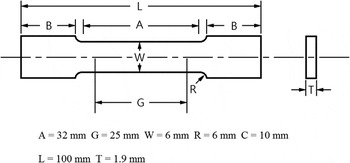
Slow strain rate testing was carried out in the atmosphere and in the 3% NaCl + 0.3% H2O2 solution to investigate the susceptibility of stress corrosion cracking of sensitized alloys. Reference Davis3 The strain rates in the atmosphere and in the 3% NaCl + 0.3% H2O2 solution were 2 × 10⁻⁴ s−1 and 10−5 s−1, respectively. The dimension of experimental specimens in accordance with ASTM B557M is presented in Fig. 1. For estimating susceptibility of SCC, elongation loss rate is defined by the following equation,
 $${\rm{E}}{{\rm{l}}_{{\rm{loss}}\left( \% \right)}} = {{\left( {{\rm{E}}{{\rm{l}}_{{\rm{air}}}} - {\rm{E}}{{\rm{l}}_{{\rm{scc}}}}} \right)} \over {{\rm{E}}{{\rm{l}}_{{\rm{air}}}}}} \times 100\%$$
where Elloss(%) is elongation loss rate, Elair(%) is elongation tested in atmospheric environment, and ElSCC(%) is elongation tested in the corrosive environment.
Rectangular tension test specimens.

III. RESULTS AND DISCUSSION
A. Microstructure
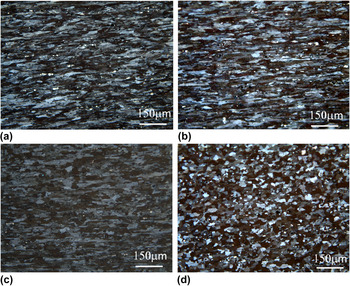
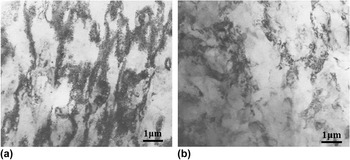
Figure 2 shows the microstructures of the H15, 200, 250, and 300 °C alloys. Cold rolling evidently leads to an elongated grain structure of the H15 and 200 °C alloys. The both alloys have similar microstructure under examination of optical microscopy, as shown in Figs. 2(a) and 2(b). After annealing at 250 °C, very few equiaxed grains can be found and most elongated grains are retained, as presented in Fig. 2(c). Figure 2(d) shows that the microstructure of the 300 °C alloy is apparently different from those in Figs. 2(a)–2(c). This is because annealing temperature above 300 °C has sufficient energy to cause the occurrence of recrystallization. For investigating detailed microstructure of Figs. 2(a) and 2(b), transmission electron microscopy is used. Figure 3 presents the H15 alloy has more tangled dislocations caused by cold working as compared with the 200 °C alloy. The difference in microstructure between Figs. 3(a) and 3(b) suggests that annealing heat treatment at 200 °C results in a partial recovery of the microstructure.
Microstructures of H15 alloys treated with various annealing temperatures. (a) Non-annealing, (b) 200 °C, (c) 250 °C, and (d) 300 °C for 3 h.

TEM micrographs of H15 alloys (a) Non-annealing and (b) after 200 °C annealing heat treatment.

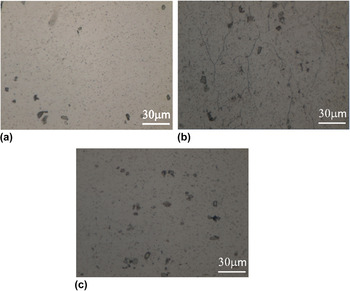
Figure 4 presents the precipitation of β phases in the H15 alloys treated with various annealing temperatures. The H15 alloy, without annealing heat treatment, maintains its original microstructure, so the precipitation of β phase cannot be found in Fig. 4(a). After annealing at 200 °C, continuous precipitation of β phase can be observed, as shown in Fig. 4(b). This result is consistent with the Bovard's conclusion that annealing under 200 °C easily forms a continuous precipitation of β phase. Reference Bovard, Shifler, Tsuru, Natishan and Ito4 Fig. 4(c) shows the absence of precipitation of β phase at annealing temperature of 250 °C, mainly because this annealing temperature markedly exceeds the temperature of precipitation. The behavior of the precipitation of β phase in the 200 °C alloy is different from that in the 250 °C alloys.
Precipitation of β phases in (a) H15, (b) 200 °C, and (c) 250 °C alloys.

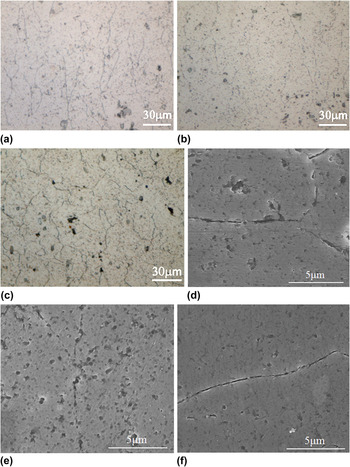
After sensitization treatment, the H15s and 300 °Cs alloys have continuous precipitation of β phase along grain boundaries. In contrast, the 250 °Cs alloys shows the discontinuous precipitation of β phase along grain boundaries. As observed in Fig. 5, the microstructure of 250 °Cs alloy is superior to those of H15s and 300 °Cs alloys because the former exhibits a discontinuous precipitation which has a better corrosion resistance. The microstructure characteristics of the experimental alloys before and after sensitization are tabulated in Table II. However, β phase is prone to precipitate continuously along grain boundaries both in cold-worked and in recrystallization structures. The recovery structure is beneficial to the discontinuous precipitation of β phase.
Precipitation of β phases in (a) H15s, (b) 250 °Cs, (c) 300 °Cs alloys under low magnification, and (d) H15s, (e) 250 °Cs, (f) 300 °Cs alloys under high magnification.

Effect of annealing temperature and sensitization on microstructures of AA5083–H15 alloys.

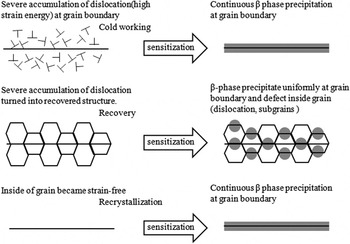
Figure 6 demonstrates the precipitation procedure of β phase in different structure of H15 alloys during sensitization. Because of their high strain energy, phase precipitation occurs preferentially at grain boundaries, the region around constituent particles, and the plane of localized deformation (slip planes and shear bands) of the alloys in cold-worked state. Reference Popovic and Romhanji7,Reference Humphreys15 Thus, the continuous precipitation of β phase along grain boundaries can be easily found in H15s alloy. Recovery can lower high energy of grain boundary by means of dislocation movement. Reference Goswamia, Spanosa, Paoa and Holtza16,Reference Callister17 Lower energy of grain boundary leads to a reduction in the precipitation of β phase along grain boundary. In addition, recovery retains some defects in the grains. These defects in the grains are also preferential nucleation sites for the precipitation of β phase. The slighter difference in the energy between grain boundary and grain interior causes a uniformly distributed precipitation. After recrystallization, high strain energy of the structure is relieved. Heterogeneous nucleation of β phase in the grain interior becomes difficult due to lack of nucleation site. Reference Popovic and Romhanji7 The grain boundaries with high strain energy are preferential nucleation sites for the precipitation of β phase.
Schematic diagrams for the precipitation of β-phase in different microstructures.

B. Corrosion properties
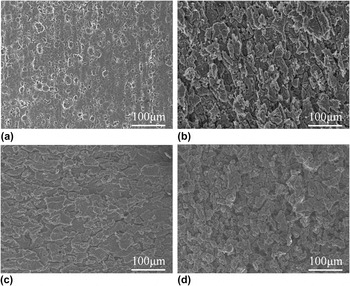
Table III shows the results of ASTM G67 mass loss test for various annealed H15 alloys before and after sensitization. According to the specification of ASTM G67, if the mass loss exceeds 25 mg/cm2, the type of corrosion is regarded as IGC. Table III indicates that both 150 and 200 °C alloys (26.6, 29.8 mg/cm2) are susceptible to IGC before sensitization. This result is consistent with the microstructure examination of the 200 °C alloy which exhibits continuous precipitation of β phase along grain boundaries. After sensitization, only the 250 °Cs alloy (6.7 mg/cm2) is not susceptible to IGC, which is also in agreement with the microstructure examination in Sec. 3.1, that is, alloys with discontinuous precipitation of β phase have a better corrosion resistance. Figure 7(a) shows the presence of pitting in the H15 alloy during mass loss test. The presence of pitting suggests that IGC may not occur. The H15 alloy exhibits good corrosion resistance mainly because it has no precipitation of β phase before sensitization. In contrast, Figs. 7(b) and 7(d) display that the 200 and 300 °Cs alloys have appreciable IGC characteristics during mass loss test. Figure 7(c) shows the slighter IGC of the 250 °Cs alloy, indicating that the corrosion resistance of the 250 °Cs alloy is superior to those of the 200 and 300 °Cs alloys.
ASTM G67 mass loss test of AA5083–H15 alloys (mg/cm2).

Standard deviations are listed in parenthesis.
SEM micrographs of (a) H15, (b) 200 °Cs (c) 250 °Cs, and (d) 300 °Cs alloys after G67 mass loss test.

The H15s alloy (41.9 mg/cm2) has the highest IGC susceptibility in all experiment alloys, because high density of dislocation can facilitate the precipitation of β phase during sensitization. Reference Popovic and Romhanji7,Reference Goswamia, Spanosa, Paoa and Holtza16 The continuous precipitation of β phases along grain boundaries also can be found in the 150 and 200 °Cs alloys. These β phases remain along grain boundaries after sensitization, and therefore both the alloys (35.2, 33.3 mg/cm2) still have severe corrosion. The β phase precipitation in the 250 °Cs alloy exhibits discontinuous precipitation along grain boundaries, which leads to the interruption of IGC and to improvement in corrosion resistance (6.7 mg/cm2). The corrosion resistance of the 300 and 350 °Cs alloys markedly decreases because of the continuous precipitation of β phase during sensitization.
C. Stress corrosion properties
The results of slow strain rate testing of the sensitized alloys are tabulated in Table IV. The loss rate of elongation after slow strain rate testing drops markedly in the H15s, 150, and 200 °Cs alloys. As discussed previously, these sensitized alloys are susceptible to IGC and therefore they also exhibit high susceptibility to SCC in the slow strain rate test. In contrast, the 250, 300, and 350 °Cs alloys have lower loss rate of elongation, indicating those alloys are not susceptible to SCC.
Elongation of sensitized AA5083–H15 alloys after slow strain rate testing.

Standard deviations are listed in parenthesis.
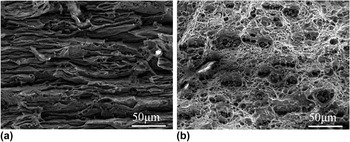
The susceptibility to SCC can be further verified by examining the SEM micrographs of the fracture morphologies of sensitized H15 alloys after slow strain rate testing. Figure 8(a) shows that the intergranular fracture of the elongated grains can be observed in the H15s alloy, which means this alloy is susceptible to SCC. The ductile fracture of the 250 °Cs alloy, shown in Fig. 8(b), indicates that this alloy is not susceptible to SCC. Alloys with good corrosion resistance against environments may avoid occurrence of SCC. Reference Jones8 In the present work, the 250 °Cs alloy exhibits both good IGC and SCC resistances.
SEM micrographs of fracture morphologies of (a) H15s and (b) 250 °Cs alloys after slow strain rate testing.

Although 300 and 350 °Cs alloys have poor IGC resistance, they still exhibit good SCC resistance dramatically. This phenomenon is very different from that of the 250 °Cs alloy. That is, not only IGC resistance but also some factors affect SCC resistance. The difference in tensile properties between the experimental alloys may be an important factor. Numerous studies indicated that alloys with lower strength and higher elongation have better resistance to SCC. Reference Wei and Gangloff10,Reference Bulloch12–Reference Savoie, Esnouf, Fournier and Delafosse14 Table V also shows that the 300 and the 350 °Cs alloys have lower strength and higher elongation as compared with the other experimental alloys. This result is consistent with the references. In addition to the reference, linear elastic fracture mechanics is adopted to support this phenomenon further.
Tensile properties of various annealed AA5083–H15 alloys after sensitization.

Standard deviations are listed in parenthesis.
The stress intensity factor at the crack tip is designated as K I and can be obtained by
 $${K_{\rm{I}}} = Y\sigma \sqrt {\pi a}$$
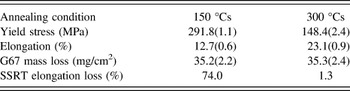
where Y is dimensionless parameters, σ is normal applied stress on materials, and a is crack length. K ISCC is the critical value of stress intensity factor for SCC. Alloys with high K ISCC exhibit better SCC resistance. Reference Jones8,Reference Meyers and Chawla9 In general, alloys with lower yield strength have higher K ISCC. The nucleation and propagation of cracks caused by interaction between stress and corrosion are the main reason for the formation of SCC. The cracks of Al–Mg alloys are easy to be attacked along grain boundaries and cause the deeper ones under stress and corrosive environments. Thus, the mass loss in ASTM G67 test is deemed as the crack length in the present work. The strength of alloys increases with the increment of strain in slow strain rate testing. This static stress can be deemed as σ. Table VI shows that the mass loss of the 150 °Cs alloys (35.2 mg/cm2) is approximately equivalent to that of the 300 °Cs alloy (35.3 mg/cm2), which implies that the both alloys have almost the same crack length. On the other hand, the yield strength of the 150 °Cs alloys (291.8 MPa) is markedly superior to the 300 °Cs alloys (148.4 MPa). According to Eq. (1), the tip of crack in the 150 °Cs alloy can sustain larger K I value than that in the 300 °Cs alloy under the same condition. In general, the materials with higher strength have lower K ISCC. Therefore, the stress intensity factor K I can easily exceed K ISCC and cause occurrence of SCC in the 150 °Cs alloy. In contrast, the 300 °C alloy with lower K I and higher K ISCC may avoid occurrence of SCC.
Tensile, corrosion and stress corrosion properties of 150 and 300 °Cs alloys.

Standard deviations are listed in parenthesis.
IV. CONCLUSIONS
The effects of annealing temperature on stress corrosion sensitivity of AA5083–H15 alloys were investigated in the present study and the following conclusions can be drawn:
-
(1) The H15 alloy is less susceptible to IGC. After sensitization, this alloy has the highest susceptibility to IGC and SCC in all experimental alloys.
-
(2) The 150 and 200 °C alloys exhibit continuous precipitation of β phase along grain boundaries and become susceptible to IGC. After sensitization, both alloys are also susceptible to IGC and SCC.
-
(3) The 250 °C alloy is less susceptible to IGC due to absence of the precipitation of β phase at grain boundaries. After sensitization, discontinuous precipitation of β phase along grain boundaries is found and this alloy is also less susceptible to IGC and SCC.
-
(4) The 300 and 350 °C alloys are less susceptible to IGC. After sensitization, both alloys are more susceptible to IGC but less susceptible to SCC.
ACKNOWLEDGMENTS
The authors thank the Ministry of Science and Technology, R.O.C. for financially supporting this research under Contract No. MOST104-2221-E-008-015-MY2.