Introduction
According to the Freedom House's 2006 rating on political rights and civil liberties for the countries in the Asia-Pacific region, sixteen (41%) are classified as ‘free’, twelve (31%) as ‘partly free’, and eleven (28%) as ‘not free’.Footnote 2 This ‘balanced’ distribution stands out when we compare it with that of Western Europe (96% of countries are ‘free’), the Americas (71% of countries are ‘free’), or the Middle East and North Africa (only 6% of countries are ‘free’), providing abundant opportunities for comparative political analysis from various points of view. One topic that can be explored is the relationship between macro-political settings and the micro-political attitudes of citizens who live in these countries. Do political attitudes of the citizens in each country differ considerably, reflecting the diversity of state institutions that can be found in Asia? If so, which aspects of country-level differences are responsible for the variation?
In answering these questions, the two separate survey data sets collected by the AsiaBarometer (Tokyo) and the Center for the Study of Developing Societies (Delhi) are useful materials for empirical analysis, because together they cover eleven Asian societies and share several important issues typically used to measure political attitudes of ordinary citizens. Whereas the latest wave of the AsiaBarometer Survey examined six societies in East Asia – China, Hong Kong, Japan, South Korea, Singapore, and TaiwanFootnote 3 – the latest South Asian Survey covers Bangladesh, India, Nepal, Pakistan, and Sri Lanka.Footnote 4
In this article, our goal is to examine how macro-political differences influence micro-political attitudes of ordinary citizens using both of these Asian data sets. With the introduction of a multilevel modeling technique into the field of political science, the number of studies that incorporate the causal effects of macro-level differences on micro-level phenomena has rapidly increased. Hence, the idea of a cross-level causal relationship itself is not new. Matthew Carlson and Ola Listhaug (2006), in their analysis of public opinion on the political role of religion, examine the effects of GDP per capita, Freedom House scores, and ethnic fractionalization, while Raymond Duch and Randy Stevenson (2005) explore the possibility that individual-level economic voting is influenced by the national-level concentration of policymaking responsibility, to name but a few. In that sense, this article is another empirical study that contributes to the accumulation of the literature. But it is also unique in that it focuses on the context of Asia, the world's epitome in terms of institutional variety.
We organized the article as follows. The first half of the article devotes much space to the description of political diversity in Asia. After briefly outlining the macro-political contexts in Asia with a special focus on the eleven societies, we classify the present state of macro-politics using the component variables of Freedom House rating as well as those of the Polity IV scores, two well-known data sets on political regime. In doing so, we use the component variables rather than aggregated variables because we are interested in which aspects of the macro-political institutions are related to the micro-political attitudes. We then examine the micro-level differences in these countries based on the two surveys, comparing frequency distributions of responses to the broadly comparable questions and the factor scores extracted as the underlying dimensions of political attitudes from each sample. The factors common to both regions are: (1) citizens’ attitudes toward political activities other than voting, (2) their commitment to a democratic system, (3) their political frustration, and (4) their confidence in their ability to govern themselves.
The second half of the article explores the sources of these variations in individual factor scores. Particularly, we test whether they are attributable to the country-level differences in political institutions using random-effect regression models with the component variables of Freedom House and Polity IV as main predictors. The results show that although the country-level predictors for citizens’ attitudes toward direct political actions are common to both regions (ethno-linguistic fractionalization and the degree of institutionalization of preference articulation), factors influencing the variations in other dimensions – their commitment to a democratic system, their political frustration, and their confidence in their ability to govern themselves – are different between the two regions. Specifically, the effects of political competitiveness and inclusiveness are more salient in South Asia than in East Asia. Based on these results, we discuss the possible reason of this causal heterogeneity and posit, as a route for further study, a hypothesis that the effects of institutional differences vary depending on the stability of regime: the more frequent regime changes are, the more vivid institutional differences might be for ordinary citizens. We summarize our findings in the final section.
Macro-level political diversity in Asia
As a beginning, we review the diversity of the macro-political settings in the eleven Asian societies of China, Hong Kong, Japan, South Korea, Singapore, Taiwan, Bangladesh, India, Nepal, Pakistan, and Sri Lanka. Among the many macro-level differences found in these countries, the following three factors seem to be important as possible determinants of the political attitudes of ordinary citizens: (1) difference in regime type, (2) difference in election opportunities, and (3) difference in actual development of politics.
First, of the eleven countries included in this study, six countries satisfy the procedural minimum requirements of democracy, namely, Japan, South Korea, Taiwan, Bangladesh, India, and Sri Lanka.Footnote 5 Although there might be some irregularities, people in these countries can, in principle, change their government through the ballot box. By contrast, in the remaining countries there exist no equivalent systems: in China, Hong Kong, and Singapore the ruling party monopolizes political power, whereas in Nepal and Pakistan national politics is controlled by the king and the military, respectively. A corollary of this is that freedom of choice (in elections), speech, association, and expression are more severely curtailed in these latter countries.
Apart from this fundamental difference in regime type, the countries differ in terms of the institutional framework of their electoral system. For instance, South Korea, Singapore, Taiwan, and Sri Lanka, adopt direct elections for both the assembly (lower chamber) and the head of state (president). At the other extreme is China, where the national assembly (the National People's Congress) is indirectly elected. Hong Kong is unique in that only one-half of the seats in its Legislative Council are directly elected, whereas the remaining half are reserved for the professional and special interest groups designated by the authority. Although the meaning of voting may be fundamentally defined by the type of regime, these differences in the institutional framework itself can play a part in structuring people's attitudes.
Perhaps more important are the political developments in each country, which can be compared from several points of view. In terms of experience with democracy, Japan, India, and Sri Lanka are the three oldest democracies lasting more than 50 years. It was not until the end of the Cold War that other democracies – that is, South Korea, Taiwan, and Bangladesh – made transitions to democracy. (Nepal and Pakistan also attempted to introduce a democratic system of governance at the time, but it was in vain.) In terms of changing governments, however, Japan is the most problematic in that the ruling Liberal Democratic Party has remained in power since 1955, with the exception of a brief 10-month period in the early 1990s, whereas viable alternative parties exist in other democracies. Still, competition does not always promise a healthy functioning of democracy. In Bangladesh, for example, a harsh rivalry between the Bangladesh Nationalist Party and the Awami League has led to the chronic boycotts of parliament and periodic nationwide strikes, destabilizing politics as well as the economy. From a security viewpoint, Sri Lanka and Nepal are in a group together in that politics revolves around long-standing civil wars. Severe political violence also spoils politics in India and Pakistan. By contrast, countries in East Asia are generally free from political violence.
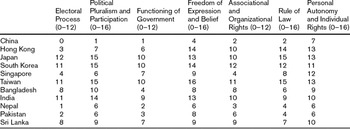
These diversities in politics are captured concisely in the scores of the component variables rated by two databases used widely in comparative politics – the Freedom House and the Polity IV. Although not as famous as the 3-point Freedom Status or the 7-point rating of political rights and civil liberties, the Freedom House data set contains seven component variables: (1) Electoral Process, (2) Political Pluralism and Participation, (3) Functioning of Government, (4) Freedom of Expression and Belief, (5) Associational and Organizational Rights, (6) Rule of Law, and (7) Personal Autonomy and Individual Rights. Each variable is the sum of scores given to three or four questions for the respective areas. For example, in the area of ‘Electoral Process’, the following three questions are asked:
• Is the head of government or other chief national authority elected through free and fair elections?
• Are the national legislative representatives elected through free and fair elections?
• Are the electoral laws and framework fair?
Each of the three questions is evaluated on a scale of ‘0’ to ‘4’, where a point of ‘0’ represents the smallest degree and a point of ‘4’ the greatest degree of rights or liberties present. The resulting total score for this area ranges from ‘0’ to ‘12’.Footnote 6 From Table 1, it is evident that in all aspects of the macro-political settings measured by these variables, the countries under investigation in this article show considerable variations.Footnote 7
Variations of macro-political settings in Asia measured by the component variables of Freedom House data set

Note: All scores are evaluation in 2006. Ranges of variables are in parentheses.
Source: Freedom House.
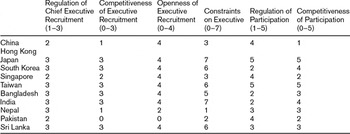
Similarly, the Polity IV data set, other than the often-used 11-point Polity Score, contains six component variables, namely, Regulation of Chief Executive Recruitment (XRREG, ranging from ‘1’ to ‘3’), Competitiveness of Chief Executive Recruitment (XRCOMP, from ‘0’ to ‘3’), Openness of Chief Executive Recruitment (XROPEN, from ‘0’ to ‘4’), Constraints on Chief Executive (XCONST, from ‘0’ to ‘7’), Regulation of Participation (PARREG, from ‘1’ to ‘5’), and Competitiveness of Participation (PARCOMP, from ‘0’ to ‘5’). All variables are ordinal measures that indicate a greater degree of regulation, constraints, competitiveness, and openness with larger values. As Table 2 shows, the countries also vary considerably in terms of these measures. However, the variables of Polity IV are not just the alternatives for variables of Freedom House. The main feature that differentiates the variables of Polity IV from those of Freedom House is that the two regulation measures – XRREG and PARREG – are relatively independent of the degree of democratization. The former asks whether there are any established procedures for transferring executive power, and the latter asks whether there are any enduring political organizations and binding rules for preference articulation by citizens. These two variables mainly evaluate the degree of institutionalization without differentiating among the processes of executive recruitment or participation, as is exemplified by the high scores of non-democracies regarding the regulation measures.Footnote 8
With these macro-political divergences in mind, in the next section we shift the level of analysis from macro- to micro-level, describing the individual political attitudes found in the eleven Asian societies. The main purpose is to detect national differences. The sources of the data are the two separate survey projects that were conducted in East Asia (AsiaBarometer Survey) and South Asia (South Asia Survey) in 2006. The eleven questions common to the two surveys can be categorized into the following six parts: (1) people's feelings of their own political power, (2) their frequency of voting in national elections, (3) their participation in other political activities, (4) their attitudes toward freedom of speech, (5) their satisfaction with the way democracy works in their own country, and (6) their preference for the type of political system that should govern their own country. Do citizens in different countries collectively tend to show some particular patterns, or do their attitudes vary completely and randomly regardless of the country in which they reside?
Variations of macro-political settings in Asia measured by the component variables of Polity IV data set

Note: All scores are evaluation in 2004. Ranges of variables are in parentheses.
Source: Polity IV.
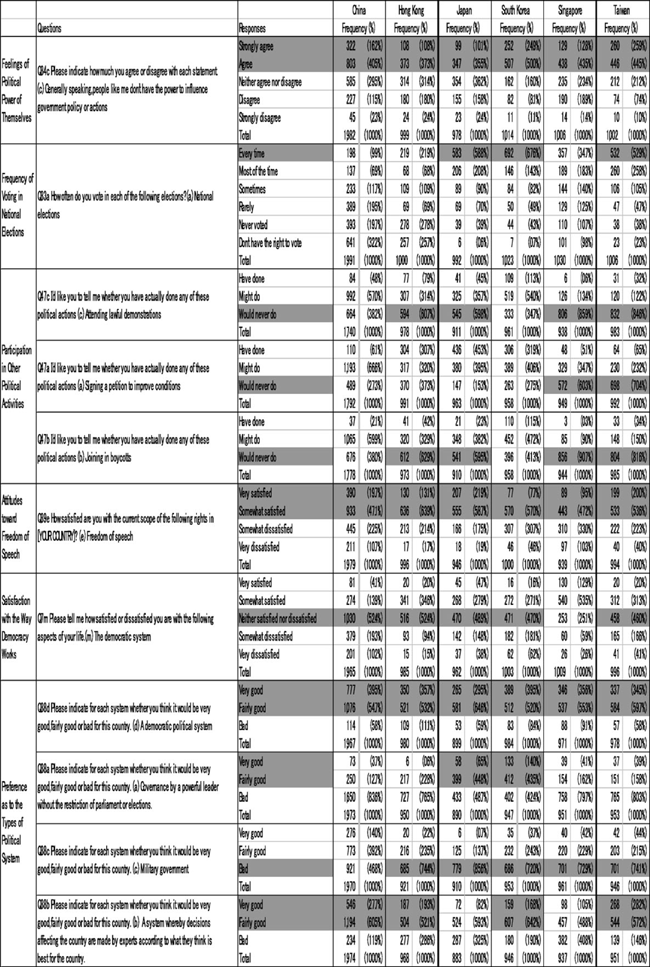
Frequencies of Answers to Each of the 11 Questions by Country (East Asia)
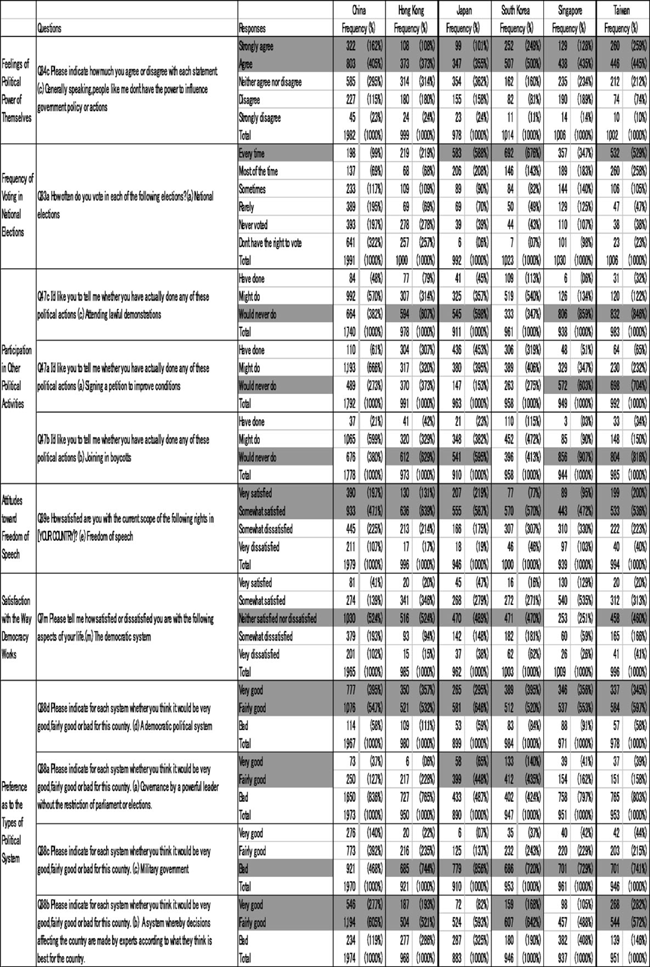
Note: Num bers are raw counts. Relative frequencies are in parentheses.
Source: AsiaBarometer 2006.
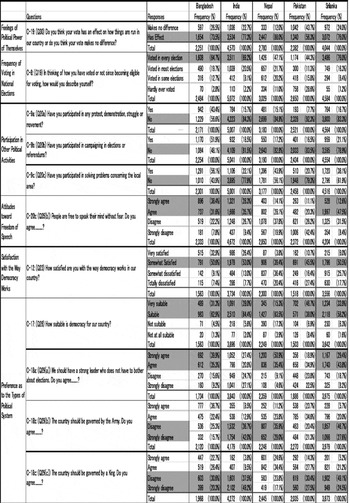
Frequencies of Answers to Each of the 11 Questions by Country (South Asia)

Note: Figures are raw counts. Relative frequencies are in parentheses.
Source: South Asia Survey 2006.
Micro-level political diversity in Asia
We begin with examining the frequency distributions of the responses to each of the questions, which are reasonably comparable between the two surveys. The first three columns of Tables 3 and 4 list the six categories of political attitudes that we intend to measure, the wordings of the eleven questions used in the two surveys, and the corresponding choices available for respondents, followed by the frequencies observed in respective countries. ‘Don't know’ answers are treated as missing values. As the tables reveal, the questions and answers are not exactly the same in the two modules. In particular, the questions used to measure respondents’ feelings of political powerlessness differ slightly between the East and South Asian surveys. Although the question for East Asia asks about political effectiveness in general, the question for South Asia specifies the effect of voting. Second, the types of political activities listed in the question on political participation are different except for the question on demonstrations. Third, the question asked in relation to freedom of speech is not the same in the East and South Asian surveys: respondents in the latter group are asked whether or not they think that freedom of speech exists in their respective countries, whereas those in the former are asked whether they are satisfied with the current scope of that right. Finally, the third type of non-democratic system listed in the question on regime preference is not the same: the question asks about technocracy in East Asia and about absolute monarchy in South Asia. Despite these nuances, we believe that a parallel examination of results should provide some interesting insights.
Our first immediate observation is the existence of a regional contrast in the responses to the question on political effectiveness. An overwhelming number of people in most South Asian countries believe in their power to influence national politics through their votes, whereas almost one-half of the citizens surveyed in East Asia are sceptical about their individual political effectiveness. The sum of the positive responses (‘strongly agree’ and ‘agree’) to the statement, ‘generally speaking, people like me don't have the power to influence government policy or actions’, exceeds 50 percent in China, South Korea, Singapore, and Taiwan. In contrast, more than 70 percent of people in most of the countries in South Asia exhibit confidence in the importance of their vote. Only Pakistanis have a lower level of confidence (56.3%), probably a reflection of the ‘election without democracy’ conducted in 2002 under President Musharraf.
Second, inter-regional commonalities are found in responses to the question regarding satisfaction with the ‘present democracy’ and to questions about participation in political activities other than voting. In the first question, with the exception of Singapore, most respondents indicated a neutral position: ‘neither satisfied nor dissatisfied’ in East Asia and ‘somewhat satisfied’ in South Asia. In the second question, participation in direct actions other than voting is less popular in most countries of both regions. One apparent exception is Bangladesh, in which two of the three types of activities are participated in by more than one-half of the respondents. Nepal and Sri Lanka are relatively active, but only in terms of local problems. Among East Asian countries, the citizens of China and South Korea show a strong intention to participate in direct political actions, although the percentages of people who have actually done so are much lower than those of Bangladesh. Japan and Hong Kong are active only in terms of signing petitions.
Of the remaining aspects, the frequency distributions are not that simple. On the regularity of voting, more than one-half of the population votes regularly in Japan, South Korea, and Taiwan; the same assertion applies to Bangladesh, India, and Sri Lanka. For freedom of speech, the majority of East Asian citizens are, regardless of the type of current regime, satisfied with the present situation in their respective countries, whereas among the South Asian countries, only Bangladesh, India, and Sri Lanka have more than one-half of the citizens answering positively in this category. Finally, common patterns across regions are also found regarding legitimacy of democratic systems: more than one-half of the people in each country endorse it. But ‘approval ratings’ of the alternatives to democracy exhibit considerable variation among countries. An unrestricted leader system is popular in Japan, South Korea, Bangladesh, Nepal, and Sri Lanka, whereas a generally unpopular military government can be more widely accepted in China, Bangladesh, and Pakistan. Rejection of technocratic rule is strong only among Japanese and Singaporeans in East Asia, whereas a monarchy would be unpopular among all South Asians, with the exception of the Nepalese among whom the monarchy is popular.
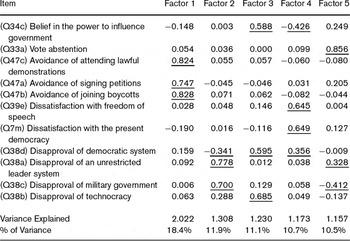
As the foregoing analysis of frequency tables shows, people in different countries exhibit similar as well as divergent responses depending on the questions asked. This suggests a considerable variation of political attitudes among nations. To better understand the national differences, we next try to simplify the variations of political attitudes as much as possible because multiple questions, although providing us with a lot of information on how citizens answer specific questions, do not inform us about the underlying political attitudes that tend to be associated with these response patterns. For that purpose, we employ factor analysis using the principal components as the method of factor extraction. With this method, we should be able to avoid arbitrarily selecting one question from the multiple questions we have chosen to measure the political attitudes of ordinary citizens. Five factors were extracted from the East Asia sample, and rotated using the varimax method. The resultant factor loadings are given in Table 5. For each factor, the questions (items) with a correlation greater than 0.3 or smaller than −0.3 are underlined for ease of interpretation. The original values of the response categories are in ascending order, indicating the more negative the answer is to that question, the higher the score; the items in Table 5 (and also in Table 6) paraphrase the original questions for ease of interpretation.
Rotated component matrix: East Asia

Note: Items are the paraphrases of the original questions listed in Table 3.
Extraction Method: Principal Component Analysis. Rotation Method: Varimax with Kaiser Normalization.
Kaiser-Meyer-Olkin Measure of Sampling Adequacy = 0.627. Bartlett's Test of Sphericity (Approx. Chi-Square = 5355.42, Degree of Freedom = 55, Probability = 0.00).
Rotated component matrix: South Asia

Notes: Items are the paraphrases of the original questions listed in Table 4.
Extraction Method: Principal Component Analysis. Rotation Method: Varimax with Kaiser Normalization.
Kaiser-Meyer-Olkin Measure of Sampling Adequacy = 0.630. Bartlett's Test of Sphericity (Approx. Chi-Square = 9808.65, Degree of Freedom = 55, Probability = 0.00).
Factor 1 might be interpreted as ‘avoidance of direct action’ because we see that it has a positive correlation with the questions that ask about nonparticipation in political activities other than voting. ‘Commitments to a democratic system’ is the possible dimension that factor 2 captures: it has a negative correlation with the question on the illegitimacy of a democratic system and a positive correlation with negation of other non-democratic types of system. Factor 3 is characterized by its positive correlation with the question on the belief in the power to influence the government and with the rejection of a technocratic rule, representing ‘confidence of respondents in their ability to rule by themselves’. High correlations with factor 4 questions about dissatisfaction with freedom of speech and democracy as well as the negative correlation with belief in the power to influence government suggest that this factor summarizes ‘political frustration’. Finally, factor 5 could be considered to represent the dimension of the ‘importance of stability in politics’, in that it has a negative correlation with opposition to a military government and a technocracy, but a positive correlation with rejection of an unrestricted political leader. That it also has a high correlation with vote abstention supports this interpretation.
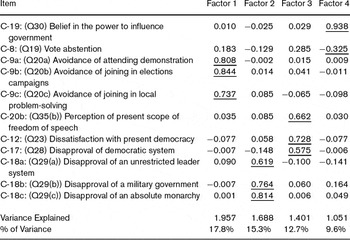
In the same manner, we can extract four factors from the sample of South Asia. Table 6 presents the rotated factor loadings. Although the questions are not exactly the same, a similar underlying structure emerges. Heavy loadings of factor 1 on the three questions relating to political activities outside of voting show that this dimension represents the ‘avoidance of direct actions’. Also, factor 2 can be safely seen as the ‘commitment to democratic rule’ based on its correlation with the questions on the illegitimacy of non-democratic regimes. Factor 3 roughly corresponds to ‘political frustration’ in that it represents the tendency to negate the present situations surrounding freedom of speech and democracy. Last, factor 4 seems to indicate the degree of ‘confidence of respondents in their ability to rule by themselves’ because it strongly relates to the question on belief in the power to influence the government and negatively correlates with vote abstention.
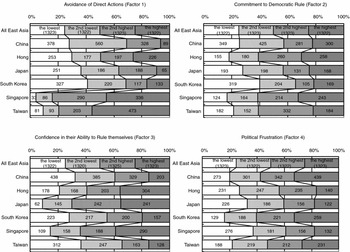
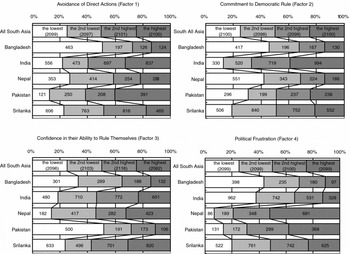
To illuminate differences between nations, we first divide respondents equally within each region into four groups (the lowest group, the second lowest group, the second highest group, and the highest group) based on the ranking of these factor scores, and then compare how these four groups of people with varying levels of factor scores are distributed within each country. If a country is dominated by the people of the highest group of a specific factor score, the nation can be interpreted as having a stronger tendency in that dimension than other nations, and vice versa. In what follows, we concentrate on the four dimensions commonly extracted from both regions, namely, ‘avoidance of direct actions’, ‘commitment to democratic rule’, ‘confidence in their ability to rule themselves’, and ‘political frustration’.
Figure 1 show the results for East Asia. The first bands in each graph represent the overall distribution within East Asia, which are composed, as stated above, of four groups of equal size. Figures in parentheses are raw counts. The ensuing bands show the proportion of each group within each component country of East Asia. For example, we see the proportions of the lowest groups in terms of ‘avoidance of direct action’ are extremely small and those of the highest groups are large in Singapore and Taiwan, which indicates that most people in these countries have a strong tendency to avoid participating in direct political actions. In contrast, the distributions for factor 1 show that South Koreans, Japanese, and Chinese do not appear to hesitate to participate in these political activities. In terms of commitment to democratic rule, South Korea stands out for the large proportion of citizens who belong to the lowest group, whereas in Hong Kong and Singapore a somewhat larger proportion of citizens have a higher score in this category. More people are confident in their ability to govern themselves in Japan, Singapore, and Hong Kong, compared to China and Taiwan, which have larger proportions of less confident citizens. In South Korea, a relatively equal proportion of all four types of people exist. Last, in the area of political frustration, China and South Korea show a stronger tendency of frustration, whereas the proportions of people with higher political frustration are smaller in Japan, Hong Kong, and Singapore.
Comparison of countries based on the distribution of people with varying degree of factor scores (East Asia)
Note: Figures are raw counts.

Figure 2 shows the corresponding results for South Asia. Not surprisingly, the tendency to avoid direct political actions is strong among people in Pakistan, where the military governs. Conversely, about one-half of Bangladeshi citizens belong to the lowest groups, which mean that most people in Bangladesh do not hesitate to participate in direct political action. What is more, the proportions of people with the lowest commitment to democratic rule are alarmingly large in Bangladesh and Nepal, which might concern those who are interested in the consolidation of and transition to democracy in these countries. India seems to be the sole fortress of democracy in the region. Low confidence levels in their power to influence politics are most salient among Pakistanis, followed by Bangladeshis. In the category of political frustration, the proportions of the highest group are strikingly large in Nepal and Pakistan, but in Bangladesh and India the reverse is the case. Last, it should be noted that the distributions in Sri Lanka are not skewed in any of the four dimensions.
Comparison of countries based on the distribution of people with varying degree of factor scores (South Asia)
Note: Figures are raw counts.

As Figures 1 and 2 show, all four groups of people with different degrees of ‘avoidance’, ‘commitment’, ‘confidence’, and ‘frustration’ exist within each country. But the distributions of these groups are considerably different from country to country. Provided that each national sample is for the most part equally allocated in demographic terms, these skews suggest the influences of some type of country-level factors, although the overwhelming portion of the variance in factor scores stems from individual differences. In the next section, therefore, we explore the sources of this cross-national variation in factor scores of the four dimensions of political attitudes, with the expectation that the macro-political differences we described in the earlier section will have some, albeit limited, influence along with the socioeconomic differences.
Sources of differences in political attitudes
After analysing and summarizing how political attitudes differ from nation to nation, we explore the sources of this cross-national variation found in micro-political attitudes. The country-level predictors on which we focus here are: (1) socioeconomic factors and (2) political factors. In the former category, included are the GDP per capita (Purchasing Power Parity),Footnote 9 the United Nations’ Human Development Index (HDI),Footnote 10 GINI index,Footnote 11 population,Footnote 12 and the three indices of fractionalization (ethnicity-base, language-base, and religion-base).Footnote 13 In the latter group of country-level predictors are the component variables of Freedom House and Polity IV, which have been discussed above. As noted in the discussion, we use component variables rather than aggregated variables because we are interested in which aspects of the macro-political institutions are related to the micro-political attitudes.
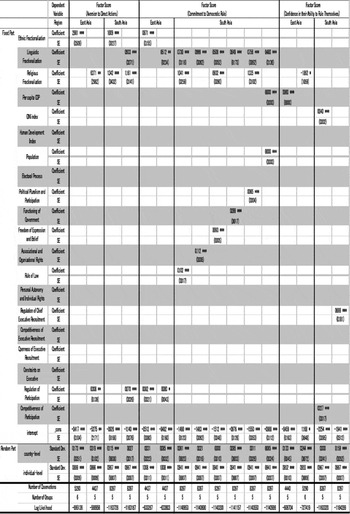
The dependent variables are the individual factor scores of (1) avoidance of direct actions, (2) commitment to democratic rule, (3) confidence in their ability to rule themselves, and (4) political frustration. Because we regress individual factor scores exclusively on country-level predictors, random-effects models are used for estimation. In other words, estimations of the coefficients are based on the assumption that the residual is decomposed into country-level and individual-level parts.Footnote 14 After implementing simple bivariate regression with each of the independent variables (results not shown) we proceeded into multivariate regression, selecting the variables of statistical significance. However, high correlations between predictors prevented us from simultaneously estimating their effect (Table 7). The results are as follows.
Results of Regression Analysis for Country-level Variables Predicting Individual-level Variance in the Four Factor Scores


maximum-likelihood random-effects model.
*p < .10. **p < .05. ***p < .01.
In predicting the factor score on ‘avoidance of direct action’, there are two country-level factors that exhibit statistical significance in both regions. The first is the fractionalization measure, namely ethnic, linguistic, and religious diversity. The most likely explanation for this result is that transaction costs increase, regardless of the region, according to the diversity of a society. Conversely, in a more ethnically, linguistically, and religiously homogeneous society the first contact necessary for un-institutionalized participation is more easily achieved, resulting in a greater public propensity for direct actions. The other is the dampening effect of the institutionalization of participation through party politics (one party or multiple parties). This result can be interpreted as evidence that institutionalized routes of preference articulation offset the need for ad hoc actions. No other country-level factors, socioeconomic or political, seem to be related to this dimension of political attitudes either in East or South Asia.
Meanwhile, regressions that use other factor scores as dependent variables yield different results between the two regions. In general, differences in macro-political settings tend to better predict political attitudes of South Asians, whereas in the context of East Asia, only socioeconomic factors are found to be statistically significant in most cases. In predicting people's attitudes toward democratic rule, for example, in both East and South Asia fractionalization exerts a positive effect, probably because democratic procedures are more strongly perceived as indispensable for self-protection in a fractionalized society. However, the existence of these procedures (freedom of expression and association, protection of minority groups, independent media and judiciary, less corrupt government and police, etc.) promotes commitment to democracy among citizens in South Asia, whereas in East Asia the only political factor that seems to facilitate democratic norm is well-regulated participation. Also, ordinary citizens’ confidence in their ability to govern themselves increases as the society becomes wealthier in East Asia, but in South Asia the factors enhancing confidence in self-rule are political ones, such as competitive participation and institutionalization of executive recruitment. Finally, in East Asia, political frustration decreases if societies as a whole or individuals are more developed, but in South Asia it is influenced more by whether electoral processes are free and fair, the extent of accountability among elected officials in their decision-making, and whether the protection provided for various kinds of individual and organizational rights is sufficient.
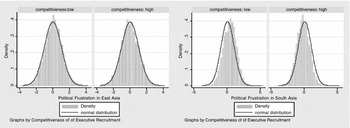
The impact of difference in competitiveness of executive recruitment on the predicted distributions of political frustration (left: East Asia Model, right: South Asia Model)

To visualize the different impact of macro-level political factors on micro-level political attitudes, we depicted histograms of predicted factor scores of political frustration based on the level of competitiveness of executive recruitment (Figure 3). According to the model, using competitiveness of executive recruitment as a predictor, in South Asia, the overall mean of the political frustration score is 0.657, and a one-unit increase in competitiveness of executive recruitment reduces political frustration by 0.3 point. Assuming that both country-level and individual-level residuals have a normal distribution with mean ‘0’ and standard deviation of 0.26 and 0.912, respectively, we inserted a score of ‘1’ as the level of competitiveness of executive recruitment for 4,000 samples and a score of ‘3’ for another 4,000 samples. Similarly, based on the estimates of overall mean (0.131), the coefficient of competitiveness of executive recruitment (−0.055), and the standard deviations of country-level and individual-level residuals (0.199 and 1.007, respectively) in East Asia,Footnote 15 we generated predicted factor scores of political frustration with different levels of competitiveness of executive recruitment (also scores ‘1’ and ‘3’) for East Asia. As the pair of the histograms on the left of Figure 3 shows, a difference in the level of competitiveness of executive recruitment does not provide any discernible difference in the distributions of political frustration that are predicted by the East Asia model. In contrast, the distributions of predicted values of political frustration differ systematically when we use the South Asia model (the pair of histograms on the right). The histogram under higher competitiveness in executive recruitment is further to the left as against those under lower competitiveness in executive recruitment (i.e. under higher competitiveness, the degree of political frustration is less than predicted).
The formal exploration (e.g., by pooling samples from both regions) of the causal heterogeneity found between the two regions is impossible, at least within the framework of the present study, because the dependent variables are the factor scores based on the distinctive distributions within each region. However, if we assume that some unincorporated and contrasting factors between the two regions are responsible for this causal heterogeneity, one possible candidate for interaction might be the apparent difference in regime stability.
In Pakistan, the democratic period that began after the end of military rule in 1988 was suddenly interrupted by the 1999 military coup. Yet the revived military regime has not stabilized the country, as was evident in the eruption of the May 2007 riot. Also in Nepal, the second attempt (the first was in 1959) at a democratic system in this country after the end of the cold war failed to produce a stable government and degenerated into an absolute monarchy after the assassination of King Birendra in 2001. The reintroduction of a dictatorship is not accepted by most Nepalese politicians and the public. There is a widespread protest against the King, including a Maoist civil insurgency in the northern region. Lively politics is not limited to non-democracies. Although India and Sri Lanka have been continuously democratic since their independence, in India, Hindu nationalism radically transformed the nature of politics in the mid 1990s, causing two changes in government since then; in Sri Lanka, the policy to end the long-standing civil war has itself become a major source of conflict within the central government. In Bangladesh, as already mentioned, the reckless use of parliamentary boycotts and the rallying of strikes by political leaders places the country in a constant state of political crisis.
In contrast, countries in East Asia, regardless of the type of regime, exhibit remarkable stability. Take, for example, Singapore, where the ruling People's Action Party has not had to hand over political power since independence in 1965. No serious challenges have ever been posed by any political force. Lee Kuan Yew and his son, Lee Hsien Loong, have succeeded apparently in constructing a modern patrimonial state with a liberal face. Another example is Japan, in which the ruling Liberal Democratic Party, although losing power briefly in the early 1990s, recaptured the governing position within a year and continues to rule the country, albeit with the help of its changing coalition partners. Indeed, it seems highly unlikely that a change of government in Japan will become more frequent in the foreseeable future. Also in China, despite the changing economic system in the last few decades, no realistic possibility exists that could end the communist dictatorship. Although South Korea and Taiwan exhibit some dynamism in politics, the overall characteristics of East Asia appear to reside in the ‘static state’ of politics. This region does not suffer from the frequency of either coups or civil wars as is the case in South Asia.
When the rules and the players of the game of politics remain unchanged, the meaning of a specific form of macro-political institution may fade away in the minds of ordinary citizens. Yet if new political procedures are introduced suddenly out of the blue or existing institutions are suddenly abolished, then the difference in institutions becomes more vivid in the minds of people. In other words, the impact of institutional differences can be amplified through political change and shifts in status. Although this does not explain why the causal heterogeneity is not salient in the dimension of direct actions, there seems to be considerable validity to this hypothesis. Yet because we do not have enough empirical evidence, further discussion will lead us nowhere. However, what our regression results show is that the causal patterns of political attitudes of ordinary citizens are partly similar and partly different between regions. On the one hand, citizens’ propensity for direct political action is commonly influenced by the transaction costs associated with social diversity and the existence or inexistence of institutionalized opportunity for preference articulation. On the other hand, when it comes to the other dimensions of political attitudes – commitment to democratic rule, confidence in self-rule, and political frustration – macro-political settings matter only in South Asia, whereas in the East, only socioeconomic differences appear to play a part in shaping the attitudes of ordinary citizens.
Conclusion
Making use of the natural experimental diversity of macro-political contexts found in East and South Asia, we have examined the possible influence of macro-political institutions on the structure of people's attitudes. The materials used are up-to-date data collected by the AsiaBarometer Survey project and by the Center for the Study of Developing Societies, which include broad comparable questions about: (1) the feelings of citizens’ own political power, (2) their frequency of voting in national elections, (3) their participation in other political activities, (4) their attitudes toward freedom of speech, (5) their satisfaction with the way democracy works in their own country, and (6) their preference for the types of political system that should govern their own country. We summarize the findings of this article into three parts.
First, from the simple examination of the frequency tables, the following supra-regional similarities were revealed: most people vote regularly, but do not participate in other political action such as demonstrations; they are only moderately satisfied with the present form of ‘democracy’ in their own country, but approve of it as a desirable system. Inter-regional difference was also detected: people in South Asia believe more strongly in their own political effectiveness than their counterparts in East Asia. Evaluations of other types of system exhibited inter-regional as well as inter-national variations.
Second, factor analysis allowed us to detect the underlying dimensions of political attitudes common to both regions and to summarize the national differences into the variances in the four factor scores, that is, (1) avoidance of direct action, (2) commitment to democratic rule, (3) confidence in their ability to rule by themselves, and (4) political frustration. In East Asia, we found a stronger tendency of avoidance of direct political action among Singaporeans and Taiwanese; weaker commitment to democratic rule among South Koreans; firmer confidence in self-rule among people in Japan, Singapore, and Hong Kong; and deeper frustration among Chinese and South Koreans. In South Asia, we saw a tendency to avoid direct political activities only among Pakistanis with the opposite true for Bangladeshis; weaker commitment to democratic rule among Nepalese and Bangladeshis; lower confidence in self-rule among Pakistanis; and high levels of political frustration among Nepalese and, again, Pakistanis.
And last, we explored, exclusively focusing on the country-level differences, the sources of these variations in the factor scores. Apart from the historical contexts of each country, we examined in this article the socioeconomic factors such as the size, inequality, and diversity of a society as well as the level of economic and human development. At the same time, as political factors, various component variables from Polity IV and Freedom House data sets were considered. The results revealed a partly homogeneous and partly heterogeneous causal pattern between the two regions. The attitudes toward direct political action were mainly influenced by the transaction costs that stem from the fractionalization of a society and the availability of institutionalized routes of political participation. This pattern was common to both regions. However, with regard to the other dimensions, the factors with a statistically significant effect differed from region to region: we found statistically significant effects of a number of the political procedures that compose a political system in the context of South Asia; but we found little evidence to suggest their influence in the analysis of East Asians. As a possible explanation of this causal heterogeneity we posited the amplifying effect of regime stability on the differences in political factors, but due to a lack of sufficient evidence could not test the hypothesis.
Of course, individual attitudes toward politics are not limited to the aspects examined in this research, nor are they exclusively determined by the country-level differences. Although political attitudes can collectively vary from nation to nation, political values naturally differ from person to person, which can cause variation in political attitudes among people who reside in the same country. Consequently, overwhelming portions of variance remain unexplained in our models that do not incorporate any individual-level predictors. What also remains to be done is the empirical examination of the interaction effects of instability and the difference of political institutions we postulated tentatively. Even with these limitations, we still believe that this research succeeded in shedding some light on the origins of political attitudes with substantial data. Further accumulation of survey data are needed for the development of the study in this area.