On November 21, 2013, protests erupted in Ukraine. The immediate catalyst was then-president Victor Yanukovych’s decision not to sign an association agreement with the European Union (EU). The protests grew as citizens linked them to grievances about civil liberties, national sovereignty, and corruption (Diuk Reference Diuk2014; Onuch and Sasse Reference Onuch and Sasse2014; Peisakhin Reference Peisakhin2015; Wolczuk and Wolczuk Reference Wolczuk and Wolczuk2013). Whereas many scholars have studied the causes and effects of Euromaidan, this article examines how Ukrainians perceive the appropriate role of protest in a democratic system and, more specifically, how they view the Euromaidan protests. With a history now marked by the Orange Revolution and Euromaidan, the question of the democratic legitimacy of changing leadership through protest is potentially an important factor for Ukrainians’ continued engagement with the democratic process.
Original survey data gathered in three key Ukrainian cities in December 2013 demonstrate that the democratic legitimacy of protest is distinct from approval for the Euromaidan protests in Ukrainians’ perception. Approval for the Euromaidan protests correlates with partisanship, age, political satisfaction, and policy preferences. However, the perceived general legitimacy of protest does not significantly correlate with party affiliation or regional factors; rather, it is affected by commitment to a democratic political system.
DEMOCRATIC LEGITIMACY OF PROTEST
Many citizens see protest as highly democratic—a means by which the public directly makes demands, even when institutions fail to provide voice or accountability (Robertson Reference Robertson2011; Trejo Reference Trejo2014). However, protests can undermine the rule of law and institutionalized power transfer (Linz Reference Linz, Linz and Stepan1978). Protest involves a small percentage of the population and contains neither adequate representation of societal views nor safeguards for minority rights (Beissinger Reference Beissinger2014; Dalton, Van Sickle, and Weldon Reference Dalton, Van Sickle and Weldon2010; Powell Reference Powell1982). This democratic duality can lead to divided public opinion on the legitimacy of protest (Della Porta Reference Della Porta, Giugni, McAdam and Tilly1999; Martin Reference Martin1994).
This divided opinion was evident in public discourse during the Euromaidan protests. Although many citizens and politicians supported the protests (Herszenhorn Reference Herszenhorn2013a, Reference Herszenhorn2013b; Kramer, A., Reference Kramer2013), others referred to them as “disgraceful,” “crude hooliganism” (Roth Reference Roth2013); “barbaric,” “making a garbage bin out of [Kyiv]” (Herszenhorn and Kramer Reference Herszenhorn and Kramer2013); and “hysteria” (Walker Reference Walker2013). Yanukovych sought to delegitimize the protests, stating, “The leaders of the opposition have disregarded the principle of democracy according to which we obtain power through elections and not on the street” (Oliphant and Ensor Reference Oliphant and Ensor2014).
In addition to concerns about legitimacy and fidelity to democratic principles, the Orange Revolution (2005) and Euromaidan (2014) represent political victories for some Ukrainians and the loss of their preferred leadership and policy for others. Whether the latter group views these events as isolated losses in a legitimate democratic process or as illegitimate changes in the rules of democracy is unclear.
The role of protest in government decision making is particularly problematic in electoral democracies—that is, regimes that hold regular elections but fall short of other requirements for democracy. Some people view elections as legitimizing the government in power despite their faults. However, those same faults push others to seek for change through non-institutionalized means (Markoff Reference Markoff1996; Trejo Reference Trejo2014). If many people view protestors’ demands or actions skeptically, then government responsiveness to protest undermines the stability of democratic institutions. In contrast, approval for a specific protest depends on whether individuals stand to benefit in terms of politics or policy preferences. Disagreements about whether a specific protest is appropriate are less problematic than entrenched disagreement about the legitimacy of protest as a political tool in a democracy.
If many people view protestors’ demands or actions skeptically, then government responsiveness to protest undermines the stability of democratic institutions. In contrast, approval for a specific protest depends on whether individuals stand to benefit in terms of politics or policy preferences.
A vast literature considers why protest occurs and who is likely to protest (Almond and Verba Reference Almond and Verba1963; Anderson and Mendes Reference Anderson and Mendes2006; Barnes and Kaase Reference Barnes and Kaase1979; Giugni, McAdam, and Tilly Reference Giugni, McAdam and Tilly1999; Markoff Reference Markoff1996; Marx Reference Marx2002; McAdam, Tarrow, and Tilly Reference McAdam, Tarrow and Tilly2001; Robertson Reference Robertson2011; Tarrow Reference Tarrow1998, Reference Tarrow2005; Thomas, Walker, and Zelditch Reference Thomas, Walker and Zelditch1986; Worchel, Hester, and Kopala Reference Worchel, Hester and Kopala1974). However, those who actually protest are a small subset of those who view protest as legitimate. Non-participants may view protest as an acceptable—even valuable—political activity. A smaller literature considers how the broader public views protest (Della Porta Reference Della Porta, Giugni, McAdam and Tilly1999; Funderburk Reference Funderburk1974; Hall, Rodeghier, and Useem Reference Hall, Rodeghier and Useem1986; Olsen Reference Olsen1968; Turner Reference Turner1969; Yuchtman-Yaar and Hermann Reference Yuchtman-Yaar and Hermann1998). This analysis tests the following four hypotheses about personal characteristics that correlate with protest legitimacy and approval for Euromaidan among Ukrainians.
Views about democracy influence perceived legitimacy of protest and approval for Euromaidan but in different ways (Hypothesis 1). Satisfaction with the performance of the democratic system and belief that democracy is the best possible political system are distinct concepts and need not be positively correlated. Doubts about the value of democracy correlate with lower protest approval (Canache Reference Canache2001; Pollock Reference Pollock1983) and contentious political behavior (Anderson and Mendes Reference Anderson and Mendes2006; Farah, Barnes, and Heunks Reference Farah, Barnes, Heunks, Barnes and Kaase1979; Muller, Jukam, and Seligson Reference Muller, Jukam and Seligson1982; Muller and Opp Reference Muller and Opp1986). In the Ukrainian case, dissatisfaction with the performance of democracy should be associated with greater approval of the Euromaidan protests; more satisfied citizens are more likely to view them as unnecessary. However, satisfaction with the current functioning of the system should not significantly influence a general view of protest legitimacy. Endorsement of democracy as the best political system, conversely, should not significantly affect opinions about Euromaidan but rather should bolster the opinion that active citizen involvement and protest activity are legitimate.
Approval of Euromaidan also should be higher among individuals who are currently “losers” in terms of policy and politics (Hypothesis 2). Those who support parties that are not in power or disagree with the ruling power’s policies are generally less satisfied with democracy and have greater protest potential, particularly in newer democracies (Anderson and Mendes Reference Anderson and Mendes2006). Whereas it is impossible to identify all government policies that might contribute to support for protest, favoring the EU association agreement should correlate with approval of the Euromaidan protests, given the prominence of the issue in the protestors’ demands (Diuk Reference Diuk2014; Guliyev and Akhrarkhodjaeva Reference Guliyev and Akhrarkhodjaeva2014). However, current “loser” status should not correlate strongly with the perceived legitimacy of protest.
Demographic characteristics that are strongly correlated with protest potential in other studies (i.e., young, male, and educated) may correlate with approval for the Euromaidan protests. However, it is unclear why age or gender would correlate with perceived general protest legitimacy. Education may correlate, if exposure to liberal ideas contributes to the view that protest has greater democratic legitimacy (Hypothesis 3).
Finally, because of the prominence of the regional divide in Ukraine, the analysis examines whether location influences the view of protest. Footnote 1 The common explanation is that approval for Euromaidan and views of the legitimacy of protest grow increasingly negative moving eastward across Ukraine (Hypothesis 4). Eastern Ukraine has closer historic, economic, and cultural ties to Russia, including centuries of rule by the Russian Empire. Western Ukrainian trade patterns and political leanings have been tied more closely to Europe. Historically, it was under Austrian or Polish rule, with parts (including Lviv) coming under Soviet rule after 1945 (Diuk Reference Diuk2014). However, it is unclear whether these factors are relevant after controlling for “loser” status and views of democracy, which also differ among the regions. If the city remains a significant determinant of protest legitimacy or Euromaidan approval with relevant controls in place, then this indicates that unmeasured sociocultural factors are involved. However, if including partisanship and political preferences renders the city insignificant, then this provides evidence against a separate political culture in eastern Ukraine.
DATA
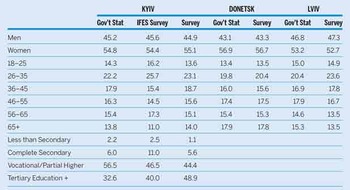
One thousand adult respondents were sampled haphazardly on the street from December 12 to December 23, 2013, in Kyiv, Footnote 2 Lviv, and Donetsk. Quota sampling was used to ensure that respondents mirrored the demographics of each city. Table 1 compares data collected in the original survey with government and other survey statistics to show the degree to which the survey sample reflects the cities’ populations. Footnote 3

These three cities were chosen to capture the extremes of political opinion in Ukraine. Kyiv is the capital and largest city in Ukraine. Donetsk and Lviv represent the eastern and western centers of political power, respectively. Donetsk is headquarters for the Party of Regions. In the 2010 presidential elections, Yanukovych received 89% of the vote in Donetsk; in Lviv, he received less than 15%.
Survey fieldwork took place after protestors had occupied Kyiv City Hall and Independence Square but before Ukraine’s parliament passed restrictive antiprotest laws or police fatally clashed with protestors. In December 2013, most Ukrainians and foreign experts considered Yanukovych’s removal from office only a remote possibility (Tucker Reference Tucker2013; Way Reference Way2013).
The measure of protest legitimacy is an index of four statements about the role of protest in democracy. More positive assessments of protest receive a higher score on the five-point Likert scale. The four statements are as follows:
-
• Protests are a sign of a healthy democracy. (M: 3.9; SD: 1.4)
-
• Protests are a way to keep government accountable to the people. (M: 3.7; SD: 1.4)
-
• Protests should not significantly impact government policy decisions. (M: 2.6; SD: 1.5)
-
• Protests undermine electoral results and proper governance. (M: 3.0; SD: 1.5) Footnote 4
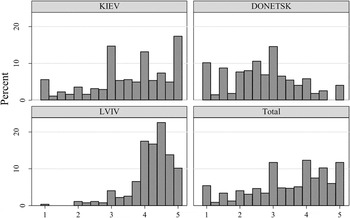
The index has a mean of 3.5 on a scale of 1 to 5. Figure 1 displays the distribution of the democratic legitimacy of protest in each city and in the overall sample.
Views of the Democratic Legitimacy of Protest by City

Approval for Euromaidan is a binary dependent variable equal to 1 if respondents agreed with the statement: “I approve [versus do not approve] of the protests that took place in Ukraine in November/December 2013.” Overall, 52% of the respondents approved and 42% disapproved; 5% had no answer. Although approval for Euromaidan correlates with the democratic legitimacy of protest, more than 22% of those who did not approve scored at least the mean on the legitimacy-of-protest index; almost 10% of those who approved of the 2013 protests scored below the mean.
Views of democracy are measured by agreement (i.e., on a five-point scale; higher values indicate stronger agreement) with the following statements: “Despite its flaws, democracy is the best political system for Ukraine” (M: 4.14; SD: 1.14); and “I am satisfied with how democracy works in Ukraine” (M: 2.3; SD: 1.4).
Political “losers” are identified using the party that is closest to the respondents’ political views; the omitted category includes the opposition parties that publicly support the protests (i.e., Ukrainian Democratic Alliance for Reform, Svoboda, and Batkivschina). Party of Region supporters should be less approving of protests, whereas those who do not support any party or parties not represented in the legislature may or may not differ from those associated with the opposition parties. Policy “losers” are those who favor entering the EU association agreement. In the sample, 57% favored the agreement, 34% opposed it, and almost 10% had no opinion. City, gender, college education, and age variables are included.
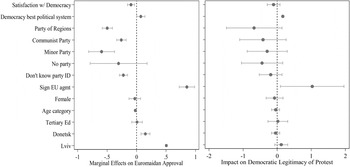
As expected, those who strongly disagreed that they are satisfied with how democracy works were 38% more likely to approve of Euromaidan than those who strongly agreed. However, satisfaction had no influence on perceived protest legitimacy.
RESULTS
Figure 2 presents the marginal effects after a probit analysis on approval for Euromaidan (on the left) and parameter estimates of OLS regression on the index of protest legitimacy (on the right). As expected, those who strongly disagreed that they are satisfied with how democracy works were 38% more likely to approve of Euromaidan than those who strongly agreed. However, satisfaction had no influence on perceived protest legitimacy. Those for whom democracy is the best political system view protest as more legitimate. This contrasts with findings from Latin America (Canache Reference Canache2001) and indicates that protest is not seen as antidemocratic. Support for democracy also increases the likelihood of approval for the Euromaidan protests, albeit at the 95% rather than the 99% confidence level. The unexpected correlation with the specific protest is likely due to protestors portraying the Yanukovych government as undemocratic. Footnote 5
Individual Characteristics and Views of Protest

As expected, partisanship correlates with approval for the Euromaidan protests but not with the legitimacy of protest. It is obvious that the strongly anti-Yanukovych sentiment contributes to the relationship with Euromaidan. However, even in the highly polarized context of the Ukrainian crisis, many individuals were able to disapprove of a specific protest without dismissing a role for protest in democratic decision making.
It is not surprising that opinion about the EU association agreement significantly affected the probability that a respondent approves of the Euromaidan protests. It also influenced general views of the legitimacy of protest—although the standard errors are much larger and the effect (relative to the scale of the dependent variable) is smaller. This may be a consequence of the context in which the data were collected, or it may indicate that those favoring the EU association agreement have more participatory views of democracy.
Demographics exert no influence on the legitimacy of protest. Only age had any influence on approval for the Euromaidan protests. Older people were slightly but significantly less likely to approve of the Euromaidan protests. However, they did not express systematic distaste for protest in general. Whereas other studies have found gender and education to be strong indicators of protest potential, they did not influence approval for Euromaidan or the assessment of the legitimacy of protest.
Once partisanship and policy preferences are controlled for, respondents in Donetsk were significantly more likely to approve of the Euromaidan protests than those in Kyiv. It may be that respondents in Kyiv experienced disorder and disruption as a result of the protest, whereas those in Donetsk did not. It is not surprising that respondents in Lviv approved of Euromaidan. This finding potentially challenges the contention that deep cultural factors create a distinct political culture in eastern Ukraine. If these factors exist, they appear to be captured in policy preferences and partisanship. Perceptions of the democratic legitimacy of protest did not differ significantly among the cities, which reinforces doubts about the salience of cultural factors.
DISCUSSION
Mass protest has dramatically changed the course of Ukrainian politics twice in a decade. In both cases, the protests were a victory for current political “losers.” However, they also represent a defeat for millions of Ukrainians who preferred the status quo. This study contributes to our understanding of how “loser” status and views on democracy affect individuals’ assessments of the appropriate role for protest in a democracy. Satisfaction with democracy, partisanship, and region did not influence whether Ukrainians view protest to be legitimate. Even those whose political preferences led them to disapprove of the Euromaidan protests did not generally reject a role for protest in government accountability and decision making, even in Ukraine’s eastern regions. However, this analysis indicates that changes in policy or leadership in response to mass protest may appear illegitimate to those who already are uncertain about the value of democracy, resulting in further alienation.