Introduction
Depression is one of the most common psychiatric disorders in old age. Its prevalence rate ranges from 1% to 4% in community (Blazer, Reference Blazer2003) and from 4% to 14% in primary care settings or institutions (Kramer et al., Reference Kramer, Allgaier, Fejtkova, Mergl and Hegerl2009). Among older adults, depression increases risk of co-morbidity and self-neglect, decreases physical, cognitive, and social functioning, and thus increases mortality (Blazer, Reference Blazer2003). Yet, it remains under-diagnosed and under-treated (Mulsant and Ganguli, Reference Mulsant and Ganguli1999; Small, Reference Small2009), especially by non-psychiatrists (Harman et al., Reference Harman, Schulberg, Mulsant and Reynolds2001). It may be attributed to different presentations among older adults in comparison to younger adults. For example, older adults are less likely to report sadness (Gallo et al., Reference Gallo, Anthony and Muthen1994). Sleep disturbance, fatigue, psychomotor retardation, loss of interest in life, and hopelessness about the future may be more prevalent in late-life depression (Christensen et al., Reference Christensen1999). A recent meta-analysis found that older adults with major depression may experience more somatic symptoms, such as fatigue or pain (Hegeman et al., Reference Hegeman, Kok, van der Mast and Giltay2012). Many older people with physical discomforts usually visit non-psychiatric clinics (Lv et al., Reference Lv, Wu, Li and Liu2004). The limited awareness and lack of appropriate screening instrument of depression in general hospitals or community clinics (Unutzer, Reference Unutzer2002) even delay the recognition of late-life depression.
Several instruments are commonly used for screening depression in old age, but they are not quite appropriate for Chinese culture. The Center for Epidemiologic Studies Depression Scale (CES-D) (Radloff, Reference Radloff1977) evaluates the frequency of recent depressed mood. Several items, e.g. I cried most of the time, are not well-understood by the elderly (Carleton et al., Reference Carleton2013). Crying in Chinese culture symbolizes moral vulnerability instead of emotional depression. Though the Geriatric Depression Scale (GDS) (Brink et al., Reference Brink1982) is developed specifically for elderly, there is yet consensus on cut-off points. For 15-item version, the cut-off point varies from 3 to 7, and for 30-item version, 7, 10, or 11 is recommended (Mitchell et al., Reference Mitchell, Bird, Rizzo and Meader2010). In clinical practice, the GDS is not sensitive enough to identify depression. Somatic symptoms or thoughts about self-harm are not adequately evaluated by GDS (Hammond, Reference Hammond2004). Apart from these limitations, the vast majority of these instruments have been developed for a Western cultural background. The expression of emotional problems is quite different in Chinese (Wong et al., Reference Wong, Wu, Guo, Lam and Snowden2012). The factor structure of GDS varies significantly depending on the linguistic and cultural factors. Different cultures conceptualize, experience, and express depressive symptoms in different ways, and that there may be no equivalent concepts for depression in certain non-Western cultures (Kim et al., Reference Kim, DeCoster, Huang and Bryant2013). Chinese older adults tend to deny the presence of depressive symptoms or express it somatically (Parker et al., Reference Parker, Gladstone and Chee2001). Many depressed Chinese people do not report feeling sad, but rather express boredom, discomfort, feelings of pressure in “heart” (“xin” in Chinese pronunciation, in the same meaning of mind in English), and symptoms of pain, dizziness, and fatigue (Kleinman, Reference Kleinman2004).
Therefore, we explored the clinical core symptoms of depression among older adults in Chinese culture, developed a new screening instrument for potential application in non-psychiatric clinics, and then tested its psychometric properties.
Methods
The study was approved by the institutional review board of Peking University Institute of Mental Health. Written informed consent was obtained from each participant.
Development of the Geriatric Depression Inventory (GDI)
In reference to diagnostic criteria of Depressive Disorder in the International Classification of Diseases (ICD-10), and scales which are now widely used in clinical practice and epidemiological surveys like GDS, CES-D, and in conjunction with the clinical experience of our research team members of geriatric psychiatrist, we selected 15 possible core symptoms of depression among Chinese older adults. Descriptive definition was given to each symptom, to make it more understandable and practical for clinical practice. The original 15 core symptoms were as follows: low mood, self-blame, change of appetite, loss of memory, thoughts of self-harm, helpless or despaired, physical complaints, unable to experience pleasure, insomnia, anxiety, feeling lazy and slow, fatigue, hypochondria, hesitation, and loss of interest.
In the next stage, we utilized the Delphi method to modify the symptom checklist and descriptive definition for each item. The expert panel consisted of 27 geriatric psychiatrists and 3 psychologists, with 24 from mainland China (21 geriatric psychiatrists and 3 psychologists), 3 from Hong Kong SAR and 3 from Taiwan. Experts from Hong Kong SAR and Taiwan are geriatric psychiatrists and fluent in written and spoken Mandarin. Details and results of the Delphi consensus were reported elsewhere (Xie et al., Reference Xie, Lin, Lv, Wang and YU2013). After two rounds of survey, the consensus of the core symptoms and descriptive definition was reached.
According to opinions of the experts, three of the original 15 symptom items were abandoned, and the title and descriptive definition of remaining items were modified to fit the linguistic background. The final core symptoms and descriptive definitions in the GDI were as follows: change of appetite and body weight (“食欲或体重改变” in Chinese character, same as below), sleep disturbance (“睡眠紊乱”), physical complaints (“躯体不适”), fatigue (“疲乏感”), feeling lazy and slow (“懒散迟缓”), anxiety and being upset (“焦虑不安”), low mood (“郁闷”), feeling helpless or despaired (“无助绝望”), self-blame (“自责”), thoughts of self-harm (“轻生观念或行为”), unable to experience pleasure (“缺乏愉快体验”), and loss of interest (“兴趣减退”). GDI evaluates mood changes in the last two weeks, with “yes” (score = 1) or “no” (score = 0) response. In addition to the rater-interviewed version (GDI-RI), we also develop the self-reported version (GDI-SR) to facilitate implementation in community settings. There are no differences in the items, definition and structure between self-reported and physician-interviewed versions.
Pilot testing
Eleven older adults aged above 60 years recruited from a general hospital, completed the draft version of the GDI as part of a pilot test. They provided comments on the readability, item wording, and phrasing immediately following completion of the instrument in paper-pencil form. The GDI was subsequently reviewed and modified to formulate the final 12-item version, items based on the qualitative and response feedback from participants, theoretical fit, and comprehensiveness. This study represents its first full psychometric assessment.
Validation study of the GDI
Participants
The participants were consecutively recruited from clinics of neurology, cardiology, and gastroenterology in general hospitals and internal medicine clinics in community health centers in Beijing from November 2013 to March 2014.
All participants met the inclusion criteria as following: aged 60 years or above; with normal cognition as indicated with a total score of the eight-item informant interview (AD-8 scale) < 2 (Galvin et al., Reference Galvin2005; Li et al., Reference Li2012); having competency in listening, speaking, reading, and writing to complete the interview and questionnaire, voluntary to participate in the study, and sign the informed consent. Those who were previously diagnosed with dementia, depression, and psychiatric disorders were excluded. Those with life-threatening physical conditions, such as severe heart failure, renal failure and liver function failure, disturbances of consciousness and any type of dementia, deficit in thyroid function, and acute stroke were also excluded.
To evaluate reliability, both self-reported and physician-interviewed versions of GDI were administered. The GDS-15 (Liu, Reference Liu1999; He et al., Reference He, Xiao and Zhang2008) was administered to all the participants to evaluate the concurrent validity of the GDI. The GDI and GDS-15 were administered on the same day. The test administrators were blinded to the depression diagnosis of participants when administering the GDI and GDS scale.
To evaluate test–retest reliability, nine patients with major depressive disorder were separately recruited and administered with GDI one week after the initial evaluation.
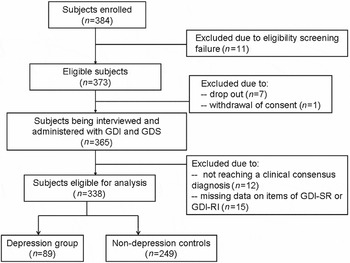
The diagnosis for each participant was made based on the consensus of two independent senior geriatric psychiatrists. Those who received the consensus diagnosis of depressive disorder were categorized into depression group. Those who did not receive a consensus diagnosis of depression were excluded in data-analysis. The flow diagram of the entire evaluation process is shown in Figure 1. Both groups were included in the evaluation of the sensitivity and specificity of distinguishing depression with a ROC curve analysis. The clinical consensus diagnosis was used as the gold standard for the ROC analysis.
Flow diagram of participant recruitment and validation procedure.

Statistical analysis
Internal consistency was measured using Cronbach's coefficient α. The consistency between GDI-SR and GDI-RI was evaluated using κ value. To test concurrent validity, GDI total scores were compared with GDS-15 scores using Spearman's ρ correlation coefficients. Sensitivity and specificity of the GDI to differentiate depressive disorder from non-depression control were calculated with the ROC analysis. p < 0.05 was considered to be significant for all analyses.
Results
Demographic characteristics
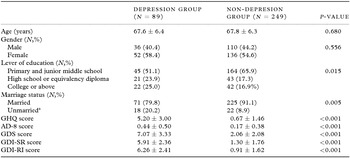
A total of 384 participants were recruited into this study. 46 participants were excluded due to eligibility screening failure (n = 11), drop out during the interview (n = 7), withdrawal of consent (n = 1), not reaching a clinical consensus diagnosis (n = 12), and incomplete item of GDI-SR or GDI-RI (n = 15). In total, 338 participants were included in the validation study. Table 1 summarizes the demographic characteristics of the depression group (N = 89) and non-depression group (N = 249). There were no significant differences in age and gender. Levels of education, marital status, sum score of the GHQ, AD-8, GDS-15, GDI-SR, and GDI-RI were statistically significant different between two groups (p < 0.05). In relative to non-depression group, the sum score of GDS-15, GDI-SR, and GDI-RI were higher in depression group.
Sociodemographic and clinical characteristics of participants

aIncluding divorce, widowhood, and separation.
GHQ: general health questionnaire; GDS: geriatric depression scale; GDI-SR: geriatric depression inventory – self-report; GDI-RI: geriatric depression inventory – rater interview.
Reliability
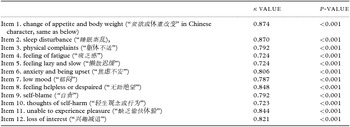
Cronbach's coefficient α was 0.843 for GDI-SR and 0.880 for GDI-RI. Inter-item correlations coefficients for GDI-SR were ranged from 0.081 to 0582, p < 0.001; item-total correlations were 0.219~0.765, p < 0.001. For GDI-RI: the inter-item correlations coefficients were 0.068~0.690, item-total correlations coefficients were 0.204~0.793, p < 0.001 (supplement 1). The κ value of each symptom item between the GDI-SR and GDI-RI ranged from 0.723 to 0.874 (Table 2), indicating a higher reliability between the evaluations based on self-report and rater interview. Test–retest reliability is acceptable (r = 0.680, p = 0.044).
κ values between scores of GDI-SR and GDI-RI

GDI-SR: geriatric depression inventory – self-report; GDI-RI: geriatric depression inventory – rater interview.
Validity
The correlation between GDI-SR and GDS-15 was substantial (r = 0.750, p < 0.001), as was the correlation between GDI-RI and GDS-15 (r = 0.733, p < 0.001).
Clinical cut-offs, sensitivity, and specificity
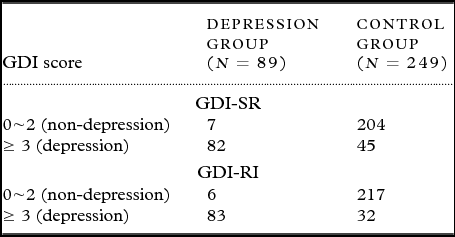
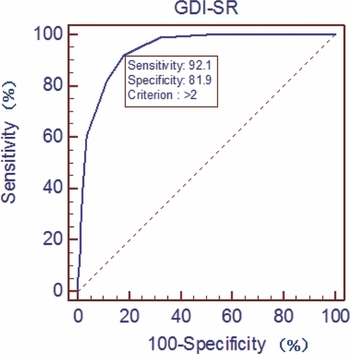
ROC curves were generated to measure the effectiveness of the GDI-SR in classifying non-depressive versus depressive participants. The area under ROC curve (AUC) (Figure 2) is 0.938 (95% confidence interval (CI) 0.913–0.962), suggesting good to excellent ability to discriminate between non-depression and depression groups. Using a cut-off score of 3 on the GDI-SR to predict depression, yielded the most desirable combination of sensitivity (92.1%) and specificity (81.9%) (Table 3). With a prevalence of 37.6%, the positive predictive value (the probability that someone with a GDI-SR score of 3 or above has depression) was 64.6%, whereas the negative predictive value (the probability that someone with a GDI-SR score of < 3 is non-depressive) was 96.7%.
Classification using GDI score of 3 for depression and non-depression groups

GDI: geriatric depression inventory; GDI-SR: GDI-self-report; GDI-RI: GDI-rater interview.
Receiver operator characteristic (ROC) curve for non-depression group versus depression group: ROC curve comparing the GDI-SR scores of non-depression group with the GDI-SR scores of participants with depressive disorder. The area under the ROC curve is 0.930, suggesting excellent ability of the GDI-SR to discriminate between groups. GDI-SR: geriatric depression inventory – self-report.

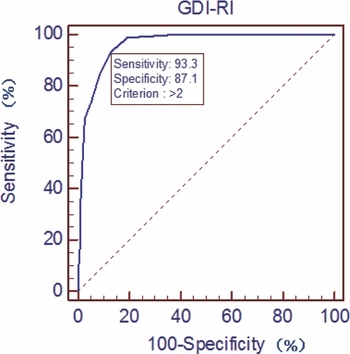
When predicting membership in the depressive group versus status as a non-depressive participant with GDI-RI, the ROC area under the curve (Figure 3) was 0.961 (95%CI 0.942–0.979), suggesting excellent discriminative ability. Sensitivity increased to 93.3% and specificity increased to 87.1% (also see Table 3). The positive predictive value increased (72.2%), and negative predictive value (97.3%) remained essentially the same, and the prevalence rate (34.0%) decreased slightly.
Receiver operator characteristic (ROC) curve for non-depression group versus depression group: ROC curve comparing the GDI-RI scores of non-depression group with the GDI-RI scores of participants with depressive disorder. The area under the ROC curve is 0.961, suggesting excellent ability of the GDI-SR to discriminate between groups. GDI-RI: geriatric depression inventory – rater interview.

Discussion
We develop a new tool to identify depression in older adults, and carry out an initial clinical testing for it. We design self-reported and rater-interviewed versions to improve its applicability for clinical practice. The results show that both GDI-SR and GDI-RI are valid and reliable instruments for the detection of depression in older adults.
Considering the cultural factors and some shortcomings of available scales, the new instrument is designed with the following features: (1) relative brevity (3–5 minutes to complete) to maximize patient's compliance to complete the evaluation; (2) no specialized training required; (3) simple to use “agree/disagree” item response format; (4) no reverse scored items included, and not using polytomous scoring, whose models may be too complicated for the older adults. As indicated by previous studies, the complex standardized symptoms and clinical probe questions, and the required judgmental process embedded in diagnostic interviews often exceed the cognitive capacity of older adults. Symptom and probe questions were recommended to be simplified for screening (Knauper and Wittchen, Reference Knauper and Wittchen1994); (5) including the clinical core symptoms of depressive disorder among older adults in Chinese cultural context.
The results for the GDI-SR and GDI-RI are consistent and complimentary. Calculated by Cronbach's α coefficient, the internal consistency of this new instrument is good. The two formats can distinguish depression from controls quite well with the cut-off point of 2/3, with the sensitivity and specificity being high.
It might be a major concern that we used consensus diagnosis of two independent geriatric psychiatrists as the gold standard rather than the diagnostic instrument such as the structured clinical interview for DSM-IV (SCID) or the mini international neuropsychiatric interview (MINI). The best clinical estimate in our study is based on the clinically operational criteria of ICD-10. Chinese older adults may use distinct vocabulary and language from the Western culture to express emotional symptoms. It would add more value to test the psychometric properties of GDI with the well-validated diagnostic interviews (SCID or MINI has yet been examined among Chinese older adults) in Chinese culture.
Another potential shortcoming of the present study is that the sample was not population-based; as with any volunteer sample, selection biases limit generalization of the results. Our sample was largely patients in general hospitals and community health centers. The somatic presentations, such as change of appetite and body weight, sleep disturbance, and feeling of fatigue, may overlap with the deteriorating symptoms in hidden malignant conditions. To minimize the false positive phenomena, per the definition, each somatic symptom can only be scored when the routine physical examinations preclude the potential of malignant conditions. Though, the GDI instrument could offer an aid for physicians in non-psychiatric settings to screen depression in their practice.
Since most of our samples are not oldest old, and most of them have only one or two chronic conditions. Whether the results will be compromised by more comorbidities or older age remains to be explored.
In all, this study has preliminarily proven that both GDI-SR and GDI-RI are valid and reliable instruments for detecting depression among older adults. The use of GDI in non-psychiatric healthcare settings may improve timely diagnosis of late-life depression in general practice. Further investigations on its applicability in the community and other regions speaking Chinese are warranted. In particular, comparative studies are needed to seek a culturally appropriate tool for screening depression in the old age.
Conflict of interest declaration
None.
Description of authors’ roles
H. Wang and X. Yu formulated the research questions. H. Wang, X. Lv, and X. Yu designed the study and supervised the data collection. Z. Xie, Y. Hu, W. Ma, H. Xie, K. Lin, and H. Wang collected the data. Z. Xie and X. Lv carried out the statistical analysis. Z. Xie, X. Lv, and H. Wang wrote the paper. X. Yu provided critical review and comments on the manuscript.
Acknowledgments
This research was supported by grants from the Capital Special Health Development Research (2011-4024-02), the Natural Science Foundation of China (L1222017), and the National Institute of Mental Health and the Fogarty International Center Project (1D43TW009081). The authors thank 30 experts participating in expert consultation (in alphabetic order of surname): Feng Bao, Wai Chi Chan, Wei Chen, Helen Chiu, Yongping Feng, Buxin Han, Jianhua He, Jen-Ping Hwang, Tzung-Jeng Hwang, Weihong Kuang, Linda Lam, Guanjun Li, Hailin Li, Juan Li, Xia Li, Kai Lin, Rong Lu, Xin Ma, Nan Mu, Lan Shang, Xinyu Sun, Muni Tang, Jing Wei, Zhenyun Wu, Shifu Xiao, Yung-Jen Yang, Enyan Yu, Xin Yu, Youwen Zhao, Yuping Zhao. We would also like to thank Jiexin Fang, Yushuang Zhao, Yue Xie, Hongji Sun, and Wei Liu for their support in data collection.
Supplementary Material
To view supplementary material for this paper, please visit http://dx.doi.org/10.1017/S1041610215000162.