The Hindus have never had any historical writings: all that is known of India is to be gathered from popular poems, or the accounts of foreigners.
———H. H. Wilson Reference Wilson1854: 123It was the unanimous opinion of the early Orientalists of British India that India had no history, at least in the sense of historical writings. Like every consensus, it contained many variations of detail, as we shall see, but as the view of experts it was widely influential for a long time. For example, R. C. Majumdar gave a thoughtful version of this view at the beginning of the multivolume History and Culture of the Indian People (Majumdar Reference Majumdar1951) by Indian scholars, published shortly after independence. But the consensus was eroded by the rise of what we may call the “colonial knowledge” paradigm, which asserted a close connection between European rule and European knowledge of India. It tended to discredit the old consensus and to lighten the specific gravity of Orientalist knowledge, simplifying it as an object of historical explanation. This development has cleared an opening, in recent decades, for a rush of new studies tending to create an opposing consensus, that India did have history of a kind, it being the task of scholars to explicate what kind, exactly, that was (for example, Pathak Reference Pathak1966; Warder Reference Warder1972; Thapar Reference Thapar1992; Wagoner Reference Wagoner1993; Ali, ed. Reference Ali1999; Narayana Rao, Shulman, and Subrahmanyam Reference Narayana Rao, Shulman and Subrahmanyam2001; Guha Reference Guha2004; Mantena Reference Mantena2007). This in itself has been very much to the good, by reopening questions that had been closed by the old consensus. The old consensus itself, by contrast, was dismissed without much examination, and was attributed to colonial interest, cultural misunderstanding, or insufficient grasp of Indian languages and literatures. The old consensus now is seen as a simple ideological projection, easily explained and dismissed, with little complexity or interest for historical investigation. But this simplifying action of the prevailing paradigm renders invisible some of the very real effects of the old consensus, effects whose explanation can be very valuable to us. In order to gain the benefit it holds we have to take it seriously, trying both to explain it historically and to decide whether or in what way it is true.
But before we ask whether the claim that India has no history is true we need to investigate what it means. We will need to ask, not what was its relation to colonial power, but what the logic of it was for those who held it, and what were the historical circumstances under which that logic seemed compelling to them. As a matter of principle I will not assume that this logic is given entirely by the colonial relation, nor will I decline to examine its content on grounds that it is tainted by that relation. I will not assume a closed feedback loop between a mutually reinforcing European power and European knowledge of India, as a kind of immaculate conception of Orientalist knowledge in which Indians have no intrinsic role; rather I assume a complex interaction between European and Indian scholars which, because of the colonial relation, was unequal but also exceptionally intense and in certain spheres exceptionally fruitful. It is my belief, and I hope to show, that by analyzing the Orientalist view that India has no history we can learn something new about the relations of India and history as they were constituted over the last two centuries. I further believe that what we learn by doing so can lead us to a way forward.
At the outset let me stipulate that by India the Orientalists meant ancient India, and by history I mean disciplinary history—that is, I am asking whether ancient India had history, and is an object of study for the discipline of history. But in spite of that narrowing of the terms of the investigation it will be apparent in what follows that India and history often stand for much more than themselves––for historical subjects such as the non-West in general, and histories of the other-than-human.
I will proceed as follows. First, I will lay out some ways in which Europeans of the eighteenth and nineteenth centuries used the new Orientalist-generated knowledge of ancient India as a resource to reinterpret their own history in novel ways, believing that India was “good to think” (as Lévi-Strauss taught us to say). Second, I will examine the countervailing European tendency to assert that India has no history, centering on the Orientalist Wilson and the historicizing philosopher Hegel. Third, I will propose that we view the Europeans and the Indians as joint heirs of a tradition of history writing that stems from the narrative of the flood in ancient Mesopotamia.
Part 1. Ancient India Is Good to Think
What cultural work was ancient India called upon to do for Europe? We begin with the flood of Noah.
The Flood in St. Paul's
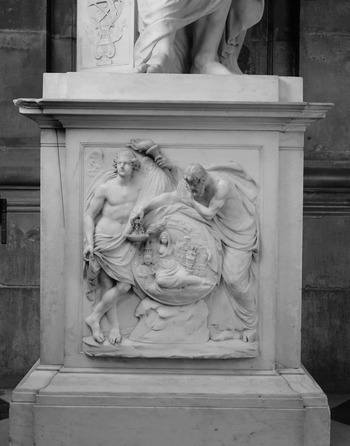
In St. Paul's Cathedral in London, under the dome, we find a colossal statue of Sir William Jones, Orientalist and philologist, done by the elder John Bacon and installed shortly after Jones' death in 1794. It is in the company of three other statues that make up a group, and it is distinguished company indeed: the writer and lexicographer Samuel Johnson, the painter Joshua Reynolds, and the prison reformer John Howard. The figures are done in classical dress, as if they were ancient Romans. This is unexceptional for its time; what is surprising and unexpected for a Christian church, let alone the basilica of the Church of England, is a scene carved on the pediment of the statue of Jones. It is from the ancient Sanskrit texts of Hinduism, called the Puranas.Footnote 1
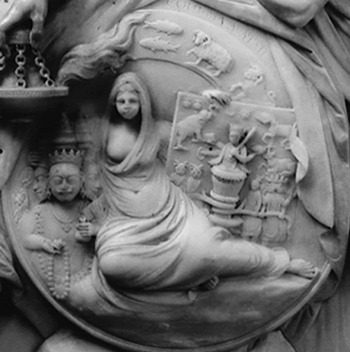
The image in question shows a female figure holding a tablet which depicts the churning of the ocean (samudra-manthana) by the gods and demons, pulling opposite ends of the snake Vasuki, who serves as a churning rope, wrapped around Mount Mandara, which serves as the dasher. An inscription, “courma avatar,” recalls that the carapace of the tortoise (Kurma) incarnation of Vishnu was the resting-place of the dasher. From this churning came the fourteen precious things (ratna) that serve to give the gods the upper hand over the demons, depicted on the tablet. There is also a representation of the zodiac, which Jones thought was an invention of the Indians. There is, beside, a three-headed trinity of god as Shiva, Vishnu, and Brahma. Framing figures in classical style, of an angel and a scholar—doubtless an Orientalist––are drawing back the veil that conceals ancient India, and shining a lamp upon it.
Statue of Sir William Jones, by John Bacon, in St. Paul's Cathedral. (Photo courtesy Conway Library, The Courtauld Institute of Art, London.)

Relief on the front of the pedestal. (Photo courtesy Conway Library, The Courtauld Institute of Art, London.)

Detail showing scene from the Puranas. (Photo courtesy Conway Library, The Courtauld Institute of Art, London.)

What is this bit of Hindu mythology doing in St. Paul's? Jones held that the first three of Vishnu's incarnations, the Fish, Tortoise, and Boar, are all connected with the universal flood of which the Bible speaks, and therefore constitute an independent testimony to its truth, and an answer to learned skeptics such as Voltaire.
This idea died soon after it was carved in stone and enthroned in a cathedral. No further Hindu stories of the deep past were represented in Anglican churches thereafter so far as I know. As a consequence the pediment of the Jones statue became simply illegible in years to come. Floodology, of course, did not die, and to an extent it continues today, but at some point it ceased to be respectable for scholars to espouse it, and it became a preserve of enthusiastic amateurs and true believers, circulating outside the academy but having no credibility within.
The structure of floodology is this, that India (and all other places having flood narratives to be gathered up by comparative mythology) is a witness to the truth of the history recorded in the Bible; but it is imperfect testimony, marred by fable, allegory, and exaggeration, while the superior truth of the Bible narrative is evinced by the simplicity and lack of evident embellishment of its telling. As it bears upon the object of our inquiry, the relation of India to history, we need to note two things. The first is that it takes the Genesis narrative of the flood as true history; that is, its conception of what counts as history in the question of whether India has history includes the flood of Noah. In times to come, the flood will recede from the scholarly conception of what constitutes history. The second is that it says, yes, to a degree, India does have history, in respect of the flood narrative, though it is an imperfect history. This structure grows to encompass other flood stories in other literatures, so that comparative mythology is the site in which floodology flourishes before it fades, a site at which narratives of the flood are taken to be true reports of an event which is singular and universal. There are other notable aspects of this structure that we can see when we consider the related work of a contemporary and admirer of Jones.
Both this structure of thought and the propitiousness of the moment in which it was celebrated in St. Paul's are seen more clearly in the voluminous works of a younger contemporary of Jones and an avid fan and recycler of his writings, Thomas Maurice, Anglican priest, scholar, and librarian at the British Museum, who published multivolume works of Indian history without having suffered the inconvenience of traveling to India or learning an Indian language. In the 1790s, as the French Revolution unfolded, Maurice felt it an urgent duty of piety and patriotism to controvert the use of ancient India for the purposes of infidelity and atheism by French writers such as Voltaire, Bailly, and Volney. During that period he brought out the successive volumes of his Indian Antiquities (Maurice Reference Maurice1793–1800) in which the counter-argument was made, based upon what he saw as striking similarities between ancient Indian and biblical versions of ancient history. Ancient Indian history had become the “debatable ground” on which France's “atheistical rulers had taken their determined stand, during their efforts to root out Christianity and demoralize the world” (Reference Maurice1822: 84–85), and Maurice determined to resist, taking Jones as his model. As he argued, “So far were the antiquities and literature of India, and her codes of religion and jurisprudence, when closely examined, from being injurious to the cause and interests of Christianity, that great and important light was diffused from them, and greater still will be reflected, as we advance in our inquiries, upon many of its leading doctrines.”
Floodology over-spilled the flood of Noah. Here is a list, from his memoir, of the striking similarities with the Bible account of the ancient world Maurice found in ancient India: The creation of the world by an incumbent spirit “impregnating with life the primordial waters of chaos”; the fall of man; the future state of rewards and punishments; a great deluge; the trinity; the incarnation of God in human form; and the end of the world in a general conflagration (1822: 97–98). Thus we see that floodology expands to encompass a bundle of religious beliefs, held to have been bequeathed by Noah to all his descendants, which is to say, the whole human race.
At the same time, Maurice has an explanation for the imperfection of the Indian testimony to the truth of the Bible. It is due to the priestcraft of the Brahmins, manipulating collective memory to serve their class interest––a distinctly Protestant theme transferred from the priests of Catholicism to the Brahmins. This especially applies to Indian time, with its immense conception of the ages of history that stretch far beyond the received chronology of the Bible. The imperfect truth of Indian history is admitted into St. Paul's with Indian time compressed to within the confines of Bible time, in order to make India's ancient past a usable resource for Europe.
Maurice's histories are tedious, derivative, and justly forgotten. But they have an inestimable value for us, as an explication of the statue of Jones in St. Paul's, with its gesture to the flood narrative in ancient India. They make plain the meaning of the statue, which it held in the brief moment before it became unreadable. Ancient India was the “debatable ground” between Continental skeptics and English Christians. Enlightenment skeptics such as Voltaire, Bailly, and Volney found ancient India good to think, as an opening to a larger worldview and deeper chronology for the past that surpassed the scope of the Bible. As against them, the Enlightenment Christian Jones found reasoned arguments to show that ancient India gave independent proof of Bible truth. Jones and the Puranic flood have a statue in St. Paul's because they contribute a reasoned defense of Christianity against its rationalist opponents, on their own ground.
The debate over ancient India calls attention to the fact that the rapid expansion of historical consciousness in Europe had the effect of throwing doubt upon existing beliefs and institutions, but also that history could be deployed in ways to protect existing beliefs and institutions from the corrosive effects of the intensification of historical consciousness. This describes Jones' project of using the supposed testimony of the Puranas to uphold the truth of the Bible flood narrative against Voltaire and company. But the longer-term effect of the expansion of historical consciousness in Europe was to discredit floodology and banish it from the academy. Not to kill it off altogether, for a large extramural literature exists and continues to grow, along with supposed sitings of the remains of Noah's ark on Mt. Ararat. Floodology has become stigmatized knowledge, along with other such enquiries, such as those into the present-day remnants of the lost tribes of Israel, the Hebrew origin of the American Indians, Viking inscriptions in North America, and many other topics that were once objects of study by well-respected mainstream scholars such as Jones, but have been banished from universities yet continue to live and even flourish outside them. Because these knowledges are stigmatized, the academy does not know much about them, and does not care to.
Historical Linguistics
While Jones' views about the flood are largely forgotten, another aspect of his project had a very long life and is very much alive today: I mean his discovery of the historical relation of the Sanskrit language to Greek and Latin, as he proposed, via an ancestral language “now perhaps lost,” and also with Celtic, Gothic, and Old Persian; in short, what we call the Indo-European language family (Jones Reference Jones1788; Trautmann Reference Trautmann1997: 37–52; Reference Trautmann2006: 13–21). Not only is this idea alive today, more that two centuries hence, it became the model for comparative philology or historical linguistics of all languages, worldwide. This achievement was unexpected and utterly new both to India and Europe.
The result was unexpected but it was not a fluke. Leibniz had formulated a project for discovering the historical relations among nations through their languages, collecting the core vocabularies for comparison. The program of Jones in India was replicated by Catherine in Russia and Jefferson in America, more or less at the same time and independently of one another (Pallas Reference Pallas1780–1789; Jefferson ca. Reference Jefferson1782). But it was in India that this “languages and nations” project was most fruitful. It was the unanticipated result of the conjuncture of two traditions of language analysis, European and Indian, in colonial Calcutta. It was not an accident that British India was the site at which the Indo-European language family concept emerged. The acute phonological analysis of Sanskrit was the fruit of an obsessive concern with exactness in the recitation of the hymns of the Veda, and it is imprinted upon the alphabetical order of the scripts of India, such that first lessons in Sanskrit are first lessons in a scientific phonology. This analysis was the sharp tool that the European project of mapping the historical relations among the languages of the world needed to accomplish its object. And so effective was this joining of intellectual traditions that no less than four major new discoveries were connected with British India: the Indo-European language family, the Dravidian language family of South India, the connection of the languages of the Roma or Gypsies with India, and the Malayo-Polynesian language family stretching from Madagascar to Hawaìi. These surprising, new, and durable findings persist in the present, two centuries later (Trautmann Reference Trautmann2006).
Following this breakthrough, other European and American intellectuals found ancient India good to think for finding the place of Europe in the expanded world-picture that European imperial and commercial expansion had revealed. At the center of that India-connected intellectual development we would have to place Indo-European comparative linguistics, as the leading edge of the newly-emerged science of historical linguistics, and the model for the study of other language families, both as the most deeply-studied example and the one that generated methods and analytic concepts used in the study of other families. The development of historical linguistics is a complex history, from which many contributors could be selected to illustrate our theme, beginning with Franz Bopp and his program of comparative grammar. But Jacob Grimm's historical grammar of German is the best example of how ancient India served as a resource for Europeans explaining themselves to themselves in novel ways and from a perspective that had only now become available because of the European encounter with the Indian tradition of language analysis.
Jacob Grimm, one-half of the team that compiled Grimms' fairy tales, wrote a massive, multi-volume historical grammar of German (Deutsche Grammatik, Reference Grimm1819), drawing upon the newly available Indo-European comparative material made possible by access to the Sanskrit language. In this project he made ancient India a resource for the deeper illumination of German and, by implication, other European languages. Grimm identified regular sound shifts, called “Grimm's Law,” between different historical phases of the Indo-European languages, such as, for example, P to F as in Sanskrit pada and English foot, or Sanskrit pitr and English father. This finding set comparative philology on a path of increasing rigor and precision, expressed in the form of laws of sound change. These “laws” were modeled on the laws of the natural sciences, but were unlike them in that they were not universal but specific to a particular language family, Indo-European; they were historical laws. In their making they deployed the Indian phonological analysis to historical-linguistic ends with tremendous success.
This can be shown by comparing Grimm's historical grammar of German with the earlier English dictionary of Samuel Johnson (Reference Johnson1755). Johnson was alive to the importance of etymology, and the value of using closely related languages to explicate the meaning-history of English words. But he did not have the advantage of the exactness of comparison that had become possible through European study of Sanskrit and absorption of the Indian phonological tradition thereby. Thus although the gesture toward language comparison was pointed in the direction of future practice, the execution was bound to be amateurish and pre-scientific, and to be replaced in successor dictionaries of English with etymologizing based on the comparative philology of Indo-European. Before Grimm there was not yet a single scientific standard for etymology, and a perfect anarchy of competing systems prevailed; because of Grimm's Law a single standard judged to be scientific came to the fore, and previously regnant systems were rendered obsolete. Exposure to the Sanskrit language and through it to Indian language analysis assisted in the creation of comparative philology or historical linguistics. For Jones, the history of languages opened up by access to Sanskrit and the Indian tradition of language analysis was a means to get at the history of nations in the deep past. For Grimm and his successors, language itself was the objective, and the improved means of study afforded by the Indian tradition led to a string of successes in the form of further refinements of the laws of sound change in Indo-European, and the project of encompassing all the languages of the world into the new paradigm.
Histories of the Family and Kinship
The evident successes of the comparative study of Indo-European languages occasioned by the encounter of European and Indian scholarly traditions of language analysis created openings for other kinds of historical inquiry, the most salient of which were the comparative studies of the family and kinship. Here again Europeans found ancient India good to think, as a means by which to reconceptualize the deep past of Europe within a wider picture of the ancient world, locating Europe within the new, larger space-time grid of the Indo-European conception. I illustrate this, briefly, through descriptions of three projects that had long afterlives: Fustel de Coulanges' reconstruction of the Indo-European family in The Ancient City, a classic of history that also profoundly shaped Durkheimian sociology; Sir Henry Maine and the “village community” literature; and L. H. Morgan's comparative study of kinship systems.
Numa Denis Fustel de Coulanges
In his classic book, The Ancient City (1980; La cité antique, 1864), Fustel de Coulanges used ancient India as a resource to recover the earliest form of Greek and Roman society before the city-state, and found it in the patrilineal family and the worship of its ancestors with food offerings.
Fustel thought that Europeans had gotten the Greeks and Romans badly wrong by treating them as if they were Frenchmen in togas (not unlike the statues of prominent Englishmen in togas in St. Paul's). Understanding “the radical and essential differences which at all times distinguished these ancient peoples from modern societies” is his project, and its purpose is remedial. “In our system of education, we live from infancy in the midst of the Greeks and Romans, and become accustomed continually to compare them with ourselves, to judge of their history by our own, and to explain our revolutions by theirs” (Reference Fustel de Coulanges and Small1980: 11). Such errors have dangers: “Having imperfectly observed the institutions of the ancient city, men have dreamed of reviving them among us. They have deceived themselves about the liberty of the ancients, and on this very account liberty among the moderns has been put in peril. The last eighty years [which is to say, since the French Revolution] have clearly shown that one of the great difficulties which impede the march of modern society is the habit which it has of always keeping Greek and Roman antiquity before its eyes” (ibid.: 11).
The remedy is to study the Greeks and Romans “as if they were entirely foreign to us; with the same disinterestedness, and with the mind as free, as if we were studying ancient India or Arabia” (ibid.: 11–12) This purposive distancing does not use ancient India only as a metaphor; it draws upon Sanskrit sources containing traces of the most archaic form of the family and its ancestor-rites, which will fill out the record of the most archaic level of Greek and Roman that survives in fragments in the Greece of Pericles and the Rome of Cicero. The first third of the book makes use of Sanskrit sources—mainly the Sanskrit law book of Manu and the Mitakshara commentary on the law book of Yajnyavalkya in translation—to reconstruct the “Aryan” family and its religion of ancestor worship, which gives the logic of the otherwise inexplicable laws of family life left over from that ancient period. The warrant for this form of comparativism is the Indo-European idea, interpreted to imply not only a shared language, but also a shared religion and family structure among Greeks, Romans, and Indians. It serves a view of history that is governed by a series of revolutions of the human intelligence, “always in movement; almost always progressing,” and subjecting institutions and laws to change (ibid.: 12). The result is a magnificent reconstruction of the “Aryan family” in its structure and in its worship of the ancestors. Fustel's book, translated into English soon after its publication in Reference Fustel de Coulanges1864, and in print continuously ever since, had a large influence. Fustel was a teacher of Durkheim, and through him, and through his nephew Marcel Mauss who studied Sankrit at Durkheim's suggestion, early sociology had a marked presence of ancient India in it.
Henry Sumner Maine
Henry Maine's attempt to capture the strangeness of the ancients is found in his book Ancient Law (Reference Maine and Pollock1970 [1861]) and the formula describing his vision of the development of institutions with which it concludes: “from status to contract.” We can substitute kinship for status in this formula, for the subject of the book is the Roman family of the most ancient period in which the res familia encompasses much, including slaves and real property. Anticipating Fustel by a few years, Maine explicates the strange logic of kinship by which relationships through males (agnation) are abstracted from relationships of all kinds and privileged over others, and by which the female ends the family in that agnation ends with her (mulier finis familiae).
Unlike Fustel, Maine took no aid from India in building his justly famous book, which stays within the horizon of Latin literature for its source material. But shortly after he wrote it he went to India as law member of the governor-general's council. India and its history were now forcefully thrust into his field of vision, and presented him two features that were useful. The first was the Indo-European concept which provided that India was related to Europe linguistically but also in other ways. The second was the concept of the village community (or village republic), which had emerged among British Indian administrators such as Thomas Munro and Mark Wilks, as largely self-sufficient, kinship-based, and resistant to outside influence (Dumont Reference Dumont1970; Trautmann Reference Trautmann and Trautmann2009). Maine joined these two features to create a comparative framework that used ancient Rome, Greece, and India along with Irish and Serbian materials to reconstruct with more fullness the “status” pole of the movement from status to contract. The village community becomes an analytic concept for the history of law and custom among Indo-European-speaking peoples, in his book Village Communities in the East and West (Reference Maine1871). This way of conceptualizing the object of study is carried forward in his later books, Lectures on the Early History of Institutions (Reference Maine1875) and Dissertations on Early Law and Custom (Reference Maine1883).
The appeal of the village community literature was strong and broad, joining the Tory Maine with the radical Marx. Here again, ancient India's history was a resource by which to better illuminate, indeed to rewrite, the ancient history of Europe.
L. H. Morgan
All the foregoing examples of Europe using ancient India to shed new light upon itself through comparative study are authorized by the Indo-European concept and the hope it engenders for extending knowledge of the past with an exactness approaching that of the natural sciences. L. H. Morgan conceived his project as one of carrying comparative philology further into the past than the inherent limits of its methods permitted. The result was the invention of kinship as an object of comparative study and, therewith, the invention of anthropology (Trautmann Reference Trautmann2008).
While for Maine and Fustel the project was to confront the strangeness of ancient Roman and Greek history, and to discover its logic in concepts of agnation and the rites of ancestor worship, for Morgan the provocative strangeness came from the Iroquois, as explicated to him by his Seneca Iroquois friend Ely Parker and presented in the League of the Ho-dé-no-sau-nee, or Iroquois (Reference Morgan1851), “the fruit of our joint labors.” For the Iroquois, the father's brother was equally a father as Morgan put it, and the mother's sister was a mother. This pluralism of fathers and mothers was the strangeness, for Morgan; and the logic behind it is what anthropologists call crossness, which creates a perfectly regular checkerboard square alternation of cross and parallel kin through the three central generations of one's relatives.
Comparative philology had long used a vocabulary list as a simple but effective first tool by which to compare historical relationships among languages. The list represented words that formed the core vocabulary of a language, presumed to be ancient and durable, words including such things as numbers, parts of the body, and the relations of kinship. For example, that the language of kinship is durable and conservative is evident when we compare Sanskrit with its distant cousin, English:

Morgan perceived that the kinship words of the list formed a set, more exactly a semantic set that instantiated its logic, and therefore he abstracted the kinship words from the vocabulary list of the philologist to make the kinship set visible as the object of comparison. He augmented the list through a series of ethnographic trials to over two hundred, creating massive tables, to explore systematically and by worldwide comparison the difference of kinship logic he had found between Iroquois and English kinship terminologies. The result was to show a worldwide distribution of the crossness that underlay Iroquois. This was the burden of his great summa, Systems of Consanguinity and Affinity of the Human Family (Reference Morgan1871).
It was in the Tamil language, through information supplied by an American missionary returning from South India, that Morgan found something like what he had initially found in Iroquois: a form of kinship that was both strange (different from English, that is) and internally consistent, having a logic of its own, the logic of crossness.
It was this apprehension that gave Morgan a basis on which to propose that family and kinship relations do not merely reproduce themselves but have a history. Attempts to write that history took both conservative and radical forms, the latter through Friedrich Engels, whose book was called The Origin of the Family, Private Property and the State in the Light of the Researches of Lewis H. Morgan (Der Ursprung der Familie, des Privateigenthums und des Staats, in Anschluss an L. H. Morgan's Forschungen) (Reference Engels1884; trans. Reference Engels1972).
At the same time as ancient India served as a resource for Europeans to re-imagine their cultural past, it contributed to the newly conceptualized European notion of race.
Race as the Key to History
The Sanskrit ethnonym Aryan had a large and largely doleful development in nineteenth-century Europe that cast a long shadow forward, to this day. Of this development much has been written. But it is not difficult to pull out one of many figures from that narrative to illustrate. Gobineau was not the creator of the race idea or of racism, but of the racial theory of world history––providing, in effect, a theory for the politics of racial hatred.
Arthur, Comte de Gobineau, was a minor French aristocrat who regretted the overthrow of the aristocracy in the French Revolution. He subscribed to the view developed by the Comte de Boulainvilliers and published at the end of the eighteenth century, that France was composed of two nations, the aristocracy, who were descendants of Germanic invaders, and the resident Gauls over whom they ruled by right of conquest (Arendt Reference Arendt1944). This two-nation theory, essentially an aristocratic construct for its political struggle with the bourgeoisie (which, by Gobineau's time, had long since been decided in favor of the latter), he joined with the new knowledge of ancient India, to construct a racial theory of world history. Gobineau was fluent in German and interested in all things Germanic. He imbibed the new Indology largely through a four-volume work by Christian Lassen, a Norwegian who wrote in German and taught at Bonn, called Indische Alterthumskunde (Lassen Reference Lassen1847–1858). Gobineau also knew Persian and had served as France's ambassador to Persia.
Gobineau's book was a massive two-thousand-page Essay on the Inequality of the Human Races (Essai sur l'inégalité des races humaines, Reference Gobineau1853–1855). This learned, nasty book did not invent race thinking, but it raised it to the dignity of a theory of world history. It promised to account for the rise, and especially the fall, of civilizations, and to make history into a science. Gobineau recognized ten civilizations in world history. Imagined unchanging qualities of race, more especially of the special virtues of the white race, were causes of the rise of the world's ten civilizations, and the racial mixture that empire inevitably brings was the cause of the fall of nine of them, Europe being the lone remaining exception, and only for the time being. Gobineau's radioactive book was translated into English and published in America soon after the first volume appeared (Reference Gobineau and Hotz1856, an abridgement), serving as a support to the cause of slavery in the run-up to the Civil War. It is the ultimate source text for the politics of racial hate in Europe and the United States.
It is essential to keep it in mind that race is not skin color, an observable phenomenon, but an invisible, inferred, unseen entity of which skin color and other bodily attributes are taken to be the signs. Gobineau asserts that the nature of this unseen entity, race, is that it is the unmoved mover of all history, itself a trans-historical object that never changes.
Passage to India
Finally, and to fix upon why it was India, and in particular ancient India, that was good to think for Europeans and Euro-Americans, we turn from Gobineau, French aristocrat, pessimist, and architect of the racial theory of world history to a figure as different as can be: Walt Whitman, poet, optimist, and democratic visionary, and his “Passage to India.”
“Passage to India” is the name of a poem, but also a “cluster” of poems that, briefly, made up a self-contained book of the same name (Reference Whitman1871), though the poem and its cluster were absorbed into later editions of Leaves of Grass and their identity as a unit was submerged and largely forgotten.
Nevertheless, Whitman signals the importance of the cluster explicitly, identifying it as an equal and opposite partner of Leaves of Grass. While Leaves deals with the body, Passage to India deals with the soul. Leaves addresses the unmentionable subject of sex, Passage the unmentionable subject of death, and the immortality of the soul (Whitman Reference Whitman1982: 1005 fn., from the preface to the 1876 edition of Leaves of Grass).
“Passage” the poem is remarkable for the unexpected juxtaposition of the recently completed Suez Canal (1869), the transatlantic telegraphic cable (1866), and the transcontinental railroad (1869), on the one hand, and ancient India, on the other. The two taken together bring about an expansion of consciousness into the distant and the deep past. The outcome toward which this widening horizon tends is an amalgamation of peoples and a literature that is no longer dominated by the poetry of European feudalism.
Emerson and Thoreau had already found ancient India a resource by which to acquire critical distance upon American religion, money-worship, and literary feudalism. The stimulus was the first English translation of the Bhagavad Gita, that of Charles Wilkins, which, according to Richard Davis,Footnote 2 Emerson got hold of in 1845. Whitman did not make extensive study of ancient India and shows no great mastery of the knowledge then available. But ancient India does important work as a symbol, and the work it does is similar to the uses to which Emerson and Thoreau had put it.
The work it does is complex. Ancient India is not a simple good in this poem, or in Whitman's writings generally. In many prose passages ancient India is a sign of the ancient civilizations and their religions which culminate in European feudalism—one of the “Asian eggs out of which European chivalry was hatch'd” (1982: 933, fn., from Democratic Vistas). But in this poem the past is the object of a sea-borne passage, a voyage of discovery like that of Columbus, a central figure of the poem and indeed the subject of its title, which alludes to his voyages in which he sought India and found America. It is the discovery of knowledge of the deep past, the pressing back of the limits of our knowledge of the past, of which ancient India is the symbol, creating the wider consciousness that will inform the new poetry—the past as resource for the future. In the end, India is not a final goal. The soul seeks “passage to more than India.”
In Whitman, it is the ancientness of the India he seeks that gives it value as a tool for the enlargement of the mind's horizon, its distance from the familiar that gives it value for cultural critique. Whitman's influence has been immense, and ancient India is a part of it.
All of these writers––Jones, Grimm, Fustel, Maine, Morgan, even, in a negative way, Gobineau and his racial theory of world history––make the case for (ancient) India to be included within the boundaries of history. Why, then, was it not?
Part 2. India Has no History
It will be apparent from what has already been said, that the early Orientalists of British India held the view that ancient India had no history in a weak form––namely, that ancient India had no genre of writing that can properly be called history, and that its traditions about the past are faulty because of a tendency toward the fabulous, though they contain a germ of truth. It was a delicate maneuver to argue both that the Puranas contain a genuine remembrance of the flood of Noah, and that it is an imperfect remembrance––relying on the witness and impeaching the witness at one and the same time. However that may be, the weak form of the doctrine is that ancient India had no historical writing, but it has a history that can be recovered from the sources of the past that remain in the present.
Others held the doctrine in a strong form: ancient India had no history writing properly so-called because it had no historical consciousness; and because it had no historical consciousness there is no history of ancient India to be recovered.
H. H. Wilson, the leading Calcutta Orientalist in the generation after Jones and Colebrooke, is the ideal figure through whose work we can explore the weak form of the no-history-in-India doctrine; G.F.W. Hegel, philosopher of history and leading anti-Orientalist of his generation, is the ideal figure through whom to understand its strong form. We begin with Wilson, and the two issues that combined to form the Orientalist consensus: the lack of history as a genre, and the excesses of Indian time.
The Question of Genre
Early Orientalists of British India, and even somewhat before, assumed that ancient India had a history and set about looking for its written history. Itihasa-purana is the categorical designation for stories of the past in the ancient texts, a category that includes three very large works and groups of works. These are the two epics, Mahabharata and Ramayana, and the texts called Puranas, whose name means something like “antiquities.” The epics tell of wars and kings of the ancient past, although they were not contemporary witnesses of history. The Puranas, of which there are said to be eighteen (plus lesser texts called Upapurana, plus local texts called Sthalapuranas), also speak of kings of the past, though the narrative is cast in the form of the prophesy of an ancient sage. By one traditional definition a Purana has five attributes or topics (lakshanas): the creation, the successive world ages (making up “Indian time” as described in the next section), the genealogies of gods and sages, the ages of the Manus or first humans of their times, and the genealogies of kings. This last item, the royal genealogies, seems once to have been a unitary text, which Pargiter and others have tried to reconstruct from the great variation among the different Puranas (Pargiter Reference Pargiter1962).
The two epics, and especially the Puranas, were the places to which the Indian interlocutors of the early Orientalists of British Indian Calcutta directed their attentions. Even before Jones arrived in India the British had commissioned the composition of an epitome of Puranic history from a Bengali pandit, Radhakanta Sharma, the Puranarthaprakasha, in Sanskrit (Rocher and Rocher Reference Rocher and Rocher1994–1995), which they translated into Persian and thence into English––though it suffered much in the process.
H. H. Wilson carried on the Orientalist search for India's ancient history, and its ancient history writings, with a comprehensiveness of scope and intensity of effort that put him at the forefront of the question of genre. He and a small army of Indian assistants formed a large, section-by-section English précis of the contents of the major Puranas, giving a detailed overview of the whole Puranic corpus. This work, which resides in manuscript in the British Library, was not published as such, but from it Wilson formed his view of the whole, and selected the Vishnu Purana for translation as an important representative of this literature. Another outcome of this project was An Outline of Universal History, for the Use of Schools. It was written for students in India, perhaps at Hindu College or other colleges for which he had responsibilities of oversight as secretary for the Committee of Public Instruction, and was subsequently published in England, for students there (Wilson Reference Wilson1854 [1st. ed. 1831]). Wilson's pronouncement at the head of this article comes from that text. In view of the scope and depth of his history project it is impossible to dismiss Wilson's position as mere uninformed prejudice or misapprehension, since it was based on a thoroughgoing search for ancient Indian history. At first glance the conclusion is absolute: the Hindus have never had any historical writings. But it distinguishes history from historical writing, and provides that something can be known of ancient Indian history from popular poems—meaning the epics and Puranas––and the accounts of foreigners. This is the view the Orientalists adopted, as they set about rewriting India's ancient history to a standard that would meet an increasingly rigorous level of evidence.
The little textbook for Indian and English schoolboys has the value for our purposes that it takes a comprehensive view in a brief compass, boiling it all down to its essence. We see in this something further that may not be so evident in writings on more narrowly Orientalist topics. In this textbook, history is made out of what we may call sub-historical texts, which do not rise to the dignity of histories themselves but are sources of facts from which histories can be made. What we see in this treatment is the expanding historical consciousness of Europe adjusting downward the historical status of ancient texts both of the West and of the Rest, texts of tradition, national ballads and poems, annals or chronicles, contemporary and personal narratives and documents, plus monuments, meaning coins, medals, tombs, temples, and other public buildings (ibid.: 1–3).
The early histories of all nations are traditional. In the infancy of communities, the people are few and rude, occupied with present wants; imperfectly provided with ideas, and consequently with words, and unacquainted with the arts of reading and writing; and they are too indifferent to the past or the future to be very solicitous about preserving the passing moment from forgetfulness. As they rise in power and civilization, they begin to be curious concerning the past, and construct, from the few and imperfect recollections of their progenitors, and accounts of their origin and history as are most flattering to their self-love; hence the pretensions of the Chinese, Egyptians, Chaldeans, and Hindus, to extravagant antiquity and a celestial descent; and hence the fabulous exploits and superhuman character of the heroes of ancient Greece (ibid.: 1).
We note for future discussion the eloquent absence of the ancient Hebrews—of the Bible—from this otherwise uniform skepticism about traditions of the ancient civilizations, because tradition is based upon memory and oral transmission. “National ballads and poems” are but little better, being closer in time to actual events, but having been transmitted orally by bards before being written down. Such are the epics of Homer, recited by “vagrant mistrals or rhapsodists” (ibid.: 2), such is the Ramayana, first sung or recited at the court of king Rama by his sons, such is the Mahabharata, recited by Vyasa to king Parikshit. To make up the deficiencies of such texts, and more especially the lack of chronology, requires methods of comparative history, genealogies, coins, or inscriptions with dates and references to eclipses of sun and moon which can be calculated with accuracy (ibid.: 3). In short, the expansion of historical consciousness and the ambition of encompassing ever more of the human past within it has the effect of demoting ancient histories to sources for the historians of today.
Indian Time
European belief that ancient India had no historical writing had mostly to do with the clash between Indian time and biblical time at the historical conjuncture in question, a clash in which Indian time seemed to be a result of exaggeration. We must first consider the ancient Indian theory of history, that of the four yugas, or ages, as we meet them in the law book of Manu. Manu's is the most prominent of the Sanksrit law books, and it was one of the first to be translated into a European language, by Jones. In fact, in the statue in St. Paul's Jones is holding this translation in his arm.
Each of the ages is a decreasing number of thousands, plus a morning and evening twilight of as many hundreds:
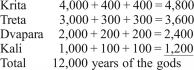
These years, however, are years of the gods; and since a human year is a day of the gods, and the days in the year are taken to be 360, we can work out the equivalence in human time as follows:
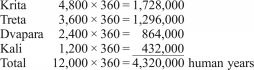
The twelve thousand divine years, which are the total of four human ages, make one age of the gods, a mahayuga, or “great age.” A thousand of these ages of the gods makes a day of Brahma, the Creator, called a kalpa, his night being of equal length. This gives us a kalpa of 12 million years of the gods, or 4.32 thousand million human years. Waking at the end of his day-and-night, Brahma creates mind, which performs the work of creation by modifying itself, impelled by Brahma's creative desire (Manu Reference Manu and Olivelle2005, verses 1.68–80).
European traveler accounts of India regularly featured this theory of yugas and treated it as definingly Indian, different from Europe and so obviously wrong it needed no refutation. The strong sense of difference sprang from the short chronology for human history allowed by the Bible, which, among English Protestants, started as recently as 4004 BC as the date of creation. This is the structure of thought that allowed Jones to drastically shorten Indian time so that it fit into biblical time, making the first three of Vishnu's avatars contemporaries of one another and of the flood of Noah, in short, processing the Puranic flood so that it would synchronize with that of the Bible and be a testimony to its truth. This is the structure of thought that allows Wilson to fit all his outline of universal history for Indian students into a chronology that commences in 4004 BC.
Muslim writers on India had the same reaction to Indian time, and reinforced Europeans insofar as the latter approached India through histories of it written in the Persian language. On the other hand, the European reaction to Indian time was not shared by the Greeks of antiquity, who were not committed to biblical time and who entertained ideas of cycles of ages. But all the Peoples of the Book—Jews, Christians, and Muslims—held to a short chronology for human history that was strikingly different from Indian theories of time. For Britons the short chronology of human history did not begin giving way till about 1860 (although geological and biological time had lengthened out earlier), so that all the early Orientalists of British India, beginning with Jones, approached the vastness of Indian time from the shortness of biblical time (Trautmann Reference Trautmann1992a).
This was the prime cause of the European belief that ancient Indians had a defective grasp of history. But it cannot be the whole story, because it did not change when Europeans began to abandon the short chronology of the Bible in the face of mounting evidence of a long prehistory for mankind, in the second half of the nineteenth century. The expansion of European historical consciousness brought about a radical change in the interpretation of the Bible and its place in history, but finding fault with the sense of history in the Bible did not lessen the European conviction that ancient Indians had a defective sense of history. If anything, the push for a scientific history based on exactness in historical accounts deepened that sense.Footnote 3
To complete the picture we need to bring in Hegel. While Orientalists such as Wilson held the “no history in India” view in a weak form, averring that while the ancient Indians had a feeble sense of history and no literary genre corresponding to their concept of history writing, India nevertheless had a history that could be recovered, in Hegel we meet it in a strong form. History writing and therefore historical consciousness is taken to be a sign of real history, and vice-versa. History itself is tied to historical consciousness because history that is truly history involves self-conscious actors creating what is new and without precedent, and, conversely, history writing is a sign of a history-consciousness.
Nature v. history
Hegel is completely clear, without a trace of ambiguity: India has no history (keine Geschichte hat) (Reference Hegel and Nisbet1975: 136; Reference Hegel1970: 84). To be sure, “a rudimentary knowledge of the treasures of Indian literature” shows that “this country is rich in spiritual achievement of a profound reality,” and even though it had prerequisites for the growth of history (Bedingung der Geschichtesbildung) in the form of ancient books of law, Hegel is almost certainly thinking of the Laws of Manu, which he knew in the translation of Jones. What India has is not history, but fore-history (Vorgeschichte). In another passage Hegel makes it certain that he is speaking of ancient India: “[T]he real objective history of a nation cannot be said to have begun until it possess a written historical record. A culture which does not yet have a history has made no real cultural progress [, and this applied to the pretended history] of India over three and a half thousand years” (1975: 13).
Hegel is valuable to us for this bluntness, and also because he did not come by it cheaply. As Halbfass (Reference Halbfass1988: 84–99) has shown, Hegel read widely in the Orientalist literature on India, including works by Jones, Colebrooke, and Wilson among the flood of new studies from British-Indian Calcutta. Whether one agrees with him or not––and I do not––one has to be impressed with the depth of Hegel's study of India, before he read India out of the history of philosophy and the philosophy of history. This serious engagement with Orientalist scholarship on India gives weight to his judgment against it, and against the European enthusiasm for India that it had created and which fed what became a veritable Indomania. Hegel's judgment against the European enthusiasm for ancient India proved decisive. Indian philosophy, which had been eagerly sought by European philosophers since Schopenhauer, lost its appeal, and was recategorized as Indian religion as Roger-Pol Droit has shown (Droit Reference Droit1989). India held at best a small place in European histories. European Indomania crashed. Philosophers after Hegel no longer felt it necessary to follow his example by reading the Orientalists and making up their own minds; Hegel had closed the question.
The argument hinges upon finding a necessary connection between history writing and history doing. History combines objective and subjective meanings, both historia rerum gestorum and res gestae themselves (Hegel Reference Hegel and Nisbet1975: 135; Reference Hegel1970: 83). It is not two different things that happen to have been given the same name; to the contrary, the two meanings are deeply connected, for “the unity of history [writing] and the actual deeds and events of history make their appearance simultaneously, and they emerge together from a common source.” This common source is the state, which supplies a context for history writing and helps produce it. Thus the centuries or millennia before history came to be written have no objective history because they have no subjective history, that is, no historical narratives (1975: 136).
Hegel was the great theorist of history at the moment of the most rapid and far-reaching expansion of history-mindedness in Europe. It was the period in which the reach of human history was being expanded by historical linguistics, the invention of archaeology, and the great decipherments, of Egyptian hieroglyphics, Mesopotamian cuneiform, and Indian Brahmi scripts, recovering written records that had been illegible for millennia. This expanding historical consciousness profoundly disturbed received beliefs in Europe itself. It opened up new ways of conceptualizing the Bible narrative and its relation to the manuscripts from which it came; it put strain upon the short chronology of the Bible.
Historical thinking spread beyond human history, from geology to Darwinian biology to the new developmental cosmologies of astrophysics, attended by debate and adjustments that were more or less painful for many. In this period of rapid expansion of historical thinking that accompanied the worldwide expansion of European imperial power and the great advances of science, Hegel theorized the scope of history in a way that was surprisingly restrictive. It is a paradox that the great theorizer of history and promoter of historical analysis in philosophy drew the boundaries of true history so very narrowly as to exclude vast new territories colonized by the expanding history-consciousness of Europe.
Hegel's exclusions and inclusions rest on a distinction between history and nature. For Hegel, nature has no history. History is the realm of self-conscious free choice and directional change, creatively making the new and unprecedented; and the main locus of this creative making is the state. Nature, by contrast, is un-self-conscious, and always reproduces itself without net change—change without development, change as mere reproduction.
Changes in the natural world, no matter how great their variety, exhibit only an eternally recurring cycle; for in nature there is nothing new under the sun, and in this respect its manifold play of forms produces an effect of boredom. Only in those changes which take place in the spiritual sphere does anything new emerge. The peculiarity of spiritual phenomena has given rise to the idea that the destiny of man is quite different from that of merely natural objects. For in the latter we always encounter one and the same determination and a constantly stable character to which all change can be reduced, and from which all change follows as a secondary consequence; whereas man displays a real capacity for change and, as already remarked, an impulse toward a better and more perfect condition––in short, he possesses an impulse of perfectibility (1975: 124–25).
This serves to dismiss the non-human world from history at the very time that historical ways of conceptualizing objects of study were infusing and revolutionizing geology, biology, and cosmology. But, further, the nature/history distinction runs right through the human race itself, so that it serves to dismiss from history those aspects of human life which are deemed to be of nature, such as sex, kinship, family, gender, and labor. Hegel theorizes the exclusion from history of cosmology, Darwinian biology (Hegel's nature has no evolution, only self-reproduction), the astonishing new finds of historical linguistics (excluded because the changes of language are unconsciously made), the family (which Hegel thinks is natural and changeless), the working class (because it merely reproduces itself), gender and women, India and even China which, though it has many and extensive histories, lacks the sense of developmental change, according to Hegel, straining every nerve to find a way to exclude the non-West. The remaining inclusions are narrow indeed: the history of the state, in Greece, Rome, and Europe.
Hegel's exclusion of India from history proper entails the exclusion as well of Indo-European historical linguistics, and its consignment to the antechamber of history––Vorgeschichte. This is so surprising a position for the philosopher of history to have taken that it is worth quoting him at some length:
A great historical discovery, like the discovery of a new world, has been made in the last twenty [years] or upwards in connection with the Sanskrit language and its affinities with the language of Europe. In particular, it has given us an insight into the historical links between the Germanic nations and those of India, an insight which carries as much certainty with it as can ever be achieved in such matters. Even at the present time, we know of peoples which scarcely form a society, let alone a state, but which have long been known to exist; and with others again, although it is primarily their advanced condition which interests us, their traditions extend beyond the history of their first constitution, and they underwent numerous changes before this epoch began. In the above-mentioned connection between the languages of nations so widely separated in space and so very different in religion, constitutions, ethics, and in every variety of spiritual and even physical culture (differences which have existed not only in the present, but also in the already remote ages in which they first became known to us), we have before us a result which proves as an irrefutable fact that these nations have spread outwards from a centre in Asia and developed in disparate ways from an original family relationship; and this is not a fact established by the favourite method of combining and reasoning from circumstances of greater and lesser import––a method which has enriched history with so many fabrications given out as facts, and which, since alternative combinations of the same circumstances (either among themselves or with others) are equally possible, will continue to enrich it in the same fashion. But all these events, whose range appears so extensive, lie outside history proper: they in fact preceded it (1975: 135).
In the end, the brightest achievement of historical linguistics does not belong to history because it rests upon the phenomenon of sound shifts. Because these sound shifts are produced unconsciously, and not by deliberation and conscious choice, they are ruled out of the narrow confines of what constitutes history for Hegel.
Coming to the relation of Hegel to disciplinary history, it is a more complicated story. Most historians, in the past and in the present, are oblivious, indifferent, or overtly hostile to Hegel. Insofar as they take notice of it, historians have generally attacked Hegel's theory of history, and philosophers have mostly defended it by arguing that historians have misunderstood it; it has been largely a non-conversation between philosophy and history. Disciplinary history has felt free to ignore the Hegelian dicta about what does and does not count as history, though the Hegelian viewpoint in European thought generally has been strong. History has been drawn this way and that, between the poles of the Orientalists and the anti-Orientalist Hegel and his European vanguardism. Historians have generally held the un-Hegelian belief that everyone and everything has history whether or not they have a well-developed consciousness of history and a body of history writing that expresses it. Disciplinary history has been interested in family, custom, language, and other topics that Hegel rules out of bounds; Fustel de Coulanges would be an outstanding example, and one who finds ancient India good to think, as well. But disciplinary history, in the West, has chosen to remain within the limited chronological horizon of biblical time, and it has been as committed to European vanguardism as Hegel himself, if only in a softened form, until fairly recent times, that is to say, about the 1960s. Till that time the uses of ancient India that I have mentioned have largely been outside of history, in departments of linguistics, anthropology, sociology, and religion; and history departments had little or no relation to the tremendous growth of history in the natural sciences. The Hegelian exclusions serve history badly, and historians have been right in the degree to which they have opposed them.
Part 3. Back to the Flood
Sometimes when we need to find a new way forward, it helps to return to the past, to find where we took the wrong turning. This is one of those times. We need to return to the flood.
From the vantage of Christian Europe, Indian time was exotic and obviously false for its excessive length, which exceeded that of the biblical chronology for world history; but increasingly it was drawn into the Hegelian frame, in which cyclical change is of nature, and opposed to lineal change, which is of history.
Mircea Eliade is certainly involved in this reading of Indian time. There are several reasons for bringing in Mircea Eliade, Romanian novelist and public intellectual turned University of Chicago professor of the history of religions, into the analysis at this point. It brings the argument up to the recent past; it invokes a thinker whose intellectual formation included ancient Indian texts in Sanskrit and whose views were greatly shaped, therefore, by India; a thinker who was immensely influential in history of religions, at least in America; and a thinker for whom the cyclical/linear distinction is central.
Eliade was an anti-Hegelian who did not believe that “man makes himself” in the Hegel-friendly phrase of the English archaeologist V. Gordon Childe. Eliade's book, The Myth of the Eternal Return (Reference Eliade and Jonathan2005 [Le mythe de l'éternel retour: archétypes et répétition, 1949]), constructs a category he calls “archaic man,” the content of which largely comes from his study of Sanskrit and Indian philosophy as a student in Calcutta, and the writings of the ancient civilizations of Mesopotamia. Archaic man, Eliade believed, had a rage for being, expressed through the rejection of history and the repetition through ritual of models from the beginning-time of myth. These ritual reenactments of the beginning served to abolish history, that is, the events intervening between the originary model and its ritual repetition, history having the negative valence of that which deviates from the model. Eliade had a strong feeling of attraction for this supposed rejection of history by archaic man; it is for him the source of religious feeling, a philosophy of religion that we can only appreciate by going back to the pre-Hegelian world. He thinks that historical time first began to be valorized by the Hebrew Bible with its scenes of God's intervention in history; and that modern philosophies of history, starting with Hegel's, are regrettable secularizations of this biblical time-sense. He is opposed to the developmentalist history of Hegel and the “man makes himself” modernist time-sense. It is an oddity of his relation to the object of his affection that he chose history of religions for his project, but in truth, it is a philosophy of religion, not a history except in the limited sense that it operates within a contemporary sense of chronology. Even though it reverses the signs on the Hegelian construct, the structure remains Hegelian.
However that may be, and leaving aside the many problems that vex the interpretation of this complex and elusive thinker, the main point for present purposes will be that Eliade's construct of the history-fleeing archaic man comes from the very civilizations that compiled lists of kings and recorded the deeds of past kings for the edification of contemporary ones, and scrutinized the skies to discover the future––that is, who wrote the first histories. Eliade's big idea just does not hold together. The ancient civilizations were not dealing in primordial conceptions of time and being, they were inventing new theories of time, cosmos, and history and putting their ideas into circulation across Eurasia.
Between them, Hegel and the anti-Hegelian Eliade, among others, collaborate in promoting a strong contrast between cyclical and linear time-senses, attributing the first to nature, or “archaic man,” or the Indians, or the non-West, and the latter to the Greeks, to the Bible, to Europe, to modernity. I believe this is wrong and leads us down false paths.
There are two good reasons to believe a hard opposition of lineal and cyclical time is mistaken. One of them is that they are not true opposites. The second is that it wrongly takes the cyclical time of the Indian theory of world ages to be primordial.
As to the first, most measures of time are taken from the literally circular motions of bodies in space––the daily revolution of the earth, the monthly orbit of the moon about the earth, the yearly orbit of the earth about the sun; also the conjunctures of planets in their several orbits; and even the backward wobble of the earth on its axis that, once every twenty-six thousand years, makes the equinox precess through the signs of the zodiac. None of this is incompatible with the idea of linear time, that time flows in one direction and not the other. The directionality of time is not suspended by the cycles that bring recurring birthdays, saints' days, holidays, New Year days, and other anniversaries. We can go back in time, reliving the past in the movies in our mind; but we relive them forward, not backward. We know that when you run a real movie backward, you get an impossible world with strange physics in which water flows uphill, broken dishes rise and reassemble themselves, people and horses and dogs run rapidly and unerringly backward without looking where they are going.
The second objection is that the view in question wrongly makes the four world ages theory of ancient India the expression of primordial belief. As David Pingree, who was our leading scholar of the exact sciences in ancient India, observed, there is no trace of it in the earlier, Vedic age, except for the word yuga itself, which in the Veda indicates brief ages of five or so years (Reference Pingree1963; Reference Pingree and Gillispie1978). Eliade has led us astray. The yuga theory is not ancient folk-belief but is the recent invention of a religious elite. It is a new, post-Vedic theory, positing a new configuration of the relation of time and truth. We now have a conception of big time through which worlds arise and dissolve and arise again and again; eternal truth is inserted into this cycling history by religious teachers who, likewise, appear again and again, from age to age, as a series of Buddhas or Jinas or avatars of God, and through which persons migrate from life to life, body to body, seeking salvation through escape from time, into eternity. Eternal truth is brought into time by authoritative teachers and saviors who, as a signature feature of this cosmology, are repeated in each world age.
This cosmology was a new creation, surely made in India by Indian theorists of history; but it has a connection, I believe, with an international circulation of ideas about astrology, astronomy, kingship, and the sacred among the ancient civilizations of Eurasia.
Which takes us back to the flood of Noah.
If we widen and extend back in time this view of a field of variation in which ideas of astronomy, astrology, the sacred, and kingship circulate among the early civilizations of Eurasia, we will be in a position to find connections across the boundary between the non-opposites of the cyclical and the linear, the ancient Indians and the Peoples of the Book, the archaic and the modern, the non-West and the West.
Since cuneiform writings of the Sumerians and Akkadians were made once again legible by nineteenth-century Orientalists it has become apparent that the flood narrative of the Bible has many precursors in stories of the ten or so kings who ruled from the creation to the flood. An example is the history of Babylon by the Babylonian priest Berossus, written in Greek during the Hellenistic period (Berossus Reference Berossus and Burstein1978; Vergrugghe and Wickersham Reference Verbrugghe and Wickersham1996). In this version, as in the Bible, the period before the flood is a strange time in which people lived exceptionally long lives, like the 969 years of Methuselah; except that in the account of Berossus the ten kings' lives were even longer than in the Bible, in the tens of thousands of years, and the entire interval from creation to the flood was 432,000 years. Thus the Bible narrative is a miniature version of the Babylonian flood narrative or some relative of it—as became apparent to the expanding historical consciousness of nineteenth-century Europe.
This is where the yuga theory of India comes in. Pingree argued that the number 432,000 is a parameter from Babylon which the Indians took up and around which they constructed the schema of Indian time (1963). The evidence is the number itself, which is the length of the Kali age in which we live, ten times which is the total length of the cycle and a thousand times, which is a kalpa. The number is a Babylonian one, that is, a round number in the base-60 number system (which we still use, in the minutes and seconds of the clock, or degrees, minutes, and seconds of angle used in astronomy) expressed as 120 sars, one sar being 60 squared, or 3,600.
It could be pure coincidence that the Puranas contained the story of a worldwide flood from which a remnant of mankind survived in a boat towed by a fish––the Fish Avatar of Vishnu––and that Jones fixed upon this coincidence to find a connection between the Bible and the Puranas via floodology. But it seems possible and indeed more likely that the Puranas, just as the Bible, contain a version of a flood story that grew up in Mesopotamia and spread to other ancient civilizations with which it had contact. It may be that the illegible scene inscribed on the pediment of the Jones statue in St. Paul's Cathedral is a late reflex of that ancient story, about the flood in mythical times, after which strange time comes to an end, and the normal time of history begins. The Bible and the Puranas may be remote cousin-versions of some Mesopotamian original text, of how history began, reunited in the statue of Jones thousands of years after.
If so, it is certainly the case that the Indians rewrote the Middle Eastern flood story and the beginnings of history in their own way, making it both same and different from the original. In the Mesopotamian version, the flood is the dividing line between myth and history, before which gods and humans communicated directly, and humans live extraordinarily long lives, a strange time which gets normalized and familiarized after the flood, when the gods withdraw and human life assumes a familiar duration. In India the length of human life declines with the four passing ages, from four hundred, to three hundred, two hundred, and the present one hundred years—but then the cycle begins again.
If India drew its flood story and the base number of its theory of ages from Mesopotamia, one of the values of ancient history is that the further back we go in antiquity the less different from one another the West and the Rest become. The peculiar conception of Europe that Hegel proposes—that is it both universal and singular at the same time—seems to melt and disperse into a multitude of singularities in constant flux and mutual influence. This seems to me good reason to encompass the ancient and the modern world in our field of vision.
It concerns me that disciplinary history seems to have been shrinking to an ever-narrower band of the recent past, and losing interest in the uses of the deeper past. While it has become more global, its chronological depth has grown shallower; and that deeper past is left to others. At the very moment when history should be joining forces with the new technologies of the past, it is losing the capacity of doing so, thinning historians' understanding of the present, and the future.
Conclusion
By way of conclusion, let me give answers to the rhetorical questions I have posed in the title of this article.
Let me take the second one first: Does history have India? History has and should have India, more specifically, ancient India. The question is partly an empirical one, a question of fact. Departments of history, not only in India but in America as well, manifestly have India these days. It is true that the India that history departments outside of India have is mostly colonial India. It has become the mark of a good department of history in America that it includes India and China, but in the case of India at least it is first colonial India, and secondly or thirdly, if at all, ancient or medieval India. It is part of the pulling toward the recent in disciplinary history. But at least India is by now an instituted part of disciplinary history in America, as it should be.
The question is also one of philosophy of history. I see no reason that the answer to the second question should depend on the answer to the first; that is, disciplinary history should not limit itself to history self-consciously made by human agents. History has bettered itself and enlarged its field of vision in the degree to which it rejected the Hegelian linkage between being a worthy object of historical study and being a self-conscious agent of history-doing. The opening out of history beyond the narrow Hegelian boundary is altogether for the good.
That being so, the outcome of the first question, “Does (ancient) India have history (writing)?” does not determine the outcome of the second. Nevertheless, even taken by itself, and without the Hegelian linkage between the two questions, the matter is more complicated and requires a more thoughtful answer.
At one level, ancient India does have history, and it has it exactly where the Orientalists were looking for it, and failed to recognize it, in the Puranas. As we have seen, these classic Sanskrit texts, by one ancient definition, treat of five topics: the creation, the successive world ages, the genealogies of gods and sages, the ages of the Manus or first humans of their times, and the genealogies of kings. This combination of cosmogony, stories of the gods and dynastic lists of kings is not entirely different from the shape of the past as we find it in the Bible from Genesis to Kings, or in Berossus in his history of Babylonia from the Creation to the Flood, to the kings of Babylon, to his own time. It is grandly historical in an old-civilizational way. So far from representing a flight from history, it is a product of the beginnings of the keeping of history through king lists, embedded in a cosmological frame that in its day was a new departure, a way of theorizing deep time. So far as India is concerned, we need to abandon Eliade's primordialist view of Indian time, which has obscured for us the process by which the Vedic tradition reinvented itself by taking on a new cosmology, one pioneered by the anti-Vedic religions of Jainism and Buddhism. We need a different history of religion, which focuses on that reinterpretation, beginning with the theory of the yugas in Manu.
Nevertheless, the Orientalists assiduously sought out the history of ancient India, focusing especially on the Puranas, and regularly reported failure to find it. I think the datum needs to be taken seriously, and that we must try to explain it. I have suggested that one strong reason for the Orientalist verdict against ancient India on this head was the clash of chronologies between the Bible and ancient India. The Orientalists just could not recognize what they saw in India as comparable to their idea of what constituted history. But we have seen that that cannot be the whole explanation, because the “no history in India” thesis survived the expansion of European timescales for history to one not unlike that of Indian time. We must, then, set the clash of chronologies aside, to find what remains. There remains something that the Orientalists register in their unanimous judgment, and we need to identify as exactly as we can the nature of the object. What is the thing that is pointed to by the purported absence of historical consciousness in ancient India?
The thing that provokes the “no history in India” view on the part of European travelers and Orientalists has to do with the way in which the Indian theorists configured the relation of time and truth. This is a large theme that needs to be explored at length; here I can only give a sketch.
The subjects of this configuration-making are not Indians-in-general, much less Eliade's “archaic man,” but the class who produced almost all of the written record that survives of India's ancient past, the religious specialists. It reflects and underwrites their own social location.
The theorists of time in the form of successive world ages had a well-developed idea of the world as process in time, and they joined to it a concept of timeless truth which is embedded in the world process but is unchanged by it. Within the world process truth is recognizable by many ways, but principally by means of the incarnations of God or the awakened truth-knowers whose teachings are the heritage of the theorists. It is the mark of this time-sense that such incarnations or awakened teachers of truth come in series, one appearing in each age––yuge yuge, as the Bhagavad Gita says.
The intellectual accomplishments of this class were substantial, especially in formal bodies of knowledge such as the astronomy-astrology-mathematics group of sciences, in language analysis, and perhaps also in aesthetic theory and logic. In all of these the tendency is toward structural rather than historical analysis; not exactly timelessness, but not making directional change the main object of interest or the engine of analysis. It is not a question of a pure absence of history, but an underdevelopment of it and a strong pulling toward structural analysis that seeks out the enduring. This is the direction in which we should pitch our attention if we want to understand, historically, why Europeans found India both good to think and lacking in history.