INTRODUCTION
Loliginid squid are important components of many marine near-shore ecosystems. They are fast-growing coastal cephalopods, with a life cycle generally shorter than one year. To date there is only evidence for three species that live longer than one year (Loligo forbesi, L. gahi and L. vulgaris reynaudii) and they are all cool-temperate species (Jackson, Reference Jackson2004). The rapid growth rates, along with physiological strategies aimed at maintaining the ‘life in the fast lane’ (e.g. efficient digestion, protein based metabolism, sustaining continued growth and efficient use of oxygen), place squid in a unique position to respond to environmental or climatic changes (see e.g. O'Dor & Webber, Reference O'Dor and Webber1986; Jackson & O'Dor, Reference Jackson and O'Dor2001). These characteristics and the rapid turnover in populations make loliginids ideal marine models for studying population dynamics and how climate changes may affect growth and population dynamics.
Statolith analysis has proved to be the best tool for estimating loliginid age and growth in wild populations (e.g. Brodziak & Macy, Reference Brodziak and Macy1996; Hatfield, Reference Hatfield2000; Jackson & O'Dor, Reference Jackson and O'Dor2001; Villanueva et al., Reference Villanueva, Arkhipkin, Jereb, Lefkaditou, Lipinski, Perales-Raya, Riba and Rocha2003; Jackson, Reference Jackson2004; Arkhipkin, Reference Arkhipkin2005; Villanueva et al., Reference Villanueva, Moltschaniwskyj and Bozzano2007). Statoliths are paired calcareous structures associated with the sensory epithelia located in the statocysts of all cephalopods. Their microstructure and chemical composition archive a variety of environmental and ontogenetic events experienced by the individual during the entire life history (for reviews see e.g. Jackson, Reference Jackson2004; Arkhipkin, Reference Arkhipkin2005). Several intrinsic and extrinsic factors affect statolith growth and formation such as temperature, photoperiod, ontogenetic shifts and food ration (González et al., Reference González, Castro and Guerra1996; O'Dor et al., Reference O'Dor, Rodhouse, Dawe, Hancock, Smith, Grant and Beumer1996; Villanueva, Reference Villanueva2000a,Reference Villanuevab; Jackson & Moltschaniwskyj, Reference Jackson and Moltschaniwskyj2001a; Jackson et al., Reference Jackson, McGrath Steer, Wotherspoon and Hobday2003; Pecl, Reference Pecl2004; Pecl et al., Reference Pecl, Moltschaniwskyj, Tracey and Jordan2004a; Arkhipkin, Reference Arkhipkin2005). Likewise, the length of embryonic development and the different temperature regimes faced by embryos can directly influence statolith formation (Villanueva, Reference Villanueva2000a,Reference Villanuevab; Villanueva et al., Reference Villanueva, Arkhipkin, Jereb, Lefkaditou, Lipinski, Perales-Raya, Riba and Rocha2003, 2007; Sakai et al., Reference Sakai, Brunetti, Ivanovic, Elena and Nakamura2004). Linear relationships between statolith diameter and body size- and weight-at-hatching have been described for some laboratory reared cephalopods (Martins, Reference Martins1997; Ikeda et al., Reference Ikeda, Wada, Arai and Sakamoto1999; Jackson & Moltschaniwskyj, Reference Jackson and Moltschaniwskyj2001a). Loliginid squid display a distinct stress mark in the statolith structure associated with hatching. This mark, commonly referred to as ‘hatch-check’ or ‘natal ring’, is not resorbed and is clearly visible in adult statoliths (Villanueva et al., Reference Villanueva, Arkhipkin, Jereb, Lefkaditou, Lipinski, Perales-Raya, Riba and Rocha2003). It is therefore possible to back-calculate an individual's size at hatching from the radius of its natal ring preserved in the adult statolith (Ikeda et al., Reference Ikeda, Wada, Arai and Sakamoto1999; Steer et al., Reference Steer, Pecl and Moltschaniwskyj2003). Consequently the comparison of the natal ring radii (NR) in individuals collected from different locations, years and seasons, can provide important information about the effects of these factors in determining hatchling size. In addition, hatchling size may represent a source of variation among adult size-at-age data, both within a single cohort and between cohorts (Steer et al., Reference Steer, Pecl and Moltschaniwskyj2003; Pecl et al., Reference Pecl, Moltschaniwskyj, Tracey and Jordan2004a). Accordingly, the comparison of the NR from individuals collected in different locations may help to explain the size-at-age variation observed among the adults.
Seasonal variations in environmental factors such as temperature, day length, and food availability also have a profound influence on squid reproduction and can induce earlier or later gonad maturation and mating activity (e.g. Rowe & Mangold, Reference Rowe and Mangold1975; O'Dor et al., Reference O'Dor, Durward and Balch1977; Pecl, Reference Pecl2001; McGrath & Jackson, Reference McGrath and Jackson2002; McGrath Steer & Jackson, Reference McGrath Steer and Jackson2004). Moreover, environmental conditions in general may have a significant effect on the reproductive strategy of a species by influencing the rate and timing of energetic allocation and maternal investment (e.g. Pecl, Reference Pecl2001; McGrath & Jackson, Reference McGrath and Jackson2002; McGrath Steer & Jackson, Reference McGrath Steer and Jackson2004). In any case, the reproductive strategies exhibited by a species are linked to the source of reproductive energy, i.e. feeding or storage.
Loliolus noctiluca appeared to be a good model organism for understanding squid growth. It is a small near-shore loliginid with a wide latitudinal distribution (about 35 degrees, from New Guinea to Tasmania, see Lu et al., Reference Lu, Roper and Tait1985). Loliolus noctiluca is characterized by a short lifespan (<9 months), clear statolith increment structure, and statolith increments which have been shown to be laid down daily (Jackson, Reference Jackson1990; Dimmlich & Hoedt, Reference Dimmlich and Hoedt1998). Growth rates and reproductive parameters of L. noctiluca have been studied in the northern (tropical North Queensland waters) and in the central (temperate waters off New South Wales and Victoria) regions of its distribution, and considerable variability in growth rate was found depending on latitude and season of hatching (Dimmlich & Hoedt, Reference Dimmlich and Hoedt1998; Jackson & Moltschaniwskyj, Reference Jackson and Moltschaniwskyj2001b). To date no information has been reported on the growth of this species at the southern limits of its distribution and on its reproductive strategy. The aim of this study was to describe for the first time the reproductive ecology and growth of L. noctiluca from Tasmanian waters, at the southernmost limit of the distribution of the species (Lu et al., Reference Lu, Roper and Tait1985). Furthermore, the potential variation in size of hatchlings from different latitudes, seasons and years was explored using statolith natal ring radius analysis. Exploring latitudinal and seasonal variation in key life history parameters from embryo to adult in L. noctiluca provides a mechanism to obtain a preliminary picture on the possible effects that climate change may have on near-shore loliginid populations generally.
MATERIALS AND METHODS
Samples and data collection
In this study a variety of samples was used for different investigations. Age, growth and reproductive ecology of Loliolus noctiluca were investigated for the first time off the southernmost limits of its geographical distribution using new samples from Tasmania (hereafter referred to as Tasmania). Differences in hatchling size were evaluated by comparing the radius of the natal ring (NR) using the Tasmania statoliths, and statoliths collected from Newcastle, New South Wales 1998 and Townsville, Queensland 1996 and 1997, which were used for age and growth studies only by Jackson & Moltschaniwskyj (Reference Jackson and Moltschaniwskyj2001b) and stored embedded in thermoplastic cement on microscope slides.
The Tasmania samples (78 individuals) were obtained in 2003 in Hobart, Tasmania, from commercial fishing which operated daily off the south-eastern Tasmanian coast. At the end of each fishing trip the collected specimens were frozen and the sampling date recorded. The specimens were dissected at the Institute of Antarctic and Southern Ocean Studies laboratory. All the individuals were defrosted, sexed and assigned to a maturity stage based on Lipinski's (Reference Lipinski1979) universal maturity scale. Total weight (TW), dorsal mantle length (ML), mantle weight (MW), and fin weight (FW) were also measured. Gonad weight, including the associated reproductive structures, was recorded for each individual. This included the testis and spermatophoric complex in males and the ovary, oviducts, oviducal glands and nidamental glands in females. All the weights were taken at the nearest 0.01 g. Gonadosomatic indices (GSI) were calculated for both males and females using the following equation:

where total reproductive weight included all accessory reproductive structures. Statoliths were removed from all specimens for ageing and stored dry after cleaning with distilled water.
Statolith ageing
The statoliths were mounted in Crystal Bond™ thermoplastic cement on a microscope slide in preparation for ageing. Statoliths were ground dry by hand, on both the posterior and anterior surface, along the longitudinal plane after Jackson & Moltschaniwskyj (Reference Jackson and Moltschaniwskyj1999). To grind and polish statoliths four lapping films with decreasing grit size (30, 12, 3 and 0.05 µm) were used in sequence: the coarsest lapping films (30 and 12 µm grades) were used for the main grinding, while the remaining films (3 and 0.05 µm grades) were used to remove the scratches from the ground surface. Increments were counted using a Nikon Eclipse E400 high-power microscope (200–400×) with polarized light, connected to a computer monitor via a high-resolution video camera. Increment counts were taken on live images off the computer screen. According to previous validation studies carried out on L. noctiluca, each growth increment or ring (i.e. the sequence of a dark and light increment outside the natal ring) was assumed to represent one day's growth (Jackson, Reference Jackson1990; Dimmlich & Hoedt, Reference Dimmlich and Hoedt1998). Each statolith was counted twice, with 60% of the statoliths counted by a second reader. If the variation between the two counts was greater than 10%, a third count was taken and the average of all three counts was used to estimate the age in days. Estimated hatch dates were back-calculated from age data (hatch date = sampling day–age estimated in days) and grouped into monthly cohorts. Growth curves were generated using size-at-age (TW or ML) for each monthly cohort. Due to the low number of males, the analysis was performed on females only.
Several functions were fitted to the length- and weight-at-age data, including logistic, power, exponential and linear (e.g. after Dimmlich & Hoedt, Reference Dimmlich and Hoedt1998; Jackson & Moltschaniwskyj, Reference Jackson and Moltschaniwskyj2001b). The curve of best fit was determined by the least coefficient of variance of the curve parameters (estimated according to the least square method), the highest determination coefficient (r 2) value and the examination of residuals (e.g. Arkhipkin et al., Reference Arkhipkin, Laptikhovsky and Golub1999; Jackson & Moltschaniwskyj, Reference Jackson and Moltschaniwskyj2001b; Triantafillos, Reference Triantafillos2004; Hoving et al., Reference Hoving, Lipinski, Roeleveld and Durholtz2007). The t-test was used to test the significance of the differences between pairs of curves. The slopes of the size-at-age regressions were used to derive estimates of ‘average growth rate’. Individual growth rate (IGR) was calculated as millimetres per month (IGR = (mantle length – hatchling size)/(age in days) after Jackson et al. (Reference Jackson, Forsythe, Hixon and Hanlon1997), and a hatchling size of 1.3 mm ML was assumed (Jackson, Reference Jackson1990; Dimmlich & Hoedt, Reference Dimmlich and Hoedt1998). The IGR values were compared using a t-test.
Hatch size measurements
The radius of the natal ring (NR) was measured on 475 statoliths: 76 from Tasmania, 288 from Townsville and 111 from Newcastle. The NR was measured from the nucleus to the natal ring margin along the longest axis using the Image pro-plus 5.0 software. This measure was chosen as it can be reliably measured in prepared adult statoliths when they have been ground dorso-ventrally or when they are small and translucent (Steer et al., Reference Steer, Pecl and Moltschaniwskyj2003).
To investigate the effect of several factors (i.e. gender, location, season and year of hatching), the NR data were segregated according to sex, location and date of hatching (season and year, back calculated from age and date of capture). Analysis of variance (ANOVA) was used to test for the effects of each factor on NR but since the dataset was highly unbalanced, with several missing cells, separate analyses were conducted within and between locations using Type III sums of squares (SSq) (e.g. Quinn & Keough, Reference Quinn and Keough2002). Using Type III SSq it is possible to test the ‘full’ model without the factor/interaction of interest. This procedure is not sensitive to the order of each term, making the Type III SSq more appropriate for analysing unbalanced design (Quinn & Keough, Reference Quinn and Keough2002).
For comparing NRs within location, the data from Townsville were segregated by sex, year and season of hatching (i.e. Townsville NR ~ yr+season+sex). Tasmanian individuals were hatched in the same year but in different seasons so the sex and season effects were investigated (i.e. Tasmania NR ~ season+sex). Samples from Newcastle were hatched in the same season and year, thus it was possible to test for the gender effect only (i.e. Newcastle NR ~ sex).
To compare NRs from different locations, the samples hatched in the same season but in different years were used: Townsville–autumn 1996 × Townsville–autumn 1997 ×Tasmania–autumn 2003; Townsville–summer 1996 ×Townsville–summer 1997×Newcastle–summer 1998. In the comparison the differences between years in Townsville was first tested and then, if the differences were not significant (P > 0.05), comparison among locations was undertaken. In the analysis all the two-way interaction terms were considered but the non-significant interaction terms (F test, alpha = 0.05) were excluded from the model. Where the presence of high order interactions was indicated, the Tukey's pair-wise comparisons amongst groups were computed. All the analysis was carried out using the ANOVA and Multcomp package in R (Westfall, Reference Westfall1997; Westfall et al., Reference Westfall, Tobias, Rom, Wolfinger and Hochberg1999; Bretz et al., Reference Bretz, Genz and Hothorn2001).
Maturity and condition
To study the relative investment between somatic and gonad growth, the geometric mean regression (Model II) equations for ML–MW, ML–FW, ML–gonad weight were calculated separately for males and females (Moltschaniwskyj & Semmens, Reference Moltschaniwskyj and Semmens2000; Green, Reference Green2001; Jackson et al., Reference Jackson, Semmens, Phillips and Jackson2004; McGrath Steer & Jackson, Reference McGrath Steer and Jackson2004). From these equations the residuals were calculated for each specimen and they were used as a size-independent measure of somatic condition (García-Berthou, Reference García-Berthou2001). By regressing each of the tissue weights against ML, the residual value of each individual provides a size-independent method to compare the relative condition of each tissue. An individual or a tissue that is lighter for its length than predicted from the regression equation is considered to be in poorer condition and vice versa (Moltschaniwskyj & Semmens, Reference Moltschaniwskyj and Semmens2000).
The ML–gonad weight residuals were correlated with both ML–FW residuals and ML–MW residuals for each sex separately. Similarly, ML–FW residuals were correlated with ML–MW residuals. This type of analysis can highlight any trade-offs occurring between somatic and reproductive growth (McGrath & Jackson, Reference McGrath and Jackson2002; Jackson et al., Reference Jackson, Semmens, Phillips and Jackson2004; McGrath Steer & Jackson, Reference McGrath Steer and Jackson2004). The ML–MW relationship was used as a measure of somatic condition. The mean ML–MW condition residual was calculated for each of the maturity stages, for males and females, to determine how somatic condition changed with maturity.
RESULTS
Age and growth
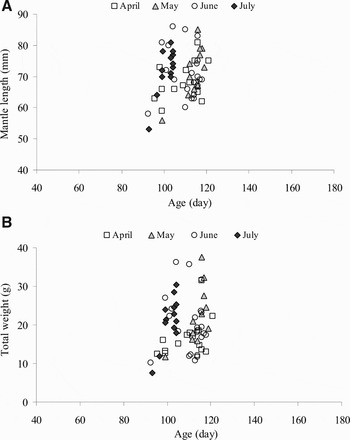
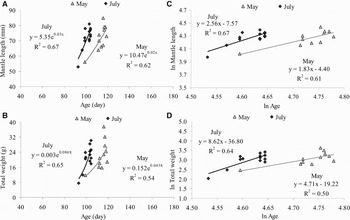
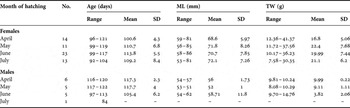
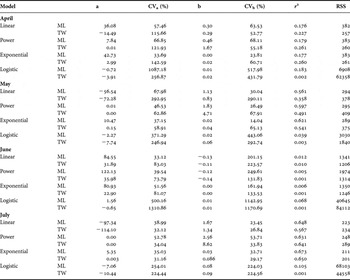
A total of 79 individuals was sampled in Tasmania between August and October 2003 (61 females, 18 males) and they were all successfully aged. Growth of Loliolus noctiluca was rapid and the life cycle appears to be less than six months. Estimates of age ranged between 92 and 121 days for females and between 84 and 122 for males (Table 1). There was considerable scatter in the size-at-age plots by weight and mantle length (Figure 1), however, by grouping the samples according to hatch month, some differences in growth patterns were found. The July-hatched individuals had a faster growth rate than the May-hatched individuals, whereas the individuals hatched in April and June did not display any specific growth pattern due to small sample sizes and narrow range in individual size. Accordingly, the estimation and comparison of growth curves was possible only for the May and July hatched individuals. The linear, power and exponential models described well the size-at-age data (i.e. ML-at-age and TW-at-age) for both the May and July hatched individuals, but the exponential model provided the best fit (Table 2). On the contrary, the fit of the logistic model was weak probably due to the lack of an inflexion point in the growth or of an asymptotic size in the ML- and TW-at-age data. Individuals hatched in July grew significantly faster than those hatched in May (t = 4.87, df = 24, P < 0.001): the former reached 60–70 mm ML and 15–25 g TW in approximately three months, the latter reached the same size range in nearly four months (Figure 2).
Size-at-age plots for female individuals of Loliolus noctiluca grouped per hatch month. (A) Mantle length-at-age; (B) total weight-at-age. April, May, June and July—month of hatching.

Size-at-age plots for female individuals of Loliolus noctiluca hatched in May and July. (A) Mantle length-at-age; (B) total weight-at-age; (C) log transformed mantle length-at-age; (D) log transformed total weight-at-age data. May and July—month of hatching.

Descriptive statistics for the collected samples of Loliolus noctiluca in Tasmania 2003.

ML, dorsal mantle length; TW, total weight; SD, standard deviation.
Parameter estimates and statistical response for the different models applied to the size-at-age data of Loliolus noctiluca from the Tasmanian waters: Linear, ML = a+b*Age; Power, ML = a+Xb; Exponential, ML = a*eb*Age; and Logistic, ML = 1/(1+e(a-b*Age)).

ML, mantle length; TW, total weight; a, b, curve parameters; CV, coefficient of variation of estimates parameters; r 2, determination coefficient; RSS, residual sum of square.
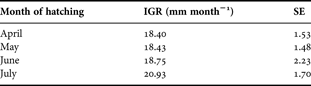
The IGRs were significantly different (t = 3.86, df = 25, P < 0.001) between individuals hatched in May (average = 18.43 mm month−1) and July (average = 20.93 mm month−1) (Table 3). There were no significant differences in average IGR between the April (18.40 mm month−1) May and June (18.75 mm month−1) hatchlings (for all the comparisons t < 1, df > 20, P > 0.05).
Average instantaneous growth rate (IGR) for each monthly hatched cohort of Loliolus noctiluca.
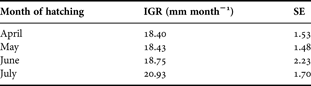
SE, standard error.
Hatchling statolith size
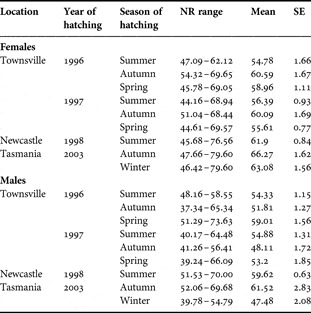
There was significant variation in NRs with respect to sex, location, season and year of hatching (Table 4). The smallest NR was recorded in a male from Townsville hatched in autumn 1996 (NR = 37.34 µm), while the largest NR was found in a Tasmanian female hatched in winter 2003 (NR = 79.60 µm).
Range (NR range), mean and standard error (SE) of hatchling statolith size (μm) from different locations, years and seasons for female and male individuals of Loliolus noctiluca.

Comparisons between males and females revealed significant differences at all locations with mean NR significantly larger in females than in males (overall data F = 22.78, df = 1, P < 0.001). In Townsville the mean NRs ranged from 54.78 to 60.59 µm in females, and between 48.11 and 59.01 µm in males (significance for gender effect: F = 22.31, df = 1, P < 0.001). In Newcastle, where it was possible to test for gender effect only, females' NRs (mean = 61.90 µm) were significantly larger than males' NRs (mean = 59.62 µm) (F = 4.43, df = 1, P < 0.05). The same differences were recorded in Tasmania where females had significantly larger mean NRs (66.27 µm in autumn and 63.08 µm in winter) than males (61.52 µm in autumn, 47.48 µm in winter) (F = 23.13, df = 1, P < 0.001).
Townsville females had the largest mean NR in autumn and the smallest in summer in 1996, while the largest and smallest NRs were found respectively in autumn and spring in 1997. An opposite pattern occurred in Townsville males, with a decrease in mean NRs from spring to autumn in 1996 and an increase from autumn to summer in 1997. In Tasmania the comparison was undertaken from autumn- and winter-hatched individuals and the mean NRs were significantly larger in autumn than in winter for both sexes.
There was a general trend across all locations with the largest mean NRs in Tasmania, and the smallest in Townsville: NRs from Tasmania and Newcastle were significantly greater than NRs from Townsville (Tasmania versus Townsville: F = 53.49, df = 1, P < 0.001; Newcastle versus Townsville: F = 13.56, df = 1, P < 0.001), with Newcastle NRs smaller than Tasmania NRs. Unfortunately the differences in the sampling season did not allow for a direct comparison between Tasmania and Newcastle. Similarly, the difference in NRs between summer 1996 and summer 1997 Townsville samples made it impossible to compare NRs between Townsville and Newcastle.
Maturity and condition
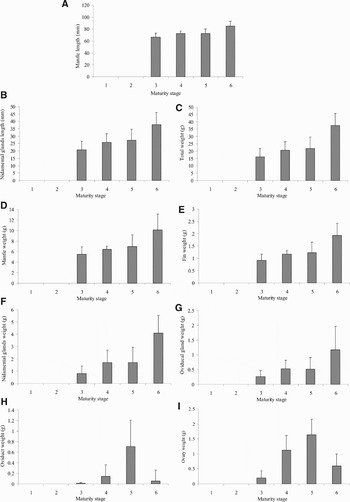
The mantle length, total weight, mantle weight, fin weight, oviducal gland weight and nidamental gland weight/length increased up to Stage 6 individuals (Figure 3). In contrast, oviduct and ovary weight increased up to Stage 5 but decreased in Stage 6. Ovary weight increased from Stages 3 to 5 (with some ovaries exceeding 2 g) and then dropped by 66% from Stage 5 (average value = 1.78 g) to Stage 6 individuals (average value = 0.61 g).
The change in mean (A) mantle length and (B) nidamental gland length, and weight of selected parameters with maturity stage for female individuals of Loliolus noctiluca. (C) Total weight; (D) mantle weight; (E) fin weight; (F) nidamental gland weight; (G) oviducal gland weight; (H) oviduct weight; (I) ovary weight.

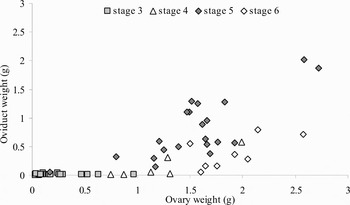
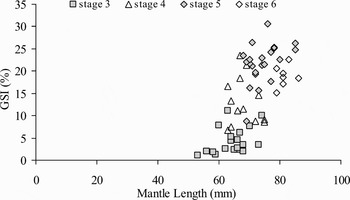
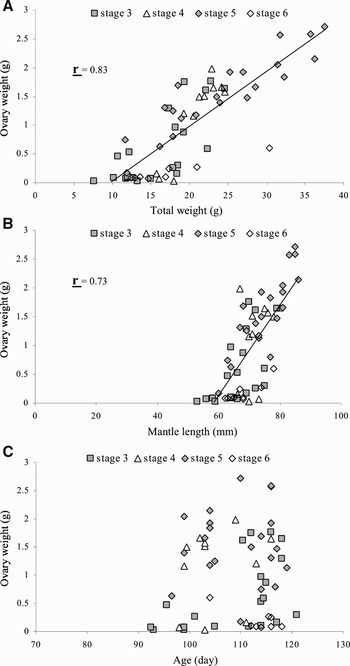
The oviduct was generally small but easy to distinguish in most individuals. The weight of the oviduct was relatively low in Stages 3 and 4 females (<0.1 g), but increased in Stage 5 individuals (in some cases exceeding 1 g). The observed increase was due to the large number of eggs packed into the oviduct in all the Stage 5 females. The oviduct increased in size along with the ovary in maturing and mature individuals, but the oviduct weight never exceeded the ovary weight (Figure 4). The GSI values increased with maturation: the highest values were observed in larger and mature females, but generally the GSI did not exceed 30% (Figure 5). The mean GSI for mature females was 20.6% with minimum and maximum values of 15 and 30.6% respectively. There was a significant linear relationship between ovary weight and both total weight and ML (P < 0.01) but there was no relationship between ovary weight and age (P > 0.05) (Figure 6).
The relationship between the ovary weight and the oviduct weight for Stages 3, 4, 5 and 6 female individuals of Loliolus noctiluca.

The gonadosomatic index (GSI) values for mantle length and maturity stages for female individuals of Loliolus noctiluca.

The relationship between (A) ovary weight and total weight, (B) ovary weight and mantle length and (C) ovary weight and age, for Stages 3, 4, 5 and 6 female individuals of Loliolus noctiluca. Only significant trends are reported: r = Pearson's correlation coefficient (bold underlined, r, denotes significance at 0.01).

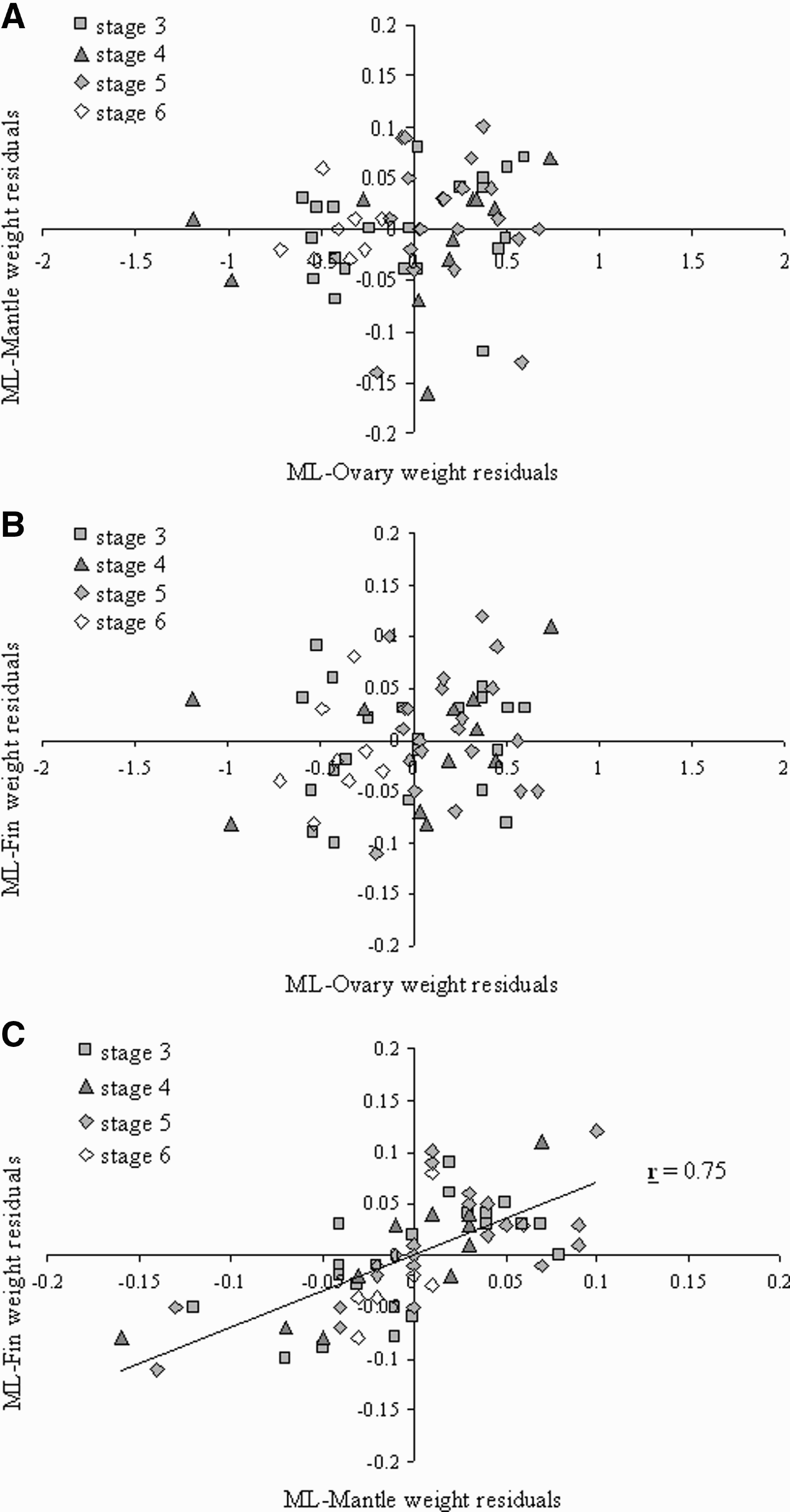
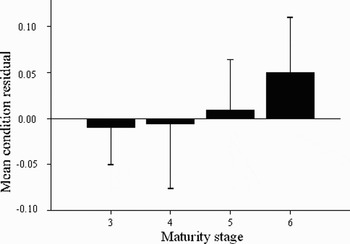
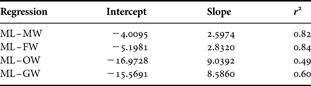
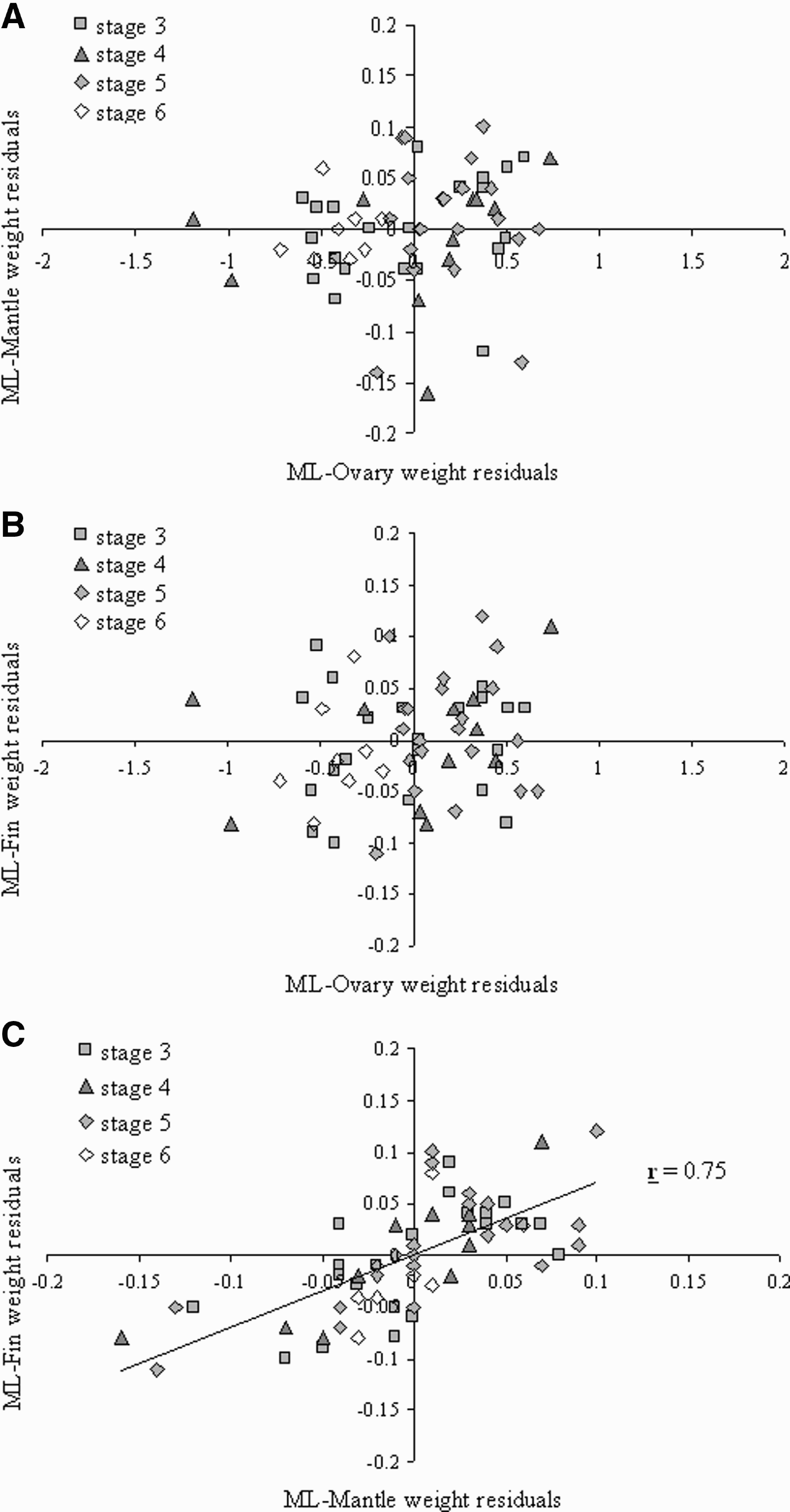
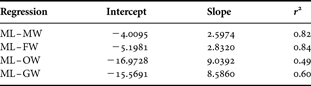
The geometric-mean (Type II) regressions between ML and gonad, mantle and fin weight were all strong (Table 5) except for ML–ovary weight which was relatively lower (r 2 = 0.49) due to the small ovary size (ovary degeneration) in Stage 6 females. There was no relationship between the ML–ovary weight residuals and ML–MW or ML–FW residuals (Figure 7A, B). There was a positive relationship (r = 0.75, P < 0.01, N = 61) between ML–MW residuals and ML–FW residuals, indicating that the condition is maintained in both these structures (Figure 7C). The comparison of the mean ML – MW residual for each maturity stage revealed a continual increase in condition with maturation, as immature and maturing individuals displayed lower somatic condition (i.e. smaller values with respect to the predicted) compared to mature individuals. Stage 6 individuals had the greatest mean somatic condition (Figure 8).
Relationship between (A) ML–ovary weight residuals × ML–mantle weight residuals; (B) ML–ovary weight residuals × ML-fin weight residuals; and (C) ML–mantle weight residuals × ML–fin weight residuals for preparatory (Stage 3), maturing (Stage 4), mature (Stage 5) and spent (Stage 6) females of Loliolus noctiluca. Only significant trends are reported: r = Pearson's correlation coefficient (bold underlined, r, denotes significance at 0.01).
Female mean somatic condition residual (ML–MW) for each maturity stage.

Geometric mean regressions between dorsal mantle length and the weights of the mantle (ML–MW), fins (ML–FW), ovary (ML–OW), and gonad (ML–GW), for individuals of Loliolus noctiluca.
DISCUSSION
Age and growth
This study contributes to the knowledge on the life history of Loliolus noctiluca at the southern limit of its distribution. The comparison with the growth and maturation dynamics of lower latitude populations gives a means to study population dynamics of a species under different temperature regimes. In this context L. noctiluca provides a somewhat unique example given the extensive latitudinal distribution of this species. Thus it is possible to discern life history patterns under different climatic regimes and potentially predict how loliginid populations will respond generally if climate change considerably warms near-shore waters.
While much of this work is preliminary, patterns in growth and reproduction in this southern region are still discernible. In a previous study Dimmlich & Hoedt (Reference Dimmlich and Hoedt1998) used a logistic function to describe growth in L. noctiluca from temperate waters (Victoria). Subsequently, Jackson & Moltschaniwskyj (Reference Jackson and Moltschaniwskyj2001b) compared the growth pattern of the same species from locations at different latitudes and seasons, i.e. Townsville (Queensland) and Newcastle (New South Wales). Jackson & Moltschaniwskyj (Reference Jackson and Moltschaniwskyj2001b) found substantial differences in the form of growth with respect to that reported by Dimmlich & Hoedt (Reference Dimmlich and Hoedt1998) with no evidence of asymptotic growth in any location or season. This study corroborates the results by Jackson & Moltschaniwskyj (Reference Jackson and Moltschaniwskyj2001b) since no evidence of asymptotic size (both mantle length and total weight) or of an inflexion point in the growth were found. This would indicate that in the Tasmanian population, the growth of L. noctiluca is continuous as in several other loliginids and squid in general (for review see Jackson, Reference Jackson2004).
Jackson & Moltschaniwskyj (Reference Jackson and Moltschaniwskyj2001b) observed that in the same location the winter-hatched individuals were faster growing and achieved larger sizes compared with summer or autumn-hatched individuals. Furthermore, comparing the patterns of growth of L. noctiluca between tropical and temperate waters, Jackson & Moltschaniwskyj (Reference Jackson and Moltschaniwskyj2001b) hypothesized that a temperate environment was more suitable for this species and that individuals in tropical waters possibly experienced temperatures at their physiological limit during summer. These observations, based on the validated daily periodicity of statoliths increments in L. noctiluca (Jackson, Reference Jackson1990; Dimmlich & Hoedt, Reference Dimmlich and Hoedt1998), resulted in the ‘cooler is better’ hypothesis (Jackson & Moltschaniwskyj, Reference Jackson and Moltschaniwskyj2001b), in contrast with considerable evidence that warmer temperatures accelerate growth (e.g. Forsythe, Reference Forsythe, Okutani, O'Dor and Kubodera1993, Reference Forsythe2004). In Tasmania, at the southern extremity of the distribution of L. noctiluca, the cool-season (July) cohort showed faster growth than its warm-season (May) counterpart, further supporting the hypothesis of accelerated growth at a lower temperature. Taking into account limitations due to the relatively small sample size, a comparison of the length- and weight-at-age data from Tasmania (present study) and Townsville confirms that L. noctiluca at higher latitudes lives a few days longer and attains a considerably larger body size. This is likely due to latitudinal differences in water temperature from North Queensland to Tasmania, with intermediate temperatures in New South Wales and Victoria (data from NOAA-CIRES Climate Diagnostic Centre, available at http://www.cdc.noaa.gov). However, many other factors may have contributed to these differences. In many studies the seasonal variation in growth rate was not attributed to the direct effect of water temperature. Rather, other oceanographic or meteorological events influencing food supply were considered the predominant cause of the observed differences in growth (González et al., Reference González, Castro and Guerra1996; O'Dor et al., Reference O'Dor, Rodhouse, Dawe, Hancock, Smith, Grant and Beumer1996; Jackson et al., Reference Jackson, McGrath Steer, Wotherspoon and Hobday2003; Pecl, Reference Pecl2004; Pecl et al., Reference Pecl, Moltschaniwskyj, Tracey and Jordan2004b).
Growth rate can also be linked to the interaction of factors such as food availability and the relationship between temperature, feeding-rate and metabolism (O'Dor & Wells, Reference O'Dor, Wells and Boyle1987; Jackson & Moltschaniwskyj, Reference Jackson and Moltschaniwskyj2001a). The ‘cooler is better’ hypothesis for this species reveals a decrease in growth rate, a shortening of life span and an increase in the rate of the generations turnover in situations of increased sea temperature, with each generation not living for more than two seasons. Moreover L. noctiluca, which at tropical latitudes is probably at its physiological limits with respect to temperature (Jackson & Moltschaniwskyj, Reference Jackson and Moltschaniwskyj2001b), would likely be excluded from these northern limits (but may expand into higher latitudes) if seawater temperature increased.
Hatchling statolith size
The analysis of the NRs suggested that the response of squid populations to environmental factors can vary considerably over time and space even in the prenatal period, assuming that NR is directly related to hatchling body size. A more robust analysis between locations was initially planned by pooling the samples over season and year, but the unexpected differences in NRs prevented this approach and added complexity to the analysis. Nevertheless, some patterns in NR were found. There was a strong gender effect on the NRs, with females larger than males in each location, season and year, suggesting that there is an advantage for female hatchlings to be larger. The larger hatch size may have enhanced survival, since larger hatchlings are less vulnerable to size-mediated mortality (e.g. Steer et al., Reference Steer, Pecl and Moltschaniwskyj2003). Moreover, in several near-shore loliginids the maturity process seems to be controlled by size rather than age (e.g. Boyle et al., Reference Boyle, Pierce and Hastic1995; Jackson et al., Reference Jackson, Forsythe, Hixon and Hanlon1997; Pecl, Reference Pecl2001; Steer et al., Reference Steer, Pecl and Moltschaniwskyj2003; Jackson, Reference Jackson2004) and, in animals living less than six months, the need to attain the minimum size for reproduction in a relatively short period could be a critical factor for the species' survival. In L. nocticula and in many other short-lived species, females should need more time than males to attain a larger body size for the physical and physiological constraints on egg production compared to sperm production. Therefore, a larger hatchling size for females would reduce the time necessary for attaining the needed size at maturity.
Comparing NR data from different locations revealed a positive gradient with latitude. The largest NRs were recorded in Tasmania and the smallest in Townsville, while Newcastle squid had intermediate values. This suggests that NRs and consequently hatchling size was larger at higher (cooler) latitudes, probably due to the influence of the lower temperature experienced during embryonic development. Daily fluctuations in light, temperature, and activity rhythms under natural conditions affect the embryonic growth and the deposition rate in statoliths of many species e.g. Alloteuthis subulata (Morris, Reference Morris, Jereb, Ragonese and von Boletzky1991, Reference Morris1993), Loligo vulgaris (Villanueva, Reference Villanueva2000a,Reference Villanuevab; Villanueva et al., Reference Villanueva, Arkhipkin, Jereb, Lefkaditou, Lipinski, Perales-Raya, Riba and Rocha2003, Reference Villanueva, Moltschaniwskyj and Bozzano2007), Sepioteuthis lessoniana (Ikeda et al., Reference Ikeda, Wada, Arai and Sakamoto1999), Sepia officinalis (Bouchaud, Reference Bouchaud1991), and in the otoliths of fish larvae (Blaxter, Reference Blaxter1992). Temperature, in particular, can directly affect the yolk conversion and duration of embryonic development and, consequently, hatchling size (e.g. Villanueva et al., Reference Villanueva, Arkhipkin, Jereb, Lefkaditou, Lipinski, Perales-Raya, Riba and Rocha2003). Lower temperature generally results in longer pre-hatching development which means relatively larger hatchlings (with improved swimming and prey-capture abilities) (e.g. Villanueva et al., Reference Villanueva, Arkhipkin, Jereb, Lefkaditou, Lipinski, Perales-Raya, Riba and Rocha2003, Reference Villanueva, Moltschaniwskyj and Bozzano2007). Greater spatial and temporal sampling would be required to better understand factors influencing hatchling size. However, the results highlight the potential usefulness of the natal ring radius measurement as a tool to detect differences in the size of hatchlings and to identify the factors that potentially affected the prenatal growth from adult individuals (Ikeda et al., Reference Ikeda, Wada, Arai and Sakamoto1999; Steer et al., Reference Steer, Pecl and Moltschaniwskyj2003).
If sea temperature should increase in the future due to climate change, the results from this work for both L. noctiluca and other loliginids generally suggest that that there will be a shortening of embryonic development. Warming oceans may therefore see a downwards shift in the size of loliginids hatchlings emerging from inshore spawning grounds, unless females compensate by producing larger (and therefore fewer) eggs (Pecl et al., Reference Pecl, Moltschaniwskyj, Tracey and Jordan2004b). This will in turn result in hatchlings which are smaller and with less competence in swimming or food-searching capabilities (e.g. Villanueva et al., Reference Villanueva, Arkhipkin, Jereb, Lefkaditou, Lipinski, Perales-Raya, Riba and Rocha2003) profoundly affecting the larval and juveniles' growth rate, the adult size and the size at maturity (e.g. Pecl & Jackson, Reference Pecl and Jackson2008).
Maturity and condition
Females displayed a marked regression in gonad weight in spent individuals, mostly due to egg-release, resulting in ovary and oviduct drastically reduced in size if compared to the same organs in mature individuals. Growth of the nidamental gland and oviducal gland, however, continue, even in Stage 6 individuals, highlighting that Loliolus noctiluca maintains the integrity of organs essential to the reproductive process. The large number of packed eggs observed in the oviduct and the dramatic loss in weight of this organ in Stage 6 individuals, suggests that eggs accumulate in the oviduct in preparation for spawning (e.g. Moltschaniwskyj, Reference Moltschaniwskyj1995; Jackson et al., Reference Jackson, Semmens, Phillips and Jackson2004). In terminal spawning squid, eggs are released in a single spawning event. As a consequence, in mature females evidence for terminal spawning is a dramatic enlargement of the oviduct/s that, in the latest stages of maturation, exceeds the ovary weight (Harman et al., Reference Harman, Young, Reid, Mangold, Suzuki and Hixon1989; Moltschaniwskyj, Reference Moltschaniwskyj1995; Pecl, Reference Pecl2001; McGrath & Jackson, Reference McGrath and Jackson2002). In this study the oviduct weight never exceeded the ovary weight, even in mature females, suggesting that L. noctiluca is probably not a single spawning species. The GSI values were also relatively low which contrasts with terminal spawning species (e.g. Todarodes pacificus, Loligo opalescens) which can have GSI values up to 50% (Fields, Reference Fields1965; Ikeda et al., Reference Ikeda, Sakurai, Shimazaki, Okutani, O'Dor and Kubodera1993). The continued increase of the mantle, fin and gonad weight suggests that in Loliolus noctiluca there is no storage or transfer of energy from the mantle or fins to support the maturation process. If these two organs had been involved in energy storage, there would have likely been a decrease in weight of the mantle/fins along with an increase in gonad weight (Moltschaniwskjy & Semmens, Reference Moltschaniwskyj and Semmens2000). Moreover, food was found in stomachs at all the maturity stages indicating that feeding continued along with maturation, and likely fuelled egg production in L. noctiluca. These features (i.e. relatively low GSI, the ovary weight always exceeding the oviduct weight, egg production fuelled by feeding, good condition maintained in somatic organs in mature individuals) have already been observed in other loliginid squids (e.g. Wells & Clarke, Reference Wells and Clarke1996; Moltschaniwskjy & Semmens, Reference Moltschaniwskyj and Semmens2000) and contrast with the strategy observed in Octopus vulgaris (O'Dor & Wells, Reference O'Dor and Wells1978) and in several oegopsid species (e.g. Todarodes pacificus, Ikeda et al., Reference Ikeda, Sakurai, Shimazaki, Okutani, O'Dor and Kubodera1993; Gonatus fabricii, Arkhipkin & Bjorke, Reference Arkhipkin and Bjorke1999; Moroteuthis ingens, Jackson et al., Reference Jackson, Semmens, Phillips and Jackson2004) in which maturing or brooding females undergo tissue breakdown and remobilization of protein to fuel reproduction during starvation. It has been suggested that there is likely a continuum of reproductive strategies among cephalopods from a ‘big bang’ single spawning species to multiple spawning species (Jackson & Mladenov, Reference Jackson and Mladenov1994). According to the findings of the present study L. noctiluca appeared to have a reproductive strategy more similar to a multiple-spawning species than to a single spawning as also found by Dimmlich & Hoedt (Reference Dimmlich and Hoedt1998). The relatively lower somatic condition of immature and maturing individuals of L. noctiluca compared to their mature counterparts suggests that a certain level of somatic condition is required before directing energy towards reproduction (Moltschaniwskjy & Semmens, Reference Moltschaniwskyj and Semmens2000). Moreover, the significant correlation between ovary weight and both, mantle length and total weight, and the lack of a correlation between ovary weight and age, confirm for L. noctiluca that the maturation process is a process more related to a critical size than to age (Dimmlich & Hoedt, Reference Dimmlich and Hoedt1998; Jackson, Reference Jackson2004).
These findings, along with results on other loliginids (see e.g. Jackson, Reference Jackson2004; Pecl & Jackson, Reference Pecl and Jackson2008), suggest some possible effects on near shore squid populations due to an increase in sea temperature resulting from climate change. An increase in sea temperature would probably lead to a decrease in the adult size and in the size at maturity, as well as a change in the proportion between body and gonad weight (Pecl, Reference Pecl2000; Jackson & Moltschaniwskyj, Reference Jackson and Moltschaniwskyj2002). Warm-water individuals would probably have a greater relative gonad investment with a higher percentage of their body weight as reproductive tissue, even though in absolute terms their gonads would weigh less due to reduced body size and physical constraints on just how much gonadal tissue a squid can produce (Pecl, Reference Pecl2000, Reference Pecl2001; Jackson & Moltschaniwskyj, Reference Jackson and Moltschaniwskyj2002). However, it is not clear if this potential drop in fecundity might be over-ridden by other compensatory mechanisms such as an increase in the number of spawning episodes, fuelled by a more rapid production of gametes (Pecl & Jackson, Reference Pecl and Jackson2008).
Loliolus noctiluca presents an excellent model of the adaptability of a near-shore cephalopod to various environmental conditions that are encountered across broad latitudinal ranges from the tropics to cool temperate waters. This study, along with previous work on the species, reveals considerable plasticity in both growth (during pre- and post-hatching periods) and reproduction in relation to environmental conditions. It further demonstrates how squid can readily adapt to different ocean conditions over broad geographical areas and to any future environmental variations due to climate change. In particular, in the context of a changing environment with global increase of seawater temperature, the features observed in this species (i.e. shorter life span, smaller individual size and smaller hatchling size in higher temperature) would involve dramatic changes in terms of distribution, generation turnover and, overall biomass. The results of this study on L. noctiluca suggest that higher seawater temperature would involve a shortening of the embryonic development leading to smaller hatchlings with lower swimming and food searching capability, negatively affecting growth rate in early life stages. Higher seawater temperature would also decrease growth rate in adult individuals of L. noctiluca leading to smaller size at maturity and to a shortening of the life span. This would produce a more rapid turnover of populations which would potentially reduce the response time to environmental change. However, in terms of reproduction, higher seawater temperature might negatively affect fecundity due to an overall decrease in gonad size. The same features, reduction in life span, decreased adult size mostly due to smaller hatchlings in spite of increased growth rate, as well as reduction of size at maturity and possibly fecundity, are likely to occur in near-shore loliginds generally in the scenario of increased water temperature (Pecl & Jackson, Reference Pecl and Jackson2008). This (provided that food supply remain adequate and temperature does not exceed physiological limits) in turn may result in: (i) competitive advantage over other competing longer-lived species, possibly leading to higher overall biomass due to an accelerated turnover of generations with an increased capacity to cope with further environmental changes; (ii) possible variation in timing or location of peak abundance; and (iii) a possible shift in distribution range.
However, the response of inshore squid populations to climate change is likely to be extremely complex as individual squid will require more food per unit body size, require more oxygen for faster metabolisms and have a reduced capacity to cope without food (see e.g. Pecl & Jackson, Reference Pecl and Jackson2008). Pecl & Jackson (Reference Pecl and Jackson2008) provided some evidences that smaller hatchlings, even in the case of faster growth rate due to temperature increase, would probably lead to a shorter life span and a smaller adult size, with a possible reduced capability for egg production. Accordingly, as recorded in L. noctiluca, better growth performance, longer life span and larger adult size (and possibly higher fecundity) could be observed in populations of near-shore loliginids living at relatively higher latitudes and then experiencing relatively lower temperatures. Finally, whilst it is still impossible to provide a clear picture on how ocean-scale climate change may impact on inshore squid population dynamics, due to their high adaptability two things are for certain: (i) should the oceans warm, the pace of life for this high-speed group will increase even further, and (ii) it will be further possible to use squid as recorders to track environmental and ecological changes.
ACKNOWLEDGEMENTS
The authors would like to thank Kate Stark and Simon Wotherspoon for their kind assistance with statistical analysis of the natal ring size measurements. The authors are also grateful to Christine Jackson for editorial assistance. Many thanks are due to the crew of the commercial fishing vessel ‘Sagitta’ who collected squid samples that made this study possible. The authors also thank the three anonymous referees for their useful comments on the submitted draft of this paper.