





Introduction
The criteria for pediatric autoimmune neuropsychiatric disorder associated with streptococcal infection (PANDAS) were described by Swedo et al. (Reference Swedo, Leonard, Garvey, Mittleman, Allen, Perlmutter, Lougee, Dow, Zamkoff and Dubbert1998) after reports of acute-onset obsessive-compulsive and tic disorder in children following a recent streptococcal infection. High rates of obsessive-compulsive disorder (OCD) and tic disorder symptoms had been found in Sydenham’s chorea, a presumed autoimmune sequela of streptococcal infection, with these psychiatric symptoms often emerging 2–4 weeks prior to the emergence of chorea (Asbahr et al., Reference Asbahr, Negrão, Gentil, Zanetta, da Paz, Marques-Dias and Kiss1998). This led to the suggestion that both PANDAS and Sydenham’s chorea may share a common disease mechanism leading to the development of OCD and tic disorder symptoms in both, with Sydenham’s chorea representing a more severe and neurologically distinct manifestation. Thus, PANDAS has been proposed to be a ‘forme fruste’ of Sydenham’s chorea (Swedo, Menendez, & Cunningham, Reference Swedo, Menendez, Cunningham, Ferretti, Stevens and Fischetti2024). The distinguishing clinical feature of PANDAS from primary psychiatric disorders is the extremely acute onset of symptoms within 24–48 h.
One suggested biological mechanism for PANDAS has been a self-directed immune response, driven by molecular mimicry related to streptococcal infection (Dop et al., Reference Dop, Marcu, Padureanu, Niculescu and Padureanu2020), in which antibodies against the streptococcus bacteria target self-proteins in the brain, such as in the basal ganglia, which could then drive the behavioral changes seen in PANDAS. Biological evidence of ongoing inflammation or an antigen-specific immune response in PANDAS, pediatric OCD, or tic disorder (Wilbur et al., Reference Wilbur, Bitnun, Kronenberg, Laxer, Levy, Logan, Shouldice and Yeh2019) has been inconsistent to date. While the presence of autoreactive antineuronal antibodies has been demonstrated in some children with PANDAS (Frick et al., Reference Frick, Rapanelli, Jindachomthong, Grant, Leckman, Swedo, Williams and Pittenger2018), some authors have expressed concerns that commercially available panels of neuronal antibodies cannot consistently distinguish cases that meet PANDAS clinical criteria from children with presumed primary psychiatric illness (Hesselmark & Bejerot, Reference Hesselmark and Bejerot2017).
Many studies where PANDAS cases have been identified have used small retrospective designs and have focused on identifying evidence of streptococcal infection in children with established psychiatric symptoms such as OCD and tic disorder (La Bella et al., Reference La Bella, Attanasi, Di Ludovico, Scorrano, Mainieri, Ciarelli, Lauriola, Silvestrini, Girlando, Chiarelli and Breda2024). A systematic review (Nielsen et al., Reference Nielsen, Köhler-Forsberg, Hjorthøj, Benros, Nordentoft and Orlovska-Waast2019) of prospectively identified PANDAS cases associated with confirmed streptococcal infection included only three papers (Kurlan et al., Reference Kurlan, Johnson and Kaplan2008; Leckman et al., Reference Leckman, King, Gilbert, Coffey, Singer, Dure Iv, Grantz, Katsovich, Lin and Lombroso2011; Lin et al., Reference Lin, Williams, Katsovich, Findley, Grantz, Lombroso, King, Bessen, Johnson, Kaplan, Landeros-Weisenberger, Zhang and Leckman2010) with a total pooled PANDAS cohort of only 82.
The precise prevalence of PANDAS is unknown, but Streptococcus pyogenes infection is the most common bacterial cause of sore throat in children, causing over 280 million pediatric upper respiratory infections (URIs) every year (Miller et al., Reference Miller, Carapetis, Van Beneden, Cadarette, Daw, Moore, Bloom and Cannon2022). This makes electronic health records (EHRs) an ideal resource to investigate the prevalence of PANDAS-like presentations. To date, there have been two studies using EHRs to investigate incidence of PANDAS symptoms following streptococcal infection in a general population sample. Orlovska et al. (Reference Orlovska, Vestergaard, Bech, Nordentoft, Vestergaard and Benros2017) conducted one of the largest nationwide cohort studies (n = 1,067,743) evaluating the PANDAS hypothesis in the Danish general pediatric population. They found that a presumed positive streptococcal test result (streptococcal test carried out followed by a filled antibiotic prescription within 8 days) was associated with an increased risk of a new diagnosis of any psychiatric disorder, OCD and tic disorder compared to those who did not receive a test. A presumed negative streptococcal test (test that was not followed by filled antibiotic prescription within 8 days) was also associated with a smaller, but still increased, risk of psychiatric disorder, OCD, and tics. This may indicate that this increased risk may not be restricted to streptococcus as the causative organism. Wang et al. (Reference Wang, Lau, Lin, Chang and Kao2016) conducted a similar database study in Taiwan, with a smaller total sample of 28,556 and found an increased risk of incident psychiatric disorders, with the largest increase observed for tic disorder. However, in a subgroup analysis, they found this risk was increased for hospitalized patients with streptococcal infection only, with no difference observed between outpatients. As such, there is inconsistent evidence of increased PANDAS-like symptoms following streptococcal infection in global general pediatric populations.
The finding of increased incident psychiatric outcomes in a general pediatric population following streptococcal infection has yet to be replicated in another large-scale database. Therefore, we used a large global database to evaluate the PANDAS hypothesis and the specific associations of confirmed streptococcal infection with psychiatric outcomes in children.
In 2012, broader diagnostic criteria were proposed under the term Pediatric Acute-onset Neuropsychiatric Syndrome (PANS), encompassing cases with abrupt onset of OCD-like symptoms alongside other features such as restricted oral intake and anxiety (Chang et al., Reference Chang, Frankovich, Cooperstock, Cunningham, Latimer, Murphy, Pasternack, Thienemann, Williams, Walter and Swedo2015; Swedo, Leckman, & Rose, Reference Swedo, Leckman and Rose2012). PANDAS is now considered as the only pathogen-specific subtype of PANS, distinguished by its requirement for temporal association with streptococcal infection (Swedo et al., Reference Swedo, Leonard, Garvey, Mittleman, Allen, Perlmutter, Lougee, Dow, Zamkoff and Dubbert1998). Given the overlap in clinical features, both PANS and PANDAS criteria are often evaluated when assessing children with new-onset psychiatric symptoms following streptococcal exposure.
We aimed to evaluate the effect of a confirmed S. pyogenes exposure in the context of a recent URI on the subsequent risk over 1-year follow-up of being diagnosed with any psychiatric disorder and specifically OCD, tic disorder, anxiety, and restricted oral intake.
Methods
Setting
The data used for this study were sourced from TriNetX, a global federated health research network providing access to deidentified electronic medical records across large healthcare organizations (HCOs). The study is compliant with Reporting of studies Conducted using Observational Routinely collected health Data (RECORD) guidelines (Benchimol et al., Reference Benchimol, Smeeth, Guttmann, Harron, Moher, Petersen, Sørensen, von Elm and Langan2015). TriNetX provides access to specific electronic medical record data that include diagnoses, procedures, medications, and laboratory values. At the time of the main analysis (March 27, 2025), there were 141 HCOs available globally with a total population of over 150 million individuals. This includes data from over 20 countries across six continents (full list in the Supplementary Materials), although approximately 75% of records were from the United States. The TriNetX platform is compliant with the Health Insurance Portability and Accountability Act as it only contains deidentified data, which are presented in aggregate form. Further information about TriNetX has been published elsewhere (Palchuk et al., Reference Palchuk, London, Perez-Rey, Drebert, Winer-Jones, Thompson, Esposito and Claerhout2023).
Participants and exposure
The primary exposure was a positive versus negative S. pyogenes test result following an acute URI.
The streptococcal-positive cohort was comprised of children with a recorded diagnosis of any acute URI (ICD 10-J00-J06), accompanied by a positive S. pyogenes test on the same day or within 2 weeks following an acute URI diagnosis.
The streptococcal-negative cohort was comprised of children with a negative S. pyogenes test within 2 weeks after a confirmed diagnosis of any acute URI (ICD 10-J00-J06).
A 2-week window was included to allow for delays in testing being conducted and a result being recorded in the healthcare records following clinical symptoms of a URI. Eligible diagnostic tests included antigen detection tests, throat cultures, and nucleic acid–based assays, with a full list of tests provided in the Supplementary Materials. Samples were included if they were collected from the throat or were nonsite-specific samples, while serum samples were excluded.
Children aged 3–16 years at the time of infection were included in both cohorts. This age range was selected to reflect the reported epidemiology of PANDAS, which describes onset after early childhood, while also allowing sufficient follow-up prior to transition to adulthood.
The date at which a child met all the inclusion criteria was defined as the index event for all further analyses.
Outcomes
The outcomes of interest we selected were based on psychiatric outcomes after streptococcal infection, as described in the PANS and PANDAS criteria. This included both a composite psychiatric outcome and specific disorders of interest. These were operationalized using corresponding ICD-10 CM codes. These included:
-
1) Any psychiatric disorder (F01–F99) to capture overall incident psychiatric outcomes.
-
2) OCD (F42) a core outcome of PANDAS.
-
3) Tic disorder (F95) another core manifestation of PANDAS.
-
4) Restricted oral intake (F50 Eating Disorder OR R63.0 Anorexia), as described in PANS criteria. Although F50 may include eating disorders beyond restricted oral intake, they were included to reflect routine clinical recording of severe restricted food states.
-
5) Anxiety disorder (F40 Phobic Anxiety OR F41 Other Anxiety Disorders). Stress-related, dissociative, and somatoform disorders (F43–F48) were not included.
-
6) Guttate psoriasis (L40.4), an autoimmune dermatological complication of streptococcal infection with typical onset within 1–2 weeks of infection (Leung, Barankin, Lam, & Leong, Reference Leung, Barankin, Lam and Leong2023). This was included as a positive control to test the validity of our cohorts.
Covariates
Baseline characteristics were measured as those present up to 1 month prior to the index event. Participants were matched on 70 of these variables using propensity matching (using a 1:1 greedy nearest neighbor algorithm). This was based on recorded histories of diagnosis (as per ICD-10 CM codes), medication, and procedures. Participants were matched on demographic variables (age, sex, and ethnicity); socioeconomic factors (Z55-65); and family history of mental disorders (Z81). We also matched on variables which were of clinical importance based on previous literature or if they occurred at different rates between cohorts (i.e., the baseline incidence was greater than 5% in both cohorts and the difference between cohorts was greater than 2% before matching). A complete list of the 70 baseline variables used for propensity score matching is available in the Supplementary Materials (Supplementary Table S1). Matching was deemed successful for each variable if the standard mean difference (SMD) between the two cohorts was less than 0.1 (Haukoos & Lewis, Reference Haukoos and Lewis2015).
Statistical analysis
The incidence of children receiving a new diagnosis for each outcome measure listed above (i.e. excluding those with existing diagnoses for each specific outcome) from the same day to 1 year after the index event was measured in each cohort and compared to calculate risk ratios and 95% confidence intervals. All statistical analyses were conducted within the TriNetX platform.
Supplementary analyses
To identify the contributory nature of the covariates to the psychiatric outcomes, additional exploratory multivariate Cox proportional hazards analyses were carried out. These explored the combined group of streptococcal-positive and streptococcal-negative cohorts and 14 covariates (13 taken from the covariates used in propensity matching in the main analysis, with the addition of Streptococcal test result). These covariates were selected based on clinical relevance and to avoid multicollinearity. Estimated adjusted hazard ratios were calculated for these 14 covariates assessing the risk of the same six outcomes defined above (any psychiatric disorder, tic disorder, OCD, restricted oral intake, any anxiety, and guttate psoriasis) over the same 1-year follow-up. Further details are available in the Supplemental Materials.
Results
The streptococcal-positive cohort included 464,513 children and the streptococcus negative cohort included 1,023,171 children prior to matching. After matching, there were 456,221 children in both cohorts.
Table 1 details the baseline characteristics up to the index event, including previously recorded diagnoses, demographic variables, and procedures. Prior to matching the streptococcal-positive cohort was younger (age at index mean 7.9 vs. 8.9; SMD 0.264), more male (49.6% vs. 46.5%), and included more children of white ethnicity (63.3% vs. 62.6%).
Baseline Characteristics of streptococcal positive and streptococcal negative cohorts

Table 1. Long description
The table compares two cohorts: Positive Strep and Negative Strep.
Before propensity matching, the Positive Strep group (n = 464,513) had a mean age of 7.9 years (S D 3.4) compared to 8.9 years (S D 4.1) in the Negative Strep group (n = 1,023,171), with an S M D of 0.264 (p < .001). After matching, both groups (n = 456,221 each) show balanced ages: 7.9 (S D 3.4) for Positive and 7.7 (S D 3.7) for Negative, with an S M D of 0.037.
Key demographic and clinical categories include:
* Race: White participants make up approximately 63% of both groups after matching.
* Sex: Males represent 49.6% of both groups after matching.
* Acute upper respiratory infections: Acute pharyngitis (J 0 2) was present in 37.9% of the Positive group and 36.7% of the Negative group after matching (S M D 0.026).
* Symptoms: Fever (R 5 0) and Cough (R 0 5) were balanced after matching at approximately 31-32% and 30-31% respectively.
* Mental health: Mental, behavioral, and neurodevelopmental disorders (F 0 1 to F 9 9) were present in 19.9% of the Positive group and 19.2% of the Negative group after matching.
* Medications: Amoxicillin use was 36.0% in the Positive group and 35.2% in the Negative group after matching (S M D 0.017).
The S M D (Standardized Mean Difference) values significantly decreased across all variables after propensity matching, indicating a successful balance between the two study cohorts.
Note: SMD, standardized mean difference. All % reported to one decimal place. SMD and p values reported to three decimal places.
Several indicators of recent infection were more common in the streptococcal-positive cohort; an increased history of acute pharyngitis (37.9% vs. 30.0%; SMD 0.169), fever (32.0% vs. 27.1%; SMD 0.108), and amoxicillin prescription (36.0% vs. 31.2%; SMD 0.102). After propensity score matching, all covariates achieved a standardized mean difference of less than 0.1, indicating successful balance of covariates between cohorts (full baseline characteristics before and after matching are available in Supplementary Table S1).
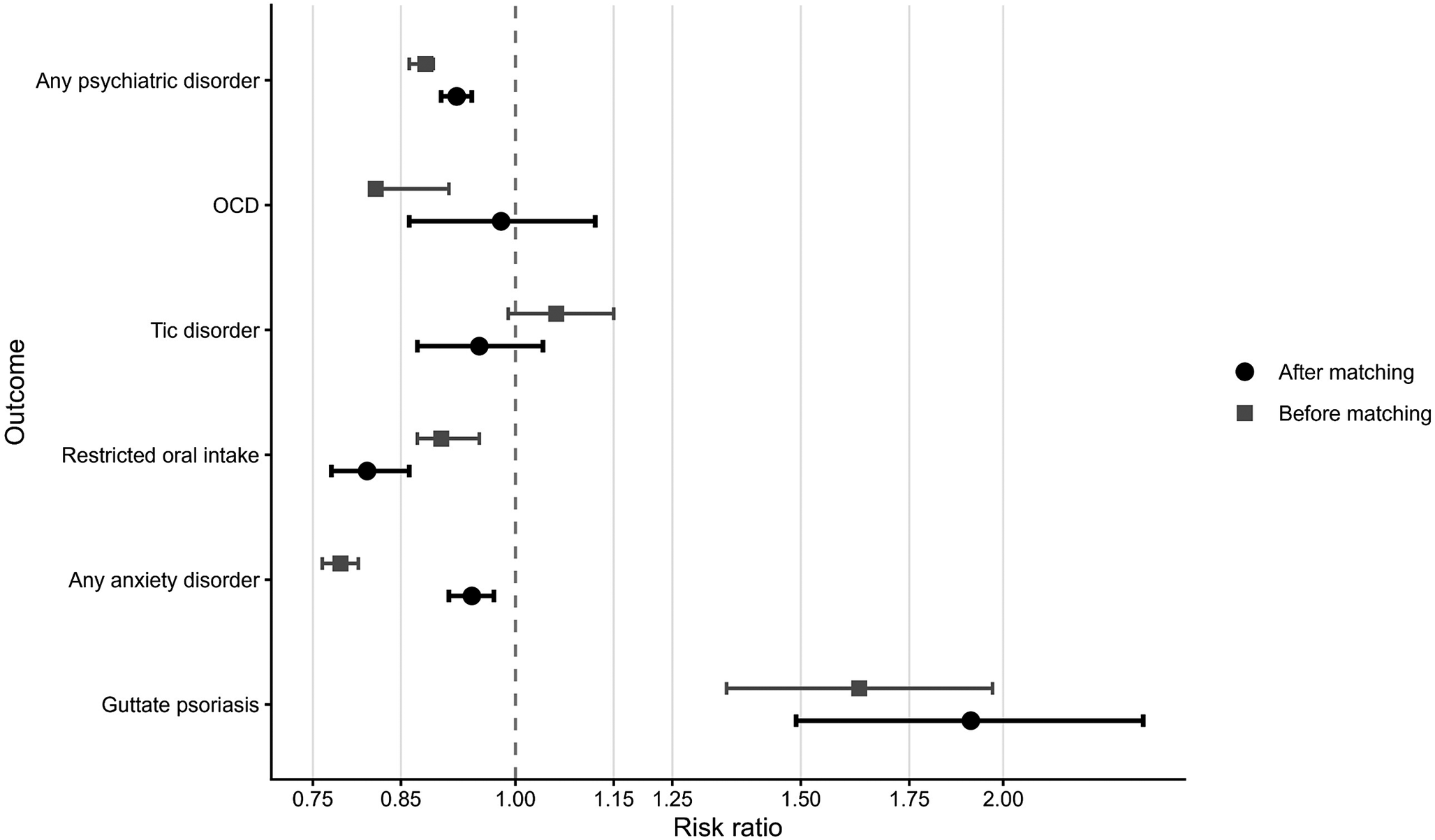
Following matching, the 1-year incidence of psychiatric outcomes in the streptococcal-positive versus streptococcal-negative cohorts (both total cohorts of 456,221 after matching) was as follows: 17,517 versus 19,172 were diagnosed with any psychiatric disorder; 419 versus 428 with OCD; 926 versus 971 with tic disorder; 2,283 versus 2,813 with restricted oral intake; 7,688 versus 8,198 with anxiety; and 181 versus 95 with guttate psoriasis (Figure 1 and Supplementary Table S2).
Forest plot demonstrating risk ratios of incident psychiatric diagnoses and positive control (Guttate Psoriasis) 1 year after index event.

Figure 1. Long description
A forest plot with the Y axis labeled Outcome and the X axis labeled Risk ratio. The X axis scale ranges from 0.75 to 2.00 with a dashed vertical line at the null value of 1.00. A legend on the right indicates that grey squares represent Before matching and black circles represent After matching.
From top to bottom, the outcomes are.
* Any psychiatric disorder. Before matching is 0.88. After matching is 0.92.
* O C D. Before matching is 0.82. After matching is 0.98 with a wide confidence interval.
* Tic disorder. Before matching is 1.06. After matching is 0.95.
* Restricted oral intake. Before matching is 0.90. After matching is 0.81.
* Any anxiety disorder. Before matching is 0.78. After matching is 0.94.
* Guttate psoriasis. This positive control shows significantly higher risk ratios. Before matching is 1.63. After matching is 1.91.
In matched analyses, the positive streptococcal cohort had a reduced risk of anxiety disorder, restricted oral intake and any psychiatric disorder. Specifically, the relative risk was 6% lower for anxiety (RR 0.94 [0.91, 0.97]), 19% lower for restricted oral intake (RR 0.81 [0.77, 0.86]), and 8% lower for any psychiatric disorder (RR 0.92 [0.90, 0.94]).
Prior to matching a positive streptococcal test was associated with a reduced risk of OCD (RR 0.82 [0.74, 0.91]) but this was no longer statistically significant after matching (RR 0.98 [0.86, 1.12]). The risk of tic disorder was not significantly different between the two groups (RR 1.06 [0.99, 1.15]), and although slightly attenuated by matching, remained nonsignificant afterward (RR 0.95 [0.87, 1.04]).
The positive control, guttate psoriasis was the only outcome variable with an increased risk in the positive streptococcal cohort (RR 1.63 (1.35, 1.97]), which remained after matching (RR 1.91 (1.49, 2.44]).
Supplementary analyses
Table 2 provides a summary of the multivariate adjusted cox proportional hazards of the combined streptococcal-positive and streptococcal-negative cohorts (n = 1,400,034). Cox regressions demonstrated that almost all covariates had an independent influence on risk of psychiatric outcome after 1 year.
Multivariate Cox regression looking at neuropsychiatric outcomes up to 1 year following a positive or negative streptococcus test in context of recent upper respiratory infection (n = 1,400,034)

Table 2. Long description
The table presents multivariate Cox regression results for a cohort of 1,400,034 individuals. Columns represent outcomes: Any psychiatric disorder, O C D, Tic disorder, Restricted oral intake, Anxiety disorders, and Guttate psoriasis. Each cell contains the Hazard Ratio H R, 95 percent Confidence Interval C I, and p-value in brackets.* Streptococcal-positive cohort: H R 0.96 for any psychiatric disorder; 0.94 for O C D; 0.98 for Tic disorder; 0.81 for Restricted oral intake; 0.97 for Anxiety; and 1.48 for Guttate psoriasis.* Age at Index: H R 1.03 for any psychiatric disorder; 1.09 for O C D; 0.99 for Tic disorder; 0.95 for Restricted oral intake; 1.15 for Anxiety; and 1.09 for Guttate psoriasis.* White: H R 1.30 for any psychiatric disorder; 1.58 for O C D; 1.37 for Tic disorder; 0.78 for Restricted oral intake; 1.57 for Anxiety; and 1.46 for Guttate psoriasis.* Black: H R 1.21 for any psychiatric disorder; 0.62 for O C D; 0.72 for Tic disorder; 0.96 for Restricted oral intake; 0.75 for Anxiety; and 0.46 for Guttate psoriasis.* Male: H R 1.25 for any psychiatric disorder; 1.11 for O C D; 2.37 for Tic disorder; 0.89 for Restricted oral intake; 0.71 for Anxiety; and 0.68 for Guttate psoriasis.* Socioeconomic/Psychosocial hazards Z 55-65: H R 1.62 for any psychiatric disorder; 1.07 for O C D; 0.95 for Tic disorder; 1.68 for Restricted oral intake; 1.69 for Anxiety; and 0.79 for Guttate psoriasis.* Routine child health exam Z 00.129: H R 1.34 for any psychiatric disorder; 1.22 for O C D; 1.55 for Tic disorder; 1.24 for Restricted oral intake; 1.49 for Anxiety; and 0.94 for Guttate psoriasis.* Family history of mental disorders Z 81: H R 1.21 for any psychiatric disorder; less than 10 for O C D; 1.76 for Tic disorder; 1.23 for Restricted oral intake; 1.72 for Anxiety; and 0.53 for Guttate psoriasis.* Congenital malformations Q 00-Q 99: H R 1.38 for any psychiatric disorder; 1.15 for O C D; 1.16 for Tic disorder; 1.47 for Restricted oral intake; 1.30 for Anxiety; and 1.71 for Guttate psoriasis.* Head injuries S 00-S 09: H R 1.18 for any psychiatric disorder; 0.98 for O C D; 1.12 for Tic disorder; 1.11 for Restricted oral intake; 1.22 for Anxiety; and 1.25 for Guttate psoriasis.* Mood disorders F 30-F 39: H R 2.16 for any psychiatric disorder; less than 10 for O C D; 1.41 for Tic disorder; 2.42 for Restricted oral intake; 4.21 for Anxiety; and 1.41 for Guttate psoriasis.* Anxiety/Stress disorders F 40-49: H R 3.39 for any psychiatric disorder; 14.78 for O C D; 3.64 for Tic disorder; 2.15 for Restricted oral intake; N / A for Anxiety; and 1.19 for Guttate psoriasis.* Eating disorders F 50: H R 1.66 for any psychiatric disorder; less than 10 for O C D; 1.16 for Tic disorder; N / A for Restricted oral intake; 1.85 for Anxiety; and 0.96 for Guttate psoriasis.* Pervasive and Developmental disorder F 84: H R 4.28 for any psychiatric disorder; less than 10 for O C D; 2.10 for Tic disorder; 2.89 for Restricted oral intake; 3.17 for Anxiety; and 1.01 for Guttate psoriasis.
Key findings for the Streptococcal-positive cohort (positive vs. negative test result):
* Any psychiatric disorder: H R 0.96, C I 0.95 to 0.97, p less than .001.
* O C D: H R 0.94, C I 0.87 to 1.03, p .188.
* Tic disorder: H R 0.98, C I 0.92 to 1.04, p .420.
* Restricted oral intake: H R 0.81, C I 0.78 to 0.85, p less than .001.
* Anxiety disorders: H R 0.97, C I 0.95 to 0.99, p .001.
* Guttate psoriasis: H R 1.48, C I 1.26 to 1.73, p less than .001.
Other covariates listed include Age at Index, White, Black, Male, Socioeconomic circumstances (Z 55 to 65), Routine child health examination (Z 00.129), Family history of mental disorders (Z 81), Congenital malformations (Q 00 to Q 99), Injuries to the head (S 00 to S 09), Mood disorders (F 30 to F 39), Anxiety/nonpsychotic disorders (F 40 to 49), Eating disorders (F 50), and Pervasive and Developmental disorder (F 84).
Notable high Hazard Ratios include:
* Anxiety/nonpsychotic disorders (F 40 to 49) for O C D: H R 14.78.
* Mood disorders (F 30 to F 39) for Anxiety disorders: H R 4.21.
* Pervasive and Developmental disorder (F 84) for Any psychiatric disorder: H R 4.28.
Note: N/A indicates that the covariate was not included as it includes the outcome of interest.
a TriNetX Live was unable to include the covariate due to too few individuals developing the outcome in the combined cohort having a history of that covariate 30 days prior to the index event. TriNetX does not report patients counts of <10 to protect patient privacy and reduce the risk of patient reidentification. CI, confidence interval. All hazard ratios and confidence intervals presented to two decimal places. p-Value reported to three decimal places.
The presence of a history of an encounter without abnormal findings and of congenital disorder was both associated with an increased rate of all psychiatric outcomes. Children with black ethnicity were less likely to develop all four specific psychiatric disorders. Hazards related to socioeconomic and psychosocial circumstances (ICD Z55-65) were associated with increased risk of all psychiatric outcomes except tic disorder. An existing comorbid psychiatric disorder (any or specific disorders included in the analyses) was associated with increased risk of another psychiatric disorder.
Belonging to the positive streptococcal cohort was associated with reduced risk of restricted oral intake, anxiety, and any psychiatric disorder. There was no significant difference in risk of developing OCD or tic disorder based on streptococcal cohort (positive or negative streptococcal cohorts), in line with the findings of the main analysis.
Discussion
This study represents the largest retrospective pediatric cohort study to date examining psychiatric outcomes after an URI, stratified by streptococcal test result. We found no evidence that a streptococcal-positive upper respiratory tract infection was associated with an increased risk of any measured psychiatric outcome within 1 year of infection compared to other URIs. On the contrary, lower rates of anxiety disorders, restricted oral intake, and any recorded psychiatric disorder were observed among children who tested positive for S. pyogenes compared to those who tested negative. We observed no difference in the incidence of OCD or of tic disorder based on streptococcal test result. As anticipated, guttate psoriasis, a known autoimmune sequela of streptococcal infection, was more common in the streptococcal-positive group, serving as a positive control and supporting the biological validity of cohort classification.
Beyond sample size, a major strength of our study is the use of detailed propensity score matching, which allowed us to account for a wide range of covariates beyond streptococcal test result that could influence the risk of developing psychiatric outcomes. This included age, psychiatric and medical comorbidities, and previous healthcare contacts. The breadth of confounders considered in our study exceeds previous studies and allows for a more refined estimation of any association specifically attributable to streptococcal exposure. This provides a robust epidemiological test of hypotheses that have posited a causal association between streptococcal exposure and the psychiatric outcomes under consideration. By restricting cohort definitions to children in whom testing was carried out in temporal proximity to recent URI, we further ensured that comparison groups were drawn from clinically comparable contexts. These methodological safeguards, along with the observed positive association between streptococcal positivity and guttate psoriasis support the biological validity of cohort separation and strengthen the inference that streptococcal exposure is not associated with an increased risk of new-onset psychiatric disorders in children. While this does not rule out the possibility of rare autoimmune psychiatric syndromes following streptococcal infection, it suggests that such cases are unlikely to be common at the population level. As such, clinicians, patients, and families should interpret the results regarding streptococcal testing in relation to OCD and tic disorder with caution and avoid assuming a causal link without further evidence.
To our knowledge, this is the first study to examine psychiatric outcomes following confirmed pediatric streptococcal exposure using a global EHR network. Our findings partly contrast with, but also help contextualize, the findings of Orlovska et al. (Reference Orlovska, Vestergaard, Bech, Nordentoft, Vestergaard and Benros2017) and Wang et al. (Reference Wang, Lau, Lin, Chang and Kao2016), both of which reported increased psychiatric risk following streptococcal infection in national healthcare databases. However, they are consistent with more nuanced aspects of those studies. In Orlovska et al. (Reference Orlovska, Vestergaard, Bech, Nordentoft, Vestergaard and Benros2017), increased psychiatric risk was also observed after presumed non-streptococcal throat infection, suggesting that at least part of the association may reflect nonspecific effects of infection, testing, healthcare contact, or underlying vulnerability rather than streptococcal exposure alone. Similarly, Wang et al. (Reference Wang, Lau, Lin, Chang and Kao2016) reported increased risk overall, but this appeared to be concentrated among children with more severe infection-related healthcare contact. By directly comparing children with confirmed positive versus negative S. pyogenes test results following upper respiratory tract infection, and by using extensive propensity score matching, our study suggests that streptococcal positivity itself is not associated with increased subsequent psychiatric risk in the tested pediatric population.
Although our study was not designed to investigate mechanistic pathways, our findings suggest that the development of psychiatric disorders in children after an URI are influenced by both (non-streptococcal) biological and psychosocial factors associated with illness and healthcare engagement may warrant further attention. Our supplementary analysis identified important group level factors independently associated with increased risk of psychiatric symptoms in pediatric patients, irrespective of streptococcal test result. These included increased healthcare contacts, history of head injury, socioeconomic issues, congenital abnormalities, existing psychiatric comorbidities, and family history of mental illness.
Some of these, such as family history (with childhood-onset OCD conferring a risk of 26% in first-degree relatives [Geller & Grossman, Reference Geller and Grossman2024]), are well established. Although our study only looked at children experiencing an URI, a growing body of literature using Swedish national registers has shown that associations between childhood infections and subsequent OCD are no longer significant once adjusted for sibling analysis (Pol-Fuster et al., Reference Pol-Fuster, Kuja-Halkola, De La Cruz, Brikell, Chang, D’Onofrio, Larsson, Lichtenstein, Beucke, De Schipper and Mataix-Cols2024; Zhang et al., Reference Zhang, Brander, Isung, Isomura, Sidorchuk, Larsson, Chang, Mataix-Cols and de la Cruz2023). Pol-Fuster et al. (Reference Pol-Fuster, De La Cruz, Beucke, Hesselmark, Crowley, De Schipper, Brikell, Chang, D’Onofrio, Larsson, Lichtenstein, Kuja-Halkola and Mataix-Cols2025) did find a dose–response relationship; that increasing number of infections in children or their relatives was associated with an increasing risk of OCD. This highlights the importance of accounting for genetic vulnerability when evaluating the impact of severe infection on psychiatric outcomes.
Other factors, such as increased healthcare contacts and socioeconomic factors, have received less attention in the context of PANDAS-like symptoms. A pediatric longitudinal study by Panagi et al. (Reference Panagi, White, Howdle, Bennett, Heyman, Shafran and Ford2024) found that experiences of stressful life events were associated with both increased contact with primary care services and childhood mental health services. The finding of a recorded history of ‘an examination without abnormal findings’ being associated with an increased measured incidence of all psychiatric outcomes needs to be considered in the context of whether healthcare utilization itself may be viewed as a marker of underlying vulnerability or a pathway through which diagnostic labels are applied. This highlights the nuance when trying to interpret epidemiological associations between infection and psychiatric outcomes, which are both likely to be influenced by patterns of help-seeking and clinician behaviors.
Limitations
As with all research using electronic healthcare databases, our analysis relies on diagnoses and test results being recorded accurately and in a timely manner. While TriNetX has the advantage of being a live database that is continually updated by member HCOs, the data remain subject to the limitations of routine clinical documentation, variable coding practices, and potential under-recording of relevant exposures or outcomes.
The prevalence of sore throat and upper respiratory symptoms in children is high, with many episodes resolving spontaneously without medical consultation or diagnostic testing. Hence, our cohorts only include children who underwent formal testing and had a confirmed presence or absence of streptococcal infection. While this may lead to sampling bias by excluding untested cases, it represents a naturalistic sample of real-world clinical practice, although likely biases inclusion to those with more severe symptoms where a putatively immune-mediated consequence would be more likely and confounders should be distributed equally between groups.
Our inclusion criteria permitted both rapid antigen tests and microbiological culture results as evidence of streptococcal infection. Microbiological culture has a higher sensitivity for streptococci, while rapid antigen tests (commonly used in frontline clinical settings) are less sensitive and clinically can require a confirmatory culture if the antigen test is negative (Spellerberg & Brandt, Reference Spellerberg, Brandt, Ferretti, Stevens and Fischetti2022). While inclusion of both test types increases ecological validity, this may have led to the inclusion of some false-negative results. However, given the size of the cohort, we expect this to reflect only a small proportion of negative results and not introduce substantial bias.
Some recent estimates suggest that diagnoses labeled as PANDAS and PANS may be as rare as 1 in 60,000 (Goren et al., Reference Goren, Bitnun, Doja, Gill, Laxer, Levy, Pringsheim, Sandor, Yeh, Wilbur, Kronenberg and Shouldice2025). Our study was well powered to assess whether confirmed S. pyogenes infection is associated with an increased population-level risk of the coded psychiatric outcomes examined here. However, population-based EHRs cannot reliably identify rare, clinically defined PANS/PANDAS-like presentations as distinct entities, because abruptness of onset, symptom clustering, clinician-attributed causality, and biomarkers of immune mediation are not consistently coded. The present findings therefore do not exclude rare post-infectious or immune-mediated neuropsychiatric presentations after streptococcal infection. They do suggest, however, that confirmed S. pyogenes infection is unlikely to account for a substantial proportion of incident psychiatric diagnoses in the general pediatric population.
We did not match for personal or family history of autoimmune disease. Family history of autoimmune disease is not routinely recorded in EHRs, and there is no specific ICD-10 code for it. Personal history of autoimmune diseases did not meet our prespecified criteria (baseline incidence greater than 5% in both cohorts, and the difference between cohorts was greater than 2% before matching). Although residual confounding from autoimmune predisposition cannot be excluded, the available coding was not considered sufficient for propensity score matching.
Children with streptococcal-positive URIs may have been more likely to receive antibiotic treatment than those with a negative test result. If antibiotic treatment reduced subsequent psychiatric risk, differential post-index prescribing could theoretically attenuate or mask a positive association between streptococcal infection and psychiatric outcomes. Although baseline antibiotic exposure was included in propensity score matching, post-index antibiotic use was not included in the primary matching strategy because it occurred after cohort entry and may have been influenced by infection severity, clinician decision-making, and healthcare utilization. We therefore cannot exclude the possibility that antibiotic treatment modified subsequent psychiatric risk. However, Orlovska et al. (Reference Orlovska, Vestergaard, Bech, Nordentoft, Vestergaard and Benros2017) defined presumed streptococcal infection partly by a streptococcal test followed by a filled antibiotic prescription and nonetheless reported an increased incidence of psychiatric outcomes, suggesting that antibiotic prescribing alone is unlikely to fully account for differences between studies.
Given that the TriNetX platform only allows analysis of aggregate data, we were unable to investigate individual-level analysis of the association between streptococcal infection and symptom onset or exacerbation. Moreover, the lack of a specific diagnostic code for PANDAS limits our ability to distinguish between psychiatric diagnoses that are clinically determined to be autoimmune-mediated and those incidentally recorded after a streptococcal infection (although we note that, in clinical practice, the determination that an incident post-infectious psychiatric diagnosis is autoimmune-mediated is frequently made on the basis of the PANS or PANDAS criteria alone rather than on paraclinical or laboratory evidence of autoimmunity). To account for this, we selected a shorter follow-up time of 1 year, compared to other record-based studies, as a balance between showing a temporal relationship between exposure and outcome while also allowing sufficient time for diagnosis to be recorded due to clinical delays.
Conclusions
URIs are common in childhood, and some children go on to develop psychiatric disorders following such episodes. However, this large-scale retrospective cohort study found no evidence that streptococcal infection specifically confers an increased risk of subsequent psychiatric diagnoses compared to individuals with a URI but a negative streptococcal test. The specific focus of a literature that centers on streptococcus as an exposure that is temporally and causally related to increased psychiatric symptoms is not supported by this study. This does not rule out the existence of rare, biologically distinct, putatively immune-mediated neuropsychiatric subgroups after streptococcal infection, but establishing this requires careful, scrupulously matched clinical studies using established biomarkers of autoimmunity, ideally with concurrent demonstration of in vitro or in vivo pathogenicity. The current study should raise caution in interpreting and attributing incident psychiatric disorders to recent streptococcal infections in the general pediatric population, even when temporally associated.
More broadly, our findings reinforce the view that childhood infections and illnesses, as well as healthcare utilization, occur within a complex context of interrelated socioenvironmental factors and biological susceptibilities. We identified several such risk factors for developing psychiatric outcomes after an URI regardless of causative organism. Future work in this area using general pediatric samples should explore how these intersecting vulnerabilities shape both infection risk and the likelihood of receiving a psychiatric diagnosis. A more nuanced understanding of these complex developmental trajectories will be essential for disentangling specific pathogen-related mechanisms from broader influences on children and adolescents’ mental health.
Supplementary material
The supplementary material for this article can be found at http://doi.org/10.1017/S0033291726105820.
Data availability statement
Data used in this study were obtained from the TriNetX Global Collaborative Network. Analyses were conducted through the TriNetX Live platform, which returned aggregate results in downloadable files. The study had no special access privileges. Other researchers can define similar cohorts using the eligibility criteria detailed in the Methods and Supplementary Materials, although exact counts may vary due to the dynamic nature of the TriNetX database. Access to the platform is likely to require a data sharing agreement and may involve licensing costs.
Acknowledgments
The authors would like to thank TriNetX who granted them access to their platform without which this study would not have been possible.
Author contribution
T.P. and D.H. contributed to the conception and design of the study. S.W. and K.L.K. provided methodological support related to the TriNetX platform. D.H. carried out the main data analysis and wrote the initial manuscript. All authors critically revised the manuscript and approved of the final version for submission.
Funding statement
This research received no specific grant from any funding agency, commercial, or not-for-profit sectors.
Competing interests
T.P. has received consultancy fees from Arialys Therapeutics Ltd. S.W. was employed by TriNetX at the time the study was conducted. TriNetX provided access to the analytics platform used for this research but had no role in the study design, data interpretation, manuscript preparation, or the decision to submit the manuscript for publication. The remaining authors do not report any relevant declarations of interest.



 Open access

