Introduction
Vietnam is an agricultural country in which animal husbandry plays an important role in the economy, and raising domestic ruminants is one of the most important jobs of Vietnamese farmers (Le, Reference Le2007). Intestinal parasites are responsible for an increase in mortality and a decrease in animal production as these parasites can cause many pathological changes, leading to severe illness or death of the host (Soulsby, Reference Soulsby1986). Among the intestinal parasitic diseases that cause economic loss in animal husbandry, monieziasis is a major problem in domestic ruminants raised in Vietnam (Nguyen et al., Reference Nguyen, Nguyen, Phan and Nguyen1997, Reference Nguyen, Nguyen, Pham and Nguyen2008; Phan et al., Reference Phan, Nguyen and Nguyen2002). Currently 12.3–28.8% of goats in northern Vietnam are infected with Moniezia. At least seven species of Moniezia have been described from ruminants; however, only M. expansa and M. benedeni were considered by Spaskii to be valid species (Spaskii, Reference Spaskii1951). These two species can be distinguished from each other based on differences in the interproglottid glands (Spaskii, Reference Spaskii1951). Moniezia expansa has a row of rosette-like glands extending the width of mature segments, whereas the interproglottid glands of M. benedeni are arranged in a short continuous row close to the midline of each segment. Identifying Moniezia spp. based on morphological characters is sometimes difficult because of the lack of interproglottid glands in some specimens. Therefore, in this study we investigated the prevalence of Moniezia spp. in domestic ruminants in central Vietnam and developed a PCR technique to distinguish M. expansa from M. benedeni.
Materials and methods
Collection and staining of worms
During 2010 we examined 2040 domestic animals (540 cattle, 800 goats and 700 sheep) in a slaughterhouse in the central region of Vietnam for the collection of worms. Specimens of Moniezia spp. were collected from the small intestine of cattle, goats and sheep. The number of individuals collected from cattle, goats and sheep were 75, 150 and 162, respectively. The number of worms infecting each individual ranged from one to five in cattle and one to three in goats or sheep. Each individual cestode was washed in saline and divided into two (mature and other, e.g. immature) parts. The mature segments were fixed in 70% alcohol before carmine staining for morphological examination of the interproglottid region. The immature segments were frozen and stored at − 70°C for DNA extraction. Carmine staining was carried out as described by Loos-Frank (Reference Loos-Frank2000).
Polymerase chain reaction methodology
Extraction of DNA
The DNA of Moniezia spp. was extracted by using the Qiagen DNeasy® Tissue Kit (Qiagen, Hilden, Germany) following protocols for DNA extraction of animal tissues.
Primers
A set of primers (ITS1-F, ITS1-R and ITS1-R1) were designed based on the sequences of the internal transcribed spacers (ITS1) of 5.8S rRNA of M. expansa and M. benedeni from GenBank (accession numbers: AB367793 for M. expansa and AB367792 for M. benedeni). The program BLAST (www.ncbi.nlm.nih.gov) was used to compare the nucleotide sequences of the two species. Table 1 lists the primer sequences used in this study.
Sequences of the oligonucleotides used in the present study.

a According to accession number AB367792 (M. benedeni).
b According to accession number AB367793 (M. expansa).
PCR technique
Reactions (total volume 50 μl) were prepared containing 25 μl Taq PCR Master Mix (Qiagen), 2 μl primer ITS1-F (10 pmol), 1 μl primer ITS1-R (10 pmol), 1 μl primer ITS1-R1 (10 pmol), 0.5 μl sample DNA (about 0.1–0.3 μg DNA/μl) and 20.5 μl distilled water. Following an initial denaturation step at 95°C for 5 min, the reaction mixtures were subjected to 30 cycles of heat denaturation at 95°C for 1 min, primer annealing at 54°C for 1 min and DNA extension at 72°C for 2 min. Thereafter, the samples were maintained at 72°C for 5 min for the final extension step. The amplicons were stored at 4°C until electrophoresis. PCR products were visualized on 2.0% agarose gel electrophoresis by ethidium bromide staining.
Results
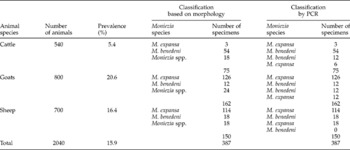
Among the 2040 domestic animals examined, Moniezia was recovered from 29/540 cattle (5.4%), 115/700 sheep (16.4%) and 181/800 goats (20.6%). By using carmine staining, 243 worms were classified as M. expansa, 84 were M. benedeni and 60 were unknown and designated as Moniezia spp. (table 2). Of the 60 Moniezia that could not be classified, 18 were from cattle, 24 were from goats and 18 were from sheep.
Identification of Moniezia spp. recovered from domestic ruminants.

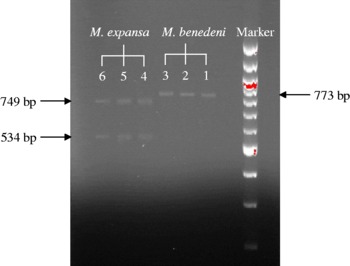
In parallel with classification by carmine straining, we developed a PCR method to distinguish M. expansa from M. benedeni. Based on nucleotide sequences, the primer pair ITS1-F and ITS1-R resulted in the amplication of products of 749 bp with M. expansa and 773 bp with M. benedeni, respectively. In contrast, primers ITS1-F and ITS1-R1 resulted in the amplification of a product of 534 bp with M. expansa and no amplification with M. benedeni, as this species does not have nucleotides corresponding to primer ITS1-R1. The PCR method was applied to 457 specimens (75 from cattle, 162 from goats, 150 from sheep, and 30 from horses, 30 from chickens and 10 from dogs). Fragments of the expected size were amplified from DNA from 387 specimens from cattle, goats and sheep, but no PCR product was detected from 30 worms (10 Anoplocephala magna, 10 Anoplocephala perfoliata, 10 Palanoplocephala mamillana) recovered from the horses, 30 worms (10 Raillietina echinobothrida, 10 Raillietina tetragona, 10 Raillietina cesticilus) from chickens, and 10 worms (Taenia hydatigena) from dogs.
The results of the PCR technique were in agreement with the results of the carmine-staining method in which 243 worms were classified as M. expansa (two fragments of 749 and 534 bp) and 84 individuals were classified as M. benedeni (one fragment of 773 bp) (fig. 1). Furthermore, of the 60 worms that could not be classified by the carmine-staining method, 36 were found to be M. expansa and 24 were M. benedeni. Of 75 specimens from cattle, nine were classified as M. expansa and 66 were M. benedeni. Among the 162 caprine specimens, 138 were M. expansa and 24 were M. benedeni. The distribution of M. expansa and M. benedeni in 150 ovine specimens was 132 and 18, respectively.
Agarose gel electrophoresis of PCR-amplified Moniezia DNA products. (See online for a colour version of this figure.)

Discussion
The aim of the present study was to investigate the prevalence of Moniezia in domestic animals and to develop a reliable PCR method to distinguish between M. expansa and M. benedeni. Classification of Moniezia based on morphology is complicated due to the lack of interproglottid glands in some specimens. In this study, by using carmine staining, we could classify 327 out of 387 worms recovered from domestic animals. There are some genetic methods that have been used for classification of Moniezia, such as electrophoresis (Ba et al., Reference Ba, Wang, Renaud, Euzet, Marchand and De Meeus1993) and multilocus enzyme electrophoresis (Chilton et al., Reference Chilton, O'Callaghan, Beveridge and Andrews2007). In this study, we developed a PCR method for classification of Moniezia. The results showed that two pairs of primers amplified DNA from 387 worms recovered from cattle, goats and sheep but not DNA from 70 worms collected from horses, chickens and dogs. Furthermore, one pair of primers (ITS1-F and ITS1-R1) only amplified DNA from M. expansa, and not DNA from M. benedeni. Moreover, the results of the PCR technique were in agreement with the results of carmine staining in the classification of 327 worms. The PCR method also distinguished M. expansa from M. benedeni for 60 worms that could not be classified based on morphology. These results suggest that the PCR method described above is specific for the detection and classification of Moniezia spp.
The overall prevalence of Moniezia spp. from cattle, sheep and goats was 5.4%, 16.4% and 20.6%, respectively. We found the rate of Moniezia spp. infection in cattle in this study to be similar to that reported from Brazil (4.76%) (Borges et al., Reference Borges, da Silveira, Graminha, Castagnolli, Soares, do Nascimento and da Costa2001) but lower than that reported from France (31%) (Achi et al., Reference Achi, Zinsstag, Yeo, Dea and Dorchies2003) and the USA (16%) (Ciordia, Reference Ciordia1975). In the present study 16.4% of sheep were found to be infected with Moniezia spp. This result is in agreement with the reports of Eeranska et al. (Reference Eeranska, Vanrady and Eorba2005) in the Slovak Republic (19.2%) and Bashtar et al. (Reference Bashtar, Hassanein, Abdel-Ghaffar, Al-Rasheid, Hassan, Mehlhorn, Al-Mahdi, Morsy and Al-Ghamdi2011) in Saudi Arabia (11.5%), but other authors have reported a lower rate (less than 4%) of Moniezia infection in sheep in Saudi Arabia (Al-Qureishy, Reference Al-Qureishy2008) and Iran (Moazeni & Nili, Reference Moazeni and Nili2004). On the other hand, observations of a high prevalence of infection (29–61%) have been reported in the Czech Republic (Chroust, Reference Chroust1997) and Ethiopia (Sissay et al., Reference Sissay, Uggla and Waller2008). Possible explanations for the differences in infection are differences in sampling times and variations in geographic locations. Panitz et al. (Reference Panitz, Dodson and Godfrey2006) and Bashtar et al. (Reference Bashtar, Hassanein, Abdel-Ghaffar, Al-Rasheid, Hassan, Mehlhorn, Al-Mahdi, Morsy and Al-Ghamdi2011) have shown that in the wet warm season the rate of Moniezia infection in sheep is higher than in the dry and mildly dry seasons. The prevalence of Moniezia in goats has been reported to be 31% in Nigeria (Nwosu et al., Reference Nwosu, Ogunrinada and Fagbemi1996) and 36% in Ethiopia (Sissay et al., Reference Sissay, Uggla and Waller2008). The rate of infection in goats in our study was slighly lower (20.6%). When considering the prevalence of M. expansa and M. benedeni and their hosts, we found that the Moniezia species in this study were more likely associated with a specific animal host. Moniezia expansa was dominant in goats (85.2% versus 14.8% M. benedeni) and sheep (88.0% versus 12.0% M. benedeni), whereas M. benedeni was dominant in cattle (88% versus 12% M. expansa) (table 2). These results are in agreement with the results that have been reported for Turkey (Memmendov, Reference Memmendov2009) and Egypt (Bashtar et al., Reference Bashtar, Hassanein, Abdel-Ghaffar, Al-Rasheid, Hassan, Mehlhorn, Al-Mahdi, Morsy and Al-Ghamdi2011), where M. expansa was dominant in sheep at a prevalence of 69.3% (versus 30.7% M. benedeni) and 74% (versus 4.8% M. benedeni), respectively.
In conclusion, the results of the present study indicate that the PCR method is a valuable approach for the detection and classification of M. expansa and M. benedeni. The species M. expansa was dominant in goats and sheep, whereas M. benedeni was more common in cattle, as described in other countries.
Acknowledgements
This work was supported by the Ministry of Agriculture and Rural Development, Nha Trang, Vietnam. The authors would like to thank Dr Kurt Miller, University of Wyoming for checking the English language of the text.