Introduction
In the extremely abundant literature available on caste, the concept of territory has been very little explored, though it is a richer and more complex notion than space and region, which have comparatively received more attention by scholars of South Asia.Footnote 1 Territory can be defined as ‘economic, ideological and political (therefore social) appropriation of space by groups that have a particular representation of themselves, of their history, of their singularity’.Footnote 2 In the Indian context, these ‘groups’ could typically be endogamous castes trying to assert their dominance through territorial control. The dominant castes, whose main characteristic lies in landownership, have been particularly successful in appropriating space. According to anthropologist M. N. Srinivas, ‘for a caste to be dominant, it should own a sizable amount of the arable land locally available, have strength of numbers and occupy a high place in the local hierarchy’.Footnote 3 This classical definition is no longer sufficient to analyse dominant castes today, first because their dominance can be observed on a larger scale than the locality, second because it is no longer limited to rural areas, and finally because numbers and ritual hierarchy need to be replaced with new attributes of dominance that have become much more central to the understanding of these groups.
The evidence for these theoretical claims will be provided in this article through a case study of the Kammas—a dominant agrarian caste from Coastal Andhra, where they continue to own most of the fertile deltaic land, even after migrating in large numbers towards the interior and southern regions of the Indian peninsula, both to newly irrigated areas and to the cities. In spite of their relatively low ritual status (in the varna hierarchy, they traditionally stood as ShudrasFootnote 4), they occupy key positions in the politics and economy of Andhra Pradesh, and to a lesser extent of Tamil Nadu and Karnataka. Their upward social mobility will be examined in relation to spatial mobility, since their migration patterns can be analysed as a collective endeavour towards territorial control and economic expansion. Both space appropriation and capital accumulation are essential to understand the change in scale and nature of Kamma dominance and to study its regional variations. As Kammas became more hegemonic through their access to state power, they faced increasing resistance from Dalits, who see them as their main oppressors in Andhra villages, and from the people of Telangana, who resent their economic and cultural domination in a region where they continue to be perceived negatively as ‘settlers’. The demand for a separate Telangana State, which was carved out of Andhra Pradesh in 2014, is not unrelated to this process of ‘internal colonization’—a term that will be discussed in this article.
The empirical material presented here has been collected over a period of 30 months of extensive fieldwork between 2006 and 2010, in the South Indian states where Kammas have a significant presence (Andhra Pradesh/Telangana, Tamil Nadu and Karnataka). The methodology adopted for this investigation combines qualitative and quantitative approaches. Six different sitesFootnote 5 were chosen for ethnographic studies that included participant observation and informal discussions both with Kammas and with members of other castes living in the same areas. Formal in-depth interviews were conducted with 75 Kamma personalities selected from different fields (politics, business, industry, media, and culture). The quantitative survey is based on a questionnaire administered to a sample of 200 Kamma households—100 in a Krishna delta village called Godavarru and another 100 in Kukatpally, a suburb of Hyderabad—for a comparative analysis of Kammas’ socio-economic profile in rural and urban areas. The first section of this article is a summarized review of the literature that aims to understand the ‘absence’ of territory in caste studies. The second section looks historically at the emergence of Kammas as a dominant caste through territorial expansion. The third is a study of the regional variations in the territorial expressions of caste dominance. Finally, the last section raises the question of the decline of Kamma dominance due to Dalit mobilization and to the creation of the Telangana state.
The territorial dimension of caste dominance: a brief review of the literature
In the introduction of Territory, soil and society in South Asia, Daniela Berti and Gilles Tarabout trace back the origin of a widespread stereotype in South Asian studies, according to which the notion of territory is of secondary importance for the understanding of Indian civilization, and has ‘little value as a cognitive category’.Footnote 6 The arguments that sustain this idea are classified into three groups. The first dismisses territory as a mere ‘empirical’ fact, as opposed to ‘ideology’, which, according to Louis Dumont, is the fundamental factor in social organization. The second line of argument tends to devaluate the links between people and ‘soil’, supposedly because Hindus do not bury their dead. The last group comprises arguments of a political nature, according to which Hindu kingdoms were defined by the relationships between the king and his subjects rather than by territories. Those who believe in the ‘absence of territory’ in pre-colonial India generally argue that boundaries were fuzzy and that the Hindu king was a universal sovereign rather than a ruler over a specific territory. In fact, there is confusion here between the discourse and the practice of power. The other arguments are also confronted by the different contributions of the book, which fills an important thematic and methodological gap in South Asian studies by emphasizing the role of territory in social, political, and religious organization.
In his latest book, Beyond Caste, Sumit Guha devotes a whole chapter to the study of ‘territorial power’.Footnote 7 He also deplores the fact that the spatial dimension of social organization has long been ignored, while the existing research in this field has been neglected, with a few exceptions, such as the work of Nicholas Dirks on ‘little kingdoms’ and that of Burton Stein on ‘nadus’. Dirks's contribution is of particular interest, since he studied territory in relation to caste dominance: ‘The way in which territory figures in the social organization of any group is strongly related to the nature and extent of political dominance exercised by the group’.Footnote 8 Stein's exploration of the ‘nadu’ in South India—a vernacular term that could be translated as ‘county’—draws the attention to the village cluster, which, he argues, is the most relevant territorial level for the analysis of dominant agrarian castes.Footnote 9
Though Srinivas first developed the concept of dominant caste from his ethnography of the Vokkaligas in a single Mysore village, he later acknowledges that ‘no longer is dominance a purely local matter in rural India’.Footnote 10 In his study of Rajputs in Central India, Adrian Mayer tried to apply the concept of dominance to a whole region—a scale at which the numerical importance of a particular caste ceases to be a decisive criterion to determine its economic and political power.Footnote 11 According to Oliver Mendelsohn, the very idea of dominant castes was losing its significance as the country was becoming more urbanized—an argument based on his observations of the Ahirs in rural Rajasthan.Footnote 12 However, this hypothesis is contested by Craig Jeffrey, who argues that ‘Jats, and particularly rich Jats, have been fairly successful in reproducing their economic and political privileges in the post-Independence era at different political levels’.Footnote 13 These levels include the villages where they continue to be dominant, as shown by his fieldwork in rural Uttar Pradesh, even though many Jats migrated to the cities. Migration in fact reinforced their traditional village dominance thanks to rural–urban networks based on caste solidarity and mutual help, which contradicts Mendelsohn's thesis of increased ‘atomization’ and ‘individualism’ among dominant castes.Footnote 14 Quite the opposite: Jeffrey's bourdieusian analysis aims at showing how caste is used more than ever as social capital by the dominant groups whose initial wealth is ‘converted’ into cultural capital, as suggested by their heavy investment in urban private education for their children.Footnote 15
While most students of caste discussed territory in a rather descriptive way as a simple framework of analysis in order to position themselves in the debate about the proper unit of study (village/group of villages/region/state), Jeffrey used the theoretical contributions of social geography to problematically examine the territoriality of the dominant castes by highlighting the specific forms of socio-spatial mobility observed among rural elites. Robert David Sack defines territoriality as ‘a spatial strategy to affect, influence, or control resources and people, by controlling area’.Footnote 16 One can thus identify a triangular relation between people and their environment, but also between different groups of people in a given territory. The aim of territorial control can be both to contain and to exclude, by either sharing or limiting access to resources. These different degrees of accessibility are based on power relations, power being defined as the capacity to act on the world and on others. The appropriation of territory by dominant groups can express itself through various forms of socio-economic marginalization and political subordination of the subaltern groups, without necessarily implying spatial segregation. The territoriality of the dominant castes therefore appears as a strategy of control, which cannot be understood without taking into account time, space and power: ‘Territoriality then is a historically sensitive use of space, especially since it is socially constructed and depends on who is controlling whom and why.’Footnote 17
By tracing the socio-spatial trajectory of the Kammas in the long run, the next section will highlight the importance of history in shaping territory as a sphere of influence forged through power relations.Footnote 18 Since these relations vary not only over time, but over space, it is then necessary to explore caste dominance regionally and ethnographically, before analysing the challenges to this dominance and how those struggles are expressed territorially.
Emergence of the Kammas as a dominant caste: a historical overview
A mobile peasant-warrior caste in the medieval period
According to epigraphical records, the Krishna delta area was known as Kammanadu during the Chola empire—a toponym that probably came from the Buddhist monastic institutions called sanghakammas. After the decline of Buddhism in the Krishna valley, the term ‘Kamma’ no longer referred to a place and started to be used as a caste name to designate the main agrarian community inhabiting that territory. The Kamma historian K. B. Chowdary claims that, while these cultivators were reintegrated into the Hindu fold, they lost their previous Kshatriya status and were treated as Shudras by Brahmin priests.Footnote 19 To support this thesis, he provides examples of matrimonial alliances between Kammas and members of the ruling dynasties, based on an analysis of intiperlu (surnames). However, the martial activities of the Kamma agriculturists were intermittent and limited to times of war, when they worked as soldiers in the service of the Kakatiya kings of Warangal, and later of the Vijayanagar emperors.Footnote 20 Military campaigns were attractive to the peasants, as they offered opportunities for wealth acquisition through looting. During the Vijayanagar empire, some Kammas rose to the rank of army commanders and participated in the conquest of the Tamil country. War was thus an important factor of socio-spatial mobility for peasant-soldier castes. These waves of military migration towards the South of the Indian peninsula from the fifteenth century onwards explain the significant presence of Kammas in Tamil Nadu, where they again turned into agriculturalists in times of peace.
Kammas’ rise to dominance both in their territory of origin (the Krishna delta) and in the southern territories they later conquered was based on their control over agricultural land. At that time, land control did not refer simply to private property, but implied complex social and political relations:
A dominant caste emerged as, through a stable set of alliances, it became endowed with sufficient material and symbolic resources to establish for itself a superior position in the total complex of transactions critical in agricultural production: that is, it became a jati of patrons more than of clients.Footnote 21
Under the Telugu Nayaks, who were provincial governors appointed in Tamil Nadu by the Vijayanagar emperor, the Telugu settlers were favoured and therefore ‘displaced Tamil-speaking local leaders as dominant cultivating groups’.Footnote 22 Kammas also acquired land in the interior regions of the Deccan Plateau between 1600 and 1800. Agricultural colonization of forest areas was another major factor of migration for the peasant castes—a process that led to the dispossession of local tribes from their resources. In the Telangana region, the Muslim rulers collected taxes through intermediaries from the dominant castes who were given the title of chowdaris. Muslim princes thus played a role in reinforcing caste hierarchy, which they saw as a guarantee of social order among their Hindu subjects.Footnote 23 Some wealthy Kammas, such as Vasireddy Virappa Naidu in 1670, were elevated to the status of hereditary zamindars. By 1725, his heirs were controlling 225 villages in the Krishna delta.Footnote 24
Kamma farmers were generally supported by the ruling elites, whether Hindu or Muslim, and later British, because they were considered expert cultivators known for their ‘hard work’, ‘enterprising nature’, and ‘agricultural transformation ability’:
The migration of Coastal Andhra peasants into Telangana increased in response to the invitation by the Nizam's government . . . [that] envisaged the distribution of cultivable waste lands to outside settlers and provided certain incentives . . . . Although the Coastal Andhra settlers were drawn from different castes and socio-economic groups, the Kamma cultivators are conspicuous by their overwhelming presence in the irrigated zones of Telangana.Footnote 25
Kammas’ expertise in paddy cultivation stemmed from their experience of irrigation in the Krishna and Godavari deltas after the construction of two big dams by the British administration in the mid-nineteenth century.
An agrarian caste that benefitted from regional development under British rule
In 1802, soon after their establishment in Coastal Andhra, the British introduced the Permanent Settlement that reinforced the zamindari tenure system. A new landed aristocracy was created among Kammas as they received another 14 zamindaris under colonial rule, the zamindar of Guntur being one of the wealthiest.Footnote 26 However, most Kammas were small farmers paying taxes directly to the revenue administration under the ryotwari system. These Kamma ryots, whose private-property rights were now consolidated, emerged as the main beneficiaries of the construction of dams on the Krishna and Godavari rivers around 1850. After the introduction of canal irrigation in the deltas, they were able to intensify paddy cultivation and to generate surpluses. This increased prosperity enabled the Kamma peasantry to become more and more powerful politically. Caste dominance was therefore not limited to the big zamindari landlords, but was expressed through the growing influence of the local ryot elites.Footnote 27
The commercialization of agriculture in Coastal Andhra, following the introduction of cash crops such as sugarcane, tobacco, and cotton, led to the development of transportation infrastructure, urban growth, and industrialization. In the Krishna delta, the small town of Vijayawada became a thriving market and an important railway junction. Kamma farmers diversified their activities by investing in urban areas, using their agricultural surplus to start bus companies or food-processing industries such as rice mills and sugar factories. Those who were able to commercialize their own agricultural production and to become moneylenders progressively sidelined the traditional merchant castes and business communities.Footnote 28 In 1926, the Kamma leader, N. G. Ranga, noted:
In every village there are a few enterprising Kammas, who have 10 to 20 acres of land and who are anxious to do some sort of business or the other. Most of them have taken to dealing in paddy and have found it profitable. They also opened general stores, manufacture factories.Footnote 29
In spite of this shift of accumulated capital and entrepreneurship from rural to urban areas, local dominance was still preferentially exercised in the countryside: ‘Once the surplus was disposed of, the cultivator would return to his local factional politics, moneylending, consolidation of his power at the village and taluk levels—activities which increase his status in an agrarian society.’Footnote 30
The commodification of land also benefitted the middle peasantry of the Krishna delta, where the value of agricultural properties increased tremendously thanks to irrigation. Kammas’ influence and money power helped them ensure that the canals would reach their lands due to their privileged links with the local administration.Footnote 31 The Andhra peasantry was thus characterized by the polarization of the agrarian social structure: while the fertile and irrigated properties were concentrated in the hands of the dominant castes, the landless agricultural labourers were mostly ‘untouchable’ Malas and Madigas.Footnote 32 However, not all Kammas were rich farmers: the emergence of a class of ‘Kulaks’ among them led to an important economic differentiation within the community, that the elites tried to compensate by gathering funds for the education of poor Kamma children in a conscious effort to promote caste unity. This was the primary objective of the first Kamma caste association established in 1910: the construction of hostels in the towns and the allocation of scholarships encouraged small farmers to send their children to study outside the villages.Footnote 33 Quite early on, education was perceived by Kammas as a key to social mobility. Their literacy rate increased from 4.8 per cent in 1901 to 13.6 per cent in 1921, and was the highest among other agrarian dominant castes such as Reddis and Kapus, though much lower than that of Brahmins.Footnote 34
The network of Kamma caste associations spread rapidly to Tamil Nadu, where the zamindar Kondala Ramaswamy Naidu became the president of the Kamma Mahajana Sabha in Tinnevelly, while the zamindar Subba Naicker was heading the Dakshina Desa Kamma Mahasabha (‘the Great Assembly of Kammas from the Southern Country’) in the 1920s.Footnote 35 To achieve caste unification, these associations encouraged marriages between subcastes. Kammas were divided into two main endogamous subcastes, namely Chinna Kamma (‘small Kamma’) and Pedda Kamma (‘big Kamma’), which originally might have been a class division between small peasants and the landed aristocracy. Kammas’ matrimonial networks started extending territorially as well.Footnote 36
Kammas formed only 3 per cent of the population of the Madras Presidency in 1921 but, as shown in Figure 1, 18 per cent of Guntur district in the Krishna delta, where they were the main landowners, since they progressively acquired the properties of Brahmins who had migrated to the cities.Footnote 37 In Andhra, Brahmins were the first to go through the process that Srinivas calls ‘Westernization’, but they were soon followed by Kammas, who invested in English-medium private education to access employment in the administration and in the professions. The difference was that, as farmers, they rarely disposed of their land, even after migrating. They would sell only a few acres to transfer capital from countryside to town, while the rest of the property would be taken care of by relatives back in the village. Kammas also emulated Brahmins by adopting some of their rituals to improve their status, though this attempt at ‘sanskritization’ (the other major route of social mobility according to Srinivas) was limited, because of the influence of the rationalist anti-Brahmin movement among agrarian castes in the Madras presidency.Footnote 38 The Kamma reformist intellectual Tripuraneni Ramaswamy Chowdary was heading the non-Brahmin movement in Andhra in the 1920s and was close to the Justice Party that shared this ideology. However, its pro-British positions made him leave the Justice Party when the nationalist movement became stronger.
Distribution of Kammas in the Madras presidency, based on the 1921 Census.

In the 1930s, the Congress Party in Andhra was controlled by the Reddis, while the newly created Communist Party of India (CPI) found support among the Kammas, who saw it as an alternative vehicle for political power.Footnote 39 These two dominant agrarian castes were divided not only by political rivalry, but by territorial claims: while Kammas dominated the prosperous delta areas, Reddis’ stronghold was in the less developed Rayalaseema region.Footnote 40 Though Kammas formed 40 per cent of the agricultural population of the Krishna delta, they owned 80 per cent of its fertile land.Footnote 41 The paradox of this wealthy agrarian elite supporting the CPI can be explained by the fact that the Congress Party was not able to accommodate the demands for political participation from a new generation of educated Kammas.Footnote 42 The Telugu communist press was owned by a Kamma publisher, Katragadda Rajagopal Rao, whose family was controlling the Andhra fertilizer market and one of India's largest tobacco plantations. Though Kamma communist leaders participated in the Telangana peasant armed struggle between 1946 and 1951, they tried to moderate the movement when it became too radical, and many refused to increase the wages of the agricultural labourers who fought along with them against feudal lords.Footnote 43
Kammas’ territorial expansion and rise to power since independence
Kammas’ support for the CPI was also due to its strong commitment in favour of a separate Andhra province, comprising only the Telugu districts of the multilingual Madras state, against what was perceived as Tamilian hegemony in the administration. This demand was achieved in 1953, and led three years later to the formation of Andhra Pradesh, the first Indian state created on a linguistic basis, after the integration of the Telugu-speaking Telangana region to Andhra and Rayalaseema. Linguistic states mostly served the interests of the regional dominant castes, as the DalitFootnote 44 leader B. R. Ambedkar predicted:
In our country, linguism is only another name for communalism. Take Andhra. There are two major communities spread over the linguistic area. They are either the Reddis or the Kammas. They hold all the land, all the offices, all the business. The untouchables live in subordinate dependence on them. In a linguistic state, what would remain for the smaller communities to look to?Footnote 45
However, the rivalry between Kammas and Reddis increased considerably in the new Andhra Pradesh state. The CPI started declining after Telugu regionalism could not be used as an electoral argument anymore, while the Reddy-dominated Congress came to power at the state level in 1956 and continuously won the elections for almost three decades. Despite their political marginalization, the Kammas continued to prosper economically and started migrating to Hyderabad, the capital city of Andhra Pradesh, for business, employment, and higher education. The post-independence territorial recompositions provided them with new opportunities for investment in Telangana, where they bought land in the proximity of irrigation projects. Particularly efficient as agriculturalists and entrepreneurs, Kammas acquired considerable financial and commercial interests in both urban and rural areas of the Deccan Plateau. These settlers were educationally more advanced and wealthier than the locals who had lived under the Nizam rule, and who thus felt threatened by these intensified waves of migration from Andhra, which led to the first Telangana separatist movement in 1969.Footnote 46
The uneven development between the coastal and interior regions of Andhra Pradesh was accentuated by the Green Revolution that started in the 1960s. As elsewhere in India, the new techniques of agricultural production were introduced in the already advanced regions, and the financial incentives to use them, such as cheap credit, were offered to the already rich farmers, thus deepening socio-spatial disparities. In Coastal Andhra, Kammas were the main beneficiaries of the Green Revolution, since they had enough capital to invest in high-yielding varieties of rice and new inputs such as chemical fertilizers and pesticides. The intensification of agriculture in the deltas areas accelerated the process of economic diversification, as Kamma farmers’ wealth increased to such an extent that the agrarian surplus had to be transferred to agro-industries, transportation, or other businesses, and children's higher education. They resented the 1973 Land Ceiling Act, which they perceived as a direct attack against their economic power by the Telangana Brahmin Chief Minister P. V. Narasimha Rao. In fact, the land reforms did not radically change the agrarian structure of Andhra Pradesh. While the big landlords lost some of their hereditary property, the medium prosperous farmers just below them were mostly left unaffected because they could counteract the law by dividing their lands among family members or by benami transactions. Very little surplus land could therefore be distributed by the government to the landless farmers, who mostly belonged to the Dalit castes.Footnote 47
The arid inland Telangana did not benefit from agricultural modernization, but offered the advantage of cheap land and low-wage manpower to the Andhra migrants who, by selling one acre of land in the deltas, could buy ten acres in the Deccan Plateau.Footnote 48 Due to the paucity of land in the deltas and the high density of population, territorial expansion became essential for Kamma farmers to find new outlets for their accumulated capital.Footnote 49 Spatial mobility thus appeared as a necessary condition for Kammas’ continued social mobility. This flow of migrants and capital from Andhra to Telangana was not perceived by the locals as a positive sign of economic development for their region, but as exploitation of their poorer conditions. Kammas generally migrated with their families: ‘Kinship played an important part in the colonization process. The initial settlers were not only from the same village but the lineages were linked by affinal ties. Later, many more families joined, and they came from different villages.’Footnote 50 Using a typical colonist narrative, Kamma settlers in Telangana claim that they ‘turned the desert green’. If land was not available for sale, they used to practise reverse tenancy, by taking land on lease from poor farmers and lending them money at very high interest rates. When the local peasants became too indebted to their rich Kamma tenants, they ultimately had to yield their lands. The same process of land alienation led to the dispossession of Adivasis in the tribal areas of northern Andhra:
The third phase of migration started when the light soil flue-cured Virginia tobacco was introduced in Polavaram taluk in 1960. The Kamma migrants were the first to take advantage of this opportunity . . . . However, for the tribals, it meant further loss of land and control over the exploitation of the vast benefits from commercialized agriculture. Although the non-tribal farmers were ‘tenants’ . . ., the tribals who were the landowners came to be exploited by the tenants as a major share of the benefits of the tobacco economy went to the latter.Footnote 51
The ‘farmer-capitalists of Coastal Andhra’, as Carol Upadhya calls them,Footnote 52 became more and more urban-oriented, in search of new avenues of employment, both in Andhra towns and in Hyderabad. A new highly educated generation of Kammas started migrating abroad, preferentially to Great Britain and the United States of America, while sending remittances to their families back in the villages. This socio-professional diversification within Kamma families was best described by K. Balagopal:
A typical family of this provincial propertied class has a landholding in its native village, cultivated by hired labour, tenants or farm-servants and supervised by the father or one son; business of various descriptions in towns—trade, finance, hotels, cinemas and contracts—managed by other sons; and perhaps a young and bright child who is a doctor or engineer or maybe even a professor at one of the small town universities.Footnote 53
In the 1980s, the number of Kamma settlers in Hyderabad increased significantly. According to some informants, they felt encouraged to migrate to the capital after the 1983 victory of Telugu Desam Party (TDP)—a new regional party founded by the Kamma ex-movie star N. T. Rama Rao (NTR). For the first time since independence, a Kamma chief minister was leading Andhra Pradesh, and many of his caste fellows felt that it would open new opportunities to them in Hyderabad. The TDP's rise to power, just a few months after its creation, cannot be explained simply by Kamma votes, since this caste forms only 5 per cent of the total population of Andhra Pradesh.Footnote 54 However, it did benefit from the financial support of Kamma industrialists who wanted a chief minister from their caste to better serve their interests, as well as Kamma-owned regional media, such as Ramoji Rao's Telugu newspaper Eenadu, that actively campaigned in favour of the TDP:
The Kammas had always resented the fact that the Reddis dominated the state politics . . . . The growing disjuncture between their economic power and the failure to capture the highest political office—with all the symbolic and the real gains that involves—alienated the Kammas, and they threw their support behind NTR, himself a Kamma and well connected with other wealthy Kammas in the movie, hotel, and newspaper industries.Footnote 55
NTR's trajectory from an agricultural family to cinema and then politics is typical of Kammas’ pattern of social mobility. Since its inception, the Telugu film industry has been dominated by Kamma directors, producers, and actors. The surplus of agrarian capital generated from Coastal Andhra started being invested in movie production during the 1930s Depression, when agriculture was becoming less profitable.Footnote 56 This trend shaped the landscape of Kammas’ territory in the delta towns: ‘In a typical small town, the pride of place is taken by the twin symbols of Coastal Andhra: cinema halls that look like rice-mills and rice-mills that look like cinema halls, give or take a chimney stack.’Footnote 57 Under NTR's regime, from 1983 to 1989, health and education also became lucrative investment sectors for upwardly mobile Kammas. The first generation of Kamma doctors who migrated to the United States of America in the 1960s accumulated capital abroad before coming back to Hyderabad, encouraged by NTR, to invest in private hospitals. Engineering is now the most common career option among the Kamma youths, who generally study in corporate colleges owned by businessmen from their caste,Footnote 58 before seeking employment in the information technology sector in India and abroad. This corporatization of health and education was initiated by Kammas in Andhra Pradesh one decade before the liberalization process started at the national level in 1991.
From 1995 to 2004, under the TDP Chief Minister Chandrababu Naidu, NTR's son-in-law, the economic reforms and disengagement of the state accelerated this phenomenon. Naidu's neoliberal policies were praised by the corporate media and the World Bank, which, for the first time, granted a loan to a subnational entity, namely the state of Andhra Pradesh. In Hyderabad, Naidu focused on the development of infrastructure and global growth sectors such as information technology (IT). The location of HITEC City (Hyderabad Information Technology Engineering Consultancy City) near the residential areas of Jubilee Hills and Kukatpally, where most of the Kammas of Hyderabad live, led to a tremendous appreciation of their properties. Kamma businessmen who benefitted from political patronage and privileged access to information for real-estate speculation could make a lot of profit by investing in those areas. Naidu was therefore often accused of corruption, nepotism, and casteism, since his development choices benefitted his own Kamma caste more than any other community. In 1999, a post-electoral survey showed that 87 per cent of Kamma voters re-elected him for a second mandate.Footnote 59 The capture of state power corrected the discrepancy that existed between Kammas’ economic wealth and lack of political influence. Under TDP rule, they could finally impose their hegemony, which was not based anymore on landownership alone, but on control over the media, culture, and politics. However, they became hegemonic only in Andhra Pradesh, while, in the other states where they migrated, their dominance was not as decisive. It is also useful to distinguish between rural and urban dominance within those states, as the following section will show, based on comparative field studies.
Territorial expressions of caste dominance: a regional approach
Rural and urban dominance in Andhra Pradesh: a comparative analysis of Kammas in Kukatpally (Hyderabad) and in Godavarru village (Krishna district)
In order to compare the socio-economic profile of Kammas in Andhra Pradesh and their degree of dominance in both rural and urban areas, I conducted a quantitative survey with a questionnaire addressed to 100 Kamma households in a Hyderabad suburb called Kukatpally and 100 Kamma households in a Krishna delta village named Godavarru. The choice of Kukatpally was based on the concentration of Kammas in this area—the highest in Hyderabad.Footnote 60 To make the sample representative in terms of socio-economic status, I selected three residential areas of different standing within Kukatpally.Footnote 61 Godavarru is a Kamma-dominated village of Krishna district, and the sample covered almost all the Kamma households present at the time of the survey. A few households had entirely left the village to migrate to the cities or abroad, but most of them still had relatives who stayed back. The data collected concerned all family members, whether they were still living under the same roof or not. In total, information was gathered on approximately 1,000 rural and urban Kammas.
Their migration patterns are characterized by intense circulation between town and countryside, as most keep agricultural lands in their villages, which are either looked after by old parents who stayed back or are informally leased out to tenants from Backward Castes.Footnote 62 Kammas generally do not sell their village properties when they migrate to the cities. The ancestral house is used during festivals such as Sankranti at the time of harvest and during ceremonies such as weddings and funerals. Two-thirds of the interviewed Kammas in Kukatpally visit their villages of origin more than once a year, and only 2 per cent never return to their native place because they have neither family nor property there anymore. Land remains an important symbol of prestige and power. Even if agriculture is not very profitable anymore, land value is increasing in the Krishna delta, especially around Vijayawada, since Kammas speculated that the city might become the new capital of Andhra after the formation of a separate Telangana state, and many of them bought agricultural properties there as investment, even when they were not living in the villages anymore. Land is also used as dowry and is generally kept in the wife's name, which had an empowering effect on Kamma women. Eighty per cent of the interviewed Kammas in Godavarru had at least one family member who moved out of the village, either to other rural areas (25 per cent) or to an Indian city (mostly Vijayawada, Hyderabad, Chennai, and Bangalore) or even abroad (20 per cent), especially to the United States of America.
In Kukatpally, all the heads of the 100 surveyed households were first-generation migrants and 80 were from the Krishna delta. They started settling in Hyderabad in the 1960s, but two-thirds arrived only after the TDP came to power in 1983. When asked about the reasons for migration, 50 answered that they came because of the new employment opportunities in Hyderabad, 30 for business purposes, ten for completing their higher education, and ten for their children's education. When asked about the choice of Kukatpally to settle in, 35 said that it was a cheap and fast-developing suburb, and that buying a residence there was a good investment because of the rapid appreciation; 30 replied that they already had relatives or caste fellows settled in Kukatpally, and that they wanted to live in a place known for its ‘Andhra culture’, where the influence of Telangana culture is less important and where the Muslim population is not too numerous. Some informants talked more specifically about their preference for areas having a strong ‘Kamma culture’. Twenty said that they chose Kukatpally because it is near HITEC City and offers a lot of business and employment opportunities. Fifteen described Kukatpally as an educational hub with a lot of private schools and engineering colleges for their children.
Within the Kukatpally sample, 73 per cent had a university degree. Women were also highly educated and most of them studied in private English-medium schools. Since parents are ready to invest a lot of money in their children's education, Kammas’ human capital is mainly related to their financial capital. More than half of the interviewed households in Kukatpally had an annual income of more than Rs 500,000 and properties worth Rs 10 million or above.Footnote 63 In terms of social capital, Kamma settlers benefitted from various caste-based networks, whether familial, educational, associational, professional, or political. Interviews with active members of various Kamma institutions located in Kukatpally (marriage bureau, caste association, hostels and colleges, builders’ association, political leaders) highlighted the role of caste as social capital not only in the process of migration (through information and mutual help), but also in the integration process (fast and easy access to property, to educational institutions for children, and to job opportunities).
In Godavarru, the education level of Kammas was lower than in Kukatpally: 3 per cent were illiterate, 18 per cent studied until tenth class, 43 per cent until twelfth, and 36 per cent had a university degree. However, the Kammas of Godavarru spend more than those of Kukatpally for their children's higher education: one-quarter of the surveyed households in the village paid more than Rs 100,000 per year for their children to study in university, whether in an Indian city or abroad—a considerable sum that is equivalent to the annual agricultural income generated by ten acres of land in the delta. These heavy investments in higher education aim to ensure that the next generation finds employment outside agriculture, preferentially in professions such as medicine and engineering. In terms of income, Kammas in Godavarru were not as well-off as in Kukatpally: only 5 per cent of the interviewed families had a total annual income above Rs 500,000, while 47 per cent earned less than Rs 100,000 a year. However, in terms of assets, 44 per cent of Godavarru households had immovable property worth more than Rs 10 million, which was just a little less than the proportion in Kukatpally. Their properties mostly consisted in agricultural land, with an average of ten acres per households, each acre worth Rs 2 million on average. The average number of children per household, whether in Godavarru or Kukatpally, was two. Kammas adopted family planning quite early on in order to avoid the division of their properties.
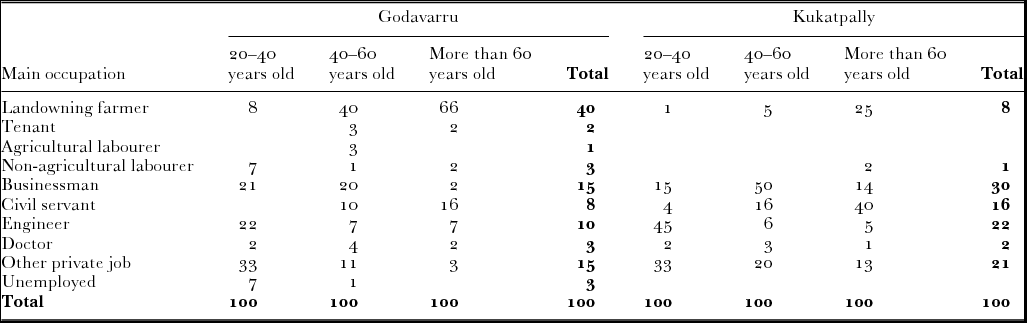
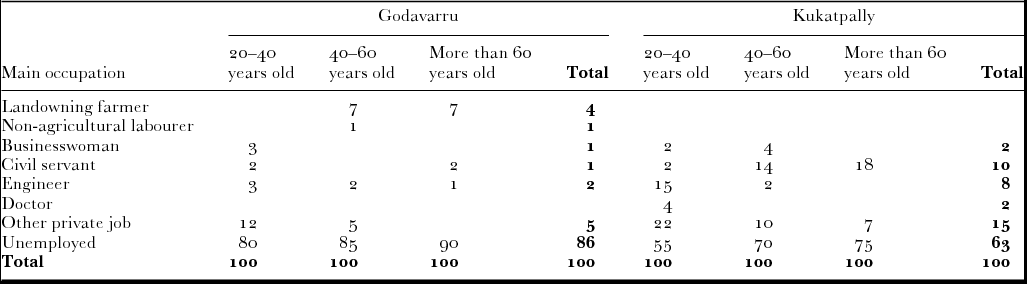
The socio-professional mobility of Kammas in Kukatpally is more rapid than in Godavarru, as shown in Tables 1 and 2—comparative tables on profession by gender and generation. Whether in Godavarru or in Kukatpally, Kammas depend less and less on agriculture for their livelihood. The declining importance of the farm incomes is of course most noticeable in the urban sample, where the young generation of both genders is turning to professions such as engineering.
Profession of men by generation (%)

Profession of women by generation (%)

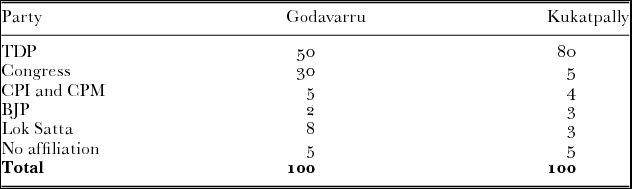
Though less upwardly mobile, Godavarru Kammas exercise a stronger dominance than Kukatpally Kammas, in spite of occasional strife due to factionalism.Footnote 64 Half of the 100 interviewees in Godavarru supported the TDP, while 30 voted for the Congress (Table 3). In Kukatpally, the TDP support was much more important (80 per cent), while all other parties received a more or less equal support.
Political affiliations (%)

Both communist parties (CPI and CPM) are led by Kammas at the state level, and the Lok Satta was founded in 2007 by an ex-bureaucrat, Jayaprakash Narayan, who also belongs to this caste. Though the national president of the Bhartiya Janata Party (BJP, Hindu nationalist right) was a Kamma (Venkaiah Naidu), the support for the BJP was low in the surveyed samples. At the village level, Kammas’ political influence is stronger than in a big city such as Hyderabad. Despite the village-elected head (sarpanch) being a Dalit at the time of the Godavarru survey, he had virtually no power and was politically controlled by the dominant Kammas.Footnote 65 Though Kammas formed 20 per cent of the population of Godavarru, they owned 85 per cent of the village lands, which, associated with other attributes of power such as connections with the urban world, gave them a decisive dominance.
One could be tempted to interpret these differences between rural- and urban-dwelling Kammas as a sign of growing internal divisions and socio-economic inequality. Many informants from Hyderabad looked down upon their caste fellows who still live in villages, referring to them as ‘frogs in the well’. However, if one thinks in terms of territory, the Kammas as a caste have only gained from the expansion of their sphere of influence which now encompasses both rural and urban areas. Far from losing their grip over their native villages, their traditional dominance has been reinforced by migration to the cities. The powerful positions acquired by the Kamma elites in urban areas help to enhance the social status of their caste as a whole. Moreover, spatial mobility here goes hand in hand with economic expansion as Kammas are drawn to the cities by ‘pull factors’, unlike distress migration, where ‘push factors’ are responsible for poor people abandoning their villages. Kammas’ enlarged territory changed the nature of their dominance by making it more hegemonic. No longer is rural landownership the sole reason for their political power, since control over key sectors of the economy in urban areas has become an increasingly important material basis for their socio-cultural pre-eminence at the state level.
Kamma dominance in urban areas: a comparative study of two regional metropolises: Vijayawada (Andhra Pradesh) and Coimbatore (Tamil Nadu)
Vijayawada and Coimbatore are two cities of comparable size with approximately 1 million inhabitants each, an estimated one-fifth of whom are Kammas. In Vijayawada, they share local dominance with the Kapu caste, who are politically influential, and in Coimbatore with the Gounders, an economically powerful Tamilian agrarian caste.Footnote 66 A qualitative analysis of caste relations through in-depth interviews revealed important differences in the nature of Kamma dominance in both places. Their territorial grip is, however, similar, as it is based on holdings of prime real estate and control over large sectors of the local economy, including trade, services, transport, and industry. Kamma migration to Coimbatore dates back to the sixteenth century's military conquest of Kongunad, but intensified in the nineteenth century after cotton became the region's major commercial crop.Footnote 67 The Kamma Naidus, or Kammavars, as they are called in Tamil Nadu, were mostly cotton farmers who were also involved in the trade of their raw production, which was exported in totality to Great Britain before the establishment of the first Coimbatore mill in 1888 by a British industrialist. Two decades later, Kuppuswamy Naidu, the son of a large Kamma landlord, founded the Lakshmi Mills Company, and was soon followed by other Kamma entrepreneurs who started their own mills.Footnote 68 In the 1930s, Coimbatore was known as the ‘Manchester of South India’ and, even today, the textile industry is the main economic sector in the city, almost entirely controlled by very affluent Kamma families whose origins can be traced back to the landed aristocracy of Kongunad.
In Vijayawada, Kammas’ economic strategies follow a different pattern: they form a class of neo-rich entrepreneurs interested in making quick, short-term profits, which in effect means that there is little investment in manufacturing. Their main sectors of activity are trade, agro-based industries, transport (bus and truck companies), ownership of cinema halls, restaurants and hotels, construction, finance, and real estate. They are perceived by the rest of the population as very aggressive businessmen, ready to make money at any cost. This includes participation in the underground economy characterized by illegal activities such as black-marketing of goods that are in short supply, illicit liquor trade, counterfeiting, protection rackets, patronage of gangs, extortion, and prostitution.Footnote 69 Moreover, Kammas’ involvement in a wide range of social and political movements makes Vijayawada a highly politicized centre, typical of what Parthasarathy calls a ‘provincial city’:
One of the key aspects of a provincial city is the migration of a rich peasant class, which over a period of time, tends to dominate various aspects of the city . . . . The rich peasants attempted to take control of political and social power structures initially within the villages, and then expanded the locus of power to the cities . . . . In the case of the Kammas, their participation in politics is not only crucial for their dominance in other sectors, but is itself a significant aspect of their migration and presence in the city.Footnote 70
Another characteristic of Vijayawada, according to the same author, is the ‘collective violence’ exercised by the two dominant castes: the Kammas and the Kapus, whose rivalry is not only economic, but also political. A large criminal empire was created by the Devineni brothers—two Kammas known as ‘Gandhi’ and ‘Nehru’. The latter joined the TDP in 1985 and was elected as an MLA (Member of the Legislative Assembly) from Vijayawada, while his Kapu rival, Vangaveeti Ranga, was a Congress MLA who was also related to the local mafia. Three years later, ‘Nehru’ organized the murder of Ranga, purportedly with the support of the police and of the TDP governmentFootnote 71:
Ranga's murder led to widespread retaliatory actions taken by the Kapus in the coastal districts against the Kammas, which left 20 people dead, while 500 cases of arson were registered in Vijayawada alone in three days, and Police opened fire in 28 places in that town . . . . A group of Ranga's supporters first axed to death Dr Uppalapati Srihari, a TDP leader. Cinema theatres owned by Kammas were set on fire, such as Kalyana Chakravarthi, belonging to NTR's brother . . . . The government imposed curfew in Vijayawada, but hundreds of Kapus continued setting fire to the shops they suspected belonged to the Kammas or Telugu Desam activists.Footnote 72
In Coimbatore, the economic rivalry between the Kamma Naidus and the Tamil-speaking Gounders is mostly peaceful, while politics are generally kept out of business.Footnote 73 As migrants, the Kammas of Tamil Nadu try to maintain cordial relations with the local dominant castes, and are now mostly assimilated into the Tamil culture. Though they continue to speak Telugu at home, they are well versed in Tamil too and rarely intermarry Kammas from outside Tamil Nadu.Footnote 74 However, their relations with the lower castes are as exploitative as in Andhra Pradesh. The Kamma industrialists of Coimbatore take pride in having put an end to the strikes in the textile factories by hiring young Dalit girls from poor villages on short-term contracts in order to avoid their unionization:
Strikes used to be a big problem in Coimbatore textile industry. So I decided to break the unions in the early 1990s by sacking all my male employees and by recruiting only migrant girls aged 18 to 21 for 3-year contracts, during which they could accumulate a small dowry (50,000 rupees) and go back to their villages in the South to get married. I was a pioneer of this method, and now many other mill owners do the same. Girls don't drink, they are more efficient, docile and work better. Their contract lasts only 3 years, so they don't have time to form unions.Footnote 75
These mill owners form an extremely wealthy capitalist class that tries to improve its image through philanthropy. Many hospitals and educational institutions in Coimbatore are funded by their trusts, whereas, for Kamma entrepreneurs in Vijayawada, both health and education are businesses only aimed at making profits. Some Coimbatore Kammas, who pride themselves in being highly cultured city-dwellers, described their Andhra counterparts with contempt because they became rich ‘too quickly’ and display their newly acquired wealth in a ‘distasteful way’ due to their strong rural roots. As migrants in Tamil Nadu, the Kamma Naidus claim that they had to struggle and work hard to reach the social position they enjoy today. This might be true for the descendants of small cotton farmers, but most of the big textile industrialists of Coimbatore have an aristocratic ancestry and therefore look down on the neo-bourgeoisie of Vijayawada.
These sharp differences between the Kammas of Coimbatore and of Vijayawada can be explained by distinct historical constructions of territory. Various regional and cultural contexts have influenced the way in which this community has evolved over time, from farmers to businessmen in Andhra or industrialists in Tamil Nadu. In Vijayawada, Kammas are ‘at home’, which gives them a certain arrogance and sense of superiority when it comes to their relations with other castes. On the contrary, the migrants who settled in Tamil Nadu made efforts to be integrated into a different environment while emulating the local Gounders. Since they form a linguistic minority, they cannot aim at political dominance, unlike in their territory of origin, which they consider to be ‘theirs’ and want to control more exclusively.
Kamma dominance in areas of agricultural colonization: a comparative study of two irrigated zones of the Deccan, in Karnataka and in Telangana
Kamma migration to Bellary and Raichur—two districts of Karnataka bordering Andhra Pradesh—dates back to the construction of a dam on the river Tungabhadra in the early 1950s. According to family histories collected there, most of those migrants were small farmers from the Krishna delta, who sold the few acres they owned to buy more land at a cheap price in the Tungabhadra belt before the arrival of canal irrigation. They first settled outside the existing villages, in small hamlets still known today as ‘Andhra camps’, though the original huts have now been replaced by sumptuous multi-storeyed houses. After the introduction of irrigation, the value of their lands increased tremendously and they became prosperous thanks to an annual double crop of paddy. Because they brought rice to the region, they claim that they taught the local farmers how to cultivate it and were therefore well accepted as the ‘migrants of development’. They were the first to adopt the Green Revolution techniques in the Tungabhadra irrigated belt, which now suffers from overexploitation of soil and water resources because of the intensification of agricultural practices. According to a local kannadiga farmer, ‘Kammas did not teach us anything, they came here for their own development, but there was a demonstrative effect of their agricultural techniques: they became rich so fast that the local people started imitating them, regardless of the ecological consequences’.
In Telangana, the hostility of local farmers towards Kamma settlers is even stronger, since their arrival was perceived as a form of ‘internal colonization’—an expression that was repeatedly used by the interviewees in Nizamabad district, where the Sriram Sagar irrigation project attracted many migrants from Andhra in the 1960s.Footnote 76 The locals sometimes speak of ‘land grab’—a term that is problematic, since Kammas legally bought the lands they now occupy, but which shows that the original owners felt cheated, since the migrants acquired the best lands for a cheap price, and then benefitted from the appreciation of their properties due to irrigation. The Kammas always seemed to know before others which lands would receive irrigation from the canals, probably thanks to their political connections and their contacts in the administration. The initial settlers progressively brought their families and formed separate settlements called after their geographical origin, such as Gunturpalle, or even their caste name, such as Kammagudem, thus keeping aloof from the local people in spite of their common Telugu language (contrary to Karnataka, where linguistic difference partly explains the spatial segregation of the ‘Andhra camps’):
The presence of an enterprising community in the midst of an economically poor, socially oppressed and less well-to-do groups in backward Telangana villages was a source of hostility and hatred. The dynamic migrant farmers displayed their skills and accumulated wealth and immensely prospered in certain parts of Telangana . . . . The images of this settler community that is aggressive, ruthless, arrogant, etc., make the local population to think that the ‘other’ is different. A popular saying reads thus, Kammavaru cherite, kadama kulalu tolugutai (‘on the arrival of Kammas, other castes go away’). The strong, intensive kinship relations among them and their concentrated habitation made others to view the community as homogeneous and unified.Footnote 77
According to Kamma informants, however, this hostility is nothing but ‘envy’ because of their success, especially since they are ‘outsiders’.Footnote 78 In the Telugu novel, Regadi Vittulu (Seeds of black soil), the writer Chandralata narrates the story of a migrant family from Andhra who settled in a newly irrigated area of Telangana to develop agriculture. The idea that land was not exploited to its full potential before the arrival of settlers is present throughout the book.Footnote 79 In an interview with the author's father, Murahari Rao, CEO of a seed company, he explained his own migration to Telangana in these terms:
Agricultural migration of Kammas is because of the hunger for land that is in our genes. I am not shy to say that we are Shudras. Shudra means producer. The Kammas spread the Green Revolution by migrating to new irrigation projects and by teaching modern agriculture to the natives. Thanks to the Krishna-Godavari dams, we were ahead of others by a hundred years.
Though Chandralata never specifies the caste of the main protagonists in her novel, readers could identify them as Kammas and many were displeased by the way Telangana characters and culture were portrayed in the book, which received a literary prize from the Telugu Association of North America (TANA)—a Kamma-dominated diaspora organization based in the United States of America. The controversy over the novel and the attribution of the award was followed by debates among Telangana literary circles on the cultural domination of Kammas and the way they ideologically justify the imposition of capitalist development on ‘backward’ regions, even though traditional rain-fed cereals were more sustainable than the monoculture of paddy and genetically modified cotton introduced along with irrigation.
Kammas’ ideology of progress and modernity became more hegemonic as they migrated outside their territory of origin. The interviewed migrants argue that they value symbols associated with mobility more than rootedness: ‘While a tree strikes roots and gets fixed, the seeds are free to fly. Acquired land is more prestigious than the ancestral. Territoriality is bondage but migration is freedom. Spirit of adventure and risk are more desirable than conservatism.’ However, their hegemony was met with resistance wherever they migrated, especially in Telangana, since the struggle for a separate statehood was born in opposition to Andhra domination. In their own delta villages, Kammas had to face the growing mobilization of Dalits whom they had used as agricultural labour and suppressed for centuries. Both these social movements threaten Kammas’ power and influence, which seem to be declining, as will be discussed in the last section.
Dalit mobilization and Telangana statehood: towards a decline of Kamma dominance?
The Dalit movement in Andhra against Kamma caste oppression
The Dalits of Andhra Pradesh started organizing on a large scale after a massacre perpetrated by Kamma landlords in 1985 in a village called Karamchedu—one of the richest and most developed villages of Coastal Andhra. Eighty per cent of its fertile and irrigated land belongs to the Kammas, who form 40 per cent of its population. The two main Dalit communities of Karamchedu—the Malas and Madigas—are relatively well educated, as the Christian missionaries were present in the region since the nineteenth century and the opening of schools for ‘Untouchables’ constituted one of their main activities. Though many Dalits converted to Christianity, they were still subjected to untouchability.Footnote 80 In reaction to those discriminatory practices, the Adi-Andhra Mahasabha (‘the Great Assembly of Andhra original inhabitants’) tried to raise awareness about caste oppression by organizing various conferences in the 1920s.Footnote 81 The economic situation of Dalits in Andhra was better than in Telangana, since the regional development provided abundant employment in agriculture and the wages were higher than in the interior regions. After independence, Dalits started benefitting from the reservation system to access education, government jobs, and elected positions, thus becoming less dependent on landlords to employ them in their fields.
In the 1950s, Karamchedu was a communist stronghold and, while the Kammas were active in the CPI, the Dalits supported the Congress Party. After the creation of the Telugu Desam in 1983, the Kammas of Karamchedu, where NTR's own relative was contesting the elections, instructed their agricultural labourers to vote for the new regional party, but most Dalits remained faithful to the Congress. This act of disobedience was considered insulting by the powerful Kammas, who realized that they were unable to transform the economic dependence of their employees into political loyalty. The Kammas saw the political assertion of Dalits as a dangerous sign of rebellion and contestation of their traditional dominance, and therefore decided to attack them to ‘teach them a lesson’: ‘Nobody can defy a Karamchedu Kamma and get away with it,’ boasted an old farmer in the village when asked about the conflict. They felt emboldened to act when the TDP came to power. The pretext for retaliation was an incident that opposed a Kamma boy to a Madiga woman who scolded him for washing his buffalo in the pond used by Dalits for drinking water. This was taken as a sufficient provocation for the Kammas to plan a punitive expedition in the Madiga hamlet, where a mob of more than 2,000 burnt down the huts, beat up men with axes, leaving many terribly injured and six murdered, while three women were gang-raped.Footnote 82
These caste atrocities were followed by a strong mobilization that led to the creation of the Andhra Dalit Mahasabha—an Ambedkarite organization that soon spread across the entire state. Getting the culprits arrested and punished proved difficult, since NTR, the then chief minister, had Kamma relatives in Karamchedu, one of them directly involved in the massacre and whose name was not even included in the 92-accused list.Footnote 83 In 2008, 23 years after the killings, only one culprit was condemned to life imprisonment and 30 others to three years in jail. The victims were disappointed by this judgment, which they found too lenient. Also, the judges never acknowledged the culpability of the highly placed Kammas who supported the actual perpetrators:
The assailants are mostly ordinary peasants but invariably they have had the backing and instigation of the class of provincial rich. Ministers, MLAs, absentee landholders with trade and business in nearby towns, resident landlords who also indulge in trade and contracts—such individuals have been accused of behind-the-scenes complicity by the dalits, and claimed as their patrons by the assailants.Footnote 84
However, in an interview with the Dalit Mahasabha leader, Katti Padma Rao, he emphasized the fact that, during their collective struggle for justice, the Dalits gained a sense of dignity and self-respect that they had not experienced before. Armed with a new intellectual leadership, the anti-caste movement quickly gathered momentum, as it appeared during the protest march to the Andhra Pradesh Legislative Assembly in which 500,000 people from all over the state participated.Footnote 85 The publicity they gave to the event brought shame to their oppressors: ‘The bourgeois Kammas felt embarrassed by the incident because it broke the myth of Kamma progressiveness.’Footnote 86 No incident of similar violence reoccurred in Kamma-dominated villages, especially since the TDP lost state power, though atrocities continued to be perpetrated by other dominant castes in rural Andhra, such as the Chundur massacre in 1991 by Reddis and the Lakshmipeta massacre in 2012 by Kapus.
Karamchedu united Dalits over a large territory and therefore became a turning point in the history of caste-based mobilization in Andhra Pradesh—a state where the Naxalite movement had been fighting an agrarian struggle along class lines.Footnote 87 In a Maoist pamphlet circulated after the massacre, the killings were described as a ‘landlords’ attack against labourers’, without mentioning the caste identity of the victims and perpetrators. The Ambedkarite leaders of the Dalit Mahasabha subsequently distanced themselves from the revolutionary Left and from the dominant Marxist class analysis. No doubt, Kamma domination in Karamchedu was based on capitalist exploitation of their agricultural labourers, but caste oppression was essential to perpetuate this economic exploitation by ensuring submissiveness. Therefore, Dalit assertion against this subjugation constituted the main factor behind the massacre.
According to Srinivasulu, Coastal Andhra is characterized by a rapid capitalist development that went hand in hand with a polarization of society along caste divisions, whereas Telangana's feudal agrarian structures gave rise in the 1940s to an intense class struggle that was revived later under Maoist leadership.Footnote 88 His study provides a rare analysis of social mobilization in relation to territory, showing how the historical specificities of each region shaped the way dominance is both expressed and contested. However, there is a strong discontinuity between the Telangana peasant armed struggle and subsequent Naxalite movement on the one hand and the regionalist agitation for a separate Telangana state on the other.Footnote 89 Though less radical in its ideological agenda, the statehood movement represented a major challenge to Kamma hegemony.
The Telangana movement against Andhra domination and the contestation of Kamma hegemony
The three main contentions of the supporters of a separate Telangana state were unequal access to education, to employment, and to natural resources, which led to the lopsided development of Andhra Pradesh. Their grievances were compiled in a report written by a committee appointed by the Government of India after the 2009 crisis, during which K. Chandrasekhar Rao (KCR), the leader of the regionalist party called Telangana Rashtra Samithi (TRS), started a hunger strike for a separate statehood:
Regional sentiment or identity is not a ‘given’ and comes into play only when a region experiences feelings of neglect or discrimination in relation to other regions of the political unit of which it is a part. At the root of this feeling usually lies a sense of being marginalized by other groups or regions which seem to dominate either culturally, economically or politically. There may be a sense that the dominant region, due to greater economic or political power receives greater attention or a larger share of resources and benefits from government. It may also have political power to enable it to divert a greater share of resources and benefits towards itself. Some of this is true in the case of Telangana, which perceives domination by the coastal Andhra region.Footnote 90
In Hyderabad, the protests were particularly strong among the students of Osmania University, worried about the harsh competition in the context of limited employment opportunities, while, in the countryside, Telangana farmers accused the government of diverting water resources in favour of Coastal Andhra. Telangana was the region of Andhra Pradesh that had the highest number of farmers’ suicides, many of them related to indebtedness, which explains the hatred towards moneylenders who came from the coastal region. Another type of suicide, committed by pro-Telangana students, raised some questions, since such a huge number of self-immolations (around 1,000 in the last decade according to journalistic sources) were previously unheard of in the region, even though the movement dates back to the 1960s. Kancha Ilaiah accused the TRS upper-caste leaders of encouraging these ‘sacrifices’, in order to put pressure on the central government, by calling the young victims ‘martyrs’ and offering financial compensations to their families, most of them from poor and lower-caste backgrounds.Footnote 91 Other intellectuals made similar allegations against the leadership of the Telangana movement, seen as an opportunistic elite interested in grabbing power positions after the formation of the new state.Footnote 92
However, the interviewed students in Osmania University offered a different perspective. Mohan, introducing himself as a ‘Scheduled Tribe student’, explains that ‘the Telangana movement is a just cause fought for by the wrong leaders’. As the Srikrishna Committee observes, ‘the leadership of the movement remains with the upper caste while the mass following is provided by the Scheduled Castes and Other Backward Castes’.Footnote 93 According to the same report:
Dalit communities have favoured smaller states, citing the view point of Ambedkar that ‘minorities’—among whom he counted the SCs/STs and religious minorities—would be better off in smaller states as they could make their voice heard and have better access to political power and governance. Taking this logic forward, groups like the Andhra Dalita Mahasabha (formed post-Karamchedu incident in coastal Andhra) led by Katti Padmarao, are demanding Telangana state arguing that splitting of the state would break the domination of upper castes and provide opportunities for the SC, ST and OBC communities in both the states.Footnote 94
Similarly, Osmania students claimed that ‘the Telangana movement aims at uprooting the two-dominant-caste system of Andhra Pradesh’ and is thus directed against both the Reddis and the Kammas. If the latter have been particularly targeted, it is because of their migrant status, as indicated by the way they are referred to as ‘settlers’. The Telangana supporters of a separate state wanted to challenge Kammas’ cultural hegemony as much as their economic domination, since the latter's control of the Telugu media and cinema enabled them to portray the Telangana culture in a derogatory manner.Footnote 95 Activist-scholar Sujatha Surepally defined the Telangana movement as a ‘struggle for life, for resources, language, culture; not merely a fight for territory’. One could argue that it was in fact a fight for territory, but in the socio-cultural sense of the term, which is more encompassing than its mere physical dimension.
This struggle has finally been successful: the new state of Telangana was officially declared on 2 June 2014. Before the formation of the state, the interviewed Kammas were extremely worried about the ‘loss’ of Hyderabad—a city they claim to have developed through their investments, while the people of Telangana perceive this exogenous ‘development’ as the (often illegal) occupation of prime real estate that has been the object of intense speculation:
While the IT sector helped real estate to boom, the operational side of the real estate development continues to have a number of problematic aspects such as unclear land titles, uncertain land use, etc. A number of transactions may not be formal and registered. Another aspect of Hyderabad's real estate industry is the formal linkage to political leadership, often from other regions in Andhra Pradesh. For example, LANCO, an infrastructure and real estate company is associated with Lagadapati Rajagopal, an MP from Vijayawada . . . and Transstroy, a firm involved in building the Outer Ring Road, is associated with Rayapati Sambasiva Rao, the MP from Guntur.Footnote 96
Both the members of parliament mentioned in the report are Kammas, whose fortunes are among the largest of India. Lagadapati Rajagopal tried to stop the vote of the Telangana bill by using pepper spray inside the Indian parliament. This violent opposition to the formation of Telangana by the Kamma super-rich shows that they have a lot to lose economically from the bifurcation of Andhra Pradesh. While the Kamma middle class might not be as affected, the caste as a whole has started to experience the decline of its dominance in the political, social, and cultural fields. Politically, the Kamma-ruled TDP has lost its influence in Telangana since its defeat in the 2014 elections in favour of the TRS: socially, the castes that were traditionally dominated by the Kammas are no longer accepting their subjugation; and, culturally, the separate statehood movement has strongly asserted a distinct, autonomous regional identity that refuses to see itself as inferior. Kamma dominance has been reduced to the residuary state of Andhra Pradesh under TDP rule. Since his election as Andhra chief minister in 2014, Chandrababu Naidu's main endeavour has been the construction of Amaravati—a new ‘world-class’ capital near Vijayawada where most of the land is owned by Kammas. His caste fellows are thus benefitting tremendously from the appreciation of their properties and favourable real-estate deals. After a long period of expansion, Kamma territory is shrinking back to the Krishna delta's heartland.
Conclusion
Beyond the detailed ethnographic study of the Kammas, a community about which relatively little has been written, the main theoretical contribution of this article has been to demonstrate that a territorial approach to caste dominance is crucial to understanding the various control mechanisms mobilized by powerful groups in order to expand their influence. The Kamma case illustrates how economic, social, and political appropriation of space—a long-term historical process of territorial consolidation—has been facilitated by landownership in rural areas, though what makes a caste dominant in contemporary India is no longer limited to command over agricultural properties at the village level. After migrating to the cities, Kammas have progressively acquired new attributes of dominance thanks to the key positions they started to occupy in the urban economy, culture, media, and politics. Access to state power made them hegemonic on a large scale as Kamma political leaders used their electoral mandates to promote their own caste and class interests, while imposing their capitalist ideology through the implementation of neoliberal policies. Thus redefined, by taking into account both the material and immaterial basis of territory, the concept of dominant caste is still relevant to analyse Indian social and spatial dynamics today.
The comparative multi-sited ethnography presented here explored the breadth and depth of Kamma territory by following them wherever they have migrated within South India, from their village strongholds in the Krishna delta to Hyderabad, rural Telangana and Karnataka, as well as urban Tamil Nadu. The aim was not only to offer a comprehensive picture of Kammas’ engagements with different communities and regions, but to theorize territory as a strategy of control over people and resources, which helps explain how dominant groups maintain their power. However, as the last section of this article highlighted, ‘no hegemony can be so pervasive as to eliminate all ground for contestation or resistance’.Footnote 97 Through reclaiming territory, the Telangana struggle challenged Kamma hegemony, while Dalit resistance, which used to be sporadic, became more widespread and organized after the Karamchedu massacre. The trend towards a decline of Kamma dominance can be observed in the case of other landowning castes in various parts of India, though their loss of influence needs to be analysed in specific regional contexts where power relations are changing. Spatial recompositions, such as the formation of new states, are unlikely to radically alter the social order, which can only be subverted by the political mobilization of those at the receiving end of it and who are kept at the bottom of the socio-economic hierarchy by the dominant groups.