


The rubric ‘Snipings’, introduced into the World Trade Review in 2004, is intended for contributions which, while rigorous, are shorter and therefore less extensively developed and documented than our standard length articles. It offers, among other things, an opportunity for early analyses targeting topical policy issues concerning the multilateral trading system.
After ten years of negotiations, the Doha ‘Round is on the verge of collapse. At this difficult juncture, it is interesting to get a sense of the mood and thinking of the trade community on three key questionsFootnote 1:
1. How serious is the situation?
2. What are the causes of the current stalemate?
3. What are the best solution(s)
Two recent fora give an opportunity to analyze the answers of 71 observers to these questions at a crucial time, namely the month preceding the collapse of expectations that Doha might be completed by the end of 2011 (from April 1 to May 2, 2011). The CUTS Trade Forum (2011) triggered by Jagdish Bhagwati's op.ed. ‘Polly Wants a Doha Deal’ offered an open discussion forum where the 57 self-selected respondents could make their remarks with no pre-established format. The VoxEU (Reference Baldwin and Evenett2011) e-book ‘Why World Leaders Must Resist the False Promise of a Doha Delay’ gathered short chapters written by 14 authors chosen by the e-book editors and willing to contribute. The respondents (all of them with a long experience in trade matters) include academics (25), former and current negotiators (9), lawyers (4), journalists (3), business (3), national civil servants (2) and trade policy experts (25 in total, of whom six are working in international institutions and nine in think tanks). Participants came from all continents: Africa (1), Asia (6), Europe (23), North America (15), Latin America (6), with a few countries particularly well represented (11 from the USA, 4 from Canada, 3 from Australia). The 17 respondents based in Geneva represent a wide range of nationalities.
The answers to the three questions were classified under broad common headings. Each answer to a question by each participant was given one point. In the case of questions 2 and 3, some participants put forward multiple answers (in different fora or at different times): one point was granted to each of their answers. We also checked whether the participants' answers to questions 1 and 2 exhibited any differences or inconsistencies over time (15 participants sent two or three responses to these questions. We did not subject questions (3) to such a close check, since it is an open question asking respondents for possible solutions.
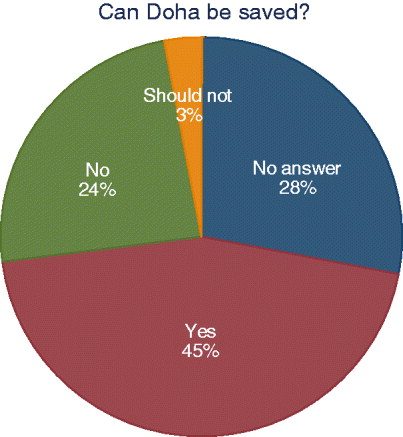
How serious is the situation: Can Doha still be saved?
Only a very small number of participants (3 percent) said that the Doha Round should not be concluded or should not have been launched. In other words, the sample of participants consists essentially of trade observers who, ten years ago, presumably supported the launch of the Doha Round.
This initial wide consensus however, has now fallen apart. Just under half of the trade community still thinks that a successful conclusion of the Doha Round is possible while, a quarter cannot see how it could be concluded within the near future and how negotiations could now be saved.
A quarter of participants does not answer the question. Such a silence has many possible interpretations – from a feeling that one lacks key information to the wish not to add to negotiators' stress. However, all participants who are silent on question 1 opt for solutions in question 3 which imply some sort of failure of the Doha Round. In short, they should be seen as close to the ‘no’ group.
Debates on the internet are very sensitive to the general mood, and to self-reinforcing forces. Looking at the distribution of the various answers over time is thus important. The opinions expressed are relatively stable over time, suggesting that reason is prevailing over emotions.
What are the causes of the current stalemate? Who or what is to blame?
Almost a quarter of the participants did not address the question of who or what is to blame, but their answers to question 3 are more or less equally distributed over the range, which suggests that the group does not have a strongly prevailing view on blame. The remaining participants can be divided into two broad groups.

First, there are those who blame countries' policies, following the traditional trade approach that sees international trade conflicts as reflecting unresolved domestic conflicts. This group is the largest (it includes half of the participants), but it is not homogeneous. A notable number of its participants invoke the ongoing tectonic shifts in the world economy among industrial and developing countries with no specific target to blame (they simply argue that Doha suffers from the opposition between high-income countries having low growth and relatively low barriers to trade and low-income countries having high growth and higher barriers). Another group of similar size points the finger at the ‘big’ players – EU, US, China and India. Last, two smaller groups see the US as the main culprit or give this role jointly to both the US and the EU by a precise reference to agriculture.
Second, there are participants who believe that the whole trade community has not been up to the task during the last decade. They feel that the stance on the gains from trade has been much too narrow and that Doha should rather have focused on reducing policy uncertainty in terms of tariff bindings and securing rules. They perceive policy disciplines as being more critical for welfare and growth than the marginal effects arising from lower applied tariffs. Some within this group argue explicitly that clearer and more honest communications should have taken place between private stakeholders and the trade community.
Last, there is a wide set of ‘other’ causes (each supported by one or two participants): the absence of development issues in trade negotiations; the difficulties arising from the increased number of WTO Members and/or the set of issues dealt within the WTO; the Single Undertaking constraint; increasing food prices; the threat of another global financial crisis; the non-democratic nature of the WTO; and Pascal Lamy's role.
The distribution of opinions by location and professional status is interesting. Half of the forum participants who blame the big players are based in Geneva, but they have very diverse professions (from trade officials to consultants). By contrast, the participants who raise the failure of the whole trade community are mostly academics, domestic policy makers or staff from international institutions, and are widely dispersed geographically.
What are your preferred solutions?
This last question has the smallest percentage of ‘no answer’. But the answers are even more fragmented than those of the previous question – and appear to be independent of time, profession or location.

First of all, the half of participants who still think that a successful conclusion of the Doha Round is possible (see question 1) are split over half a dozen quite different solutions. Only a meagre group is in favour of letting the Doha Round negotiations continue, possibly keeping them on a hold for a period and then concluding them some time in the future. A group of similar size favours a ‘limited’ Doha deal (mainly through binding tariffs, extending commitments to more services, adopting rules in areas important for trade costs, e.g. trade facilitation), arguing that such a solution already brings sizable welfare gains to the world economy. A smaller group focuses on the end-date (2011) because they believe that if no outcome is achieved by then, it will not be achieved within the following decade.
These three solutions (altogether 29 percent) have in common a focus on the WTO negotiating process. Other solutions open the door to three non-WTO processes (even if the WTO could be re-introduced at a later stage): involving the world leaders in the G20 context, putting more pressure on the US Congress, and making a wider use of ‘plurilaterals’ as a way to move forward on some topics.
At the opposite end of the spectrum, a group – as large as the one supporting the continuation of Doha – favours a complete abandonment of the negotiations, mainly because to continue negotiations would harm the WTO. The last group of notable size argues that WTO negotiations should be less ‘biased’ against low-income economies.
Finally, there is a wide range of other solutions, each of them with few supporters: to create a group of wise men, to give more attention to small and medium size firms, to bring food security into the negotiations, to drop the Single Undertaking, and to build on current autonomous (regional or bilateral) liberalisation by promoting plurilaterals.
Concluding remark
These two fora suggest a deeper problem than a mere stalemate of negotiations. They reveal a trade community much more divided than ten years ago, influenced by the conflicting interests in the world trade, and with no leading group capable of influencing the negotiations. This fragmentation may be a long-lasting collateral cost of the Doha Round, whether it succeeds or fails.


