Introduction
Parasites have been recognized as an important component of global biodiversity and can be excellent indicators of biodiversity in an ecosystem (Marcogliese & Cone, Reference Marcogliese and Cone1997). The life cycles of helminth parasites are generally complex and require one or more intermediate and definitive hosts, so that the presence of phylogenetically diverse species and appropriate densities in the community in a given area is a direct indicator of the existence of a variety of invertebrates and vertebrates, which, in turn, could act as an indicator of environmental quality (Poulin & Morand, Reference Poulin and Morand2004; Marcogliese, Reference Marcogliese2005; Hudson et al., Reference Hudson, Dobson and Lafferty2006; King et al., Reference King, McLaughlin, Gendron, Pauli, Giroux, Rondeau, Boily, Juneau and Marcogliese2007). On the other hand, anthropogenic disturbances to watersheds or alterations to the landscape can affect the richness and abundance of parasitic infracommunities, as well as the distribution of helminth parasites (Hamann et al., Reference Hamann, Kehr and González2006a; McKenzie, Reference McKenzie2007; King et al., Reference King, Gendron, McLaughlin, Giroux, Brousseau, Cyr, Ruby, Fournier and Marcogliese2008; Marcogliese et al., Reference Marcogliese, King, Salo, Fournier, Brousseau, Spear, Champoux, McLaughlin and Boily2009).
Some research has related parasite occurrence to the habitat preference of their vertebrate hosts. In this sense, Aho (Reference Aho, Esch, Bush and Aho1990) described the richness pattern of intestinal helminth communities in amphibians and reptiles according to their respective habitat throughout their lifespan, and found that there was a trend for helminth species richness to peak in anurans with semi-aquatic life histories. Similarly, Bush et al. (Reference Bush, Aho and Kennedy1990) examined the richness pattern in communities of intestinal helminth parasites of fish, reptiles, birds and mammals, in relation to the number of species in a host population. They showed that terrestrial hosts have, on average, fewer parasitic species than aquatic hosts. Additionally, Kennedy et al. (Reference Kennedy, Bush and Aho1986) showed in the aquatic habitat that differences between freshwater fish and aquatic birds are related to the complexity of their alimentary canals, diets and host vagility.
Numerous studies have also focused on the search for characteristics in amphibian hosts (e.g. diet, behaviour) that may determine the structure of helminth communities (Goater et al., Reference Goater, Esch and Bush1987; Aho, Reference Aho, Esch, Bush and Aho1990; McAlpine, Reference McAlpine1997; Muzzall et al., Reference Muzzall, Gillillant, Summer and Mehne2001; Bolek & Coggins, Reference Bolek and Coggins2003; Hamann et al., Reference Hamann, González and Kehr2006b; Yoder & Coggins, Reference Yoder and Coggins2007). Furthermore, the presence and abundance of intermediate hosts have also been suggested as key determinants of which kinds of life cycles are possible, and ultimately parasite diversity, in a given host (Esch & Fernandez, Reference Esch and Fernandez1994; Esch et al., Reference Esch, Barger and Fellis2002).
On the other hand, Poulin (Reference Poulin1998b) suggested that finding a parasite in various hosts does not mean that they all constitute equally suitable hosts for the species, but rather that host suitability should be gauged based on the reproductive rates of the parasite in each and the relative abundance of each in the hosts. He also defined the specificity of a parasite as the degree of restriction on the number of host species used at a particular stage of its life cycle (Poulin, Reference Poulin1998b).
Local studies made in recent years have contributed to the knowledge of the organization of helminth communities in different amphibian hosts (e.g. Pseudis limellum, Leptodactylus chaquensis, Leptodactylus latinasus and Scinax nasicus). These studies indicate that the presence or absence of helminth parasites in a host responds to various ecological factors, such as abiotic and biotic characteristics of the habitat (Kehr et al., Reference Kehr, Manly and Hamann2000; Hamann et al., Reference Hamann, Kehr and González2006a, Reference Hamann, González and Kehrb, Reference Hamann, Kehr and González2010). However, comparative analyses of trematode communities in amphibians with different habitat preferences from the same location are non-existent. The present research was undertaken to test the following hypotheses: (1) the parasite composition of a particular host is determined by its feeding characteristics and the habitat frequented; and (2) locally abundant parasite species can successfully infest a wide range of amphibian hosts. These premises are tested by analysing the specific composition of larval and adult trematodes present in the following host amphibians: Pseudopaludicola boliviana, Physalaemus santafecinus, Rhinella fernandezae, Leptodactylus bufonius, Leptodactylus latrans and Odontophrynus americanus. This study also considers previously published information from the same geographical area about L. chaquensis, L. latinasus and S. nasicus (Hamann et al., Reference Hamann, Kehr and González2006a, Reference Hamann, González and Kehrb, Reference Hamann, Kehr, González, Dure and Schaefer2009).
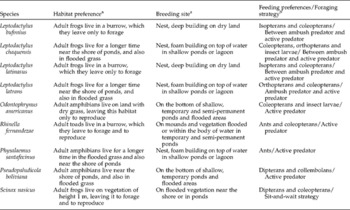
Amphibian hosts have different feeding characteristics (e.g. strategies and preferred food items). The diet of S. nasicus is dominated by insects, and it employs a sit-and-wait foraging strategy; L. chaquensis, L. latrans, L. latinasus and L. bufonius are generalist predators, using an intermediate strategy between active foraging and sit and wait predation; R. fernandezae has a diet intermediate between that of a generalist and a specialist, and is an actively foraging predator; P. santafecinus has a specialist diet, with active foraging; O. americanus and P. boliviana are generalist predators (Duré, Reference Duré2004; Duré et al., Reference Duré, Schaefer, Hamann and Kehr2004; Schaefer et al., Reference Schaefer, Hamann, Kehr, González and Duré2006).
The main objectives of this study were: (1) to determine mean species richness and diversity of trematode parasite communities; (2) to evaluate the distribution of parasites in nine amphibian species; and (3) to examine whether the feeding and habitat-use strategies of amphibians are important determinants of trematode species richness.
Materials and methods
Study area
The study area was located ~15 km east of the city of Corrientes (27°30′S, 58°45′W). Although limited to 30 ha, the area was characterized by its variety of habitats, containing numerous temporary, semi-permanent and permanent ponds. A permanent pond sampled in this study (30 m long,15 m wide and 0.8 m deep) presented vegetation consisting of: Eichhornia azurea, Nymphaea sp., Hydrocleis nymphoides, Salvinia sp. and Ludwigia peploides; the pond was surrounded by grasslands (Andropogon lateralis). Plant species in the forest sampled in this study consisted of quebracho (Schinopsis balansae), urunday (Astronium balansae) and ñandubay (Prosopis affinis), with a herbaceous stratum comprising patches of gramineous plants (Elyonurus muticus) and terrestrial bromeliads (Aechmea distichantha, Bromelia serra). Mean annual temperature for the area is 23°C and the mean annual precipitation is 1500 mm, without a well-defined dry season, albeit with periods of rain shortage occurring every 4–6 years (Carnevali, Reference Carnevali1994).
Collection and examination of amphibians
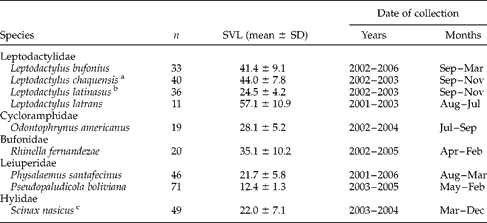
Adult amphibians (n= 325 specimens), comprising representatives of five families (Leptodactylidae: L. latinasus, L. chaquensis, L. latrans and L. bufonius; Leiuperidae: P. santafecinus and P. boliviana; Hylidae: S. nasicus; Bufonidae: R. fernandezae and Cycloramphidae: O. americanus), were collected between April 2001 and December 2006 (table 1). Specimens were hand-captured between 18.00 hours and 21.00 hours, using the sampling technique defined as ‘visual encounters survey’ (Crump & Scott, Reference Crump, Scott, Heyer, Donnelly, McDiarmid, Hayek and Foster1994). Frogs were transported live to the laboratory, killed in a chloroform (CHCl3) solution, and then dissected following standard protocols (Goater & Goater, Reference Goater and Goater2001). The snout–vent length (SVL) and body weight of each specimen were recorded. During necropsy hosts were sexed and their oesophagus, stomach, gut, lungs, liver, urinary bladder, kidneys, body cavity, musculature, skin and brain examined for parasites. Trematode parasites were observed in vivo, counted and subsequently killed in hot distilled water and preserved in 70% ethyl alcohol. Digeneans were stained with hydrochloric carmine, cleared in creosote and mounted in Canada balsam, and identified taxonomically using Yamaguti (Reference Yamaguti1971, Reference Yamaguti1975), Gibson et al. (Reference Gibson, Jones and Bray2002), and Jones et al. (Reference Jones, Bray and Gibson2005). Parasite specimens were deposited in the Helminthological Collection of Centro de Ecología Aplicada del Litoral (CECOAL), Corrientes, Corrientes Province, Argentina [accession numbers CECOAL, 04012008, 03051608, 04062502, 06030604, 05022410, 03061301, 03032704, 03092404, Travtrema aff. stenocotyle Cohn, 1902; 04092904, 06022413, 02082201, 06030604, 05062918, 03061302, 03012904, 03022001, Opisthogonimus sp.; 04012003, 03070401, 06030607, 04090601, 04062503, 03051605, 05022430, Styphlodora sp.; 03120202, 06022411, 03070401, 04062502, 05022401, 06030615, 03061301, 03012904, 0309240, Bursotrema tetracotyloides Szidat, 1960; 04121324, 03052702, Unknown strigeid species #1; 04121318, Nephrostomum sp.; 04012014, Unknown echinostomatid sp.; 04121324, Lophosicyadiplostomum aff. nephrocystis (Lutz, 1928); 03091002, Petasiger sp.; 03042807, Heterodiplostomum sp.; 03092406, 03012904, 03061304, 02103022, 03051608, 01082294, Glypthelmins repandum (Rudolphi, 1819); 01102346, 02042629, 03111804, Glypthelmins palmipedis (Lutz, 1928); 04121330, 06022414, 03070401, 05022407, 02103022, 03070405, 02091101, 03092404, Catadiscus inopinatus Freitas, 1841; 03070401, 02042629, 03070415, 03111804, 03042402, Haematoloechus longiplexus Stafford, 1902; 03032704, Gorgoderina rochalimai Pereira & Cuocolo, 1940; 03070401, 03070402, Gorgoderina parvicava Travassos, 1922; 03070422, Gorgoderina cryptorchis Travassos, 1924; 04092904, Glypthelmins sp.
Sample size (n), mean ±1 SD snout–vent length (SVL; mm), and date of collection for nine amphibian species from Corrientes Province, Argentina.
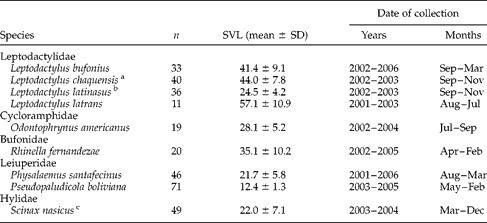
Data from aHamann et al. (Reference Hamann, Kehr and González2006a); b Hamann et al. (Reference Hamann, González and Kehr2006b); cHamann et al. (Reference Hamann, Kehr, González, Dure and Schaefer2009).
Statistical analysis
Helminth communities were classified at two levels: infracommunity level (i.e. all trematode infrapopulations within a single host), and component community level (i.e. all trematode infracommunities within a population of a host species) (Esch & Fernandez, Reference Esch and Fernandez1993). Prevalence, intensity and abundance of infection were calculated for trematode parasites following Bush et al. (Reference Bush, Lafferty, Lotz and Shostak1997). The measures of community richness and diversity employed included: the total number of helminth species ( = species richness), Shannon index (H′), and evenness (J′) as H′/H′ maximum (Zar, Reference Zar2010). The Brillouin index (BH) and evenness (E) were used to compare trematode infracommunities among amphibian species. The diversity indices were used with decimal logarithms (log10). Mean trematode species richness is the sum of trematode species per individual frog, divided by the total sample size. The Kruskal–Wallis test was used to compare diversity and richness of trematodes between hosts, and among hosts' habitat preferences. The probabilities were calculated according to the Bonferroni procedure, because it provides great control over Type I error. Since the sample sizes were different we used rarefaction methods for comparing the mean diversity and the mean richness. Rarefaction uses probability theory to derive expressions for the expectation and variance of species diversity and richness for a sample of a given size. This method ‘rarefies’ its samples down to a common abundance level and then compares species diversity and richness. The process was repeated 1000 times to generate a mean and a variance of species diversity and richness. For this calculation, the software used was EcoSim 7.7 (Gotelli & Entsminger, Reference Gotelli and Entsminger2004). In this analysis the diversity indices used natural logarithms (ln).
The most dominant species were determined using the Berger–Parker index of dominance (d; Magurran, Reference Magurran2004). The trematode species data were classified into common and rare categories. Those parasites that had been recorded as infecting more than one family of amphibians were considered as common; while those that had been recorded only from species within a single family of amphibians were considered as rare. To examine the distribution of trematode species through the host specificity, a regression analysis between prevalence and mean abundance (as a measure of parasite abundance) was applied across all hosts in which it occurred (as a measure of host specificity). This analysis was performed for parasite species for which at least three hosts were recorded. Regressions between these parasitological descriptors were performed using EcoSim 7 software. This process was repeated 1000 times to generate a standard linear regression for the data, and then randomization was used to test the null hypothesis that the slope, intercept or correlation coefficient equals 0.0 through a low sample number. To determine the qualitative similarity between component communities Jaccard's coefficient similarity index was used and a Cluster Analysis was then performed using the UPGMA (Unweighted Pair Group Method Average) method. Analyses were performed using the software packages Xlstat 7.5 (Addinsoft, 2004) and Bio Dap (Tomas & Clay, 2008).
To study the richness of trematode species associated with the hosts' habitat preferences, amphibian hosts were classified as fossorial, terrestrial, semi-aquatic and arboreal, according to their use of these habitats, following the classification proposed by Aho (Reference Aho, Esch, Bush and Aho1990). This characteristic was then linked to the variations in trematode communities present in each amphibian group, also taking into account that all amphibians return to water bodies for reproduction at some time during the year, with the time of permanence in the aquatic environment depending on the species' reproductive mode and pattern of reproductive activity. Accordingly, amphibians were grouped as: those frogs that live and breed in burrows, considered as typical fossorial species (L. latinasus and L. bufonius); those amphibians that live in burrows but come back to the water for reproduction, considered as terrestrial (R. fernandezae and O. americanus); those frogs that live strongly associated with the aquatic environment, considered semi-aquatic (P. boliviana, P. santafecinus, L. latrans and L. chaquensis); and those frogs that live on small trees and shrubs, considered as arboreal species (S. nasicus) (table 2).
Summary of ecology and biology of nine amphibians from Corrientes, Province of Argentina; the breeding season occurs in the spring, summer and autumn in all species except for Scinax nasicus, where breeding occurs in all seasons.

aData from Schaefer et al. (Reference Schaefer, Hamann, Kehr, González and Duré2006), Schaefer (Reference Schaefer2007) or our observations. bData from Duré (Reference Duré2004), Duré et al. (Reference Duré, Schaefer, Hamann and Kehr2004), Schaefer et al. (Reference Schaefer, Hamann, Kehr, González and Duré2006).
Results
Trematode fauna
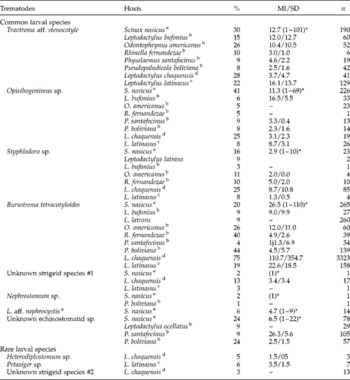
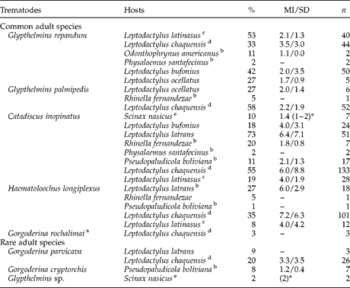
Nineteen trematode species were found in representatives from five anuran families. The predominant groups of parasites were the metacercariae (Opisthogonimus sp., Styphlodora sp., Travtrema aff. stenocotyle, an unknown echinostomatid sp., Nephrostomum sp., Petasiger sp., Bursotrema tetracotyloides, Lophosicyadiplostomum aff. nephrocystis, unknown strigeid sp. #1, unknown strigeid sp. #2 and Heterodiplostomum sp.) (table 3) compared to the adult digeneans (Glypthelmins repandum, Glypthelmins palmipedis, Glypthelmins sp., Catadiscus inopinatus, Haematoloechus longiplexus, Gorgoderina parvicava, Gorgoderina cryptorchis and Gorgoderina rochalimai) (table 4). Of all individuals (n= 6300) found in the amphibian hosts, 90% of them corresponded to metacercariae.
Survey of common and rare larval trematodes found in amphibians from Corrientes Province, Argentina. Prevalence (%), mean intensity (MI)/standard deviation (SD), and total number (n) of parasites.

aInfects other hosts, see Hamann & Kehr (Reference Hamann and Kehr1998, Reference Hamann and Kehr1999). bNew host record. cData from Hamann et al. (Reference Hamann, González and Kehr2006b). dData from Hamann et al. (Reference Hamann, Kehr and González2006a). eData from Hamann et al. (Reference Hamann, Kehr, González, Dure and Schaefer2009). *Range of intensity.
Survey of common and rare adult trematodes found in amphibians from Corrientes Province, Argentina. Prevalence (%), mean intensity (MI)/standard deviation (SD) and total number (n) of parasites.

aInfects other hosts, see Hamann et al. (Reference Hamann, Kehr and González2010). bNew host record. cData from Hamann et al. (Reference Hamann, González and Kehr2006b). dData from Hamann et al. (Reference Hamann, Kehr and González2006a). eData from Hamann et al. (Reference Hamann, Kehr, González, Dure and Schaefer2009). *Range of intensity.
The trematode fauna were dominated by common species, with only five rare species (Petasiger sp., unknown strigeid sp. #2, Heterodiplostomum sp., G. parvicava, G. cryptorchis) found in Leptodactilidae (L. chaquensis, L. latinasus, L. latrans) and Leiuperidae (P. boliviana) frogs. Additionally, G. rochalimai and L. aff. nephrocystis may be considered as common species, as they have been found in other amphibians; namely L. aff. nephrocystis in P. limellum, from another area (table 3), and G. rochalimai in S. nasicus from the same study area, but during a different period (table 4).
Comparison of infection between the nine hosts
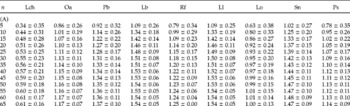
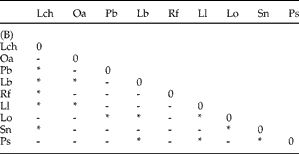
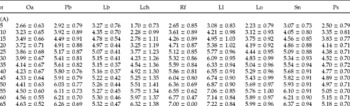
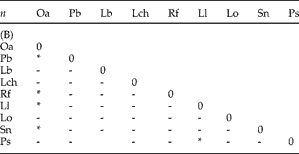
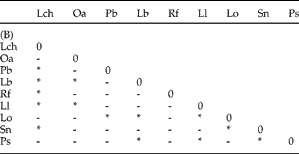
Using a rarefaction method, the number of individuals was combined and the values of mean diversity (table 5A) and mean richness (table 6A) for each of the hosts were obtained. Mean species diversity of the trematodes between the nine hosts were different (Kruskal–Wallis K-test = 94.16; P= 0.0001; df = 8; n= 13). Mean species richness of the trematodes between the nine hosts were also different (Kruskal–Wallis K-test = 32.72; P= 0.0001; df = 8; n= 13). A comparison of diversity (table 5B) and richness (table 6B) between nine amphibians showed significant differences (P= 0.0014) for some of them.
Summary of main results of the rarefaction method; (A) the number of individuals (n) was unified to obtain values of mean diversity; (B) probabilities of Bonferroni procedure were posteriorly analysed for nine amphibian species.

*P= 0.0014. Lch, Leptodactylus chaquensis; Lo, Leptodactylus latrans; Ps, Physalaemus santafecinus; Pb, Pseudopaludicola boliviana; Ll, Leptodactylus latinasus; Lb, Leptodactylus bufonius; Oa, Odontophrynus americanus; Rf, Rhinella fernandezae; Sn, Scinax nasicus.
Summary of main results of the rarefaction method; (A) the number of individuals (n) was unified to obtain values of mean richness; (B) probabilities of Bonferroni procedure were posteriorly analysed for nine amphibian species.
*P= 0.0014. Lch, Leptodactylus chaquensis; Lo, Leptodactylus latrans; Ps, Physalaemus santafecinus; Pb, Pseudopaludicola boliviana; Ll, Leptodactylus latinasus; Lb, Leptodactylus bufonius; Oa, Odontophrynus americanus; Rf, Rhinella fernandezae; Sn, Scinax nasicus.
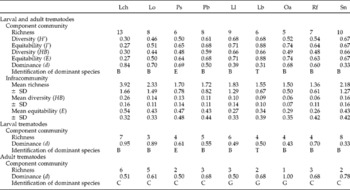
The diversity of the trematodes tended to be greatest in L. latinasus followed by L. bufonius, while L. chaquensis presented the lowest value (table 7). The host exhibiting the highest trematode richness (n= 13) was L. chaquensis. The dominant species corresponded to B. tetracotyloides for most of the hosts (78%) followed by the unknown echinostomatid sp. and Travtrema aff. stenocotyle. On the other hand, when only adult trematodes were analysed, the dominant species in most hosts (67%) was C. inopinatus followed by G. repandum.
Ecological indices of trematode communities in nine amphibians from Corrientes Province, Argentina.

Lch, Leptodactylus chaquensis; Lo, Leptodactylus latrans; Ps, Physalaemus santafecinus; Pb, Pseudopaludicola boliviana; Ll, Leptodactylus latinasus; Lb, Leptodactylus bufonius; Oa, Odontophrynus americanus; Rf, Rhinella fernandezae; Sn, Scinax nasicus. E, unknown echinostomatid sp.; B, Bursotrema tetracotyloides; T, Travtrema aff. stenocotyle; C, Catadiscus inopinatus; G, Glypthelmins repandum. Diversity data obtained with log10.
Considering trematode infracommunities, the mean Brillouin's index and mean richness generally showed low values but tended to be comparatively greater in L. chaquensis (mean diversity = 0.26 ± 0.16 and mean richness = 3.92 ± 1.66).
Trematode distribution across specific hosts
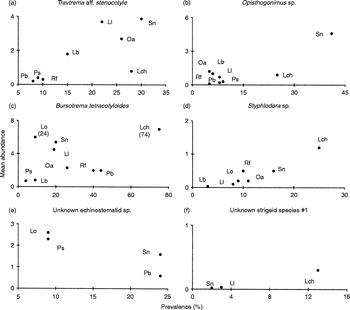
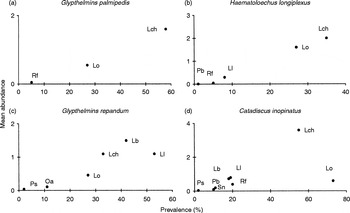
Regressions between mean abundance and prevalence of metacercariae (as a measure of parasite abundance) among host species used by a parasite (as a measure of host specificity) revealed significant positive relationships for Travtrema aff. stenocotyle (r= 0.73, P< 0.05, fig. 1a), Opisthogonimus sp. (r= 0.86, P< 0.05, fig. 1b) and Styphlodora sp. (r= 0.94, P< 0.05, fig. 1d), but this relationships was non-significant for B. tetracotyloides (r= 0.70, P>0.05, fig. 1c) and unknown strigeid sp. #1 (r= 0.99, P>0.05, fig. 1f). The unknown echinostomatid sp. showed a non-significant negative correlation (r= − 0.88, P>0.05, fig. 1e). Regressions between both descriptors of adult trematodes were all positively correlated but not always statistically significant (G. palmipedis: r= 0.04, P>0.05, fig. 2a; H. longiplexus: r= 0.99, P< 0.05, fig. 2b; G. repandum: r= 0.89, P< 0.05, fig. 2c; C. inopinatus: r= 0.56, P>0.05, fig. 2d).
Relationship between prevalence and mean abundance of common metacercariae, among host species. Pb, Pseudopaludicola boliviana; Ps, Physalaemus santafecinus; Sn, Scinax nasicus; Ll, Leptodactylus latinasus; Lch, Leptodactylus chaquensis; Rf, Rhinella fernandezae; Lb, Leptodactylus bufonius; Oa, Odontophrynus americanus; Lo, Leptodactylus latrans.

Relationship between prevalence and mean abundance of adult common trematodes, among host species. Pb, Pseudopaludicola boliviana; Ps, Physalaemus santafecinus; Sn, Scinax nasicus; Ll, Leptodactylus latinasus; Lch, Leptodactylus chaquensis; Rf, Rhinella fernandezae; Lb, Leptodactylus bufonius; Oa, Odontophrynus americanus; Lo, Leptodactylus latrans.

Similarity analyses among host species
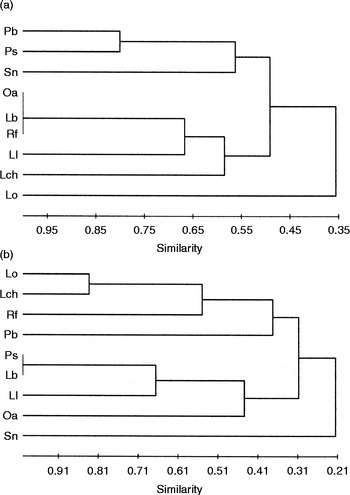
A cluster analysis based on the Jaccard's coefficient grouped the R. fernandezae, O. americanus and L. bufonius with highest similarity (1.00) followed by P. boliviana and P. santafecinus (0.80) in terms of metacercarie species composition (fig. 3a), while L. bufonius and P. santafecinus showed greater similarity (1.00) followed by L. latrans and L. chaquensis (0.83) in terms of species composition of adult digeneans (fig. 3b).
Similarity among nine species of amphibians with respect to their component communities of larval (a) and adult (b) trematodes. Pb, Pseudopaludicola boliviana; Ps, Physalaemus santafecinus; Sn, Scinax nasicus; Ll, Leptodactylus latinasus; Lch, Leptodactylus chaquensis; Rf, Rhinella fernandezae; Lb, Leptodactylus bufonius; Oa, Odontophrynus americanus; Lo, Leptodactylus latrans.

Richness of trematode community and host's habitats
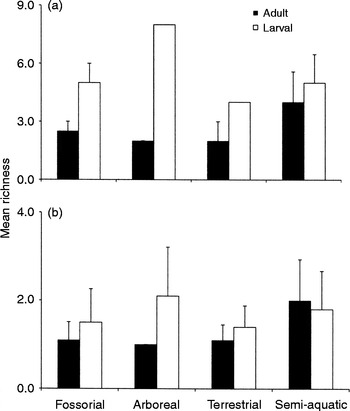
Using a rarefaction method, the number of individuals was combined and the values of mean richness of trematodes for each of the localities were obtained (table 8A, C, E). Mean species richness of the trematodes between the four environments were different (adult: Kruskal–Wallis K-test = 9.83, P= 0.02, df = 3; larval: K= 21.28, P= 0.001, df = 3; larval+adult: K= 8.34, P= 0.03, df = 3). Adult trematode communities showed a greater value in semi-aquatic amphibians than in terrestrial, arboreal and fossorial amphibians (fig. 4a), nevertheless, a significant difference (P= 0.0083) was only observed between semi-aquatic and arboreal amphibians (table 8B). The larval trematode trend was different, with a higher species richness in arboreal amphibians (fig. 4a), where there was a significant difference (P= 0.0083) between this group and terrestrial and fossorial hosts (table 8D). Larval and adult trematodes showed no significant differences between host and habitat preferences (table 8F).
Summary of main results of the rarefaction method; the number of individuals (n) was unified and values of mean richness ±1 SD were obtained for adult (A), larval (C) and larval+adult (E) trematodes; probabilities according to Bonferroni procedure were posteriorly analysed for adult (B), larval (D) and larval + adult (F).
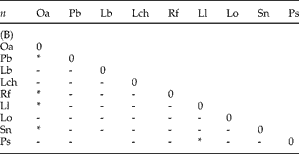
*P= 0.0083.
Comparison of host habitat preferences with the mean richness ( ± 1 SD) of adult and larval trematodes at component community (a) and infracommunity (b) levels.

Trematode infracommunities between the four habitats were different (adult: Kruskal–Wallis K-test = 35.12, df 3, P< 0.001; larval: K= 8.49, df 3, P <0.05; larval+adult: K= 20.55, df 3, P< 0.001). The results revealed similar trends to those reported at component community levels (fig. 4b).
Discussion
Trematode parasites of amphibians from the area studied comprised an assemblage of 19 species. Considering the component community, species richness varied between 5 and 13 species of trematodes, whereas the infracommunity richness was no more than 4 species of trematodes per infected host. Larval trematodes had the highest species richness; among them, the metacercaria of B. tetracotyloides was dominant in the parasite component community of the amphibians studied. The high occurrence of these larvae would suggest that these amphibians are the principal intermediate hosts in the trematode's life cycle. The life cycles of the other metacercariae found in this study are also complex and require generally more than one intermediate host (table 9), so the presence of these larval stages is a direct indicator of the existence of several different definitive hosts (Hamann et al., Reference Hamann, Kehr and González2010).
Summary of trematode life cycles in amphibians from Corrientes Province, Argentina; the first intermediate hosts for the majority of the trematodes are aquatic snails, apart for aquatic clams in the case of the three species of Gorgoderina.

aPossible definitive hosts. * References: life cycles of congener species or species of the same family.
On the other hand, C. inopinatus was the dominant adult trematode species in the component communities. This parasite employs a different strategy of infection, in which cercariae encyst on the skin of frogs and tadpoles, or on aquatic plants (Smyth & Smyth, Reference Smyth and Smyth1980). Plants are always available as vectors of infection and the cercariae emerge at any hour of the day or night (i.e. arrhythmic emergences; Bouix-Busson et al., Reference Bouix-Busson, Rondelaud and Combes1985), possibly explaining its dominance.
At the infracommunities level, amphibian species had low values for diversity and species richness of trematodes. The depauperate nature of these communities was also shown by other studies in temperate (Goater et al., Reference Goater, Esch and Bush1987; Aho, Reference Aho, Esch, Bush and Aho1990; Muzzall, Reference Muzzall1991; Bolek & Coggins, Reference Bolek and Coggins2003; Yoder & Coggins, Reference Yoder and Coggins2007) and tropical (Luque et al., Reference Luque, Martins and Tavares2005; Hamann et al., Reference Hamann, Kehr and González2006a, Reference Hamann, González and Kehrb, Reference Hamann, Kehr and González2010; Ibrahim, Reference Ibrahim2008) regions. All of these studies suggest that trematode communities are responsive to host and parasite life histories at particular sites.
Factors related to host susceptibility may explain the distribution of parasites (Bush & Holmes, Reference Bush and Holmes1986; Holmes & Price, Reference Holmes, Price, Anderson and Kikkawa1986; Stock & Holmes, Reference Stock and Holmes1987; Poulin, Reference Poulin1998a, Reference Poulin1999). By focusing on this relationship and applying it to our dataset, it becomes evident that those species with relatively high prevalences and mean abundances, e.g. G. repandum, are characterized by some degree of host specificity. Other species, such as B. tetracotyloides and C. inopinatus, which do not reach high abundances in their various hosts, are common species. Among the species with low prevalence and mean abundance, there were some that infected few hosts (e.g. unknown echinostomatid sp.) and others that were characterized by a wide range of hosts (e.g. Styphlodora sp.). These results provide evidence of their proximity to the pattern observed in bird parasites, in which parasites are supported by increased resource amplitude, where species with high prevalence and abundance have a wide range of local hosts and establish a positive relationship with them (Poulin, Reference Poulin1998b, Reference Poulin1999). In this sense, generalist parasites exploiting hosts belonging to different amphibian families or orders would require adaptations to counteract a wider range of immune responses, and this would hinder their high abundance in any or all of their hosts. In contrast, specialist parasites that exploit congeneric species in which immune responses are likely to be similar, might have a competitive advantage and reach high abundances in their various hosts (Poulin, Reference Poulin1998b).
Regarding the species composition of larval trematodes, the patterns of similarity among the studied amphibian species showed two groups: the first group consisted of species that occupy terrestrial and fossorial habitats, and the second was a group represented by amphibians that share a semi-aquatic habitat. These results indicate that the composition of larval parasites in both groups is a consequence of the length of time that these hosts remain exposed to the larval infections in an aquatic habitat. Additionally, these infections can occur during the breeding season or in the tadpole stage (Hamann & González, Reference Hamann and González2009; Hamann et al., Reference Hamann, Kehr and González2010). Adult trematodes also showed two similar groups; the first set was represented by amphibians that use fossorial and semi-aquatic habitats, e.g. P. santafecinus which is associated for a longer time with flooded grass (table 2); all of these host species were infected by a small number of adult species of trematodes, which are characterized by having encysted larval stages in different substrates (C. inopinatus) or infective cercariae to penetrate the host (Glypthelmins spp.). However, the second group was represented by amphibians that exploit semi-aquatic habitats, and these host species presented the highest values of trematode species richness. Of these, the genera Haematoloechus and Gorgoderina use the larvae of insects (e.g. dragonfly) as second intermediate hosts in their life cycle (Smyth & Smyth, Reference Smyth and Smyth1980); consequently, infection by these genera was directly related to the hosts' feeding behaviour and diet.
In relation to the importance of the habitat-use made by hosts (Aho, Reference Aho, Esch, Bush and Aho1990), the richest and most diverse adult trematode community was found in semi-aquatic amphibians, which may indicate that these hosts are exposed to a greater diversity of parasites because they are exposed to their prey, and, hence, to trematode infective stages in both the aquatic and terrestrial environments. These results are consistent with previous findings by other studies of helminth communities in temperate amphibians; where hosts that exhibit a gradient in preference for aquatic habitats show parasitism dominated by adult digeneans (Muzzall, Reference Muzzall1991; McAlpine, Reference McAlpine1997). Similar conclusions were reported by Bolek & Coggins (Reference Bolek and Coggins2003) and Yoder & Coggings (Reference Yoder and Coggins2007) who demonstrated that infection by trematodes in semi-aquatic frogs is more abundant than in terrestrial frogs. All of these studies associated these results with a set of variables that are linked to aquatic and terrestrial productivity, e.g. a wider variety of aerial, terrestrial and aquatic invertebrates contributing to a more diverse trematode fauna. Also, other factors determine the biological interactions that occur, such as frog vagility and transmission dynamics of trematodes.
Similarly, studies of larval trematode communities show the same general pattern, with terrestrial hosts being infected with fewer species. This may be related to a short period in water for reproductive activities, i.e. implies a lower probability of penetration by larval trematodes, and so this factor can favour lower values of parasitism. Nevertheless, arboreal amphibians show high larval infections, resulting from acquisition of parasites when the frogs visit the water at different seasons of the year, coinciding with prolonged breeding (see Hamann et al., Reference Hamann, Kehr, González, Dure and Schaefer2009). Additionally, infections by metacercariae in all the amphibian species studied can occur throughout ontogenetic development (tadpole, juvenile and adult), and suggests that these stages are suitable secondary intermediate hosts for most of these metacercariae. In fact, this may represent an alternative strategy of the parasites, to ensure transmission, since amphibians occupy an intermediate position in the food web, constituting easy prey for potential definitive hosts, such as snakes, birds and mammals (e.g. the case of Styphlodora sp., Opisthogonimus sp. and Travtrema aff. stenocotyle, which infect reptiles as the final host). It may be expected that the metacercariae that infect short-lived hosts (e.g. tadpoles) are obliged to maintain an ability to infect a broad spectrum of hosts to ensure their transmission. These results would suggest that the composition of larval parasites in these host groups is a consequence of local physical and biological characteristics of the habitat (Esch et al., Reference Esch, Shostak, Marcogliese, Esch, Bush and Aho1990; Marcogliese, Reference Marcogliese2001).
Aho (Reference Aho, Esch, Bush and Aho1990) states that amphibian hosts with an ambush feeding strategy tend to have fewer parasites, whereas hosts that forage actively show richest and most diverse helminth communities. Therefore, ecological differences in feeding strategies could easily contribute to differences in the complexity of the helminth community within each and between amphibian families. The patterns arising when comparing different amphibian feeding strategies showed that the probability of encounter between parasite and host was higher for those amphibians that actively seek prey and have higher vagility (e.g. L. chaquensis) than for those that use a sit-and-wait strategy (e.g. S. nasicus). Furthermore, the lowest number of encounters between parasites and hosts take place in amphibians with a specialist diet (e.g. P. santafecinus).
The hypothesis that semi-aquatic amphibians harbour a greater richness of adult trematode parasites was supported by this study. In this sense, the habitat characteristics and the feeding strategies of amphibian hosts were important factors for the determination of larval and adult trematode parasite communities. Larval trematode parasites have a wide range of hosts, which allows them to adopt alternative environments in the event that the preferred host is not abundant or inaccessible by ecological circumstances. Also, the lack of specificity for prey (intermediate host) allows those parasites which have complex life cycles to increase the chance of encountering the predator (definitive host of the parasite). Finally, dispersion depends on the mobility of the definitive host, which assists in the spatial dispersion of the propagative parasite forms (e.g. metacercariae, eggs).
Acknowledgements
We are grateful to Dr David J. Marcogliese for his valuable suggestions and critical comments on an earlier version of the manuscript. Financial support was provided partially by Consejo Nacional de Investigaciones Científicas y Técnicas (CONICET) of Argentina, through grant PIP 2945 to M.I.H.