Adequate caloric nutrient intake is essential for normal growth and development throughout infancy and childhood. Growth failure occurs when the rate of growth is below expectations based on age- and gender-specific growth charts in a healthy population.Reference Argyle1 Many children who experience growth failure as infants have adequate catch-up growth by the time they reach school years.Reference Rudolf and Logan2 However, malnutrition early in life is known to be associated with later deficits in neurobehavioural development, cognition, motor performance, and behaviour.Reference Grantham-McGregor, Walker and Chang3 Several studies have shown later growth and cognitive deficiencies in children with growth failure early in life, including increased incidence of short stature and poor arithmetic performance,Reference Black, Dubowitz, Krishnakumar and Starr4 of attention problems and aggressive behaviour,Reference Dykman, Casey, Ackerman and McPherson5 and of poor overall emotional, social, and cognitive development.Reference Argyle1
Congenital cardiac disease is the most common human congenital defect.Reference Hoffman and Kaplan6 Infants with congenital cardiac disease are known to be at risk for growth failure.Reference Forchielli, McColl, Walker and Lo7 The aetiologies that are proposed for this phenomenon include inadequate caloric intake, increased energy expenditure, intestinal malabsorption, and genetic factors.Reference Menon and Poskitt8–Reference Lees, Bristow, Griswold and Olmsted11 Despite some infants showing catch-up growth following surgical congenital cardiac disease repair,Reference Vaidyanathan, Roth, Gauvreau, Shivaprakasha, Rao and Kumar12 early growth failure may affect long-term development in those with and without catch-up growth. Improvements in surgical technique and post-operative care have led to better survival rates and increased morbidity related to their congenital cardiac disease, including poor nutritional status and growth failure.Reference Mahle, Spray, Wernovsky, Gaynor and Clark13 A healthy newborn is expected to lose between 4% and 7% of birth weight before beginning to regain weight by day 3 of lifeReference Wright and Parkinson14 and going on to gain between 20 and 30 grams per day in the first 6 months. Infants with congenital cardiac disease often undergo corrective cardiac surgery during this period of rapid growth.
To date, the available literature on the pattern of post-operative weight change in infants with congenital cardiac disease was based on retrospective chart reviews.Reference Cribbs, Heiss, Clabby and Wulkan15–Reference Schwalbe-Terilli, Hartman and Nagle18 The purpose of this study was to describe the pattern of weight change in infants with congenital cardiac disease with two-ventricle physiology following surgical repair and to identify predictors of growth in this population. In addition, we sought to look at the association between growth in this group of infants and their post-operative length of stay.
Materials and methods
Study design
This is a nested retrospective cohort study that was carried out following the completion of a larger prospective cohort study of infants admitted to the Cardiac Intensive Care Unit at The Children's Hospital of Philadelphia (Philadelphia, Pennsylvania, United States of America) following surgical repair of congenital cardiac disease between March, 2003 and May, 2007. This study was approved by the Institutional Review Board of The Children's Hospital of Philadelphia.
Study population
Eligible infants included those greater than or equal to 36 weeks postmenstrual age who had surgical repair of congenital cardiac disease during the first 6 weeks of life, had two-ventricle post-operative physiology, and were discharged home following surgery. Infants with congenital facial and/or gastrointestinal anomalies, trisomy chromosomal abnormality, congenital or acquired neurological insult and/or birth weight less than 2500 grams were excluded as these factors are known to be associated with disruption in growth. Families who were unable or unwilling to return to The Children's Hospital of Philadelphia for study visits were not enrolled. Infants were categorised as two-ventricle physiology through review of post-operative echocardiography by one investigator (BSM).
Operative information and hospital course
Medical records were reviewed for intra- and post-operative courses for each infant, including cardiopulmonary bypass time, aortic cross-clamp time, and duration of deep hypothermic circulatory arrest. Aristotle Basic Complexity Score and Risk Adjustment for Congenital Heart SurgeryReference Lacour-Gayet and Clarke19, Reference Jenkins20 scores were determined to estimate surgical complexity and risk of morbidity, respectively. Records were reviewed daily for post-operative course, including the duration of mechanical ventilation, frequency of reintubation, and diagnosis of infection, defined as a positive gram stain (respiratory, urine, blood, or wound sites) with the presence of white blood cells and/or a positive culture and the patient's clinical presentation. Records were reviewed for the timing and method of nutritional support (total parenteral nutrition or enteral nutrition) provided in the pre- and post-operative periods. The initial type and route of nutrition received in the post-operative period was recorded, as was the type of nutrition being given at the time of hospital discharge. The timing of initial nutrition in the post-operative period was defined as the post-operative date when any nutritional intake was begun, including enteral or parenteral nutrition. Information on caloric density of nutritional support and volume of feeds or intravenous fluids was not available. The hospital length of stay was computed from the day of admission to the day of discharge from The Children's Hospital of Philadelphia.
Post-operative echocardiographic data
Discharge echocardiograms were evaluated by one investigator (BSM) for the presence of significant systolic ventricular dysfunction, defined as moderate or greater systolic dysfunction in either the right or left ventricle or a shortening fraction less than 28% in the left ventricle; moderate or greater systemic atrio-ventricular valve regurgitation; moderate or greater neoaortic/aortic or pulmonary insufficiency, aortic arch obstruction – greater than 20 millimetres of mercury; left or right ventricular outflow track obstruction – greater than 20 millimetres of mercury; obstruction of pulmonary venous return – greater than 3 millimetres of mercury; presence of a restrictive atrial communication – greater than 3 millimetres of mercury; presence of a residual non-restrictive ventricular septal defect; and to confirm physiological group categorisation.
Anthropometric measurements
Given the variability of daily weight gain secondary to normal changes following birth as well as fluid shifts that typically following cardiac surgery, we chose to examine changes in weight-for-age z scores. This measure also allowed for indexing weight regardless of age at surgery or discharge. Weight-for-age z scores were calculated for birth weight, weight at surgery, and discharge weight using reference standards developed by the World Health Organization.21 Birth weight was reported by the family or was obtained from the medical record. Surgical weight was obtained within 24 hours before surgery by the Cardiac Intensive Care Unit nursing staff following an established protocol, using an infant scale (Scaletronix, Model no. 4802, Carol Stream, Illinois, United States of America) accurate to 1 gram plus or minus 0.02 grams. Owing to the fact that not every infant had a weight performed on the day of discharge, hospital discharge weight was defined as the average of three weights obtained during the 7 days immediately preceding discharge using the same scale and protocol. Weight change was defined as: weight-for-age z score at hospital discharge minus weight-for-age z score at surgery, and was calculated for each infant. Length and head circumference measurement were not recorded during the hospital admission.
Statistical analysis
The primary outcome variable was the change in weight-for-age z score from surgical intervention to hospital discharge. The secondary outcome variable was hospital length of stay. The Wilcoxon signed-rank test was utilised for two-way paired comparisons between weight-for-age z score at birth, at surgery, and at discharge. The primary predictor variables were complexity of cardiac disease/surgical repair (Risk Adjustment for Congenital Heart Surgery and Basic Aristotle scores), presence of significant post-operative residual cardiac defects (see section ‘Post-operative echocardiographic data’), and timing of initiation of nutritional intake in both the pre- and post-operative periods. Statistical analyses were performed using SAS 10.0 software (SAS Institute Inc., Cary, North Carolina, United States of America).
All continuous variables were described and tested for central tendency to determine the normality of the data distribution. Normally distributed continuous variables are expressed as mean and standard deviation. Non-normally distributed data are expressed using the median value and range. Potential dichotomous predictor variables that did not occur in more than 10% of our study population were not statistically evaluated. Bivariate analyses of potential association between predictor variables and outcomes were performed using the Wilcoxon rank-sum test for continuous variables and Fischer's Exact test for dichotomous variables. Candidate predictor variables for multi-variable modelling had a p-value less than 0.1 on bivariate analyses. Multivariable analyses were performed using linear regression. A correlation table was utilised to assess for colinearity of variables. A p-value of less than 0.05 was considered statistically significant.
Results
Study population
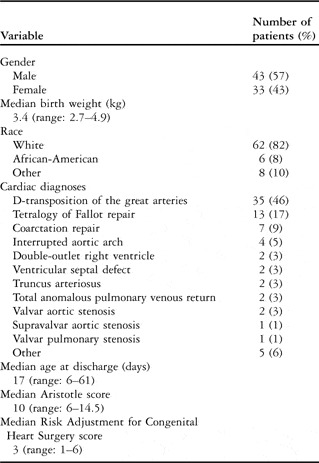
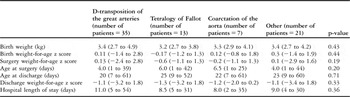
A total of 76 infants underwent surgical repair for congenital cardiac disease resulting in two-ventricle physiology, and met the inclusion criteria. Of note, five additional infants were excluded from the analysis because they were transferred to another institution, rather than discharged home. Patient characteristics are shown in Table 1 and characteristics based on cardiac diagnoses are shown in Table 2. The most common diagnosis was transposition of great arteries (46%), followed by tetralogy of Fallot.
Baseline characteristics of infants.

Characteristics of infants by cardiac diagnosis group.

Ranges are given in parentheses
Operative information and hospital course
The median age at surgery was 5 days with a range from 1 to 44. A total of 71 infants required cardiopulmonary bypass for a median of 89 minutes with a range from 27 to 239; 71 infants required aortic cross-clamp time for a median of 57 minutes with a range from 7 to 158; and 28 infants required deep hypothermic circulatory arrest for a median of 34 minutes with a range from 1 to 77. The median post-operative ventilator time was 48 hours with a range from 3 to 1176 with 11% requiring reintubation following initial extubation during the hospitalisation. There were 10 infants (13%) who developed post-operative infections, which included bacteremia (n = 6), sternal surgical site infection (n = 2), urinary tract infection (n = 1), osteomyelitis (n = 1), and cellulitis (n = 1); one infant developed both bacteremia and a sternal surgical site infection. The median hospital length of stay was 11 days with a range from 2 to 54.
Post-operative echocardiographic data
Echocardiograms were performed at a median of 2 days with a range from 0 to 13 before discharge. The most common residual cardiac defects were moderate or greater pulmonary regurgitation in 28% of infants and valvar pulmonary stenosis in 20%. There was one infant with a non-restrictive residual ventricular septal defect, two with a residual left ventricular outflow tract obstruction, and three with a residual aortic arch obstruction.
Anthropometric measurements
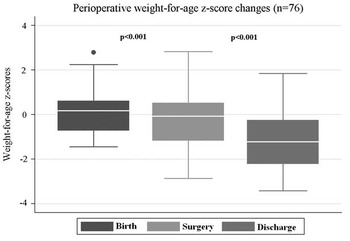
The median birth weight was 3.3 kilograms with a range from 2.6 to 4.9, with a weight-for-age z score of 0.2 with a range from −1.4 to 2.8. By the time of surgical repair, the median weight was 3.4 kilograms, with a range from 2.5 to 5.0, with a reduced weight-for-age z score of −0.2 with a range from −2.9 to 2.8. The median discharge weight was 3.3 kilograms with a range from 2.6 to 5.1 with a weight-for-age z score of −1.2 with a range from −3.4 to 1.8. The median change in weight-for-age z score during hospitalisation was −1.0 with a range from −2.3 to 0.2, indicating a reduced growth velocity. The progression in weight-for-age z score from birth to discharge can be seen in Figure 1. There was a significant drop in weight-for-age z score between birth and surgery (p < 0.001) as well as between surgery and discharge (p < 0.001).
Change in pre-operative weight-for-age z scores over time.

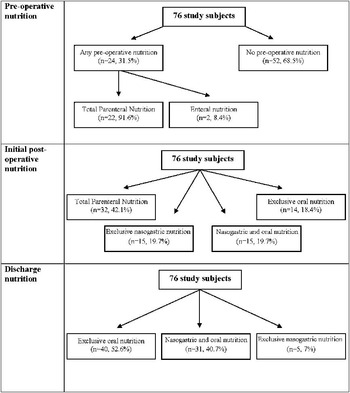
Considerable variation in nutritional interventions was documented pre- and postoperatively, and at hospital discharge. A description of the infants’ nutritional management is shown in Figure 2. Most infants did not receive nutritional support before surgery. Following surgery, the median time to starting any nutritional support was 2 days with a range from 1 to 5. By hospital discharge, the majority of infants were receiving exclusively oral feedings, but many required supplemental nasogastric tube feedings. No infants underwent placement of a gastrostomy tube in the post-operative period.
Nutritional interventions preoperatively, postoperatively, and at discharge.

Statistical analyses
Predictors of change in weight-for-age z score between surgery and discharge
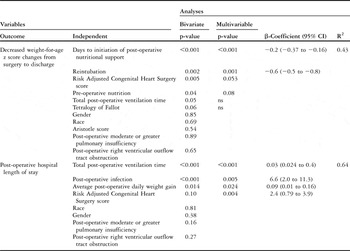
Table 3 shows the results of bivariate and multivariable analyses. Despite bivariate analyses identifying several possible predictors of worsening weight-for-age z score changes, multivariable modelling showed that later initiation of caloric nutrient intake in the post-operative period (p < 0.001) and reintubation following post-operative extubation (p = 0.001) were associated with a worsening weight-for-age z score status during hospitalisation. Despite their not being statistically significant, infants with lower Risk Adjustment for Congenital Heart Surgery scores (p = 0.053) and those who received pre-operative nutritional support (p = 0.08) trended towards better weight-for-age z score status.
Univariate analysis and multivariable modelling for predictors of weight-for-age z score changes.

ns = not significant
To better understand the relationship between the timing of post-operative nutrition and growth, post-hoc analyses were performed to examine the patients with the worst weight gain. Infants who initiated nutritional intake later than post-operative day 1 (n = 24) trended towards worse weight gain following surgery (p = 0.07). Infants with a decrease in weight-for-age z score of greater than 1 (n = 27) trended towards receiving nutrition later than post-operative day 1 (p = 0.09).
Predictors of change in weight-for-age z score between surgery and discharge
Multivariable modelling showed several factors that were associated with a longer post-operative hospital length of stay. These factors included a higher Risk Adjustment for Congenital Heart Surgery score (p = 0.004), increased total time spent ventilated (p < 0.0001), development of a post-operative infection (p = 0.005), and worse average daily weight gain (p = 0.024).
Discussion
The term infants with congenital cardiac disease in our study had a normal weight distribution at birth but experienced a poor rate of weight gain and had a lower weight-for-age z score discharge. Despite the possibility of experiencing some difficulty with weight gain following cardiac surgery in the first days of life, the magnitude of poor growth seen in this cohort following a reparative cardiac surgery was unexpected. Factors that were associated with poor growth included the need for post-operative reintubation and a delay in initiation of post-operative nutritional support. There was also a trend towards association between lack of nutrient intake in the pre-operative period and poor post-operative growth. Despite other studies showing poor weight gain in infants with single-ventricle physiology after neonatal palliation,Reference Kelleher, Laussen, Teixeira-Pinto and Duggan22, Reference Anderson, Beekman and Eghtesady23 to our knowledge, this is the first study to evaluate growth in infants with two-ventricle congenital cardiac disease undergoing surgical repair in the first weeks of life and to identify potentially modifiable factors that may lead to improved growth in this high-risk population.
Early initiation of nutritional support in the post-operative period was associated with improved weight gain. In addition, those infants who were provided nutritional support before their cardiac surgery also showed a trend towards better weight gain. Despite the lack of clarity as to whether initiation of nutrition was simply a marker of better haemodynamics and clinical stability, optimal nutritional support in the perioperative period is essential for infants undergoing surgical repair of congenital cardiac disease. In the immediate post-operative period, infants experience a short period – ranged from 12 to 24 hours – of increased resting energy expenditure that is most likely due to a concomitant increase in respiratory rate and heart rate.Reference Agus and Jaksic24–Reference Owens and Musa26 Protein catabolism is a component of the response infants experience to prolonged physiological stress. Protein and fat stores are smaller in infants compared with older children, and infants experience a higher rate of protein catabolism in the face of physiological stress.Reference Agus and Jaksic24 Owing to limited metabolic reserves, the infant is at increased risk for the adverse effects of even short-term malnutrition and the detrimental consequences of a prolonged catabolic response.Reference Owens and Musa26, Reference Madhok, Ojamaa, Haridas, Parnell, Pahwa and Chowdhury27 In addition, infants undergoing cardiopulmonary bypass are at an increased risk for developing an exaggerated inflammatory response, which can be manifested by generalised oedema, capillary leak syndrome, and multi-system organ failure.Reference Cooper and Nichter28 Maximising perioperative caloric nutrient intake may alleviate or diminish some of these deleterious effects of cardiopulmonary bypass.
Nutrient intake in the pre-operative period and the timing of initiation of nutrition postoperatively were variable in our sample. Several possible explanations for this variation exist. Nutritional care did not follow a prescribed protocol, but was left to the discretion of the cardiologists, intensivists, and nurses caring for individual infants. Clinical factors will play a role in the timing of nutritional interventions, but the ability to enhance intake with a focused nutritional support protocol has not been evaluated. Meyer et alReference Meyer, Harrison, Sargent, Ramnarayan, Habibi and Labadarios29 showed that utilisation of a feeding protocol for paediatric patients cared for in an intensive care unit decreased the time to initiation of feeds and the percentage of patients reaching goal energy intake for their expected needs. Standardisation of nutritional practices in the pre- and post-operative periods for these high-risk infants may similarly lead to increased attainment of nutrient and caloric goals and improved growth.
Kogan et alReference Kogon, Ramaswamy and Todd30 found a relationship between total ventilation time and failure to meet nutritional goals in post-operative infants undergoing surgical repair or palliation for both single- and two-ventricle congenital cardiac disease. We similarly found that infants who required reintubation had difficulty with growth. Clinical instability most likely affects the decision of caregivers to initiate or optimise nutritional support in these settings. Infants who had early initiation of nutrient intake in the pre- and post-operative periods may have been considered healthier leading to clinician to be comfortable with initiating nutritional support. More attention to meet the nutritional needs is required and earlier nutritional administration in the pre- and post-operative periods may enable infants to meet the physiological demands related to cardiopulmonary bypass and cardiac surgery.
In our study, those infants with a higher Risk Adjustment in Congenital Heart Surgery score trended towards decreased weight gain in the post-operative period. Despite a higher Risk Adjustment for Congenital Heart Surgery score being associated with a longer total hospital length of stay and increased overall mortality,Reference Boethig, Jenkins, Hecker, Thies and Breymann31, Reference Larsen, Pedersen, Jacobsen, Johnsen, Hansen and Hjortdal32 the association between Risk Adjustment for Congenital Heart Surgery score and growth has not been reported. This relationship may be secondary to the hesitancy of caregivers to begin feeding infants with more complex cardiac repairs due to haemodynamic instability, but it may also be secondary to increased metabolism and physiological stress in infants who have undergone more complex repairs.
We also found that nutrition and growth are independent factors related to hospital length of stay following surgery for these infants. The finding that pre-operative nutrition and better weight gain were associated with a shorter hospital length of stay, independent of other factors affecting hospital course, provides early data that a focus on nutrition during the perioperative period in these infants may shorten their hospital course.
There are limitations to this study. This was a single-centre study, and therefore the demographic make-up of this infant cohort and the methods of caring for this group of infants with congenital cardiac disease may not reflect those of other centres. The retrospective nature of this study limited the variables that could be collected. Specifically, there was limited information regarding the daily nutrient intake of these patients during their neonatal hospitalisation as well as information on daily weight or intravenous fluid intake. Despite data being available regarding the timing of initiation and method of nutritional support both before and after surgery, data on research-quality caloric nutrient intake were not available. In addition, nutritional management was determined by individual caregivers, rather than protocol, leading to variability in nutrition and growth management and potential treatment biases. In this study, the rate of weight gain was used as a marker of nutritional adequacy. This is an indirect measure of nutrition and direct measurement of energy requirements, energy intake, and nutritional biomarkers, which would augment the diagnosis of poor nutritional status and growth problems in these infants.
Conclusion
Infants with complex congenital cardiac disease are known to be predisposed to growth failure. Infants with two-ventricle physiology, despite undergoing what is considered to be complete cardiac repair, exhibit failure to gain weight at the typical rate during the perioperative period. Our findings suggest that there are modifiable factors to prevent or treat this growth failure, including attention to timing of pre- and post-operative nutritional support. Development of standard protocols for the consistent assessment and provision of energy and nutrient requirements during the hospitalisation for cardiac care may alleviate the poor weight gain shown by these infants by optimising their nutritional status.
Acknowledgements
Geoffrey L. Bird, MD, Co-Investigator, Division of Cardiology at The Children's Hospital of Philadelphia, assisted with study visits, patient assessments, and data review. Jeffrey B. Anderson, MD, MPH, assisted with development and writing of the manuscript, and also added biostatistical expertise and primarily carried out data analysis. Bradley S. Marino, MD, MPP, MSCE, Co-Investigator, assisted with study visits, patient assessments, data review, and manuscript development, and also acted as the primary statistician working on study design and data analysis. Sharon Y. Irving, CRNP, MSN, Project Manager, assisted with daily study management, study visits, data collection, data review, data analysis, and manuscript development. J. Felipe García-España, PhD, Statistician, assisted with initial study design and data analysis. Chitra Ravishankar, MD, Co-Investigator, Division of Cardiology at The Children's Hospital of Philadelphia, assisted with study visits, patient assessments, data review, and manuscript development. Virginia A. Stallings, MD, Co-Investigator, GI/Nutrition, assisted with grant development and authorship, data review and analysis, and manuscript development. Barbara Medoff-Cooper, RN, PhD, Principal Investigator, assisted with study design, grant development and authorship, data review and analysis, and manuscript development. All authors participated in reviewing, revising, and approval of the final version of the manuscript. This study was funded by the Grant numbers NIH/NINR R01 NR002093, MO1-RR00240 and UL1-RR-024134. This project was supported by the National Institutes of Health, the National Institute of Nursing Research, the National Center for Research Resources, and the Nutrition Center of the Children's Hospital of Philadelphia. The content is solely the responsibility of the authors and does not necessarily represent the official views of the National Center for Research Resources or the National Institutes of Health.