Melanoplus gaspesiensis Vickery, 1970 is a robust grasshopper characterised by dark hind femurs with two pale oblique streaks. It is considered endemic to Mont Albert, on the Gaspé Peninsula, Québec, Canada (Vickery and Kevan Reference Vickery and Kevan1985). NatureServe currently lists M. gaspesiensis as critically imperilled due to its extremely limited distribution (https://explorer.natureserve.org/Taxon/ELEMENT_GLOBAL.2.114138/Melanoplus_gaspesiensis). By contrast, Melanoplus borealis (Fieber, 1853), a closely related species, is widely distributed throughout North America. Restricted to the upper parts of the mountain, M. gaspesiensis can be found in grassy areas near small ponds (Vickery and Kevan Reference Vickery and Kevan1985). Little else is known about the species.
Located within Gaspésie National Park, Mont Albert stands out as the summit offering the largest expanse of alpine tundra in the region (13 km2) while having a relatively low maximum altitude of only 1151 m (Durand Reference Durand2022). Its unique geology compared to neighbouring mountains is responsible for its unusually low tree line. Although most alpine summits in the mountain ranges of the Gaspésie are composed of granite, Mont Albert is composed largely of serpentine. Serpentine is an ultrabasic rock with a high content of heavy metals (chromium, nickel, cobalt, and scandium) and magnesium, combined with often reduced concentrations of calcium and molybdenum (Sirois and Grandtner Reference Sirois and Grandtner1992; Durand Reference Durand2022). Because of this, soils derived from the serpentine covering most of the summit of Mont Albert are phytotoxic, hindering the growth of vegetation and favouring a unique community of specially adapted plants (Sirois and Grandtner Reference Sirois and Grandtner1992). The region surrounding Mont Albert comprises many other mountains with summits extending beyond their tree lines. However, due to the difficulty of access, the alpine summits of the Gaspé Peninsula remain understudied.
Climate change has been predicted to disproportionately affect alpine regions (Ernakovich et al. Reference Ernakovich, Hopping, Berdanier, Simpson, Kachergis, Steltzer and Wallenstein2014). Given the emerging climate risks, it is important to make greater efforts to understand local alpine communities before irreversible change happens. The present study aims to start documenting the Acrididae communities of the alpine summits contained within Gaspésie National Park, paying special attention to the highly endemic M. gaspesiensis by verifying whether it is present on other nearby summits.
Acrididae (Orthoptera) were surveyed on four alpine summits located within Gaspésie National Park: Mont Albert’s south summit (altitude 1088 m), Mont Xalibu (altitude 1140 m), Mont Jacques-Cartier (altitude 1270 m), and Petit Mont Sainte-Anne (altitude 1148 m). Over two consecutive summers (mid-June to mid-August) in 2020 and 2021, each summit was sampled eight times. Each sampling session included two days of opportunistic searching while other activities were being performed on the summits. All orthopteran bycatches in a 150-m transect of 30 bee bowls set out for 24 hours were included among the collected samples. Bee bowls 18 cm in diameter and divided equally among blue, yellow, and white colours were placed on the ground and filled with soapy water. During the last sampling event on each alpine summit in August 2021, a standardised one-person 60-minute active search of all Orthoptera was also performed. Identification of collected specimens was done with the help of Jean-François Roch (Association des entomologistes amateurs du Québec), and specimens are deposited at the Montreal Insectarium collection.
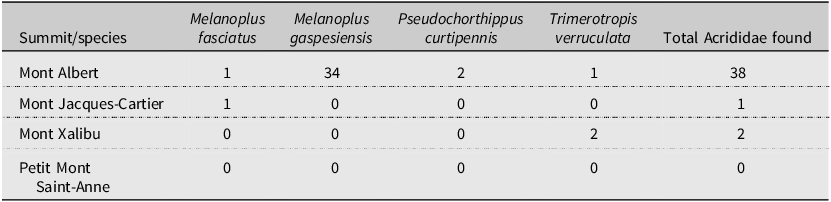
Forty-one specimens of a total of four species of Acrididae were found; the four species were present on Mont Albert, whereas no Acrididae were found on Petit Mont Saint-Anne (Table 1). Melanoplus gaspesiensis was the most abundant species found, with 34 specimens (16 males, 18 females) collected, and it was found only on Mont Albert. Twelve of the 41 specimens of Acrididae were collected during the 60-minute active hunts, including 11 of 34 specimens of M. gaspesiensis and 1 of 2 specimens of Melanoplus fasciatus (Walker) – again, all on Mont Albert. That is, no specimens of Acrididae were collected during the 60-minute active hunts on the other peaks (Table 1).
Total numbers of Acrididae captured per summit during the summer of 2020 and 2021, combining bee bowl bycatch, opportunistic captures, and 60-minute active hunts. The 60-minute active hunts accounted for 11 of the 34 specimens of Melanoplus gaspesiensis and the single specimen of M. fasciatus collected on Mont Albert but none of the specimens of Acrididae collected on the other peaks.

During the 16 August 2021 sampling event on Mont Albert, oviposition by M. gaspesiensis was observed. It was performed at the centre of a patch of moss campion, Silene acaulis (Linnaeus) Jacquin (Caryophyllaceae), surrounded by woolly fringe-moss, Racomitrium lanuginosum (Hedwig) Bridel-Brideri (Grimmiaceae) (Fig. 1).
A, Melanoplus gaspesiensis observed ovipositing on a patch of moss campion, Silene acaulis, on Mont Albert on 16 August 2021. B, The patch of moss campion was surrounded by woolly fringe-moss, Racomitrium lanuginosum.

Our results confirm that the population of M. gaspesiensis remains present on Mont Albert. Males and females appear to be equally abundant, and oviposition was observed in mid-August. No evidence that M. gaspesiensis is present on the other surveyed summits was found. However, due to the nature of serpentine and its effect on plant communities such as those observed on Mont Albert, we hypothesise that M. gaspesiensis may be associated with summits of similar geological composition. Therefore, we recommend that Mont Olivine, which is also composed of serpentine and is located near to Mont Albert, also be surveyed for M. gaspesiensis despite its minimal alpine surface area. Another possible explanation for the restricted range of M. gaspesiensis is that Mont Albert, with a significantly larger alpine area than any other mountain on the Gaspé Peninsula (13 km2 of alpine area, compared to less than 3 km2 on each of the other nearby mountains), has been the only area where populations have been able to persist through time.
More efforts are needed to better understand the particularities of Mont Albert and why it appears to play a critical role in supporting the continued existence of M. gaspesiensis. This cricket is just one of many rare and endemic species that inhabit the summit of Mont Albert and are threatened by climate change. As climate pressures increase, the mountaintop community dynamics may undergo irreversible change, leading to the disappearance of many of these vulnerable species. Sustained efforts to preserve and study this unique mountain are now more urgent than ever.
Acknowledgements
The authors thank Jean-François Roch, from the Association des entomologistes amateurs du Québec, for his help in identifying the specimens collected.
Competing interests
The authors declare they have no competing interests.