INTRODUCTION
There have been many significant developments in the field of second language acquisition (SLA) since the 1960s (Ellis, Reference Ellis2008). As pointed out by Ellis (Reference Ellis2008), some of these developments include a wider scope, new contributions to linguistic theories, and an increasing number of theory-guided experimental studies. Echoing Ellis, Gass (Reference Gass, Ritchie and Bhatia2009) has also concluded that the field is moving from descriptive to theoretical. All these changes seem to suggest that the field is becoming more diversified.
Besides scope and diversity, another sign of development is size. As described in the following text, there has been a boost in number of articles published in major journals in the field over the last two decades. The field is experiencing a fast growth, which cannot have happened without the contributions of hundreds of scholars who produced thousands of publications that constantly further our understanding of SLA. However, as the field grows bigger, it becomes more difficult to identify the main themes in the field. One solution is to survey the bibliometric information of a large number of publications in the field to detect systematic patterns. This type of quantitative analysis is known as bibliometric analysis.
Pritchard (Reference Pritchard1969) described “bibliometrics” as “the application of mathematical and statistical methods to books and other means of communication” (p. 349). In other words, bibliometrics is a type of quantitative analysis that extracts patterns from publications to provide insights into a field or a discipline based on characteristics of publications such as publisher productivity (e.g., journal impact), dates and places of publications, patterns of citations and referencing in the literature, and so forth (de Bellis, Reference de Bellis2009). Bibliometrics has been widely implemented to evaluate the impact of publication venues, regions, research institutions, authors, and documents, which is particularly useful to scholars, teachers, students, librarians, and funding agencies alike (Holden, Rosenberg, & Barker, Reference Holden, Rosenberg, Barker, Holden, Rosenberg and Barker2005 ). Combined with network mapping techniques, bibliometrics can also detect major themes in a field (de Bellis, Reference de Bellis2009), allowing the researchers to keep track of the scope of a field (Chang, Huang, & Lin, Reference Chang, Huang and Lin2015). When taking into consideration the factor of time, bibliometrics can also be utilized to identify new trends, assisting scholars to design and plan their future research.
Although there are various forms of bibliometric analyses, cocitation analysis is one of the most commonly used methods to discover intellectual structure of a field (Bichteler & Eaton, Reference Bichteler and Eaton1980). Cocitation analysis measures how frequently two documents are cited together (Small, Reference Small1973). As pointed out by Small, if two documents are often cited together, there is a good chance that the two documents are related. Using cocitation information, publications (or authors) that are often cited together can be grouped in clusters to reveal the intellectual structure of a discipline (Small, Reference Small1973). Indeed, the cocitation technique has been widely adopted by various disciplines for structural analysis. For example, White and McCain (Reference White and McCain1998) employed this method to perform a domain analysis on information science. White and McCain successfully identified the most influential authors in information science. The patterns emerging from their cocitation analysis enabled White and McCain to unveil two subdisciplines within which researchers coherently cited each other. In the field of operation management, Pilkington and Meredith (Reference Pilkington and Meredith2009) were able to use cocitation analysis to reveal how the field evolved between 1980 and 2006.
Different from cocitation analysis that analyzes the connections between cocited references, citation analysis of impact is more descriptive in nature. This type of analysis uses citation counts to determine impact of authors, documents, research institutions, publication venues, and so on. Perhaps one of the most well-known applications of citation analysis of impact is journal citation indexing that has now been widely adopted to measure journal impacts (for more information about journal citation indexing, see a discussion in the text that follows). Garfield (Reference Garfield1955) first introduced the concept of impact factor (IF) based on citation counts, which was later incorporated in the science citation index and social science citation index (see a discussion in Garfield, Reference Garfield2006). In addition to journal citation indices, citation analysis has also been applied to evaluate the impact and productivity of individual scholars (e.g., h-index by Hirsch, Reference Hirsch2005), academic institutions (see a critical discussion in van Raan, Reference van Raan2005), and regions (Lei & Liao, Reference Lei and Liao2017; Leydesdorff & Wagner, Reference Leydesdorff and Wagner2009; van Leeuwen, Moed, Tijssen, Visser, & van Raan, Reference van Leeuwen, Moed, Tijssen, Visser and van Raan2001).
In addition to cocitation analysis and citation analysis of impact, keyword analysis is another important bibliometric method. While cocitation analysis is a superior bibliometric technique to visualize the intellectual structure of a discipline (Bichteler & Eaton, Reference Bichteler and Eaton1980), this technique does not provide much information about key topics in a discipline. This issue can be addressed by keyword analysis. As its name implies, keyword analysis uses keywords to identify important topics and concepts in a field. Based on frequency count information, it is possible to reveal prominent topics and important changes over a period. Content analysis using keywords can add great values to a bibliometric analysis given that keywords constitute the building blocks of concepts and knowledge (Callon, Courtial, Turner, & Bauin, Reference Callon, Courtial, Turner and Bauin1983). To illustrate the value of keyword analysis, it is helpful to use Lei and Liu (Reference Lei and Liu2019b) as an example. Lei and Liu extracted keywords from the articles published in System during the last 40 years. By comparing the frequency of keywords in different periods, Lei and Liu were able to identify some significant changes to the key topics in and the research focus of System, which are difficult, if not impossible, to be uncovered by citation or cocitation analysis.
As bibliometrics is applied in different disciplines, bibliometric analysis at different levels (e.g., the journal level, Lei & Liu, Reference Lei and Liu2019b; the regional level, Lei & Liao, Reference Lei and Liao2017) are gradually introduced to different domains of the linguistics discipline. Swales (Reference Swales1986) may be the first to introduce the citation method to discourse analysts in the field of applied linguistics. White (Reference White2004) took one further step to promote a number of bibliometric techniques among applied linguists and called for a greater integration of different disciplines. Wang and Zhang (Reference Wang, Zhang, Wen and Ahmadian2019) used cocitation analysis to investigate the subject of task difficulty and found that Peter Skehan is the most prominent contributor to the subject according to the citation counts of his publications.
In a large-scale study, de Bot (Reference de Bot2015) studied the field of applied linguistics between 1980 and 2010 based on professional opinions and citation analysis. de Bot surveyed more than 100 applied linguists to identify leading scholars (or leaders in de Bot’s term) and new trends in the field. de Bot also gathered the citation information (h-index) of the leaders and confirmed that these professionally rated leading scholars (e.g., Claire Kramsch, Merrill Swain, James Lantolf) were indeed highly influential in the field. Moreover, de Bot discovered a number of trends in applied linguistics as the field has become more multidisciplinary due to increasing influences from cross-disciplinary theories (e.g., complexity theory and sociocultural theory) and methodologies (e.g., corpus linguistics, sociolinguistics, neurolinguistics). In a more recent study, Lei and Liu (Reference Lei and Liu2019a) utilized both cocitation analysis and keyword analysis to investigate the field of applied linguistics. The study found that substantial changes have taken place in the last decade as theories from other disciplines were introduced to the field. Lei and Liu also spotted a growing interest in the topics such as multilingualism and sociopsychology.
While de Bot (Reference de Bot2015) and Lei and Liu (Reference Lei and Liu2019a) have revealed some recent trends in applied linguistics, the bibliometric method has not yet been employed to provide a systematic and holistic overview of SLA (including L2 teaching, L2 processing, and etc.). The current study aims to address this gap by using a combination of bibliometric methods to identify the key publications, prominent scholars, and major themes in the last two decades so as to capture the state of the art in SLA. Three research questions have been raised:
1. Which documents, authors, institutions, and regions are most influential in terms of citation counts?
2. What are the most frequently explored SLA themes and topics?
3. What are the new trends in the field?
METHOD
BIBLIOMETRIC DATABASE
The current study used bibliometric data retrieved from Web of Science (WoS). WoS, Scopus, and Google Scholar are the three major online data resources for bibliometric analysis. With more than 7,000 subscribers, two times more than the closest competitor Scopus (3000+), WoS is one of the best-known and most widely used library resources (Roemer & Borchardt, Reference Roemer and Borchardt2015). Google Scholar is a free online search engine that provides citation information. Different from WoS and Scopus, which limit their citation sources to journal articles, Google Scholar covers a wider range of citation sources that include unpublished documents, blog posts, web pages, and so forth (Roemer & Borchardt, Reference Roemer and Borchardt2015). However, Google Scholar was not used in the current study for two reasons. First, although Google Scholar has a broader citation source coverage, it does not discriminate between academic citations and nonacademic citations (e.g., blog posts), which can lead to bias because citations from nonacademic works (e.g., news story) and citations from academic journal articles might not have equal scholarly values (de Bellis, Reference de Bellis2009). Second, Google Scholar does not offer cocitation information, which is an important component of the current study.
INDEXING AND CITATION METRICS
One of the most commonly used and influential indicators of scientific performance (e.g., journals, authors, and academic institutions alike) is citation analysis of impact in the form of citation metrics (de Bellis, Reference de Bellis2009). Citation metrics are easy to understand and compute, making them popular among academics, research institutions, and funding agencies. All three databases (WoS, Scopus, and Google) maintain their own citation metrics. For example, Scopus introduced SJR (SCImago Journal & Country Rank), SNIP (source normalized impact per paper), and Citescore. WoS created its influential SCI (Science Citation Index) and SSCI (Social Science Citation Index), with the latter one closely related to the field of SLA. Despite their popularity, citation-based metrics (e.g., impact factor) are not without limitations and criticisms. For example, some journal citation indices (e.g., the impact factor) are biased due to highly skewed citation distributions (e.g., 20% of articles make up 80% of citations, Garfield, Reference Garfield2006). Besides, the relatively objective quantitative indexes can be distorted by authors’ citation choices (de Bellis, Reference de Bellis2009) and may even be abused by publishers and editors (Brumback, Reference Brumback2009). What’s more, scholarly impact is a multifaceted construct that cannot be fully defined by a single citation metric (Glänzel, & Moed, Reference Glänzel and Moed2002). Despite all these limitations, the citation-based metrics continue to be regarded as one of the most important indicators of academic impact (Garfield, Reference Garfield2006; Glänzel, & Moed, Reference Glänzel and Moed2002).
JOURNAL SELECTION
VanPatten and Williams (Reference VanPatten and Williams2002) compiled a list of 15 top SLA journals based on professional opinions. This list has been adopted in various studies to investigate issues in SLA (e.g., Gass, Reference Gass, Ritchie and Bhatia2009; Plonsky, Reference Plonsky2013; Plonsky & Gass, Reference Plonsky and Gass2011). Besides professional opinions used by VanPatten and Williams, other criteria were also used to evaluate quality of SLA journals including abstract indexing in Language Teaching (Jung, Reference Jung2004), rejection rate, time of publication, availability/accessibility, and professional opinions (Egbert, Reference Egbert2007). Based on citation analysis, a recent study by Al-Hoorie and Vitta (Reference Al-Hoorie and Vitta2019) surveyed quantitative studies published in a broad range of international and regional L2 journals to investigate the relationship between journal indexing and statistical quality of studies in L2 journals. One important finding is that the majority of studies published in the SSCI-indexed L2 journals have a high quality in terms of statistical rigor.
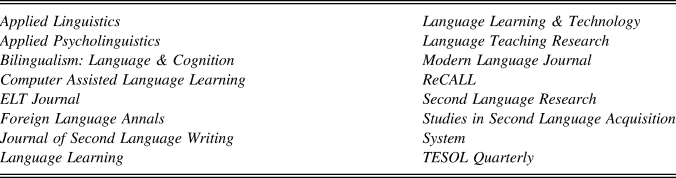
Based on the results of SLA journal evaluation in the previous studies (e.g., Al-Hoorie & Vitta, Reference Al-Hoorie and Vitta2019; Egbert, Reference Egbert2007; VanPatten & Williams, Reference VanPatten and Williams2002), 16 journalsFootnote 1 were selected for bibliometric data retrieval (Table 1). These journals are all international journals indexed by SSCI. The current study focused on international journals for the reasons that research studies appearing in international journals usually go through a rigorous peer-review process and that international journals are more accessible and visible to academics (Benson, Chik, Gao, Huang, & Wang, Reference Benson, Chik, Gao, Huang and Wang2009). However, this is not to say that regional journals are not important.
Journals surveyed in the current study

All 16 international journals surveyed in the current study could be considered to be high-quality venues. According to the most up-to-date ranking (March 2019) of Journal Citation Reports (WoS), 13 out of the 16 journals were rated as Q1 journals in the linguistics sector and two as Q2 journals. Thirteen journals had an IF above 1.5 in 2017. Nine journals had an IF of more than 2.0 and two slightly below 2.0 (also see Table 4 in the appendix for year-by-year IFs). Twelve journals were listed as the top journals in VanPatten and Williams (Reference VanPatten and Williams2002). All seven top-quality L2 journals in Egbert (Reference Egbert2007) were included in the current journal list. In sum, the journals in this list, publishing almost 8,000 full-length articles in the last two decades, constitute a good representation of SLA for identifying influential works and authors in the field.
TYPES OF DATA
Only full-length articles published between 1997 and 2018 were included in the analysis. Other forms of publications such as book reviews, forums, and comments were excluded. The following types of information were collected from WoS: titles, authors and their affiliations, abstracts, author-supplied keywords, and references.
TYPES OF ANALYSIS
Three types of bibliometric analyses were employed: citation analysis of impact, cocitation analysis, and keyword analysis. For citation analysis of impact, Bibexcel (Persson, Danell, & Schneider, Reference Persson, Danell and Schneider2009) was used to count citations on journals, journal articles, and research institutions. Based on citation counts, this part of analysis not only identified the most-cited articles in the 16 journals but also pinpointed key research institutions and regions in the field.
Cocitation analysis was utilized to discover the most important sources of publications, scholarly works, and authors. More importantly, this study used cocitation analysis to produce bibliometric network maps of key journals, documents, and authors. These network maps, which were constructed using VOSviewer (Waltman, van Eck, & Noyons, Reference Waltman, van Eck and Noyons2010; see Waltman & van Eck, Reference Waltman and van Eck2017 for an introduction to the software), would offer visualizations of the intellectual structure of the field.
Keyword analysis was employed to detect important topics in the field. One common method to identify keywords is to collect author-supplied keywords (e.g., Chiu & Ho, Reference Chiu and Ho2007; Courtial, Reference Courtial1994; Law & Whittaker, Reference Law and Whittaker1992). Although authors usually have good knowledge of their own articles, some authors may provide only a limited number of keywords. As a result, some important topics may be overlooked in author-supplied keywords. This limitation can be partially solved by extracting highly frequent words/phrases directly from abstracts, which was used in previous studies to identify keywords (e.g., Lei & Liu, Reference Lei and Liu2019a, Reference Lei and Liu2019b). Although this method can generate additional keywords, it involves some degree of subjectivity in regard to which words/phrases should be included in the keyword analysis. Because the two methods each have their merits and limitations, the current study employed both methods to define the key SLA topics.
DATA CLEANING
Data cleaning was performed to remove coding errors. For example, references extracted from journal articles may use different names to refer to the same author. Therefore, authors’ names were recoded. For example, “Ellis N C,” “Ellis N,” “Nick Ellis,” and “Ellis N” refer to the same scholar. All these names were recoded into “Ellis N.” In terms of keywords, different journal articles may use different keyword terms to refer to the same concept. Therefore, data cleaning was also carried out to unify keywords. For example, event-related potential, event-related potentials, event related potential, event related potentials, ERP, and ERPs represent the same concept. All these terms were recoded as event-related potentials. However, the keywords that only share some degree of similarity were not combined for the reason that these keywords can convey different meanings. For example, vocabulary acquisition and vocabulary learning were not coded into one keyword because some researchers differentiate learning from acquisition (Ellis, Reference Ellis2008). To give another example, working memory and working memory capacity were not coded into the same term because working memory capacity is a subcategory of working memory, and thus these two keywords are somewhat different. Similarly, teacher education and second language teacher education are similar, but second language teacher education may be subsumed under teacher education. An advantage of keeping these terms separated in the analysis is that changes in similar topics with different scopes can be evaluated (e.g., teacher education vs. second language teacher education).
ANALYSIS
For the citation analysis of impact, citation information (e.g., author affiliation, year, publication venue, number of citations) was extracted directly from WoS. In addition, lifetime citation counts of documents and journal impact factors were also retrieved from WoS. The lifetime citation count of a document equals the number of times the document has been cited by all citable documents maintained by WoS.
For the cocitation analysis, citation information was computed based on the references in the surveyed articles. The articles published between 1997 and 2007 cited more than 50,000 unique references. The articles between 2008 and 2018 cited more than 130,000 unique references. It is not common to include thousands of references in a network map simply because too many nodes are hardly interpretable. Therefore, a cutoff point is needed to limit the number of nodes in a map (McCain, Reference McCain1990). For example, to build the author network map in the 1997‒2007 period, a cutoff point of 115 citation counts was used to restrict the total number of nodes to the top 50 most-cited authors. For all three types of cocitation analyses (sources of publications, most-cited authors, most-cited publications), the cutoff points were set at the values to keep the top 50 most-cited items or authors in the maps.
For the keyword analysis, both author-supplied keywords and keywords-from-abstracts were used. The author-supplied keywords were directly retrieved from WoS. To identify the keywords-from-abstracts, Antconc (Anthony, Reference Anthony2018) was used to extract n-grams (up to four-gram) from abstracts (Lei & Liu, Reference Lei and Liu2019a). Using SQL language, those n-grams containing function words such as pronouns and modal words were filtered out. The remaining n-grams were then manually checked and filtered by two SLA researchers for keyword identification in reference to one of the criteria given in Lei and Liu (Reference Lei and Liu2019a): to exclude words/phrases that are common in research in general, but too broad to be applicable to the field of SLA (e.g., bilingualism, language, second language acquisition, L2 learner). This screening process involved some degree of subjectivity. Therefore, we tried to be lenient when deciding what constituted a topic so as to include as many keywords as possible. This practice could create space for a broader audience to interpret the results. It is worth emphasizing that the keywords-from-abstracts are supplementary to the author-supplied keywords.
After the keywords were identified, the frequency information of each keyword was calculated. To perform frequency counting, each keyword was searched against all the abstracts. A keyword can appear in an abstract more than once. But multiple occurrences can lead to bias (e.g., a skewed distribution). Therefore, multiple occurrences in an abstract were treated as a single occurrence toward the final frequency counts.
The frequency profiles of keywords were then submitted to log-likelihood (LL) tests to investigate which topics (represented by keywords) were unusually frequent in one period as opposed to the other. The LL test in the current analysis used the following formulas to identify unusually frequent topics in one text against another text (Rayson & Garside, Reference Rayson and Garside2000).
 $$Ei = {{{N_i}\sum\nolimits_i {{O_i}} } \over {\sum\nolimits_i {{N_i}} }}$$
 $$- 2\,\rm In\,\lambda = 2\it{\sum\nolimits_i \it{{O_i}} \,\rm In \it \left( {{{{O_i}} \over {{E_i}}}} \right)$$
Where Oi is the observed frequency count of a word/phrase, Ni represents the total number of word tokens or the size of a corpus, and Ei is the expected frequency value of a word/phrase. It should be emphasized that the raw frequency of a word/phrase should be used in the formula because this method has taken into consideration the corpus size factor (see Rayson & Garside, Reference Rayson and Garside2000).
In addition to the LL values, Bayes factor was also computed (BIC = LL – log(N), where N is the total number of word tokens in two corpora; Wilson, Reference Wilson, Bieswanger and Koll-Stobbe2013). The LL test and the Bayes factor have been widely used for keyword identification in corpus linguistics (Rayson & Garside, Reference Rayson and Garside2000; Wilson, Reference Wilson, Bieswanger and Koll-Stobbe2013). A word/phrase with a LL value greater than 3.84 suggests that the word/phrase can be regarded as a keyword (Rayson & Garside, Reference Rayson and Garside2000), a criterion considered to be the adequate threshold in social science (Wilson, Reference Wilson, Bieswanger and Koll-Stobbe2013). In the current context, the words/phrases with LL values greater than the threshold (e.g., LL > 3.84) were treated as the topics that had experienced a significant change from one period to the other. A word/phrase with a LL value smaller than the threshold suggests that the interest toward this topic remained relatively stable during the two periods. Compared to LL, BIC uses a stricter criterion: a word/phrase with a BIC value smaller than 2 cannot be considered to be a keyword (a BIC value of 2 equals a LL value of 10.83 in the keyword analysis).
RESULTS
In this section, the result of the keyword analysis would be presented first, followed by the citation analysis of impact and the cocitation analysis. The reason to present the results in this order is that one main focus of the current study is to identify trends in the field, which can be revealed by changes in interest toward prominent topics in the field.
KEYWORD ANALYSIS
A total of 4,778 keywords were identified through the keyword analysis. Data cleaning was performed to recode the keywords. After data cleaning, a total of 791 keywords remained, including 495 author-supplied keywords and 296 keywords-from-abstracts (if a keyword-from-abstracts was also given in the author-supplied keyword list, this keyword would be tagged as an author-supplied keyword).
The author-supplied keywords (au) and keywords-from-abstracts (ab), with their corresponding LL and BIC values, are given in the supplementary material. The current study used a relatively liberal criterion of LL > 3.84, which is a widely accepted threshold in social science for keyword identification (Wilson, 2013). According to this criterion, the results of the keyword analysis are presented separately in three tables in the supplementary material. Table 1 lists the SLA topics that have attracted significant greater interests. Table 2 gives the topics with decreasing interests. Table 3 presents the topics without a significant change.
CITATION ANALYSIS OF IMPACT
Most-Cited Articles
Table 1 in the appendix gives the citation information of the top 20 most-cited articles in the 16 journals. In the first period, a number of the most-cited articles investigated the topic of vocabulary and formulaic language (e.g., Biber, Conrad, & Cortes, Reference Biber, Conrad and Cortes2004; Coxhead, Reference Coxhead2000; Laufer & Hulstijn, Reference Laufer and Hulstijn2001). Firth and Wagner (Reference Firth and Wagner1997), who called for a reconceptualization of SLA and subsequently stimulated a heated cognitive-social debate, was found to be one of the most-cited articles published in the 1997‒2007 period (adjusted for the time effect that scholarly works published in earlier years usually receive more citations).
Journals
The lifetime citations of articles in each journal surveyed in this study (up till 3/2019) were aggregated to calculate the sum of citations for each journal (or the lifetime citations till 3/2019). The lifetime citation offers a good overview of a document’s impact, which translates to evaluate the overall impact of a journal (de Bellis, Reference de Bellis2009). As summarized in Table 2 in the appendix, a total of 2,041 full-length articles were published between 1997 and 2007, and these publications received a total of 86,596 lifetime citations. In the following period (2008‒2018), the number of full-length articles increased to 5,825, and these articles were cited 72,737 times (if the counts were limited to the 12 journals logged by WoS across both periods, the total number of publications would be 4,179 with 56,558 citations). The numbers of publications over the two periods show how the field as a whole has grown in the last two decades.
The annual journal citations (in contrast to the lifetime citations) and the IFs were also retrieved directly from WoS’s Journal Citation Reports (see the supplementary material for how to calculate IFs based on citation counts). Tables 3 and Table 4 in the appendix list the citation and IF information. Almost all the 5-year IFs are greater (mean = 2.28, SD = .78, 2014 ∼ 2017) than their equivalent IFs (mean = 1.73, SD = .68, 2014 ∼ 2017), suggesting that the impact of journal articles in the field takes a couple years to reach a high level, contrasting with Garfield’s early observation that most citations are received in the first 2-year window (de Bellis, Reference de Bellis2009). The difference may be due to the relatively longer time span to publish in the major SLA journals.
Research Institutions and Regions
A total of 2,041 organizations/institutions located in 87 regions were extracted from the bibliometric dataset. Table 5 in the appendix gives citation information of the top 20 research organizations in the field. Universities such as Georgetown University, Penn State University, Michigan State University, Northern Arizona University, University of Maryland, and University of Auckland have appeared on the list in both periods.
Table 6 in the appendix lists the most productive regions in the field. The top five regions in the 1997‒2007 period were found to include the United States, Canada, England, Australia, and Japan and the top five regions in the 2008‒2018 period were the United States, England, China, Canada, and Japan. Four regions have remained on the top five list. One major change is that China took the third spot on the list in the second period, consistent with Lei and Liu’s (Reference Lei and Liu2019a) observation that China is becoming more influential in applied linguistics in terms of productivity.
COCITATION ANALYSIS AND NETWORK MAPPING
The Highly Influential References
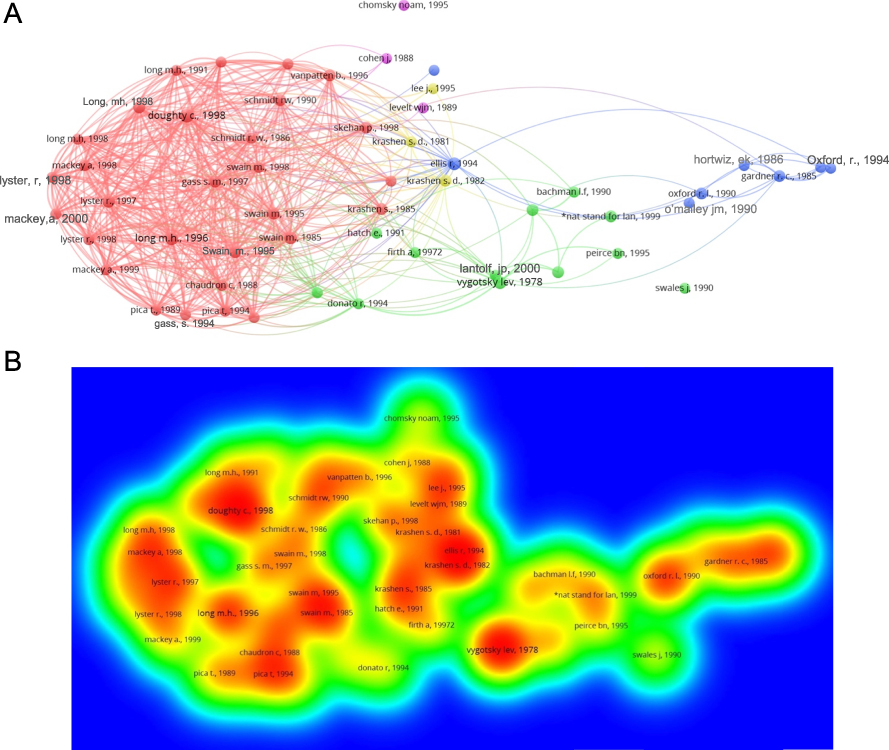
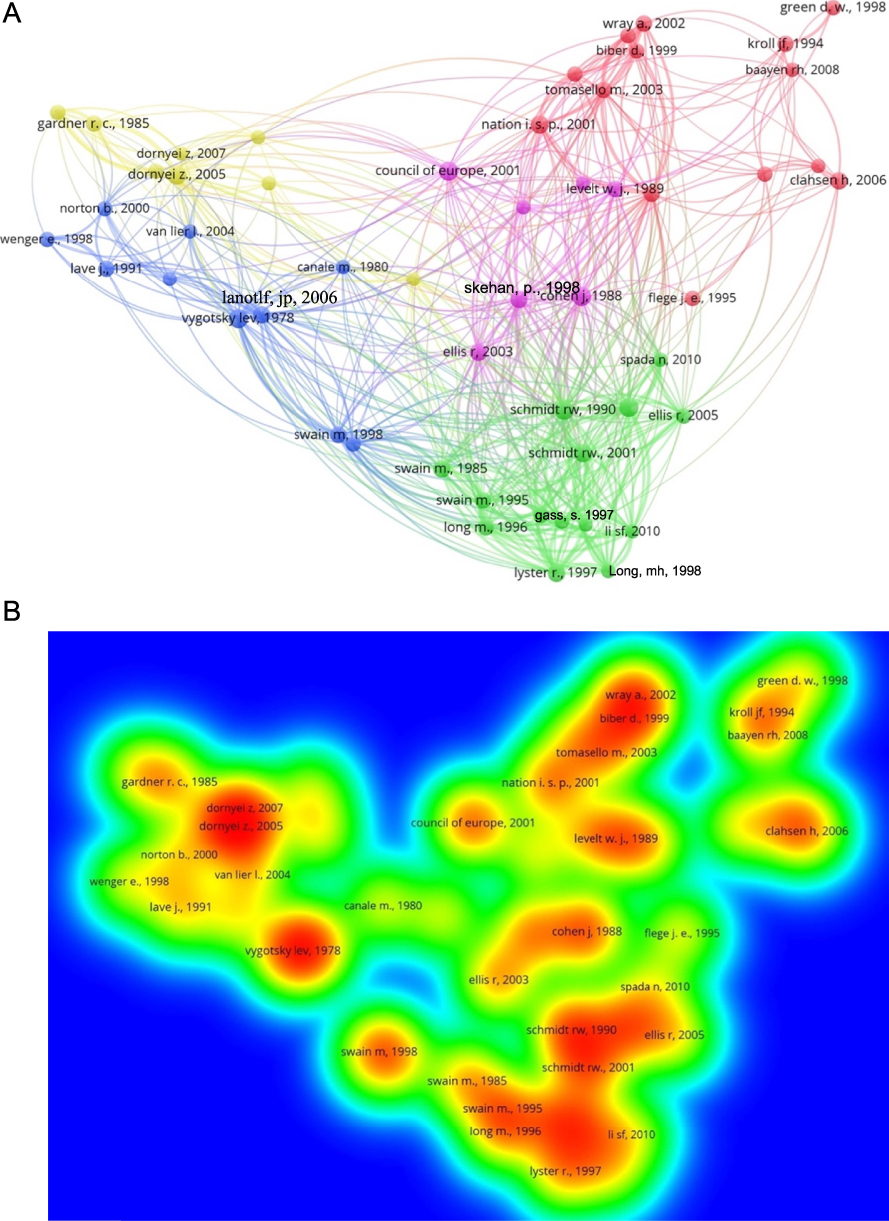
Among the 51,500+ unique references cited in the articles published between 1997 and 2007, all top 50 most-cited references (given in Table 7 in the appendix) had citation counts of at least 36. The network map generated by the smart local moving algorithm (Waltman & van Eck, Reference Waltman and van Eck2013) produced four major clusters (Figure 1a). The density view of the network is given in Figure 1b to help readers visualize the hot topics between 1997 and 2007. Among the 130,000+ references in the 5,825 articles that appeared between 2008 and 2018, all 50 most-cited references were cited at least 82 times (Table 8 in the appendix). The network analysis produced six clusters. Figure 2a shows the connections and clustering of the top references and Figure 2b provides the density view of the network.
(a). Network map of the most-cited references (1997‒2007); (b) Density view (1997–2007).

(a). Network map of the most-cited references (2008‒2018); (b) Density view (2008–2018).

A number of differences can be found between the two network maps. First, anchored on the west side of the 1997‒2007 map is the biggest cluster (the communicative/interactional cluster). Many key documents in this cluster applied the interaction approach to investigate topics such as corrective feedback and meaning negotiation (Gass & Mackey, Reference Gass, Mackey, VanPatten and Williams2007). Some important figures in this cluster are Susan Gass, Michael Long, Roy Lyster, Alison Mackey, and Teresa Pica. Other key publications in this big cluster concerned the topic associated with L2 input/output (e.g., Merrill Swain’s work). In the 2008‒2018 network map, the communicative/interactional cluster has shrunk. But this cluster continued to remain one of the most important research themes in the field. Two clusters located on the northwest side of the map covered a variety of topics such as individual differences (e.g., Dörnyei, Reference Dörnyei2005) and the Vygotskian sociocultural approach to SLA (e.g., Lantolf & Thorne, Reference Lantolf and Thorne2006; Vygotsky, Reference Vygotsky1997). Second, focus-on-form was a key topic between 1997 and 2007 (at least four items on the list are associated with this topic). This topic has become less influential between 2008 and 2018, as research on this topic was largely missing from the most-cited publications list. Third, in the 2008‒2018 map, vocabulary, corpus-related research (e.g., Nation, Reference Nation2001; Wray, Reference Wray2002), and usage-based theory (Tomasello, 2003) have emerged to form one of the most-cited clusters.
The Most Influential Authors
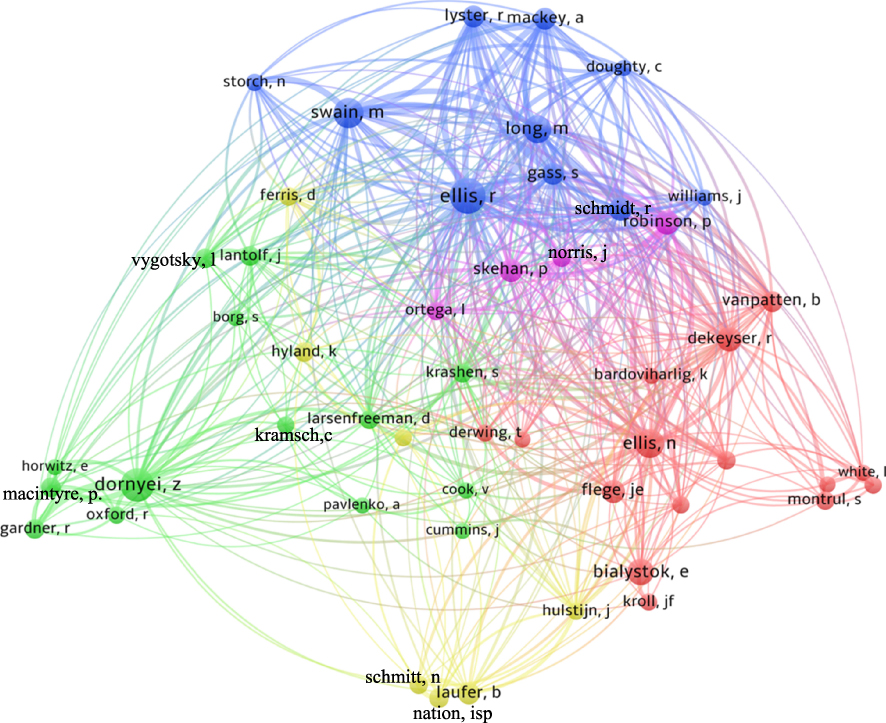
The top 50 most-cited authors between 1997 and 2018 are listed in Table 9 in the appendix. This list is somewhat consistent with the professionally rated leader list in de Bot (Reference de Bot2015), though the order is quite different. The discrepancy may be due to retirement of some leading scholars who were less active in recent years. In addition, the top author list shows that the majority of scholars have stayed on the list in both periods and have remained to be very influential in the field (e.g., Kathleen Bardovi-Harlig, Robert Dekeyser, Diane Larsen-Freeman, Richard Schmidt, and Peter Skehan). A number of highly influential authors (e.g., E. Bialystok, Zoltan Dörnyei, Nick Ellis, Rod Ellis, Susan Gass, Michael Long, Peter MacIntyre, Merrill Swain, and Bill VanPatten) have kept the top 20 seats throughout the two periods. A number of authors, such as Alan Baddeley, Douglas Biber, Ken Hyland, John M. Norris, Lourdes Ortega, and Norbert Schmitt, moved up to the list between 2008 and 2018. A number of scholars, such as Robert Dekeyser, Nick Ellis, Zoltan Dörnyei, James Lantolf, and Paul Nation, had a citation boost between 1997 and 2018
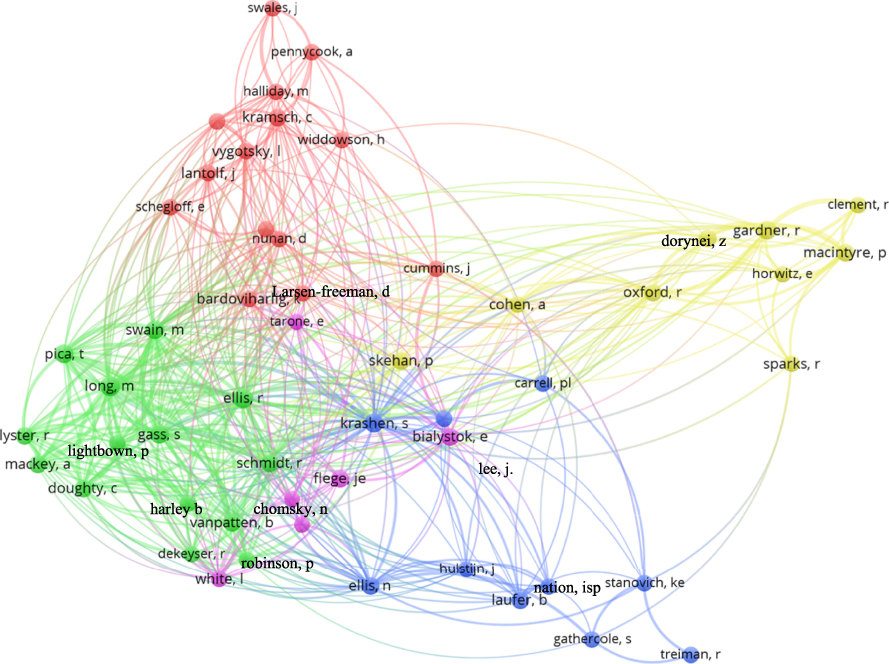
The network maps (Figures 3 and 4) offer a visualization the intellectual structure of the field by showing how the highly influential authors are associated with each other. For example, the 1997‒2007 map identifies several large clusters: the cognitive cluster (e.g., Michael Long, Susan Gass, and Alison Mackey), the individual differences cluster (e.g., Rebecca Oxford, Robert Gardner, and Elaine Horwitz), and the social cluster (e.g., James Lantolf, Lev Vygotsky, and Diane Larsen-Freeman).
Author network map (1997‒2007).

Author network map (2008‒2018).

Top Sources of Publications
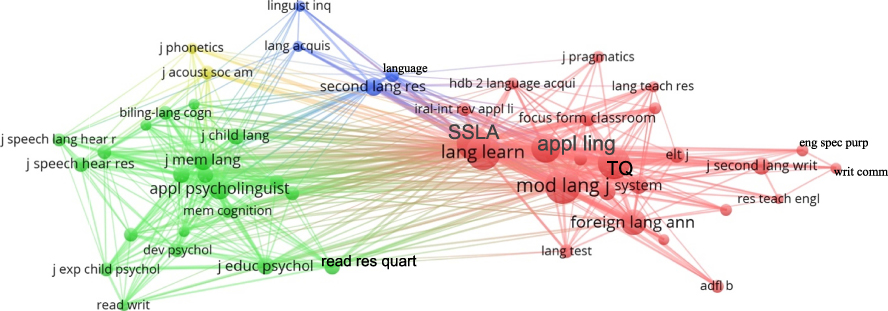
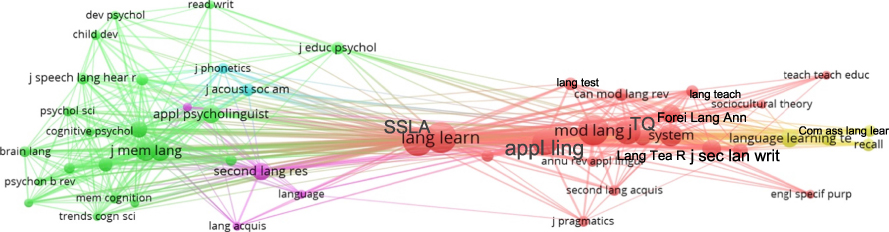
The intellectual structures of the top publication venues are visually presented in Figures 5 and 6. The smart local moving algorithm (Waltman & van Eck, Reference Waltman and van Eck2013) identified three large clusters representing three major sub areas in SLA (Figures 5 and 6). The first cluster was labeled the “Psycholinguistics/Bilingualism cluster” and includes journals/books such as Applied Psycholinguistics, Bilingualism: Language and Cognition, Cognition, and Journal of Memory and Language. The second cluster was named the “SLA/SLT cluster,” which includes Applied Linguistics, Journal of Second Language Writing, Language Learning, Language Teaching Research, Modern Language Journal, Studies in Second Language Acquisition, System, TESOL Quarterly, and so forth. The third cluster was labeled the “Linguistics and Formal Approach cluster,” including journals/books such as Language, Linguistics Inquiry, Language Acquisition, and Second Language Research. The layouts of the network maps over the last 20 years have not changed much except the emergence of the “Technology-Based SLA” cluster on the far east side of the 2008‒2018 map. The emergence of the new cluster was partially due to the rise of a number of technology-based journals logged in the WoS database (e.g., Language Learning & Technology, ReCALL, and Computer Assisted Language Learning).
Network map of sources of publications (1997‒2007).

Network map of sources of publications (2008‒2018).

DISCUSSION
CHANGES AND TRENDS IN TERMS OF SIZE AND DIVERSITY
The citation analysis of impact found several exciting new trends. The field of SLA has flourished during the past 20 years. The data shows that the majority of SLA journals have had a boost in number of publications and impact since the 2000s. This fast growth (e.g., the SLA/SLT cluster) may be partially attributable to a greater diversity in the field.
The network maps found a clear pattern showing that the cognitive SLA approach dominated the field in the 1997‒2007 period (Figures 1a and 1b) and has remained to be the mainstream approach to SLA during the 2007‒2018 period. A number of SLA approaches in the cognitive family continue to be very active, including the interaction approach (e.g., Gass & Mackey, Reference Gass, Mackey, VanPatten and Williams2007), the input processing theory (VanPatten, Reference VanPatten, VanPatten and Williams2007), and the skill acquisition approach (DeKeyser, Reference DeKeyser, VanPatten and Williams2007) (also see the most influential authors in Table 9). However, a notable trend in the field concerns the emergence of alternative SLA approaches (e.g., sociocultural theory, complex theory) that have somewhat different perspectives from the psychologically oriented cognitive account of SLA (Ortega, Reference Ortega and Atkinson2011). About 20 years ago, Firth and Wagner (Reference Firth and Wagner1997) stimulated a heated cognitive-social debate. While scholars from the cognitive side have argued that the cognitive account of SLA views L2 learning as an interplay between learners’ internal and external factors, scholars from the social side maintain that there are fundamental differences between the cognitive account and the social account of SLA (e.g., learning as a psychological process vs. learning as a social accomplishment; abstractness vs. situatedness; Ortega, Reference Ortega and Atkinson2011). Regardless of their differences, the heated cognitive-social debate signals that alternative approaches to SLA have become more influential (see a similar observation in Lei & Liu, Reference Lei and Liu2019a). Ortega (Reference Ortega and Atkinson2011) viewed the change as a positive force that makes the field stronger for the reasons that alternative SLA approaches have brought new insights to the field and that “epistemological diversity we find in SLA—both across and within social, sociocognitive, and cognitive theories alike—fosters multiple and improved understandings of SLA” (p. 167).
The diversification of the field is also reflected by a greater diversity in research institutions over the last two decades (also see Lei & Liu, Reference Lei and Liu2019a). The North American universities have left many influential footprints in the field. Between 1997 and 2007, more than 65% of full-length articles published in the top SLA journals were affiliated with universities in North America and more than 57% of citations belonged to North America. Universities in the United States alone contributed more than 55% of documents and almost 45% of citations. In the 2008‒2018 period, about 43% of articles and 45% of citations were associated with the universities in North America. At the same time, a growing number of publications were found to be affiliated with regions in Asia (e.g., China and Japan). The increasing impact of the Asian region has also been observed in Lei and Liu (Reference Lei and Liu2019a).
CHANGES AND TRENDS IN TERMS OF KEY TOPICS AND THEMES
Changes/Trends in Key Topics Identified by the Keyword Analysis
A number of topics have gained significantly greater interests over the last 20 years. These topics include bilingual advantage, collaborative writing, Common European framework, cognitive control, dynamic system(s), formulaic language, languaging, ideal L2 self, learner corpus, multilingualism, lingua franca, multimodality, usage based, study abroad, teacher cognition, teacher identity, and working memory. More and more topics are related to technology: web 2.0, Facebook, online language learning, computer-mediated communication, Google, and wiki. This significant increase may be attributable to the greater presence of technology-based language learning journals in the 2008‒2018 period. Although the current study surveyed an unbalanced number of technology journals in the two periods due to the availability of bibliometric information in the WoS database, there is little reason to deny the role of technology in SLA, as technology is affecting every aspect of our lives. It should be recognized that application of technology to language learning can take time (e.g., wiki was developed in 1994 but application of wiki to collaborative L2 writing flourished in the 2010s) and many new technologies were developed only in recent years. Perhaps more importantly, the development of technology is beneficial to the field (for a critical review of technology and language learning, also see the 2009 special issue in Modern Language Journal). As technology advances (e.g., more computing power and increased data storage), there was a surge in the number of corpus-based studies published between 2008 and 2018 and several corpus-related keywords have earned more interests. Corpus linguists such as Douglas Biber took a spot on the most-cited author list. Language corpora have various applications to SLA, including theory testing, L2 learning outcome evaluation, wordlist development, and data-driven language learning and teaching (also see a discussion on the influence of technology and corpus linguistics in de Bot, Reference de Bot2015).
While some terms have gained popularity, a number of topics became less popular. Some of these topics are focus on form, extrinsic motivation, topic familiarity, and phonological awareness (also see the results in Lei & Liu, Reference Lei and Liu2019a). Dörnyei’s (Reference Dörnyei2005, Reference Dörnyei2009) motivation framework, adopted from educational psychology, offers a new model to identify and contextualize L2 motivation in addition to the traditional way of classification (extrinsic vs. intrinsic), leading to a drop in usage of the keyword extrinsic motivation. Quebec is a region where both English and French are spoken. The number of studies conducted in the region decreased as the keyword French witnessed a significant drop in number of occurrences.
A number of topics have remained relatively stable. Some of these topics include code switching and willingness to communicate. In addition, no significant change was spotted among all four skills over the past 20 years, as all four keywords had small LL/BIC values. However, there was an unbalanced interest toward the four skills: reading (842) > speaking (756) > writing (665) > listening (293). These sum frequency counts reveal that a large body of research in the field concerns reading, speaking, and writing. Obviously, more studies in listening are needed to achieve a greater balance if listening is no less important than the other skills. The keyword multimodality (zero occurrence, 1997‒2007), somewhat associated with the four skills, was found to have gathered greater attention (LL = 7.85). A closer examination of the keyword in the abstracts shows that multimodality has been connected to technology, writing, grammar teaching, L2 comprehension, and collaborative learning. The increased frequency of this keyword may suggest that the theory of communication and semiotics involving meaning-making exerts a great influence on the field.
The keyword analysis also discovered a number of new topics in the 2008‒2018 period. Although these emerging topics may not be new concepts, they did not appear in the abstracts of the 1997‒2007 period. Some of these topics include statistical learning, languaging (Swain & Watanabe, Reference Swain, Watanabe and Chapelle2012), translanguaging, teacher cognition, multilingualism, and verbal working memory. While statistical learning and verbal working memory have a cognitive nature, other topics (e.g., languaging, translanguaging, and multilingualism) are socially oriented. This is another piece of evidence to confirm that the field is becoming more diversified. Indeed, Lei and Liu (Reference Lei and Liu2019a) made a similar conclusion: the social approach has gained momentum in many domains of applied linguistics. Interestingly, the social and cultural aspects of SLA have been found to be one of the main knowledge fields in TESOL programs worldwide (Stapleton & Shao, Reference Stapleton and Shao2018), supporting the significance of the social approach in language teaching.
A number of keywords are related to research method. Several research methods have been used more frequently between 2008 and 2018, for example, elicited imitation, eye-tracking, mixed method, semistructured interview, and self-paced reading. While both quantitative and qualitative have remained relatively stable, the keyword mixed method has made the biggest jump (LL = 34.76) among all keywords. This result suggests that the field gives great value to combination of research methods, which can provide multiple perspectives on problems in SLA. Finally, while most research methods have remained stable (e.g., conversation analysis), the current study did not identify a decrease of interest in any type of research method, suggesting that many research methods (e.g., factor analysis) are still of great importance to SLA.
Changes/Trends in Key Themes Identified by the Most-Cited Articles in the Citation Analysis of Impact
To some extent, the top-cited articles identified by the citation analysis of impact convey first-hand information about the contemporary themes in the field. In the 1997‒2007 period, some key publications were related to traditional topics such as implicit/explicit learning, collaboration, interaction, and vocabulary. The 1997‒2007 period marked the rise of the dynamic system theory, with two key publications on the list attracting tremendous attention (de Bot, Lowie, & Verspoor, Reference de Bot, Lowie and Verspoor2007; Larsen-Freeman, Reference Larsen-Freeman1997). In the next period, topics in bilingualism (e.g., bilingual advantages) have become extremely popular as the theme occupied eight spots on the top 20 most-cited articles list, including the most-cited article by Creese and Blackledge (Reference Creese and Blackledge2010). Another notable trend is that the meta-analysis method started to play a significant part in the field as two of the most-cited articles in the second period were meta-analytic papers. Because of the influential meta-analysis of Norris and Ortega (Reference Norris and Ortega2000), dozens of meta-analytic studies have been published in SLA journals that investigated the pooled effect sizes of topics such as feedback, implicit/explicit instruction, reading, corpus instruction, and language aptitude. One of the cited publications in the second period is the position paper by the Douglas Fir group (consist of some very influential authors such as Dwight Atkinson, Heidi Byrnes, Meredith Doran, Patricia Duff, Nick Ellis, Joan Hall, Karen Johnson, James Lantolf, Diane Larsen-Freeman, Eduardo Negueruela, Bonny Norton, Lourdes Ortega, John Schumann, Merrill Swain, and Elaine Tarone) that offers a framework to conceptualize language learning and teaching in the multilingual context of the globalized world. At the same time, Plonsky and Oswald’s (Reference Plonsky and Oswald2014) study on effect size has also received enormous attention, as it offers important guidance on how to interpret quantitative results in the field. Another notable trend is an increasing interest in technology (taking three spots of the list), which is consistent with the results in the keyword analysis. As technology advances, it is foreseeable that technology (such as mobile apps and the Internet) will be widely deployed to promote SLA.
Changes/Trends in Key Topics Identified by the Most-Cited Authors in the Cocitation Analysis
The cocitation analysis identified the top 50 scholars in the field in terms of citation counts. Although some of the authors are not SLA specialists, their theories/models have been widely practiced in SLA. Some of these theories include Tomasello’s usage-based theory and Vygotsky’s sociocultural theory. Schmidt’s noticing hypothesis continues to influence the field. Schmidt (Reference Schmidt1990) was one of the most-cited publications in both periods even though the paper was published almost 30 years ago. To some extent, the influence of Schmidt’s theory reflects the mainstream status of cognitive SLA.
A number of most-cited authors are second language vocabulary specialists. These specialists include Paul Nation, Batia Laufter, and Norbert Schmitt. According to the cocitation analysis, Nation’s (Reference Nation2001) book was one of the most-cited publications in the 2008‒2018 period. The keyword analysis confirmed that second language vocabulary research is one of the most important topics in the field. The citation analysis of impact also demonstrated that vocabulary research is popular among SLA researchers. In the most-cited 20 articles list, Coxhead (Reference Coxhead2000) was one of the most-cited articles published in all major SLA journals since 1997. Other documents such as Laufer and Hulstijn (Reference Laufer and Hulstijn2001) and Simpson-Vlach and Ellis (Reference Simpson-Vlach and Ellis2010) were also on the top 20 list. Second language vocabulary is of great importance to SLA for the apparent reason that L2 vocabulary learning is essential for learning a new language (Nation, Reference Nation2001). Over the past 20 years, research in L2 vocabulary has grown substantially, partially due to the comprehensive monograph by I. S. P. Nation (Reference Nation2001) that covers a wide range of topics in L2 vocabulary learning and teaching. Within the L2 vocabulary domain, a number of notable changes have taken place over the past 20 years. One major change is associated with formulaic language (see the cocitation analysis on key publications and the keyword analysis). The number of studies about formulaic language has grown over the past 20 years as SLA scholars have emphasized the importance of formulaic language in vocabulary acquisition (e.g., Schmitt & Carter, Reference Schmitt, Carter and Schmitt2004; Wray, Reference Wray2002). Indeed, there is a great interest in various aspects of formulaic language including its cognitive process, identification, and application (e.g., Biber et al., Reference Biber, Conrad and Cortes2004; Conklin & Schmitt, Reference Conklin and Schmitt2008; Ellis, Simpson-Vlach, & Maynard, Reference Ellis, Simpson‐Vlach and Maynard2008; Hyland, Reference Hyland2008; Kremmel, Brunfaut, & Alderson, Reference Kremmel, Brunfaut and Alderson2015).
Individual differences (IDs) is another hot area in the field, featuring the work by a number of most-cited scholars such as Robert Gardner, Zoltan Dörnyei, Peter Skehan, and Peter MacIntyre. According to the keyword analysis, the interest in IDs has gradually increased. Motivation is one of the key topics in IDs. Dörnyei’s influential motivation model has generated numerous publications. The keyword L2 self has experienced a very rapid growth over the last two decades (also see the keyword analysis and the density view in Figure 2b). Some other hot topics in IDs, as indicated by the keyword analysis, include L2 aptitude and L2 anxiety. However, not all IDs topics have grown. For example, language learning strategy (e.g., Oxford’s influential model) was a key topic in the 1997‒2007 period (Figure 1a), but lost momentum in the 2008‒2018 period (also see the result of the keyword analysis). One criticism on language learning strategy is associated with its conceptualization and reliability, which limits its application across different individual learners (Tseng, Dörnyei, & Schmitt, Reference Tseng, Dörnyei and Schmitt2006).
CHANGES AND TRENDS IN TERMS OF SLA THEORIES
In addition to the mainstream cognitive SLA approaches (e.g., interaction approach, input processing theory) that are highly influential in the field, the current analysis also found that a number of approaches emerged on the most-cited publication list. Two notable ones are the sociocultural theory (e.g., Lantolf & Thorne, Reference Lantolf and Thorne2006) and the complexity theory (e.g., de Bot et al., Reference de Bot, Lowie and Verspoor2007; Larsen-Freeman, Reference Larsen-Freeman1997). This result echoes de Bot’s (Reference de Bot2015) findings on the trends in applied linguistics that were summarized from professional opinions.
In the special issue edited by Lantolf (Reference Lantolf1994), Lantolf and colleagues reported a series of studies informed by the Vygotskian sociocultural theory (SCT), which led to the subsequent trend to apply the theory in the field. Vygotskian theory has offered a number of influential concepts (e.g., zone of proximal development, internalization) and research approaches (e.g., activity theory) that have great impacts on education. Since its introduction to SLA, SCT has gained a well-respected status in the field. The influential monograph by Lantolf and Thorne (Reference Lantolf and Thorne2006) has described two pedagogical applications of the theory in the L2 classroom setting (concept-based instruction and dynamic assessment), substantially extending the theory’s impact on instructed SLA. Indeed, in the last decade, the field has observed a growing volume of publications associated with SCT, including a specialized journal (Language and Sociocultural Theory), a handbook (The Routledge Handbook of Sociocultural Theory and Second Language Development), monographs, edited books (e.g., Lantolf & Poehner, Reference Lantolf and Poehner2014), book chapters, dissertations, and journal articles devoted to the theory and its application in language learning and teaching.
The complexity theory (or dynamic system theory) has also gained tremendous momentum (de Bot, Reference de Bot2015). Larsen-Freeman is one of the first leading scholars who introduced the theory to the field. Larsen-Freeman regards the complexity theory as a member of the “emergentist theory” family that includes theories such as connectionism and usage-based theory (Larsen-Freeman, Reference Larsen-Freeman2018, p. 58). Larsen-Freeman (Reference Larsen-Freeman1997) has described SLA as a chaotic, open, dynamic, and adaptive system. The theory has been embraced by a number of leading scholars in the field (e.g., Kee de Bot, Nick Ellis, Marjolijn Verspoor, Zoltan Dörnyei) and has been applied to various domains such as individual differences (e.g., Dörnyei, Reference Dörnyei2009), mutilingualism (e.g., Herdina & Jessner, Reference Herdina and Jessner2002), vocabulary modeling (Meara, Reference Meara2006), and L2 development (Ellis & Ferreira-Junior, Reference Ellis and Ferreira-Junior2009).
CHANGES AND TRENDS IN TERMS OF FOCUS OF JOURNALS
The network maps of journals offer interesting insights into the research focuses of the major journals in the field. In these maps, journals with relatively similar research focuses would be clustered together. If the distance between two journals is shorter, the two journals tend to have a closer research agenda. As shown in the two maps, the majority of publication venues are contained in two big clusters, the SLA/SLT cluster (e.g., Applied Linguistics, Language Learning, SSLA, Modern Language Journal, TESOL Quarterly) and the psycholinguistics/bilingualism cluster (e.g., Applied Psycholinguistics, Bilingualism: Language & Cognition). Modern Language Journal, TESOL Quarterly, and Language Teaching Research are located in the middle of the SLA/SLT cluster, and they have the most in common: a strong focus on teaching. These teaching-oriented journals have relatively little commonality with psycholinguistics journals, which are more interested in language processing and production (e.g., Applied Psycholinguistics). Therefore, the teaching-oriented journals are located far away from the psycholinguistics cluster. The two major SLA journals, Language Learning and SSLA, however, have a broader focus. For example, keywords given in the official website of Language Learning included cognitive, psychology, neuroscience, education, ethnography, sociolinguistics, sociology, semiotics, and semantics. Therefore, Language Learning and SSLA are located on the west side of the SLA/SLT cluster. Second Language Research of the Linguistics and Formal Approach cluster has a somewhat different focus from the other journals. According to the official website, one major theme of the journal concerns “theoretical linguistics focused on second and additional language acquisition” (this focus has remained the same since 1985; Gass, Reference Gass, Ritchie and Bhatia2009). However, Second Language Research also publishes articles in neuroscience, cognitive science, and psycholinguistics. Thus this journal is located closer to the psycholinguistics/bilingualism cluster.
The far east side of the 2008‒2018 network map is occupied by the technology-based cluster (including journals such as Language Learning & Technology, Computer Assisted Language Learning, and ReCALL). While this cluster has a heavy focus on technology, it is closer to the language teaching-oriented journals in the SLA/SLT cluster. This suggests that technology-based language learning has a strong connection to theories and findings in language teaching and that the psycholinguistic and formal approaches to SLA have not yet been widely adopted by technology-oriented journals.
CONCLUSION
The current study used the bibliometric method to describe trends and changes in the field of SLA over the past 20 years. Using citation information, this study performed analysis on publications, sources of publications, authors, research institutions, and research topics. Due to space limitations, it is not possible to offer a full description of all the key publications, authors, theories, models, and topics in the field.
Nevertheless, the current study was able to list some of the most influential publications, journals, authors, and research institutions in the field. The keyword analysis also offered insights into new trends in the field, which, in my view are useful to those who are interested in conducting SLA research. The list of the most influential publications is a useful resource for newcomers to the field. This list can be regarded as a mini-guide for students who plan to pursue a degree in the field. This mini-guide may also assist scholars and students new to a particular SLA domain (e.g., L2 vocabulary) to quickly locate key publications and authors. In addition, the network analysis of journals has offered insights into the focuses of the key journals in the field, which may help authors make better decisions concerning which journal(s) may be the best fit for submitting their scholarly research.
Due to space limitations, this study has only listed a limited number of publications and authors. SLA is not a small field. There are hundreds of researchers who have published thousands of articles and books. Although it is not possible to list all authors and publications here, it should be acknowledged that all SLA publications and authors have strengthened the field. As the process of globalization has made second language learning necessary for many people, the field’s fast growth is exciting not only to researchers but also to learners and teachers. This is because this development would continuously refine our understanding of SLA, which would eventually benefit people who learn and use a second language.
SUPPLEMENTARY MATERIAL
To view supplementary material for this article, please visit https://doi.org/10.1017/S0272263119000573