Introduction
In many societies, marriage signifies the transition from childhood to adulthood and the beginning of socially acceptable sexual behaviour and childbearing. Women who marry early are more likely to have their first child at a young age, and they also tend to have more children than those who marry later. Age at first marriage has been considered to be one of the most important determinants of fertility (Lesthaeghe et al., Reference Lesthaeghe, Kaufmann and Meekers1989). Early marriage among women has also been found to be associated with increased risk of HIV infection (Clark, Reference Clark2004), particularly in developing countries (Palamuleni, Reference Palamuleni2011). An early childbearing mother is at higher risk of various prenatal morbidities such as gestational diabetes, gestational hypertension and preterm delivery than her counterparts in the population (Palacios & Kennedy, Reference Palacios and Kennedy2011). Early childbearing is also associated with low social status of women and adverse health risks for both the mother and the child (Palamuleni, Reference Palamuleni2011).
Many women will bear their first child about one year after marriage, and they are usually responsible for household chores and care of the children. Due to the unique role of women in the population, studies on age at first marriage may provide valuable information on level of women and child health, and general standard of living of the population. For the population of Bangladesh, relationships between age at first marriage and socioeconomic factors (Ahmed, Reference Ahmed1986), early childbearing (Kamal, Reference Kamal2012), fertility (Islam et al., Reference Islam, Islam and Padmadas2010) and other socio-demographic factors (Khan et al., Reference Khan, Krämer, Khandoker, Prűfer-Krämer and Islam2011; Hossain et al., Reference Hossain, Bharati, Aik, Lestrel, Abeer and Kamarul2012) have been reported.
The trend of change in age at first marriage will provide valuable feedback on efforts by the government to improve the social and health standards of the population, especially in developing countries like Bangladesh where health and clinically related reforms are being actively implemented. Many studies have reported changes in the age at first marriage in several populations over time (Andersson, Reference Andersson1998; Löfstedt et al., Reference Löfstedt, Ghilagaber, Shusheng and Johansson2005; Mukherjee et al., Reference Mukherjee, Das and Banik2007; Marston et al., Reference Marston, Slaymaker, Cremin, Floyd, McGrath and Kasamba2009; Cremin et al., Reference Cremin, Mushati, Hallett, Mupambireyi, Nyamukapa, Garnett and Gregson2009; Chen, Reference Chen2009; Copen et al., Reference Copen, Daniels, Vespa and Mosher2012). The purpose of this study was to determine the age of first marriage among Bangladeshi women, its trend of change over time and the prevalence of child marriage, and to investigate the association of these with various socio-demographic factors.
Methods
Data
Data were derived from the 2011 Bangladesh Demographic and Health Survey (BDHS-2011), a national-level survey where various districts of Bangladesh were represented. Married women of reproductive age (15–49 years) within the sample population were identified. Socioeconomic, demographic, anthropometric, health and lifestyle information from 17,842 ever-married Bangladeshi women was collected from 8th July 2011 to 27th December 2011. Age a marriage was recorded to the nearest year. The sampling technique, survey design, survey instruments, measuring system and quality control have been described elsewhere (NIPORT, 2013). The data set was checked for outliers by the present authors using appropriate statistical techniques (Dunn & Clark, Reference Dunn and Clark1974). Some missing values were detected, and these cases were excluded from the analysis. After removing outliers, the size of the data set was reduced to 16,200 for the current analysis. For analysis of trends, data from previous BDHS surveys conducted in 1993–1994, 1996–1997, 1999–2000, 2004 and 2007 were included in the analysis.
The legal age of first marriage of Bangladeshi women is 18 years (NIPORT, 2009). The sample population was classified into two groups according to their age at first marriage: (i) child marriage (less than 18 years) and (ii) legal age marriage (18 years and older).
Statistical analysis
Multiple binary logistic regression analysis was used to observe the effect of education level of respondents and their husbands, present wealth index, religion and residence on child marriage. The model corresponding to each variable is:
 $${\rm log}[P/({\rm 1}{\minus}P)]=\beta _{0} {\plus}\beta _{{\rm 1}} X_{{\rm 1}} {\plus}\beta _{{\rm 2}} X_{{\rm 2}} {\plus}\beta _{{\rm 3}} X_{{\rm 3}} {\plus}\beta _{{\rm 4}} X_{{\rm 4}} {\plus}\beta _{{\rm 5}} X_{{\rm 5}} $$
where, P=the probability of child marriage (coded 1), 1−P=the probability of legal age marriage (coded 0); X 1 =respondent’s education level (0 if uneducated, 1 if primary, 2 if secondary, 3 if higher); X 2 =husband’s education level (0 if uneducated, 1 if primary, 2 if secondary, 3 if higher); X 3 =wealth index (0 if poor, 1 if middle, 2 if rich); X 4 =religion (1 if Muslim, 0 if other); X 5 =residence (1 if urban, 2 if rural); β 0 =intercept term, and β i =unknown logistic regression coefficients (i=1, 2, 3, 4, 5). The parameter β i refers to the effect of X i on the log odds, such that Y=1, controlling the other X i . The multicollinearity problem (being dependent on each other) among the independent variables in the multiple logistic regression model was checked by the magnitude of the standard error (SE): if this lies between 0.001 and 0.5, it is judged that there is no evidence of multicollinearity (Chan, Reference Chan2004).
Finally, an independent t-test and ANOVA were used to find the significance differences between two and more than two groups, respectively. Statistical significance was accepted at p<0.05. All statistical analyses were performed using IBM SPSS (version 19.0).
Results
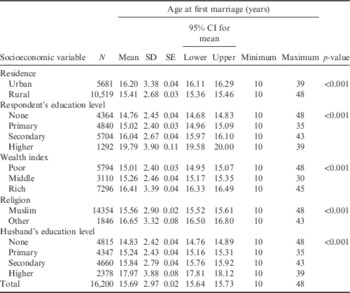
Data for 16,200 married Bangladeshi women from the BDHS-2011 survey were included in the analysis. The mean age at first marriage of the women was 15.69±2.97 years (95% CI: 15.64–15.73), ranging from 10 to 48 years (Table 1), and the median was 15.00 years. The mean age of marriage for women living in rural areas (mean and median: 15.41±2.68 and 15.00 years, respectively) was significantly lower (p<0.001) than that of urban women (mean and median: 16.20±3.38 and 16.00 years, respectively). Early marriage was especially pronounced among women who were uneducated, had uneducated husbands, were Muslims and were living in poor economic conditions (Table 1).
Descriptive statistics for age at first marriage among Bangladeshi women by socioeconomic factors, BDHS-2011

Prevalence of child marriage
The prevalence of child marriage (marriage at <18 years) among Bangladeshi women was 78.2% (rural 81.6%; urban 71.9%). Of these, 72.7% (rural 76.2%, urban 66.3%) were married between the ages of 13 and 17 years. More than 5% of Bangladeshi women were married before the age of 13, and only 21.8% (rural 18.4%, urban 28.1%) were married after they reached the legal age to do so (Table 2).
Distribution of age at first marriage among Bangladeshi women by residence, BDHS-2011

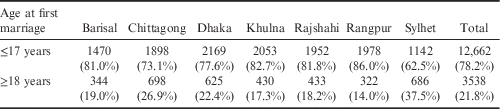
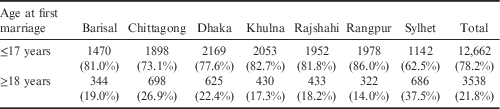
The highest prevalence of child marriage was found among women in Rangpur division (86.0%), followed by Khulna (82.7%), Rajshahi (81.8%), Brisal (81.0%), Dhaka (77.6%), Chittagong (73.1%) and Sylhet (62.5%) (Table 3).
Distribution of age at first marriage among Bangladeshi women by region, BDHS-2011
Effect of socioeconomic factors on child marriage
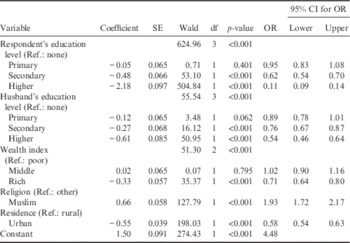
The coefficients and odds ratios determined by logistic regression analysis demonstrated that uneducated women were more likely to have a child marriage than women with secondary (OR=0.62, 95% CI: 0.54–0.70; p<0.001) or higher (OR=0.11, 95% CI: 0.09–0.14; p<0.001) education. Married men who were uneducated were more likely to marry a woman before her legal age of marriage compared with men with primary (OR=0.89, 95% CI: 0.78–1.01; p=0.062), secondary (OR=0.76, 95% CI: 0.67–0.87; p<0.001) or higher (OR=0.54, 95% CI: 0.46–0.64; p<0.001) education. Child marriage was more common among women from the poor economic index group (OR=0.71, 95% CI: 0.64–0.80 p<0.001) compared with those from the rich economic index group. Child marriage was also more common among Muslim women (OR=1.93, 95% CI: 1.72–2.17; p<0.001) compared with women from other religious backgrounds. Rural women were more likely to engage in child marriage (OR=0.58, 95% CI: 0.54–0.63; p<0.001) than women living in urban areas (Table 4).
Logistic regression estimates for the effects of socioeconomic factors on the likelihood of child marriage, BDHS-2011

Trends in child marriage over time
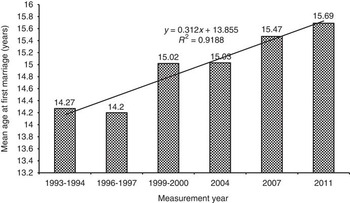
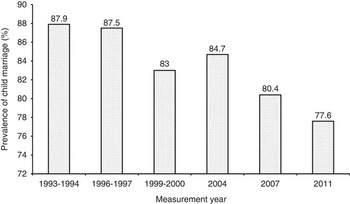
Additional data sets were included from previous BDHS surveys conducted in 1993–1994, 1996–1997, 1999–2000, 2004 and 2007 for analysis of changes in age at first marriage over time. The ANOVA model was used to determine the group variation in age at first marriage. The data sets were initially checked for normality and homogeneity. The Kolmogorov–Smirnov non-parametric teat was used to test the normality of the data, and the Levene test was performed to check the group homogeneity in age at first marriage. These tests showed that the data were normally distributed and that the groups were homogeneous. Thus the standard assumptions of ANOVA were satisfied, and the ANOVA results demonstrated that the variations in the age at first marriage of Bangladeshi women among the various BDHS surveys were statistically significant (p<0.001). The presence of trends in age at first marriage was subsequently examined over the different data sets using linear regression analysis (Fig. 1). The slope of the regression line indicates an increasing tendency of the age at first marriage of Bangladeshi women over the whole period for the various BDHS surveys. As expected, there was also a decreasing tendency of child marriage over the same period (Fig. 2).
Trends in age at first marriage among Bangladeshi women, BDHS 1993/94 to 2011.

Trends in prevalence of child marriage among Bangladeshi women, BDHS 1993/94 to 2011.

Discussion
Based on the data set from the BDHS-2011 survey, this study demonstrates that the mean and median of age at first marriage of Bangladeshi women were 15.69±2.97 and 15.00 years, respectively. Despite the fact that the legal age of marriage in Bangladesh is 18 years for women and 22 years for men, many marriages still took place before the legal age (NIPORT, 2009). More than 78.2% of Bangladeshi women married before the legal age of marriage, and this was higher in rural area (86.1%) compared with urban areas (71.9%). The median age of marriage was obviously lower than that reported for American and Chinese women: 25.8 years (Copen et al., Reference Copen, Daniels, Vespa and Mosher2012) and 22.5 years (Löfstedt et al., Reference Löfstedt, Ghilagaber, Shusheng and Johansson2005), respectively. More recently, Cremin et al. (Reference Cremin, Mushati, Hallett, Mupambireyi, Nyamukapa, Garnett and Gregson2009) reported that the median age at first marriage of Zimbabwean women was 18.5 years and that of Nigerian women 17.8 years (Adebowale et al., 2012), while Aryal (2007) reported that the median age at first marriage of Nepalese women was only 17 years. Level of education has been associated with age at first marriage and this would explain the younger age at first marriage in developing countries, as reported in the literature (Raymo, Reference Raymo2003; Borkotoky & Unisa, Reference Borkotoky and Unisa2015). A recent study based on the BDHS-2011 survey reported that 26.1% of Bangladeshi women are not educated (NIPORT, 2013). Further analysis of the sample population showed that uneducated women married earlier than those with primary, secondary and higher education.
This study also showed that women from poor families married earlier than those from rich families, and that women who were living in rural environments married earlier than those from urban areas. Women living in urban areas are generally more educated than those living in rural areas, and more than 50% of the sample population residing in an urban environment fell into the highest wealth index group, whereas this figure was only 9% for the rural population (NIPORT, 2013).
In Bangladesh, parents usually select spouses for their children. In some middle-class urban families, men may occasionally negotiate their own marriages. Only in the most sophisticated, elite families do women participate in their own marriage arrangements. Woman may be contracted to marry a man of higher social status, but generally arrangements are made between families of similar social standing (Heitzman & Worden, Reference Heitzman and Worden1988). It is obvious that social and traditional factors influence marital arrangements in general, and this also includes age at first marriage. It was not possible to further analyse these factors due to the nature of the available data.
The current study showed that the median age at first marriage of Bangladeshi women has had an increasing trend over time. At the same time, the trend for child marriage has decreased over subsequent BDHS surveys from 1993–94 to 2011. This result is in agreement with that of Kamal (Reference Kamal2012), who also reported a decreasing trend of child marriage among Bangladeshi women based data from BDHS-2007. The mean age at first marriage of Bangladeshi women fluctuated among the measurement year cohorts from 1993–94 to 2011. For this reason the present study used linear regression analysis to assess the trends, and the relevant coefficient of the regressions demonstrated that it has been increasing over the last five decades. A similar trend has been reported in other populations, including in women in sub-Saharan Africa (Marston et al., Reference Marston, Slaymaker, Cremin, Floyd, McGrath and Kasamba2009), the USA (Copen et al., Reference Copen, Daniels, Vespa and Mosher2012) and China (Löfstedt et al., Reference Löfstedt, Ghilagaber, Shusheng and Johansson2005).
Government and non-government organizations in Bangladesh are trying to create awareness among the population about the disadvantages of early marriage. Illiteracy and a poor economy are two of the main factors hampering this effort. There were more illiterate women in rural areas (32.2%) than urban areas (23.2%), but improvement has been observed over the years; the percentage of rural women who have never attended school has decreased from 50% in 1993–94 to 32% in 2007 (NIPORT, 2009). More than 50% of the population residing in urban environments are in the highest wealth index, compared with only 9% of the rural population (NIPORT, 2009). A recent report also showed that over the past two decades, the proportion of Bangladeshi women marrying before the legal age decreased from 73% in 1989 to 65% in 2011 (NIPORT, 2013). Moreover, the proportion of women marrying by age 15 years had declined by two-thirds over time, from 65% among women in the oldest cohort (survey year 2004) to 21% among women in the youngest cohort (survey year 2007). Similarly, the proportions of women marrying by ages 18 and 20 years have decreased substantially (NIPORT, 2009).
Nowadays parents are more conscious about their child’s future and girls are also more aware about the health, medical and economic implications of early marriage and pregnancy. Education has been considered as one of the most effective catalysts to changes in lifestyle among the population, and the Government of Bangladesh and various non-government organizations have put in much effort to improve the education of parents on the disadvantages of child marriage and early pregnancy. Many women with higher education may decide to be more financially independent before settling down and having a family.
In conclusion, this cross-sectional study shows that age at first marriage among Bangladeshi women in 2011 was low (mean and median: 15.69±2.97 years and 15.00 years respectively) compared with that of women from developed and other developing nations. More than 78% were married before the legal age for marriage (18 years of age for women) in Bangladesh. The practice was more common among uneducated women, those with uneducated husbands, women from rural areas and women from poor families. An increasing trend in age at first marriage (and decreasing trend in child marriage) was observed between the 1993–94 and 2011 BDHS surveys.
Acknowledgment
The authors would like to thank the Bangladesh Demographic and Health Survey (BDHS) for providing nationally representative data from 1993–94 to 2011. The authors declare that there are no conflicts of interests in relation to this study.