INTRODUCTION
For many observers, the election of Donald Trump as President of the United States signaled the peak of America’s distrust in government. By focusing his campaign around his “outsider” status and ability to change the way government is run through business expertise, then-candidate Trump seemed to capitalize on the electorate’s rampant cynicism. As one Washington Post op-ed put it, “Trump’s victory was not primarily a vote in favor of anything. Trump is a surfer atop a wave of mistrust and disillusion” (Von Drehle Reference Von Drehle2017). In examining his campaign in New Hampshire, a National Public Radio story focused on exit poll data showing that “one of the main reasons people voted for Trump was that they didn’t trust the government,” (Lo Wang Reference Lo Wang2016). Indeed, trust in government has declined significantly since the mid-1960s, when nearly eighty percent of Americans said they trusted the government to do the right thing most or all of the time. By 2015, that number had dropped to just nineteen percent (Pew Research Center 2015). According to this logic, the public’s vast distrust served as a mobilizing force in the 2016 election, with Trump’s campaign turning out voters by tapping into their skepticism.
In stark contrast to this account of the 2016 election, the attention given to Ferguson, Missouri following the shooting death of Michael Brown by police officer Darren Wilson focused on the demobilizing influence of distrust in government. Many noted that Ferguson’s residents were majority Black, while the municipality’s elected officials were almost exclusively White (Weissmann Reference Weissmann2014). To explain this disjuncture, journalists pointed to the city’s racially biased criminal justice system and the low voter turnout among Black residents which seemed to grow out of it (U.S. DOJ 2015). As one resident noted, “I think there is a huge distrust in the system… [Many Blacks in Ferguson think]: Well it’s not going to matter anyway, so my vote doesn’t count,” (Roth Reference Roth2014, p. 1).
The difference between these two narratives, one in which government distrust promotes political involvement and one where it works as a politically disengaging force, raises an important question: how should we understand the relationship between distrust and participation in America? This question is not new. Following the initial decline in political trust in the late 1960s, political scientists and sociologists devoted significant energy to unlocking this relationship (e.g. Citrin Reference Citrin1974). Understanding this decline seemed particularly pertinent at the time as it aligned with a decrease in voter participation (Putnam Reference Putnam2001). As trust in government has settled into a lower and more stable level, however, scholarly attention devoted to this issue has waned. Yet the election of Donald Trump and the events of Ferguson highlight the need to revisit the relationship between participation and political trust within the modern context. Further, the dynamics of these contrasting accounts call for a perspective that places race at the center of this relationship.
In taking on this task, this article argues that the connection between trust and participation in contemporary America is best understood through the racial contingencies contained within this relationship. The evidence presented here demonstrates that among White Americans, distrust in government encourages greater political engagement, while skepticism among People of Color generates political quiescence. To explain this racial variation, I put forward a theoretical framework rooted in policy feedback and evaluate it through a mixed-methods design that incorporates quantitative analysis and in-depth interviews. The results demonstrate that the racial variation in the political consequences of distrust can be traced to Whites and People of Color experiencing government differently in contemporary America. For Whites, distrust in government stems from a sense that government is poorly managing “their” tax dollars (i.e. their investment in government), mobilizing them to change this dynamic by getting involved in the political process. In contrast, distrust among People of Color is grounded in a fear of the criminal justice system that teaches individuals to become invisible to government. Ultimately, by exposing different racial groups to different modes of governance, the modern American state perpetuates racially patterned political inequality even as formal laws promoting this dynamic have largely faded away.
In the next section, I review the scholarship concerned with the connection between political trust and participation. I highlight the lack of recent attention given to this matter, as well the absence of racial contingencies considered within this literature. I then provide a theoretical framework rooted in policy feedback to explain how the relationship between trust and participation might vary across racial groups, before detailing the mixed-methods design used to carry out this framework. Following this, I turn to interview data to demonstrate how the expectations derived from this framework are met, as well as quantitative analysis to statistically generalize the interview findings out to the nation as a whole. Finally, I conclude with a reflection on the implications of this research for future scholarship, as well as American democracy and policymaking.
DISTRUST: THE GREAT (DE)MOBILIZER
One potential reason that so much research has been devoted to understanding the connection between trust in government and political participation is that there are logical but contradictory arguments contained within this relationship. It is reasonable to believe that trusting individuals would be the most likely to view participating in the political process as a worthwhile endeavor, but one could also argue that “Those who are most dissatisfied with government have the largest incentive to change it” (Hetherington Reference Hetherington2005, pp. 64-65). These competing expectations provide a compelling puzzle. Indeed, different scholars have put forward evidence supporting both sides, with some of the earliest research on the subject contending that trust should encourage participation (Almond and Verba, Reference Almond and Verba1963), while others saw distrust as generating political engagement (Gamson Reference Gamson1968). A third set of scholars contends that there is no link between levels of political trust and participation, helping to explain why trust is not seen as a particularly important variable in most studies analyzing political involvement (Miller Reference Miller1980; Rosenstone and Hansen, Reference Rosenstone and Hansen1993).
Of course, there are two possible ways to explain a null relationship between trust and participation. The first is that the two are not associated with each other, while the second would argue that the null result appears due to a “cancelling-out” effect. That is to say, perhaps distrust encourages participation in some contexts and discourages it in others. If this is the case, a failure to differentiate between these two contexts would lead one to erroneously conclude that trust is not linked to participation where in reality a strong but contingent relationship exists. This second possibility has driven a large amount of scholarship. As Margaret Levi and Laura Stoker (Reference Levi and Stoker2000) note, “One theme that pervades this entire literature on distrust and political engagement is that the proper model linking the two is likely to involve complex interactions and contingencies” (p. 487). If this is the case, the important question is what salient contingencies can help us make sense of this relationship?
A multitude of answers have been put forward in response to this question, with the scholarship clustering around two central aspects of the relationship. In the first, research has focused on different types of political acts. In particular, a distinction has been drawn between “conventional” forms of participation (e.g. voting), and “unconventional” forms (e.g. protesting). The central argument is that distrust does not encourage conventional participation but instead spurs people to engage outside of the traditional process (Citrin Reference Citrin1977; Jackson Reference Jackson1973). For a second group of scholars, individual characteristics explain the contingent relationship between trust and participation. Some early research suggested that distrust fosters political engagement among those who possess a high level of political efficacy (Gamson Reference Gamson1968; Miller Reference Miller1974; Shingles Reference Shingles1981). Here, scholars contend that distrust convinces people that change needs to happen, while efficacy gives them the belief that they are capable of creating that change. Similar arguments have been made by substituting other characteristics for efficacy, asserting that distrust will lead to political participation among those who can draw on their educational or financial resources to translate cynicism into political action (Chan Reference Chan1997; Citrin Reference Citrin1977; Nie and Verba, Reference Nie and Verba1987).
Two limitations within the extant research call for further analysis. First, as can be seen in the years of most of the citations above, little attention has been devoted to this subject recently. Scholars were initially attracted to this relationship due to the severe decline in political trust that occurred in the late 1960s and the corresponding shift in turnout rates, illuminating the potential importance of understanding the connection between trust and participation. As Americans’ trust in government has leveled off (Pew Research Center 2015), and turnout in presidential elections has rebounded over the last twenty years (Wallace Reference Wallace2016), this issue has drawn less attention. This leaves open questions about how trust is related to participation in the contemporary era, where cynicism feels more like a central facet of the political dynamic rather than a new phenomenon.
Second, that the decline in political trust over the past half century has been experienced relatively evenly across racial groups seems to have pushed scholars away from pursuing an investigation of the relationship between cynicism and participation that centers around race (Miller Reference Miller1974; Orren Reference Orren, Nye, Zelikow and King1997). This is notable given scholarship showing how White hostility towards government began to rise at the same time that trust levels started to fall, with this hostility emerging in response to the federal government’s more aggressive approach to racial inequality (King Reference King2017). Thus, racial politics seem to provide an important context for understanding the decline in political trust. To the extent that race and distrust have been covered, scholars have tended to focus on dynamics within racial groups (Nunnally Reference Nunnally2012). For example, research has considered contexts in which distrust fosters participation among Black Americans (Jackson Reference Jackson1973; Shingles Reference Shingles1981). Yet, the perception of Trump’s election being driven by the distrust of mostly White voters, coupled with the demobilizing distrust of Black people covered extensively in Ferguson, calls for a new analysis that places emphasis on potential contingencies across racial groups. That is to say, might there be racial variation in the relationship between trust and participation in America today? In the next section, I provide a theoretical framework for examining this question.
POLITICALLY MEANINGFUL DIFFERENCES IN GOVERNMENT EXPERIENCES
The framework introduced here focuses on a central mechanism through which race continues to divide American society. As Desmond S. King and Robert C. Lieberman (Reference King and Lieberman2009) note, “racially constructed differences among the population have been central to the structure and processes of American politics, such that White and Black Americans (and more recently, Latinos, Asian Americans, and other groups) have experienced the state in very different ways,” (p. 578). This reality of Whites and People of Color experiencing government differently has been an enduring truth of the American state, from its founding in slavery and native removal (King and Smith, Reference King and Smith2005; Young and Meisner, Reference Young, Meisner, Joseph, Novkov and Warren2008) through to the contemporary rise of the carceral state (Alexander Reference Alexander2010).
Two important points are illuminated by focusing on this particular aspect of race in America. First, as highlighted by King and Lieberman (Reference King and Lieberman2009), an emphasis on this racial split in governing experiences implicates more than a Black-White divide. Instead, the function of American government, both historically and currently, extends this schism out to a difference between Whites and People of Color more broadly. Second, using this divide in governing experiences to investigate contingencies in the connection between political distrust and participation shows the need for a theoretical framework that re-orients the approach to studying this relationship. Rather than beginning with a focus on what distrust does for different people, I must start with a consideration of the governing experiences that have produced this distrust in the first place and investigate how these experiences might differ across racial groups.
Research on policy feedback highlights why this difference in distrust-inducing experiences might have implications for the political consequences of that distrust (Pierson Reference Pierson1993). People’s political attitudes and behaviors can develop out of their experiences with government in that they extrapolate from these experiences in deciding how government, writ large, functions. For example, Soss (Reference Soss2000) shows that the lack of voice welfare recipients exercise in their encounters with caseworkers fosters lower levels of external efficacy and political engagement, as they extrapolate from these experiences in concluding that all of government will similarly be unresponsive to their demands. In this way, government experiences (e.g. receiving welfare) teach people lessons about how government relates to them, thus shaping people’s political actions and attitudes, such as their trust in government (Lerman and Weaver, Reference Lerman and Weaver2014b).
My framework combines this understanding of racial differences in government experiences, and people extrapolating from these experiences in forming their trust in government, to explain how racial variation in the participatory consequences of distrust could be generated. First, I build on the notion of racial variation in government experiences to argue that we should also expect racial variation in the state interactions that produce distrust. From here, the theoretical framework posits that experiences with the state not only produce distrust, but also attach a particular meaning to it. For example, consider that if one’s distrust is generated through an experience with the state that teaches them to be fearful of government, the meaning of that distrust is likely to be different from the meaning emerging from an experience where one becomes frustrated with government. Finally, in linking this framework back to participation, I argue that it is this meaning of one’s distrust that ultimately shapes its participatory impact. To use the same example, distrust connected to a fear of government seems likely to have a different participatory impact when compared to distrust tied to frustration with government. In this way, racial differences in government experiences can explain racial contingencies in the participatory impact of political distrust, insofar as racial variation in distrust-inducing experiences fosters a racial split in the meaning of distrust.
From this perspective, the framework leaves open a few central questions to be answered by the remainder of this article. What experiences with the state tend to produce distrust and how do they differ across racial groups? How do these divergent experiences shape the meaning of one’s distrust, and how do these meanings alter the political influence of that distrust? Answering these questions requires an analysis that begins with uncovering racial differences in where distrust comes from, using this information to explore what distrust means, and finally applying this knowledge in analyzing what distrust does.
UNCOVERING DISTRUST AND ITS POLITICAL CONSEQUNCES
Employing this framework to investigate the racially contingent relationship between trust and participation necessitates a redesign of how policy feedback scholarship is usually conducted. Feedback scholars generally choose a specific policy and examine how it shapes beneficiaries’ behavior. Examples of this approach include Andrea Louise Campbell’s work on Social Security (Reference Campbell2003) and Suzanne Mettler’s examination of the GI Bill (Reference Mettler2002). In contrast, this study does not begin with a policy of interest. Rather, I am trying to uncover which government experiences drive individual’s distrust of government, how these experiences vary across racial groups, and how this variation might illuminate any differences in the political consequences of distrust. As a result, my methodological approach must provide people with the flexibility to bring up any government experience they have had, rather than asking questions about a particular policy or government entity.
To carry out this approach, I rely on a mixed-methods design that is centered on in-depth, semi-structured interviews. For the purposes of the analysis shown here, these interviews included three crucial components. First, I sought to obtain a sense of people’s general feelings about government, a section that often revealed their level of trust in it. Second, I asked questions to uncover the different ways each individual had experienced government, giving interviewees the space to draw on the full range of their interactions with the state. Third, each interview involved questions about people’s political participation habits.Footnote 1 Importantly, semi-structured, in-depth interviews provide two distinct advantages for this study. First, I could ask probing questions that gave me a more nuanced understanding of how these components fit together within each individual to form a coherent whole (Lin Reference Lin1998; Rubin and Rubin, Reference Rubin and Rubin2011). Specifically, I could better elucidate how people’s distrust developed out of their experiences with government and how this distrust connected to their level of political engagement. Second, interviews conducted in this format allow researchers to place greater skepticism on the shared meaning of concepts across contexts (Schaffer Reference Schaffer2016). Drawing on the framework above, this gave me the analytic opportunity to begin with the idea that distrust might not mean the same thing to individuals from different racial groups, and to explore how these differences in meaning might shape the political impact of distrust.
To obtain racial variation across interviewees, I primarily recruited subjects from four areas in an upper Midwest state in which I did ethnographic work. The interviewees differed not only in their racial identification but also along several other salient political dimensions, including their socioeconomic status, geography, and party identification. In this way, I could isolate race’s specific role by exploring commonalities in government experiences for people with the same racial identification but different contexts (e.g. different town, different socioeconomic status, etc.). In total, I interviewed fifty-eight individuals between February and December of 2016, with these interviews ranging from forty minutes to over three hours.Footnote 2 Finally, as will be seen in the final section of this paper, I complemented the interviews with quantitative analysis using the 2016 American National Election Study (ANES). As a nationally representative sample, the ANES provides important external validity in demonstrating the statistical generalizability of the conclusions drawn from the interview data.
WHERE DOES DISTRUST COME FROM?
To get a sense of how people experience government, a central component of each interview was how individuals felt government most impacted their life. Consider the contrast in answers from Jay, a Black woman, and Charlotte, a White woman, who live in the same neighborhood.
Interviewer: Do you feel like government impacts your life every day?
Jay: I mean, maybe some days more than others just for the, like, policing downtown… When I have to take the bus a lot of time, I’m wondering if I’m gonna have to stand out in the cold, because the police are gonna harass me to get out of the [indoor tunnel system]. Or just get harassed by the police on the regular.
Interviewer: When you think about government in your own life, what would you say you feel like are the one or two ways it has the biggest impact on you?
Charlotte: Taxes. I mean, I don’t really have any government assistance, so I mean, it doesn’t, in our neighborhood it makes an impact because of people that need government assistance, but me personally, I pay taxes. And fees that they call ‘not taxes’ but are basically taxes.
As this section will show, these quotes represent a recurring theme, with the difference between them demonstrating a salient racial split in the accounts of distrust I heard among the interviewees.
“There’s distrust with the police”: Distrust of government among People of Color
In explaining how she sees government’s influence in her daily life, Jay drew on her interactions with the criminal justice system. Similarly, when asked about any interactions with government that stood out to her, Emmie, another Black interviewee asked in return, “So like a police officer?” Coach Y, an African immigrant, told me that his “first experience with government” was getting arrested when he was falsely accused of having an overdue seatbelt ticket. Finally, Mohamed, a South Asian immigrant, spent much of our interview discussing the many times that he had been pulled over in his car for seemingly minor offenses, including going two miles over the speed limit. As these excerpts illustrate, questions about experiences with government were frequently answered by People of Color with stories about encountering the criminal justice system (CJS).
The salience of the CJS for People of Color is not surprising considering recent policy changes that have effectively increased the presence of the CJS within communities of color (Soss and Weaver, Reference Soss and Weaver2017). Perhaps the most widely discussed among these policies are mandatory minimums, three strikes laws, and truth in sentencing laws, which have led to the disproportionately large number of People of Color under correctional control (Alexander Reference Alexander2010). In addition, Jay’s quote illustrates the salience of the CJS coming from People of Color being subject to pedestrian stops, an increasingly common form of police-citizen interaction due to the rise of “stop-and-frisk” policies (Lerman and Weaver, Reference Lerman and Weaver2014a). Similarly, Mohamed’s account demonstrates the impact of policies which have legitimated “investigatory stops,” wherein police officers increasingly pull drivers over for either minor offenses or no offense at all (Epp et al., Reference Epp, Maynard-Moody and Haider-Markel2014). Research into these policies has also revealed their racially disproportionate impact (Baumgartner et al., Reference Baumgartner, Epp, Shoub and Love2017). Finally, it is worth pointing out that CJS workers are distinguished from many government workers, insofar as their uniforms and cars illuminate their connection to government, making it easier for individuals to immediately recognize the role of the state in these encounters (Lerman and Weaver, Reference Lerman and Weaver2014b). In this way, the interview evidence can be contextualized within a policy feedback framework to explain how policy changes have worked to ensure that People of Color more commonly experience government through interactions with the CJS.
Further, exposure to the CJS need not be direct for it to shape how People of Color experience government. While Jay talked about her own negative interactions with the police, she also noted that they were preceded by conversations with her boyfriend about “all these bad experiences he has when he gets pulled over with police officers.” Further, Jay explained that these stops are less frequent when her mother is driving, but that if her father is driving, “he’ll have a worse experience [with the police], and my mom will be in the [passenger seat].” Her observations highlight the gendered nature of experiences with the CJS; contact with police is frequently direct for men of color, but it often indirectly reaches women of color through familial and social ties (Goffman Reference Goffman2014; Katzenstein and Waller, Reference Katzenstein and Waller2015). Sierra, a multi-racial interviewee, attributed her own apprehension about interacting with the police not to personal experiences but instead to her exposure via social media to police violence aimed at People of Color (Thurston Reference Thurston2018). Taken together, these accounts show that the CJS can often be made into a salient representation of government for People of Color through various forms of indirect contact. Most importantly for the purposes of this analysis, the high level of exposure to the CJS among People of Color, whether direct or indirect, works to create a sizable gap between their experience of government and that of Whites. As Joe Soss and Vesla Weaver (2017) note, Du Bois’s 100-year-old claim that the “police were our government” remains a compelling notion among many communities of color today (Du Bois Reference Du Bois1899).
The interview evidence further demonstrates the strong connection between CJS exposure and People of Color’s level of trust in government. As Jay told me, interactions with the police often epitomize what it means to have a “bad experience with government.” Even more to the point, Maya, a Latina interviewee, succinctly explained her neighborhood’s distrust of government by telling me that, “There’s distrust with the police in the community.” In short, mistreatment at the hands of the CJS was a significant factor in creating political distrust among interviewees of color. This claim aligns with research on CJS contact showing that encounters as minor as an investigatory stop and as serious as serving prison time generate feedback effects that depress political trust levels (Epp et al., Reference Epp, Maynard-Moody and Haider-Markel2014; Lerman and Weaver, Reference Lerman and Weaver2014b). Indeed, the connection between CJS contact and distrust is further supported by longstanding scholarly understandings. As sociologist Kelly Miller put it in 1935, “Too often the policeman’s club is the only instrument of the law with which the Negro comes into contact. This engenders in him a distrust and resentful attitudes toward all public authorities,” (quoted in Muhammad Reference Muhammad2010, p. 251). Thus, by demonstrating how People of Color frequently experience government and how these experiences foster distrust, the interviewees’ stories illuminate the commonplace nature of People of Color rooting their political distrust in CJS contact.
Finally, it is important to note that this section reinforces the value of approaching this divide in governing experiences as occurring between Whites and People of Color, in contrast to only examining White and Black Americans. First, studies have shown that while disparities in CJS contact and treatment tend to be particularly large between White and Black Americans, the gaps remain when examining Whites in relation to other communities of color (Nichols et al., Reference Nichols, LeBrón and Pedraza2018; The Sentencing Project 2016). Second, as can be seen above in quotes from non-Black People of Color such as Maya and Mohamed, the interview evidence indicates that this is where the divide needs to be placed. Put simply, the CJS took on a central role within accounts of distrust across interviewees of color, rather than remaining limited to Black interviewees.Footnote 3
“Those are my tax dollars”: Distrust of government among Whites
Similar to the prominence of the CJS in the accounts of distrust provided by People of Color, Charlotte’s quote at the outset of this section about taxes being government’s biggest influence on her life represented a common theme among White interviewees. Consider these responses from two other White interviewees when asked how government most impacted their life:
Dick: More like regulations. Taxes.
Dave: Taxes. I mean, I don’t see a lot of limits. Honestly, you pay taxes. There’s not a lot of things that I want to do that [the government] prevents me from doing.
In the same way that the CJS seemed to be a key representative of government for People of Color, taxes showed up as the most salient manifestation of the state in the lives of White interviewees.
To understand this contrast, it is important to think about changes to tax policy, as well as the racial history of tax-related rhetoric, in America. To start, several policy changes have driven up the visibility of taxes. These include a growth in more visible forms of taxation, such as state and local taxes (Morgan Reference Morgan, Soss, Hacker and Mettler2007), as well as policy changes which made property taxes more visible and ultimately fueled a “permanent tax revolt” in America (Martin Reference Martin2008). Using a policy feedback framework helps to explain how these policy changes encouraged stronger connections between taxation and government, as reflected in the answers above. Importantly, while one might expect these changes to impact all Americans equally, scholars have noted that the “taxpayer” identity has become increasingly bound up with Whiteness (Roediger Reference Roediger2007). As anti-tax rhetoric has surged over the last forty years, the implicit image of the “American taxpayer” has grown Whiter (Winant Reference Winant1993), with Whiteness often “automatically presumed to imply ‘taxpayer’” (Walsh Reference Walsh2017, p. 237). This connection between taxation and White privilege became clear in my interviews, where White interviewees not only complained about taxes more often, but frequently invoked possessive pronouns in doing so. That is to say, it was not just tax dollars being wasted that bothered White interviewees, but “my” tax dollars. For instance, DK relayed a story about a prisoner who sued the county for getting hurt while trying to escape, telling me that, “Those are my tax dollars paying for that type of behavior.”
While this notion of wasted tax dollars may sound like a more politically conservative argument, it is worth noting that it was also common among White liberals. Charlotte identified as a Democrat and complained that her tax dollars went to other neighborhoods. Another White interviewee, Marc, similarly identified as liberal and a strong Democrat. When asked about how government most impacted his life, he lamented that the state government “wastes my money” on sports stadiums. In contrast, not a single interviewee of color brought up taxation as a central way government influenced their life. Thus, the centrality of taxes as a manifestation of government seemed to vary more across racial groups, as opposed to dividing along partisan or ideological lines.
As the quotes from Charlotte and Marc indicate, not only did taxes stand out as the primary way White interviewees felt government impacted their life but, further, this impact came in the form of (White) tax money being wasted on causes that did not benefit them, helping to generate a broader distrust of government. That is to say, Whites extrapolated from experiencing government primarily as an entity that wastes “my” tax dollars to formulate a view of all government as untrustworthy, in the same way that People of Color extrapolated from their experiences with the CJS. As such, the interview evidence illustrates a crucial racial divide in the distrust-inducing government experiences in contemporary America.
In sum, these interviews demonstrate how Whites and People of Color experience government differently in contemporary America, but in a way that fosters distrust for both racial groups.Footnote 4 While the data above partially fill out the theoretical framework in showing how distrust in government feeds back from different experiences with the state, it does not address how this racial variation shapes the meaning of that distrust. Does the distrust generated by the CJS have the same meaning as a distrust stemming from feelings about poorly spent taxes? The next section turns to this question.
WHAT DOES DISTRUST MEAN?
To understand the meaning of distrust rooted in CJS experiences, consider a few stories from People of Color talking about their interactions with the police. Jay described a recent incident in which she and her boyfriend were pulled over three times in one hour by different police officers, saying “I don’t want to go driving outside of [the central city]. Cause I’m just scared of how the police might react out in [nearby suburbs]. I’ve been to these areas before, I know kind of how the police are.” Similarly, Mohamed told me that People of Color in his neighborhood know to not travel on a certain road due to the likelihood of police harassment, while Michelle mentioned that she skipped her recent block party because the police were there “showing off their badges.” Finally, TJ told me about a lesson her mother, a former police officer, taught her about the police:
TJ: But that’s a lesson my mom taught me: never use the address you’re in… Because police, if you have a problem with the police, they’ll have your address… and they will make you their priority.
Beyond the somewhat remarkable fact that TJ’s mother, a police officer, told her daughter to mislead the police, what is important to take away from each of these stories is their common theme of avoidance. For Jay, Mohamed, Michelle, and TJ, their distrust of the police led them to take various steps to evade contact with the authorities (Brayne Reference Brayne2014).
Their emphasis on avoidance explains how People of Color’s distrust-inducing experiences with government ultimately shape the political impact of that distrust. Through these encounters, People of Color learn that the best strategy for dealing with their distrust is to avoid contact with the system. Thus, just as their distrust of the CJS becomes a distrust of government more broadly, avoidance of the CJS becomes a strategy for dealing with government more broadly. In the language of Cathy Cohen (Reference Cohen2010), this kind of distrust fosters a desire for “political invisibility,” in which one learns through their eagerness to remain hidden from the police that any contact with the government is potentially dangerous. This desire for avoidance then encompasses contact that would occur through the political process. As Sky, an Asian immigrant, told me:
Sky: And then government is scary. I had a very odd connection between government and the police force… You kind of go to [a protest at the] Governor’s Mansion, I’m probably gonna get arrested… But the system itself, really mutes immigrants… We have a tendency to hold still, don’t make a fuss. And that’s like part of our identity as an immigrant. And we don’t really have a lot of strong power. We don’t vote.
Here, Sky clarifies the political consequences of distrust rooted in experiences of the CJS. Her “odd connection between government and the police force” involves extrapolating from one part of the state to forming an opinion of government writ large. In this case, her knowledge that the government functions like the police keeps her away from participating in the political process, including voting or attending a protest. It is not just that one cannot trust government, but that it is a “scary” entity that will potentially arrest you for speaking up. From this perspective, the safest and most logical course of action is to disengage from any potential contact with government, providing a disincentive to political participation. Thus, it would seem that the most distrusting People of Color are the least likely to become politically engaged, or the most likely to become politically invisible.
This theme of invisibility showed up frequently among People of Color, as seen in the following answers from individuals being asked what politicians would see if they looked at them:
Emmie: I don’t think they would. I don’t think they’d see me.
Chuck Wes: Honestly, I don’t think they’d see me.
Thus, political invisibility can become a central feature of one’s political identity. Importantly, White interviewees answered this question about how politicians saw them quite differently.
Christina: I don’t know. A voter, and somebody who pays their taxes.
Zoe: A little soft White woman, a highly educated White woman… But, I think they see me as a taxpayer, as a constituent, someone who’s engaged in some way.
Among White interviewees, the centrality of taxes as their experience of government deeply influenced their perception of how government relates to them, marking taxation as a central aspect of their political identity.
Rather than this generating a desire for invisibility, however, Whites’ distrust was linked to a concern over the way “their” tax dollars were being spent. Their perceived ownership over tax money gave them a sense of investment in the polity. In short, these individuals had placed “their” money into the state, and because this was “their” investment, they deserved to have a voice in how that money was spent. This can be seen in the discussions of taxation with White interviewees, which often invoked distrust, but also tended to feature ideas about mobilizing politically. One White interviewee, Jeff, told me: “One of the reasons I think I got involved in government on the local level was because I saw my taxes going up.” Similarly, when asked how government impacted her life, Marny told me about her experience working in a local store and witnessing the purchases of food stamp recipients.
Marny: We’re not allowed to speak on behalf of it. Whatever they buy, they buy. But personally, I think they need to buy nutritious food. The energy drinks are not something I think they should be allowed to buy. I have a problem with that. And I’ve spoken to a few legislators about that.
For Jeff and Marny, a sense that government was not appropriately spending “their” tax dollars caused them to express distrust in government, with this distrust mobilizing them to get more politically involved. Where Marny’s frustration with her tax money being used for food assistance programs inspired her to contact elected officials, Jeff’s concern with rising taxes facilitated a run for local office. Importantly, each drew on their distrust-inducing experience of taxation not only as an incentive for getting involved but also as a symbol of their membership in the polity, giving them a voice in the political process (Edelman Reference Edelman1985). Thus, it would seem that for Whites, high levels of distrust connected to a sense of investment are likely to generate political engagement.
In sum, the racial variation in distrust-inducing experiences of the state seems to alter the meaning of that distrust. For People of Color, a distrust fostered by the CJS becomes tied to a desire for invisibility from the state, resulting in political quiescence. For Whites, distrust that is extrapolated from an experience of taxation promotes a sense of investment, which in turn mobilizes individuals to engage in the political process. In concluding this analysis, I turn in the next section to a quantitative test of these findings in order to assess their statistical generalizability.
WHAT DOES DISTRUST DO?
The different meanings and roots of political distrust create some difficulty for quantitative analysis. In particular, it may be that People of Color and Whites are referring to different parts of government in registering their distrust. It is therefore essential that any measure of distrust allows for this ambiguity, letting individuals draw on their own image of government in providing their level of trust. For this reason, I avoid three of the questions that are included in the four-item scale often used to measure political trust (Hetherington Reference Hetherington2005). In particular, these three questions are more likely to prime people to think about particular aspects of government by asking specifically about taxation, corruption, and “big interests.” Instead, I rely on a measure in which respondents are asked “how often they can trust government in Washington to do what is right.”Footnote 5 Here, connecting one’s trust to the ambiguity involved in notions of the government “doing right” becomes a strength for this analysis. It gives greater flexibility to respondents, allowing them to pull on their own image of government and their own meaning of trust, thus aligning this measure more closely with the theoretical framework’s treatment of trust. Responses to this question therefore serve as the independent variable of interest.Footnote 6
To capture the dependent variable, the analysis includes four different measurements of political participation. The first three fall into the “conventional” category of participatory acts. These include a dichotomous indicator of turnout and a scale composed of five participatory acts one might engage in, used to capture the depth of people’s involvement (Verba et al., Reference Verba, Lehman Schlozman and Henry1995). The final measure of conventional participation uses this same participatory scale but is coded to create a binary measure of one’s complete avoidance of the political process. Thus, an individual is given a score of 1 if they do not engage in any of the five acts listed in the scale and a score of 0 if they engage in one or more. This measure is included to capture the notion of political invisibility described in the previous section and matches up with Cohen’s (Reference Cohen2010) coding of this same concept. Finally, to capture the potential that distrust only mobilizes “unconventional” forms of participation, I include involvement in a protest as a fourth dependent variable (Citrin Reference Citrin1977).
Of course, the central concern of this analysis is not how trust and participation are related to each other across the whole population, but rather how they may be differently connected for different racial groups. To measure this dynamic, I interact the trust measure with one’s racial identification, splitting this by Whites and People of Color to align with the racial distinction held within the theoretical framework and supported by the interview evidence. Through this interaction term, I am able to explore how trust may be differently related to participation across racial groups.
Finally, I include a standard set of controls for participation models.Footnote 7 These include one’s gender, age, income, education, political knowledge, and religiosity, as well as the strength of one’s ideological and partisan attachments.Footnote 8 Each independent variable included in the analysis has been scaled to run from 0 to 1. As such, the displayed results signify the movement on the dependent variable when going from the minimum to the maximum value of the independent variable. The models for turnout, invisibility, and protest participation all utilize logistic regression and display the coefficients as odds ratios, meaning they show the odds, relative to 1, of the dependent variable taking on a value of 1 given this movement from the minimum to maximum value on an independent variable. As the participation scale is a count variable, it is modeled using negative binomial regression.Footnote 9 All of the analyses use the 2016 ANES and employ the provided survey weights to make the data representative of the nation as a whole.Footnote 10
Quantitative Results
To begin with, the models presented in Table 1 only control for race, providing a sense of how trust relates to participation for the whole population. As would be expected based on previous participation research, the results show that those with stronger partisan and ideological attachments are more likely to participate in conventional ways, as are wealthier, better educated, older, and more politically knowledgeable individuals. For protesting, only age reaches significance, showing that younger people are more likely to get involved in less conventional ways. Also finding agreement with many previous studies (e.g. Miller Reference Miller1980), these results suggest there is no association between trust and participation, as the coefficient for trust fails to reach statistical significance for each of the four dependent variables. Importantly, this is true for both conventional and unconventional forms of participation, indicating a lack of contingency based on the form of engagement.
Relationship Between Political Trust and Participation

Source: 2016 ANES, ^p<.1, *p<.05, **p<.01, ***p<.001. All coefficients are exponentiated. Standard errors in parentheses. Significance tests are two-tailed. Survey weights provided by the ANES are employed.
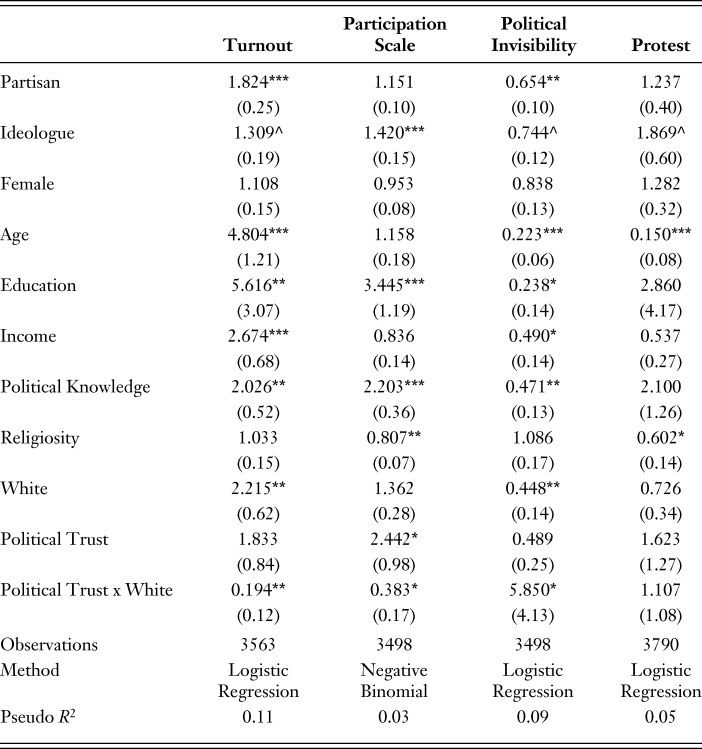
Table 2 turns to the main purpose of this analysis, presenting results for the same four dependent variables with models that include an interaction between political trust and race. For all three measures of conventional participation, this interaction is statistically significant, demonstrating that the relationship between trust and participation differs considerably for Whites and People of Color.Footnote 11 Only in the case of protesting does this interaction not reach significance. To illustrate this contingency, Figure 1 provides predicted probability plots for each of the dependent variables, displaying how the influence of trust on participation shifts across racial groups.Footnote 12
Racially Contingent Relationship Between Political Trust and Participation

Source: 2016 ANES, ^p<.1, *p<.05, **p<.01, ***p<.001. All coefficients are exponentiated. Standard errors in parentheses. Significance tests are two-tailed. Survey weights provided by the ANES are employed.
Racially Contingent Relationship Between Political Trust and Political Participation
Source: 2016 ANES Whiskers show 95 percent confidence intervals. All control variables are held at their modal or mean value.

As these graphs show, the racial contrast in the relationship between trust and conventional forms of participation is strong.Footnote 13 As would be expected based on the interview evidence, it is the least trusting Whites who are the most likely to get involved, with the negative slope indicating that levels of engagement decrease as trust in government increases. Also in line with the interview data, this relationship flips for People of Color. Here, it is the most distrusting that are the least likely to be politically active, while those expressing the greatest level of trust in government engage at higher levels. This reveals that the null relationship between trust and participation found in Table 1 does indeed represent a cancelling out effect. As the figures show, important contingencies are masked when an analysis only explores how this relationship functions for the population as a whole. As indicated by the interviews, distrust mobilizes White individuals but demobilizes People of Color.Footnote 14 Interestingly, this racial contrast does not extend to protest behavior. In strong contrast to the other results, the final panel in Figure 1 shows that distrust seems to decrease the likelihood of protesting for both Whites and People of Color, though not to levels of statistical significance.
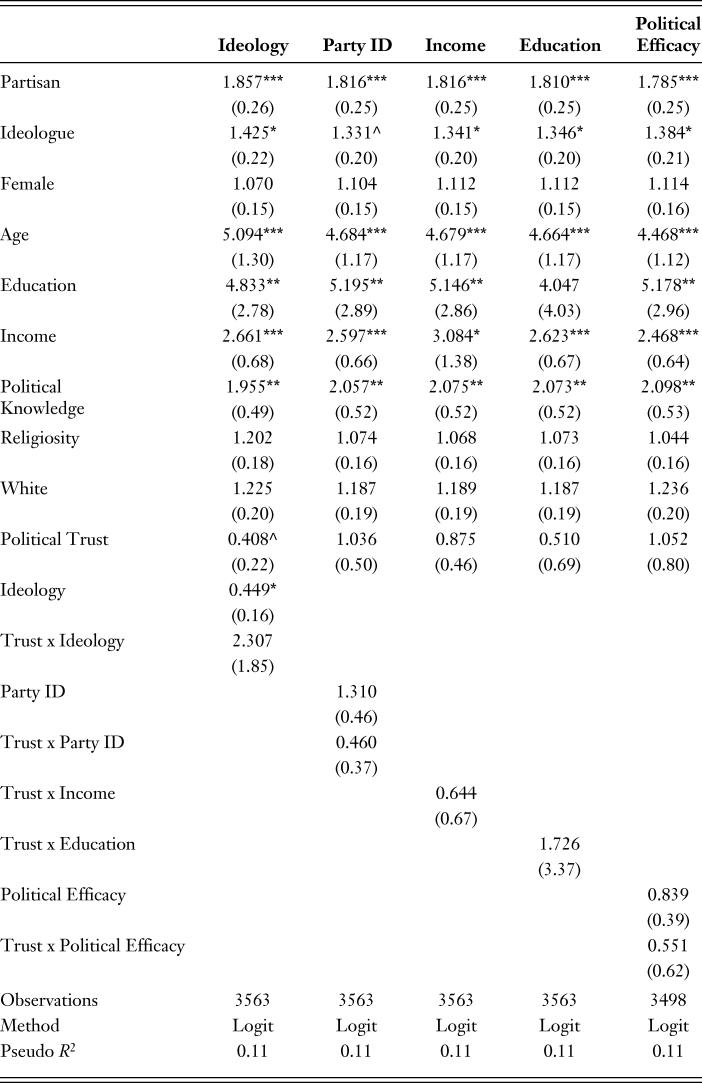
While these results appear to confirm the interview findings, it is plausible that this variation in the political consequences of distrust is the product of other characteristics heavily associated with race. Table 3 tests this possibility by investigating if variables other than race condition the relationship between trust and participation. First, I consider whether this is a function of political or ideological differences. Given the distrust present in the election of Donald Trump, perhaps cynicism only mobilized conservative voters or Republicans. Then I examine some of the variables known to moderate this relationship, including income and education. These models test if the results for race actually stem from those with greater educational attainment or financial means being able to channel their distrust into participation (Chan Reference Chan1997; Citrin Reference Citrin1977; Nie and Verba, Reference Nie and Verba1987). Finally, given the centrality of political efficacy in the extant literature, I consider the possibility that distrust promoted participation for individuals who felt they had the ability to shape political outcomes (Gamson Reference Gamson1968; Hooghe and Marien, Reference Hooghe and Marien2013).Footnote 15
Other Explanations for Contingent Relationship Between Political Trust and Turnout

Source: 2016 ANES. ^p<.1, *p<.05, **p<.01, ***p<.001. All coefficients are exponentiated. Standard errors in parentheses. Significance tests are two-tailed. Survey weights provided by the ANES are employed.
Table 3 addresses each of these possibilities by looking at the extent to which ideology, party ID, income, education, and political efficacy condition the relationship between political trust and turnout. As seen in the results, none of these interactions reach statistical significance, suggesting that trust does not have a differential impact on participation across ideological or partisan lines, income levels, educational attainment, or feelings of political efficacy. While not included in Table 3, this same set of insignificant interaction terms is generally found when using the other three measures of political participation.Footnote 16 Ultimately, these null results strengthen the conclusion that race is specifically driving the contingent relationship between trust and participation and that this contingency can best be understood as arising due to the racially divergent roots, and thus racially divergent meanings, of political trust in America today.
CONCLUSION AND IMPLICATIONS
The question of how trust relates to participation has been asked by political scientists for the last half century (Gamson Reference Gamson1968). In providing a contemporary answer, the analysis presented here suggests that this relationship contains a strong racial contingency that centers on the different ways People of Color and White Americans experience government. The centrality of taxation as a manifestation of government for Whites means their political distrust arises from a sense that “their” personal investment in the state is being poorly spent. As such, this distrust is tied to a sense of ownership over the polity that leads to it serving as a politically mobilizing force. For People of Color, political distrust is rooted in direct and indirect experiences of discrimination at the hands of the CJS. These experiences generate a distrust linked to a desire for invisibility in relation to the police and the government more broadly, resulting in political disengagement.
Ultimately, these racial contingencies suggest that the most politically engaged Americans are Whites who harbor the greatest distrust in government, while the most quiescent are distrusting People of Color. This trend, coupled with the fact that most Americans have low levels of political trust, reveals how the state perpetuates racially patterned political inequality by subjecting different racial groups to different modes of governance (Michener Reference Michener2019), even as formal laws promoting this anti-democratic dynamic have become taboo. Further, these findings have important implications for the potential passage of progressive policy reforms. In particular, not only are distrusting Whites the most politically active, but this distrust is rooted in a feeling of White privilege that leads them to conclude that they should be in charge of how “their” taxes are spent. As a result, any push to pass policies that promote greater government spending through increased taxation will be heavily resisted by the distrusting White Americans who are most likely to make their political voices heard.
Beyond these implications, the results presented here also open up several avenues for future research. First, the analysis presented here focuses on the unique context surrounding the 2016 election, leaving an open question as to how the results might generalize to other years, both preceding and following 2016. Studying this temporal element is interesting for several reasons. First, there is a question of how much the White mobilization fostered by the connection between taxation and government stemmed from the messaging involved in Donald Trump’s campaign. Differently, this mobilization might trace back to the rhetoric from the Tea Party movement. In this way, looking across other elections might provide insight into the role of social movements, campaign messaging, and political entrepreneurs in fostering the interpretations of government covered here, as well as the participatory consequences generated by those interpretations.
Within this investigation into the role of social movements, one might also consider the role played by Black Lives Matter and its attempt to create political engagement through the connection between government and the police. While the results presented here are disheartening in this regard, further research could engage with scholarship showing how CJS contact can result in greater political participation under certain contexts as a way to consider conditions in which the demobilization found in this analysis could be reversed (Owens and Walker, Reference Owens and Walker2018; Walker and García-Castañon, Reference Walker and García-Castañon2017). That is to say, are there contexts in which the political distrust fostered by CJS experiences could be turned into a politically mobilizing device?
Second, the notion that political distrust for Whites and People of Color comes from different parts of the state suggests racial division not only in experiences of government, but more broadly in government visibility (Mettler Reference Mettler2011). Such a division points to a limitation in the existing visibility literature (e.g. Hackett Reference Hackett2017, Reference Hackett2019; Morgan and Campbell, Reference Morgan and Campbell2011), which has generally been disconnected from scholarship exploring the racial foundations of, and racial segregation within, the American state (King Reference King2017; Omi and Winant, Reference Omi and Howard2014). Indeed, as recent work has noted, the conventional wisdom of a submerged state exists in an “uneasy tension” with scholarship on the many overtly visible ways that American government has manifested itself in the lives of People of Color (Thurston Reference Thurston2018, p. 162), as seen here in the form of the CJS. Future scholarship might connect the analysis presented here to research concerning race and the notion of uneven state capacities as an entry point for exploring racial variation in American state visibility (King and Lieberman, Reference King and Lieberman2008).
SUPPLEMENTARY MATERIAL
To view supplementary material for this article, please visit https://doi.org/10.1017/S1742058X19000298
ACKNOWLEDGMENTS
The author thanks Dr. Florencia Montal, Dr. Joe Soss, Dr. Andrew Karch, Dr. Paul Goren, and Dr. Teresa Toguchi Swartz, as well as the anonymous reviewers, for their constructive feedback.