Acute public health problems, emergencies, and recent disasters have highlighted weaknesses in the general capabilities of nonuniformed civilian volunteers in the United States.Reference Fletcher, Puerini and Caum 1 - Reference de Ville de Goyet 5 Their lack of uniformity, organization, and chains of command limits their efficiency and usefulness, especially in light of new emergent crises of the post-Cold War.Reference Zuckerman, Hershkowitz, Smalkin and Carafano 6 - Reference Tulak, Kraft and Silbaugh 10 Indeed, the uncoordinated, undisciplined, and spontaneous convergence of medical volunteers is part of the problem. 11 , 12 Sufficient and reliable, well-trained, and highly disciplined uniformed volunteer medical personnel familiar with the areas of operations are needed to augment full-time public health and medical personnel. State Defense Force (SDF) medical units can provide just such a volunteer paramilitary medical and public health resource.Reference Nelson and Smalkin 8 , Reference Nelson and Arday 13 To show how SDFs can do this, the purpose of this article was to report on the work of an important, yet little known, force for public health and emergency/disaster response preparedness that has been “flying under the radar” for years in terms of the public health literature. Specifically, this article describes the Texas State Guard (an SDF) and its Operation Lone Star. In so doing, the article will discuss the advantages and disadvantages of SDFs, offer recommendations, and suggest future avenues for research inquiry.
BACKGROUND AND SIGNIFICANCE
The 2nd Amendment of the US Constitution and Title 32 of US Code Sec 109 allow and affirm the right for states to maintain uniformed troops that are not part of the federal active, reserve, or US National Guard.Reference Zuckerman, Hershkowitz, Smalkin and Carafano 6 , Reference Nelson and Smalkin 8 Twenty-seven US states have their own uniformed SDFs (ie, State Guards or State Militias) with about 8000 members.Reference Zuckerman, Hershkowitz, Smalkin and Carafano 6 , Reference Sieg 14 They are under exclusive control of their respective state governors through the state’s adjutant generals, who are the state’s chief military officers.Reference Zuckerman, Hershkowitz, Smalkin and Carafano 6 These SDFs are primarily trained and dedicated to providing uniformed crisis response and disaster relief in case of large-scale public health emergencies and disasters to support civil authorities within their respective state jurisdictions.Reference Zuckerman, Hershkowitz, Smalkin and Carafano 6 , 15 , 16 This includes but is not limited to disease epidemics, search and rescue, flood and hurricane relief, wildfire suppression, ice storms and blizzards, and oil spills and eco-disasters.Reference Tulak, Kraft and Silbaugh 7 , 16 Of the 27 SDFs, 18 have units specifically devoted to medical and public health emergency and disaster response, including the Texas State Guard (TSG).Reference Zuckerman, Hershkowitz, Smalkin and Carafano 6 , Reference Sieg 14 , 16
The TSG Medical Brigade’s support mission is to provide an operations-ready military force prepared to effectively respond to state emergencies and disasters. It supports Texas civil authorities to do the same, upholds homeland security, and conducts community service activities.Reference Zuckerman, Hershkowitz, Smalkin and Carafano 6 , 16 The TSG Medical Brigade (Med BDE) has 8 companies and an Area of Operations Task Force popularly known as the “Texas Medical Rangers” with over 350 medical and support personnel statewide and plans to expand to 1000.Reference Nelson and Smalkin 8 , 16 The TSG Med BDE was the first to register under the US Surgeon General’s Medical Reserve Corps program as a rapid response public health force to augment Texas civil health authorities.Reference Nelson and Smalkin 8 , 15 , 16 In terms of civil health, during state-sponsored events, the TSG Med BDE provides military-uniformed, mobile medical teams; infection control; urgent care staffing; and assessments of physical and mental health that could degrade to a worse prognosis or even death.Reference Zuckerman, Hershkowitz, Smalkin and Carafano 6 , Reference Nelson and Arday 13 , Reference Greenstone 17 In the past, the TSG Med BDE has established emergency medical clinics in disaster shelters during hurricanes and provided public health services.Reference Moorecook, Greenstone and Hays 18
The TSG operates on a shoestring budget and a voluntary basis, so much of its equipment and supplies, including medical resources, are donated by members or other organizations.Reference Zuckerman, Hershkowitz, Smalkin and Carafano 6 , 16 TSG members purchase their own uniforms and equipment. SDFs including the TSG typically wear US military uniforms and their organization mirrors and is comparable to the federal military structure, protocols, and authority.Reference Sieg 14 This includes members’ oaths to serve and protect the constitutions of their states and to obey the orders of their governors and officers appointed over them.Reference Zuckerman, Hershkowitz, Smalkin and Carafano 6 , Reference Sieg 14 Members’ time is unpaid, except when governors activate them in an emergency disaster response or for annual training.Reference Cohen 19 Those activated receive the same token pay regardless of rank, and they are reimbursed for mileage and receive per diem meal costs. Many members work as medical providers (eg, physicians, nurses, physician assistants, emergency medical technicians, administrators) in their civilian lives.Reference Tulak, Kraft and Silbaugh 7 Also, people without health care backgrounds can provide administrative support, patient tracking and flow control, logistical assistance, security, and communications.
OPERATION LONE STAR
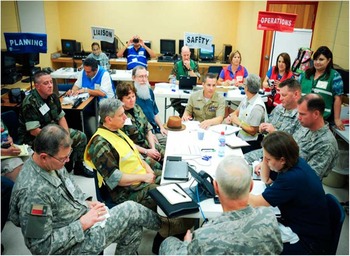
For the past 8 years, the TSG Med BDE, along with 300 federal, state, and county public health officials and workers, has conducted Operation Lone Star (OLS) in the impoverished and challenged Texas Rio Grande Valley region.Reference Elliott 20 This is one of the largest humanitarian and public health efforts in the United States. It is also a vital training mission that affords its participants practical experience for emergency disaster response preparedness in coordination with civil authorities. Over 2 weeks, it trains in emergency medical response and care capabilities for future large-scale public health emergencies (eg, Gulf Coast hurricanes), while addressing the needs of thousands of medically disadvantaged and underserved Texans (Figure 1).Reference Sieg 14
Military Decision Making Process for Operation Lone Star.

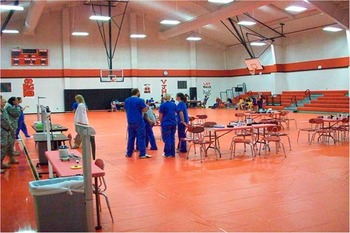
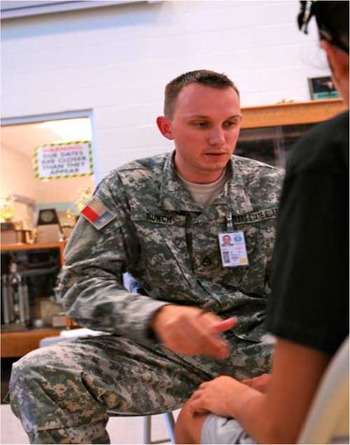
Predetermined sites are designated for establishing community health clinics and medical treatment facilities.Reference Tulak, Kraft and Silbaugh 10 , Reference Sieg 14 , 16 , Reference Cohen 19 , Reference Elliott 20 Free health care is provided on a mass scale and on a daily basis for 2 weeks to those without access to health care. This is done in the summer months as annual training for TSG Med BDE members. The medical services offered include immunizations, blood pressure and diabetes screenings, hearing and vision examinations, physicals, limited dental treatment, and limited pharmacy services (Figure 2). Should initial screenings reveal more serious underlying medical conditions, those patients are then referred to a physician for a higher level of care. For many, OLS is the only time they have the opportunity to visit a physician. For long-term chronic medical conditions, OLS patients are sent home with written prescriptions for low-cost generic medications or are directed to public medical treatment facilities (Figure 3).
Clinic Prep for Operation Lone Star.

Provision of Treatment at Operation Lone Star.

Overall, Texans benefit from OLS’s public health intervention and the event is extremely popular among the target population served; the massive undertaking of OLS would not be the substantial success it is without the TSG Med BDE’s presence and tireless efforts. From 2013 until 2015, OLS is estimated to have seen approximately 27,000 patients in need and to have provided roughly 146,000 medical services, that is, 750 patients and over 4000 services per day (or approximately 5 services per person). This is not to mention the massive set-up and tear-down on the events’ front- and back-end days.Reference Cohen 19
OVERALL ADVANTAGES AND DISADVANTAGES
SDFs, especially the TSG, provide a reservoir of trained people and resources who are familiar with their local and regional backyards as well as their SDFs’ mission requirements.Reference Tulak, Kraft and Silbaugh 10 They play a key role in their states’ ability to respond quickly through preplanning and rehearsal events (eg, OLS) during times of stability—so they can intervene effectively in times of crisis.Reference Sieg 14
SDFs including the TSG support but do not lead civil governments, despite popular misconceptions.Reference Nelson 9 Nevertheless, since they wear a military uniform comparable to that of federal troops, there is potential to be mistaken for federal troops and unduly influence civil proceedings in a public health disaster. However, they have the potential to fulfill the homeland security mission when the National Guard is fulfilling its deployment obligations abroad.Reference Tulak, Kraft and Silbaugh 10 , 16 Tulak et alReference Tulak, Kraft and Silbaugh 7 speculate that one way to balance the potential of SDFs to fulfill the homeland security mission against their over-influence of civil proceedings is through the “inclusion and integration of their valuable capabilities into planning, training, and command and control for homeland security operations at the state and regional levels.”
Since SDFs are uniformed militias, they tend to attract some members on the militant fringe who intend to engage in unsanctioned or even unlawful activities.Reference Sieg 14 , Reference Friedlich and Pridemore 21 For this reason, the TSG has instituted extreme and comprehensive background investigations and places its members under the Texas Code of Uniformed Justice (UCMJ) modeled after the US military UCMJ.Reference Zuckerman, Hershkowitz, Smalkin and Carafano 6 To its credit, TSG attracts good men and women—mostly retired federal military—with a vast array of valuable expertise, skills, and experiences, as well as military discipline that would otherwise be wasted.Reference Zuckerman, Hershkowitz, Smalkin and Carafano 6 They report looking for military camaraderie and a way to channel their proficiencies and talents for the benefit of their communities and the nation.Reference Nelson and Smalkin 8 , Reference Nelson 9 On the other hand, for younger members, SDFs serve as training, proving, and recruitment grounds for federal forces.
CONCLUSIONS
This article reported on the work of an important, yet little known, force for public health and emergency and disaster response preparedness, namely, SDFs and specifically the TSG and OLS. The TSG is emblematic of regional volunteer uniformed SDFs in the advancement of public health in that its programs and operations, especially OLS, are opportunities for members to hone their skills in anticipation of public health emergencies while providing public health services to their communities. Nevertheless, SDFs like the TSG are voluntary and relatively self-supporting compared to the US Army and US Army National Guard. Therefore, the advantages of SDFs are that they represent a far less burdensome alternative in terms of fulfilling a need for a trained, uniformed, and concerted response to public health emergencies and disasters. 15 This is because their members personally absorb most of the expenses. Their downside is that because their time is unpaid and they pay for their own uniforms and equipment and they are volunteer organizations, relying on them can be questionable. They are also prone to organizational drift or diversion and can unduly influence civil proceedings.
Continuity and the voluntary nature of SDFs also lead to one paramount challenge, namely, recruitment flow. Recruitment flow is substantial during high-profile events but ebbs soon afterward when the emotional impact dies down.Reference Nelson and Smalkin 8 Recruitment has become increasingly critical given that SDFs have been incorporated as vital components in the US government, Homeland Security, the Surgeon General’s office, Department of Defense Northern Command, and Federal Emergency Management Agency missions.Reference Tulak, Kraft and Silbaugh 10 For example, the TSG has been authorized to create a relatively sizable increase in new positions.Reference Tulak, Kraft and Silbaugh 10 , Reference Cohen 19 Those positions bring increased funding and it will be interesting to see how that funding is channeled and its impact. 15 Similarly, because the TSG (and any SDF) is a paramilitary organization, fears related to conscription, overseas deployment, possible courts martial, and familial concerns with military involvement must be overcome.Reference Zuckerman, Hershkowitz, Smalkin and Carafano 6 , Reference Nelson and Smalkin 8 Moving forward, the challenge and an avenue for future inquiry will be how to optimally capitalize on events like OLS to find and keep sufficient high-quality volunteers and quell apprehensions to make SDFs timely, effective, and vibrant regarding their public health capabilities.
Another challenge SDFs confront and another opportunity for inquiry will be how they define their roles and where they fit, especially for public health and emergency response, given that the US military has assumed greater involvement with homeland security. 15 For example, the US Army has assumed control over OLS, although the TSG Med BDE remains the key player and proponent. Yet another challenge that SDFs must tackle, especially the TSG, is that their members have professional and personal time commitments; thus, the unit training on which military discipline is predicated becomes difficult. So far, these obstacles have been overcome with short-term, specific, didactic training augmented by distance learning depending on volunteers’ particular positions. Whether this will be viable in the future is yet to be determined.Reference Nelson and Smalkin 8
Future directions for inquiry might be how SDFs fit into the overall Incident Command system in the United States during a disaster, especially with the US Army Command assuming overall operations responsibility in these situations. Another avenue of inquiry might be the differences in how SDFs operate compared to the US Army National Guard units and civilian and federal agencies during a response to disasters. Additionally, it might be worth looking into the other SDFs that contain medical units to see how their medical units functionally operate and stack up to the TSG. Finally, a burning question is simply: Do SDFs provide a good return on their investment in light of potential funding, training, and retention issues?
Acknowledgments
The author gratefully thanks the University of Texas, US Army Reserves, for material support, and the Texas State Guard. Neither organization had any involvement in writing the report nor in the decision to submit the report for publication.
Disclaimer
The opinions expressed herein are solely those of the author and do not necessarily represent the views of the US Army or any other organization.