Introduction
The question of whether to offer a research participant's genomic results to family members, including after the participant's death, is a difficult and pressing issue. Research projects sequencing probands with life-limiting conditions such as fatal cancers will predictably encounter this issue, as will projects that archive data and specimens for potential reanalysis long into the future. In Fall 2015, we published groundbreaking recommendations for the return of adult and pediatric research results to family members, including after the death of the research participant.Reference Wolf1 We published those consensus recommendations as part of a journal symposium issue growing out of a project funded by the National Institutes of Health (NIH) and offering multiple papers on these issues.Reference Wolf, Koenig and Petersen2 The project additionally collected data on stakeholder attitudes and preferences,Reference Breitkopf3 and then began piloting return of results to relatives.
Researchers and commentators have begun to address the complex issues raised by return of results (defined here to include return of incidental or secondary findings) to relatives,Reference Goodman4 including the relatives of pediatric research participants.Reference Botkin5 However, largely missing from this literature is pragmatic guidance, offering a process and toolkit for addressing return of results to family members, including the documents needed to progress systematically through this complicated and multi-actor process. This paper aims to fill that gap.
Developing tools for genomics implementation is a crucial part of successful translation of genomics into clinical care.Reference Weitzel6 Our project has been part of the Clinical Sequencing Exploratory Research (CSER) Consortium created by NIH to develop best practices for integrating genome and exome sequencing into clinical care. Our toolkit of core documents can aid research projects by offering a place to start in developing their process and documents for sharing results with family members. While this publication offers written tools, projects can adapt these tools to develop a process that may include written, telephone, face-to-face, and computer-aided communications.
Using our previously published recommendations as the starting point, this paper offers the first communications toolkit for return of results to relatives. Our earlier recommendations urged genomics researchers to anticipate the possibility of relatives requesting a participant's results, and to clarify for prospective recipients how the research project plans to handle such requests. We recommended that, “If there is any potential for return of such results to relatives, the researchers should ask participants their preferences for sharing results with relatives, including after the participant's death, and should invite participants to identify their preferred representative to make decisions about relatives' access to their genomic results” when the participant is unable to do so or deceased.7 Inviting participants to name a preferred representative can guide later identification of the person to make decisions about relatives' access to the participant's results when the participant cannot decide for him–or herself because of decisional incapacity or death. As in our prior paper, we refer to that person here as the participant's Representative, “the person legally authorized to access a participant's results.”8
Our recommendations stated that researchers are not obligated to return a participant's results to relatives, but may decide to participate in that return. We recommended that if researchers decide to participate in return to relatives, the researchers should generally adopt a passive disclosure policy of responding to relatives' requests, instead of an active policy of initiating disclosure to relatives. However, the majority of our group concluded that in exceptional cases (discovery of a highly pathogenic and actionable variant that a relative is likely to carry), the researcher “may be ethically justified in actively reaching out” to the relative.9
We add additional detail in our earlier recommendations paper, and we elaborate below on how to put these recommendations into practice. Together, our previously published recommendations and the toolkit developed here can aid research design and genomics implementation. This paper presents tools that research studies can use in research with adult and pediatric participants, both before and after the participant's death.
I. Method
Funded by a grant from the National Cancer Institute (NCI) and National Human Genome Research Institute (NHGRI) at NIH, our project conducted empirical research10 to undergird a normative process of developing the consensus guidelines that were published in Fall 2015.11 Those guidelines were the product of work led by one of the project's principal investigators (PIs) (S. M. W.) with participation from the other PIs (G. P. and B. A. K.) and the project's multidisciplinary Working Group. After completing work on those guidelines, we undertook a process of collecting and analyzing documents and guidance available to researchers for return of results to family, in order to create a basic toolkit of documents to help researchers address this issue. We canvassed the published literature as well as tools available through the website of the CSER Consortium, in which this project has participated.Reference Green12
At the same time, our project has undertaken a process of piloting return of results to family members. This has required designing a practical process for the family members of deceased probands with pancreatic cancer who have participated in Mayo Clinic's pancreatic cancer SPORE, a biobank supported by NCI. That pilot process and data collection is under way, but required the creation of a full set of documents and communication tools for the families involved. The toolkit presented here benefited from design of that pilot project, though the tools offered in this paper are not identical to those tailored for the pilot.
After preliminary research and analysis, the Working Group met in May 2015 to discuss potential tools to create for investigators, Institutional Review Boards (IRBs), biobanks, and research institutions in order to facilitate the ethical and pragmatic return of research results to family members. After further research and drafting of potential products, the Working Group met again by telephone in December 2015 and in person in May 2016. Throughout the preparation of this paper we continued research on the literature and relevant consent models.13 This paper and appendices were subsequently finalized by circulating written drafts for comments and approval.
II. Results
Through careful consideration of the ethics, law, and practical issues surrounding return of research results to family members, this paper presents tools that can be adapted to the many contexts in which genomics research is performed. It is important to emphasize that the tools we offer are a starting point — research projects will need to adapt these depending on their research design and population, the specific genomic results being generated (including potential family interest in both “positive” results showing the presence of a pathogenic variant and “negative” results showing the absence of a variant), and the context for their research.14 Part of customizing these forms will be deciding when to reach out to the participant's Representative to alert them to their responsibilities if a family member requests results; the processes outlined below include alerting the Representative once that person is identified, but some research projects may prefer to wait until a relative's request arises. In addition, these forms may require modification to adjust reading level in order to optimize readability and comprehension, depending on the population. Our goal is to outline the flow of decisions and the key elements needed at each step, as further indicated by the “Points to Consider” included for the research team at the top of each form.
These forms are meant to help structure a larger communication process. Much as consent forms are only part of a larger consent process, the document templates offered here are intended to aid and anchor a communications effort that may include in-person, telephone, computer-aided, and other means of contact and counseling. While we offer here a set of forms, the research team for a particular project may decide that some of these processes are best handled orally, with written or electronic records created of the decisions made. The set of forms we offer can serve as a starting point for the research team in designing a process tailored to the specific research project.
Finally, we note that a family request for research participant results may arise after the end of the research project generating those results. Throughout this paper we address the responsibilities and options that fall on the researcher and research team to anticipate family requests and plan for them. A number of published papers have urged that researcher duties to return results should not continue past the end of research funding.Reference Jarvik15 Because family members may request results at any time, including after research funding has ended, researchers anticipating family requests should work with their institution to plan which office or individuals at the institution should be responsible for handling family requests after the conclusion of the research generating the findings. Context will determine the options, which may involve more than one entity at the institution, including the relevant biobank (if any), genomics laboratory, and records office.
This paper proceeds in four parts, addressing four different basic scenarios that researchers and institutions may encounter: return of results to family when there is (1) a living adult research participant, (2) a deceased adult participant, (3) a living pediatric participant, or (4) a deceased pediatric participant. Each part references the template documents we offer in the Appendices.
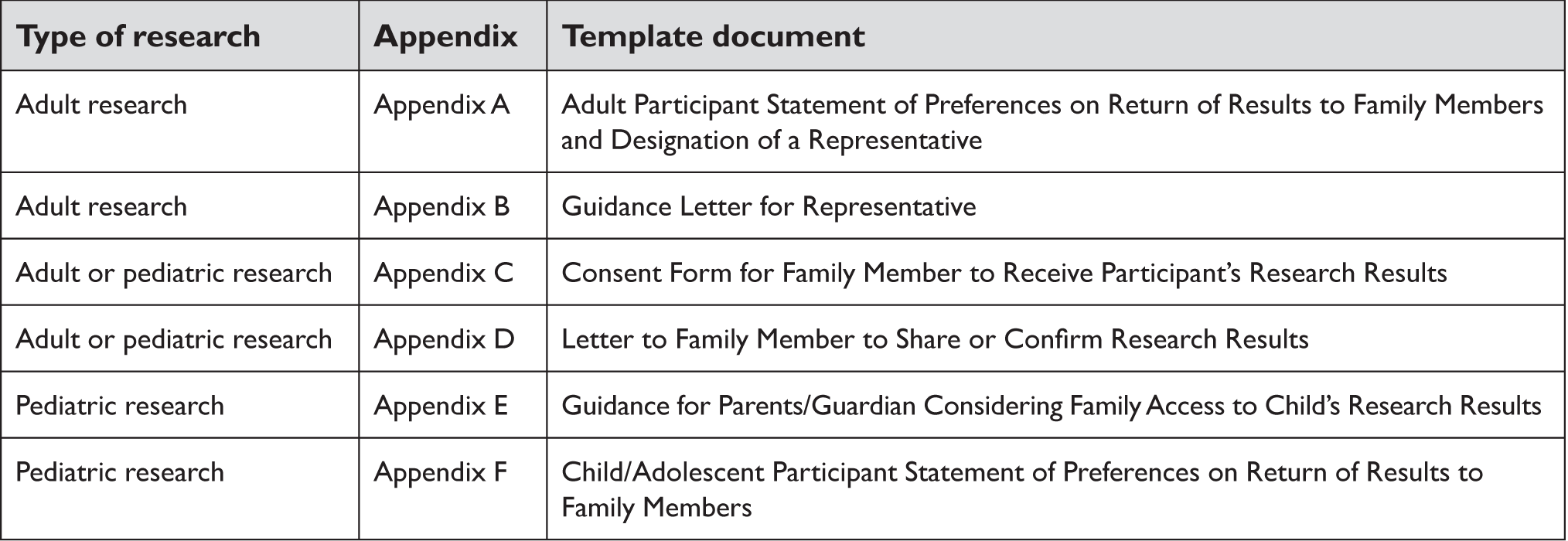
Table 1 enumerates the 6 template documents in the Appendices that offer a starting point for research projects considering return of results to family members.
The 6 templates created to address return of research results to family.

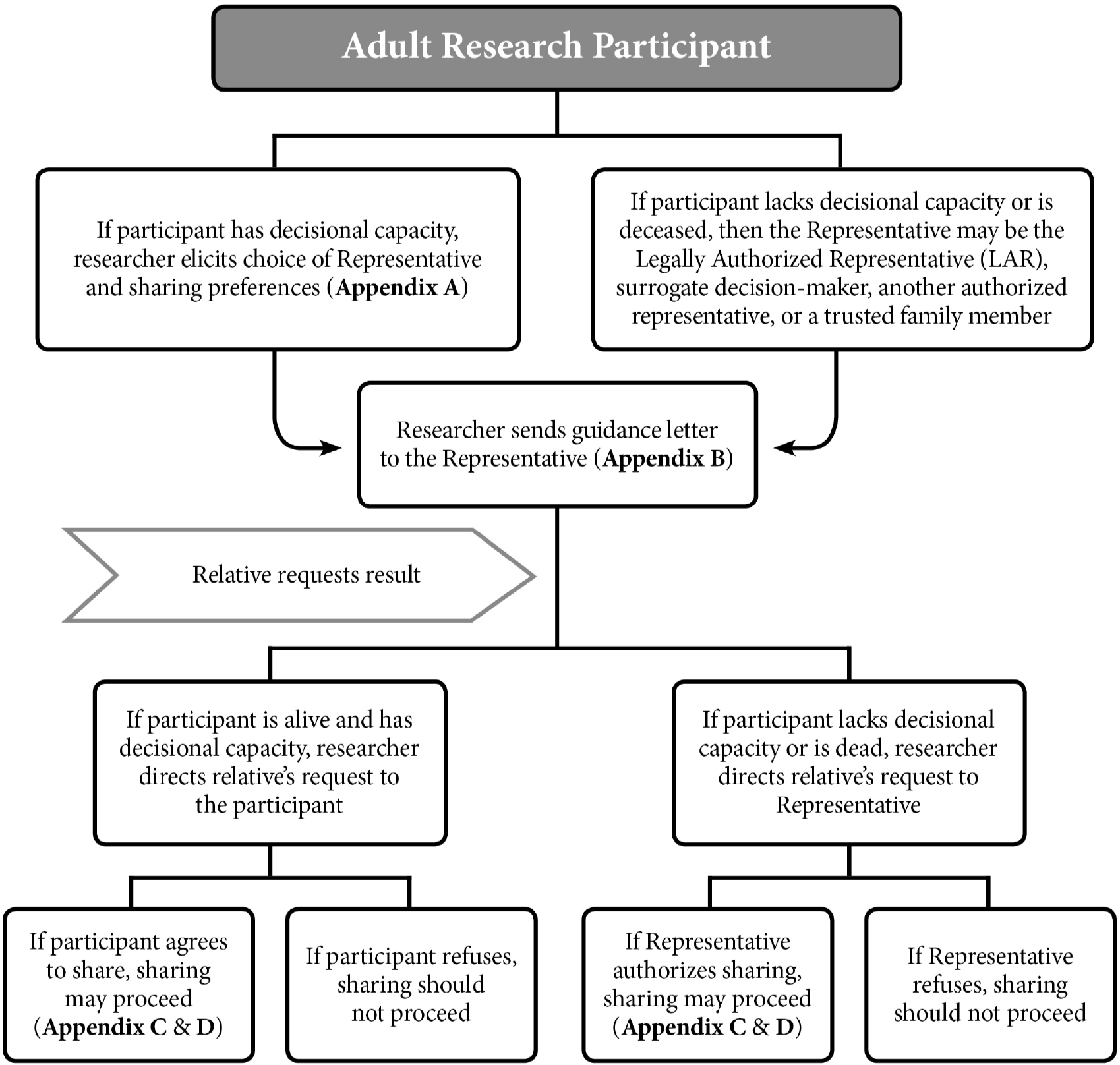
We first address return of results to relatives when the research participant is an adult. Figure 1 summarizes the recommended roadmap for returning results to relatives when the adult participant is living or is deceased.
Recommended roadmap for returning research results to family members of adult research participants, both living and deceased.

1. Adult Research Participant — Living
A. Statement of Participant Preferences on Return to Family and Representative
The process of enrolling eligible adults in a research study customarily starts with informed consent. During this consent process, researchers should discuss with the prospective participant the project's policy on sharing results with family members, explaining how requests from family members will be handled and whether the researchers in some circumstances may initiate an offer of results to relatives without such a request (as discussed below in section D.). As noted above, our project's prior recommendations urged eliciting participant preferences on whether to offer results to family members as well as participant designation of a preferred Representative to make decisions about sharing results if and when the participant cannot do so due to incapacity or death. Researchers should elicit participant preferences on sharing with family and choice of a Representative; a suggested form is presented in Appendix A. However, the form should make clear that while the participant is alive and has decisional capacity, the participant (not the Representative) will make decisions about family access to results.
In Fall 2015, Amendola and colleagues published a return of results authorization form used in their NEXT Medicine Study, taking a different approach.16 That form allows the participant to designate a recipient for results if the participant dies or becomes incapacitated before all results have been returned. Their form is similar to a sample form from the Multi-Regional Clinical Trials (MRCT) Center of Harvard and Brigham and Women's Hospital, which authorizes a third party to receive research results.17
In contrast, our form is not just an authorization for a designated individual to receive results not yet returned to the participant, but rather an authorization for the Representative to potentially receive all results and to decide on other relatives' access to results. After the participant's death or loss of decisional capacity, our form allows the Representative to share the participant's results if other family members seek out the participant's results and the participant approved of sharing. Our form also notifies the participant that even if the participant does not want the Representative to share the results, other applicable law may trump this decision (e.g., HIPAA18 or state law). Additionally, the form alerts the participant that in rare circumstances, researchers may reach out directly to family members to initiate an offer of results. However, under our project's previously published guidelines, this active disclosure will be limited to cases in which the research result poses a high and imminent health risk that can be reduced or eliminated if the relative is informed.
Also unlike the form from Amendola and colleagues, our form does not expire once the participant him- or herself receives results. An expiring authorization form could shut down family access to a result that the participant received but felt too ill to share. Empowering a Representative to share all results avoids the problem and allows the Representative to consider sharing even results generated by analyses undertaken after the participant's death.
B. Guidance for the Representative on Return of Results to Relatives
If the participant completes the statement of preferences form and designates a Representative (Appendix A), the researcher should provide guidance to the designated individual. The researcher can send a letter explaining the Representative's role and what to do if the participant becomes decisionally incapacitated or dies (Appendix B). Our template letter informs the Representative that relatives seeking the participant's genetic results after the participant's loss of decisional capacity or death will be directed to the Representative. The letter then addresses how the Representative should decide about family access; the participant who has completed a statement of preferences (Appendix A) will have provided strong grounds for the Representative to follow those preferences. Finally, the letter notes that in rare circumstances, researchers may reach out directly to family members if they discover a result that poses a high and imminent health risk that can be reduced or eliminated if the family member is informed — an approach that the majority of our group supported in our prior recommendations paper.19 The letter notes that in these rare circumstances, the researchers or institution will first work with the Representative to facilitate sharing this result, but may reach out directly to family members in some situations to prevent harm (see section D. below).
If a family member comes forward requesting the participant's research result, the living adult participant should be contacted so the participant can decide whether to authorize sharing. While the participant can proceed to share the result with the family member, the participant may request help from the researcher. If the researcher or research team provides assistance, they should first confirm that the family member agrees to receive the result. (Appendix C) The result can then be communicated by a knowledgeable professional equipped to counsel the family member on the result's implications and on the availability of genetic testing to ascertain the relative's genetic status, such as a medical geneticist or genetic counselor. This professional can then follow up with a letter confirming the communicated result, so that the family member can share the letter with his or her clinician or with other family members (Appendix D). The letter should provide the research result, state the potential health implications for the family member, and indicate how to seek further counseling and genetic testing.
One issue that may arise is whether researchers should return a participant's research results to family members when those results are from a lab that is not CLIA-certified. Some group members thought results should not be returned unless the testing was performed (or the results were confirmed) in a CLIA-certified lab. However, the debate continues about whether researchers can return research results from a lab without such certification.Reference Burke, Evans and Jarvik20 Although the Centers for Medicare and Medicaid Services (CMS) have indicated that only results generated in CLIA-compliant laboratories should be considered for return, there is a strong argument that other laboratories should be able to offer important research results with an explicit caution that no clinical action should take place until the results have been confirmed in a CLIA-compliant setting.21 In the context of return of results to relatives, we recommend that the proband's results be verified in a CLIA-compliant lab if possible before those results are communicated to family members. If research results are offered without such verification that should be clearly stated. In any case, relatives receiving the participant's results should not act until they themselves have been tested and received clinically verified results of their own, as noted in the family letter in Appendix C.
C. Adult Participants Lacking Decisional Capacity
Some participants will be incapable of designating a Representative and stating preferences regarding family sharing because they lack decisional capacity. Performing genomic research in this context can raise challenges.22 In these cases, the participant's Representative may be the participant's Legally Authorized Representative (LAR), surrogate decision-maker, another authorized representative, or a trusted family member.23
Once this Representative is determined, the researchers should send guidance to inform the Representative of their role (Appendix B). Our suggested form clarifies for the Representative how to make decisions on sharing results with relatives, in keeping with the recommendations of our consensus paper:24
If the research participant agreed to sharing results with family members, this provides strong grounds for the Representative to permit access.
If the participant stated a preference not to share, this provides strong grounds for the Representative to refuse access.
If the participant was silent on sharing results with family members, the Representative should balance the participant's privacy and personal interests against the interests of relatives in receiving the genetic results.
We noted in our consensus paper that this suggested decisional approach differs from the approach recommended for surrogate decision–makers making a treatment decision for decisionally incapacitated adults.25 In decisions about treatment, the surrogate is customarily encouraged to (1) follow the patient's express wish if known; or (2) if no express wish is available, to exercise substituted judgment to decide as the patient would have decided, based on what is known of the patient's preferences; or (3) if the surrogate lacks adequate information to use these standards, to decide in the patient's best interests. Our Working Group decided that the question of sharing results within the family called for a simpler and more flexible standard that considered participant preferences, but when those were unknown, encouraged the Representative to balance the participant's privacy and personal interests with the needs of family members.
If application of these standards leads the Representative to conclude that sharing is appropriate, we offer two forms to aid that process. Appendix C strives to ensure that the family member agrees to receive the result. Appendix D then provides the result in written form to support accuracy and allow the family member to share the document with his or her clinician. While use of these forms can help structure the communication process, some families may find the use of such forms to be too formal and may prefer oral communication. We nonetheless offer these forms to help the research team consider the issues involved and plan how best to handle them. In addition, the Representative may ask for assistance from the research team in communicating the result to the family member. In that case, the research team may find these forms useful to document the family member's agreement to receive the result and the nature of the result communicated to that family member.
D. Rare Circumstances in Which Researchers May Initiate Return to Relatives
Our published consensus recommendations urged that return of results to family members should generally be in response to a family request rather than initiated by the researcher. However, most Working Group members agreed that a researcher may actively reach out to a participant's relative to offer research results in the rare case in which the researcher finds “highly pathogenic and actionable variants that the relative is likely to carry, and whose disclosure is highly likely to avert imminent harm.”26 Both the Representative authorization form and guidance letter (Appendix A and B) alert the participant and Representative to this possibility. If this exceptional circumstance arises, the researcher should first try to work with the participant (if alive and decisionally capable) or alternatively with the Representative to offer the result to the relative. If the participant or Representative permits sharing, then the researcher can offer a family consent form and letter to the participant or Representative to facilitate sharing the result with the family member (Appendix C and D).
However, if the participant or Representative declines to reach out to the relative with this urgent result, then the researcher should seek an ethics consultation. If deemed appropriate, the researcher may go ahead and contact the relative to seek their agreement to receive the result (Appendix C) and then to communicate the result if the relative agrees (Appendix D).
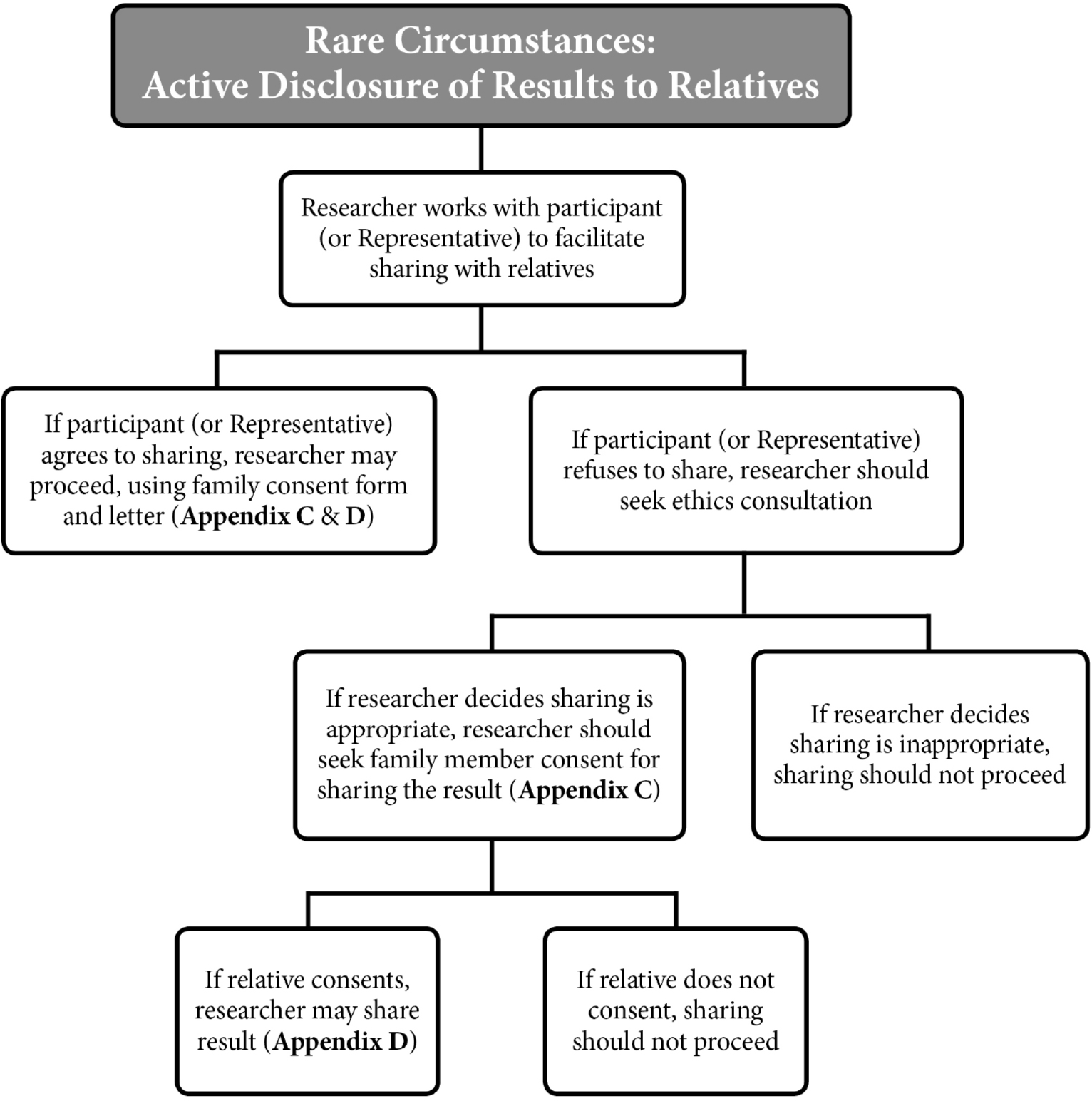
Figure 2 provides a roadmap for researchers to follow in these rare circumstances. This figure is applicable to both adult and pediatric research, both before and after the participant's death; in pediatric research, the researchers will work with both the parents/guardian as Representative and the child (if alive and capable of assent). (See sections 3.B. and 4.A. below.)
Recommended roadmap for rare circumstances justifying researcher-initiated return of results to family.

2. Adult Research Participant — Deceased
After the death of the participant, the Representative acts as the gatekeeper to the participant's research results. The researcher should refer family access requests to that individual. The Representative should apply the decisional standards outlined above and in our prior recommendations paper — give weight to the participant's preferences on sharing, and if the participant has provided no guidance on sharing, balance the participant's privacy and personal interests against the interests of relatives in receiving the genetic results. (See section 1.C. above.) If relatives seek the participant's results and the participant authorized sharing the research results, then the Representative has strong support to share the results. If the Representative authorizes the sharing, the researcher can offer to provide them with a family consent form and letter explaining the result (Appendix C and D), although some Representatives will choose to proceed more informally.
A. No Representative Authorization Form
If the participant did not complete the form designating a Representative, the deceased participant's Representative may be the participant's Legally Authorized Representative (LAR) or surrogate decision-maker, another authorized representative, or a trusted family member; state law may clarify who can serve in this capacity. Once the Representative is determined, the researcher should share guidance on that role with the Representative (Appendix B). As discussed above, if the participant did not indicate preferences on sharing results with family members, the Representative should balance the participant's privacy and personal interests against the interests of relatives. If the Representative determines that sharing is appropriate, researchers can provide the Representative with a family consent form and letter explaining the result (Appendix C and D).
B. Rare Circumstances in which Researchers may Initiate Return to Relatives
As noted above, in rare cases, researchers may discover a highly pathogenic and actionable variant whose disclosure to relatives is highly likely to avert imminent harm. In these cases, if the participant or Representative agrees to share, then they or the researchers can offer the result to relatives (Appendix C and D). If the participant or Representative refuses to share the result, the researcher should seek ethics consultation for guidance on whether the researcher should nonetheless offer the result to relatives.
When researchers are offering results to relatives, they should ascertain whether the relative agrees to receipt of the result (Appendix C) and can adapt the letter we suggest to confirm the result communicated (Appendix D).
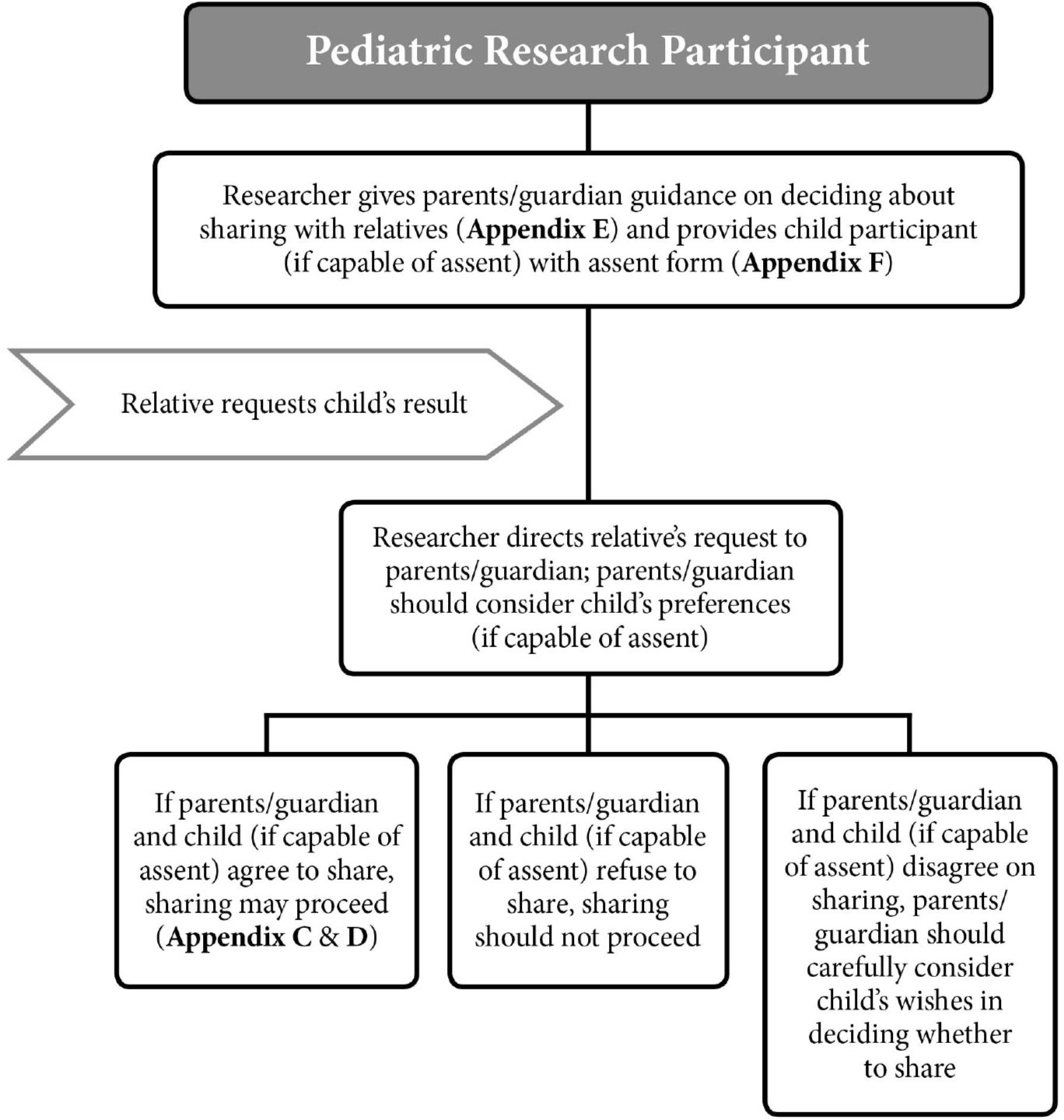
We next consider return of results to relatives when the research participant is a child or adolescent. Figure 3 summarizes the recommended roadmap for returning results to relatives when the pediatric participant is living or is deceased.
Recommended roadmap for returning research results to family members of pediatric research participants, both living and deceased.

3. Pediatric Research Participant — Living
A. Parents/Guardian's Representative Guidance & Pediatric Participant Assent
Child and adolescent research participants present additional challenges.Reference Sabatello and Appelbaum27 Parents or a guardian must grant permission for the child's participation28 and the child, if capable, must assent to participate in the study.29 Results that implicate adult-onset diseases or that have reproductive significance raise additional ethical issues, because the child may receive no direct benefit from receiving the results, but parents and family members may benefit.Reference Hufnagel30
During the permission and assent processes, researchers should discuss the project's policies on return of results to family with the child participant (a term used here to include child and adolescent research participants) and the parents/guardian, explaining how researchers will handle requests from family members as well as whether the researchers may initiate disclosure of results to relatives in the absence of such a request. In most cases, the parents/guardian providing permission for the child's participation in research will also serve as the child's Representative to make decisions about sharing results with relatives while considering the child's preferences (if any). Accordingly, we provide no form in which the child states a preference for who should act as Representative; nor do we provide a form asking the parents/guardian who should act as the Representative if they cannot. However, these issues may arise in some studies and some individual cases. Researchers may then need to consider eliciting the child's preferences on who should serve as Representative and can consider the format we recommend for eliciting this preference from adults (Appendix A). When researchers need to consider asking the parents/guardian who they feel should serve as the Representative if they cannot, the researchers again can consider adapting the form we recommend for eliciting the adult participant's preference on Representatives (Appendix A). In cases of conflict between a child capable of assenting and parents/guardian on who should serve as the child's Representative, ethics and legal consultation may be needed.
The parents/guardian serving as the child's Representative should be alerted that a family member may seek results. The form we recommend to orient parent/guardian Representatives to their responsibilities may be helpful (Appendix E). While this guidance form provides much of the same information that would be provided to the Representative of an adult participant, this letter addresses issues that are unique to pediatric genomic research, such as the role of participant assent. The letter also alerts the Representative to the ongoing debate about whether researchers should disclose genomic results that pertain to adult-onset diseases,31 while acknowledging that the researchers will determine whether to return these results within the study.
In addition, we offer a form that can be shared with a child or adolescent capable of assent, in order to orient them to the sharing question and to elicit their preferences on sharing their results with family members (Appendix F). Similar to the form for adult participants (Appendix A), this form provides general information about relatives' potential desire for the child's results. The form also notes that the child's parents/guardian will determine whether to share those results until the child reaches the age of majority, but should consider the child's preferences. The form states that when the child reaches the age of 18, the child will control access to their own results. Note that if the child is unable to assent due to age, maturity, or psychological state, then researchers should not provide this guidance form to the child and instead should rely on the decision of the parents/guardian to share the child's results.
If a relative requests the participant's results, the child's Representative (usually the parents/guardian) should be contacted. As indicated in the guidance form for the child's Representative (Appendix E), if the Representative and the child (if capable of assent) agree to share the result, sharing may proceed. In these cases, the child's Representative may find helpful the two forms discussed above — the family consent form and letter to share the research result (Appendix C and D). However, if the child's Representative and child (if capable of assent) both refuse to share, then sharing should not proceed.
A more difficult case will arise if the child's Representative and the child participant disagree about whether to share research results. Appendix E advises the child's Representative on the decisional approach our earlier consensus paper recommended.32 The parents/guardian (or other Representative) should carefully consider the child's preferences if the child is capable of assent, has been informed of the issues, and has communicated a considered view on whether to share results with relatives. We noted that cases of disagreement in which a living child wishes to block family access to results will need ethics consultation.33
Another challenging scenario may arise if the participant's parents disagree between themselves about sharing results with relatives. Parental disagreement over sharing will need to be addressed on a case-by-case basis, and researchers may need to seek ethics or even legal consultation.
B. Rare Circumstances in which Researchers May Initiate Return to Relatives
Again, exceptional cases may arise involving highly pathogenic and actionable variants whose disclosure to a family member is highly likely to avert imminent harm. The researcher should work with the parents/guardian and child (if capable of assent) to facilitate the return of the result. However, if the parents/guardian and child refuse to share, the researcher should seek ethics consultation. After the consultation, the researcher may still offer these results to the relative if offering is deemed appropriate. (See Figure 2.) The researcher can then use the forms we suggest to ground a process of notifying the relative of the option to receive the result and to seek the relative's agreement to receive the result (Appendix C). If the relative agrees, the researcher may share the result with the relative and can use the form we offer to aid that process (Appendix D).
4. Pediatric Research Participant — Deceased
After the death of a pediatric participant, the parents/guardian as the child's Representative customarily have control over family access to the child's results, assuming they are alive and have decisional capacity. Investigators should direct family requests to the parents/guardian, who may then decide whether to share the result. If the parents/guardian elect to share the result and the child, while living and able to assent, approved of sharing, then sharing may proceed. If the parents/guardian do not wish to share and the child while alive also preferred not to share, then sharing should not proceed.
If the parents/guardian and child disagreed about sharing research results with family members, the parents/guardian should carefully consider the child's preferences, especially if the child was informed of the issues and communicated a considered preference on sharing. Cases in which the child communicated a considered preference to block sharing with relatives may need ethics consultation.34
A. Rare Circumstances in which Researchers may Initiate Return to Relatives
As discussed above, exceptional cases may arise involving highly pathogenic and actionable variants whose disclosure to a family member is highly likely to avert imminent harm. In these unusual cases, the researcher may initiate return. As noted above in the case of adult participants, the researcher should first try to work with the parents/guardian as the child's Representative to facilitate sharing. If the parents/guardian approve sharing and the child (while alive and capable of assent) did not object, then the researcher can proceed with the process of reaching out to the relative for agreement to receive the result (Appendix C). However, if the parents/guardian or the child (while alive and capable of assent) objects to sharing, the researcher should seek an ethics consultation. After the consultation, the researcher may still offer these results to relatives if offering the result is deemed appropriate. The researcher will then need to notify the relative of the option of receiving the result and seek the relative's agreement to receive the result (Appendix C). If the relative agrees to receive the result, we offer a form that may be useful to support communication of the result (Appendix D).
Our earlier consensus paper urged that genomics research teams routinely plan ahead to determine how they will handle family member requests for access to a participant's results, including after the participant's loss of decisional capacity or death. This counsels communicating to prospective participants how such requests will be handled. We emphasized in our earlier paper that researchers are not obligated to engage in the process of return of results to relatives, but may engage in this process.
III. Discussion
Our earlier consensus paper urged that genomics research teams routinely plan ahead to determine how they will handle family member requests for access to a participant's results, including after the participant's loss of decisional capacity or death.35 This counsels communicating to prospective participants how such requests will be handled. We emphasized in our earlier paper that researchers are not obligated to engage in the process of return of results to relatives, but may engage in this process.
When researchers anticipate the possibility of sharing results with relatives, the researchers should elicit the adult participant's preferences on sharing results and on who should serve as the participant's Representative to make decisions about authorizing access to the participant's results when the participant cannot make decisions him- or herself. Planning ahead also suggests alerting the chosen Representative to the issues raised by family requests for results, orienting that individual to his or her role if such a request occurs, and communicating to the Representative any substantive preferences on sharing that the participant communicated to the research team. As noted above, this may occur at the time the Representative is identified, in order to plan ahead. That person will then know their role if family requests arise at any time, including after the end of the research project. The Representative will also have the benefit of guidance if a family member requests results from them unbeknownst to the researchers. However, some research projects and institutions may decide to alert the Representative later, when the issue of return of results to relatives arises. If the participant is a child or adolescent, the planning process should include eliciting his or her preferences (if the minor is capable of assent) and alerting the Representative (who will usually be the parents or guardian) to the possibility that a family member may request results, orienting the Representative to this role, and communicating the child or adolescent's preferences on sharing. Again, some research projects and institutions may decide to alert the child's Representative to this role later, when the issue of sharing results with relatives arises.
The toolkit we offer in this paper will be valuable to researchers, their institutions, and their IRBs, as they plan for the possibility of a relative's request for results. Planning for such a request and handling it responsibly can be complex — a number of individuals are potentially involved (including the research team, the participant, the participant's Representative, the family member making the request, and others who may include the family member's clinician and clinical genetic counselors). Further adding to the complexity is the length of time over which the issue can arise; a family member may make the request not only at any point in the research process, but also as long as the data are archived in a biobank or other facility, and potentially after the participant's death. In addition, the wide range of health concerns that may prompt a request from a family member adds to the heterogeneity of scenarios that may arise. Finally, the possibility that researchers may find urgent genomic results that prompt the researchers themselves to consider initiating return adds to the complexity.
Faced with this complexity, the toolkit we offer here can significantly ease the burden of planning for how to handle family requests. The consensus recommendations we published earlier recommend a framework for approaching these issues, and the toolkit we offer here presents a starting point for operationalizing those recommendations. This starting point should reduce the person-hours and cost to the research team required to plan for handling the return of research results to relatives. Our recommendations and toolkit should facilitate planning at the time the protocol is formulated as to how these issues will be handled.
This advance planning should also allow the research team to secure more fully informed consent to participate in the study from prospective research participants, as the researchers will be able to tell prospective participants how family requests for access to results will be managed. The process we urge can also reassure participants that their preferences will be elicited regarding who should serve as their Representative and whether their results should be shared with family members.
Empirical results are beginning to emerge on individuals' and family members' preferences concerning sharing results within the family, both before and after the research participant's death.36 Gathering data on preferences in a wide range of populations, asking how much deference should be accorded to the proband's wishes about sharing, and exploring whether preferences vary by the type of genomic results at issue (for example, actionable cancer risk variants versus much less actionable variants predicting cognitive decline versus proband carrier status) will be important to further inform policy and practice on return of results to family. The policy and practices that we urge in our earlier consensus paper and operationalize in the tool-kit presented here encourage respect for the range of participant preferences on sharing, deference to participant views on who should serve as their Representative to make sharing decisions when the participant cannot, and careful consideration of family members' need for the results.
Conclusion
The goal of this paper is to offer pragmatic guidance and implementation tools to facilitate the ethical return of genomic research results to family members. Because the issue of sharing research results with relatives arises in ethically and legally complex scenarios and in a wide variety of research studies, these tools provide a much-needed starting point and source of guidance for researchers, IRBs, biobanks, and research institutions. This toolkit will help them to anticipate family requests for research results and facilitate orderly return of results without overburdening the research institution.
Acknowledgments
Preparation of this article was supported by the National Institutes of Health (NIH), National Cancer Institute (NCI) and National Human Genome Research Institute (NHGRI) grant 1R01CA154517 on “Disclosing Genomic Incidental Findings in a Cancer Biobank: An ELSI Experiment” (Gloria Petersen, Barbara Koenig, Susan M. Wolf, Principal Investigators). This work benefited from the investigators' participation in the NIH-funded Clinical Sequencing Exploratory Research (CSER) Consortium. The biobank at the Mayo Clinic SPORE in Pancreatic Cancer is supported by NIH grants P50CA102701 and R01CA97075. Additional support was provided by NIH grants P20HG007243 (Koenig); and U01HG006500, U19HD077671, and R01HG005092 (Green). The contents of this article are solely the responsibility of the authors and do not necessarily represent the views of NIH or the CSER Consortium. Thanks to Heather Bennett, J.D., and Jon Watkins, J.D. candidate, for research assistance during this project and to Audrey Boyle for outstanding management of the work yielding this paper. Thanks also to Sydney Viel, M.P.H., at the University of Minnesota's Clinical and Translational Research Institute for review of the templates offered in the Appendices.
APPENDIX A
Adult Participant Statement of Preferences on Return of Results to Family Members and Designation of a Representative
Timing. This form can be incorporated into the initial consent process or be administered at a later time. The research team should decide when it is most appropriate to discuss and provide this form.
Communication process. This form should be part of a larger communication process between the research team and the participant. The form can be used to facilitate that conversation and document the participant's views on sharing and who should serve as the participant's Representative.
Views on sharing results. This form asks simply whether the research participant wants their research results shared with family members or not. Some research studies may choose to ask more detailed questions, such as what kind of results should be shared and with which family members.
Key elements. This document should explain that relatives may be interested in the participant's genetic research results, say how family members' requests for results will be handled, explain the need and importance of a Representative and allow the participant to designate a preferred Representative, and elicit the participant's preferences for sharing research results with family members.
Suggested Form
Research Participant's Name: __________________________________________________________
Date of Birth: _____________ Phone #: __________________ _____
This study involves genetic testing [OR GENOME SEQUENCING]. Your genetic information is unique to you, but you share some genetic similarities with your blood relatives, including your children, parents, brothers, and sisters (when they are biologically related to you). You may wish to consider whether you want to share your genetic results with family members, so they can decide whether to be tested to find out if they have the same result.
Please note that there is no guarantee that your family members will get any benefit from receiving the results. There is a risk that they may feel distress from learning the result. There is also a risk that our understanding of the result might change as we learn more.
You are free to tell your family members about your results at any time. If you share your results with family members, there is a risk that they will share your results with other people.
If your family members decide to ask the research team about your genetic results, we will ask them to talk to you so you can decide whether they should get your result. If you can no longer decide for yourself (for example, because you are too sick to decide or are deceased), we would like to refer them to someone you trust — your Representative — to decide about access to your results.
Please name below the person you would like to be your Representative. This may be a family member or someone else you trust. You may want to give a copy of this form to your Representative and talk about your preferences for sharing research results with family members.
Please note that there are some cases in which a family member has a legal right to a relative's genetic information, even if the Research Participant or Representative objects. We would be happy to answer any questions you have about this.
In rare cases, we may identify a genetic result that we would like to share with a family member to prevent harm to their health. This would be a genetic result that your family member is likely to have too and that poses a high risk of imminent health harm to them. If the high risk can be reduced by telling them so they can get genetic testing, we would like to share the result with them. In that case, we will first recommend that you (or your Representative, if they are making access decisions at that point) reach out to the family member. However, in these rare cases, we may reach out directly to the family member ourselves to prevent harm, even if you or your Representative objects.
A. Your Preferred Representative: I would like the person named below to decide on family access to my genetic results if I am unable to decide for myself.
Representative's Information:
Name: __________________________________________________________________________
Relationship to you: __________________________
Address: _____________________________ City: ______________ State: _____ Zip: ___________
Telephone: ______________ Cell: _________________ Email: _____________________________
B. Your Preferences on Offering Results to Family — Guidance for your Representative: I authorize my Representative to share my genetic results with family members (initial your choice):
Yes _________ No _________
Do you have any further guidance for your Representative on your preferences?
_______________________________________________________________________________
_______________________________________________________________________________
Your rights: I understand I have a right to:
Ask questions about this form
Think about this form and wait before signing it
Refuse to sign this form
Receive a copy of this signed form
Change my mind and revoke or change this form at any time
Continue as a research participant in the study, whether I sign this form or not.
Signatures:
The research team has discussed these choices with you and answered your questions.
By signing this page, you acknowledge that you have read and agreed to the terms of this form:
Signature of Research Participant: _______________________________________ Date: ________
Printed name of Research Participant: ____________________________________
Signature of Individual Obtaining Preferences: _____________________________ Date: ________
NOTE: If you have any questions or concerns about this form, please contact [INFORMATION].
Appendix B
Guidance Letter for Representative
Timing. The research team may provide this letter once the participant has named his/her preferred Representative (Appendix A) or may provide it at a later time. The research team should decide what timing is most appropriate.
Recipient. The research team may choose to provide this letter to the participant who can then give it to the Representative. Alternatively, the research team may send this letter to the Representative directly.
Key elements. This document should include general background about the research study, notify the Representative that he or she has been named by the participant as their preferred person to serve as Representative, outline the process by which family requests for results will be handled, provide substantive guidance on the participant's sharing preferences, alert the Representative to the possible disclosure of results under other Federal and State laws, and provide contact information.
Suggested Form
Dear [REPRESENTATIVE]: Date: ___________
[RESEARCH PARTICIPANT'S NAME] is a Research Participant in [STUDY]. [INCLUDE brief description of research study]. The Research Participant has requested that you serve as his/her Representative to make decisions about others' access to his or her genetic results if he/she can no longer make decisions. This means that if the Research Participant loses the capacity to make these decisions or dies, you may be asked to make these decisions instead.
If the Research Participant's family member(s) seeks research results and the Research Participant can no longer make decisions about this, the family member(s) will be referred to you to make decisions about their access to the genetic results.
We asked whether the Research Participant wished to share results with family member(s). The Research Participant said that he/she DID/DID NOT [INDICATE WHICH ONE] wish to share. We also asked whether the Research Participant had any more preferences on sharing results with family members. The Research Participant indicated NO ADDITIONAL PREFERENCES/THESE ADDITIONAL PREFERENCES: _____________________. [INDICATE WHICH ONE]
If a family member requests access to the Research Participant's results, and if the Research Participant has lost decisional capacity or died and so can no longer make decisions him- or herself, we will ask you to decide on family member access to results. You will need to consider any preferences the Research Participant expressed.
If the Research Participant agreed to sharing results with family members, this provides strong grounds for you to permit access.
If the Research Participant stated a preference not to share, this provides strong grounds for you to refuse access.
If the Research Participant was silent on sharing results with family members, you should balance his/her privacy and personal interests against the interests of relatives in receiving the genetic results.
Please note that there are some cases in which a family member has a legal right to a relative's genetic information, even if the Research Participant or Representative objects. We would be happy to address any questions you have about this.
In rare cases, we may identify a genetic result that we would like to share with a family member to prevent harm to their health. This would be a genetic result that the family member is likely to have too and that poses a high risk of imminent health harm to them. If the high risk can be reduced by telling them so they can get genetic testing, we would like to share the result with them. In that case, we will first work with the Research Participant to decide on family member access. However, if the Research Participant is decisionally incapacitated or dead, we will work with you to reach out to the family member. In these rare cases, we may reach out directly to the family member to prevent harm, even over the objection of the Research Participant or you as the Representative.
Serving as the Representative is an important responsibility. If you have any questions or concerns, please contact [INFORMATION].
Signed,
[RESEARCHER]
APPENDIX C
Consent Form for Family Member to Receive Participant's Research Results
Applicability. The consent form for family members may be useful in several scenarios: (1) the participant asks the research team for help in returning the research results to family members; (2) the participant's Representative asks the research team for help in returning the research results to family members; or (3) in the rare circumstance in which the research team reaches out directly to family members to offer the result in order prevent imminent harm. When the Representative is sharing research results with family members without the involvement of the research team, the Representative may prefer a more informal approach that does not utilize this form.
Genetic counseling. Some research teams may provide access to a genetic counselor for family members; other teams may instead refer family members to a genetic counselor. Research teams should consider clarifying in this form whether they will provide access to genetic counselors and who will pay for the genetic counseling.
Rare circumstances. In the rare circumstance in which researchers discover a highly pathogenic and actionable variant that a relative is likely to carry and whose disclosure is highly likely to avert imminent harm, then this consent form can be provided to the relative, who can then decide if they would like to receive the result.
Key elements. This document should include background information on the research study, alert the family member to potential risks and benefits of receiving their relative's genomic research result, allow the family member to consent or refuse to receive the research result, address access or referral to a genetic counselor, and provide contact information.
Suggested Form
Your family member [NAME] has participated in a genomics research study. We are requesting your permission to return a research result to you that was found in the course of that research study. This research result will show that your family member has a particular genetic variant. It is possible that you share this same genetic variant, but it is also possible that you do not. To be sure, you may want to get your own genetic testing.
Learning about your family member's genetic test result may raise concerns and be upsetting. Because some genetic variations can help to predict future health problems for you and your relatives, this information might be of interest to health care providers, life insurance companies, employers, and others. However, Federal and State laws provide some protections against discrimination based on genetic information. For example, the federal Genetic Information Nondiscrimination Act (GINA) makes it illegal for health insurance companies, group health plans, and many employers to discriminate against you based solely on information about your genetic risk. However, it does not prevent companies that sell life insurance, disability insurance, or long-term care insurance from using genetic information as a reason to deny coverage or set premiums. The law in your state may or may not provide additional protections.
If you agree to receive your family member's genetic result, please return this form with your signature to: [ADDRESS]. If we receive your agreement, we will communicate the research result to you. At your request, we will also provide [OR REFER YOU TO] genetic counseling to help you understand the result.
A. Your decision about whether to receive your family member's genetic result: [please check the one you choose]
Yes, I wish to receive the result _______
No, I do not wish to receive the result at this time ___________
I would like to speak to a genetic counselor before I decide _______
B. Your decision about whether to request genetic counseling about the result: [please check the one you choose]
Yes, I would like to speak to a genetic counselor about this result __________
No, I do not wish to speak to a genetic counselor about this result at this time __________
Name: __________________________________________________________________________
Address: _________________________________________________________________________
City: ________________ State: _____ Zip: _________
Telephone: _________________ Cell: ________________ Email: _____________________________
Signatures:
By signing this page, you acknowledge that you have read and agreed to the terms of this form:
Signature of Family Member: ___________________________________________ Date: ________
Printed name: ____________________________________________________________________
Signature of Individual Obtaining Preferences: _____________________________ Date: ________
NOTE: If you have any questions or concerns about this form, please contact [INFORMATION].
APPENDIX D
Letter to Family Member to Share or Confirm Research Results
Share or confirm results. This letter can be used by either the participant or the participant's Representative to share results for the first time or to confirm results that have already been shared by the participant, Representative, researcher, or genetic counselor.
Genetic counseling. Some research teams may provide access to a genetic counselor for family members; other teams may instead refer family members to a genetic counselor. Research teams should consider clarifying in this form whether they will provide access to genetic counselors and who will pay for the genetic counseling.
Rare circumstances. Researchers may use this form when reaching out to family members directly to return a genetic result. We urge that researcher-initiated return be restricted to return of a highly pathogenic and actionable variant that a relative is likely to carry and whose disclosure is highly likely to avert imminent harm. In such cases, the family member should first be offered an opportunity to consent to receiving the result or to refuse receipt of the result (Appendix C). Appendix D is relevant only when the family member has consented to receive the result. Appendix D can then be used to communicate or confirm the result.
Key elements. This document should provide background information on the study, the result itself, a description of the result, and the potential implications of this result. This form should explain the possibility that the relative may share the same genetic variant as the participant, but should caution the relative not to act on this result until he or she has been personally tested and undergone genetic counseling.
Suggested Form
Dear [RELATIVE]: Date: _______________
Your relative [PROBAND'S NAME] has participated in a genetic research study. In that study, we discovered that your relative has a genetic result called [NAME OF RESULT]. [INSERT description of pathogenic result and associated risk]
It is possible that you may have inherited the same genetic result. But it is also possible that you did not inherit this variant. You may want to seek genetic counseling and consider genetic testing to find out.
To arrange a meeting with a genetic counselor, please contact [INFORMATION].
If you have any further questions or concerns, please contact [INFORMATION].
Signed, [RESEARCHER]
APPENDIX E
Guidance for Parents/Guardian Considering Family Access to Child's Research Results
Timing. The research team can provide this letter to the parents/guardian at the child's initial enrollment in the study or later. The research team should decide when it is most appropriate to discuss and provide this form.
Communication process. This form should be part of a larger communication process among the research team, the parents/guardian giving permission for the child's participation in research, and the child (or adolescent) participant if capable of assent. The form can be used to facilitate consideration of and planning concerning questions of sharing the child participant's results with relatives.
Representative. This form assumes that in most cases the parents/guardian will be serving as the child's Representative.
Key elements. This document should include background on the research study and say how family requests for results will be handled, including how the child's sharing preferences will be considered when determining whether results should be shared with family members.
Suggested Form
Dear [PARENTS/GUARDIAN'S NAME]: Date: ______________
[CHILD'S NAME] is a Research Participant in [STUDY]. [INCLUDE brief description of research study]. As the child's parents/guardian, you will serve as the child's Representative. As the Representative for the child, your permission will generally be needed to share the child's research results with family members.
Your child may or may not have signed an assent form stating his/her wishes about sharing results. If your child has signed this form, we will give that to you. You may also want to talk with the child about the question of sharing research results with family members, the child's wishes, and his/her reasons for wanting to share or not.
Please note that there is no guarantee that family members will get any benefit from receiving the results. There is a risk that they may feel distress from learning the result. There is also a risk that our understanding of the result might change as we learn more.
If a family member seeks the child's genetic results and the child is a minor (under 18 years old) and is alive, we will refer the family member to you and to the child (if he/she is capable of assenting) to decide on sharing.
If you and the child agree to share, the child's results will be provided to you and you can then share that information with the family member.
If you and the child agree not to share, the results will not be shared.
If you and the child disagree on sharing, you should balance the child's privacy and personal interests against relatives' interest in access to the child's genetic results. You should strongly consider any well-informed preferences expressed by the child. Ultimately, we will defer to your decision on access to the child's genetic results.
If the child is incapable of providing guidance, you should balance the child's interests against the relative's interests.
When the child turns 18, he/she may decide independently whether family members can have access to his or her genetic results.
Note that researchers currently debate whether they should look for or disclose genetic results that will not affect the health of the child but may predict the child's risk of getting a disease later as an adult. For this study, the researchers will decide whether to return results that may predict adult-onset diseases.
Please note that there are some cases in which a family member has a legal right to the child's genetic information, even if the child or parents/guardian objects. We would be happy to answer any questions you have about this.
In rare cases, we may identify a genetic result that we would like to share with a family member to prevent harm to their health. This would be a genetic result that your family member is likely to have too and that poses a high risk of imminent health harm to them. If the high risk can be reduced by telling them so they can get genetic testing, we would like to share the result with them. In that case, we will first work with you and the child (if he/she is capable of assenting) to reach out to the family member. However, in these rare cases, we may reach out directly to the family member to prevent harm, even over the objection of you and the child.
Signed, [RESEARCHER]
APPENDIX F
Child/Adolescent Participant Statement of Preferences on Return of Results to Family Members
Timing. This form can be incorporated into the initial assent process, or be administered at a later time. The research team should determine when this is most appropriate.
Communication process. This form should be part of a larger communication process among the research team, the child participant, and the parents/guardian. The form can be used to facilitate that conversation and document the participant's views on sharing research results with family members.
Key elements. This form should explain that family members may be interested in the child's genetic research results, say how family requests for results will be handled, and elicit the child's preferences for sharing research results with family members.
Suggested Form
Research Participant's Name: __________________________________Date of Birth: ______________
Our bodies contain genes — the body's instructions for how to grow and develop. Some genes can cause health problems. Our genes come from our biological parents. We also share some genes with other biological relatives, such as brothers and sisters. Some of your family members may want information about your genes, to learn about genes they might have too. If they learn about your genes, they will usually need to have their own genetic testing to know for sure whether they have the same gene.
Here are some more things to think about: Even if a family member gets your genetic result, it might not help them. There is also a risk that they may get worried or distressed if they learn the result. And our understanding of what the result means might change, once scientists learn more about it.
If a family member wants information about your genes and you are younger than 18 years old, you and your parents/guardian will decide about sharing that information. You and your parents/guardian may say yes or no to sharing with a family member. If you and your parents/guardian disagree, you will need to talk together to see if you can agree. If you can't agree but your parents/guardian still think the information should be shared, they can offer the information to the family member because you are under 18 years old.
Once you are 18 years old, you may decide independently whether your family member can have the information. You will be able to say yes or no.
We want you to know that in some situations a family member may have a legal right your genetic information, even if you or your parents/guardian objects. We would be happy to answer any questions you have about this.
In rare cases, we may identify a genetic result that we would like to share with a family member to prevent harm to their health. This would be a genetic result that your family member is likely to have too and that poses a high risk of imminent health harm to them. If the high risk can be reduced by telling them so they can get genetic testing, we would like to share the result with them. In that case, we will first work with you and your parents/guardian to reach out to the family member. However, in these rare cases, we may reach out directly to the family member ourselves to prevent harm, even if you or your parents/guardian objects.
My Wishes for Sharing My Results:
I would like my genetic results shared with my family members (initial your choice):
Yes ________ No _________
Do you have more advice for your parents/guardian on what you want? ____________________________
_________________________________________________________________________________________
_________________________________________________________________________________________
Your rights: I understand I have a right to:
Ask questions about this form
Think about the form and wait before signing it
Talk to my parents/guardian before signing this form
Say “no” and refuse to sign this form
Get a copy of this signed form
Change this form at any time
Keep going as a participant in the study, whether I sign this form or not.
Signatures:
The research team has discussed these choices with you and answered your questions.
By signing this page, you are saying that you have read and agreed to the terms of this form:
Signature of Research Participant: _______________________________________ Date: ________
Printed name of Research Participant: __________________________________________________
Signature of Individual Obtaining Preferences: _____________________________ Date: ________
NOTE: If you have any questions or concerns about this form, please contact [INFORMATION].