Archaeological and ethnohistorical research has revealed that the Postclassic and Contact periods in the Maya lowlands of the Yucatan Peninsula were turbulent times of population movements, factionalism, warfare, and human sacrifice. Here, we present isotopic data on two sets of victims of ritual violence in the Postclassic southern Maya lowlands in this context of complex socio-political interrelations and internal conflicts. Specifically, we examine strontium, oxygen, and carbon ratios in human tooth enamel from two sites, Ixlu (n = 14) and Zacpeten (n = 68), both east of Lake Peten Itza in the Department of El Peten, northern Guatemala. Each assemblage represents Early Postclassic (ca. A.D. 950/1000–1200/1300) sacrifices, probably dedicatory. The Ixlu individuals were found as rows of crania around a small box altar in front of a raised shrine. At Zacpeten, the remains had been disinterred, defiled, and redeposited in a long-used borrow pit in the Late Postclassic (ca. A.D. 1200/1300–1525).
We posed two major questions about these remains: (1) “Who” did they represent in terms of socio-politico-geo-cultural identities (e.g., were they real or fictive ancestors or enemies)? and (2) What was the nature of the rituals surrounding their deaths? Our initial hypothesis was that the individuals at both sites were local to the lakes region. In the case of Ixlu, articulated cervical vertebrae and cutmarks indicated that the individuals were sacrificial victims, and we hypothesized that they were captured during the internecine conflicts that characterized the Postclassic lakes region. Additionally, similarities in dentition, specifically hyperdontia, suggested that some of the victims were related (Duncan Reference Duncan, Prudence and Don2009). As for Zacpeten, we hypothesized that the individuals might have been deceased residents, exhumed from elsewhere at the site and redeposited as a secondary interment, in which case they should share isotopic values from the Zacpeten area (Duncan and Schwarz Reference Duncan, Schwarz, Osterholtz, Baustian and Debra2014, 2015).
Our analyses revealed significant differences between the sites and among the individuals, suggesting that those from Zacpeten came from varied areas of the lowlands and possibly from as far away as central or southern Guatemala, and at least half of those from the Ixlu shrine came from the Maya Mountains. How and why did they end up in these collective interments near the Peten lakes? Although we cannot definitively answer these questions, the findings provide a look into the internal and external relations of the two sites, and underscore the politically tumultuous period following the collapse of the Classic Maya states.
Historical and archaeological background
The central Peten lakes area is defined by a series of eight closed-drainage bodies of water formed along an east–west fault in the terrain dominated by tropical forest and limestone karst (Figure 1). The lakes region did not suffer the depopulation that characterized the Terminal Classic “collapse” (ca. A.D. 830–950/1000) of Maya dynastic political order elsewhere in the southern lowlands (see Demarest et al. Reference Demarest, Rice and Rice2004). Instead, the lakes became a focus of resettlement: throughout the Postclassic, groups from elsewhere in Peten as well as outside moved to their shores and easily defended islands and peninsulas.
The central Peten lakes region.

Ethnohistorical research into sixteenth-century and later Spanish military and religious efforts to achieve capitulation of the Peten Maya disclosed endemic warfare and pervasive factionalism within and between the two dominant polities, Itza and Kowoj, in this remote region (Jones Reference Jones1998, Reference Jones, Prudence and Don2009). These two ethno-politico-linguistic groups spoke related dialects of Yukatekan Mayan in the northern lowlands, Itzaj by the Itzas and Yukateko by the Kowojs (Hofling Reference Hofling, Prudence and Don2009; Hofling and Tesucún Reference Hofling and Fernando Tesucún1997). Both groups likely grew through in-migration from the north, particularly after the collapse of Chichen Itza (by ca. A.D. 1100). Later, the walled city of Mayapan (A.D. 1200–1450) became the capital of a confederacy of high-ranking northern lineages, co-ruled (not always harmoniously) by two alliances, Kokom/Cocom (Itza) and Xiw. The Itzas of Peten were related to the northern Itza alliance and the Kowojs (Couohs) were a small lineage allied with the Xiws (Quezada Reference Quezada2014:131, 150). Growing strife within the confederacy, especially between its ruling coalitions, culminated in the Xiw overthrow of the Kokoms and abandonment of the city in the fifteenth century. Some residents fled south to Peten.
Classic-period (A.D. 200–950) inscriptions reveal a deep early history of Itza peoples in Peten and Belize (Boot Reference Boot1995, 1997). During the Early Postclassic, some northern Itzas emigrated south into Peten and resident Itzas began moving eastward from large Lake Peten Itza to the smaller lakes. By the Late Postclassic, Itzas ruled the western region from their island capital of Nojpeten or Tayza (modern Flores) in Lake Peten Itza (Rice and Rice Reference Rice, Rice, Prudence and Don2018). Meanwhile, around A.D. 1200, other immigrants, whom we consider Xiw-related ancestors of the Contact-period Kowojs, began arriving in the lakes district. They settled around Lake Yaxha in the east and made their capital on the Topoxte Islands. The sixteenth-century Kowojs told the Spaniards they had come south from Mayapan, but evidence suggests a more complex history in Peten, including ancestral ties in Classic times (Rice and Rice Reference Rice and Rice2009).
The Itzas and Kowojs competed for dominance over the lakes area, moving east/west to encroach on each other’s territory and usurp settlements. In addition, both groups formed and broke alliances with neighboring polities, particularly Mopan Maya to the east in Belize and southeastern Peten (Jones Reference Jones1998:99, 135, 239; Jones Reference Jones, Prudence and Don2009:57; Rice and Rice Reference Rice and Rice2009:13). Archaeological research around the lakes revealed that the oscillating Itza and Kowoj occupations are distinguishable by material signatures, particularly architecture (Pugh Reference Pugh2001; Pugh and Shiratori Reference Pugh, Shiratori, Prudence and Don2018; Rice and Rice Reference Rice and Rice2009) and slipped and decorated pottery: Itza Snail-Inclusion Paste (SIP) ware and Kowoj Clemencia Cream Paste (CCP) ware, respectively (Cecil Reference Cecil2001; Rice and Cecil Reference Rice, Cecil, Prudence and Don2009). Varying distributions of these diagnostics, plus radiocarbon dates, facilitate reconstruction of this history.
Architectural evidence for these back-and-forths establishes the context of the human remains discussed here. Standing Postclassic lowland Maya civic-ceremonial structures, originally described at Mayapan (Proskouriakoff Reference Proskouriakoff, Pollock, Roys, Proskouriakoff and Smith1962), exist in four common forms—hall, shrine, oratorio, and temple—in two arrangements: basic ceremonial groups (BCGs) and temple assemblages. BCGs consist of hall, shrine, and oratorio; temple assemblages have all four structure forms. In central Peten, the Itzas built BCGs (Pugh and Shiratori Reference Pugh, Shiratori, Prudence and Don2018), whereas Kowoj architecture manifests as temple assemblages (Rice Reference Rice, Sabloff and Andrews V1986; Rice et al. 2024). Zacpeten and Ixlu display both arrangements, Kowoj temple assemblages and Itza BCGs, attesting to the sites’ complex histories. At each, the analyzed human remains were associated with Early Postclassic shrine structures in a BCG. Unfortunately, we do not know if the BCGs or shrines at Mayapan can be specifically linked to the Itzas, as are those in Peten.
At different times, the Kowojs and the Itzas pressed eastward to the site of Tipu, on the Macal River in western Belize, approximately 35 km from Topoxte (Jones Reference Jones1998:52–55; Rice and Rice Reference Rice and Rice2009:48). Tipu, at the northern edge of the Maya Mountains, was a prosperous Postclassic trading node in a prime cacao-producing area. The motivation for the Peten intrusions might have been a desire to (re)capture control over north–south trade through the Río Mopan/Macal corridor. That control would have involved interactions with Tipu and Mopans to the south. Tipu evidences Peten relations through a temple assemblage and CCP ware, suggesting Kowoj occupation, as well as Itza SIP pottery.
We do not know the reasons for the Postclassic antagonisms and factionalism among the Itzas and Kowojs (Rice Reference Rice2019). The conflicts could have stemmed from their Classic-period histories in Peten, subsequent clashes in their later northern homelands, or more recent immigrant experiences. Regardless of the causes, communities around the most central of the central Peten lakes, Salpeten and Macanche, bore the brunt of the ongoing unrest, with see-sawing Itza–Kowoj dominance. Zacpeten and Ixlu lie in this hotly contested area in the basin of Lake Salpeten, immediately east of Lake Peten Itza.
Ixlu: Structure 2023
Ixlu (Figure 2) is a small but long-lived site, with occupation beginning in the Middle Preclassic period (900–400/300 b.c.). Its importance derived from its strategic location at the narrow isthmus between Lakes Peten Itza and Salpeten, a crossroads of overland and water-borne travel and trade routes through Peten (Rice and Rice Reference Rice and Rice2016). Likely known locally as Chaltuna, Ixlu was the primary eastern port of the Itzas in the Contact period, but it also had a late Kowoj temple assemblage, the westernmost of these groupings around the lakes.
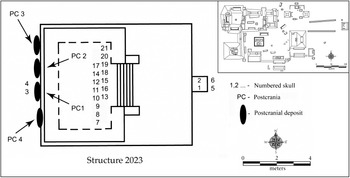
The site of Ixlu and shrine Structure 2023.

Ixlu Structure (Str.) 2023, a “raised shrine” in Mayapan terminology (Proskouriakoff Reference Proskouriakoff, Pollock, Roys, Proskouriakoff and Smith1962:90), lies in one of two Itza BCGs in the site’s large, open, main plaza. A 1.4 m-high, square building on a low, rectangular, basal platform, the shrine faces east, with an outset stairway and a small box altar, Altar 1, 6 m farther east on the platform, centered on the stairs. Excavation uncovered unusual deposits of human remains: three skull pairs, 15 skulls in two rows, and four disarticulated postcranial skeletons, placed in two construction episodes (Duncan Reference Duncan2005:197–208, 2011; Rice and Rice Reference Rice and Rice2016:71–75). Initial construction included four crania buried in pairs on the centerline of the substructural platform, two east under Altar 1 (Skulls 5* and 6*) and two west (behind the platform; Skulls 3 and 4*) (* skull with tooth analyzed). The postcrania were interred, supine, also behind the building. They lacked hands, feet, and heads, and the limbs, detached but not defleshed, had been bundled atop the articulated axial skeletons. In the second construction episode, 15 crania (Skulls 7–21) were buried in two north–south rows in the basal platform. A final pair of skulls (1* and 2*) was placed near Altar 1. All crania faced east, all had articulated cervical vertebrae (Skull 20 with two fused), and, of those not ambiguous in age and sex, all appeared to be young adolescent to young adult males (Duncan Reference Duncan, Prudence and Don2009).
Two skulls (1* and 7*) exhibited bilateral supernumerary mandibular premolars and another (16*) had a single supernumerary premolar (right side), suggesting a biological relationship (Duncan Reference Duncan2005:230, 2009, 2011). Cranium 13 had filed central and lateral maxillary incisors. Two skulls (2* and 5*) displayed the short and broad shapes of fronto-occipital modification, probably from cradle-boarding. Diverse artifacts in the platform fill included a broken, red-slipped Itza SIP jar; chipped obsidian and chert; bone and abundant shell; a bark beater, three mano fragments, and two chert pounders; and possible pigment rocks. A deer antler cache was associated with the skull stratum. We have no radiocarbon dates from Str. 2023.
In sum, the individuals represented by these remains were sacrificed. The cutmarks and articulated vertebrae of the skulls indicate that they were buried shortly after the sacrifices and were primary interments (Duncan Reference Duncan, Prudence and Don2009). The burials were included as a part of the construction of the building and may have helped animate it.
Zacpeten: Group A
The site of Zacpeten (Figure 3), east of Ixlu, occupies a small peninsula extending from the northeast shore of Lake Salpeten. Like Ixlu, it was settled from Preclassic times through the late seventeenth century (Pugh Reference Pugh2001, Reference Pugh2003; Rice and Rice Reference Rice and Rice2009). Two temple assemblages, A and C, sit atop hills, with a council house (popol naj) on a low saddle between them (Rice et al. Reference Rice, Boileau, Cecil, deFrance, Freiwald, Meissner, Pugh, Rice and Yacubic2018).
The site of Zacpeten and Group A. Op. = operation and Str. = structure.

Group A had a long history of construction, beginning on bedrock in the Middle Preclassic period. In the Early Postclassic, the area was remodeled as a two-part Itza BCG with eastern and western components. These were separated by Str. 603, a north–south “linear feature” or low rubble wall, conceivably the foundation for a perishable partition or screen of some sort (Pugh Reference Pugh2001:246–249; Pugh and Rice Reference Pugh, Rice, Prudence and Don2009:102). Although the fill around this feature was dated to the Late Postclassic, burned clay from Early Postclassic construction residue incorporated into the fill yielded a date of cal A.D. 1037–1240 (Pugh Reference Pugh2001:288–289).
In the late fourteenth or early fifteenth century, the eastern part of Group A was rebuilt as a temple assemblage by adding an east-side temple and adjacent oratorio (Pugh and Rice Reference Pugh, Rice, Prudence and Don2009:103). The builders, presumably Kowojs by virtue of architectural similarities with other Kowoj sites, set several Late/Terminal Classic carved monuments and dressed stones into structure facades. This conspicuous positioning links identity with place, the builders asserting ties to Late/Terminal Classic Sak Peten/Zacpeten and the broader lakes region. The western half of Group A retained two buildings of the earlier dual BCG: Strs. 614 (oratory) and 615 (hall), with an open area between them.
Operation 1000. Str. 614 had been constructed immediately south of a borrow pit excavated as Operation (Op.) 1000. This pit, measuring 8–9 x 7 m and 1.5–3.75 m deep, was a mass grave filled with commingled human remains, its complex stratigraphy and pottery revealing long use. In the Late Postclassic period, the remains of minimally 37 individuals—adults and juveniles; males and females—were deposited in its northeast quarter (Duncan Reference Duncan2005:108–196; see also Pugh Reference Pugh2001:282–283). Osteological analyses revealed that this was a secondary burial, the remains disarticulated and some bones exhibiting more complex processing consistent with defleshing. Left and right arm bones were placed in different spatial patterns, reflecting careful attention to body side. Classic and contemporary Maya privilege the right side (arm, hand, thigh, etc.) of the body as powerful and large, versus the left side as weak and subordinate (Duncan and Schwarz Reference Duncan, Schwarz, Osterholtz, Baustian and Debra2014). No complete crania were seen, although one young adult female skull had tabular-erect modification and retained four incisors (Duncan and Schwarz Reference Duncan, Schwarz, Osterholtz, Baustian and Debra2014:151). Many teeth (especially maxillary molars) had been removed postmortem; one 2 × 2 m excavation unit held 70+ human teeth not in occlusion. Calculation of the minimum number of individuals (MNI) on the basis of tooth class suggested that some classes were targeted for omission (Duncan and Schwarz Reference Duncan, Schwarz, Osterholtz, Baustian and Debra2014, 2015). Additionally, holes drilled in the roots of some teeth (human and animal) indicate that they were selectively taken, and, presumably, were displayed at some point (Duncan and Schwarz Reference Duncan, Schwarz, Osterholtz, Baustian and Debra2014, 2015). All remains were deposited without grave goods in a single event and stratum (Level 6) over charcoal from in situ burning of hardwood (Level 7), with a fragment of a Kowoj CCP pottery cache vessel. The whole was then ritually sealed with limestone rocks and dressed architectural stone blocks (Level 3; Duncan Reference Duncan2005:115).
Radiocarbon assays on the underlying Level 7 charcoal gave early Late Postclassic calibrated dates: A.D. 1315 ± 85 and A.D. 1365 ± 65 (Duncan and Schwarz Reference Duncan, Schwarz, Osterholtz, Baustian and Debra2014:Table 1) and a 2σ TPQ (terminus post quem) range of A.D. 1310–1440 (Pugh and Rice Reference Pugh, Rice, Prudence and Don2009:100, Table 5.2. Note that Postclassic radiocarbon dates are bimodal). Dates on wood charcoal from Level 6 were contemporaneous with this, though dates from Level 6 bone collagen from the human remains fell somewhat later, ranging between cal A.D. 1435 and 1630 (Duncan and Schwarz Reference Duncan, Schwarz, Osterholtz, Baustian and Debra2014:Table 1), and are here considered anomalous. Collagen is composed of 40–45 percent carbon, and dating it may be compromised by quantity and quality, especially preservation and environmental conditions (Calabrisotto et al. Reference Calabrisotto, Mariaelena Fedi, Bombardieri and Mandò2013; Cersoy et al. Reference Cersoy, Zazzo, Rofes, Tresset, Zirah, Gauthier, Kaltnecker, Thil and Tisnerat-Laborde2017).
Various scenarios could be envisioned as producing the interment in Op. 1000, including other mass graves (e.g., at Colha, Tancah, and Cuello), secondary burial of ancestors (with exhumation and defleshing of remains), and cannibalism (Duncan Reference Duncan2005:267–280; Duncan and Schwarz Reference Duncan, Schwarz, Osterholtz, Baustian and Debra2014, 2015). The most parsimonious scenario is that the Kowoj exhumed their enemies’ remains when they took over Zacpeten, defiled them, and deposited them in Op. 1000.
Operation 1001. The secondary remains in Op. 1000 prompt the question: Where had the individuals been interred originally? We think it highly likely that they came from Op. 1001. Op. 1001 was an 81-m2 block excavation south of the mass grave in the open space of the western BCG between Strs. 614 to the north and 615 to the south (Pugh Reference Pugh2001:286–294). A demolished building, constructed on plaster Floor 4, was evidenced by three nearly continuous piles of rocks, one topped by an inverted human neurocranium (with parieto-occipital modification) holding small bones and teeth. An incomplete and possibly disturbed, flexed, primary inhumation of an unsexed adult (Feature 1001-1), missing radii and ulnae, lay without grave goods in a shallow pit under the eastern end of this structure (Pugh Reference Pugh2001:287). Among the well-preserved teeth, the four incisors had drilled holes and round serpentine inlays. Timothy Pugh speculated that Feature 1001-1 might have been a dedicatory burial under the stairway of the edifice. This building, Str. 1001, had been the original shrine of the western Itza BCG.
Additional human remains were scattered around Str. 1001 on Floor 4, including six adult mandibles with teeth and articulated cervical vertebrae, and small cranial fragments. A complete skull and mandible with parietal and occipital modification was also found, plus a bundle of human long bones, probably “the secondary burial of both legs and the right arm of a single individual” (Pugh Reference Pugh2001:291). Otherwise, postcrania were poorly represented. The remains are thought to be from exhumed burials originally placed around or below the Str. 1001 shrine, much like those at Ixlu Str. 2023, also an Itza BCG shrine.
A mix of Late/Terminal Classic and Postclassic pottery sherds, especially Late Classic censer fragments, was recovered on and above Floor 4 (i.e., in the fill of overlying Floor 3). Quantities of obsidian, including 891 prismatic blade segments, 89 flakes or fragments, and two points, were also found (Yacubic Reference Yacubic2014:Table 7), perhaps used in the desecration of the exhumed bodies.
The individuals reburied in Op. 1000 could have come from multiple interments at Zacpeten, but several factors favor Op. 1001 as the source: proximity to Op. 1000; dedication of shrines (Str. 1001) with human sacrifices; intentional destruction of Str. 1001 (violence directed toward both sacrificial victims and the entire structure); and human remains scattered around that structure. Moreover, the rock and dressed-stone construction blocks ritually sealing the bone stratum in Op. 1000 (Level 3) were likely removed from Str. 1001.
Isotope analysis
Isotope analysis is a means of “human proveniencing”: determining from skeletal remains where individuals might have lived and what they ate. We use tooth-enamel carbon, strontium, and oxygen isotopes to examine diet and mobility patterns of the individuals recovered from Zacpeten and Ixlu. We test whether they were “local,” as hypothesized, with strontium and oxygen isotope values similar to those determined by previous studies in the lakes region, or whether they came from other areas.
Oxygen, carbon, and strontium are absorbed from consumption of food and water, are retained in bones and teeth, and inform on the environment(s) humans lived in. Values of oxygen (δ 18O) and radiogenic strontium (87Sr/86Sr) in tooth enamel can identify mobility over the landscape (Bentley Reference Bentley2006; Pederzani and Britton Reference Pederzani and Britton2019). Strontium reflects the local geology and enters the body through water and food, whereas δ 18O primarily comes from drinking water. Isotope values of carbon (δ 13C) reveal variability in diets as the teeth were growing, through the relative consumption of C3 versus C4 (photosynthetic pathway) plants and aquatic versus terrestrial food sources (e.g., Sharpe et al. Reference Sharpe, Emery, Inomata, Triadan, Kamenov and Krigbaum2018; Wright and White Reference Wright and White1996; see also Schoeninger et al. Reference Schoeninger, DeNiro and Tauber1983). In general, higher consumption of C4 plants (e.g., maize) and aquatic organisms results in elevated δ 13C values recorded in human tissues.
Previous studies in the Maya area determined 87Sr/86Sr values from various geologic regions (Hodell et al. Reference Hodell, Quinn, Brenner and Kamenov2004; also Freiwald and Pugh Reference Freiwald and Pugh2017; Freiwald et al. Reference Freiwald, Wolf, Pugh, Rand and Fullagar2020; Price et al. Reference Price, Burton, Fullagar, Wright, Buikstra, Tiesler and Cucina2015) and determined several subregions (Figure 4). In general, the lowest ratios are observed in the volcanic highlands and the highest are expected for the Maya Mountains. These overlap slightly, particularly in the geologically complex strip of mixed metamorphic and volcanic rock (the “Metamorphic Province”) of southern Guatemala and western Honduras (Hodell et al. Reference Hodell, Quinn, Brenner and Kamenov2004). Our principal interest is in the strontium values of the southern lowlands’ subregion (0.70770 ± 0.00052; sample n = 86) including the granitic Maya Mountains (0.71327 ± 0.00167; n = 3; Hodell et al. Reference Hodell, Quinn, Brenner and Kamenov2004). Using terrestrial snails that likely represent bioavailable strontium around the eastern lakes, Freiwald and Pugh (Reference Freiwald and Pugh2017) found values ranging from 0.707590 (Lake Macanche) to 0.707837 (Lake Yaxha, ∼30 km northeast of Zacpeten and Ixlu). A snail from Zacpeten had a value of 0.707618. Combined with rock, soil, plant, and water samples from Hodell et al. (Reference Hodell, Quinn, Brenner and Kamenov2004) around Lake Salpeten (0.70745 to 0.70775), we expect that the local 87Sr/86Sr of the area around the two study sites should be around 0.7074–0.7080.
Strontium isotope ranges of various regions in the Maya lowlands (data from Freiwald et al. Reference Freiwald, Wolf, Pugh, Rand and Fullagar2020; Hodell et al. Reference Hodell, Quinn, Brenner and Kamenov2004; Price et al. Reference Price, Burton, Fullagar, Wright, Buikstra, Tiesler and Cucina2015).

Oxygen isotope values vary across the landscape based on the δ 18O from rainwater and characteristics of terrestrial water in an area (rivers, lakes, etc.), and are absorbed in human teeth and bones largely through drinking water. In the Maya region, higher elevations have lower δ 18O compared to lower elevations and/or coastal areas. The most elevated δ 18O values in the Maya region will be expected for lake waters, owing to evaporation. In the Peten lakes area, the δ 18O ranges are extremely variable spatially and temporally. This is largely a consequence of evaporation and rainfall, which both vary significantly throughout the year depending on variations in rainy and dry seasons (Scherer et al. Reference Scherer, de Carteret and Newman2015; see also Lachniet and Patterson Reference Lachniet and Patterson2009). Values from tested water from Lake Peten Itza are 18O-enriched with values ranging from 1.9 to 2.6‰ (Scherer et al. Reference Scherer, de Carteret and Newman2015:Table 1), which would be expected to increase δ 18O values in humans who drank the water.
Methods and materials
The enamel of 68 teeth from Zacpeten was analyzed, including 57 from the mass grave (Op. 1000) and 11 from other locations at the site (Op. 1001 = 3; BCG hall Str. 615 = 4; Group C temple assemblage = 3; popol naj = 1). Fourteen teeth from Ixlu Str. 2023 were tested, each from a different individual. Varied teeth were sampled, primarily incisors and canines in both upper and lower arcades representing mid-late childhood (∼5–13 years; AlQahtani et al. Reference AlQahtani, Hector and Liversidge2010). Tooth samples from Zacpeten Op. 1000 could not be associated with a specific individual (teeth were not in occlusion), whereas teeth from outside Op. 1000 and those from Ixlu could be matched to cranial and sometimes postcranial remains. Of the Op. 1000 teeth, four were deciduous and the rest were permanent canines or incisors. For most of this study, we focus on the 53 permanent teeth. Deciduous teeth may show isotopic signs of weaning and yield strontium values that reflect the mother, rather than the place where the individual tested actually grew up (Wright and Schwarcz Reference Wright and Schwarcz1998).
In preparation for light stable isotope and radiogenic strontium analyses, samples of approximately 15 mg were cleaned, powdered, and homogenized. Samples were then oxidized with a 3 percent bleach solution for 16 hours, rinsed to neutral pH with distilled-deionized water, pretreated with 0.2 M acetic acid for 16 hours, rinsed to neutral again, and lyophilized in a freeze dryer for two to three days. Of the initial 15 mg homogenized sample, 0.6 mg were loaded and tooth-enamel carbonate analyzed for δ 13C and δ 18O on a Finnigan MAT 252 IRMS (Isotope Ratio Mass Spectrometer) outfitted with a Kiel III carbonate preparation device at the Stable Isotope Laboratory of the University of Florida Department of Geological Sciences. A cleaned tooth-enamel chunk (∼20 mg) from each sample was retained (for Pb and Sr analysis) and dissolved in 8 N nitric acid. The sample was separated using ion chromatography with strontium-specific resin following methods described elsewhere (Sharpe et al. Reference Sharpe, Emery, Inomata, Triadan, Kamenov and Krigbaum2018). A small aliquot of the dissolved sample was separated for elemental analysis before the Sr ion chromatography separation.
Elemental concentrations in parts per million (ppm) were measured on an Element2 HR-ICP-MS following methods outlined in Kamenov et al. (Reference Kamenov, Lofaro, Goad and Krigbaum2018). Elemental concentrations are presented in the Supplemental Information tables. Selected trace elements were used to estimate the degree, if any, of diagenetic alteration. Only vanadium (V) in several samples showed slightly elevated values (Supplemental Table 2) suggesting minor alteration, which is not expected to affect the Sr isotopes (Kamenov et al. Reference Kamenov, Lofaro, Goad and Krigbaum2018). Furthermore, elements such as the rare earth elements (REE), uranium (U), and thorium (Th) were very low, often below detection limit in all of the analyzed enamel samples. This is strong evidence that no significant enamel alteration is present in the enamel that can affect the measured Sr isotope values (see Kamenov et al. Reference Kamenov, Lofaro, Goad and Krigbaum2018 for more discussion).
Strontium values of 56 teeth were measured on a TIMS (Thermal Ionization Mass Spectrometer), following methods described by Hodell et al. (Reference Hodell, Quinn, Brenner and Kamenov2004). Strontium isotopes of 26 samples were measured on a Nu-Plasma MC-ICP-MS (Multi-Collector Inductively Coupled Plasma-Mass Spectrometer) following methods described by Sharpe and colleagues (2021). Errors in measured 87Sr/86Sr are better than ±0.00003 (2 SE), based on long-term reproducibility of the National Bureau of Standards (NBS) 987 standard (87Sr/86Sr = 0.71024).
Results
Table 1 shows the statistical summary of the 87Sr/86Sr, δ 18O, and δ 13C data, excluding deciduous teeth. The MNI was calculated in multiple ways for Op. 1000, all resulting in comparable numbers (MNI = 37; Duncan Reference Duncan2005:126–131). The minimum number of permanent teeth presented here for Op. 1000 individuals was determined using maxillary left canines, because this deposit included stray teeth. For other operations, MNI was determined by burial context.
Summary of isotope data on permanent teeth from Zacpeten and Ixlu

Note: Zacp. = Zacpeten; max = maximum; min = minimum; SD = standard deviation; VPDB = Vienna Peedee Belemnite (standard).
* Excludes four deciduous teeth from Operation 1000.
Strontium. The 87Sr/86Sr values of the Ixlu and Zacpeten tooth-enamel samples are elevated compared with the expected range of 0.7074–0.7080 for the lakes area (Freiwald and Pugh Reference Freiwald and Pugh2017; Freiwald et al. Reference Freiwald and Pugh2020; Hodell et al. Reference Hodell, Quinn, Brenner and Kamenov2004). Over half (35 of 57, 61.4 percent) of the Zacpeten enamel samples from Op. 1000 overlap with the predicted local strontium range, while seven individuals (50.0 percent) from Ixlu match the strontium ratios of the Lake Salpeten area. Furthermore, despite the sites’ proximity, results differ significantly between them (p <0.001, using Student’s t-test). Ixlu, with a smaller sample size, had a broader range of Sr values (0.707650–0.716456) and a higher mean (0.709782). At Zacpeten, teeth from both the Op. 1000 deposit and elsewhere at the site exhibited similar strontium ranges when compared (p = 0.856, using Student’s t-test), although those in Op. 1000 had somewhat broader variation (Figure 5a). Both sets had much narrower ranges of 87Sr/86Sr compared with Ixlu and a lower average (0.707907 in Op. 1000 and 0.707927 from other deposits). A comparison of 87Sr/86Sr using MNI at Zacpeten showed similar results.
Box plots of strontium, oxygen, and carbon isotope values at Zacpeten and Ixlu, comparing total permanent teeth (left) with teeth from individuals represented by MNI (right). (a) 87Sr/86Sr; (b) δ 18O, and (c) δ 13C. Whiskers display distance 1.5 times the interquartile range. Op. = operation.

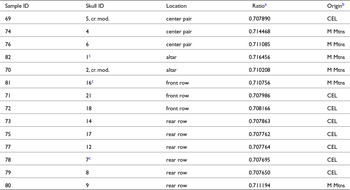
The 14 sampled Ixlu individuals (Table 2), although having the broader 87Sr/86Sr range, appear to have come from a smaller geographic area around far northeastern Peten, north-central Belize, or far southeastern Mexico/Quintana Roo, which we label the Central Eastern Lowlands (CEL). Strontium values fell into two main groups: eight comparable to the general northeast Peten and lakes region and six with higher values (>0.710). Those with the highest 87Sr/86Sr values (>0.710) likely had homes in the Maya Mountains region of south-central Belize and southeastern Peten or in the Metamorphic Province, where elevated ranges are common (Freiwald Reference Freiwald, Scott and Ardren2020; Hodell et al. Reference Hodell, Quinn, Brenner and Kamenov2004; Thornton Reference Thornton2011; Trask Reference Trask2018). The placement of these “foreign” skulls may be significant: four were in likely “special” or prestigious positions in the front (east) of the structure on the privileged centerline or near Altar 1. Only two were among the two rows of 15 skulls, along with seven others that exhibited the local strontium range. Of the two skulls displaying cranial modification, both with front-center placements, one (#2) was likely non-local, and of the three with supernumerary teeth, two were non-local.
Enamel strontium ratios of 14 analyzed Ixlu teeth

Note: cr. mod. = cranial modification; CEL = Central Eastern Lowlands; M Mtns = Maya Mountains.
a 0.7074–0.7080 = local
b The CEL is “Central Eastern Lowlands,” area encompassing northeastern Peten, north-central Belize, and southern Mexico (Quintana Roo and Campeche)
c Supernumerary tooth.
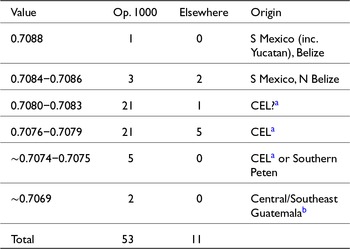
The individuals from Zacpeten appear to represent wider origins. Over two-thirds (36.8 percent) of the 87Sr/86Sr values range from 0.7080 to 0.7083 (Table 3), suggesting they likely came from the CEL, but probably not immediately around the lakes and perhaps further to the north or east. The lowest 87Sr/86Sr value (∼0.706890) suggests origins in central or southeastern Guatemala. Interestingly, the Zacpeten samples do not include any individuals from the Maya Mountains area.
Frequencies of 87Sr/86Sr values for Zacpeten tooth-enamel samples

Note: Op. = operation; S = south; inc. = including; N = north;
CEL = Central Eastern Lowlands.
a The CEL area encompasses northeastern Peten, north-central Belize, and southern Mexico (Quintana Roo and Campeche) See Table 2, note b.
b Region of modern Alta/Baja Verapaz and the Motagua Valley, excluding highlands and Pacific coast
Oxygen. Like strontium, the δ 18O ranges of the permanent teeth tested varied between the two sample sets (Figure 5b and Figure 6), with Zacpeten exhibiting a wider range (−3.7 to +0.7‰). More than half the individuals from Zacpeten had δ 18O values above −2‰, suggesting they came from the northern and eastern regions of the lowlands (Lachniet and Patterson Reference Lachniet and Patterson2009). The values are generally comparable with the enamel δ 18O obtained from individuals at nearby Mission San Bernabé (Freiwald et al. Reference Freiwald, Wolf, Pugh, Rand and Fullagar2020). The consistently elevated δ 18O values do not closely overlap with enamel data from sites in northeast Peten more distant from the lakes, including Tikal (Wright Reference Wright2012) and Nakum (Rand et al. Reference Rand, Matute, Grimes, Freiwald, Źrałka and Koszkul2020). The tooth with the lowest 87Sr/86Sr value at Zacpeten also had the lowest δ 18O value (−3.7‰), reaffirming that the person likely came from central/south Guatemala, perhaps Alta Verapaz or possibly the Motagua Valley. Teeth from Op. 1000 had δ 18O values that overlapped entirely with those outside the deposit, even taking MNI into consideration. Little statistical correlation was found among the Zacpeten 87Sr/86Sr and δ 18O values (Pearson’s r = −0.29, p = 0.016), suggesting that individuals may have come from multiple locations.
Comparison of enamel 87Sr/86Sr and δ 18O from permanent teeth at Zacpeten and Ixlu. Op. = operation; VPDB = Vienna Peedee Belemnite (standard).

Teeth from Ixlu had a narrower δ 18O range (−4.3 to −1.8‰), with only one sample exceeding −2‰. No close correlations exist between δ 18O and 87Sr/86Sr values at Ixlu. The narrower δ 18O range at Ixlu compared with Zacpeten likely reflects the fact that half the individuals appear to have come from the Maya Mountains and the other half from northeast Peten, perhaps near the lakes, rather than the broader geographic range the Zacpeten population represents.
Carbon. The overall elevated δ 13C values of the sampled enamel (Figure 5c) support the expectation that maize (Zea mays) was an important dietary constituent for these Postclassic individuals, and generally match the elevated δ 13C values at neighboring Postclassic sites such as Topoxte (Acevedo et al. Reference Acevedo, Wright, Hermes, Schwarcz, Laporte and Escobedo1997:644). Zacpeten samples had elevated δ 13C compared with that from Ixlu (an average of −1.1‰ compared with −2.5‰). No correlation was found between δ 13C and 87Sr/86Sr at Zacpeten (r = −0.63; p = 0.018). Teeth from Op. 1000 and elsewhere at the site differed statistically (p = 0.024), with those outside the deposit having lower δ 13C values, although not as low as Ixlu. Teeth of the Ixlu sacrifices exhibited a wider range of δ 13C values than at Zacpeten, perhaps indicating a more variable diet. Those with elevated strontium values matching the Maya Mountains area had the lowest δ 13C values, suggesting that maize constituted a lesser part of the diet in that region.
Discussion: Postclassic ritual and mass graves
Isotopic analysis of tooth-enamel samples from human remains at the Zacpeten and Ixlu shrines reveals significant differences between the sites and among the individuals represented in terms of both origin location and, to a lesser extent, diet. At Zacpeten, the isotopic results from the Op. 1000 deposit reveal very little difference from those of teeth from other locations at the site, indicating that they may represent the same population. This supports the hypothesis that the Op. 1000 individuals were disinterred from elsewhere at Zacpeten, likely Op. 1001. The isotopic dissimilarities between the Zacpeten and Ixlu individuals likely reflect two different cases of ritual violence, with the Zacpeten victims reflecting the broader population of the community and Ixlu reflecting a smaller targeted group of young adult males. Both groups likely had different relationships with the two Peten polities during the Early Postclassic, particularly with the Itza.
The interments discussed here reflect “ritual violence,” but how are we to interpret “ritual”? Was the violence carried out in a “ritualistic” or “ritualized” way, formalized, prescribed, and repeated? Was it part of some larger symbolic or ceremonial occasion? The Maya and others in Mesoamerica frequently displayed human mandibles and skulls as trophies, especially in the Postclassic period. This is seen in necklaces of human maxillae and/or mandibles at Teotihuacan’s Feathered Serpent Pyramid (Spence et al. Reference Spence, White, Longstaffe and Law2004), in Oaxaca (Duncan et al. Reference Duncan, Elson, Spencer and Redmond2009), and in Postclassic skull racks (tzompantli) there and in the northern Maya lowlands (Tiesler and Miller 2023). The placement of skulls in rows at Ixlu suggests emulation of tzompantlis. All these displays are proclamations of power.
More broadly, human sacrifice, frequently by decapitation, is depicted in Late Postclassic screenfold books (codices) and painted murals, and associated with calendrical rituals (Vail and Hernández Reference Vail, Hernández, Tiesler and Cucina2007). Just as societies today celebrate the beginning of a new year in their culture-specific calendars (e.g., Christian/Gregorian, Jewish/Hebrew, Islamic, Chinese), the Maya celebrated the cycling of many time periods, multiples of days or years. Period endings/beginnings often occasioned decapitation sacrifice, such as ceremonies honoring the day beginning a new year (Vail and Hernández Reference Vail, Hernández, Tiesler and Cucina2007:133–134). Sacrificial/decapitation rituals signified renewal to ensure rebirth and new life in the coming period, replicating an event in the highland Maya Popol Vuh origin myth (Vail and Hernández Reference Vail, Hernández, Tiesler and Cucina2007:138). Codices often show deities carrying skulls, which are “interpreted as prophecies for the time period in question” (Vail and Hernández Reference Vail, Hernández, Tiesler and Cucina2007:Table 6.3, note j).
Mass graves have been found at various Late Postclassic Maya lowland centers. In Peten, they appear in temple assemblages and thus are linked to the Kowoj (Duncan and Schwarz Reference Duncan, Schwarz, Osterholtz, Baustian and Debra2014:154). Moreover, they appear on the western sides of structures or building complexes, west being the realm of death and the underworld in Maya cosmology. At Zacpeten, the Op. 1000 mass grave occupied an ancient borrow pit at the northwest corner of the Group A temple assemblage (Duncan Reference Duncan2005:110–121, 2009; Duncan and Schwarz Reference Duncan and Schwarz2015; Duncan et al. Reference Duncan, Sharpe, Kamenov, Rice and Krigbaum2022; Pugh Reference Pugh2001:279–286). At Topoxte Island, an undated deposit of dismembered bodies of adults and children, plus pottery, lay on the western edge of the temple assemblage plaza, covered by a low platform (Bullard Reference Bullard and Bullard1970:267). One wonders if this mass grave was related to the construction or abandonment of the temple assemblage. The remains were not studied.
At Late Postclassic Mayapan, sacrificial burials were primarily deposited in structures of the monumental center (Peraza Lope and Masson 2014a:100–101). A mass grave lay in a shaft through the center of Temple Q-58, a “serpent column temple” at the northwest corner of the ceremonial core, and two mass graves were found in the Itzmal Ch’en temple assemblage outside the monumental precinct. One, covering the stairs at the platform’s southwestern edge, held the remains of at least 20 individuals that had been disarticulated and burned (Paris et al. Reference Paris, Serafin, Masson, Lope, Vidal Guzmán and Russell2017; Peraza Lope and Masson 2014b:127; Serafin Reference Serafin2010). Analysis of metric traits of teeth from cist burials in Mayapan shrines showed that the individuals were distinct neighboring populations in northwestern Yucatan, leading to the suggestion that this shrine-cist burial practice was introduced by outsiders (Serafin et al. Reference Serafin, Lope, González, Pedro Delgado and Gabriel2014). Alternatively, perhaps it was reserved for outsiders or those who interacted with them in some capacity. This is relevant to the non-local origins of the Early Postclassic Peten shrine interments.
Significantly, the use of non-local individuals in sacrificial ceremonies has been documented isotopically elsewhere. At the Classic-period site of Chichen Itza, for example, more than half the individuals found in the Sacred Cenote tested isotopically as outliers to northern Yucatan (Price et al. 2019). Foreigners appear to have been preferentially selected for sacrifice for hundreds of years across the Maya lowlands, but the exact motives may have differed in each situation, as they had at Ixlu and Zacpeten.
Ixlu Structure 2023
The human remains at Ixlu shrine Str. 2023 were non-funerary deposits (Duncan Reference Duncan2005; Duncan et al. Reference Duncan, Sharpe, Kamenov, Rice and Krigbaum2022). Given the Early Postclassic date of its construction, the carefully placed male skulls and postcrania might reflect ritual sacrifices carried out to celebrate a calendrical event and construction of a commemorative shrine. The cached deer antlers may represent sacrifice of a deer or part of a costume or perishable object placed in the deposit.
We do not know if the sacrificed humans were prisoners of war or intended for sacrifice for other reasons. They were relatively young males, and two skulls (2 and 5) among the pairs displayed fronto-occipital cranial modification. The presence of supernumerary teeth suggests that Skulls 1 and 16 were biologically related and originally from the Maya Mountains area, along with four others, based on the isotopic data. This region, an indigenous province called Dzuluinikob (“foreign people” in Yucatek Maya), was occupied by speakers of Mopan Mayan, the first of several languages to split off from Yukatek (Hofling Reference Hofling, Prudence and Don2009:Figure 4.1). The Itzaj language shares an “extensive vocabulary” with Mopan, reflecting their long history of interaction (Hofling Reference Hofling2018:38). During the Contact period, the Mopans and their southern neighbors Muzules and Ch’oles were sometime allies/sometime adversaries of the Itzas.
Zacpeten Group A
The human remains in Zacpeten Op. 1000, like those at Ixlu Str. 2023, were not funerary deposits. Instead, they represent the disinterred, defiled remains, likely including sacrificial victims, from the dedication of Early Postclassic shrine Str. 1001. With a 2σ radiocarbon date range of cal A.D. 1030–1260 (Pugh and Rice Reference Pugh, Rice, Prudence and Don2009:Table 5.2), that shrine and the associated Floor 4 and human skeletal material represent Itza construction and associated rituals possibly celebrating a calendrical cycle. In the Late Postclassic, sometime around A.D. 1350–1400, however, the shrine was demolished and the sacrifices disinterred and excarnated. We consider this desecration to have been perpetrated by the Kowojs, who took over the community from the Itzas and began construction of the temple assemblage of eastern Group A.
Who were the individuals originally interred under Str. 1001, presumably as a dedication ritual (as with Ixlu Str. 2023), whose violated remains were redeposited in the Op. 1000 mass grave? Determining their identity is problematic. Were they sacrificed enemies of the Itzas? Were they Early Postclassic descendants of the Terminal Classic occupants—possible ancestors of the Kowoj builders of the later temple assemblage?
Speculation yields several possibilities. One is that the victims were captives taken in a raid on a village outside the lakes area, a village that also had residents who grew up in multiple locales (see Hernández and Palka 2019:41). It seems more likely, however, that the deceased in Ops. 1000 and 1001 represented families—men, women, children—residing at Zacpeten (or nearby) in the early Early Postclassic at the time of Itza usurpation. Isotopically they are variable in terms of place of origin and diet, although most (85 percent of 53) appear to be from Peten (including seven from the lakes and 38 from the CEL area to the northeast; Table 3). Isotopic evidence in the southern lowlands has shown that mobility was common (e.g., Locker et al. Reference Locker, Valdez, Breecker, Banner, Loewy, Luzzadder-Beach, Drake, Hyde, Trachman and Lewis2023; Wright Reference Wright2012), and individuals could have come into Zacpeten through marriage (below). Some were likely descendants of Terminal Classic populations around the lakes who were affiliated with Tikal and other major centers nearby, whose power was in decline. They might be considered Itza enemies or perhaps Kowoj ancestors, newcomers to Peten fleeing disruptions in areas to the north and northeast (but not the Maya Mountains). They might have had less-than-cordial relations with possible Itza-related peoples farther east or northeast in Peten/Belize. In any case, they were sacrificed and deposited at the Str. 1001 shrine at the time of the dual BCG construction in the eleventh or twelfth centuries.
If the sacrificial victims were citizens/residents of Zacpeten at the time of death, the broader question concerns not solely their communities of origin but also their social identities. If we can generalize from the Contact-period Itzas back 500 years to the Early Postclassic period, their origins/identities might reflect a comparable assimilatory strategy of governance. The late Itzas incorporated leaders of conquered groups through marriage to Itza elites and gave them membership in ruling councils or “junior” positions in senior/junior dual rulership pairings (Jones Reference Jones1998:83). The deceased in Ops. 1000 and 1001 might have been treated similarly.
An earlier isotope study in the Peten lakes area analyzed the tooth enamel and bones of 25 individuals (19 adults, two adolescents, and four children) interred in the church of the Spanish Mission San Bernabé, on the western edge of the Tayasal Peninsula in Lake Peten Itza (Freiwald et al. Reference Freiwald, Wolf, Pugh, Rand and Fullagar2020:Table 1). The researchers noted that at least three persons, two young adult females and one male, grew up in three different areas outside the Peten lakes region, one of which was the Maya Mountains. We compared their published 87Sr/86Sr ratios with our own and the associated inferred origins (Table 3). A particularly interesting component of their published data concerns the sex of the individuals, information we lack for the Zacpeten teeth.
Conclusions
Early Postclassic Itzas at two sites in the Peten lakes area, Zacpeten and Ixlu, dedicated the shrines of their BCGs through human sacrifices. Although the two study sites are closely comparable—they lie near each other on the shores of Lake Salpeten, and the sampled remains come from the same structure type (shrines) in identical complexes (Itza BCGs) at approximately the same time (Early Postclassic)—isotopic analysis (carbon, oxygen, strontium) of tooth enamel from the two sites differs significantly. This indicates that many of the sacrificed individuals were non-local and came from different areas. Interpretation of their origins and identities is complex, as are possible reasons for their selection for sacrifice and interment.
The deposits at Ixlu Str. 2023, especially the 21 skulls, appear to have been ritual decapitation sacrifices placed to commemorate and ensoul, highly visibly, its construction, perhaps in connection with an important juncture in the Itza calendar. At Zacpeten, interments were placed at or around Str. 1001, possibly in a similar pattern and/or for the same calendrical/dedicatory purpose. Both deposits lacked grave goods. During the Late Postclassic the Zacpeten remains were exhumed, desecrated, and redeposited in a mass grave, and the structure demolished. At both sites, the original sacrifices and deposits are thought to have been the work of Itzas; at Zacpeten the later violation was likely by Kowojs.
The question is: Who were the victims? At Ixlu, they were all young males. Judging from the isotope analyses of 14 teeth, six were “outsiders” apparently from the Maya Mountains, two with supernumerary teeth and possibly related. Seven were likely from the CEL: northeast Peten (including Lake Salpeten), southern Mexico, or Belize. The identities of the 37 victims found in Zacpeten Op. 1000 (and those from Op. 1001) are more difficult to discern. They represent males and females, young and old, and from varied areas (but not the Maya Mountains), clearly distinct from those at Ixlu.
The isotope findings might be interpreted as suggesting that the Early Postclassic Itzas in central Peten traveled to distant places to capture people for sacrifice. Or, they could be interpreted as support for the argument that in the aftermath of the Terminal Classic southern lowland “collapse,” presumably caused by drought, many people—possibly kin—were displaced and traveled to the lakes region, ostensibly for access to permanent water. (This seems contraindicated by the probability that many individuals were from regions to the northeast, rather than the south.) Regardless of the reasons for settling in the lakes area, Postclassic demographic movements were not simply a consequence of the Late Postclassic collapse of Mayapan, but were a feature of the entire period. The influx of immigrants contributed to the Postclassic resilience of the lakes area.
Linguistic data provide a broader perspective on these migrations. In the southern lowlands, the diversification of the Yukatekan Mayan language family into five dialects, beginning around A.D. 950, suggests the existence of small post-“collapse” populations, increasing isolation, and reduced communication among groups. The first of the dialect divergences was Mopan, found in the difficult terrain of the Maya Mountains; Itzaj in Peten was second, around 1250 (Hofling Reference Hofling, Prudence and Don2009:Figure 4.1).
The isotope analysis results reveal that, contrary to long-standing belief, the Early Postclassic southern lowlands was not entirely a backwater of isolated, homogeneous, endogamous villages. Around the central Peten lakes, Itzas and Kowojs, joined by immigrants from varied places, engaged in regional and interregional social, ritual, political, and economic activities, evidenced by pottery with elements of the “Early Postclassic international symbol set” (Rice and Cecil Reference Rice, Cecil, Prudence and Don2009:239). The notion of such a quasi-“cosmopolitan” setting casts the Early Postclassic in Peten in a new light and merits further study. With respect to Zacpeten and its victims of ritual violence in Ops. 1000 and 1001, the most parsimonious premise is that they represent ca. eleventh/twelfth-century Itza sacrifices of residents of the Zacpeten community and/or nearby village(s) at the time of an Itza hostile takeover.
Supplementary material
The supplementary material for this article can be found at https://doi.org/10.1017/S0956536125100618.
Supplemental Table 1. Isotope data on the enamel of individuals tested from Zacpeten and Ixlu.
Supplemental Table 2. Enamel elemental concentrations (in ppm), and MTC normalized ratios for selected elements.