I. INTRODUCTION
Recently, many efforts have been devoted to searching for materials possessing a high magnetoelectric or magnetodielectric coefficient due to their potential applications such as nonvolatile memories, magnetic read heads, etc.,Reference Homes, Vogt, Shapiro, Wakimoto and Ramirez1 and a number of promising candidates in multiferroics have been reported already.Reference Ikeda, Ohsumi, Ohwada, Ishii, Inami, Kakurai, Murakami, Yoshii, Mori, Horibe and Kito2, Reference Cheong and Mostovoy3 For example, the bulk LuFe2O4 exhibits a large room temperature dielectric tunability with low external magnetic and electric fields,Reference Subramanian, He, Chen, Rogado, Calvarese and Sleight4, Reference Li, Zhang, Cheng and Sun5 opening a possible route for future devices. However, the relatively high dielectric loss in this system apparently limits the applicability.Reference Li, Zhang, Cheng and Sun5 Thus, one of the most important issues in this field is how to effectively reduce the dielectric loss.
The earlier reports have indicated that the ferroelectricity in LuFe2O4 is closely related to the charge ordering between Fe2+ and Fe3+ ions,Reference Ikeda6, Reference Kuepper, Raekers, Taubitz, Prinz, Derks, Neumann, Postnikov, de Groot, Piamonteze, Prabhakaran and Blundell7 and the electron transfer between the Fe ions plays an essential role in the resistivity and dielectric response,Reference Yoshii, Ikeda and Mori8 which illustrates that the suppression of the electron transfer on Fe site ions could reduce the conductivity and dielectric loss. So one effective route to suppress the loss is the element substitution at Fe sites.Reference Qin, Wang, Chen and Liu9–Reference Noh, Sung, Jeong, Kim, Kim and Cho12 It has been reported that the magnetic transition temperature and dielectric constants are decreased in the order of RFe2O4, RFeCoO4, RFeCuO4, and RGaCuO4 (R = Yb, Lu) samples, which is in connection with the charge transfer between the transition metal 3d orbits.Reference Yoshii, Ikeda, Matsuo, Horibe and Mori10 In addition, the temperature range of the giant dielectric tunability with electric fields is broadened but the tunable value is decreased through Mg doping.Reference Liu, Li, Zhang, Cheng and Sun11 These results demonstrate the advantages of the doping effect for both the physical mechanism and technical applications. However, it could be difficult to tune the dielectric properties with magnetic fields through doping the nonmagnetic ions such as Mg2+,Reference Qin, Wang, Chen and Liu9, Reference Liu, Li, Zhang, Cheng and Sun11 and few studies have been reported on the tunability with both magnetic and electric fields, as well as the suppression of the loss, in doped LuFe2O4 samples.
Previous investigations show that the enhanced dielectric tunability and reduced loss can be achieved in Mn-doped ferroelectric BaxSr1-xTiO3.Reference Liu, Ma, Collins, Liu, Chen, Shui, Wang, Dai, Lin, He, Jiang, Meletis and Zhang13, Reference Yuan, Lin, Weaver, Chen, Chen, Subramanyam, Jiang and Meletis14 Since the magnetic Mn2+ ion has a half-filled 3d orbit, the substitution of Mn for Fe in LuFe2O4 may prevent the exchange interaction between Fe2+ and Fe3+ and make the system with low loss and retain its multiferroic properties. Therefore, in this article, we systemically investigate the effect of Mn substitution for Fe on the magnetic and dielectric properties in LuFe2O4 compounds. The dielectric loss is effectively decreased with increasing Mn doping. Furthermore, the room temperature dielectric tunability with external fields can be observed in LuFe2-xMnxO4 system. The possible origin of these results has been discussed.
II. EXPERIMENTAL PROCEDURE
Single-phase LuFe2-xMnxO4 (x = 0, 0.3, 0.5, 0.7, and 1.0) polycrystalline samples were prepared by a standard solid-state reaction.Reference Yoshii, Ikeda, Matsuo, Horibe and Mori10 The stoichiometric mixtures of high-purity R2O3, Fe2O3, and MnO powders were well grounded. The LuFe2-xMnxO4 pellets were sintered in a flow of a mixture CO–CO2 gas at around 1200 °C for 48 h. The products are of a single phase identified by x-ray diffraction analysis.Reference Hou, Yao, Dong, Teng, Sun and Li15
For studying on the dielectric properties, the samples were cut into the same size with a thickness of 1 mm and well polished, and Ag electrodes were then painted onto the opposite faces for all the samples. To further investigate the origin of the dielectric tunability, Pt electrodes were deposited on the sample with x = 0.5. Dielectric and impedance properties with and without external fields were measured using an Agilent 4294A precision impedance analyzer (Selangor Darul Ehsan, Malaysia) at various frequencies (40 Hz–5 MHz) and electromagnets as an external magnetic field source. The magnetizations of the samples were measured by a superconducting quantum interference device (SQUID MPMS, Quantum Design, San Diego, CA).
III. RESULTS AND DISCUSSION
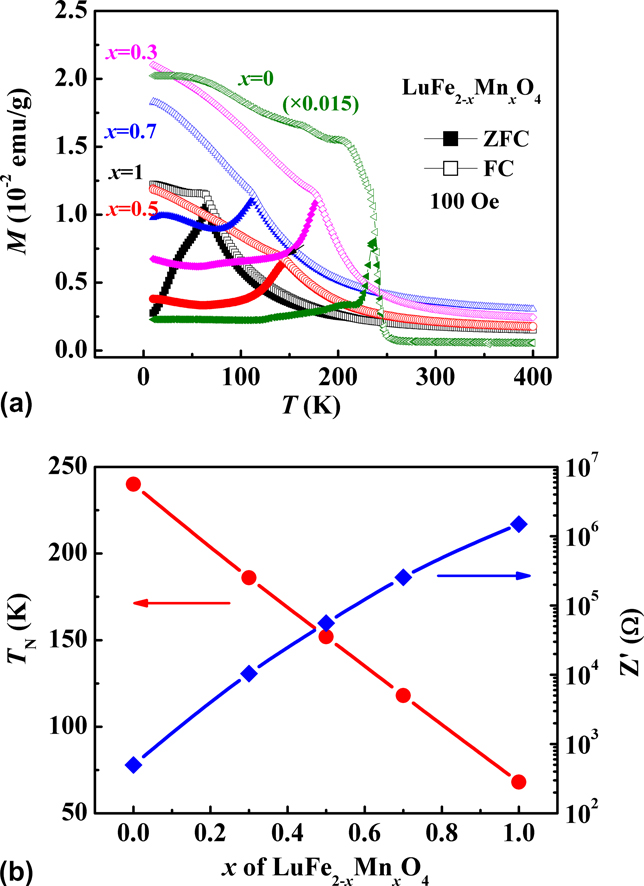
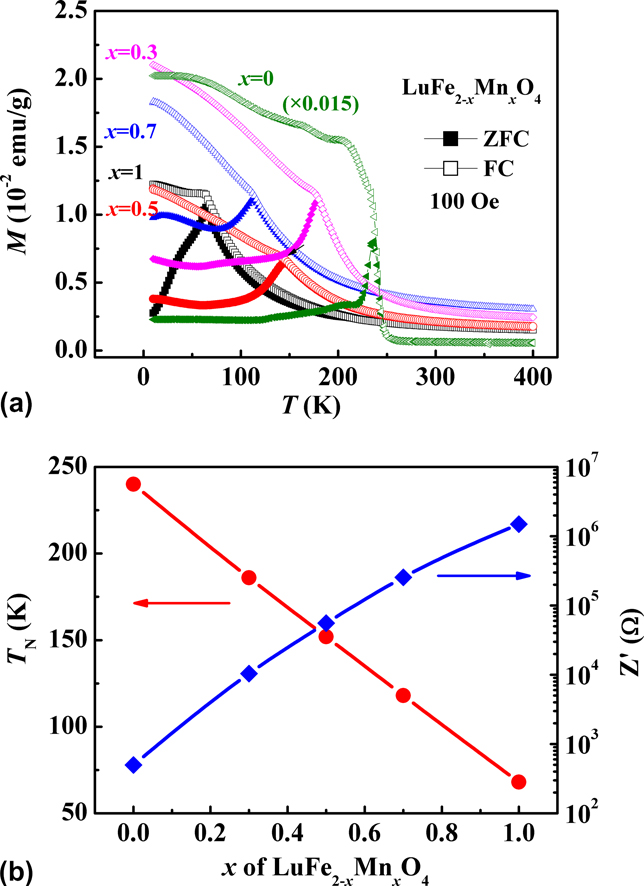
Figure 1(a) shows the temperature dependencies of the zero-field-cooled (ZFC) and field-cooled (FC) magnetizations for LuFe2-xMnxO4 (x = 0, 0.3, 0.5, 0.7, and 1.0) in a magnetic field of 100 Oe. The upturn of FC magnetization together with the cusp of ZFC magnetization for LuFe2O4 around 240 K indicates the appearance of the ferrimagnetic order of the Fe spins, which is essentially identical to the earlier reports.Reference Yoshii, Ikeda, Matsuo, Horibe and Mori10, Reference Christianson, Lumsden, Angst, Yamani, Tian, Jin, Payzant, Nagler, Sales and Mandrus16, Reference Phan, Frey, Srikanth, Angst, Sales and Mandrus17 One can see that for the Mn-substituted system, the magnetization peak temperature in the ZFC curve is gradually lowering. To show the variation of the characteristic physical properties with changing content of Mn ions, the values of the ferrimagnetic transition temperature [T N, estimated from the differential magnetizations shown in Fig. 1(a)] and the real part of impedance (Z′) at 40 Hz at room temperature as a function of Mn doping level x are plotted in Fig. 1(b). The substitution of Fe with Mn in LuFe2O4 leads to that the ferrimagnetic transition temperature monotonically decreases and the impedance increases as x increases. For LuFeMnO4, the value of T N is reduced to 68 K and Z′ is up to a high value of ∼1.5 × 10⁶ Ω which is three or four orders of magnitude larger than that of LuFe2O4 (∼500 Ω at room temperature from our results). This means that the dielectric properties could be optimized through Mn doping.
(a) Temperature dependencies of the magnetizations for LuFe2-xMnxO4 (x = 0, 0.3, 0.5, 0.7, and 1.0), measured with a magnetic field of 100 Oe. ZFC and FC stand for zero-field-cooled and field-cooled processes, respectively. (b) Magnetic transition temperature (T N) and room temperature impedance (Z′) at 40 Hz as a function of Mn content x. T N is estimated from the differential magnetization shown in (a).
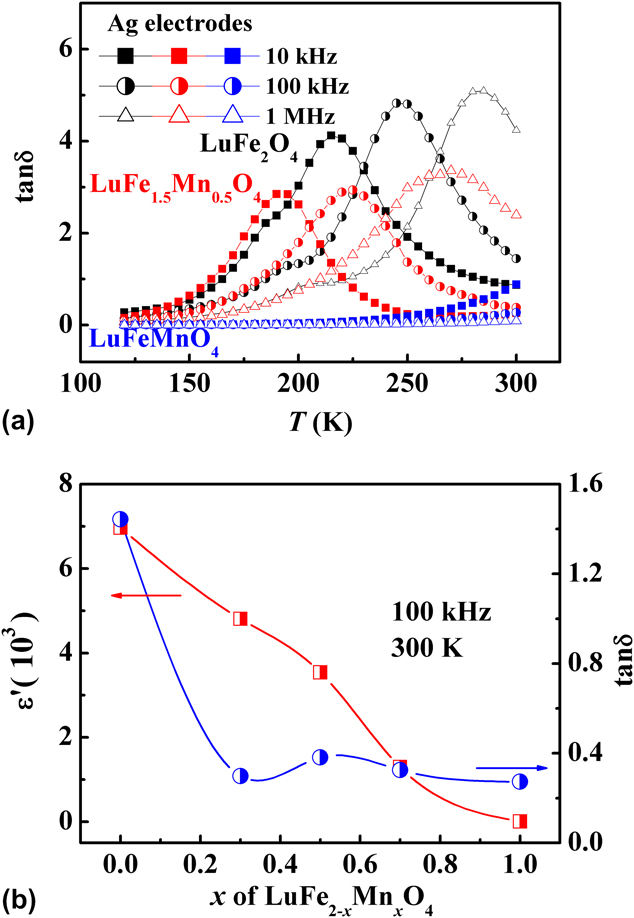
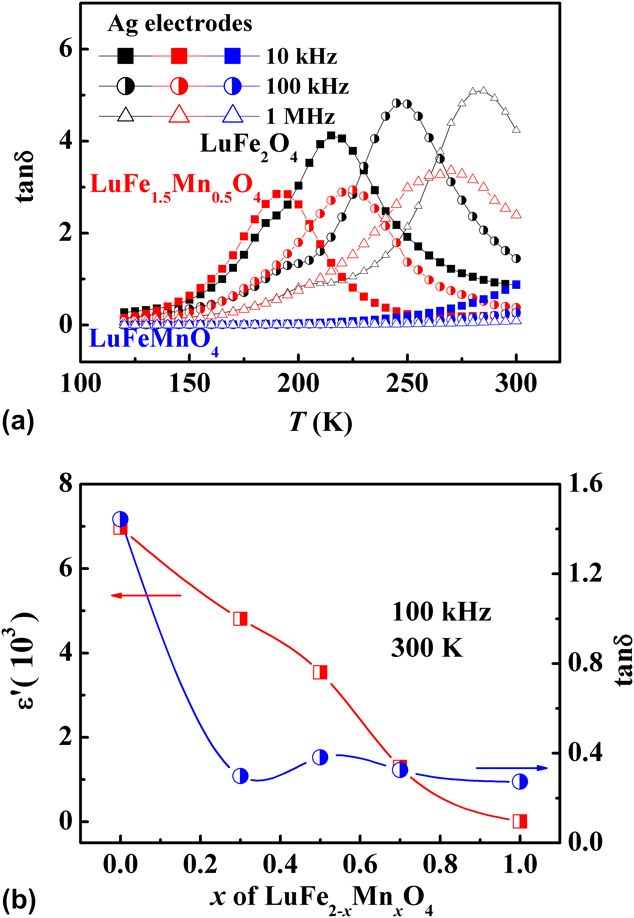
For practical applications, it is important to study the dielectric loss in this system. As shown in Fig. 2(a), the dielectric losses (tanδ) at different frequencies (10 kHz, 100 kHz, and 1 MHz) decrease with increasing Mn content. We note that the loss is reduced to a low level of 0.01 at a high frequency of 1 MHz near room temperature, which can achieve the standard for the technological applications. The room temperature dielectric constants (ε′) and losses as a function of Mn content at the frequency of 100 kHz are shown in Fig. 2(b). It clearly shows that ε′ and tanδ are both decreased with increasing x. These results further prove that the electron transfer is suppressed in LuFeMnO4 as compared with the parent oxide LuFe2O4.Reference Cohn, Peterca and Neumeier18
(a) Temperature dependencies of dielectric losses (tanδ) at 10 kHz, 100 kHz, and 1 MHz for LuFe2-xMnxO4 (x = 0, 0.5, and 1.0). (b) Dielectric constants and losses as a function of Mn content x (100 kHz, 300 K).
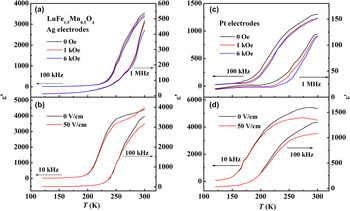
Now turn attention to the dielectric response with external fields for Mn-doped samples. Take Mn content x = 0.5 as an example, Fig. 3(a) shows the temperature dependencies of dielectric properties under different magnetic fields at 100 kHz and 1 MHz. One can see that the dielectric response with magnetic fields is tiny in the low temperature range (T < 250 K) but becomes obvious with increasing temperature. The decrease of the dielectric constants reaches 13% in the field of 6 kOe at room temperature with the frequency of 1 MHz. This means the dielectric constants are sensitive to magnetic fields and are related to the charge fluctuation in this system.Reference Xu, Angst, Brinzari, Hermann, Musfeldt, Christianson, Mandrus, Sales, McGill, Kim and Islam19 When a magnetic field is applied, the strength of the fluctuation is decreased, which induces the decrease of the dielectric constants around room temperature.Reference Subramanian, He, Chen, Rogado, Calvarese and Sleight4Figure 3(b) shows the dielectric permittivity of LuFe1.5Mn0.5O4 at 10 kHz and 100 kHz as a function of temperature under zero and 50 V/cm electric fields, respectively. Similar to Fig. 3(a), an obvious difference between two curves above 250 K means the permittivity is obviously suppressed in a 50 V/cm direct current field, indicating large room temperature tunability up to 12% in this system.
Temperature dependencies of dielectric responses with different external magnetic and electric fields for LuFe1.5Mn0.5O4 with (a) and (b) Ag and (c) and (d) Pt electrodes.

To explore deeply for the origin of the dielectric behaviors in LuFe1-xMnxO4 system, the tunability of the sample LuFe1.5Mn0.5O4 with Pt electrodes was also investigated, as shown in Figs. 3(c) and 3(d). It is well known that various electrodes with different work functions are used to form various types of contacts between the electrodes and samples. Compared with the results for the sample with Ag electrodes shown in Figs. 3(a) and 3(b), the dielectric tunability of the samples with Pt electrodes in external magnetic and electric fields has a similar trend. The dielectric tunability of 10% and 17% can be achieved around room temperature in magnetic and electric fields, respectively. This means that the Schottky effect, derived from the contact between the electrodes and samples, could influence the tunability but not the only reason.
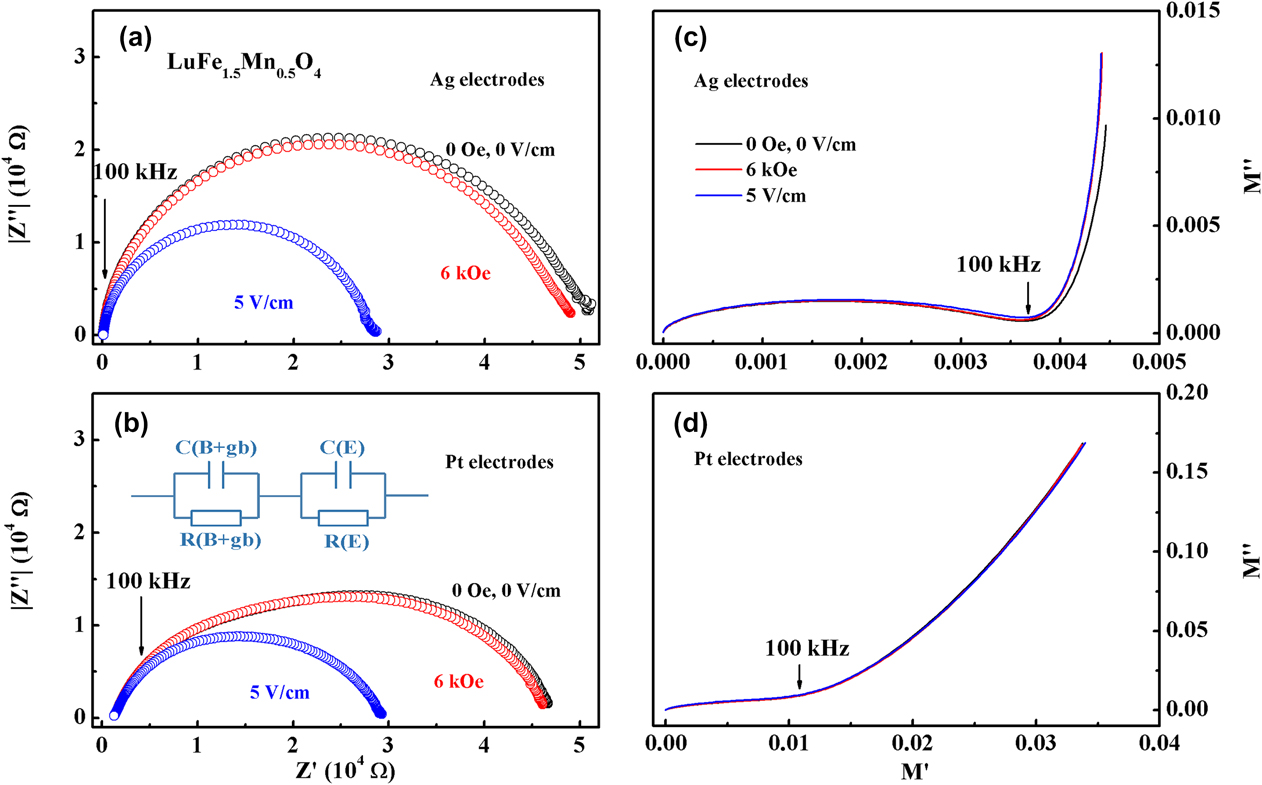
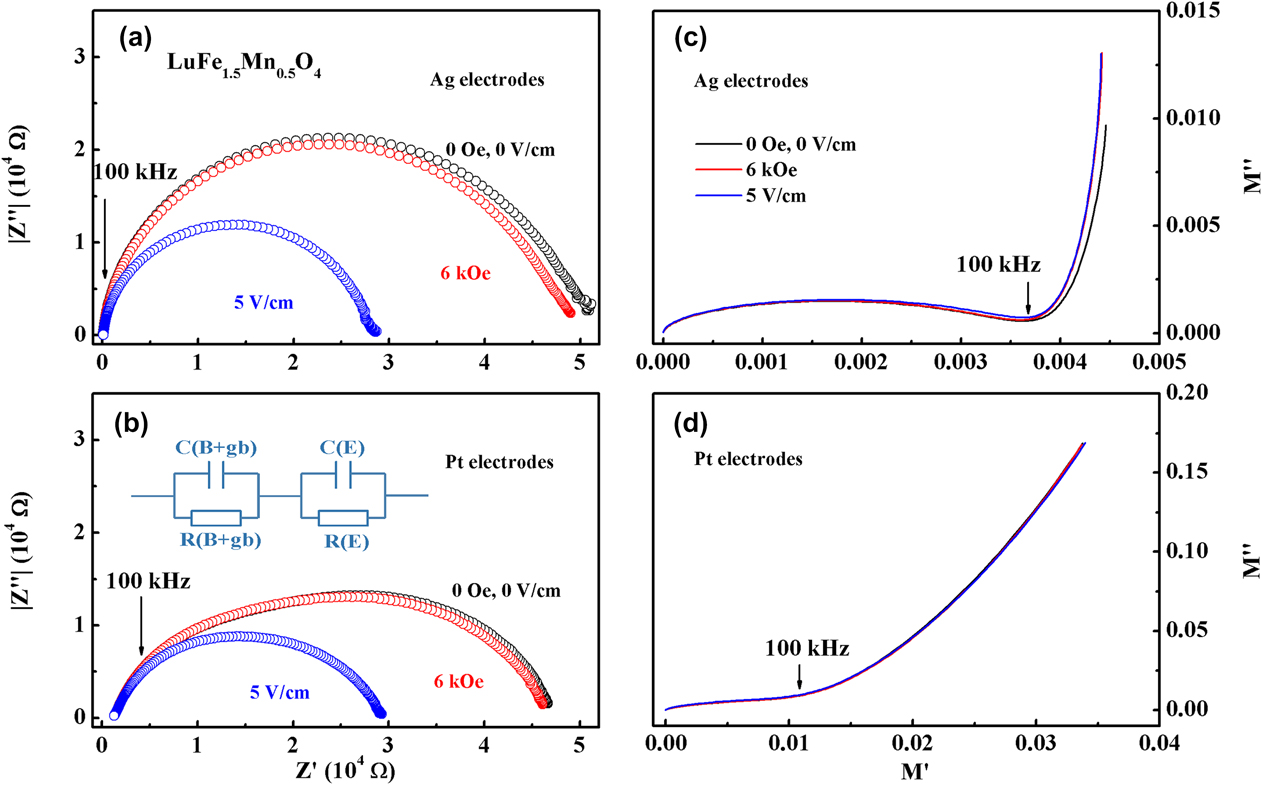
To clarify this situation, we performed the impedance and electric modulus analyses for bulk LuFe1.5Mn0.5O4 with Ag and Pt electrodes, as shown in Fig. 4. Traditionally, it is best achieved to separate the electrode, grain boundary, and bulk effect components of polycrystalline materials by using the combination of impedance and modulus spectroscopies.Reference Hou, Yao, Zhang, Yu and Li20–Reference Belattar, Graça, Costa, Achour and Brosseau22 Each of components may be represented by a parallel RC element, and the simplest appropriate equivalent circuit is a series array of parallel RC elements, as shown in the inset of Fig. 4. The modulus plots give most emphasis to those elements with the smaller capacitances, whereas impedance plots highlight those with the larger resistances.Reference Sinclair and West21, Reference Belattar, Graça, Costa, Achour and Brosseau22 For the samples with Ag and Pt electrodes, in the complex impedance plane, it seems that only a single semicircle exists while two arcs can be seen in the modulus plane. From the modulus plane, one can see two well-defined regions: 40 Hz < f < 100 kHz and f > 100 kHz. The low-frequency arc is probably due to the dielectric response from barriers induced by electrode contacts, whereas the higher-frequency arc could correspond to co-contribution of the extrinsic barriers mainly from grain boundary and intrinsic bulk effect. It is reported that the values of dielectric constants, impedance, and modulus are sensitive to the change of grain boundary,Reference Cao, Feng and Wang23, Reference Adams, Sinclair and West24 which induces the difference of these values between two samples with different electrodes at high frequency. From the results of Figs. 3 and 4, one can see that dielectric, impedance, and modulus are all changed effectively with external magnetic and electric fields over a broad frequency range, illustrating that the dielectric behavior of this system could be associated with both the extrinsic and intrinsic effects, whereas it is more influenced by the former reason than the latter. In addition, from the results with different external fields as depicted in Fig. 4, the impedance is more sensitive to the electric fields. Therefore, this tunability under external fields is mainly arisen from the space charge barriers and charge ordering between Fe2+ and Fe3+, which can be tuned more easily by electric fields.Reference Li, Zhang, Cheng and Sun5
Impedance and modulus complex plane plots of bulk LuFe1.5Mn0.5O4 measured at room temperature for (a) and (c) Ag and (b) and (d) Pt electrodes. Frequency was swept from 40 Hz to 5 MHz. The inset shows the equivalent circuit for a combination of intrinsic and extrinsic components, and B, gb, and E represent the bulk, grain boundary, and electrode.
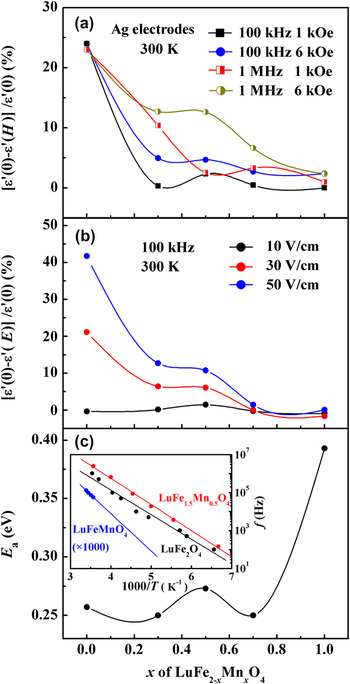
Figures 5(a) and 5(b) show the dielectric response under various magnetic and electric fields for different Mn doping samples with Ag electrodes. Here, the dielectric tunability with external fields is defined as: ∆ε′/ε′(0) = [ε′(0) – ε′(H, E)]/ε′(0), where ε′(H, E) and ε′(0) represent the dielectric constants with magnetic field H, electric field E and without external fields, respectively. Although the dielectric tunability under external fields is suppressed with increasing Mn content, the tunability achieves a high value at room temperature and low external fields. As discussed above, the dielectric tunability with low external fields could be induced by the following two reasons: One is from space charge barriers. From the analysis of impedance and modulus planes, the both barriers at the electrode contact and grain boundary play the important role in the dielectric tunability with external electric fields. Usually, the space charge barriers can be easily altered by electric fields and thus the tunability of this system can be achieved in low fields.Reference Biškup, de Andrés and Martinez25 Furthermore, the resistance is increased gradually with Mn doping, which means the grain and grain boundary regions to be more resistive, so the tunable value decreases in the same field strength as Mn content increases. The other possibility is arisen from the change of the charge fluctuation of the ordered 3d charges of Fe/Mn, mainly in the bulk. This possibility depends not only on electric fields but also on magnetic fields and thus the tunability response achieved in higher frequency range is closely related to the bulk.
Dielectric tunability as a function of Mn content x with (a) magnetic and (b) electric fields at room temperature. (c) Activation energies of all the samples. The inset of (c): the Arrhenius plots of the relaxation process with different Mn contents (x = 0, 0.5, and 1).

The decreases of the dielectric loss and the tunability could be due to the suppression of the electron transfer and charge fluctuation with increasing Mn content. Following Arrhenius equation f = f 0exp(−E a/kT),Reference Ikeda, Ohsumi, Ohwada, Ishii, Inami, Kakurai, Murakami, Yoshii, Mori, Horibe and Kito2 the activation energies (E a) are determined to be 0.26, 0.27, and 0.39 eV for LuFe2O4, LuFe1.5Mn0.5O4, and LuFeMnO4 samples, respectively. E a values with different Mn content are displayed in Fig. 5(c), and these low activation energies corresponding to the electron transfer are smaller than that of the conventional ferroelectric materials.Reference Ganpule, Roytburd, Nagarajan, Hill, Ogale, Williams, Ramesh and Scott26 The increase of activation energy with increasing x illustrates that the electron transfer is indeed suppressed through the doping. It is inferred that the electron transfer is suppressed due to a larger difference of the energy of the 3d orbitals between Fe3+ and Mn2+ ions compared with that between Fe3+ and Fe2+ ions.Reference Yoshii, Ikeda, Matsuo, Horibe and Mori10 Therefore, the tunable dielectric properties are associated with not only the electrode and grain boundary but also the bulk in Mn-doped LuFe2O4 system.
IV. CONCLUSION
In summary, the systemic investigations of magnetic and dielectric properties of the Mn-doped LuFe2O4 system show that the dielectric constant, loss, magnetic transition temperature, and conductivity are all reduced with increasing Mn doping. The dielectric tunability with external fields decreases with Mn substitution but still shows a high value at room temperature and in low external fields, and the analysis shows that this tunability is associated with the intrinsic bulk and extrinsic effects. In addition, the electron transfer and charge fluctuation between Fe ions are found to be suppressed by the Mn substitution for Fe. These results provide an alternative route to effectively achieve the multiferroic materials with low dielectric loss, which contributes to scalable applications in related devices.
ACKNOWLEDGMENTS
This work is supported by the National Natural Science Foundation of China and the National Basic Research Program of China (2012CB922003, 2011CBA00102, and 2009CB929502).