A number of scholars in the field of women and politics have predicted that increases in the number of women elected to state legislatures will lead to increases in the number of women serving in Congress (Carroll Reference Carroll1985a, 1242; Clark Reference Clark1984, 1–3; Fox and Lawless Reference Fox and Lawless2004, 265; Rule Reference Rule1990, 440). These predictions are based on the pipeline theory, the idea that women elected to lower-level offices will be able to accumulate and leverage political resources and experience to move up to progressively higher levels of political office (Duerst-Lahti Reference Duerst-Lahti, Thomas and Wilcox1998, 15; Palmer and Simon Reference Palmer and Simon2001; Seltzer, Newman, and Leighton Reference Seltzer, Newman and Leighton1997, 91–92). The pipeline theory assumes that state legislatures provide men and women with the same opportunities for congressional advancement. Although a number of studies have concluded that women who run for office are as likely as men to win (Darcy, Welch, and Clark Reference Darcy, Welch and Clark1994; Newman Reference Newman1994; Seltzer, Newman, and Leighton Reference Seltzer, Newman and Leighton1997), there is evidence that female candidates and officeholders continue to face obstacles that make them less likely than men to put themselves forward as candidates for higher-level public offices (Bledsoe and Herring Reference Bledsoe and Herring1990; Burrell, Reference Burrell1992; Carroll Reference Carroll, Williams and Lascher1993; Darcy, Welch, and Clark Reference Darcy, Welch and Clark1994; Fowler and McClure Reference Fowler and McClure1989; Rule Reference Rule1981).
Despite the continued importance of the state legislature as a springboard to higher offices, it remains unclear whether female state legislators are as likely as their male colleagues to seek and win a seat in Congress. Accordingly, this study analyzes the patterns of congressional advancement for state legislators in five states to assess whether male and female legislators are equally likely to seek and win congressional office and whether individual-level differences between men and women affect the likelihood of advancement.
This study finds that female state legislators were significantly less likely than their male colleagues to run for a seat in the U.S. House of Representatives. Male and female legislators also differed in a number of ways that are relevant to congressional office seeking. In comparison with their male colleagues, women began their state legislative service at a significantly older age; as a result, they had a smaller window of opportunity to advance to Congress during their prime office-seeking years. Female state legislators were also less likely to have occupational backgrounds in business or law, professions that served as springboards for political advancement. On the basis of these findings, it can be concluded that female representation at the state legislative level is an unreliable indicator of future levels of female representation in Congress. These findings suggest that the pipeline theory should be refined to account for the impact of gender-based differences on congressional advancement. In addition, this study may also have practical value to groups that use the pipeline theory to inform their strategies for electing women to high-level political offices.
THE PIPELINE THEORY
Although the number of women elected to legislative office has increased at all levels, women's electoral gains have come more quickly in state legislatures than in Congress. In every election cycle between 1971 and 2006, the percentage of women in state legislatures has been higher than the percentage of women in Congress (CAWP 2006, 2007).Footnote 1
Scholars viewed this pattern of women's representation as the result of a political opportunity structure that advantages individuals with prior elected officeholding experience. As Barbara Palmer and Dennis Simon (Reference Palmer and Simon2003, 128) describe it, there is a “hierarchy of political offices in the United States that functions as a ‘career ladder’ or ‘opportunity structure’ for ambitious politicians. The assumption is that lower-level offices serve as a springboard to higher office.”
Lower-level offices provide individuals with access to important political resources that can be leveraged in pursuit of higher office, including lawmaking and policymaking experience, political contacts, organization, name recognition, staff resources, and fund-raising ability (Berkman Reference Berkman1993, 104; Fowler and McClure 1989, 74–75; Jacobson Reference Jacobson1983, 38; Maestas, Maisel, and Stone Reference Maestas, Maisel and Stone2000, 4). As a result of these advantages, individuals with prior elected officeholding experience make up a sizable percentage of the candidates for higher-level offices such as Congress, and an even larger percentage of the successful ones (Abramowtz 1991; Berkman and Eisenstein Reference Berkman and Eisenstein1999, 496; Canon Reference Canon1990; Jacobson Reference Jacobson1990; Maestas, Maisel, and Stone Reference Maestas, Maisel and Stone1999; Maisel and Stone Reference Maisel and Stone1997). Candidates with prior elective officeholding experience also raise more money, receive a greater percentage of the vote, and win congressional races more often than candidates who lack similar experience (Berkman and Eisenstein Reference Berkman and Eisenstein1999; Uhlaner and Schlozman Reference Uhlaner and Kay Lehman1986).
State legislative service is particularly valuable because it provides individuals with experiences and resources that parallel and complement those needed to run successfully for Congress. Like their congressional counterparts, state legislators have significant experience serving on committees, proposing, debating and considering legislation, tending a constituency, developing relationships with lobbyists and interest groups, and running in political campaigns (Berkman Reference Berkman1993, 80–82; Fowler and McClure 1989, 74–75; Maestas, Maisel, and Stone Reference Maestas, Maisel and Stone2000, 4). By virtue of the offices they hold, state legislators are also likely to develop ambitions to serve in Congress (Black Reference Black1972). As a result of these advantages, state legislators are more likely to be successful in congressional races than nonstate legislators and typically win by larger margins (Jacobson Reference Jacobson1990). Indeed, there is evidence that in recent decades, state legislatures have become increasingly important routes to Congress. The percentage of House members with prior state legislative experience rose from around 30% in the mid-1930s to nearly 50% by the mid-1990s.Footnote 2
Prior officeholding experience is viewed as critically important to the election of women to higher-level offices (Witt, Paget, and Matthews Reference Witt, Paget and Matthews1994, 100). As relative newcomers to elective office, women are less likely than men to have access to the political and financial resources needed to win a congressional seat (Welch and Studlar Reference Welch and Studlar1996, 871 n. 7). Women must first win elections to state and local offices, where prior experience is less essential and competition is less fierce, in order to compete effectively for high-level offices such as Congress. As the women elected to lower-level offices gain experience and amass political resources, they will be well positioned to advance to high-level offices. Georgia Duerst-Lahti (Reference Duerst-Lahti, Thomas and Wilcox1998, 15) and others (Palmer and Simon Reference Palmer and Simon2001; Seltzer, Newman, and Leighton Reference Seltzer, Newman and Leighton1997, 91–92) have described this process of political advancement as “the pipeline”:
The pipeline is another explanation for the shortfall of elected women. It refers to the fact that experience in one elected office is seen as providing credentials for other offices. Serving in elected or appointed office is seen as providing credentials for other offices. Serving in elected or appointed office at a local level creates credentials for county or state office. For this reason, the number of women who serve in local office is a critical indicator of the number of women who will be seen as credible candidates for higher office. (Duerst-Lahti Reference Duerst-Lahti, Thomas and Wilcox1998, 15)
Likewise, scholars R. Darcy, Susan Welch, and Janet Clark (Reference Clark, Githens, Norris and Lovenduski1994, 51) have concluded that state legislatures are “crucial to women because they are key entry points to higher elective office” and that “barriers to women entering state legislatures [would] effectively limit the recruitment of women to higher office.” This argument was bolstered by Elizabeth Williams's study of the career paths of members of the U.S. House of Representatives, which found that most congresswomen shared a similar career path that included initial service in local government or on a school board, followed by service in the state legislature. As a result of her findings, Williams (Reference Williams1997, 33) described state legislatures as “important penultimate offices in the career paths of the few women elected to the United States Congress.”
A number of prominent scholars in the field of women and politics have taken the pipeline theory a step further by arguing that levels of female representation in state legislatures can be used as an indicator of future levels of female representation in Congress. The basics of this argument were articulated by Clark (Reference Clark1984, 1–3), who noted that
candidates generally start a career at the bottom and progress to higher level offices. Local and state offices are major political training grounds.… [A]s the number of women in state and local posts increases, greater representation in higher political office should eventually follow.
Susan Carroll (Reference Carroll1985a) came to a similar conclusion in her study of female officeholders, finding that once in office, female legislators were as likely as their male colleagues to desire advancement up the legislative career ladder. Carroll (p. 1242) contended that
in the absence of other impediments to women's advancement, the stagnation which has characterized the representation of women at the highest levels of office should soon come to an end. Within the next few years women should move into major statewide and national political positions in roughly the same proportions as they were represented in the early 1980s at lower levels of government.
Articulating the theory more explicitly, Wilma Rule (Reference Rule1990) suggested that women's representation in state legislatures would follow a “time-lagged, two tiered pattern” as women gained experience in lower houses and moved on to seats in upper houses. She indicated that this same process would eventually be seen at the congressional level, and she argued that “as more women gain legislative, and particularly state senate experience from which to launch their campaigns, modest increases in the number of women elected to the House should follow” (Rule Reference Rule1990, 440).
A GENDERED PIPELINE?
Although Carroll, Duerst-Lahti, and others have recognized potential impediments to the advancement of women through the pipeline, the focus of scholarship in this area has largely been on the opportunities that the pipeline provides for increased representation of women, rather than its potential limitations. In fact, a number of studies have identified gender-based differences related to age, children, marital status, and occupation that have the potential to hinder the ability of female state legislators to advance to Congress; these gender-based differences make it unlikely that women will advance to Congress in similar proportions as their male colleagues.Footnote 3
Age
The likelihood that an individual will pursue (or be recruited for) public office is strongly affected by that person's age. In his classic work on political ambition, for example, Joseph Schlesinger found that those who enter public office earlier have a greater range of ambitions and opportunities for advancement. He concluded that the “manifest age” for running for Congress was between 35 and 50 (Schlesinger Reference Schlesinger1966, 195). Similarly, in his analysis of progressive ambition among members of the U.S. House of Representatives, Paul Brace found that age had a strong curvilinear affect on political ambition. As a result, he noted that both younger and older members were less likely to run for higher office (Brace Reference Brace1984).
Studies have also found that women candidates and officeholders are older than their male counterparts (Carroll Reference Carroll, Williams and Lascher1993; Kirkpatrick Reference Kirkpatrick1974; Mezey 1978; Sapiro Reference Sapiro1982; Thomas and Braunstein Reference Thomas and Braunstein2000; Werner Reference Werner1966). These age differences are believed to result from the fact that many women delay the pursuit of political ambitions until after their childbearing years are over or their children are grown (Carroll Reference Carroll1985b; Deber Reference Deber1982; Kirkpatrick Reference Kirkpatrick1974; Werner Reference Werner1966). By entering office later in life, women are likely to have a smaller window of opportunity to run for Congress during their prime (or, to use Schlesinger's terminology, “manifest”) office-seeking years and less time to accumulate the experience, resources, and support needed to run successfully for Congress.
Children and Marital Status
Previous studies have found that female officeholders are less likely than male officeholders to be married and less likely to have children (Carroll and Strimling Reference Carroll and Strimling1983; Sapiro Reference Sapiro1982). When they do have children, female officeholders typically have fewer than their male colleagues, and when they reach office their children are typically at an older age (Carroll Reference Carroll1989, Reference Carroll, Williams and Lascher1993; Sapiro Reference Sapiro1982). While there is some evidence that family responsibilities are less of a factor for women than they were in the past (Dolan and Ford Reference Dolan and Ford1997; Fox, Lawless, and Feeley 2001; Maisel and Stone Reference Maisel and Stone1997), other studies indicate that marriage, children, and family responsibilities remain a more significant hurdle for women than for men, even among those already serving in political office (Bledsoe and Herring Reference Bledsoe and Herring1990, 221; Burrell Reference Burrell1994; Maestas et al. Reference Maestas, Fulton, Maisel and Stone2006, 202; Thomas and Braunstein 2000; Witt, Paget, and Matthews Reference Witt, Paget and Matthews1994).
Occupational Differences
All things being equal, candidates with occupational backgrounds that facilitate and complement their accumulation of both financial and political resources will have an advantage over those from occupations that provide fewer resources and less politically relevant experience. In the 1970s and 1980s, a number of studies found that women were at a disadvantage relative to men in terms of their professional backgrounds and education (Burt-Way and Kelly Reference Burt-Way and Kelly1992; Welch Reference Welch1978). Women had lower levels of education than men and were less likely to be represented in occupations such as business and law, which have traditionally served as stepping stones to political office (Carroll Reference Carroll, Williams and Lascher1993; Deber Reference Deber1982; Welch Reference Welch1978). Women were also at a disadvantage because they were more likely than men to serve in lower-paid professions and to have lower personal incomes in comparison to men (Clark Reference Clark, Githens, Norris and Lovenduski1994; Fox Reference Fox2003; Fox, Lawless, and Feeley Reference Fox, Lawless and Feeley2001).
Although there is evidence that the educational and occupational differences between men and women have diminished somewhat over time (Burrell Reference Burrell1992; Dolan and Ford Reference Dolan and Ford1997; Thomas Reference Thomas1994; Thompson Reference Thompson1985), women remain at a disadvantage in terms of their professional, educational, and political backgrounds. Women are still less likely than men to possess degrees, hold professional or management positions, and have prior elected officeholding experience (Darcy, Welch, and Clark, Reference Darcy, Welch and Clark1994; Thomas and Braunstein 2000).
RESEARCH QUESTIONS AND HYPOTHESES
Although it is reasonable to assume that women are better positioned to run for Congress if they are state legislators, past research has identified many individual-level factors that have the potential to undermine the continued advancement of women to higher rungs of the political career ladder. Accordingly, the main research question is whether female and male state legislators are as likely to seek and win congressional office. As part of this effort, it will also be important to assess whether individual-level factors, such as age, children, marital status, and occupation, shape opportunities for congressional advancement differently for male and female legislators.
There are five main hypotheses in this study. The first is that female state legislators are less likely to seek and win congressional office than male state legislators. The remaining four hypotheses relate to individual-level differences between men and women that have the potential to affect the likelihood that members of each group will seek and win congressional office.
- H1Likelihood of Advancement:
Female state legislators are less likely than their male colleagues to seek and win a seat in Congress.
- H2Age:
In comparison to their male colleagues, female legislators enter public office at an older age and have a smaller window of opportunity to seek congressional office.
- H3Children:
Female state legislators with children are less likely than male state legislators with children to seek and win congressional office.
- H4Marital Status:
Female state legislators who are married are less likely than similarly situated male colleagues to seek and win congressional office.
- H5Occupation:
Female state legislators are less likely than male state legislators to have primary occupations in the fields of business or law, professions that serve as a springboard because they provide money, resources, and contacts that a candidate can leverage in a congressional campaign.
DATA AND METHODS
In order to assess whether gender shapes state legislators' opportunities for congressional advancement, I created a data set of state legislative districts in five states covering a 10-year period (1993–2002). An examination of the political career ladder from the “bottom up” takes into account the individual careers of particular officeholders within the context of the state-based political opportunity structures in which they pursue higher office. This approach examines the political careers of male and female state legislators who did not move up the career ladder, as well as those who did. As Kira Sanbonmatsu (2003, 3) notes, “we miss half the story of women's representation if we only study women who run for office and ignore the women who do not run.”
This study adopts the approach taken by candidate emergence studies that have examined the factors associated with individual decisions to seek public office (Fox, Lawless, and Feeley 2001; Maisel and Stone Reference Maisel and Stone1997). In particular, it benefits from Sarah Fulton and her colleagues' (2006) analysis of office seekers among a broad national sample of state legislators. This project is more limited in scope but has the advantage of looking at whether state legislators actually run for office, as opposed to looking at their expressions of interest in future office. In addition, this study examines patterns of congressional advancement across multiple election cycles rather than just one. By studying decisions to run and not run for higher office over multiple election periods, we can learn more about the strategic decision-making process employed by state legislators and take into account the changes in individual circumstances and the political environment that occur across different election cycles.
The Data Set
The data set covers five states (Connecticut, New York, Texas, Washington, and Wisconsin), with a separate entry for each state legislator serving in the lower and upper houses of the legislature during the five two-year state legislative sessions between January 1993 and December 2002. Legislators elected during the regularly scheduled general elections of 1992, 1994, 1996, 1998, and 2000 are included in the database, along with those legislators who were elected in special elections or appointed to a state legislative office during the time period studied. In the case of Texas, Washington, and Wisconsin, the legislators in the upper houses of these legislatures served four-year terms that overlapped with two successive legislative sessions. These districts have two distinct entries: one for each of the two-year electoral cycles of the U.S. Congress during their specific term of office. Thus, legislators serving four-year terms have two separate entries for each term, one for each opportunity to seek congressional office in a regularly scheduled congressional election.
The redistricting period (1993–2001) is an important period to study because by this time, there were a significant number of women serving in state legislatures who, by virtue of their experience in office, should have been well positioned to run for a congressional seat. Until and throughout most of the 1970s, the election of women to state legislatures was a relatively rare occurrence. Until the end of the decade, women held fewer than 10% of all state legislative seats. Throughout the 1980s, the proportion of women elected to state legislatures grew steadily, rising from 10.3% in 1979 to 17.0% in 1989 (CAWP 2007). The pipeline theory assumes that women will move into congressional offices after first gaining experience and accumulating political resources at the state legislative level. By the 1990s, therefore, the female state legislators who were first elected in the 1970s and 1980s should have been well positioned to seek congressional office. In addition, the 1992 “Year of the Woman” elections marked a turning point in the history of women's representation. The unparalleled level of success that female candidates enjoyed in the 1992 congressional elections provided lower-level female officeholders and other female potential candidates with new, highly visible female role models in Congress. At the same time, the success of women in the 1992 congressional elections reflected (and strengthened) the emergence of a strong network of support for female candidates; these networks provided women with critically important financial and political support for their campaigns (Darcy, Welch, and Clark Reference Darcy, Welch and Clark1994, 190–94).
REPRESENTATIVENESS OF THE SAMPLE
The five states included in the database had a total of 85 members in the House of Representatives—19.5% of the entire body. The database includes states that had large delegations in the House of Representatives like New York (31 members) and Texas (30 members), and medium-sized delegations like Washington (nine members) and Wisconsin (nine members). Connecticut, a relatively small state with six House members, is also included. The states selected for this database also varied in their levels of professionalism, with highly professional states (New York and Wisconsin) and moderately professional states (Texas, Washington, and Connecticut). States with low levels of professionalism, which the National Conference of State Legislatures describes as “citizen legislatures,” were excluded from this analysis.Footnote 4
The five states were also regionally varied, representing the Northeast (New York and Connecticut), the Midwest (Wisconsin), the Southwest (Texas) and the Northwest (Washington). The states also varied in terms of partisanship. Overall, the sample population had similar percentages identifying with each of the two major parties. In terms of partisan control of legislatures, however, the sample leaned more Democratic than Republican. In addition, the states differed in their overall levels of female representation. Connecticut, with 28.0% of its legislative seats held by women, and Wisconsin, with 24.4%, were higher than the 50-state average of 21.5% during this period, while Texas (17.8%) and New York (19.2%) were lower. Washington was a relative outlier, ranking first among the 50 states with a legislature that was 40% female during this time period.Footnote 5
ANALYSIS
The bivariate analysis that follows analyzes the patterns of congressional advancement among male and female state legislators. The goal here is to assess how variables like age, years in office, marital status, number of children, and occupation affect the likelihood that men and women state legislators will seek and win congressional offices.
Between 1993 and 2002, 346 women and 1,023 men served as state legislators in the states of Connecticut, New York, Texas, Washington, and Wisconsin. Despite the electoral advantages enjoyed by state legislative officeholders, very few ran for Congress. Out of the 1,360 individual state legislators who served during the 10-year period examined in this study, just 51 ran for Congress (3.8%). Of the 51 who ran, 13 were successful and 38 were not.
Of the 346 women in the sample, just seven ran for Congress, two of whom were elected. Given the small subsample of women, much of the analysis that follows focuses on whether state legislators ran for Congress rather than whether or not they won. Although our main interest lies in those who win congressional office, studying office seekers remains valuable because only those who actually run for Congress have a chance of moving up the pipeline.
A review of the five main hypotheses described previously indicates that men and women in “the pipeline” were not similarly situated. The data indicate that female state legislators are not as likely as their male colleagues to seek and win congressional office. Additionally, there are notable individual-level differences related to gender that make it less likely that female state legislators will advance to Congress.
Likelihood of Advancement
The data provide considerable support for the first hypothesis: Male state legislators were more than twice as likely to run for Congress as female state legislators. Within the sample, 4.3% of men ran for Congress, compared with just 2.0% of women (p = .054). It should be noted that even though female legislators were less likely to run, they were as likely as men to win. Among the state legislators who did run, 28.5% of women and 25% of men were elected to Congress.
The critical difference is that male state legislators were more likely than their female colleagues to run for Congress: 1.1% of all male state legislators in the overall sample were elected to Congress, compared with just 0.6% of female legislators. Thus, despite the fact that women were more than 25% of the sample, they made up only 15.4% of the state legislators elected to Congress. This 15.4% is remarkably similar to the overall percentage of women elected to Congress (which also stood at 15.4% in 2006), and it illustrates that the election of relatively high percentages of women to state legislatures does not necessarily translate into similarly high percentages in Congress.
Individual-Level Differences
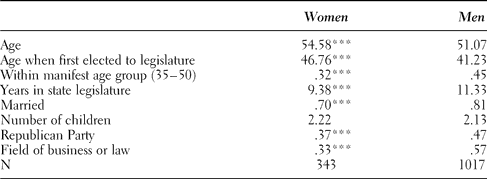
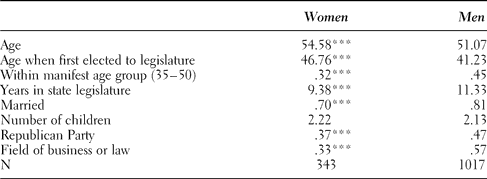
My analysis identified a number of individual-level differences between male and female state legislators that are likely to affect whether members of each group will seek and win congressional office (see Table 1). In comparison with male state legislators, female legislators
• were five and one-half years older, on average, when first elected to the state legislature;
• had fewer years of state legislative service;
• were less likely to be married; and
• were less likely to have primary occupations in the field of business or law.
Comparing male and female state legislators, 1993–2002
Notes: Individual data reflect final term of service for legislators in CT, TX, NY, WA, and WI between 1993 and 2002. Legislators who died or did not serve prior to the congressional election were not included in this analysis.
Two-tailed T-Test. *** p < .001, ** p < .05, * p < .10.
Each of these differences was significant at the .001 level. Furthermore, with the exception of the fact that no significant difference was observed in the average number of children, these findings are consistent with the hypotheses presented previously.
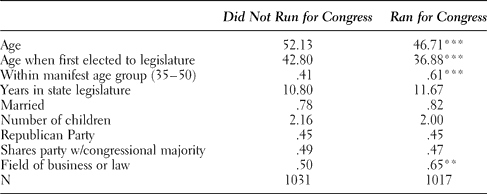
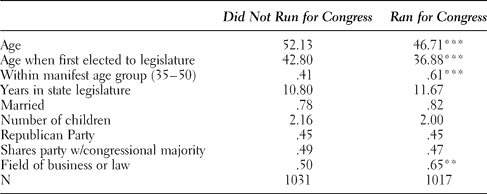
It is also important to consider whether these factors are, in fact, associated with the likelihood that a state legislator will advance to Congress. Table 2 illustrates that age was a statistically significant factor on several levels. First, the state legislators who ran for Congress were five and one-half years younger, on average, than their colleagues who did not run. Second, state legislators who ran were more likely than those who did not run to fall within the manifest age of congressional office seeking (35 to 50 years). Finally, those who ran for Congress were first elected to the state legislature at a relatively young age (36 years of age on average, compared with 42 for those who did not run).
Comparison of State Legislators Who Ran and Did Not Run for Congress
Notes: Legislators who died during the term or did not serve prior to the congressional election were not included in this analysis. Individual data reflect legislators' final term of service between 1993 and 2002.
Two-tailed T-Test. *** p < .001, ** p < .05, * p < .10.
Table 2 also shows that state legislators who ran for Congress were more likely to have an occupation in the field of business or law than those who did not run. Of state legislators who ran for Congress, 65% had a primary occupation in business or law compared with 50% of state legislators who did not run for Congress (p < .001). At the same time, those who ran for Congress and those who did not run were similar to one another in terms of marital status and mean number of children.
Age
The data provide strong support for the hypothesis that female state legislators in the sample entered the state legislature at an older age than their male colleagues and had a smaller window of opportunity in which to run for Congress. The mean age at which female legislators were elected to the state legislature was 46.7 years, compared with 41.2 years of age for men. This difference is statistically significant at the .001 level. Women also had fewer years of service than men, averaging 9.3 years compared with 11.3 years for men, a difference that is also statistically significant at the .001 level.
A difference in the years served by men and women was also observed among those who left legislative service during the period examined here, as well as those whose legislative careers were ongoing. Among those whose state legislative careers ended between 1993 and 2000, the women served an average of 8.3 years in the legislature, compared with 11.3 years for men (p < .001). This confirms that women served shorter legislative careers, and the differences are not merely the result of women being elected to state legislatures at a later date than their male colleagues.
In addition to being older when first entering the legislature, female state legislators were also less likely to be within the 35 to 50 age range that Joseph Schlesinger described as the “manifest age” for seeking congressional office (1966, 195). Of the terms served by women, 37.9% were served by legislators within the manifest age range of 35 to 50. This is significantly lower than the 48.7% of terms served by their male counterparts within the manifest age category.
The critical factor seems to be the age at which legislators were first elected to state legislatures. One-third of female legislators were elected to the state legislature after age 50, compared with just 20% of male state legislators. Furthermore, the patterns of congressional office seeking observed in this study provide added support for Schlesinger's contention that 35 to 50 years of age constitutes the most likely age at which an individual will seek congressional office. Of the subgroup of state legislators who ran for congressional office, 60.8% were within the manifest age range; this is significantly higher than the 46.1% of the overall population that fell within the manifest age group.
Among the 51 state legislators in the sample who ran for Congress, men were more likely than women to be within the manifest age (63.6% of men compared with 42.9% of women). It should be noted, however, that the small number of female state legislators who ran for Congress (N = 7) made it difficult to draw any firm conclusions about gender differences among those seeking congressional office. Likewise, no definitive conclusions could be drawn from the very small group of 13 state legislators from our sample who were successful in getting elected to Congress, of which nine of 13 (69%) were between the ages of 35 and 50.
Children
There was no statistically significant difference in the mean number of children between male and female state legislators who did not run for Congress. Likewise, there was virtually no difference in the mean number of children reported by the men who ran and the men who did not run (2.07 and 2.13, respectively). There was, however, a substantial difference between the women who ran and the women who did not. Female legislators who ran for Congress had fewer children on average than female legislators who did not run (1.57 compared with 2.24). As previously noted, the number of women who ran for Congress was small, and as a result, the difference in means was not statistically significant (p = .349).
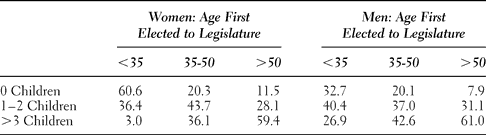
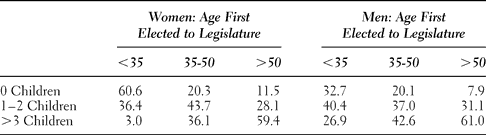
Although the sample of state legislators who ran for Congress is small, the overall number of state legislators in this study is large enough to allow for a comprehensive analysis of the impact of children on officeholding. In this case, the data provide additional evidence that female officeholders with children delayed their political careers until their children were older. Of the female state legislators in the sample who entered the state legislature prior to age 35, more than 60% had no children and only 3% reported having three or more children. In contrast, only 33% of men who entered the legislature at this relatively young age were childless and nearly 27% reported having three or more children. The impact of children on state legislative careers appears to be limited primarily to legislators who enter at a younger age. There was little, if any, difference in the number of children reported by men and women in the two oldest categories (see Table 3).
Mean number of children for state legislators, by age first elected to legislature and by sex
Notes: Number of men = 919 (missing = 104); number of women = 286 (missing = 60). “Manifest” age range is between 35 and 50. Number of children reflects the number reported in the final year of legislative service during the 1993–2002 time period.
The evidence presented here suggests that for younger women, children were an important factor that limited their ability to seek and win state legislative offices. In contrast, children did not appear to be a limiting factor for male legislators. There was also evidence, albeit suggestive, that the number of children female state legislators have is negatively associated with the likelihood that they will seek congressional office; again, men do not appear to be similarly affected.
Marital Status
Marital status is another factor that is believed to affect the likelihood that men and women will seek congressional office. Female state legislators were significantly less likely than male state legislators to be married, and this was true across all five legislative cycles. The proportion of female state legislators who were married ranged from .68 to .71, significantly lower than the proportion of male state legislators who were married, which ranged from .79 to .83 (p < .01 in all five cycles).
Also notable is the finding that male state legislators who ran for Congress were more likely to be married than those who did not run; in contrast, female state legislators who ran for Congress were less likely to be married than those who did not seek a congressional seat (see Table 4). The data also indicate that among those legislators who ran for Congress, women were far less likely to be married than men. Only 57.1% of the women who ran for Congress were married, compared with 86.4% of the men.
Percent married, by office seeker and by sex

N = 4,447 (Men = 3,304, Women = 1,129). Total Missing = 14 (0.3%).
aDifferences between men and women were statistically significant at the .01 level or below (chi-square, p = .000).
bDifferences between men and women were not statistically significant (chi-square, p = .06).
Occupational Backgrounds
The data support the hypothesis that female state legislators were significantly less likely than their male counterparts to have occupational backgrounds in the field of business or law and that these occupations were most frequently associated with congressional office seeking. Of the men in the sample, 57% had a primary occupation in business or law, compared with 33% of women (p < .001).
The fields of law and business stand out as “springboard” occupations for state legislators who pursue congressional office; 64.7% of state legislators who ran for Congress had a primary occupational background in one of these two fields, compared with just 50.5% of the overall sample (p < .001). This finding is consistent with opportunity pool explanations, which suggest that business and legal experience complements state legislators' efforts to build the political skills, support, and fund-raising base needed to compete effectively in a congressional campaign.
The evidence indicates that female legislators were not as likely as male legislators to have a primary occupation in the field of business or law. Men were far more likely than women to report a primary occupation in the field of law (28.2% to 9.9%) and slightly more likely to have a primary occupation in a business-related field (28.8% to 23.3%). In contrast, female state legislators in the sample were more likely to have a primary occupation in the field of education or work that is related to politics, government, and the community (“public service”).Footnote 6
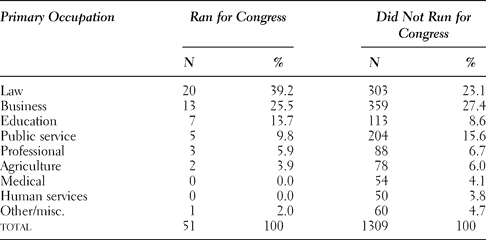
Both education and public service have the potential to be springboards to congressional office because they can provide legislators with opportunities to build relationships with political and community leaders and constituent groups. As Table 5 shows, however, education and public service were significant but secondary routes to congressional office. Moreover, to the extent that education and public service acted as springboards, men were the primary beneficiaries and made up the large majority of congressional office seekers from these categories. Thus, even though women made up 41.2% of all legislators with a primary occupation in the field of education, and 38.5% of all legislators from public service professions, they were just 16.6% of the congressional office seekers in those fields (two of 12).
Selected occupational backgrounds
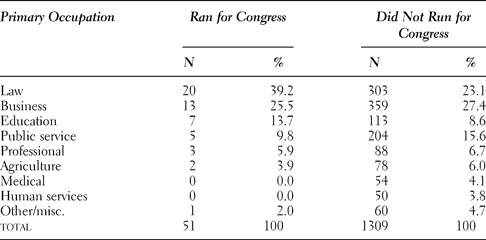
Notwithstanding the small number of women in the sample who ran for Congress, the male and female state legislators who ran had remarkably similar occupational backgrounds. Among state legislators who sought congressional office, the legal profession was the most common occupational background for both men and women. Altogether, 57% of the female state legislators who sought congressional office had a primary occupation in the field of either law or business; this was only slightly lower than the 65% for their male counterparts.
This analysis indicates that an occupational background in the field of business or law was a key factor in the advancement of both male and female state legislators to Congress. Women were disadvantaged relative to their male colleagues because they were less likely to come from “springboard” professions. The evidence suggests that although women are forging their own paths to state legislative offices, occupations in the fields of education and public service have not proven to be effective springboards to congressional office for female state legislators.
DISCUSSION
Susan Carroll predicted that female state legislators would move up the legislative career ladder “in the absence of other impediments” (1985a, 1242). It is exactly these “other impediments” that this study is concerned about. In the race for highly desirable congressional offices, state legislators have many advantages, but they are by no means equally advantaged. By articulating the contexts in which male and female state legislators run for Congress (as well as those in which they do not), we can better understand the legislative career ladder and its impact on female representation in Congress and state legislatures.
This analysis of the congressional advancement of state legislators in five states between 1993 and 2002 finds that female state legislators were less likely than their male colleagues to run for Congress. In addition, male and female state legislators differed in several ways that are relevant to the likelihood that they would seek and win congressional office. The female legislators in the sample entered the state legislature at an older age than their male colleagues and, in terms of years served, had a correspondingly smaller window of opportunity to run for Congress. Female state legislators were also less likely to be married and less likely to have primary occupations in the fields of business and law. A separate analysis of all state legislators in the sample indicates that age and a primary occupation in the field of business or law were associated with congressional office seeking. Within this sample, the legislators who ran for Congress were younger and more likely to have an occupation in the field of business or law than those who did not run.
Contrary to expectations, there was no statistically significant difference in the mean number of children for male and female state legislators. A close look at the data suggests that female state legislators with few children were more likely to seek congressional office than female state legislators with greater numbers of children; male state legislators did not appear to be similarly constrained. Although not statistically significant, the data are suggestive and warrant further research.
Though not definitive, these findings do suggest that the pipeline is gendered in that male and female state legislators differ in ways that are relevant to the likelihood they will advance to Congress. Understanding gender-based differences is important to the study of congressional office seeking because these differences can lead men and women in similar circumstances to different conclusions about whether to pursue a seat in Congress. As Barbara Burrell (Reference Burrell1992, 505) noted:
A move to a seat in Congress is qualitatively different from service in the state capitol or the mayor's office. Wifehood and motherhood, the personal realms of their lives, are significant elements of the decision-making equation with which women must deal and which men do not face in the same way.
As this study indicates, men and women did not enter the pipeline under similar circumstances. Male state legislators were more likely than female state legislators to have characteristics associated with congressional advancement, that is, relative youth and an occupational background in business or law. Both of these factors—age and occupation—are gendered in that they vary as a result of cultural and social circumstances related to whether a person is a man or a woman. The end result is that despite the relative success that women enjoyed at the state legislative level, female state legislators were less likely to advance to Congress than their male colleagues.
Once again, it is important to note that this study is not, by any means, definitive. The main limitation is that it looks at only five states over a 10-year period. Although the states were selected to reflect a variety of different structural circumstances, the number of legislators who ran for congressional office during this time period was very small and the number of women who won even smaller. Whether these states and candidates were truly representative of the larger population remains a concern that can only be dealt with through further research on an expanded number of states and candidates.
It should also be noted that despite the findings presented here, the idea of the pipeline remains descriptively useful. State legislatures are clearly an important route to Congress for both men and women. In terms of its predictive value, however, the pipeline theory is incomplete. We cannot accurately predict women's representation in Congress on the basis of aggregate state-level data for the very simple reason that legislators do not move up in the aggregate; rather, they advance as individuals in specific districts and varying institutional, cultural, and political contexts. As Sanbonmatsu argues, in order “to understand why more [women] do not run and why women run where they do, we must understand the contexts in which women run” (2000, 3). This study lends additional support to that conviction.
As it relates to women's representation, the pipeline theory needs to be refined so that it takes into account the important distinctions between male and female officeholders that are relevant to congressional advancement. While this article has focused on individual-level differences between men and women, it is important to also recognize that a full understanding of the contexts in which women run must also take into account whether institutional and cultural factors shape the political opportunity structure differently for the men and women serving in state legislatures.