Within higher education there is a widespread aspiration to develop interdisciplinary skills (National Academy of Sciences, National Academy of Engineering, & Institute of Medicine, 2005; UNESCO, 2009b). Within the Education for Sustainability (EfS) arena, government strategic educational policies also support the need for graduates with skills for interdisciplinary collaboration (Department of the Environment, Water, Heritage and the Arts, 2009; Scottish Government, 2010; Tilbury & Cooke, Reference Tilbury and Cooke2005), and this has led academics to establish interdisciplinary subjects and courses at many universities (Global University Network for Innovation, 2011; Jones, Selby, & Sterling, Reference Jones, Selby and Sterling2010). Nonetheless, the practice of implementing cross-faculty, interdisciplinary sustainability learning remains in its infancy, with key structural barriers remaining and new challenges arising, such as the corporatisation of higher education (Gale, Davison, Wood, Williams, & Towle, Reference Gale, Davison, Wood, Williams and Towle2015; Granados-Sánchez et al., Reference Granados-Sánchez, Wals, Ferrer-Balas, Waas, Imaz, Nortier, Svantröm, Van't Land and Arriaga2011). The literature on EfS in higher education identifies skills in interdisciplinary collaboration as critical for tackling complex and intractable issues (commonly referred to as ‘wicked problems’), and sustainability and climate change are frequently cited as examples (Briggs, Reference Briggs2012; Jones & Watt, Reference Jones, Watt, Davies, Devlin and Tight2010; National Academy of Sciences, National Academy of Engineering, & Institute of Medicine, 2005; Vincent & Focht, Reference Vincent and Focht2010). Unfortunately, this interest has rarely been matched by institution-wide commitment to interdisciplinary learning for sustainability (Higgins & Thomas, Reference Higgins and Thomas2016; Jones et al., Reference Jones, Selby and Sterling2010; Leihy & Salazar, Reference Leihy and Salazar2011; Sherren, Reference Sherren2005), although there are notable exceptions, as documented in a recent review of UK exemplars (Sterling, Maxey, & Luna, Reference Sterling, Maxey and Luna2013), and in Australia by La Trobe University (Hocking & Riddle, Reference Hocking, Riddle, Brandli, Leal Filho and Paço2014).
There is an impressive literature exploring issues and approaches relevant to interdisciplinary EfS teaching practice that highlight the complexities for academics of working with multiple interpretations and disciplinary knowledges, as well as the institutional constraints (Beilin & Bender, Reference Beilin, Bender, Davies and Devlin2010; McClam & Flores-Scott, Reference McClam and Flores-Scott2012; Mansilla, Reference Mansilla, Frodeman, Klein and Mitchman2010; Moore et al., Reference Moore, Pagani, Quayle, Robinson, Sawada, Spiegelman and Van Wynsberghe2005). Despite this interest, reviews of EfS in the higher education sector provide few well-researched examples of interdisciplinary approaches that contribute to understanding teaching practice or other support for student learning. Jones et al. (Reference Jones, Selby and Sterling2010) acknowledge that enthusiasm in this field has not been matched by research into the most effective means of achieving interdisciplinary EfS outcomes for undergraduates; that setting up subjects or longer courses takes considerable time and resources, and that it can be difficult to research and publish in this field. Sriskandarajah, Bawden, Blackmore, Tidball, and Wals (Reference Sriskandarajah, Bawden, Blackmore, Tidball and Wals2010) lament the rarity of curricula and pedagogy that encourages exploration of one's own and others’ understandings of the world; like Sterling (Reference Sterling2010), they see such stimulus as fundamental to developing resilient learners who can flourish in complex socio-ecological world systems.
Given these insights, the purpose of this article is to contribute a researched case study of EfS pedagogy in action in a stand-alone subject, within the higher education interdisciplinary context.
Education for Sustainability (EfS) in Australia
Despite a number of Australian universities becoming signatories to the international Talloires Declaration (University Leaders for a Sustainable Future [ULSF], 2000) or other higher education sustainability covenants that feature interdisciplinary pathways, the fragmented nature of university approaches to sustainability has generally not enabled institution-wide interdisciplinary learning for sustainability (Higgins & Thomas, Reference Higgins and Thomas2016; Leihy & Salazar, Reference Leihy and Salazar2011; O'Byrne, Dripps, & Nicholas, Reference O'Byrne, Dripps and Nicholas2015). This is despite the impetus of the Australian Government's National Action Plan on Education for Sustainability, which identified higher education as a key player in promoting this agenda and articulated principles that underline the need for interdisciplinary learning, including the connection between environment, social and political systems (systems thinking), and developing shared visions for a sustainable future (Department of the Environment, Water, Heritage and the Arts, 2009). Historically, stand-alone undergraduate EfS subjects in higher education (HE) have been created through the enthusiasm of individuals, rather than as a result of institution-wide policy or curriculum imperatives that commit the institution to radical organisational restructure (Leihy & Salazar, Reference Leihy and Salazar2011). There are encouraging signs of some universities developing innovative or holistic cross-faculty sustainability offerings (Fenner School of Environment and Society, 2016; Ralph & Stubbs, Reference Ralph and Stubbs2014), or establishing global learning attributes that underpin sustainability learning across a range of subject areas (Hocking & Riddle, Reference Hocking, Riddle, Brandli, Leal Filho and Paço2014; RMIT, 2017). However, it is still common for undergraduate courses to be predominantly discipline-based (O'Byrne et al., Reference O'Byrne, Dripps and Nicholas2015). Competing demands and territoriality create further constraints because it is difficult to locate a ‘home’ for work that moves beyond silo-like administrative structures and conventional course delivery (Buszard & Kolb, Reference Buszard and Kolb2011; Cranton, Reference Cranton2011; Gale et al., Reference Gale, Davison, Wood, Williams and Towle2015). As such, pedagogical innovation has not been a feature of EfS curricula in Australia (Christie, Miller, Cooke, & White, Reference Christie, Miller, Cooke and White2012).
The following section provides the context for the inclusion of an interdisciplinary learning template within an EfS framework. This is followed by the case study of the subject — an interdisciplinary, undergraduate semester-long subject called Creating Sustainable Futures (CSF), at Deakin University, Victoria, which aims to foster interdisciplinary learning and skills, an understanding of local and global sustainability issues and personal responsibility, and the development of futures and systems thinking. The article aims to provide insights and new knowledge about how pedagogy supports interdisciplinary sustainability learning that will inform future teaching. The case study research investigates how student accounts of the subject (CSF), combined with measures of their responses, contribute to understanding how elements of the pedagogy promote student learning.
Case Study
CSF first ran as a 12-week subject offered to second- and third-year undergraduate students at Deakin University in 2010. Deakin University's undergraduate programs reflect the university's background as an amalgamation of institutes with vocationally focused degree programs, including Environmental Science, Property/Real Estate, Business and Health Promotion; ongoing links exist with professional accreditation bodies in setting course outcomes.
CSF's evolution reflects the institutional constraints of discipline-based universities. Although the pilot in 2009 originated in the Health Faculty, limitations of university management systems means that CSF (including the Unit Chair) is administratively located within the Science Faculty. Despite considerable marketing, the majority of CSF students are from the Science Faculty. Academic staff from Health, Arts, and Environmental Science are involved in development and delivery of the subject. Curriculum development and pedagogical approaches are driven by a constructivist action research process, with student surveys, evaluations and staff focus group feedback contributing to CSF's ongoing development. Throughout this ongoing and iterative process, the authors and CSF colleagues have contributed to the curriculum, research and evaluation both as teachers and participants working within an exploratory new interdisciplinary paradigm. Collaborative learning has created new knowledge and a new teaching structure (Peters, Reference Peters, Quigley and Kuhne1997). This article describes the 2011 offering.
CSF Subject Structure and Content
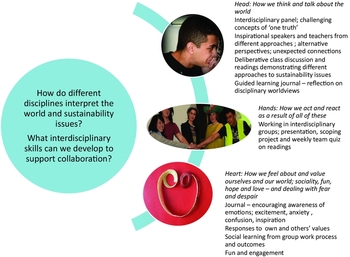
CSF shares EfS goals (Tilbury, Reference Tilbury2011), including the development of knowledge, skills and confidence around interdisciplinary collaboration. CSF starts from a critical theory perspective influenced by transformative learning theory, which emphasises individual empowerment through deliberately disrupting existing worldviews and demonstrating new understanding through action (Mezirow, Reference Mezirow2000). This approach aligns with EfS's critical thinking and action-focused pedagogy (Tilbury Reference Tilbury2011). Thus, CSF is concerned with challenging dominant ideologies, the making of new meaning and social processes, and exploring with students how understanding might translate into new types of personal and professional practice (Brookfield, Reference Brookfield2005; Mezirow, Reference Mezirow2000; Taylor & Cranton, Reference Taylor and Cranton2012). The pedagogic approach grew out of the teaching experiences of team members, informed by research into promoting learning by inspiring and engaging students (Bryson & Hand, Reference Bryson and Hand2007). These goals and approaches come together in the Transformative Sustainability Learning (TSL) framework proposed by Sipos, Battisti, and Grimm (Reference Sipos, Battisti and Grimm2008): head — cognitive domain; hands — psychomotor learning; and heart — affective domain (passion and values), which adds an emphasis on fun, inspiration and creativity to EfS critical thinking and action-focused curriculum (Figure 1).
Interdisciplinary elements of CSF linked to the TSL framework.

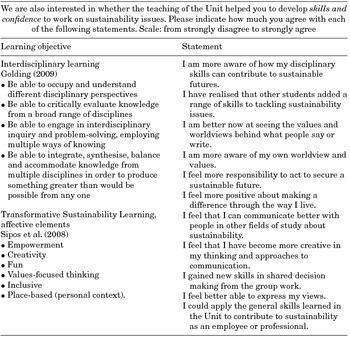
The key elements of CSF are: exploring futures and systems thinking; interdisciplinary collaboration; peer learning and group interaction; unlocking creativity; and personal engagement, relevance and action. These are translated into subject learning outcomes that derive from critical theory. They include developing an understanding of values-based thinking (Sipos et al., Reference Sipos, Battisti and Grimm2008) and — the particular focus here — specific goals for interdisciplinary skills learning: appreciating and having the ability to critically evaluate knowledge from a range of disciplinary perspectives; the capacity to apply an interdisciplinary approach to problem-solving; and the skills to bring together a range of knowledges to produce something greater than could be achieved from a single disciplinary perspective (Golding, Reference Golding2009; see Table 1). Providing a learning environment that encourages and supports transformative learning as described above is a vital element of curriculum design and pedagogy.
Survey Question 8: Statements About Skills and Confidence and Their Connection to CSF Learning Objectives and Processes

Over the 12-week semester, weekly 3-hour workshops included a team-based quiz on readings, group activities, discussion and online media presentations. A weekly lecture featured speakers from a range of sectors including health, agriculture, research, business, property and environmental advocacy, and a multi-disciplinary panel on urban planning issues. Reading content included a background to the purpose of interdisciplinary collaboration and developing group work skills.
Assessment consisted of three linked tasks: group presentation (AT1), reflective learning journal (AT2), and authentic client-based sustainability project (AT3). For AT1, small interdisciplinary groups used futures thinking to develop a 10-minute presentation of their vision for a sustainable 2030. Objectives were for students to experience working with individuals from a variety of disciplines who may hold different priorities and values when tackling a sustainability issue; and to use creativity to imagine and communicate a sustainable future. A drama teacher provided communication training. The resulting presentations showcased humorous and corporate-style videos, role-plays, current affairs shows, puppet shows, and a pop-up restaurant.
AT2 developed reflective practice though journals (10 weekly entries). Steps were taken to encourage trust and authenticity (Moon, Reference Moon2006), and students were supported with skills development, journal prompts, and formative feedback. Prompts included questions about whether they could identify their own discipline's worldview and their disciplinary skills, how their group was working, and how they responded to different perspectives. The reflective writing task engaged students cognitively, personally, and through reducing their ecological footprint (via making a pledge). To encourage awareness of transformative experiences, they were asked to write about the week's ‘light bulb’ moments.
AT3 (team project) required each group to work with a client, applying interdisciplinary thinking to scoping a current sustainability issue. Tasks included identifying a home for a permaculture club, a feasibility study for a campus community garden, and planning a Ride to University day. AT3 linked to the hands part of the TSL pedagogy, providing an opportunity for students to experience the constraints of working in the real world, and using interdisciplinary approaches to problem solving.
Interdisciplinary Component
Based on academic and student feedback from 2010, the 2011 curriculum was designed to encourage students to engage more consciously with CSF's interdisciplinary experiences, including acknowledging other students’ disciplinary skills. Figure 1 shows the critical theory approach translated into curriculum, and the integration of CSF's interdisciplinary component with the TSL framework. Elements of the curriculum were adapted from the work of Mansilla, Duraisingh, Wolfe, and Haynes (Reference Mansilla, Duraisingh, Wolfe and Haynes2009), including their work on measuring and assessing generic interdisciplinary learning, and from other higher education interdisciplinary curricula, including Golding's template for curriculum development (Bender, Reference Bender2011; Golding, Reference Golding2009). Golding's parameters included asking why and how an interdisciplinary approach would contribute; expectations of the students (deeper understanding, balanced judgement, tangible product or outcome); identifying the specific skills students need to work in this way (e.g., translating, balancing, synthesising); and identifying the disciplines and what they can contribute to a particular task. In practice, the achievement of interdisciplinary learning, as defined by Golding, depends upon students undergoing a process of critically questioning and reflecting on their own values and disciplinary paradigms, comparing these with others’ values and paradigms, and reframing their worldview and their personal-professional role to incorporate a new ‘reality’. There are two points of connection between critical theory, transformative learning, and the process of interdisciplinary learning. The first point is that both critical theory and transformative learning are concerned with exposing perspectives or paradigms and power dynamics that were previously unacknowledged. Similarly, interdisciplinary learning requires students to become more self-aware, to question their privileging of certain types of knowledge and expertise over others, and to challenge the roles that they have assumed for different players in the sustainability arena. The second point of connection is that both theories are linked to action outcomes, as is interdisciplinary learning, which in CSF is measured through the product of shared work or assessment tasks.
Methodology
The research for this paper was undertaken by the lead author as part of a longitudinal mixed methods action research project to develop an interdisciplinary sustainability subject, CSF. The study described in this article presents a unique single case study (Yin, Reference Yin2009) exploring the interaction between student experience and the novel pedagogy that explicitly fostered interdisciplinary collaboration on sustainability issues. The study was conducted with approval from the University's Human Ethics Committee and followed accepted practice in relation to gaining consent and participant anonymity. A mixed-methods sequential explanatory design involved the collection and analysis of quantitative data from a written survey. The analysis generated further research questions that were explored through qualitative interrogation of written student reflective journals (Creswell & Plano Clark, Reference Creswell and Plano Clark2011). The post-subject survey provided an overview of student self-reported responses to the teaching of the subject. It measured students’ perceived knowledge gains, their perception of how well different elements of the pedagogy helped them to learn, their attitudes to other disciplines, and their assessment of their skills and confidence about future involvement in interdisciplinary collaboration. The subsequent review of student reflective journals used a phenomenological approach and thematic content analysis to provide insight into the way students described their interdisciplinary learning experiences. The phenomenological approach is well suited to the study of a common experience shared by a number of individuals, with the research goal of developing recommendations or policies related to the phenomenon — in this case, interdisciplinary curriculum and pedagogy (Creswell, Reference Creswell2013). The focus of the qualitative research is on student descriptions of their experiences and the context or events that influenced their response (Bryman, Reference Bryman2008; Creswell, Reference Creswell2013; Moustakas, Reference Moustakas1994). The method is also particularly relevant given that the CSF pedagogy, based in critical and transformative learning theory, is also concerned with the intersection between individual responses to context and experiences.
The ethical and validity issues arising from entwining the role of researcher and teacher revolve around power relationships, voluntary involvement and/or perception of harm, and researcher integrity (partiality and independence). Measures included gaining trust with students about the research process and its aims prior to inviting participation, including demonstrating how previous student feedback had contributed to the evolution of the subject. Strategies were developed to deal with the risk of perceived bias. These included the involvement of a non-teaching member of the research team who invited participation, administered the survey and blind-coded the journals, identifying only the course: anonymity was guaranteed from the beginning, including which students had volunteered; and students were guaranteed that journals would not be reviewed for the research until after final marks had been released.
Case Study Student Population Sample
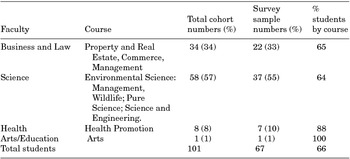
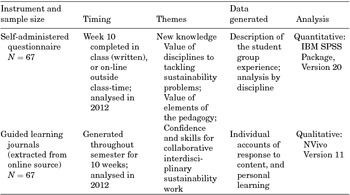
The sampling frame was 101 undergraduate students enrolled in the subject CSF at Deakin University in semester 2, 2011, unevenly representing all four faculties. Two-thirds (n = 67) of the population volunteered to participate in the research. The sample reflected the total distribution of students by faculty (see Table 2). An overview of data sources and techniques follows (see Table 3).
Comparison of Student Sample to Total Population By Discipline
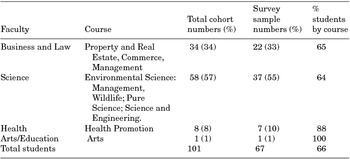
Note: The percentage (in parentheses) of students in the sample reflects the distribution by faculty of the total student sample.
Summary of Data Gathering and Analysis Techniques

Survey — Data Collection and Analysis
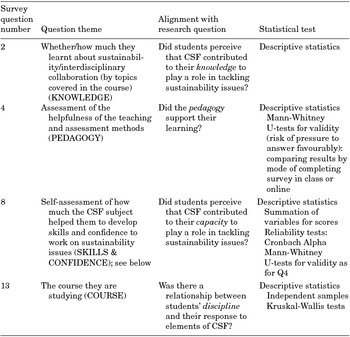
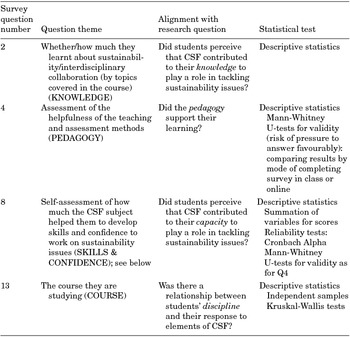
A 16-item, semi-structured questionnaire was used to gather information about students’ perceived learning during the semester. For this paper, four questions were selected (refer Table 4) that explored interdisciplinary learning experiences, responses to pedagogy, and the impact of the student's course on their experience. A trial of the research instrument with a convenience sample of previous students did not identify any issues with the questionnaire overall.
Alignment of Survey Questions With Question Theme, Research Questions and Data Analyses Performed
The questionnaire was administered during class in Week 10 (of 12) to all students who had consented to participate in the research; the process was managed by a non-teaching team member and yielded 54 written responses. Students participating in the research who were absent were contacted and invited to complete the survey online; 13 surveys were completed, suggesting that all consenting participants had responded.
Table 4 summarises each question in relation to its theme, the research question it is designed to answer, and the tests used for the data analysis. For most questions, descriptive statistics provided distributions and frequencies. Three types of statistical tests were used to look for differences between groups. Because of the lack of normality of the data (i.e., skewed distributions and unequal sample sizes), independent samples Mann-Whitney U-tests and Kruskal-Wallis non-parametric tests were used, and the likelihood ratio has been used for chi-square tests. The Cronbach alpha test assessed the reliability of the Skills Scale (i.e., whether the items are measuring the same construct) (Bryman & Cramer, Reference Bryman and Cramer1994). To identify whether student course or faculty affected student response to the CSF subject, independent samples Kruskal-Wallis tests were carried out for the three questions relating to knowledge, pedagogy, and skills.
Question 8 Skills Scale is detailed below as an exemplar for measuring student confidence about collaborative and interdisciplinary work and involvement in sustainable futures. The Skills Scale is a summated rating or Likert scale (Bryman, 2001). The attitude object of the scale is empowerment. The scale was derived from behaviour change theories of locus of control and self-efficacy, which align with the empowerment objective of transformative learning (Ajzen, Reference Ajzen2002; Cranton, Reference Cranton1994). The 11 statements relate to objectives of interdisciplinary learning — epistemological awareness and skills in collaborative work (five items, subscale 1; Golding, Reference Golding2009) and to the EfS transformative sustainability learning objectives of enlarging students’ perceptions of the world and motivating and empowering them to play a role in sustainable futures (six items, subscale 2; Sipos et al., Reference Sipos, Battisti and Grimm2008; UNESCO, 2009a). The Cronbach alpha coefficient of 0.85 suggests the scale has good internal consistency (i.e., the items are measuring the same construct; Bryman & Cramer, Reference Bryman and Cramer1994). Table 1 shows the alignment between CSF learning objectives and the 11 statements.
Reflective Journals
The qualitative research evolved from the results of the survey. The methodology was chosen to enable self-reports about individual experience to be used to generate further explanation of the quantitative results.
Population Sample
The journals of the 67 students who had completed the survey formed the basis for the qualitative research.
Data Collection and Analysis
The guided reflective journal (see subject description above) provided a self-conscious view of personal learning through CSF. While the survey measured the major areas of learning and most helpful elements of the pedagogy for the cohort, the journal analysis provided a picture of how that learning occurred. Almost all students submitted 10 unedited entries. Two-thirds of the group wrote between 2,000–3,000 words in total (the suggested length); however, the others wrote more, with one student writing 9,000 words. Post-semester, journals were matched to consent forms, deidentified by a non-teaching member of the team, and put into an NVivo database.
The content of the 67 journals was analysed via an iterative phenomenological approach based on van Kaam's method of analysis (Moustakas, Reference Moustakas1994):
-
1. Identification of categories of interest — these were areas identified as needing further explanation as a result of the data analysis of the survey;
-
2. Reduction and elimination of journals not containing a ‘moment’ of interdisciplinary experience sufficient for contributing to understanding student experience;
-
3. Clustering and thematising the ‘moments’ or quotes;
-
4. Validating by reviewing these in the context of the complete record of the research participant;
-
5. Constructing a description of each participant's experience;
-
6. Developing a composite description of the essence or meaning of the CSF experience.
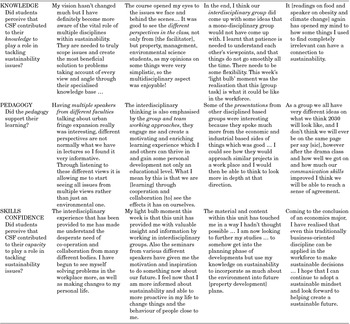
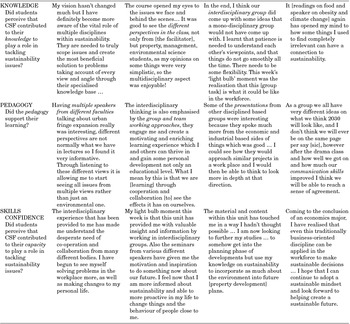
The initial process involved reading all the journals, followed by exploration of the survey data set using word search and frequency analysis. This identified comments related to the three categories of interest — interdisciplinary learning, pedagogy, and transformative learning experiences (1). Fifty-nine of the 67 students discussed interdisciplinary learning and collaboration and remained in the sample (2). Each of these journals was then reread and coded for quotes describing individual responses about disciplinary worldviews and interdisciplinary collaboration, the development of skills and confidence for interdisciplinary work, and for any links to the influence of pedagogy — the three research questions explored in the survey. These were clustered into emerging themes based on recurring ideas and language used across the group (3). Specific learning about sustainability was not included in this analysis. Selected quotes were then checked back against the individual journals to ensure they were not being taken out of context (validation) (4). A new ‘story’ was then constructed for each participant, which provided a textural description of each individual's experiences as well as a structural description of how the context or pedagogy contributed to the process of learning (Moustakas, Reference Moustakas1994) (5). Finally, the selected quotes generated a composite description of the meanings of the student experiences. A small sample of quotes is included in Table 5 and the discussion section discusses the essence or meaning (6).
Sample of Students’ Articulation of Their Interdisciplinary Learning Linked to the Three Dimensions of the Quantitative Survey: New Knowledge, the Most Helpful Components of Pedagogy, and Skills and Confidence
Results
This section presents the results from the three learning-related questions in the survey (questions 2, 8, and 13) that provide insight into interdisciplinary learning experiences. It is followed by a section detailing the findings from the journals analysis, which provides explanations into the nature of the learning.
Survey
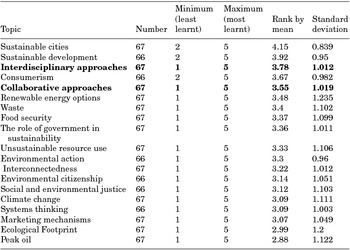
Question 2 measured students’ level of perceived learning by topics covered in the subject. The two topics of interest for this article were Collaborative Approaches and Interdisciplinary Learning, which students rated with Sustainable Cities, Sustainable Development, and Consumerism as areas of greatest perceived learning (see Table 6).
Summary of Responses to Q2: Amount Learnt, in Order of Most to Least
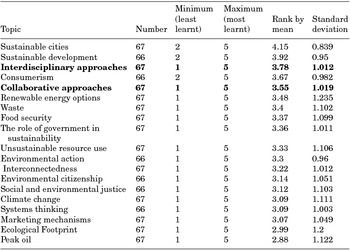
Note: Values: 1 = no more; 5 = a great deal. Bold type indicates topics concerned with interdisciplinary learning.
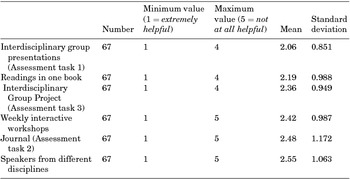
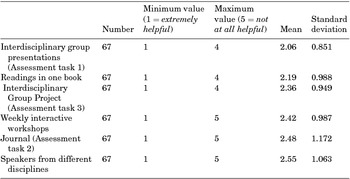
Question 4 measured student views on the degree to which components of the curriculum helped them learn. Table 7 lists the components students found most helpful to their learning: the three assessment tasks, consolidation of curriculum materials in one book, the workshops, and the speakers from different disciplinary backgrounds. Elements of pedagogy supporting group work, including the drama workshop, rated less well.
Summary of Responses to Q4: Degree of Helpfulness of Curriculum Components to Student Learning: Top Six Components, in Order of Most to Least Helpful
Question 8 Skills Scale measured students’ perceived mastery of skills for collaboration on sustainability issues. The score of 11 represents strong agreement with all 11 statements; 55 equates to strong disagreement. The vast majority of students felt they gained interdisciplinary and other skills for sustainability; the scores were clustered at the positive end of the spectrum (agree and strongly agree), within a range of 11 to 33 (M = 20.73, SD 5.037; skewness = 0.53, kurtosis -0.104).
Worthy of note, Kruskal-Wallis tests found no difference between the disciplines for the Interdisciplinarity and Collaborative Approaches items in Question 2. Similarly, for Q8 (Skills Scale), there were no significant differences between the groups (K = 1.480, df = 3, p = .687).
In summary, most students recorded a high level of learning about topics that addressed sustainable development, sustainable cities and consumerism, and interdisciplinary/collaborative approaches. Most felt the pedagogy supported their learning. The two group assessment tasks, readings collated into one book, workshops, and journals were the most helpful. The vast majority of the group felt they increased their level of skills and confidence for interdisciplinary skills and sustainability action, and there were no significant differences between the course groups.
Journal Analysis
Close reading of the 59 journals that addressed interdisciplinary learning provided rich material about the nature of the learning identified in the survey. Response to the pedagogy is woven into the writing. The analysis identified three main themes: new awareness of multiple perspectives and developing new ways of seeing and acting, learning through shared work, and empowerment. Reflections on the subject and their future roles (final journal entry) in most cases revealed some increased awareness of personal and professional potential to act on sustainability and to collaborate with other disciplines, an essential dimension of empowerment.
A dominant theme across the journals was the value of being exposed to new perspectives. Students describe their new awareness of the range of views and knowledge about sustainability issues that they gained from peer learning in interdisciplinary groups, and from the presentations and workshop discussions. The second and related theme was learning through doing — students noted how they developed new personal and intellectual skills by doing interdisciplinary collaboration, with all its challenges. The third theme underpinning the reflections was a sense of empowerment that came from new knowledge, skills and confidence, and in particular, a belief in their own capacity to contribute to a more sustainable future. These results also provide support for the survey findings that the elements of the pedagogy that most helped them learn were the two group assessment tasks, the weekly 3-hour workshops, and challenging speakers and readings. Journal responses presented in Table 5 provide a sample of students’ reflections on what they learnt and how, and what confidence they gained in relation to their interdisciplinary skills and ability to work collaboratively. These were organised to correspond to the quantitative research questions.
Discussion
The research shows that the CSF pedagogy, based in critical theory and transformative learning, provided both stimulus and structure to enable interdisciplinary learning consistent with interdisciplinary learning objectives (Golding, Reference Golding2009; and in Table 1). The pedagogy enabled this group of undergraduate students from professionally focused disciplines to reassess their personal and disciplinary identity and values, to develop broader perspectives, and to develop confidence in their future role in interdisciplinary sustainability collaboration. Students practised new group work skills and together developed unique interdisciplinary products, including real-world solutions for their assessment tasks. Importantly, the research demonstrated that both science and non-science students valued the opportunity to be challenged by and to engage productively with students and academics from other disciplines and faculties, and reported that they had gained skills and confidence.
The journals provide an explanation of the way students responded to the CSF pedagogy that offers substance to the survey findings about what helped them to learn. Students’ descriptions of the dynamics of the group work and peer learning demonstrate the power of peer learning and hands-on activities. This is consistent with the fundamentals of EfS, which emphasises hands-on, real-world activities (Tilbury, Reference Tilbury2011). Exposing students to multiple perspectives was a transformative experience that triggered new ways of seeing issues and led to new appreciation of the value of listening to different perspectives. Notably, very few students discussed how reflective practice helped them work through the challenges of the subject content and experiences — a contrast with the survey results that ranked journal writing as one of the main components that helped them to learn. This silence may reflect the assessment task instructions, which did not ask them to comment on the development of their reflective practice.
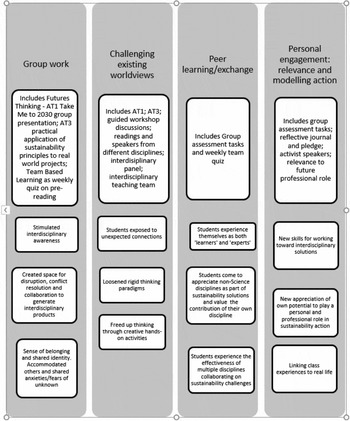
The strength of the mixed methods design lies in the multifaceted picture it creates by first measuring the group's response to the CSF experience and then gaining further insight through exploring the interaction between the context and individual experiences. The survey provides the overview of the student group's response, and the journals add the affective and interactive elements absent from the quantitative research. The survey identified the usefulness of several of the pedagogical elements, and the analysis of the students’ journal writing illuminated the connectedness of those pedagogical elements. Group work provided a testing ground for the concept of dealing with people who have different backgrounds and perspectives; it enabled new skills to be developed, and it built confidence in being able to take on alternative approaches and new roles. The results provide evidence for the value of structuring subjects to support learning through engagement and inspiration (Bryson & Hand, Reference Bryson and Hand2007). The students’ descriptions of empowerment and emerging agency resulting from new ways of seeing the world supports the use of the transformative learning framework outlined above (Sipos et al., Reference Sipos, Battisti and Grimm2008). While not all students experienced this level of change, the authors are very encouraged by the prevalence of these sentiments and reassured of authenticity by the variety of ways students described their view of their future. Consistent with transformative learning theory (Taylor & Cranton, Reference Taylor and Cranton2012), a critical element of the pedagogy was a process of social discourse used to challenge students to question their existing worldviews and ways of acting. Alternative perspectives were presented through all elements of the subject — from peers, academics, literature, and speakers. Students responded positively to different exposures, with few not actively challenged. This research demonstrates the value of a transformative learning pedagogy that connects cognitive, affective, and critical dimensions and is firmly grounded in classroom and real world experiences.
Figure 2 encapsulates the authors’ interpretation of how the pedagogy, expressed in four streams, supported student learning. Our observations in the classroom of students’ response to the pedagogy are validated and enriched by student feedback and their own descriptions of their learning. The interpretive framework (Figure 2) provides higher education practitioners with a guide for developing deliberative curriculum and pedagogy that promote interdisciplinary knowledge, skills and confidence in this emerging area of EfS.
Interpretative diagram of the four elements that facilitated interdisciplinary teaching and learning.

The strength of this study is the presentation of a documented case study of a subject featuring deliberative pedagogy for interdisciplinary learning that provides a holistic model for developing curriculum in this vital area. It makes a unique contribution to an emerging field of research into interdisciplinary sustainability education by combining a quantitative measure of student responses to curriculum with accounts of interdisciplinary learning experiences expressed through their voices. Space constraints have limited the inclusion of examples of individual student-learning journeys. Methodologically, the results are limited by the dependence on self-report and the absence of pre- and post-test measures of students’ attitudes, knowledge and skills, including pre-existing interdisciplinary skills. In addition, the design of the summative Skills Scale, which favours positive statements, would be improved by including opposing statements. Limitations difficult to eliminate, but which may have affected the authenticity of the journals, include mandatory assessment of unedited journals and our roles as researchers as well as teachers. Finally, while the pedagogy is transferable, the vocational focus of the courses limits generalising the findings to undergraduate student populations in broad-based degrees.
Conclusion
This article documented a process for integrating deliberative interdisciplinary pedagogy into a transformative learning pedagogy for EfS. The research aimed to explore how students responded to the pedagogy and the meaning of their collective experience. Using a novel mixed-methods design, the research demonstrated that CSF students engaged with the approach and developed new appreciation of interdisciplinary collaboration for sustainability, including possible future roles, and provided insights into how students perceived the process and outcomes of their learning. It was apparent that students valued the opportunity to be challenged by and to engage productively with students and academics from other disciplines or faculties. Together these findings give higher education professionals evidence and courage with which to continue promoting cross-faculty learning opportunities, despite cumbersome logistics.
Documented examples of cross-faculty EfS teaching with a focus on interdisciplinary identity are uncommon, and this article therefore makes an important contribution to the literature by illuminating the teaching and learning processes that occurred. The research established that unlike most interdisciplinary pedagogy, CSF eschews familiar ways of doing university learning. CSF operationalises a student-centred approach that connects personal engagement and real-life application, and social learning and creative approaches, with fostering more open ways of thinking. Using this multifaceted approach, academics created a subject that supported students through the potentially distressing process of giving up comfortable and unquestioned worldviews and ways of working, and built their confidence to participate in creative, collaborative interdisciplinary action on sustainability.
Importantly, this article, replete with a theoretical background, subject description and study results, provides EfS educators with a template for incorporating interdisciplinary learning that is consistent with EfS philosophies of engaging student learners, and makes a unique contribution to understanding the process of interdisciplinary sustainability learning in undergraduate higher education settings. It provides inspiration to professionals discouraged by recent articles that have highlighted lack of interest or success in pedagogical innovation in EfS in Australia (Christie et al., Reference Christie, Miller, Cooke and White2012; Gale et al., Reference Gale, Davison, Wood, Williams and Towle2015; Higgins & Thomas, Reference Higgins and Thomas2016). By convincingly demonstrating that the approach stimulated transformative learning that supports the goals of EfS, the article presents a strong case for future EfS curriculum frameworks and strategic education policy to include deliberative interdisciplinary pedagogy including cross-faculty engagement. In so doing, it challenges higher education institutions to create flexible systems that facilitate the cross-faculty interdisciplinary learning experiences that are necessary for preparing students for the future.
Acknowledgments
The authors would like to acknowledge Deakin University academic staff who have contributed to the development of CSF; in particular, Dr Kimberley James, Sonia Nuttman and Barb Ciszewska, and in addition, University of Melbourne academics Professor Simon Batterbury and the ‘Reshaping Environments’ team for generously sharing their experiences of interdisciplinary sustainability teaching.
Author Biographies
Sue Noy has taught sustainability subjects at Deakin University for the past seven years. She has been involved in the interdisciplinary subject Creating Sustainable Futures since its inception in 2009. Sue has worked in a range of fields, designing and managing state-wide and national health behaviour change campaigns, and developing adult, community education and recreation programs in Australia and overseas. Her current research includes developing students as global citizens, reflective practice, health and climate change, and interdisciplinary learning. Since 2005 she has also volunteered as a director and committee member of a leading Victorian not-for-profit environment organisation.
Dr Rebecca Patrick is a lecturer in the School of Health and Social Development at Deakin University, Australia. She was the chief investigator and project lead for the teaching and learning project that led to CSF. She now teaches into CSF, various Public Health and Health Promotion courses and co-ordinates majors in Health and Sustainability. Within the Health, Nature and Sustainability research group (http://www.deakin.edu.au/health/hsd/research/niche/hns/index.php) she leads the agenda on public health responses to climate change and sustainability. Her service activities span work-integrated learning and health-related education for sustainability.
Teresa Capetola's tertiary teaching spans over 25 years, and she currently lectures in Health Promotion and Public Health. She also has extensive experience working as a Community Educator within the public health and community sector. Over the last seven years Teresa has extended her areas of research and teaching and learning to include Education for Sustainability, in response to growing global climatic concerns and the implications for health and well-being. She is a member of the Health Nature and Sustainability Research group and is a co-creator of the subject Creating Sustainable Futures.
Janine McBurnie has lectured in Environmental Management at Deakin University since 1996. Her research and teaching focus has been how to communicate complicated environmental issues to students, as well as providing students with opportunities to practice interdisciplinary learning skills that they can use within their professional lives. A focus on interdisciplinary learning and collaboration has underpinned teaching practice throughout her career, but more formally over the past decade. She also teaches Creating Sustainable Futures.