Political economy research has only begun to tap into the richness and complexity of foreign direct investment (FDI). FDI plays a central role in many aspects of international economic integration. It is the single largest source of global capital, in some years worth more than all other forms of capital flows.Footnote 1 It drives other types of economic flows. For example, intrafirm trade—trade between subsidiaries of a single multinational firm—constitutes over one-third of total world trade.Footnote 2 FDI can also foster economic development by creating jobs and introducing new technologies.Footnote 3 Existing political economy scholarship on FDI emphasizes how political risk influences where multinational firms choose to invest. For example, current research shows that countries with lower risk receive higher volumes of FDI; debate in this literature centers on which domestic political conditions make markets appealing to foreign investors.Footnote 4 These studies model the choices of multinational firms to provide political economy explanations for the supply of FDI inflows. Although this is an important topic, it is only one dimension of FDI's politics.
In this article I focus on the demand for FDI. Specifically, I develop and test a theory of individual preferences for FDI inflows, arguing that preferences are a function of FDI's distributional effects. In FDI, multinational firms establish foreign subsidiaries to produce goods and services abroad. These activities redistribute income within recipient countries by driving up labor demand. FDI increases the supply of productive capital. Foreign firms create additional labor demand by hiring local labor; consequently wages rise. Skilled labor wages, in particular, rise because multinational firms are typically more technologically advanced and require more skilled labor than equivalent local firms. Given these distributional effects of FDI inflows, I hypothesize that labor supports FDI inflows and that this support is greater among individuals at higher skill levels.
I test these claims with three years of data from the Latinobarometer, a public opinion survey covering eighteen Latin American countries and perhaps the only major, multicountry survey project that inquires about attitudes toward FDI. These data allow me to test the observable implications of FDI's distributional effects for individuals' preferences. I show that FDI preferences are indeed consistent with FDI's expected effect on individual income. Specifically, support for FDI inflows increases with respondents' skill level. Respondents with a university education are between 7 to 10 percentage points more likely to support FDI inflows than respondents with less than a secondary school education. This finding is robust to a variety of alternate explanations including the socializing and informational effects of education, job insecurity, and opposition to privatization.
By opening up a new dimension to FDI research, these findings make two broader scholarly contributions. First, they build the foundation for a broader theory of FDI demand. Preferences underlie more aggregate phenomena including lobbying for FDI policies, the existence and form of national FDI regulation, and choices about international cooperation on investment. These are all aspects of FDI's political economy about which little is known, even though these are central questions in the study of other types of international economic flows.Footnote 5 Awareness of the demand side of FDI's politics may prompt a reassessment of extant findings on FDI supply; the volume of FDI inflows may have as much to do with demand for FDI as with investors' willingness to supply investment.Footnote 6 More generally, existing accounts of the political economy of international economic integration are, at best, incomplete without greater attention to the politics of FDI support.
Second, these findings contribute to research on individual preferences for international economic flows. The use of survey data to validate theories of distributional effects is increasingly common and has already provided new insights on preferences for trade, immigration, macroeconomic policy, and social spending.Footnote 7 Existing research identifies a role for nonmaterial sources of trade policy preferences including national pride and socialization through higher education. FDI likely has even more potential to ignite nationalist opposition than trade. It can give foreigners a high profile in the national economy as large employers and custodians of natural resources and national infrastructure. Recent years have seen takeovers by multinational firms singled out as affronts to national identity in countries from Bolivia and South Korea to the United States. As such, FDI is a particularly apt policy area in which to test the relative importance of material and nonmaterial sources of international economic policy preferences.Footnote 8
The remainder of this article is organized into three main parts. The next section develops hypotheses about the sources of individual preferences of FDI inflows. I then describe the empirical test of these hypotheses and a series of robustness checks. The article concludes with the implications of the article's findings for public policy and a broader research program on the politics of FDI regulation.
Sources of Foreign Direct Investment Preferences
Three facts about FDI help to establish FDI's economic implications for recipient countries. First, FDI is the international flow of firm-specific capital. These firm-specific assets include proprietary production technologies, managerial and organizational practices, and trademarked brands. Multinational corporations arise when firms encounter incomplete contracting problems in directly selling or licensing these assets. Additionally, holdup risk is high when a separate firm is an exclusive inputs supplier. FDI avoids these pitfalls by keeping assets within the firm and expanding the firm itself into multiple markets.Footnote 9
Second, FDI is so expensive that only the world's most productive firms undertake it. FDI requires firms to establish and monitor multiple subsidiaries, often in distant and initially unfamiliar markets. FDI is efficient for only those firms whose exceptionally high productivity offsets the costs of multinational production. For example, Helpman, Melitz, and Yeaple find that multinationals are 15 percent more productive than purely domestic, exporting firms.Footnote 10 I make use of this fact in deriving FDI's distributional effects by assuming that multinational firms are more productive than local firms in the host market.
Third, there are two distinct strategies for organizing multinational production. Like all forms of capital flow, FDI is a way for firms to earn higher returns on their capital. Owners of firm-specific capital, however, are unable to “lend” their capital due to various incomplete contracting problems. Instead, these firms earn returns to their assets indirectly via product markets. There are two different ways in which firms can organize production to realize these returns. Firms lower production costs by pursuing export-oriented FDI that fragments the production process. Firms usually retain headquarter functions such as research and development in the home country and relocate production to foreign countries abundant in necessary inputs, typically labor.Footnote 11Market-oriented FDI sees firms entering countries that are potential product markets.Footnote 12 This form of investment replicates production facilities in multiple host countries to produce goods and services for local sale.Footnote 13 Firms pursue this strategy when trade barriers or transport costs make cross-border trade prohibitive. For example, American restrictions on Japanese auto imports in the 1980s prompted major Japanese carmakers to establish manufacturing plants within the United States. Market-oriented FDI accounts for the majority of FDI flows. In the late 1990s, foreign subsidiaries of U.S.-based multinationals sold approximately two-thirds of their output in the same host country in which they produced it.Footnote 14 This figure is actually a historic low, because export-oriented FDI grew considerably in the 1990s. Any account of FDI's distributional effects has to make sense of both its factor price effects and, when relevant, product price effects.
FDI's Distributional Effects
A specific factors model provides an instructive framework in which to analyze FDI's distributional effects. The model consists of two industries and three factors—capital specific to each of the two industries and homogenous, mobile labor.Footnote 15 The assumption of industry-specific capital is apt since physical machinery and production practices cannot be easily redeployed across industries. There is also full employment of all factors and all firms are price-takers. Profit-maximizing firms hire workers until the marginal revenue product of the last worker hired is equal to that worker's wage. The marginal revenue product of labor is the revenue generated by each additional worker employed by a firm. The central determinant of marginal revenue product is productivity; all else equal, variation in marginal revenue product depends on how much a given worker can produce.
Consider the distributional effects of firm-specific capital inflows. To isolate this effect, assume that FDI does not affect local product prices. This is true of export-oriented FDI in which multinationals export goods rather than selling them locally. In the context of the model, FDI introduces new capital into one of the two local industries. Local workers become more productive because their marginal revenue product increases with additional capital inputs. The exceptionally high productivity of multinational firms magnifies this effect because these firms typically introduce more efficient production technologies than do local firms. At this higher marginal revenue product the multinational firm expands production, hiring workers away from local firms by offering a higher wage.Footnote 16 Firms re-establish the equality of wages and marginal revenue product at this higher wage. Since labor is mobile across industries, these gains accrue to all labor, not just those employed by multinational firms. These wage increases represent gains in real income because product prices are unchanged. Returns to domestic capital owners decline because a portion of capital income is redistributed to labor in the form of higher wages.
A wealth of evidence demonstrates that FDI increases wages. That foreign-owned firms pay higher wages than their domestic counterparts is an exceptionally robust finding in the context of both developed and less developed economies.Footnote 17 Most studies find between a 10 and 30 percent wage premium for unskilled workers in foreign-owned manufacturing firms. Additionally, wages paid by local firms increase after the entry of multinationals. Blonigen and Figlio examine the effects of FDI on local wages in South Carolina and find that the entry of a single average-sized, foreign-owned plant, employing about 190 workers, increases by 2.3 percent of the real wages of all workers employed in the plant's industry and county.Footnote 18 This wage increase, they argue, reflects an overall increase in labor demand. Similarly, Feenstra and Hanson identify a close association between FDI inflows and wage increases in Mexico in the 1990s, with the highest wage increases observed in those states receiving the highest volumes of investment.Footnote 19 In many developing countries, local firms pay higher wages after the entry of a foreign-owned firm despite constant or even decreasing productivity.Footnote 20 These results support the theoretical claim that FDI inflows lead to higher wages via its effect of raising labor demand.
Market-oriented FDI has the additional effect of introducing competition into the local product market. Given that multinational producers are typically more productive than their host country counterparts, market-oriented FDI can result in lower product prices through greater market competition.Footnote 21 The precise effect can range from neutral (that is, FDI has no influence on product prices), to price reductions whose magnitude depends on the degree of market competition that FDI introduces.Footnote 22 For labor, any price reductions are an additional channel through which FDI increases real income.Footnote 23
There is considerable evidence that returns to FDI increase with skill level. Recall that firms' fundamental motivation to undertake FDI is to protect firm-specific production technologies. By virtue of these technologies, production processes in multinational firms tend to be more advanced than those of equivalent domestic firms. For this reason, multinational firms systematically demand more highly skilled labor than do local firms. From this fact follows the prediction that labor's gains from FDI inflows increase with skills. Extensive evidence shows that, consistent with this hypothesis, FDI inflows have a particularly large effect on skilled labor wages.Footnote 24 Estimates of FDI's effects on skilled labor wages are as high as 50 to 70 percent above skilled wages paid by local firms.Footnote 25 Griffith and Simpson directly compare skilled and unskilled wages in UK manufacturing industries to find that the wage premium associated with multinational employment is twice as large for skilled workers compared to unskilled workers.Footnote 26 Feenstra and Hanson conclude that FDI was the single largest source of increases in skilled labor wages in Mexico during the 1980s.Footnote 27
The theoretical and empirical findings on FDI inflows have clear implications for labor's FDI preferences. Both factor price and product price effects suggest that labor will support FDI. FDI increases wages by increasing labor demand; wage increases are higher for skilled labor due to the relatively high skill intensity of multinational firms' production processes. Accordingly, labor is likely to support FDI inflows because it increases labor's real income through higher labor demand and, sometimes, lower product prices. Skilled workers have a higher probability, all else equal, of supporting FDI inflows since skilled wages receive the largest gains from FDI.
Alternate Mechanisms
Preferences are, of course, complex and multidimensional. Empirical tests must account for other potential sources of FDI preferences. Recent research on trade and immigration attitudes suggests that preferences are not exclusively a function of expected income effects. Mayda and Rodrik, and O'Rourke and Sinnott find a robust positive relationship between national pride and protectionist preferences.Footnote 28 Hiscox and Hainmueller propose that higher education uniquely socializes individuals to have more cosmopolitan preferences by fostering an awareness and appreciation of foreign cultures and influences. Higher education, they continue, also provides the requisite economic literacy to appreciate the welfare gains to free trade independent of the narrow effects on individual income.Footnote 29 These proposed effects of higher education on preferences are independent of the effect of higher education on skills.
Another possible influence on preferences is perceived job insecurity. Scheve and Slaughter argue that FDI can increase the elasticity of labor demand in host countries, thereby fueling job insecurity.Footnote 30 Although they do not address FDI preferences directly, their finding suggests that individuals who perceive their jobs to be less secure may be less favorable toward FDI. This mechanism is distinct from the distributional one but it is not necessarily inconsistent.
The finding may not generalize because FDI can also be a source of job stability, especially in times of economic crisis. Multinational firms are more resilient to economic shocks than purely domestic firms in the host country. As part of a larger multinational organization, affiliates have easier access to credit and more diversified portfolios that make them more likely to stay in operation than domestic firms who cannot call upon the resources of a parent firm. Indeed, FDI flows often increase following currency devaluations.Footnote 31 In short, the role of job security in the formation of FDI preferences is an open empirical question.
Another dimension of FDI's income effects is FDI's potential to eliminate rents accruing to labor. Privatization is frequently the context for these effects. In many countries the successful privatization of state-owned firms requires the participation of foreign-owned firms. Foreign firms alone can bring the necessary financing and production technologies to make state-owned enterprises profitable and more efficient. Public-sector employees may face the loss of perks associated with public employment including high salaries, job security, opportunities for personal rent-seeking, and prestige.Footnote 32 For these workers FDI can result in a net loss of income. Thus, it is possible that privatization's losers may be particularly opposed to FDI inflows.Footnote 33
Explaining FDI Preferences: Empirical Tests
A growing body of research in comparative and international political economy utilizes public opinion data to test the consistency of preferences with predicted distributional effects. Individual policy preferences can be directly linked to salient demographic information regarding education, employment, and geographic location. By contrast, indirect measures of preferences based on political behavior are much noisier due to the influence of interest groups and political institutions on observed behavior.Footnote 34 Following this research I use survey data to test whether preferences for FDI inflows are consistent with FDI's predicted effects on individual income. Data are from the Latinobarometer, an annual public opinion survey conducted in eighteen Latin American countries.Footnote 35 This survey is unique among the prominent multicountry survey projects in that it regularly includes questions on attitudes toward FDI inflows.Footnote 36 The surveys draw representative samples in each country and inquire about a wide range of political and social topics. Surveys from 1995, 1998, and 2001 included questions about FDI preferences. The 1995 and 1998 surveys ask: “Do you consider that foreign investment, in general, is beneficial or is it harmful to the economic development of the country?” Respondents replied “beneficial” or “harmful.”Footnote 37fdi beneficial is a binary variable equal to 1 if the respondent answered “beneficial.”
The 1998 and 2001 surveys ask a different but related question: “Do you strongly agree, agree, disagree, or strongly disagree with the phrase: foreign investment should be encouraged?” promote fdi is equal to 1 if the respondent replied agree or strongly agree.Footnote 38 The use of two different questions, both of which are present in the 1998 sample, mitigates concerns about framing effects by allowing comparisons across the two questions for the same sample.Footnote 39
Labor's skill level is the central source for FDI preferences.Footnote 40 As is standard in empirical work on economic preferences, I use respondents' level of education as a proxy for skill. There is, however, some disagreement over the most appropriate measure of educational attainment. Rather than choose among them, I use three distinct measures of education, each of which captures a somewhat different aspect of the same underlying concept. years of education measures the respondents' number of years of schooling (up to sixteen years).Footnote 41 This measure assumes a strictly linear effect of education on skill level. By construction each additional year of education is assumed to have the same effect on the probability of FDI support. Scheve and Slaughter measure educational attainment in this way.Footnote 42 A different approach is to use the highest level of education completed as the proxy for skills. I construct two variables on this basis. education level is a four-category variable that is equal to 0 for less than a primary school education (including illiterate), 1 for completed primary school, 2 for compulsory secondary education, and 3 for completed higher education.Footnote 43 This measure collapses educational attainment into ordered categories but preserves the assumption that a shift between any two categories has the same effect. Finally, I construct four separate indicator variables for whether the respondent's highest level of education is: a university degree, a partial university education (ended without a degree), postsecondary vocation training, and secondary school completed. The omitted group is all educational attainment less than secondary school completion. Hiscox and Hainmueller use a series of indicator variables like this to estimate the distinctive effects of a university education on preferences.Footnote 44
I examine the influence of job security on FDI preferences using responses to the question: “Which is your degree of concern about being without a job or being unemployed in the next 12 months?” job insecurity is a four-category variable for which higher values correspond to greater concern about job security. The expected sign is ex ante unclear; there are plausible theoretical arguments that yield opposite predictions. The coefficient represents FDI's net effect on employment volatility, controlling for FDI's effects on wages.
Occupational information provides proxies for additional alternate explanations. public employee is a binary variable equal to 1 for respondents employed in the public sector. Privatization and FDI are tightly linked because governments often sell state-owned firms to foreign firms who have the requisite capital and expertise to operate these firms as profitable enterprises. Respondents employed in the public sector are more likely to oppose FDI on these grounds.Footnote 45
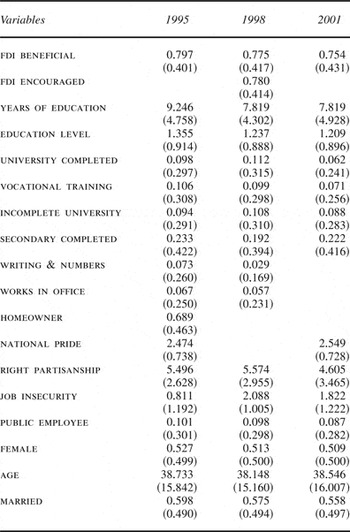
I estimate a series of probit models to consider the relationship between these variables and the probability of support for FDI inflows. All models include controls for respondents' basic demographic characteristics: female, equal to 1 if the respondent is a woman; age, the respondent's age; and married, equal to 1 if the respondent is married or cohabitating. Models also include country-fixed effects to control for the myriad of country-level factors that can influence preferences. I first estimate a set of baseline models to test core hypotheses using all three years' data. I then exploit the richness of individual surveys to test the robustness of core propositions to different measures of key variables and additional sources of FDI preferences. Table 1 provides summary statistics for all variables.
Summary statistics

Notes: Each cell reports the variable mean and, in parentheses, its standard deviation.
Empirical Results
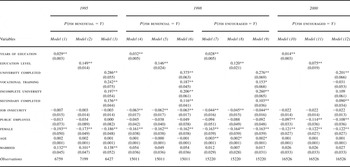
The baseline model estimates, summarized in Table 2, demonstrate a consistently positive and statistically significant relationship between skill level and support for FDI. This relationship is robust to the use of different measures of educational attainment as a proxy for the expected return to FDI inflows. Models with separate estimates for different levels of education show that the probability of supporting FDI inflows increases with more education, often quite dramatically. Respondents who have completed university are, depending on the sample, between 7 and 10 percentage points more likely to support FDI inflows than those who have not completed secondary school.Footnote 46 Those who have completed secondary school and have no further education are 3 to 4 percentage points more likely to support FDI relative to those who have not completed this level of schooling.
Baseline results

Notes: Probit coefficients with robust standard errors clustered by country in parentheses. All models include country fixed effects.
* significant at 5% level;
** significant at 1% level.
The significant findings for educational attainment below a university degree support an income-based explanation over an information or socialization explanation. Recall that Hiscox and Hainmueller single out a university education as a source of both socialization and information about economic flows.Footnote 47 A positive and significant coefficient for only the university completed variable would have supported a nonmaterial explanation. A factor income explanation is more likely given that the support for FDI is robust across educational levels.
The results are mixed for the alternate channels of FDI's income effects. job security is statistically significant for only the 1998 sample, for which it has a negative effect on the probability of support for FDI. The substantive effect of job insecurity is quite small compared to educational attainment. Similarly, public employment has the predicted negative effect but it is statistically significant in only some specifications. The negative sign on the coefficient is consistent with the theoretical claim that public employees are vulnerable to a loss of rents when FDI occurs in conjunction with privatization.
Although a control variable, female merits brief discussion given its consistently negative and statistically significant coefficient. Across the three sample years, women are between 4 to 6 percentage points less likely than men to support FDI inflows. There are no theoretical reasons to suggest why women are consistently opposed to FDI inflows. This result echoes findings on trade policy preferences that women are consistently more protectionist.Footnote 48
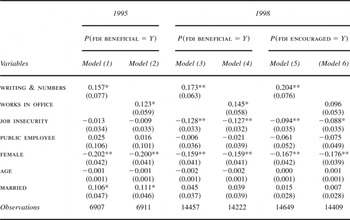
These baseline results demonstrate reasonably well that factor price effects influence support for FDI inflows. I undertake a series of robustness tests to further explain influences on FDI attitudes. The 1995 and 1998 surveys provide alternate measures of skills. One question inquires: “In your job, do you spend a lot of time writing or working with numbers?” A second question asks: “Do you work in an office?” Both questions capture dimensions of skill that may not derive from formal education but are nonetheless skills that multinational firms demand. In particular, these measures can capture skills gained through work experience. The low correlation between these variables and education confirms that they are conceptually distinct from formal education: for the 1998 sample there is a less than .01 correlation between a university education and each of the alternate measures; for the 1995 sample this correlation is approximately .06 for both variables. writing & numbers equals 1 for respondents who either write or use numbers regularly in their work. works in office equals 1 for respondents who work in an office. Both of these variables should have a positive relationship with support for FDI inflows. Table 3 reports model estimates using these alternate measures of skill. Both proxies of skill are positively correlated with support for FDI inflows at conventional levels of statistical significance in five of the six models.Footnote 49 These findings further demonstrate that returns to skills, broadly construed, explain support for FDI.
Alternate measures of returns to FDI

Notes: Probit coefficients. Robust standard errors clustered by country in parentheses. All models include country fixed effects.
* significant at 5% level;
** significant at 1% level.
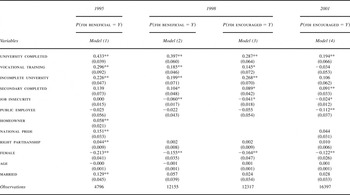
A final set of robustness checks draws on the richness of the individual surveys to specify expanded models that include a wider range of potential influences on FDI preferences. Briefly, I examine three additional factors using data for those survey years which included appropriate proxies. First, Scheve and Slaughter show that home ownership is a distinct channel through which international economic flows influence individual income.Footnote 50 To the extent that FDI flows improve local economic conditions, they raise the value of geographically fixed assets like real estate. Model 1 in Table 4 includes homeowner, a binary variable equal to 1 if the respondent is a homeowner.Footnote 51 The estimated coefficient is positive and statistically significant, supporting the importance of asset ownership in shaping economic preferences.
Expanded models of FDI preferences

Notes: Probit coefficients. Robust standard errors clustered by country in parentheses. Constant omitted. Country fixed effects included.
* significant at 5% level;
** significant at 1% level.
Second, existing research points to the negative influence of national pride on support for international economic flows. This argument is closely related to earlier discussion of the socializing effect of education; individuals with a strong professed attachment to their country are perhaps wary of foreign influences. The 1995 and 2001 surveys provide another way of assessing this class of effects. These surveys include the question: “How proud are you to be [nationality]? Are you very proud, fairly proud, a little proud, or not proud at all?” From responses to this question I construct a four-category variable ranging from 0 to 3; higher values indicate a stronger sense of national pride. Models 1 and 4 in Table 4 include the variable national pride. Consistent with existing findings, both coefficients are positive but only in Model 1 is it statistically significant. This provides limited confirmation of nationalism's effects on economic preferences. For all of the reasons that trade might be an affront to nationalist sentiment, FDI should evoke even stronger opposition. The absence of a large, robust effect of nationalism on FDI preferences is notable because it disproves the common assertion that nationalism motivates opposition to FDI.
Third, studies of public opinion regularly find that a respondent's political party exerts influence on preferences by providing informational cues and the pressure to remain loyal to the party.Footnote 52 Accordingly, partisan affiliation may independently influence preferences for FDI inflows. All four models in Table 4 include the variable right partisanship, a variable that indicates where on a 0 to 10 scale of partisanship a respondent places herself; higher values correspond to the political right. I do not have ex ante expectations about the expected sign of coefficients. Partisanship in Latin America is sufficiently complex that a simple equation of right parties with capital's preferences and of left parties with labor is ill-advised.Footnote 53 Only in Model 1 does partisanship have a statistically significant effect while the coefficients on the education variables remain substantively larger and precisely estimated. This shows that even when partisanship is correlated with preferences, it does not subsume income's influence on preferences.
Conclusion
This article has illuminated a new dimension of the political economy of FDI: the sources of individual preferences for FDI inflows. Using three years of extensive public opinion data from eighteen Latin American countries, I have shown that FDI preferences are consistent with FDI's distributional effects: support for FDI inflows increases with respondents' skill level.Footnote 54 This finding is robust to a variety of alternate explanations for preferences including concerns about job security and opposition to privatization; evidence for these alternatives is, at best, limited. These findings also speak directly to the role of ideas in the formation of preferences for international economic flows. Previous work on trade and immigration preferences shows that education informs and socializes individuals to be more receptive to international influences, independent of the expected effects of these flows on income. By contrast, I find no evidence to support these alternate mechanisms by which education could influence preferences.
These findings have clear implications for how politicians in emerging markets can build support for greater international economic integration. They show that, at least for FDI, individuals are persuaded by the economic benefits of openness. This robust support for FDI belies causal accounts of opposition to FDI that is rooted in populism and xenophobia. To be sure, there are instances of such opposition but they are the exception rather than the rule. Efficiency-minded politicians can tap into the broad support for FDI among labor to build a constituency in support of economic integration with the world. In particular, any government efforts to expand education will have the additional payoff of building support for integration. By securing this support for initial inflows of FDI, politicians can pave the way for the realization of long-term potential benefits of FDI including economic growth and development.
These findings suggest some new lines of inquiry into the sources of international economic policy preferences. For the study of FDI preferences, the next step includes testing nuanced hypotheses about different types of FDI using disaggregated data on individuals' exposure to investments. This is a formidable task given the paucity of accurate data on FDI flows but a worthwhile one that would yield many useful insights into the relative importance of ideas and income in the formation of preferences. For example, exposure to FDI into natural resource extraction is likely to elicit very different preferences than FDI into technologically advanced, export-oriented manufacturing industries. Another aspect ripe for study is how the substantive relationship between different kinds of economic flows influences preferences. As noted in the introduction, trade and FDI flows are linked. Sometimes they are complements, as in the case of export-oriented FDI, and other times they are substitutes, as seen in market-oriented FDI. Survey work can uncover how much voters perceive these interdependencies and internalize the consequences of one type of economic policy for other forms of international economic activity.
Finally, the theory and findings presented in this article establish the analytical foundation for a larger research program on the political economy of FDI demand. This broader research agenda includes explanations for special interest coalitions and lobbying activities related to FDI, patterns in formal FDI regulations, and international cooperation pertaining to FDI.Footnote 55 Why should international relations scholars be interested in the politics of FDI demand? The study of FDI speaks powerfully to the foundational questions of the discipline, including who comprise the winners and losers from international economic integration and variation in how countries balance the opportunities and risks of international economic integration in their policy choices. FDI occupies a central role in the international economy and drives other prominent forms of economic activity like international trade. To claim that one understands the politics of global integration, one needs to be able to explain the politics of FDI demand, which is still overlooked in the current understanding of international affairs. This research is also necessary to specify more accurate models of trade, finance, and other types of economic activity that intersect with FDI. Perhaps the greatest promise of this research is that it illuminates the political choices that inform how to harness the potential of international economic integration to fuel economic development. By deploying the well-established analytical traditions of international political economy to the politics of FDI demand, scholars stand to gain tremendous new insight into international economic integration more generally.