Previous research has shown evidence of a relation between language input and language acquisition, demonstrating that children's productivity with vocabulary and syntax is in part dependent on the availability of these forms in the input they receive (Huttenlocher, Haight, Bryk, Seltzer & Lyons, Reference Huttenlocher, Haight, Bryk, Seltzer and Lyons1991; Hoff-Ginsberg, Reference Hoff-Ginsberg1998; Tardif, Shatz & Naigles, Reference Tardif, Shatz and Naigles1997; Hoff & Naigles, Reference Hoff and Naigles2002; Huttenlocher, Vasilyeva, Cymerman & Levine, Reference Huttenlocher, Vasilyeva, Cymerman and Levine2002; Hoff, Reference Hoff2003). While long-term input effects have been observed in naturalistic settings, experimental methods have been employed to systematically manipulate how language input affects short-term language production. By using a syntactic priming paradigm, researchers have been able to increase young monolingual English-speaking children's use of active and passive transitive forms after modeling active and passive sentences, respectively (Brooks & Tomasello, Reference Brooks and Tomasello1999; Tomasello, Reference Tomasello2000; Savage, Lieven, Theakston & Tomasello, Reference Savage, Lieven, Theakston and Tomasello2003; Huttenlocher, Vasilyeva & Shimpi, Reference Huttenlocher, Vasilyeva and Shimpi2004; Shimpi, Gámez, Huttenlocher & Vasilyeva, Reference Shimpi, Gámez, Huttenlocher and Vasilyeva2007).
We use a similar syntactic priming paradigm to test whether presenting monolingual Spanish-speaking children with active and passive forms increases the likelihood of their use of these forms. Given the similarity in active forms across both English and Spanish, we examine the active form to see if Spanish-speaking children will show parallel priming effects that English-speaking children of the same age range (four and five years of age) have shown in the past (e.g. Huttenlocher et al., Reference Huttenlocher, Vasilyeva and Shimpi2004). The main objective here, however, is to determine whether Spanish-speaking children will also use the passive form provided for them during our priming task in Spanish, specifically, the fue-passive form.
Spanish allows for a novel opportunity to test syntactic priming and its usefulness in assessing evidence of syntactic productivity (Bock, Reference Bock1986; Huttenlocher et al., Reference Huttenlocher, Vasilyeva and Shimpi2004; Shimpi et al., Reference Shimpi, Gámez, Huttenlocher and Vasilyeva2007). In Spanish, the same discourse perspective as the passive voice can be expressed in a variety of different ways, namely using the fue-passive, impersonal subjectless forms, the se-passive and the middle-voice (Givón, Reference Givón1990; Jisa, Reilly, Verhoeven, Baruch & Rosado, Reference Jisa, Reilly, Verhoeven, Baruch and Rosado2002), which we detail in the results section of the present paper. Given the availability of these alternate passive forms in Spanish, we feel a naturalistic speech sample alone may not present an adequate representation of children's competence with particular syntactic forms like the fue-passive. Therefore, we use a syntactic priming technique to attempt to understand the nature of young children's passive use in Spanish as it provides stronger eliciting conditions than naturalistic speech observations can alone.
Properties of Spanish passives
Previous research examining Spanish language use in naturalistic settings has noted three important properties of the Spanish fue-passive. First, the fue-passive (or periphrastic as it is commonly referred to in the literature) is known to occur rather infrequently in spoken Spanish, and in comparison to the passive in other languages like English (Berman & Slobin, Reference Berman and Slobin1994). Second, the fue-passive is often considered to be a literary form and third, it is thought to be acquired late (Green, Reference Green1975; Pierce, Reference Pierce1992; Berman & Slobin, Reference Berman and Slobin1994). Berman & Slobin (Reference Berman and Slobin1994), in their cross-linguistic analyses of oral narratives, showed that the Spanish fue-passive is used less frequently than the English be-passive. That is, only one adult monolingual Spanish speaker in Berman & Slobin's (Reference Berman and Slobin1994) sample produced a fue-passive, whereas in English, be-passives were used by children as young as three years of age, suggesting the fue-passive is acquired late. Given the lack of passives in their narrative data, Berman & Slobin (Reference Berman and Slobin1994) concluded that the Spanish passive is ‘a rare and probably literary form’ (p. 531).
Indeed, Green's (Reference Green1975) evaluation of written Spanish texts revealed that passives, while infrequent in discourse, frequently appear in literary, journalistic and scientific texts. More specifically, fue-passives generally occurred in newspapers rather than any other literary outlet. Jisa et al. (Reference Jisa, Reilly, Verhoeven, Baruch and Rosado2002) also investigated the use of passives in written texts. They examined personal narratives and expository texts written in five languages, including Spanish, by three age groups: grade-school students (youngest age=nine years old), high-school students and adults. Their results showed a clear developmental trend, with passive use increasing with age. Jisa et al. (Reference Jisa, Reilly, Verhoeven, Baruch and Rosado2002) explained that children's exposure to written texts in school allows for greater productivity of passives and that this continues to increase with age.
Similarly, Tolchinsky & Rosado (Reference Tolchinsky and Rosado2005) found a developmental pattern with passive use in their own analysis of written and spoken Spanish. Here, grade-school, junior-high, high-school and university students were asked to watch a video of an interpersonal conflict and to later write and respond verbally about a similar event they experienced or about their feelings on events of a similar type. They found significantly more fue-passives in written texts than in the spoken modality and they also found a significant effect of age, with older students using fue-passives more often than younger students, even in the spoken modality.
Evidence for fue-passive use and comprehension
It is important to highlight that, albeit low in frequency, Tolchinsky & Rosado (Reference Tolchinsky and Rosado2005) did find some use of fue-passives in spoken speech, not just in written form. We feel that the occurrence of fue-passives in older children's spoken speech is noteworthy given the previous findings that the fue-passive may be primarily a literary form (Green, Reference Green1975; Berman & Slobin, Reference Berman and Slobin1994) and the related belief that the fue-passive may therefore never be available in the input children receive. Contrary to this opinion, we take Tolchinsky & Rosado's (Reference Tolchinsky and Rosado2005) results that fue-passives were used in the spoken modality, and that older children used them in their writing, to support the claim that children may indeed encounter some fue-passives in their speech input even though they may appear infrequently. In addition, the occurrence of passives in literary, journalistic and scientific texts (Green, Reference Green1975) suggests that children might also come across the fue-passive form through literature and the media, however minimal the exposure may be. Our point here is not to argue that the fue-passive occurs frequently in children's speech input. Instead, in line with previous research, we agree that the fue-passive occurs infrequently, but argue against the belief that it is completely absent from children's speech input.
In turn, we argue that given exposure to passives, albeit minimal, children are capable of understanding the message passives convey. That is, ‘both in English and Spanish, the passive voice is used when we have little interest in … the doer of the action but are more interested in what happens to … the person or thing thus affected’ (Espinoza, Reference Espinoza1997, summarizing Ewer & Latorre, Reference Ewer and Latorre1969). We argue that children's exposure to passives allows them to focus on transitive scenes in particular ways, specifically, by highlighting the patient and downplaying the agent (Jisa et al., Reference Jisa, Reilly, Verhoeven, Baruch and Rosado2002).
Previous research has also provided evidence to support our claim that young children do comprehend fue-passives. Pierce (Reference Pierce1992) examined Mexican-Spanish-speaking children's comprehension of active and fue-passive forms using a forced elicitation task. In this study, three- to six-year-olds heard an experimenter use either an active or fue-passive form and were asked to point to the picture that corresponded to the form just heard. The results showed that children performed above chance when choosing the correct picture corresponding to the active sentences and slightly above chance for passive sentences. Although Pierce (Reference Pierce1992) took her results to suggest that children did not comprehend the fue-passive form, a closer examination of her results shows a fairly equal comprehension of both active and passive forms. That is, results for her four- to five-years-old age group, labeled Group 2 (p. 61, Table 1 for SV condition), showed that active sentences with preverbal subjects were correctly comprehended 79·2% of the time. Also, fue-passives with preverbal subjects were correctly comprehended 83·4% of the time if the sentence heard included an agreement cue between the verb and the noun phrase marked by gender. We are particularly interested in Pierce's (Reference Pierce1992) preverbal subject condition that included an agreement cue as this is similar to the stimuli we use in our own study. Therefore, we take Pierce's (Reference Pierce1992) comprehension study to suggest that Spanish-speaking children have an adequate understanding of the fue-passive form such that priming effects may be elicited.
Baseline results: Total number and proportion of child sentence productions

Moreover, as we detail in the baseline study of the present paper, our own data suggest that Spanish-speaking children may have partial knowledge of the fue-passive form that allows for some priming to occur. That is, we noticed children in our sample used a form we termed the function-passive. This form, while not an adult form of the language, contains elements of the fue-passive form coupled with another Spanish passive form. Here, children used the phrases con/por un rayo and por el sol (‘with/by a bolt (of lightning)’, ‘with/by the sun’). These phrases resemble the by-phrase of a fue-passive and although ungrammatical when used with another passive form like el arbol se esta mojando con el rayo (‘the tree is getting itself wet by the lightening bolt’), they may signal a rudimentary knowledge of the fue-passive form. In fact, Espinoza (Reference Espinoza1997) explains that a construction like the function-passive is not part of adult Spanish grammar, but it has been observed in adult second-language learners of Spanish and seems to indicate incomplete mastery of passive forms. We agree that function-passives indicate incomplete mastery of passive forms. Therefore, we consider children's use of the con/por (‘with/by) phrase as an attempt at producing fue-passive sentences, thereby suggesting fue-passives may exist as a still-developing mental representation in very young Spanish-speaking children.
Syntactic priming across languages
Our study is the first we are aware of that utilizes a priming paradigm with children whose native language is not English, specifically four- and five-year-old Spanish monolingual children (for a recent study with Russian monolinguals see Vasilyeva & Waterfall, submitted). While children's use and understanding of the transitive form in English has received much attention in the priming literature (Savage et al., Reference Savage, Lieven, Theakston and Tomasello2003; Huttenlocher et al., Reference Huttenlocher, Vasilyeva and Shimpi2004), there is little known about how generalizable these results are in children using other languages, mainly those in which the passive is thought to occur more infrequently than in English. Testing priming in a language other than English can help determine whether the priming effects found in children are specific to the English language or more universal.
Several syntactic priming studies involving languages other than English have examined priming within that language (e.g. syntactic priming in Dutch; see Hartsuiker & Kolk, Reference Hartsuiker and Kolk1998) and also across languages (e.g. Meijer & Fox Tree, Reference Meijer and Fox Tree2003; Loebell & Bock, Reference Loebell and Bock2003; Hartsuiker, Pickering & Veltkamp, Reference Hartsuiker, Pickering and Veltkamp2004). These priming studies, using languages other than English, have mostly focused on adult bilinguals, for example, German–English bilinguals (Loebell & Bock, Reference Loebell and Bock2003) and Spanish–English bilinguals (Meijer & Fox Tree, Reference Meijer and Fox Tree2003; Hartsuiker et al., Reference Hartsuiker, Pickering and Veltkamp2004). The results from Meijer & Fox Tree (Reference Meijer and Fox Tree2003) and Hartsuiker et al. (Reference Hartsuiker, Pickering and Veltkamp2004) are especially relevant to the present paper in that both studies found priming effects in adult Spanish–English bilinguals using the fue-passive form. Flett (Reference Flett2003) also found priming effects for the fue-passive in monolingual Spanish speakers and second-language learners of Spanish, whose first language was English.
In the above-mentioned priming studies, researchers used methods more similar to the original priming studies with adults, in which adults listened to and repeated sentences in a dialogue game format (Bock, Reference Bock1986; Bock & Loebell, Reference Bock and Loebell1990; Bock, Loebell & Morey, Reference Bock, Loebell and Morey1992; see also Bock, Reference Bock1990, for review). We utilize a different priming task that has shown to be effective in increasing children's use of passives in English. For example, using a syntactic priming paradigm, Huttenlocher et al. (Reference Huttenlocher, Vasilyeva and Shimpi2004) and Shimpi et al. (Reference Shimpi, Gámez, Huttenlocher and Vasilyeva2007) have been successful in increasing monolingual English-speaking preschoolers’ use of specific transitive forms, most importantly passives. In these studies, preschool children were presented with prime pictures depicting transitive relations that an experimenter described using either active or passive sentences. After hearing experimenter's active or passive sentences, children were presented with target pictures displaying different transitive relations and were asked to describe the pictures themselves. Results showed that children were more likely to produce a passive sentence following a passive prime than following an active prime, thereby increasing children's total use of passive utterances.
The increase in passives using priming is noteworthy considering the use of passives in English is rather infrequent, particularly in comparison to the active form (Berman & Slobin, Reference Berman and Slobin1994). In fact, naturalistic observations of English monolinguals have depicted young children as lacking productive use of passives such that children rarely if ever produced passive utterances in their spontaneous speech (Tomasello, Reference Tomasello2000; Huttenlocher et al., Reference Huttenlocher, Vasilyeva and Shimpi2004, citing a reanalysis of the Huttenlocher et al., Reference Huttenlocher, Vasilyeva, Cymerman and Levine2002, data). Likewise, in elicited production tasks, in which preschool children were asked to describe or tell stories about pictured drawings without any caregiver or experimenter input, children's passive sentences made up a small percentage of all utterances, with children instead relying on active sentences (Whitehurst, Ironsmith & Goldfein, Reference Whitehurst, Ironsmith and Goldfein1974; Harris & Flora, Reference Harris and Flora1982; Berman & Slobin, Reference Berman and Slobin1994; Vasilyeva, Huttenlocher & Waterfall, Reference Vasilyeva, Huttenlocher and Waterfall2006; Shimpi et al., Reference Shimpi, Gámez, Huttenlocher and Vasilyeva2007).
Children's greater use of passives with priming in English suggests that spontaneous speech samples alone cannot be used in defining children's language abilities as they may underestimate children's ability to produce and understand particular forms. Instead, we argue that using a priming technique along with a spontaneous speech sample allows us to tap into forms that do not appear frequently in speech and therefore may exist as still-developing mental representations.
EXPERIMENT 1: BASELINE STUDY
Experiment 1 was designed to examine the frequency with which Spanish-speaking four- and five-year-olds spontaneously use active and passive forms to describe scenes depicting transitive relations. We were especially interested in the extent to which Spanish monolingual children would use the fue-passive or other passive forms in the absence of a linguistic model. As outlined above, the fue-passive is an infrequent form in adult speech and occurs more frequently in written text (Green, Reference Green1975; Jisa et al., Reference Jisa, Reilly, Verhoeven, Baruch and Rosado2002; Tolchinsky & Rosado, Reference Tolchinsky and Rosado2005), and therefore it is expected that children may produce competing passive forms more frequently.
METHOD
Participants
Sixteen children served as participants in this study (girls=8; boys=8). They ranged in age from 4 ; 2 to 5 ; 7 (M=5·0; SD=0·40). All participants were Mexican citizens and were monolingual and native speakers of Spanish. They were recruited from a Spanish-speaking monolingual preschool in Mexico City, Mexico.
Materials
Each child was shown a total of twenty black and white drawings. The drawings depicted scenes that could be described using transitive sentences, either active or passive. The same materials found in the Huttenlocher et al. (Reference Huttenlocher, Vasilyeva and Shimpi2004) priming study were used in this study.
Procedure
The experimenter began by telling the child that they were going to play a game in which the child was to describe a set of drawings and the experimenter would listen quietly. The child immediately proceeded to describe a set of ten drawings. Each child was tested individually for approximately 5 minutes with a single experimenter, without receiving any input. All testing was performed in Spanish by a fluent speaker of Mexican Spanish.
Data analysis and coding
To score children's responses, we used the same criteria used to score data in previous priming studies with English monolingual children (i.e. Huttenlocher et al., Reference Huttenlocher, Vasilyeva and Shimpi2004) and extended these criteria to include the alternative passive forms found in Spanish. We give details of the Spanish transitive forms below.
The use of active and passive forms in priming studies is practical because it allows for clear manipulation of the input (Bock, Reference Bock1986; Huttenlocher et al., Reference Huttenlocher, Vasilyeva and Shimpi2004; Vasilyeva et al., Reference Vasilyeva, Huttenlocher and Waterfall2006). While both forms describe the same act, they have radically different syntactic structures. For example, in active sentences, the subject of the sentence is also the agent of the action and the patient of the action is the object of the sentence. Take the following active sentence in English: The ball broke the window, where the agent, the ball, is the subject of the sentence and precedes the patient/object, the window.
In passive sentences, however, there is a different alignment of syntactic structure with the participants in the action (Chomsky, Reference Chomsky1957). For these sentences, the typical pairing of subject with agent and object with patient is reversed: the patient of the action is the syntactic subject while the agent is demoted, and may appear in a by-phrase (e.g. the window was broken by the ball) or be eliminated altogether (e.g. the window was broken). This change in the canonical or typical pairing of role in the action and syntactic function in the sentence serves to highlight the patient of the action. In other words, the use of a passive form may allow the listener to interpret the scene in a different way.
Active scores
Children's utterances were scored as ‘active’ if they contained a transitive verb (but not an intransitive verb), an agent in the subject position and an object in the patient position. Sentences with omitted objects were still considered active sentences. Returning to our English example, The ball broke the window, we note that this active sentence can be directly translated into the Spanish active form:
(1) La pelota quebró la ventana. the.f. ball break-3s.past the.f window. ‘The ball broke the window.’
Here, the agent/subject is la pelota and the patient/object is la ventana.
Passive scores
In Experiment 2, we used the fue-passive form in Spanish for priming because it has a syntactic structure parallel to the be-passive in English. Therefore, in Experiment 1, we were interested to learn about the frequency with which Spanish monolinguals naturalistically use this form, that is, without experimenter input.
Fue-passive
Children's utterances were scored as ‘fue-passives’ if they contained a patient in the subject position, a transitive verb in the past participle coupled with fue and an agent in a by-phrase (con/por). As in our earlier example of a passive sentence in English, The window was broken by the ball, this sentence can be directly translated into the fue-passive in Spanish, where the patient, the window, is the subject of the sentence and the agent, the ball, is demoted:
(2) La ventana fue quebrada por la pelota. the.f window be-3s.past break-pp.3s.f by the.f ball ‘The window was broken by the ball.’
Without using the fue-passive, demoting the agent of a sentence can be accomplished in a variety of other ways in Spanish, namely impersonal subjectless forms, the se-passive and the middle-voice (Givón, Reference Givón1990; Jisa et al., Reference Jisa, Reilly, Verhoeven, Baruch and Rosado2002). It should also be noted that these three agent-demoting forms differ from the fue-passive in that, in order to have a grammatical utterance, an agent cannot be used even within a by-phrase.
Impersonal subjectless
Children's utterances were scored as ‘impersonal subjectless’ if they did not contain an agent, the patient followed the verb and the verb was in third person singular form. For example:
(3) Se vende boletos aquí. Imp. sell-3s.pres. ticket-pl here ‘One sells tickets here.’ or ‘Tickets are sold here.’
The verb in impersonal subjectless forms is always in the third person singular form.
Se-passive
Children's utterances were scored as ‘se-passive’ if they did not contain an agent, the patient followed the verb and the verb was in the third person plural. In the se-passive, the agent of the action is excluded similarly to the subjectless form, for example:
(4) Se venden boletos aquí. Imp. sell-3pl.pres ticket-pl here ‘Tickets are sold here.’
Here, we note that the se-passive has the same word order as the impersonal subjectless forms. However, note the change in the verb. In (3), the verb, vende, is marked for third person singular, but in (4) it is plural, venden, in agreement with boletos. In Spanish, the verb agrees with the syntactic subject and thus, in (4), it is possible to argue that for the se-passive, the patient of the action is also the syntactic subject. The se-passive, then, is the most similar of the three alternative agent-demoting forms to the fue-passive because it clearly involves a passive emphasis (unlike the middle-voice, described below) and the patient is the syntactic subject (unlike the impersonal subjectless forms).
Impersonal subjectless/se-passive forms
When the sole noun phrase (e.g. árbol/tree in example (5) below) in a sentence is third person singular, this form is ambiguous between the se-passive and the impersonal subjectless form:
(5) El árbol se quebra. the.sg tree itself break.3.sg.pres ‘The tree is breaking itself./Someone is breaking the tree./The tree is being broken.’
Therefore, this form can be interpreted as having several interpretations. Like English passives and fue-passives in Spanish, the use of this form allows the speaker to ignore or downplay the agent performing the action, in this case, whatever is doing the breaking, thereby emphasizing the patient and what is being done to it (Castro, Reference Castro1999; Jisa et al., Reference Jisa, Reilly, Verhoeven, Baruch and Rosado2002). Given this ambiguity and the fine distinctions between subjectless and se-passive forms, we combined all three types (the subjectless passive, se-passive and ambiguous subjectless/se-passive) into one category: ‘subjectless/se-passive’.
Function-passives
Children's utterances were scored as ‘function-passives’ if they contained a patient in the subject position, the clitic se followed by a verb and a by-phrase (por/con) including the agent. As noted before, this construction is not part of adult Spanish grammar, but it has been observed in second-language learners of Spanish and seems to indicate incomplete mastery of passive forms (Espinoza, Reference Espinoza1997). We agree that function-passives indicate incomplete mastery of passive forms, and therefore consider children's use of function-passives as initial attempts at producing passive sentences. For example:
(6) El árbol se quebra por el rayo. the.sg tree itself break.3sgpres by the.sg (lightning) bolt. ‘Something is breaking the tree by the lightning./The tree breaks itself by the lightning.’
Here, the addition of the by-phrase, by the lightning, may signal a borrowing from the fue-passive form, indicating to the listener that the lightning broke the tree. Simultaneously, this form serves to highlight the patient and what has been done to it, although neither the se-passive nor the impersonal passive allow the use of a by-phrase in the adult language.
Middle-voice
Children's utterances were scored as ‘middle-voice’ if they contained a patient in the subject position, the clitic se followed by an intransitive verb and an adverb. The middle-voice, as its name implies, is difficult to classify as active or passive. It involves transitive verbs used intransitively to express an action without an agent (e.g. This window breaks easily):
(7) Esta ventana se quebra facilmente. this.f window imp. break-3s.pres. easily ‘This window breaks easily.’
Note the change in word order from the impersonal voice, where the subject/patient follows the verb. Here, subject/patient begins the utterance. The verb here agrees with the syntactic subject, esta ventana. We coded this form as ‘other’ because of its intransitive use. To anticipate our results, no children produced this form.
Other
All sentences that did not fit our criteria for active and passive forms were scored as ‘other’. That is, sentences were scored as other if they were incomplete forms or were structures other than the ones examined in this study; these included responses that contained only subjects, objects or verbs. Also, partial and full sentences using intransitive verbs were scored as other.
RESULTS
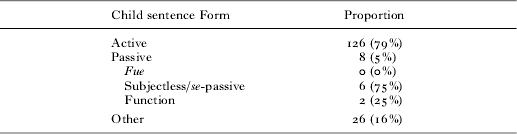
The proportion of active, passive and other sentences were calculated for children's descriptions of the drawings. Please refer to Table 1 for a summary of results. The total number of active, passive and other sentences was divided over the total number of sentences (160) that children produced.
Active responses
Similar to English-speaking children (i.e. Huttenlocher et al., Reference Huttenlocher, Vasilyeva and Shimpi2004), Spanish-speaking children tended to use active sentences more frequently than passives or any other type of sentence. A paired-samples t-test was performed on the proportion of active and passive sentences, relative to the total number of responses, and showed that children produced significantly more active responses (M=0·78, SD=13·1) than passive responses (M=0·05, SD=0·08; t (15)=10·776, p<0·001).
Passive responses
In terms of their use of passive sentences, children produced both subjectless/se-passives and function-passives, with a higher number of subjectless/se-passives. Recall that subjectless/se-passives included utterances that fit the subjectless-passive, se-passive and ambiguous subjectless/se-passive criteria. Children did not produce any utterances containing the middle-voice, and they never used fue-passives, the form that is equivalent to the English passive form. Given that children never used the fue-passsive in describing transitive relations, we sought to determine whether children could be primed to use this infrequent form (Jisa et al., Reference Jisa, Reilly, Verhoeven, Baruch and Rosado2002) in our priming study in Experiment 2.
EXPERIMENT 2: PRIMING STUDY
In Experiment 2, our specific aim was to determine whether or not there would be an increase in children's use of the active and fue-passive forms in Spanish with exposure to these forms. Specifically, we exposed four- and five-year-old Spanish monolingual children to a priming condition in which they heard either Spanish active or Spanish fue-passive sentences.
METHOD
Participants
Thirty-two monolingual Spanish speakers (girls=16; boys=16; independent of Experiment 1) served as participants in this study. They ranged in age from 4 ; 3 to 5 ; 5 (M=4·8; SD=0·33) and were Mexican citizens recruited from the same Spanish-speaking monolingual school as in Experiment 1.
MATERIALS
Priming
The same ten drawings from Experiment 1 were used in Experiment 2 and are referred to as target drawings. A set of ten different drawings were used as priming drawings and were paired with priming sentences. The priming sentences that correspond to each drawing are the same sentences found in the Huttenlocher et al. (Reference Huttenlocher, Vasilyeva and Shimpi2004) study, and were translated to Spanish by a fluent Mexican-Spanish speaker and verified by a Spanish-fluent linguist. All sentences used preverbal subject fue-passives and the majority of our sentences (70%) used agreement cues between the verb and noun by gender. Please refer to the Appendix for a list of priming sentences.
Language assessment
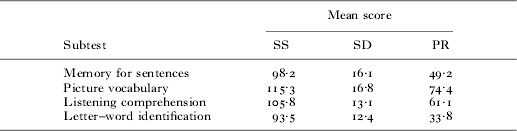
Children's oral language skills in Spanish were assessed using the Spanish version of the Woodcock Language Proficiency Battery-Revised (WLPB-R; Woodcock & Muñoz-Sandoval, Reference Woodcock and Muñoz-Sandoval1995). The following subtests were administered: Memory for Sentences, Picture Vocabulary, Listening Comprehension and Letter-Word Identification. For a complete description of each subtest, please refer to the WLPB-R (Woodcock & Muñoz-Sandoval, Reference Woodcock and Muñoz-Sandoval1995). We found that all participants had ‘average proficiency’ in Spanish (Woodcock, Reference Woodcock1991). Therefore, we feel it is acceptable to compare our priming results to previous priming studies that have tested English monolinguals in our age range (four to five years) as it is assumed that they also represent the ‘average’ English speaker within that range. Please refer to Table 2 for student's Spanish-language proficiency scores.
Language proficiency results: Woodcock Language Proficiency Battery-Revised mean scores

Procedure
Testing was conducted in Spanish by two fluent speakers of Mexican Spanish. Each child was tested individually for approximately 45 minutes. Testing was divided into two sessions: priming and language assessments. The priming session consisted of 5 minutes with a single experimenter. The experimenter began the test by telling the child that they were going to play a game in which s/he was to listen to the experimenter describe a set of drawings. When the experimenter finished, s/he would describe a set of different drawings. The experimenter then described a block of ten priming drawings using either active or passive sentences, but never both. Children were randomly assigned to receive either active or passive primes. Immediately following the experimenter's set of drawings, the child proceeded to describe a block of ten different target drawings.
An example of a drawing is a scene that depicts a ball and a broken window. In the active priming condition, this scene was described using an active sentence, La pelota quebró la ventana (‘The ball broke the window’). In the passive priming condition, the scene was described using a fue-passive sentence, La ventana fue quebrada por la pelota (‘The window was broken by the ball’). Note that the fue-passive form used to prime participants in this study is equivalent to the canonical passive form in English and the form used in the preverbal subject position condition in Pierce (Reference Pierce1992). It was our intention to prime children to use the fue-passive form; however, as we discuss later, children used alternative passive forms more frequently (subjectless/se-passive and function-passive).
Following the priming session, all children were individually tested on the Spanish version of the WLPB-R (Woodcock & Muñoz-Sandoval, Reference Woodcock and Muñoz-Sandoval1995) for approximately 40 minutes.
RESULTS
Priming Scores
The criteria used to score responses as active, passive or other was the same as in Experiment 1. Note that the passive category includes the fue-passive, subjectless/se-passive and the function-passive, but not the middle-voice construction.
Reliability between two coder pairs was tested by calculating the proportion of agreement and Cohen's kappa. Reliability checks were conducted on seventy lines from randomly selected participants, for approximately 20% of the experimental data. Agreement was very good, with proportion of agreement of 0·97 and a Cohen's kappa of 0·86. The coded responses on which coders differed were reviewed, discussed and, in agreement, a final code was assigned.
Data summary
Our analyses included a total of 320 responses, 160 responses from each condition (160=passive; 160=active). Each child contributed only 10 responses that corresponded to ten drawings.
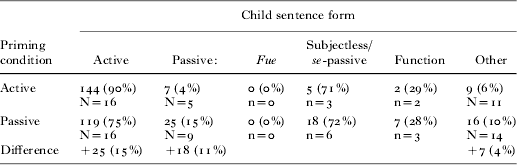
A priming effect can be seen by comparing children's use of a particular form following the experimenter's use of that form, and children's use of that form following the experimenter's use of the alternate form (Huttenlocher et al., Reference Huttenlocher, Vasilyeva and Shimpi2004). Thus, the proportion of active and passive sentences a child produced was calculated relative to the total number of sentences a child produced in each priming condition. Table 3 shows the difference between active and passive sentences for each priming condition. Specifically, children were 15% more likely to produce an active sentence when primed with active sentences than when primed with passive sentences. Furthermore, children were 11% more likely to produce a passive form when primed with passive sentences than when primed with active sentences.
Priming results: Total number and proportion of child sentence productions

Table 3 also shows the proportion of active, passive and other responses during the active and passive priming conditions, specifically indicating what proportion of sentences were fue-passive, subjectless/se-passive and function-passives. Following active primes, the proportion of active responses included 95% full actives and 5% truncated actives (i.e. the subject has been omitted). The responses in the active condition that were not actives or passives were scored as other and included 67% full intransitive sentences, 11% fragments and 22% failures to respond.
Following passive primes, the proportion of active responses included 87% full actives and 13% truncated actives. The responses in the passive condition that were not actives or passives were scored as other and included 63% full intransitive sentences, 31% fragments and 6% failures to respond.
The data show that children produced active sentences to describe the drawings more often than they used passive sentences, regardless of priming condition. However, the proportion of active responses was lower for the passive priming condition than the active priming condition, and the proportion of passive productions was higher for the passive priming condition than the active priming condition. Also, the proportion of sentences scored as other was greater for the passive priming condition than the active priming condition. In fact, the proportion of other sentences was almost twice as high in the passive condition then in the active condition.
The proportion of passive and active responses was transformed using the angular transformation, 2 arcsin √(Yijk). Thus, when proportions are mentioned, the angular transformation of proportions should be assumed.
Active responses
A one-way ANOVA with Condition as the independent variable (Passive; Active) was performed on the proportion of active responses children produced, relative to the total number of responses in each condition. The analysis revealed a significant difference between active responses given during active and passive priming conditions (F(1, 31)=11·461, p=0·002). A comparison of group means for condition shows that children produced proportionally more active sentences during the active priming condition (M=0·90; SD=0·10) than during the passive priming condition (M=0·74; SD=0·15).
Passive responses
A one-way ANOVA with Condition as the independent variable (Passive; Active) was performed on the proportion of passive responses children produced, relative to the total number of responses in each condition. The analysis revealed a significant difference between passive responses given during active and passive priming conditions (F(1, 31)=8·832, p=0·006). A comparison of group means for condition shows that children produced proportionally more passive sentences during the passive priming condition (M=0·16; SD=0·14) than during the active priming condition (M=0·04; SD=0·05).
CONCLUSION
The purpose of the present study was to determine both the degree to which Spanish-speaking children naturally use a variety of transitive forms and how they respond to priming input containing these forms. Specifically, we were interested in whether or not Spanish-speaking children would show similar priming effects that monolingual English-speaking children of the same age have shown in previous priming studies (see Huttenlocher et al., Reference Huttenlocher, Vasilyeva and Shimpi2004), in that exposure to active and passive forms would increase their use of active forms and passive forms, respectively. More importantly, we aimed to learn how Spanish-speaking children would respond to the priming of the fue-passive form given its relative rarity and the existence of alternate passive forms in Spanish (Berman & Slobin, Reference Berman and Slobin1994; Jisa et al., Reference Jisa, Reilly, Verhoeven, Baruch and Rosado2002; Tolchinsky & Rosado, Reference Tolchinsky and Rosado2005).
The priming paradigm used in the present study has been used in previous studies to assess the nature of children's syntactic representation and our results mirror previous results involving monolingual English-speaking children's use of active forms (Brooks & Tomasello, Reference Brooks and Tomasello1999; Tomasello, Reference Tomasello2000; Savage et al., Reference Savage, Lieven, Theakston and Tomasello2003; Huttenlocher et al., Reference Huttenlocher, Vasilyeva and Shimpi2004; Shimpi et al., Reference Shimpi, Gámez, Huttenlocher and Vasilyeva2007). That is, after hearing a modeled active sentence, monolingual Spanish-speaking children's use of active forms increased past their baseline usage. Furthermore, Spanish-speaking children's overall use of passives increased after hearing a particular passive form, the fue-passive, which highlights the patient and demotes the agent as all passive forms do. These results indicate that the priming technique used in the present study might be an effective way to assess children's competence in their use of a variety of different passive structures in Spanish and that spontaneous speech data alone might not be as useful for particular uses of passives.
First, in our baseline study (Experiment 1), we obtained a sample of children's spontaneous speech to drawings depicting transitive scenes. This baseline data showed that children more often used active sentences to describe transitive relations than passive sentences, similar to English-speaking children in other priming studies (e.g. Huttenlocher et al., Reference Huttenlocher, Vasilyeva and Shimpi2004). In terms of their passive use, children never spontaneously used the fue-passive form. Instead, in the few instances in which they used a passive, they used alternate passive forms (i.e. subjectless/se-passive and function-passive forms). These results mirror the results found by other studies showing that adult Spanish speakers rarely use the fue-passive form and rely instead on competing passive forms (Jisa et al., Reference Jisa, Reilly, Verhoeven, Baruch and Rosado2002; Tolchinsky & Rosado, Reference Tolchinsky and Rosado2005).
Most importantly, in our baseline data, we found what we term function-passives, which are utterances that contain a by-phrase, an important element of the fue-passive form. We took children's spontaneous use of the by-phrase to indicate a rudimentary knowledge of fue-passives, and therefore wanted to learn whether we could improve children's use of the fue-passive by modeling the form for them in our priming experiment. The presence of the by-phrase was surprising given that the fue-passive in its grammatical form infrequently occurs in speech. Tolchinsky & Rosado's (Reference Tolchinsky and Rosado2005) evidence that fue-passives can occur in both written and the spoken modality suggests that children do have opportunities for exposure to fue-passives, and thus fue-passives may exist as developing representations of passive relations. We argue that priming may be an effective way to gain access to this developing representation of the passive.
Given the non-existence of fue-passives in our baseline data in Experiment 1, we conducted a priming study in Experiment 2 to determine whether exposure to fue-passives would prime children to use this form or whether they would continue to produce alternate, competing passive forms. We were equally interested in whether children would increase their production of active sentences past their baseline usage with exposure to this form, thereby obtaining syntactic priming effects. We employed a modified version of the syntactic priming paradigm used in the Huttenlocher et al. (Reference Huttenlocher, Vasilyeva and Shimpi2004) study, which is similar to the priming technique used with adults (Bock, Reference Bock1986, Reference Bock1990; Bock & Loebell, Reference Bock and Loebell1990; Bock et al., Reference Bock, Loebell and Morey1992). In our study, an experimenter described a set of priming drawings to four- and five-year-old Spanish monolingual children, using either form of the transitive structure (active/fue-passive) in Spanish. After having been exposed to the priming drawings and hearing an experimenter's descriptions of each drawing, children were asked to describe a different set of target drawings.
Our analyses of children's responses to the set of target drawings revealed a priming effect, such that there was a significant difference between children's use of a particular form following an experimenter's use of that form. First, we found a difference in the proportion of active responses following active primes and the proportion of active responses following passive primes. That is, children produced more active responses following active primes than following passive primes. This finding is not surprising given children's frequent use of the active form even without priming. As our baseline data show, children are more likely to describe transitive relations in their spontaneous speech using active sentences than any other form.
Second, we found a difference in the proportion of passive responses following active primes and the proportion of passive responses following passive primes, such that children produced more passive responses following passive primes than following active primes. The passive form that children used, however, was not identical to the passive form offered during priming. That is, children were primed with the fue-passive form, which most closely resembles the English passive form, but instead of responding with this fue-passive form, children used alternate passive forms, mainly the subjectless/se-passive and the function-passive.
The frequency with which the subjectless/se-passive and the function-passive forms appeared in children's baseline data resembles their use of these forms following active primes. It is not until children are primed with the fue-passive form that children's use of the subjectless/se-passive and the function-passive forms increase past their baseline usage. We argue that the increase in these alternate forms reveals a priming effect that would otherwise not have been disclosed if only the primed form was investigated. As mentioned before, the use of these alternate forms allows the speaker to highlight the patient of the scene, while ignoring or downplaying the agent performing the action (Castro, Reference Castro1999; Jisa et al., Reference Jisa, Reilly, Verhoeven, Baruch and Rosado2002), similar to what fue-passive sentences achieve.
It seems as though children produced what we term the subjectless/se-passive to describe transitive relations because that particular method of focusing on the patient may be more readily available to them and because they may have more familiarity with it. Indeed, the se-passive form is more frequent in adult speech than the fue-passive (Jisa et al., Reference Jisa, Reilly, Verhoeven, Baruch and Rosado2002), and thus may be more frequent in children's input. It could also be the case that children had not yet mastered the fue-passive form, another case of comprehension preceding production, as is recurrent in language acquisition literature (e.g. Clark & Hecht, Reference Clark and Hecht1983). While the children in our study were not able to use the fue-passive in its full form, they seemed to understand it, given the significant increase in their use of alternate passive forms.
Although they were used less frequently than subjectless/se-passives, we believe that children's use of function-passives most clearly indicates attempts at producing fue-passives. This form includes sentences that contain elements of the fue-passive form used during priming, specifically the by-phrase. It also included the clitic se similar to se-passives and impersonal subjectless forms. Children's use of the function-passive after having heard the modeled fue-passive underscores our paradigm's ability to prime parts of the syntactic structure, if not the whole. That is, the priming technique we used in the present study was successful in priming the by-phrase of the fue-passive, an important syntactic element.
Despite not having used the exact syntactic structure provided for them during priming, children did preserve the perspective of transitive relations used by the experimenter and reproduced that perspective in related ways. In other words, by exposing children to the fue-passive form, we primed them to interpret scenes such that they focused on the experimenter's mapping of scene participants to syntactic structure. Specifically, while using alternate passive forms than those used during priming, children still focused on the patients of the actions depicted in the scenes, as fue-passives allow speakers to do. As a result, we do not argue that we were able to fully syntactically prime our participants to use the passive form, as has been claimed by previous research, specifically with English monolinguals (in children by Brooks & Tomasello, Reference Brooks and Tomasello1999; Tomasello, Reference Tomasello2000; Savage et al., Reference Savage, Lieven, Theakston and Tomasello2003; Huttenlocher et al., Reference Huttenlocher, Vasilyeva and Shimpi2004; and in adults by Bock, Reference Bock1986). Instead, we argue that our participants were sensitive to experimenter's input as it relates to scene interpretation as well as to syntax.
It should be noted that this finding is difficult to come across in English, as there is not the same degree of flexibility of passive forms. The presence of multiple passive forms in Spanish allows us to examine the relationship between multiple mappings of syntactic form and scene-participants: when children are not yet producing one passive form, they can readily use another form that preserves the mapping of the scene. This priming of mapping may also have consequences for English. Vasilyeva et al. (Reference Vasilyeva, Huttenlocher and Waterfall2006) report finding intransitive sentences of the type The window broke and several mixed active/passive forms (e.g. He stinged himself by a bee). While these sentences are not true passives in English, they do highlight the patient. Like the Spanish-speaking children, English-speaking children who have not yet acquired the passive may use these forms to preserve the emphasis on the patient.
Using our current methodology, we provide insight into the abilities that four- and five-year-old Spanish-speaking children have in conveying transitive relations in comparison to English-speaking children. Specifically, we found that the active form is similarly primed in English and Spanish. However, we found that whereas the English passive form appears to be fully syntactically primed in English, we did not find evidence that children at this age preserved the complete syntax of the fue-passive form. Instead, we found that children were sensitive to the perspective of the scene offered by the experimenter's input and used alternate and related syntactic structures. These results provide further evidence that a syntactic priming paradigm is a useful methodology for understanding young children's syntactic competence.
It is important to underscore the conditions under which we found our priming effects. Instead of making tasks simpler for our young participants by modeling a more frequently heard Spanish passive, including a repetition condition, and using similar verbs across prime and target pictures, we chose a more difficult design in which we modeled the most infrequently heard Spanish passive form, did not require our participants to repeat modeled sentences, and used different lexical items across trials, and yet we were able to elicit priming effects. Future studies should attempt to tweak the priming technique used here to further describe children's priming threshold by manipulating the contexts in which priming may fully elicit still-developing syntactic forms. For example, an interesting manipulation of the present design would be to test whether priming would occur for the alternate Spanish passive forms. The increase of subjectless- and se-passives we observed from modeling the fue-passive form suggests that modeling these forms would indeed result in priming.
Our recent work suggests that repetition may also be a useful modification of the technique we used in priming. Following original priming studies, Shimpi et al. (Reference Shimpi, Gámez, Huttenlocher and Vasilyeva2007) used a repetition condition in which they required children to repeat the modeled syntactic form and were successful in priming children as young as two years of age to use passive sentences grammatically, whereas in the no-repetition condition, two-year-olds were not significantly primed to use the modeled form. Therefore, it may be the case that our Spanish-speaking participants may well have used the full fue-form if we had required them to repeat it. To test this hypothesis, we are currently investigating the use of passives by Spanish-speaking children who are learning English as a second language to determine whether similar priming effects can be elicited.
APPENDIX: LIST OF PRIMING SENTENCES
Transitivo (Pasivo/Activo)
1. La ciudad fue inundada por el río./El río inundó la ciudad.
2. La ventana fue quebrada por la pelota./La pelota quebró la ventana.
3. La casa fue golpeada por la camioneta./La camioneta golpeó la casa.
4. La escuela fue destruida por el tornado./El tornado destruyó la escuela.
5. El carro fue enterrado por la nieve./La nieve enterró el carro.
6. El barco fue sacudido por las olas./Las olas sacudieron el barco.
7. El carro fue cubierto por la colcha./La colcha cubrió el carro.
8. El árbol fue comido por el castor./El castor comió el árbol.
9. La tierra fue descargada por el camión./El camión descargó la tierra.
10. La flor fue regada por la lluvia./La lluvia regó la flor.
English translation:Transitive (Passive/Active)
1. The town was flooded by the river./The river flooded the town.
2. The window was broken by the ball./The ball broke the window.
3. The house was hit by the truck./The truck hit the house.
4. The school was struck by the tornado./The tornado struck the school.
5. The car was buried by the snow./The snow buried the car.
6. The boat was rocked by the waves./The waves rocked the boat.
7. The car was covered by the blanket./The blanket covered the car.
8. The tree was eaten by the beaver./The beaver ate the tree.
9. The dirt was dumped by the truck./The truck dumped the dirt.
10. The flower was watered by the rain./The rain watered the flower.