I. INTRODUCTION
The nuclear power with high efficiency, environment friendly, and economic benefits gradually attracts much more attention and produces urgent necessities all over the world.Reference Staniša, Schauperl and Grilec1–Reference Tan, Zhang, Zhang and Zhuang3 Nuclear power rotor as the key component to run the nuclear power plant requires materials with high toughness without losing strength. NiCrMoV steel is thus proved to be a candidate material to meet the design requirements of the nuclear rotor materials.Reference Liu, Lu, Liu, Ji and Gao4,Reference Zhu, Wang and Xuan5 However, being limited by the large size and heavy section of nuclear rotor, it is difficult to manufacture high quality and uniform rotor by forging directly. On the contrary, the practical production to manufacture the combined rotor via appropriate joining method is considered to be an effective approach to meet the necessity.
Generally, some common fusion welding methods,Reference Farabi, Chen and Zhou6–Reference Arivazhagan, Singh, Prakash and Reddy10 advanced friction stir welding techniques,Reference Saeid, Abdollah-zadeh, Assadi and Malek Ghaini11–Reference Jeon, Mironov, Sato, Kokawa, Park and Hirano14 and other particular welding methodsReference Hokamoto, Nakata, Mori, Tsuda, Tsumura and Inoue15 can be used to join steels with large thickness at appropriate filler metals (FMs)Reference Das, Bhaduri, Srinivasan, Shankar and Mathew16 and welding parameters.Reference Torkamany, Tahamtan and Sabbaghzadeh17–Reference Mishra, Lienert, Johnson and DebRoy19 In particular, the characterization and analysis of the microstructure of welded joint (WJ) attracted extensive attention. Beidokhti et al.Reference Beidokhti, Kokabi and Dolati20 carried out the submerged arc welding method with single pass to weld the API 5L-X70 steel plates with 19.8 mm thickness and found that the titanium in the flux could avoid the formation of harmful manganese sulfide and refine the grains. Arivazhagan et al.Reference Arivazhagan, Sundaresan and Kamaraj21 studied modified 9% Cr steel plate manufactured by flux-cored arc welding with various shielding gas compositions and discovered that 95% argon and 5% CO2 could improve the toughness of the WJ. Villaret et al.Reference Villaret, Deschaux-Beaume, Bordreuil, Fras, Chovet, Petit and Faivre22,Reference Villaret, Deschaux-Beaume, Bordreuil, Rouquette and Chovet23 characterized a modified AISI 444 ferritic stainless steel welded by gas metal arc welding and indicated that the fatigue strength was highly enhanced. Among all the welding methods, ultra-narrow gap submerged arc welding (UNG-SAW) using multilayer and multipass techniquesReference Mark, Francis, Dai, Turski, Hurrell, Bate, Kornmeier and Withers24 could be chosen to fabricate a large scale rotor attributing to its advantages such as small weld deformation, less filler wire consumption, and high efficiency.Reference Ramakrishnan and Muthupandi25–Reference McPherson, Baker, Li and Hoffmann28
Besides, as for the WJ operated at different temperatures and stresses, various mechanical properties such as tensile strength, impact toughness, and fatigue properties are necessary to be taken into account to qualify the performance.Reference Vannod, Bornert, Bidaux, Bataillard, Karimi, Drezet, Rappaz and Hessler-Wyser29–Reference Shekhter, Kim, Carr, Croker and Ringer32 When the WJ runs at higher temperature, tensile strength and fatigue properties must be guaranteed in the service condition, and when the WJ works at lower temperature, impact toughness must be concerned. Zhu and XuanReference Zhu and Xuan33 investigated the tensile and impact toughness of 23CrMoNiWV88 and 26NiCrMoV145 dissimilar welded rotor and found that the strength decreased with increasing temperature, and also the multilayer welding process could improve the impact toughness of the WJ. Our previous studyReference Wu, Lu, Cui, Liu, Wang and Tang34,Reference Wu, Lu, Cui, Ding, liu and Gao35 reported the fatigue property of the WJ in turbine rotor, and the inclusion size was more significant at higher temperature. Among all the mechanical properties, tensile and impact toughness of engineering materials are of great importance to ensure security design for their structural applications.Reference Qi, Luo, Zheng, Chen, Lv and Xiong36 Hence, appropriate investigation on tensile and impact toughness should be performed to evaluate the performance of the WJ at various temperatures.
To qualify the reliability and feasibility of the WJ, the microstructure and mechanical properties at a wide temperature range of NiCrMoV WJs are investigated systematically in the present study. First, the UNG-SAW method is carried out to weld the NiCrMoV steels based on appropriate FM and welding parameters. Subsequently, post weld heat treatment (PWHT) will be applied to stabilize the microstructure and release the stress. The tensile and impact toughness tests were carried out at different temperatures to evaluate the strength and toughness of the whole WJ. The microstructure and fractography of the samples after the test were observed by optical microscopy (OM) and scanning electron microscopy (SEM). The relationship between mechanical properties and microstructure will be discussed in detail to provide helpful reference to design and produce qualified welded rotor with heavy section.
II. EXPERIMENT
A. Experimental materials
The base metal (BM) materials used in this study was NiCrMoV steels with large thickness used in making rotor for nuclear rotor. The chemical composition of BM and FM is listed in Table I. In view of the extremely large size of the rotor to be welded, 1500 mm in diameter, UNG-SAW process was performed with appropriately selected welding parameters. Multilayer and two-pass techniques were used to fill the ultra-narrow gap, the welding current, voltage, and welding speed for each pass were around 500 A, 30 V, and 0.6 m/min, respectively. The obtained width of the weld seam was about 20 mm. The WJ was then experienced a PWHT at 590 °C holding 30 h and then cooled down in the furnace to release the stress and get stable microstructure.
Chemical composition of BM and FM (wt%).

B. Tensile and impact tests
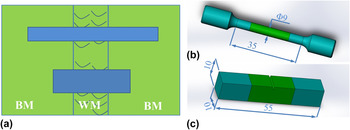
Tensile specimens are prepared with a gage length of 35 mm and a diameter of 5 mm (shown in Fig. 1). Standard specimens adopted in the tensile experiments are tested using the Zwick testing machine at the constant rate 1 × 10⁻³ s−1, and the test was carried out at both room and elevated temperatures according to ASTM E8/E8M-13a standard. At each temperature, the tensile specimens of the WJ and BM are comparatively tested. Charpy V-notch impact specimens are machined with a dimension of 55 mm × 10 mm × 10 mm according to ASTM E23-12c standard. The V type notch perpendicular to weld surface locates in the middle of the welded metal (WM).
Schematic of the specimens prepared for tensile and impact test from the NiCrMoV WJ: (a) different locations in the cross section of the WJ and the specimen location, (b) shape and size of the tensile specimen, and (c) shape and size of the impact specimen.

C. Microstructural characterization
Before the test, the specimens are taken from the WJ and prepared for the microstructural characterization in the cross section of the WJ. The surface of the specimens for optical observation is mechanically polished and then chemically etched with 4% Nital and Picric acid solution. Microhardness is measured by a hardness tester (Zwick/Roell) with a constant load of 9.8 N for 10 s. Optical microscope (OM, Zeiss Image A2 m, Germany) and scanning electron microscope (SEM, JSM 7600F, Japan) are also used to observe the microstructure and fracture morphology of the WJ.
III. RESULTS AND DISCUSSION
A. Microstructural analysis
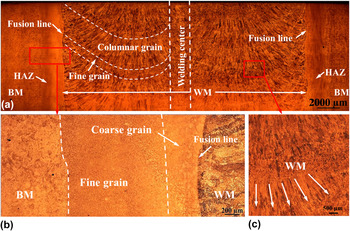
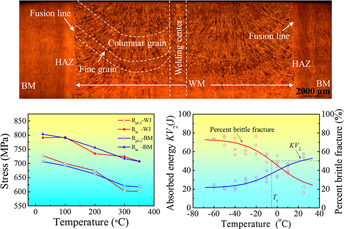
The macrostructure of the whole WJ with multilayer and two pass is shown in Fig. 2. Figure 2(a) clearly displays the detailed macrostructure characteristics of the WJ including BM, WM, and heat-affected zone (HAZ). The WM, comprised of two passes and multilayer structure, is around 20 mm in width. In addition, there exists a welding center zone formed by welding thermal cycle due to the two passes in the center of WM. The detailed microstructure of HAZ and WM is presented in Figs. 2(b) and 2(c). Figure 2(b) displays the overall microstructure of the HAZ, which is significant for the reliability of the whole WJ due to its complex microstructure resulted from thermal cycle in the welding process.Reference Wu, Lu, Cui, Liu, Wang and Tang34 It is revealed that the HAZ, over 2 mm in width, consisted of coarse grains to fine grains and transformed in the direction from the fusion line to BM. In Fig. 2(c), coarse columnar and fine grain zones in WM distributed alternatively due to multilayer welding process. The inhomogeneous microstructure of the NiCrMoV WJ could cause complex properties in different zones of WJ.Reference Farabi, Chen, Li, Zhou and Dong37 Therefore, it is essential to characterize the microstructure of the WM and HAZ in WJ.
Structure of the NiCrMoV WJ: (a) the overall macrostructure of the whole weld joint, (b) HAZ consisted of coarse to fine grains in the direction from the fusion line to BM, and (c) microstructure of the columnar and fine grain zones of WM.

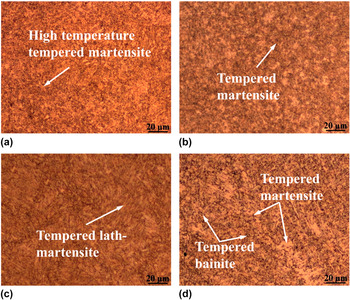
Figure 3 illustrates the OM images with typical microstructure of the BM, fine grain heat-affected zone (FG-HAZ), coarse grain heat-affected zone (CG-HAZ), and WM of NiCrMoV steels WJ. In Fig. 3(a), the main microstructure of BM is high-temperature tempered martensite (arrowed), which is beneficial to improve the strength and also toughness. Figure 3(b) presents the microstructure of the FG-HAZ, tempered martensite (arrowed) with fine grains, formed because of the quenching process in welding and PWHT, and that contributes to the mechanical properties for the high toughness and strength. Adjacent to the fine grain zone, CG-HAZ displays coarser structure of tempered lath-martensite [as arrowed in Fig. 3(c)], which can obviously improve the strength and hardness. It is deemed that the tempered lath-martensite is resulted from the overheating and quenching process under the effect of the thermal cycle in the welding process.Reference Liu, Lu, Liu, Ji and Gao4 The typical microstructure of the WM is shown in Fig. 3(d). It is observed that the microstructure is comprised of tempered martensite and granular bainite duplex microstructure (arrowed). As is reported, the martensite/bainite structure in this kind of steel is beneficial to the comprehensive properties of toughness and strength performance.Reference Zhu, Wang and Xuan5
The OM images with typical microstructure of the NiCrMoV WJ: (a) BM consisted of high-temperature tempered martensite, (b) FG-HAZ contained fine tempered martensite, (c) CG-HAZ was tempered lath-martensite structure, and (d) WM comprised of tempered martensite and granular bainite duplex microstructure.

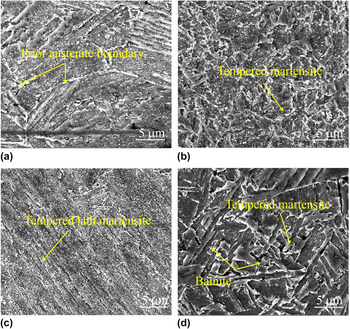
Figure 4 displays the corresponding SEM images with typical microstructure of the BM, FG-HAZ, CG-HAZ, and WM of NiCrMoV steels WJ. As is shown in Fig. 4(a), tempered martensite, together with a large number of carbides, is observed in the BM. The carbides are distributed uniformly on the matrix and along prior austenite grain boundaries, which contribute to the strength of the matrix. Figures 4(b) and 4(c) present the microstructure details of the FG-HAZ and CG-HAZ, respectively. The tempered martensite in the FG-HAZ is finer than that in the CG-HAZ and BM. Meanwhile, a large amount of carbides are observed too, which indicates that the comprehensive properties of FG-HAZ is better than other locations of WJ. In the case of the WM, as indicated in Fig. 4(d), the microstructure is mainly determined as tempered martensite and tempered bainite. The amount of carbides decreased dramatically compared with other locations due to the lower carbon content in the FM.Reference Zhu, Wang and Xuan5 The inhomogeneous microstructure of the NiCrMoV steels WJ could significantly affect the microhardness and other related mechanical properties, especially in the condition of various service temperatures.
The SEM images with typical microstructure of the NiCrMoV WJ: (a) BM, (b) FG-HAZ, (c) CG-HAZ, and (d) WM.

B. Microhardness test
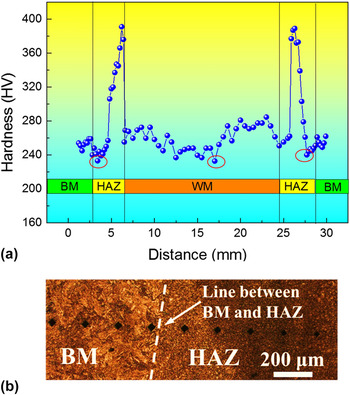
Vickers microhardness profiles over the cross section of the UNG-SAW WJ is presented in Fig. 5(a), and the corresponding test location near BM is shown in Fig. 5(b), where the line is the boundary between BM and HAZ. As is shown in Fig. 5(a), the original microhardness of the NiCrMoV BM is about 260 HV because of the high-temperature tempered martensite. When it comes to the HAZ, a soft zone (indicated by the ellipses), where hardness drops dramatically, occurs due to overtempering in welding process causing large amounts of precipitates.Reference Xu, Westerbaan, Nayak, Chen, Goodwin, Biro and Zhou38 Similar result is reported in our previous study.Reference Liu, Lu, Liu, Ji and Gao4,Reference Wu, Lu, Cui, Liu, Wang and Tang34 However, a significant highest value of hardness is observed in the coarse grain zone of HAZ due to the formation of coarse martensite structure. The microhardness of the HAZ can be demonstrated by the size of the indentation (larger indentation means lower microhardness) shown in Fig. 5(b). In the WM, the microhardness is approximately 260 HV, except an obvious decrease in the weld center with the microhardness only 230 HV. The weld center is the cross part of two welding passes during NG-SAW, becoming a soft zone in the WM by multiheating in welding.
Microhardness profile across the NiCrMoV WJ: The image (a) shows the hardness distribution across WJ, and the image (b) shows the corresponding locations of the microhardness measurement (the line is the boundary of BM and HAZ).

C. Tensile performance
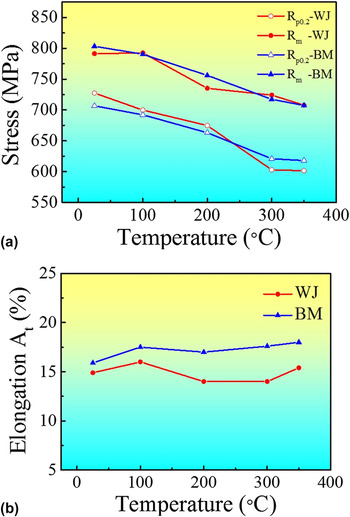
Figure 6 shows the tensile strength and elongation at 25, 100, 200, 300, and 350 °C for both BM and WJ tested at a strain rate of 1 × 10⁻³ s−1. The yield strength (R p0.2) and ultimate tensile strength (R m) are further obtained and presented in Fig. 6(a). Increasing the temperature, the yield strength and ultimate tensile strength of BM and WJ decrease gradually, while the percentage of total elongation at fracture (A t) fluctuates [Fig. 6(b)]. It is clearly seen that the ultimate tensile strength and yield strength of the BM and the WJ are approximately equivalent, which can also be explained by hardness test result. However, the percentage of total elongation at fracture of the BM is larger than that of WJ, which is contributed to the more uniform deformation of BM compared with WJ.
The tensile results obtained at 25, 100, 200, 300, and 350 °C for BM and WJ: The image (a) shows the corresponding yield strength and ultimate tensile strength, and the image (b) presents the percentage of total elongation at fracture.

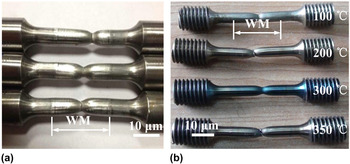
The WJs were etched by 4% HNO3 + CH3CH2OH to observe the fracture location. Regarding the failure location displayed in Fig. 7, all the tensile samples of the WJs failed by the localized necking at the weld center. Careful observations during tensile tests showed that the yielding started from the weld center and the subsequent plastic deformation accumulated in this zone until final failure. Zhu and XuanReference Zhu and Xuan33 reported that fracture located in WM when the temperature is below 200 °C, while when the temperature is higher than 300 °C, the fracture location in tension is transferred to BM. However, no obvious transition is observed for the fracture location in the present experiments. The competition of these soften zones by hardness test determines the fracture location of WJ.
Tensile test failure location determination of the WJs tested at (a) 25 °C and (b) 100 °C, 200 °C, 300 °C, and 350 °C.

D. Impact toughness and fracture morphology
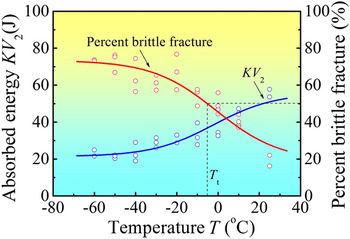
The impact toughness of WM, HAZ, and BM was tested in light of the ASTM E23-12c standard procedure. The absorbed energy of WM, CG-HAZ, and BM at room temperature is 55.7, 41.0, and 166.9 J, respectively, which all meet the requirements of the service condition. And also, the toughness of WM at various temperatures was investigated due to the nonuniform casting structure caused by welding process, shown in Fig. 8. With decreasing temperature, it can be expected that the absorbed energy of the WM will continue to decrease, indicating that the impact toughness becomes worse. As reported by Zhu and Xuan,Reference Zhu and Xuan33 the microstructure in the WM is likely to form separated areas of cleavage fracture surface for impact test specimens, which can improve impact behavior by reducing the fracture appearance transition temperature (T t). Figure 8 illustrates the absorbed energy and brittle fracture percentage to temperature curve, there is no distinction between the upper-shelf zone, transition zone, and the lower-shelf zone in this experimental test. The transition temperature (T t) is defined by a particular portion of 50% of the brittle fracture occurring in this case, 5 °C is determined according to this curve.
Absorbed energy and percentage of brittle fracture appearance at various temperatures from −60 to 25 °C.

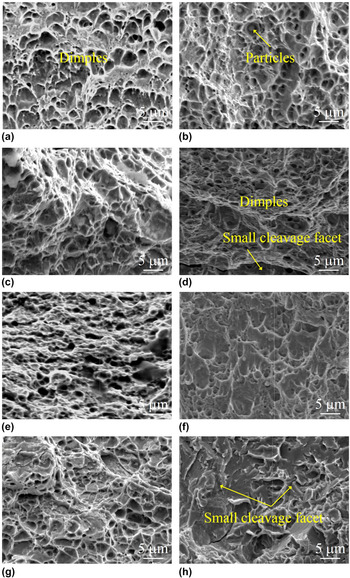
Figure 9 displays the impact fracture morphologies at various temperatures. As the temperature decreased from 10 to −60 °C, the dimple number decreased and the dimples size became shallower, especially at −60 °C there is no dimple existing and totally cleavage fracture remains. Figure 9(a) shows the fracture surface at 10 °C, exhibited nearly 100% ductile fractured morphology with dimples, which indicated that the specimens possess good ductility. In Figs. 9(b) and 9(c), some particles in the dimples were observed. It was deemed that the impact toughness has been found to be reversely correlated with the square root of average dimple size, and the particle size was the controlling factor to affect the dimple size.Reference Fattahi, Nabhani, Vaezi and Rahimi39 Therefore, the large dimple size and refined particles would improve the impact toughness. When tested from −20 to −50 °C, the fracture surfaces of the impact specimens indicated a mixture of brittle and ductile fracture. A zone of cleavage fracture was usually found in the fracture surface. Figure 9(h) shows the cleavage fracture tested at −60 °C. It is proposed that the cleavage fracture can be dominated by the fracture facet size, since the fracture facet size dominates the critical condition for the propagation of microcracks.Reference Hu, Du, Wang, Xie, Gao and Misra40,Reference Hu, Du, Wang and Gao41 The small cleavage facet size, enhanced the impact toughness significantly, is predominately attributed to the formation of the tempered martensite and bainite in WM. It can be reasonably concluded that the impact toughness of WM had been improved by UNG-SAW using multilayer and two-pass techniques at appropriate parameters, whereas the toughness still needed to be enhanced compared to the BM.
SEM images of impact fracture morphologies at various temperatures: (a) 10 °C, (b) 0 °C, (c) −10 °C, (d) −20 °C, (e) −30 °C, (f) −40 °C, (g) −50 °C, and (h) −60 °C.

IV. CONCLUSIONS
In this work, NiCrMoV welded rotor was successfully fabricated by UNG-SAW using multilayer and two-pass techniques. Based on the present study of the microstructure, microhardness profile, tensile and impact behaviors of WJ, the following conclusions can be drawn:
(1) The extremely large-size rotor with heavy section, 1500 mm in diameter and 20 mm in width of the WM was successfully manufactured by UNG-SAW. The WJ contains FG-HAZ, CG-HAZ, and WM, with microstructure of tempered martensite, tempered bainite, and an amount of carbides. This microstructure contributes to the improved comprehensive mechanical properties of WJ.
(2) The microhardness test indicated that peak hardness occurred in CG-HAZ due to the microstructure of coarse lath-martensite. The intersection of two weld passes is responsible for the soften zone in the weld center, and overtempering microstructure leads to the other soften zone in the HAZ of BM.
(3) With increasing temperature, the tensile strength of WJ is almost equivalent to that of BM. And the fracture location of all samples exists in weld center, which is determined by the competition of these two soften zones.
(4) The impact toughness of WM becomes worse with decreasing temperature, and the transition temperature is determined around 5 °C. The fracture morphology indicated that ductile fracture modes changed to quasi-cleavage modes gradually with decreasing temperature.
ACKNOWLEDGMENTS
The authors gratefully acknowledge the financial support by Shanghai Science and Technology Committee (Nos. 12DZ1101000, 13DZ1101504, and 13DZ1101502).