Introduction
Through its social regulation and policing, anthropologist Gayle Rubin (Reference Rubin and Vance1984) argues that sex operates as its own axis of inequality and social organization and thus deserves its own unique analysis. Despite her call for a new analysis of sex three decades ago, social scientists remain squeamish when it comes to studying sex (Irvine Reference Irvine2014). When social scientists have attended to the social regulation of sex, they have generally focused on sexuality minority identities, communities, and politics (see, e.g., McIntosh Reference McIntosh1968; Armstrong Reference Armstrong2002).
Of course, the attention to the construction of gay and lesbian communities, cultures, and civil rights movements is warranted; their rise represents a seismic social change. The Supreme Court of the United States first legally recognized this shift in its landmark decision in Lawrence v. Texas (2003), which many observers interpreted as overturning state sodomy laws that criminalized nonprocreative sex. In Justice Antonin Scalia's now-infamous Lawrence dissent, he warned that the Court's decision would pave the way for same-sex marriage—a comment that has proven impressively prescient as same-sex marriage is now the law of the land (see Obergefell v. Hodges). While incomplete, the resignification of the homosexual from pedophile to picket fences is, indeed, a dramatic social transformation.
But while this powerful progressive narrative is appealing, it does not provide a complete picture of how the state regulates sexuality—or even the legacy of Lawrence. At precisely the same time that activists were securing rights for same-sex couples, courts and “tough on crime” legislatures nationwide were devising new ways to punish sex (for a useful social history, see Leon Reference Leon2011). As it turns out, antisodomy laws supposedly struck down by Lawrence are, in fact, still on the books; police continue to invoke them against the very same kinds of people they did before Lawrence—namely, women sex workers and men caught having sex with other men in public venues (Agathocleous Reference Agathocleous2011). While AIDS activists successfully resisted punitive control measures such as quarantine and extreme proposals such as tattooing those infected with HIV, they were unable in many states to prevent legislatures from enacting new criminal laws that made it a crime for HIV-infected individuals to have sex without disclosing their status (see Hoppe Reference Hoppe2013,Reference Hoppe2014). In more recent years, a concern over sex trafficking has sparked a resurgence in punitive policies aimed at controlling sexual labor (Bernstein Reference Bernstein2010). Although these policies are sold as a way to punish tyrannical slave-traders who move disadvantaged women across international borders, they are often written in such a way as to regulate a much wider set of phenomena, including garden-variety prostitution.
But the most glaring expansion of the carceral state aimed at regulating sex has been the invention of publicly accessible sex offender registries. Borne out of the mid-century sex crime panic (Chauncey Reference Chauncey and William1993; De Orio forthcoming), registries were first concocted in California in 1947, but were not widely adopted until the 1990s. Recent estimates suggest that more than 750,000 Americans are registered sex offenders. Their ranks include individuals convicted of a broad range of offenses, from statutory rape to indecent exposure to sexual assault; many are first-time offenders locked up for nonviolent offenses (Lancaster Reference Lancaster2013). Yet, despite the massive scale of these registries, the social science literature examining their application is vastly underdeveloped. I contribute to our understanding of sex offender registries by grappling with two questions.
First, what is the relationship between the larger carceral state and sex offender registries? At first glance, the recent spike in the number of Americans registered as sex offenders would seem to reflect a more general trend toward using handcuffs and prisons as a response to social problems. Indeed, a wealth of scholarship has demonstrated that incarceration rates spiraled out of control in the 1980s, 1990s, and 2000s (Garland Reference Garland1990,Reference Garland2001; Alexander Reference Alexander2010; Wacquant Reference Wacquant2010; Rios Reference Rios2011; Pettit Reference Pettit2012). Leon (Reference Leon2011) draws on historical sex offender registration data to make this case, arguing that trends in sex offender registration between 1950 and 2006 have followed as a tailwind to general trends in corrections. To test whether more recent data support this theory, I compare trends in rates of sex offender registration from 2005–2013 against general trends in corrections during the same time period.
Second, who is being caught up in the net of sex offender registration? While Levine (forthcoming) has noted that sex offenders are perceived to be white, middle-aged men, few empirical studies have analyzed whether sex offenders are more or less likely to be white than the general population. While Leon (Reference Leon2011) argues that there are two tracks for white and nonwhite sex offenders, with harsher punishment being meted out for sex offenders of color, less is known about broader patterns in enforcement. In the longstanding tradition of law and social inquiry into racial disparities of those incarcerated or otherwise controlled by the carceral state (see, e.g., Baldus, Pulaski, and Woodworth Reference Baldus, Pulaski and Woodworth1983; Holcomb, Williams, and Demuth Reference Holcomb, Williams and Demuth2004; Hoppe Reference Hoppe2015), I compare US Census demographic data against a unique cross-sectional dataset of currently registered sex offenders in forty-nine states to examine racial disparities in sex offender registration rates.
Finally, looking toward a sociology of punishment that seeks to explicate “how penal processes come to exist in their present form and with what kinds of consequences” (Garland Reference Garland1990, 3), I conclude by considering what it means that the state has developed a free-moving arm of the carceral state that is specifically tailored to punishing sex. These specific regulations would seem to be motivated by the perception that sexual offenders are more likely to reoffend and thus require special control, but the empirical evidence does not bear this out (see, e.g., Sample and Bray Reference Sample and Bray2003,Reference Sample and Bray2006; Tewksbury, Jennings, and Zgoba Reference Tewksbury, Jennings and Zgoba2012). Instead, I argue that sex offender registries may be becoming a new approach to what Simon (Reference Simon2007) terms “governing through crime.”
The Social Control of Sex: Beyond the Gay/Straight Binary
Despite Rubin's (Reference Rubin and Vance1984) call to treat sex as its own axis of inequality and social organization, social scientists interested in human sexuality have often avoided the more stigmatizing questions of erotic life and its regulation (Irvine Reference Irvine2014). Instead, social scientists have taken up sexual orientation identity as the primary organizing concept (much like race or gender), with numerous studies analyzing gay and lesbian identities, activist movements, and communities (see, e.g., McIntosh Reference McIntosh1968; Armstrong Reference Armstrong2002; Ghaziani Reference Ghaziani2014), as well as the development of the heterosexual category (see, e.g., Halley Reference Halley and Warner1993; Chauncey Reference Chauncey1995; Canaday Reference Canaday2011).
Queer activists and scholars argued in the late 1990s and early 2000s for a shift away from gay/straight and toward a more complex, queer view of sexual regulation (see, e.g., McCreery Reference McCreery1999). This “postidentity” moment—originally termed queer theory (for a critical review of the term's history, see Halperin Reference Halperin2003)—promised a re-visioning of how sexuality was socially organized by deconstructing and troubling normative categories such as race, class, gender, and sexuality. Although the queer moment in the humanities served as a platform for numerous queer readings of various texts, social scientists treated queer with either skepticism or dismissal from the start, in part due to its “refusal to name a subject” (Seidman Reference Seidman and Warner1993, 132; see also Stein and Plummer Reference Stein and Plummer1994; Green Reference Green2007; Pfeffer Reference Pfeffer2014).
While queer may have proven too slippery a concept for social scientists, the critique that gay/straight is only one mode of sexual regulation has not yet been fully digested in the sociological literature. There are examples that help us move beyond this binary framework, such as Green's (Reference Green2014) Bourdieusian work on sexual fields, which helps us conceptualize how sexual life is produced through everyday practice—a useful framework for social scientists interested in how individuals practice sex (for examples, see Carrillo Reference Carrillo2002; Hoppe Reference Hoppe2011). I instead draw on the sociology of punishment to consider a form of state-sanctioned regulation—sex offender registries—devised to control a broad range of sexual practices governed as crime. The title of this article is an explicit play on those of Stein and Plummer (Reference Stein and Plummer1994) and Stacey and Thorne (Reference Stacey and Thorne1985), who both considered what new insights into gender and sexuality could be gleaned from queer and feminist theoretical and conceptual frameworks. In the next section, I consider what the literature on punitive social control can help reveal about the social production of sexuality.
Punishment and its Discontents
This article interfaces with a number of social science literatures on punishment that crisscross sociolegal studies, sociology, and criminology. First, at the conceptual level, this analysis draws on Garland's seminal analysis of punishment as a social institution in which he argues that “juridical punishment is not the transparent and rather self-evident institution of crime control that it is commonly taken to be” (1990, 3). Simon builds on these insights to argue that crime has become “central to the exercise of authority in America, by everyone from the president of the United States to the classroom teacher” (2007, 4). The political elite foments a culture of fear to legitimate the alleged war on crime, and, in doing so, they reshape the ideal citizen as a crime victim (Simon Reference Simon2000). Simon (Reference Simon2000) argues that sex offender registration policies are archetypical of this shift, noting that the major pieces of sex offender legislation are named after dead children.
Punishing sex, then, becomes a way to extend the authority of political leaders and stoke the flames of fear that legitimate their authority—a punitive form of governance. This is precisely the argument taken up by anthropologist Roger Lancaster, who argues that:
Successive waves of sex panic have kept sensational crime stories in the news, produced new victim (and villain) identities, legitimized the political expression of rage, spun elaborate webs of legislation, eroded rights of the accused and other norms of democratic law, and driven a culture of fear deep into established institutions such as the family and the school system. (2011, 231)
Social psychologist Mona Lynch (Reference Lynch2002, 59) similarly argues that sex offender policy making is driven by a “constellation of emotional expressions of disgust, fear of contagion, and pollution avoidance.” Sociologists have begun to take up these lines of inquiry. Bernstein (Reference Bernstein2010) reveals how feminist discourse became interwoven with punitive ideologies and how this marriage propelled a new movement to punish prostitution under the banner of sex trafficking. Leon's (Reference Leon2011) critical history of sex crime policies since the 1930s dissects policy and popular discourses that have driven periodic expansions in the punishment of sex. However, although there is specificity to the sex crime politics driving the implementation of these policies, Leon finds that trends in sex offender registration historically have closely tracked those of corrections more generally. In this article, I build on our understanding of sex offender policies by testing whether more recent data support Leon's tailwind theory of sex offender policies.
Beyond the conceptual, this analysis builds on the long tradition in sociolegal studies of analyzing disparate criminal justice outcomes between racial minorities and whites. Approaches for evaluating discrimination under the law vary, ranging from analyses of racial bias in criminal sentencing (see, e.g., Crawford, Chiricos, and Kleck Reference Crawford, Chiricos and Kleck2006; Kautt Reference Kautt2009; Doerner and Demuth Reference Doerner and Demuth2010) to the disparate impact of the war on drugs on racial minorities (for a review, see Provine Reference Provine2011) to the contextual factors such as victim race and gender that moderate the increased burden faced by racial minorities under the criminal justice enterprise (see, e.g., Baldus, Pulaski, and Woodworth Reference Baldus, Pulaski and Woodworth1983; Holcomb, Williams, and Demuth Reference Holcomb, Williams and Demuth2004; Hoppe Reference Hoppe2015). Collectively, sociolegal scholars argue that these factors contribute to a system of mass incarceration that helps maintain and exacerbate racial inequality in the United States (Garland Reference Garland1990,Reference Garland2001; Alexander Reference Alexander2010; Wacquant Reference Wacquant2010; Rios Reference Rios2011; Pettit Reference Pettit2012). By comparing sex offender registration data against US Census figures to analyze whether racial minorities are disproportionately impacted by these policies, this article brings these insights to bear on the study of sex offender registration policies.
Background: The Rise of Sex Offender Registries
California enacted the first sex offender registry in the United States in 1947. Originally billed as a way to inform the police of the whereabouts of habitual sex offenders, registries were not widely adopted for many years. Indeed, between 1947 and 1976, only four other states—Alabama, Arizona, Nevada, and Ohio—created sex offender registries (De Orio forthcoming). States instead favored the so-called sexual psychopath laws that facilitated the commitment of “persons with criminal propensities to the commission of sex offenses” to mental institutions (Sutherland Reference Sutherland1950, 543). Although Sutherland (Reference Sutherland1950) reports that these statutes were not widely used, they had the effect of “expanding the criminalization of non-normative sex and effectively mystifying that expansion by medicalizing sexual deviance” (Kunzel forthcoming, 6).
By the 1970s, sexual psychopath laws had fallen out of favor, either being repealed or widely ignored as ineffective and unjust policies (Freedman Reference Freedman1987). In many ways, however, the sex offender registry laws that spread throughout the United States in the 1990s and 2000s pick up where these laws left off. Sparked by the rape and murder of a young girl, Megan Kanka, by a convicted sex offender, New Jersey enacted the first in a wave of community notification acts regulating sexual offenders in 1994 (Simon Reference Simon2000). Under the banner of Megan's Law, legislators in New Jersey enacted ten separate measures, “including extending terms, making the murder of a child under fourteen an aggravating circumstance for purposes of New Jersey's death penalty, and introducing involuntary civil commitment for ‘dangerous criminals,’ lifetime parole supervision, and mandatory DNA sampling for identification procedures” (Simon Reference Simon2000, 1134–35). The federal government quickly followed suit, enacting the Jacob Wetterling Crimes Against Children and Sexually Violent Offender Registration Act (1994), which required that states develop registries of convicted sex offenders and to make public information that was “necessary to protect the public.” The federal mandate to track and regulate sex offenders was expanded further with the passage of the Adam Walsh Child Protection and Safety Act (2006), which mandated the creation of a national sex offender database and instituted postrelease civil commitment procedures that facilitated keeping putatively dangerous sexual predators locked up for life in alleged treatment.
Legal scholar Corey Yung (Reference Yung2009) argues that these policies amount to an unnamed “war on sex offenders” that threatens to reap many of the same consequences of the failed war on drugs–increased inequality, great financial expenditures, and very little in the way of measurable benefit. Yet, despite the scale of sex offender policies, the empirical literature systematically analyzing the application of these policies remains thin. I contribute to our understanding of these policies by analyzing: (1) their relationship to broader trends in corrections; and (2) how the demographic characteristics of registered sex offenders compare to the US population at large.
Data and Methodology
Despite the fact that all US states have now moved toward having publicly available Internet sites that basically serve as databases of registered sex offenders, finding comprehensive US data on sex offenders is exceedingly difficult. The only longitudinal figures publicly available are from nongovernment organizations (NGOs) such as Parents for Megan's Law and the National Center for Missing and Exploited Children (NCMEC). These organizations annually compile state-reported figures on the number of reported sex offenders. They publish these figures as annualized counts and rates, by state.
The validity of these NGO figures was unknown for many years. To assess their validity, Ackerman et al. (Reference Ackerman, Harris, Levenson and Zgoba2011) analyzed discrepancies between the figures reported by NGOs and the data published online in state-run Internet sex offender registries. To do this, the authors built an automated Web scraping application that compiled the data for every person listed on a state-run sex offender registry webiste; they then compared those figures against counts reported by NCMEC. Although in many cases the total number of sex offenders reported by NCMEC was similar to the total number of individuals whose information was published on state-run sex offender registries, these figures varied—sometimes wildly—in some states.Footnote 1
In this study, I assess variation in sex offender registration rates over time and compare these figures against general correctional supervision rates during the same period (2005–2013). I drew on annualized figures published by Parents for Megan's Law (California Department of Corrections and Rehabilitation 2014) on the number of sex offenders registered in every state as well as the District of Columbia (DC).Footnote 2 To ensure that any trend observed was not merely an artifact of the misreporting observed by Ackerman et al. (Reference Ackerman, Harris, Levenson and Zgoba2011), I ran a separate analysis for only those seventeen jurisdictions for which the discrepancy rate between NGO figuresFootnote 3 and data scraped by Ackerman et al. was less than 10 percent (Connecticut, DC, Florida, Georgia, Idaho, Louisiana, Maine, Maryland, Missouri, Nebraska, New Mexico, Ohio, Oklahoma, South Dakota, Texas, Utah, and West Virginia).
Next, to compare these figures longitudinally, I drew on annual US Census Bureau adult (eighteen years and older) resident population estimates for July 1 of each year to generate rates of sex offender registration per 100,000 adult residents. For the seventeen-jurisdiction reliability sample, I relied on the corresponding census adult resident population estimates for only those jurisdictions. To assess how sex offender registration rates compare to correctional supervision rates generally, I compared them against published annualized figures from the Bureau of Justice Statistics (Glaze Reference Glaze2010; Glaze and Herberman Reference Glaze and Herberman2013) of the total adult corrections population in the United States. These rates include those in prison and jails, as well as those on probation or parole. To compare those figures longitudinally, I also generated rates of correctional supervision per 100,000 resident adults using the same, aforementioned census adult resident population estimates.
In the next section, I analyze the most recent cross-sectional dataset scraped by Ackerman (for a full description of this methodology, see Ackerman et al. Reference Ackerman, Harris, Levenson and Zgoba2011), which represents the population of sex offenders listed on online state-run registries at the time the data were collected (around July 2012). For the purposes of this analysis, duplicate entries were dropped. In addition, data from two jurisdictions (Maine and the District of Columbia) for which no race data were reported were dropped. The resulting dataset describes a population of 605,039 registered sex offenders from forty-nine states. I then generated sex offender registration rates per 100,000 adult residents and compared these figures across racial subpopulations. For the data from thirty-four states that did not report Hispanic origin, I compared sex offender data against census population estimates of white, black, American Indian, and Asian or Pacific Islander residents (regardless of Hispanic ethnicity) aged eighteen years or older, by state. For the remaining fifteen states that reported Hispanic offender data, I instead compared the sex offender data against census population estimates of non-Hispanic white, non-Hispanic black, non-Hispanic American Indian, non-Hispanic Asian or Pacific Islander, and Hispanic (calculated by combining anyone who reported their ethnicity as Hispanic, regardless of their reported race) residents aged eighteen years or older, by state. In both analyses, I generated the total sex offender registration rate for each state using the census total adult resident population estimate in the state.Footnote 4 The vast majority of figures presented in this article are rounded to the nearest whole integer, for ease of review and comparison.
Sex Offender Registration Rates, 2005–2013
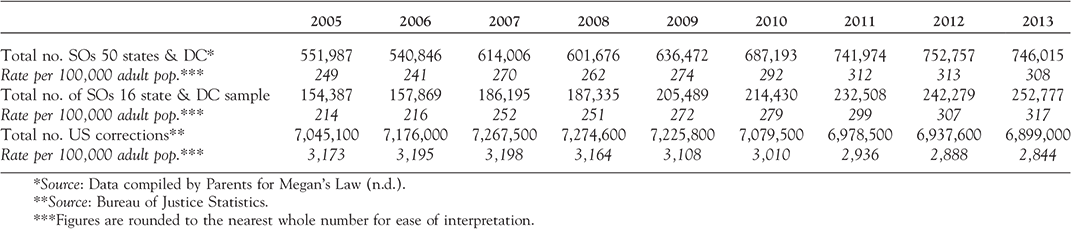
The number of registered sex offenders has ballooned in recent history. In terms of raw numbers, whereas in 2005, NGOs that compile state-reported data reported that 550,000 sex offenders were registered in the fifty US states as well as the District of Columbia, that number swelled to nearly 750,000 in 2013—a 35 percent increase. When that analysis is winnowed to the seventeen-jurisdiction reliability sample, the increase is even more pronounced, with an increase of 63.7 percent in nine years from 154,387 to 252,777 registered offenders.
Even when those figures are transformed into rates per 100,000 adult residents, the trend remains strong. NGO-compiled data suggest that there were 249 sex offenders registered for every 100,000 American adults in 2005, compared to a rate of 308 offenders per 100,000 adults in 2013 (see Table 1)—a 24 percent increase in just nine years. That spike is even more exaggerated when I narrow the analysis to the seventeen-jurisdiction reliability sample. In those jurisdictions, the sex offender registration rate increased from 214 per 100,000 adults in 2005 to 317 in 2012—a 48.1 percent spike.
Trends in Sex Offender Registration and Correctional Supervision, 2005–2013

| 2005 | 2006 | 2007 | 2008 | 2009 | 2010 | 2011 | 2012 | 2013 | |
|---|---|---|---|---|---|---|---|---|---|
| Total no. SOs 50 states & DC * | 551,987 | 540,846 | 614,006 | 601,676 | 636,472 | 687,193 | 741,974 | 752,757 | 746,015 |
| Rate per 100,000 adult pop. *** | 249 | 241 | 270 | 262 | 274 | 292 | 312 | 313 | 308 |
| Total no. of SOs 16 state & DC sample | 154,387 | 157,869 | 186,195 | 187,335 | 205,489 | 214,430 | 232,508 | 242,279 | 252,777 |
| Rate per 100,000 adult pop. *** | 214 | 216 | 252 | 251 | 272 | 279 | 299 | 307 | 317 |
| Total no. US corrections ** | 7,045,100 | 7,176,000 | 7,267,500 | 7,274,600 | 7,225,800 | 7,079,500 | 6,978,500 | 6,937,600 | 6,899,000 |
| Rate per 100,000 adult pop. *** | 3,173 | 3,195 | 3,198 | 3,164 | 3,108 | 3,010 | 2,936 | 2,888 | 2,844 |
* Source: Data compiled by Parents for Megan's Law (n.d.).
** Source: Bureau of Justice Statistics.
*** Figures are rounded to the nearest whole number for ease of interpretation.
The consistent increases in rates and numbers observed in the seventeen-state sample better represent most US states, as these analyses exclude California, where the number of sex offenders reported varies considerably year to year. This may in part be due to the state's realignment programs instituted in 2011 (California Department of Corrections and Rehabilitation 2014), but this instability was evident even before these programs were introduced. For example, the number of offenders dropped from 87,706 in 2007 to 66,041 in 2008; then back to 86,912 in 2010. Due to the state's large population, a dramatic drop in the number of sex offenders reported in 2013 largely explains the slight decline observed in the national figures. Excluding California, the total number and rate of sex offenders in the United States increased every year; overall, numbers increased 48 percent while rates increased 35.7 percent.
As shown in Figure 1, these marked increases in sex offender registration figures are out of step with general correctional trends in the United States. In the same period that sex offender registries ballooned as much as 63.7 percent, the number of individuals under correctional supervision (including those in prisons and jails, as well as those on probation and parole) fell from 7,045,100 to 6,899,000—a 2.1 percent decline. Although that is a modest decrease in raw numbers, the rate of corrections supervision dropped by 10.4 percent, from 3,173 US adults under correction supervision per 100,000 residents in 2005 to 2,844 adults under supervision in 2013.
Sex Offender Registration Versus Corrections Supervision Trends in the United States, 2005–2013

Sex Offender Registration Rates, By Race and State
The preceding longitudinal analysis demonstrates that sex offender registration rates have risen in recent years, at precisely the same time that general correctional supervision rates have stabilized and even declined. Who is being impacted by this expansion in sex offender registries? Is there evidence of racial disparities among those forced to register as sex offenders? To answer this question, it is necessary to turn to an original dataset compiled by Ackerman et al. (Reference Ackerman, Harris, Levenson and Zgoba2011), who have compiled the only known national sex offender dataset that includes offender demographic characteristics.
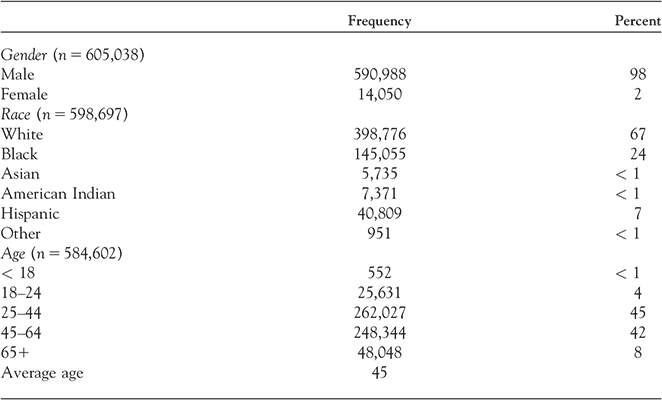
On its face, the demographic snapshot of sex offenders in the United States (see Table 2) would seem to confirm expectations: the average sex offender in the population is a forty-five-year-old white male. More specifically, exactly two-thirds of sex offenders in the population were white, almost one-fourth of the sample was black, 6.8 percent were Hispanic, 1.2 percent were American Indian, and less than 1 percent were Asian or Pacific Islander or other. An overwhelming majority of sex offenders—98 percent—are men.
Demographic Snapshot of Sex Offender Population

| Frequency | Percent | |
|---|---|---|
| Gender (n = 605,038) | ||
| Male | 590,988 | 98 |
| Female | 14,050 | 2 |
| Race (n = 598,697) | ||
| White | 398,776 | 67 |
| Black | 145,055 | 24 |
| Asian | 5,735 | < 1 |
| American Indian | 7,371 | < 1 |
| Hispanic | 40,809 | 7 |
| Other | 951 | < 1 |
| Age (n = 584,602) | ||
| < 18 | 552 | < 1 |
| 18–24 | 25,631 | 4 |
| 25–44 | 262,027 | 45 |
| 45–64 | 248,344 | 42 |
| 65+ | 48,048 | 8 |
| Average age | 45 |
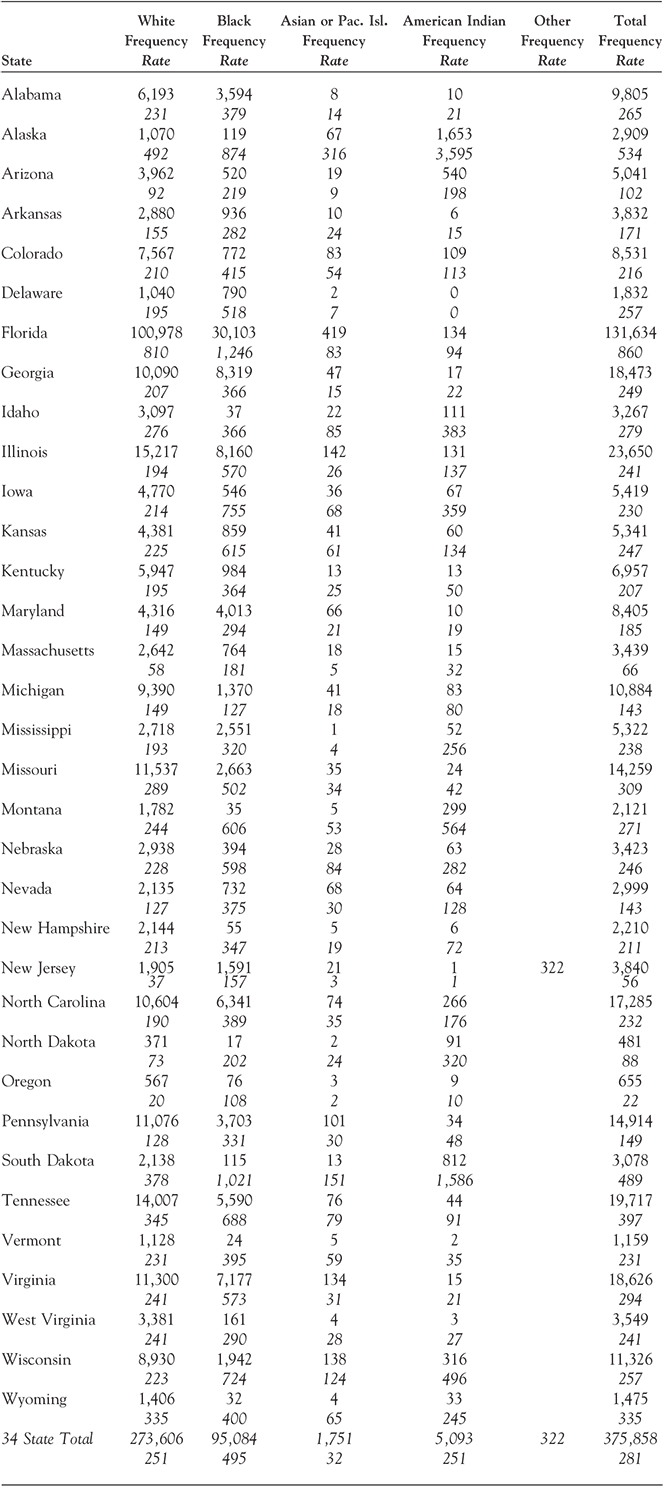
But how do these proportions match up against the general population? In the thirty-four states that did not report Hispanic offender data, the difference between black and white sex offender registration rates is consistent: in every state but one (Michigan), a higher sex offender registration rate was observed for blacks than for whites. In fourteen states, blacks were observed to face a sex offender registration rate at least twice as high as that of whites. In five states (Iowa, Massachusetts, New Jersey, Oregon, and Wisconsin), blacks were registered at a rate at least three times as high as whites.
While in most states American Indian communities faced low rates of sex offender registration, in a handful of jurisdictions they faced dramatically higher rates than other groups. In six states (Alaska, Arizona, Montana, North Dakota, South Dakota, and Wisconsin), American Indians faced a sex offender registration rate at least twice as high as their white counterparts. The difference between white and American Indian registration rates was particularly severe in Alaska, where American Indians were registered at a rate more than seven times that of whites. Put differently, in Alaska, the data suggest that over 3 percent of the American Indian population was registered as sex offenders at time of data collection.
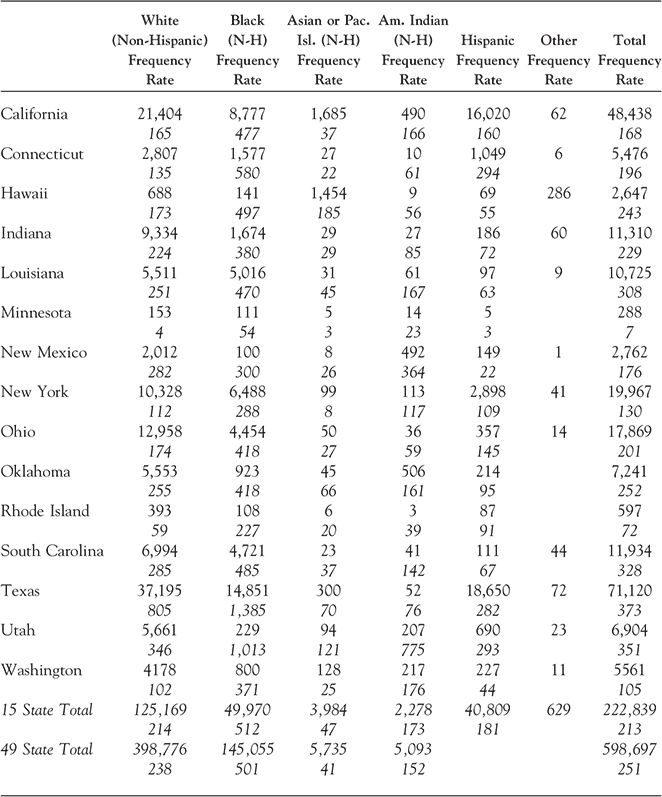
But what about Hispanic offenders? Given that Hispanic Americans also face a high rate of incarceration, we might expect them to have similarly disproportionate sex offender registration rates. However, Hispanic communities were not observed to have the highest sex offender registration rates among racial subpopulations in any of the fifteen states reporting Hispanic offender data (see Table 4). Hispanic offenders faced a rate higher than white offenders (but lower than black offenders) in only two states: Connecticut and Rhode Island. The disparity in Rhode Island was greatest, where they faced a rate more than twice as high as whites. However, Hispanic offenders were observed to face a sex offender registration rate lower than whites overall (181 vs. 214).
Notably, the black-white trends in the fifteen states reporting Hispanic offenders are similar to those in the thirty-four jurisdictions that did not report Hispanic offender data. Observed black sex offender registration rates were higher in all fifteen states and at least twice as high in nine of the fifteen states. In three statesFootnote 5 (Connecticut, Rhode Island, and Washington), observed black sex offender registration rates were at least three times as high as white rates. Among these fifteen states, American Indians faced a disproportionately higher sex offender registration rate only in New Mexico.
Overall, the sex offender registration rate observed for all forty-nine states was 251 sex offenders per 100,000 adult residents. If the two outliers (Florida at the high end and Minnesota at the low end) are dropped, the estimated sex offender registration rate drops to 213 sex offenders per 100,000 adults. To put that figure in perspective, a sex offender registration rate of 213 per 100,000 adults roughly translates to one in every 470 adults. Considering that 98 percent of sex offenders are men, these findings suggest that one out of every 230 men in these forty-seven states (and one in every 206 white men) were registered sex offenders at time of data collection.
The figures are even more troubling for black men. Overall, the sex offender registration rate observed for black residents was more than twice that of whites (501 vs. 238 sex offenders per 100,000 adults). Roughly one out of every 119 black men living in the forty-nine states analyzed were registered sex offenders—nearly 1 percent of all black men.
The rate observed for Asian and Pacific Islanders was 80 percent less than white rates (a trend that was consistent across states). In the main, American Indian rates were more than 35 percent lower than whites, but this trend was not consistent across states, as noted previously.
Discussion and Conclusion: Governing through Sex Crime Beyond the “Straight State”
Some readers may be wondering, “Who cares what happens to the sex offender?” There are many potential ethical and political responses to this normative line of argument, and they are important and necessary discussions. Although I do not primarily grapple with these questions, I expect that they may prevent some readers from being able to engage with the argument at all. My limited response for these pages would be, in part, to point to the long tradition in sociolegal studies of studying the uneven application of legal systems. Scholars critical of how the death penalty has been unevenly applied are rarely critiqued by colleagues for defending murderers or for making light of the crime of homicide. Although many registered sex offenders are committed for nonviolent and questionably criminal offenses, I do not wish to fall into the trap of defending some while condemning others. Surely many in this population deserve criminal sanction while others may not, but this is not the question I wish to raise.
Frequency and Rate of Sex Offender Registration per 100,000 Adult Residents, Thirty-Four States Not Reporting Hispanic Offender Data

| White | Black | Asian or Pac. Isl. | American Indian | Other | Total | |
|---|---|---|---|---|---|---|
| State | Frequency Rate | Frequency Rate | Frequency Rate | Frequency Rate | Frequency Rate | Frequency Rate |
| Alabama | 6,193 | 3,594 | 8 | 10 | 9,805 | |
| 231 | 379 | 14 | 21 | 265 | ||
| Alaska | 1,070 | 119 | 67 | 1,653 | 2,909 | |
| 492 | 874 | 316 | 3,595 | 534 | ||
| Arizona | 3,962 | 520 | 19 | 540 | 5,041 | |
| 92 | 219 | 9 | 198 | 102 | ||
| Arkansas | 2,880 | 936 | 10 | 6 | 3,832 | |
| 155 | 282 | 24 | 15 | 171 | ||
| Colorado | 7,567 | 772 | 83 | 109 | 8,531 | |
| 210 | 415 | 54 | 113 | 216 | ||
| Delaware | 1,040 | 790 | 2 | 0 | 1,832 | |
| 195 | 518 | 7 | 0 | 257 | ||
| Florida | 100,978 | 30,103 | 419 | 134 | 131,634 | |
| 810 | 1,246 | 83 | 94 | 860 | ||
| Georgia | 10,090 | 8,319 | 47 | 17 | 18,473 | |
| 207 | 366 | 15 | 22 | 249 | ||
| Idaho | 3,097 | 37 | 22 | 111 | 3,267 | |
| 276 | 366 | 85 | 383 | 279 | ||
| Illinois | 15,217 | 8,160 | 142 | 131 | 23,650 | |
| 194 | 570 | 26 | 137 | 241 | ||
| Iowa | 4,770 | 546 | 36 | 67 | 5,419 | |
| 214 | 755 | 68 | 359 | 230 | ||
| Kansas | 4,381 | 859 | 41 | 60 | 5,341 | |
| 225 | 615 | 61 | 134 | 247 | ||
| Kentucky | 5,947 | 984 | 13 | 13 | 6,957 | |
| 195 | 364 | 25 | 50 | 207 | ||
| Maryland | 4,316 | 4,013 | 66 | 10 | 8,405 | |
| 149 | 294 | 21 | 19 | 185 | ||
| Massachusetts | 2,642 | 764 | 18 | 15 | 3,439 | |
| 58 | 181 | 5 | 32 | 66 | ||
| Michigan | 9,390 | 1,370 | 41 | 83 | 10,884 | |
| 149 | 127 | 18 | 80 | 143 | ||
| Mississippi | 2,718 | 2,551 | 1 | 52 | 5,322 | |
| 193 | 320 | 4 | 256 | 238 | ||
| Missouri | 11,537 | 2,663 | 35 | 24 | 14,259 | |
| 289 | 502 | 34 | 42 | 309 | ||
| Montana | 1,782 | 35 | 5 | 299 | 2,121 | |
| 244 | 606 | 53 | 564 | 271 | ||
| Nebraska | 2,938 | 394 | 28 | 63 | 3,423 | |
| 228 | 598 | 84 | 282 | 246 | ||
| Nevada | 2,135 | 732 | 68 | 64 | 2,999 | |
| 127 | 375 | 30 | 128 | 143 | ||
| New Hampshire | 2,144 | 55 | 5 | 6 | 2,210 | |
| 213 | 347 | 19 | 72 | 211 | ||
| New Jersey | 1,905 | 1,591 | 21 | 1 | 322 | 3,840 |
| 37 | 157 | 3 | 1 | 56 | ||
| North Carolina | 10,604 | 6,341 | 74 | 266 | 17,285 | |
| 190 | 389 | 35 | 176 | 232 | ||
| North Dakota | 371 | 17 | 2 | 91 | 481 | |
| 73 | 202 | 24 | 320 | 88 | ||
| Oregon | 567 | 76 | 3 | 9 | 655 | |
| 20 | 108 | 2 | 10 | 22 | ||
| Pennsylvania | 11,076 | 3,703 | 101 | 34 | 14,914 | |
| 128 | 331 | 30 | 48 | 149 | ||
| South Dakota | 2,138 | 115 | 13 | 812 | 3,078 | |
| 378 | 1,021 | 151 | 1,586 | 489 | ||
| Tennessee | 14,007 | 5,590 | 76 | 44 | 19,717 | |
| 345 | 688 | 79 | 91 | 397 | ||
| Vermont | 1,128 | 24 | 5 | 2 | 1,159 | |
| 231 | 395 | 59 | 35 | 231 | ||
| Virginia | 11,300 | 7,177 | 134 | 15 | 18,626 | |
| 241 | 573 | 31 | 21 | 294 | ||
| West Virginia | 3,381 | 161 | 4 | 3 | 3,549 | |
| 241 | 290 | 28 | 27 | 241 | ||
| Wisconsin | 8,930 | 1,942 | 138 | 316 | 11,326 | |
| 223 | 724 | 124 | 496 | 257 | ||
| Wyoming | 1,406 | 32 | 4 | 33 | 1,475 | |
| 335 | 400 | 65 | 245 | 335 | ||
| 34 State Total | 273,606 | 95,084 | 1,751 | 5,093 | 322 | 375,858 |
| 251 | 495 | 32 | 251 | 281 |
Instead, I wish to draw our attention to how the carceral state has constructed an entirely separate arm dedicated to controlling sex. Trends in sex offender registration may have followed as a tailwind to trends in corrections historically, as Leon (Reference Leon2011) argues. However, state and federal policies enacted in the 1990s and 2000s ratcheted up the scope and punitiveness of sex offender registries. The findings in this article suggest that these policies have allowed registries to continue growing even as rates in correctional supervision declined. As the findings in this article demonstrate, that growth has been substantial: estimates in this article suggest that the sex offender registration rate has spiked 25 percent between 2005 and 2013. Given that Bureau of Justice Statistics (2002) figures indicated that 263,166 sex offenders were registered in 1998, the number of registered sex offenders nearly tripled between 1998 and 2013.Footnote 6 Further, because many sex offenders are required to register for life, it is highly likely that this trend will continue for many years to come. In short, while sex offender registries may have followed as a tailwind to trends in corrections historically, these findings suggest trends in sex offender registration are now moving as a headwind—opposite to the trends in corrections more generally.
Frequency and Rate of Sex Offender Registration per 100,000 Adult Residents, Fifteen States Reporting Hispanic Offender Data

| White (Non-Hispanic) | Black (N-H) | Asian or Pac. Isl. (N-H) | Am. Indian (N-H) | Hispanic | Other | Total | |
|---|---|---|---|---|---|---|---|
| Frequency Rate | Frequency Rate | Frequency Rate | Frequency Rate | Frequency Rate | Frequency Rate | Frequency Rate | |
| California | 21,404 | 8,777 | 1,685 | 490 | 16,020 | 62 | 48,438 |
| 165 | 477 | 37 | 166 | 160 | 168 | ||
| Connecticut | 2,807 | 1,577 | 27 | 10 | 1,049 | 6 | 5,476 |
| 135 | 580 | 22 | 61 | 294 | 196 | ||
| Hawaii | 688 | 141 | 1,454 | 9 | 69 | 286 | 2,647 |
| 173 | 497 | 185 | 56 | 55 | 243 | ||
| Indiana | 9,334 | 1,674 | 29 | 27 | 186 | 60 | 11,310 |
| 224 | 380 | 29 | 85 | 72 | 229 | ||
| Louisiana | 5,511 | 5,016 | 31 | 61 | 97 | 9 | 10,725 |
| 251 | 470 | 45 | 167 | 63 | 308 | ||
| Minnesota | 153 | 111 | 5 | 14 | 5 | 288 | |
| 4 | 54 | 3 | 23 | 3 | 7 | ||
| New Mexico | 2,012 | 100 | 8 | 492 | 149 | 1 | 2,762 |
| 282 | 300 | 26 | 364 | 22 | 176 | ||
| New York | 10,328 | 6,488 | 99 | 113 | 2,898 | 41 | 19,967 |
| 112 | 288 | 8 | 117 | 109 | 130 | ||
| Ohio | 12,958 | 4,454 | 50 | 36 | 357 | 14 | 17,869 |
| 174 | 418 | 27 | 59 | 145 | 201 | ||
| Oklahoma | 5,553 | 923 | 45 | 506 | 214 | 7,241 | |
| 255 | 418 | 66 | 161 | 95 | 252 | ||
| Rhode Island | 393 | 108 | 6 | 3 | 87 | 597 | |
| 59 | 227 | 20 | 39 | 91 | 72 | ||
| South Carolina | 6,994 | 4,721 | 23 | 41 | 111 | 44 | 11,934 |
| 285 | 485 | 37 | 142 | 67 | 328 | ||
| Texas | 37,195 | 14,851 | 300 | 52 | 18,650 | 72 | 71,120 |
| 805 | 1,385 | 70 | 76 | 282 | 373 | ||
| Utah | 5,661 | 229 | 94 | 207 | 690 | 23 | 6,904 |
| 346 | 1,013 | 121 | 775 | 293 | 351 | ||
| Washington | 4178 | 800 | 128 | 217 | 227 | 11 | 5561 |
| 102 | 371 | 25 | 176 | 44 | 105 | ||
| 15 State Total | 125,169 | 49,970 | 3,984 | 2,278 | 40,809 | 629 | 222,839 |
| 214 | 512 | 47 | 173 | 181 | 213 | ||
| 49 State Total | 398,776 | 145,055 | 5,735 | 5,093 | 598,697 | ||
| 238 | 501 | 41 | 152 | 251 |
Of course, this analysis has its own limitations, and is not intended to be an exhaustive study of sex offender policies. First and foremost, because it relies on public registries, this study excludes offenders convicted of sex crimes for which their respective states do not require public registration. California, for example, estimates that up to 25 percent of sex offenders are not documented in its online registry because they are not required to register publicly (California Office of the Attorney General 2014). As such, the findings in this article should be read as an account of sex offenders forced to register publicly and not sex offenders more broadly. However, as community notification is unique in many respects to sex,Footnote 7 this study has unique insights into the punishment of sex.
As I argue, it is possible to envision a wider array of possibilities for the sexuality studies by broadening our conceptualization of what counts as sexuality beyond the gay/straight binary. Punishment provides one useful analytic lens for studying how a particular set of social processes, institutions, and actors shape sexuality. Sex has enabled the state to develop new forms of punishment that are not merely a copy-paste of other carceral programs; sex brings its own social baggage and character. For example, despite empirical evidence to the contrary, sex offenders are viewed as particularly likely to reoffend and thus in need of special, more invasive social control. The sociology of sexuality can help explain the persistence of this inaccurate view in at least two ways. First, stigma and religious morality protects this argument against criticism by painting sex as dirty and shameful. As such, condemning the sex offender as hopelessly unsalvageable aligns with dominant, religiously informed worldviews that sex corrupts the body and mind. Second, sex offender registries align with our medicalized understanding of sexuality as an immutable, biologically determined characteristic. LGBT rights groups helped usher in this modern understanding of sexuality by employing a “born this way” medical discourse as a shield against morality. While framing same-sex desire as a benign biological difference proved useful for securing social and legal recognition for LGBT people, it may have inadvertently deepened the logic underpinning sex offender registries: if sexuality cannot be changed, then sex offenders are guilty not just of bad behaviors but of being a bad kind of person. Conventional modes of punishment are not sufficient.
There are many avenues for exploring the punishment of sex in future studies. For example, the role medicalization plays in the social control of sex offenders is not well understood. Indefinite commitment policies developed to help control sex offenders allow the state to keep individuals convicted of sex offenses locked up far beyond their criminal sentence, perhaps for life, at the discretion of corrections officials. The Supreme Court ruled in Kansas v. Hendricks (1997) that such indefinite detainment was not cruel and unusual punishment because it was not punishment at all. In fact, the Court ruled, since the state is treating the sex offender under lock and key and—since treatment is not a form of punishment—it can do so for as long as it sees fit. These policies echo historian Regina Kunzel's (forthcoming, 3) account of early twentieth-century sexual psychopath laws: “Medical discourse … mystified the laws' criminalization of sexual difference in ways that made them difficult to challenge.” Although sexual psychopath laws fell out of favor in the 1970s, their spirit appears to have been resurrected with the rise of sex offender policies in the 1990s.
Future studies might also better explicate the historical relationship between LGBT political projects and sex offender policies. Historian Scott De Orio (forthcoming) demonstrates that early gay liberation activists in the 1970s organized against California sex offender policies. Over time, however, the causes and strategies mobilized under the banner of LGBT rights were increasingly winnowed to focus on equal treatment under the law for gays and lesbians (Phelan Reference Phelan2001). This shift may in part reflect what political scientist Cathy Cohen (Reference Cohen1999, 9) terms “secondary marginalization,” or the way elite group members purge more deviant members and their issues from their ranks over time. By narrowing the scope and vision of the LGBT movement to more sanitized equal rights issues and displacing more stigmatized issues such as public sex, LGBT rights movements may have inadvertently emboldened the state to punish more severely other kinds of sex. Indeed, the failure of Lawrence to resist the growth of new punishments targeting sex reveals that its primary lasting impact may be to pave the way for same-sex marriage rights (for a more robust version of this critique, see Franke Reference Franke2004).
Beyond insights into the politics of sexuality, other studies might analyze how the uneven application of sex offender registries contributes to racial inequality. As I show, sex offender policies are disproportionately impacting black communitiesFootnote 8 and, in several states, American Indian communities. Indeed, in four states—Florida, South Dakota, Texas, and Utah—it appears that more than 1 percent of black residents were publicly registered as sex offenders at time of data collection. Considering that the vast majority of sex offenders are men—97.7 percent—the sex offender rate for black men in these states is nearly double these figures. Given that black male sexuality is frequently portrayed as hypersexual and dangerous (Entman and Rojecki Reference Entman and Rojecki2001; Cohen Reference Cohen and Herdt2009), the fact that black men are more heavily regulated under sex offender registries may not come as a surprise. That black men are already so heavily entangled with the criminal justice enterprise also plays a central role, as they are already funneled into the system through which sex offender registration operates.
Yet, Hispanic men face similarly skewed popular media representations (see, e.g., Mastro and Behm-Morawitz Reference Mastro and Behm‐Morawitz2005), and although Hispanic overrepresentation in the criminal justice system is not as exaggerated as it is for black Americans (1.8 times greater than white rates of incarceration vs. 5.6 for blacks, according to Mauer and King Reference Mauer and King2007), it is nonetheless inflated nationally. However, at least in the states that reported Hispanic offenders, they faced rates either similar to or lower than whites. This puzzle may be in part explained by two issues. First, CDC data show that Hispanic women report experiencing rape and sexual assault at lower rates than white and black women—33 percent lower than reported rape rates for black women and 22 percent lower than reported rape rates for white women (Black et al. Reference Black, Basile, Breiding, Smith, Walters, Merrick, Chen and Stevens2011). As such, variations in reporting may play a small role in shaping these differences.Footnote 9 Second, Hispanic offenders who are not US citizens face a great risk of deportation. Once deported, they are (obviously) not required to register.
Beyond race, these policies also likely have important implications for class inequality. For example, these policies likely contribute to patterned unemployment between blacks and whites that has buttressed racialized class inequalities. Employment is not only jeopardized by community notification policies and public registries themselves, but also through a host of punitive policies such as driver's licenses stamped “sex offender” in red (as is required in Louisiana). Other states literally zone sex offenders out of the community by placing extensive restrictions on where they can live, such as in the case made famous by The New York Times of the “sex offender village” located in the middle of Florida farmland (Jackson and Feige Reference Jackson and Feige2013).
Without an overarching theoretical and conceptual framework, however, it is difficult to interpret this complex set of phenomena. Attempting to understand sex offender policies through the conventional lens of sexuality studies—the gay/straight binary—makes little sense. For example, Canaday (Reference Canaday2011) persuasively argues that state policies aimed at punishing homosexuality gave birth to a second-class form of citizenship for gays and lesbians. But Canaday's concept of the straight state cannot account for the parallel rise of sex offender policies without the aid of some serious academic gymnastics: while sex offender policies do govern same-sex sexualities, they do so alongside a litany of other kinds of sex. To reduce all that variation to homophobia or heterosexism does not make sense. This is not a flaw in their account; it is simply not a conceptual apparatus built for understanding the regulation of sex outside the gay/straight binary.
Sociolegal scholarship on punishment, such as Simon's (Reference Simon2007) important work on governing through crime, may prove useful for understanding these complex set of phenomenon. For the many decades in which the war on drugs maintained its legitimacy as an important social project, it proved to be a useful rallying cry for legislators seeking to shore up their “tough on crime” persona and authority in general. But the drug user has been rehabilitated in the public's mind through discourses of medicine (“medical marijuana”) at the same time that the war on drugs has been revealed as grossly unjust (the new Jim Crow). The sex offender, on the other hand, remains largely indefensible and most Americans know little of the policies used to control him (much less how those policies are administered). To many, “sex offender” is synonymous with “rapist” and “child molester.” In short, he is the perfect villain for a new theater in the war on crime.