




No CrossRef data available.
Article contents
Neuropsychological and information processing deficits following mild traumatic brain injury
Published online by Cambridge University Press: 01 March 2004
Abstract
Neuroradiological and neuropathological investigations have found evidence of diffuse brain damage in the frontal and temporal lobes, corpus callosum, and fornices in patients who have sustained a mild traumatic brain injury (TBI). However, neuropsychological assessments of these patients do not typically target many of the subtle information processing deficits that may arise from diffuse damage involving the frontotemporal regions of the brain as well as white matter pathology, including the corpus callosum. Consequently, we have a limited understanding of the deficits that may be attributable to temporary or permanent disruptions to these functional pathways. This study assessed a group of mild TBI patients (N = 40) and a matched control group (N = 40) on a number of standard neuropsychological tests of selective and sustained attention, verbal and non-verbal fluency, and verbal memory. In addition, reaction time (RT) tasks, requiring both the inter- and intra-hemispheric processing of visual and tactile information, were used to assess the functional integrity of the tracts that are likely to be affected by diffuse damage. In the 1st month after sustaining their injury, the mild TBI group demonstrated deficits in attention, non-verbal fluency, and verbal memory. They also demonstrated slower visual and tactile RTs, with the visual RTs of mild TBI patients being more affected by increased task difficulty and the need to transfer information across the corpus callosum, than did their matched controls. (JINS, 2004, 10, 286–297.)
Keywords
Information
- Type
- Research Article
- Information
- Journal of the International Neuropsychological Society , Volume 10 , Issue 2 , March 2004 , pp. 286 - 297
- Copyright
- © 2004 The International Neuropsychological Society
INTRODUCTION
Neuropsychological investigations of mild TBI patients have yielded mixed results, the interpretation of which is complicated by methodological inconsistencies, including the use of different cognitive tests, diagnostic criteria, injury-assessment intervals, patient groups (e.g., consecutive hospital admissions, symptomatic referrals), types of injury (e.g., sports concussion, motor vehicle accidents, mixed causes), and levels of injury severity (i.e., mild only, mild and moderate, mild to severe). Although deficits have been found in speed of information processing, memory, attention and executive functions, both the clinical significance and the etiology of these deficits have been questioned (Binder, 1997; Binder et al., 1997).
With respect to speed, a number of information processing tasks have been found to discriminate between mild TBI patients and controls (Comerford et al., 2002; Gronwall & Sampson, 1974; MacFlynn et al., 1984; van Zomeren, 1981; Waterloo et al., 1997), and between subgroups of mild TBI patients (Waterloo et al., 1997). While information processing speed usually returns to normal by 1 to 6 months post injury (Gronwall, 1989; MacFlynn et al., 1984), long-term reductions in mental speed have been found in some mild TBI patients (Leininger et al., 1990).
Subjective accounts of memory problems are also common, with Rimel et al. (1981) reporting that 59% of mild TBI patients complained of memory problems. However, objective assessments of memory have provided mixed findings. Whereas Gentilini et al. (1985), Levin et al. (1987), and Mathias and Coats (1999) found no evidence to indicate visual or verbal memory problems at 1 month post injury, other studies have shown significantly poorer working memory (Newcombe et al., 1994) and delayed recall (Dikmen et al., 1986) at similar post-injury intervals. Problems with verbal learning (Leininger et al., 1990) and delayed recall (Stuss et al., 1985) have additionally been reported in chronically affected mild TBI patients at 3 and 5 months post injury, respectively.
Deficits in selective and sustained attention have also been demonstrated following mild TBI (Bigler & Snyder, 1995; Gentilini et al., 1989; Mclean et al., 1983; Stuss et al., 1989). However, studies of executive functioning have reported inconsistent findings. For example, deficits in verbal and non-verbal fluency have been reported by some (e.g., Fos et al., 1995; Levin et al., 1991; Mathias & Coats, 1999) but not others (Leininger et al., 1990). Similarly, tests of mental flexibility have reportedly differentiated between mild TBI patients and controls in some (Dikmen et al., 1986; Fos et al., 1995), but not all, studies (e.g., Leininger et al., 1990).
When a meta-analysis of mild TBI research was completed by Zakzanis et al. (1999) in order to weight and compare the research findings using a common yardstick, namely effect size (Cohen's d), the largest effects (≥1.0, averaged over studies) for individual measures were reportedly for the Controlled Oral Word Association Test (mean d = 1.22), the short delay trial of the Rey Auditory Verbal Learning Test (mean d = 1.09), semantic fluency (mean d = 1.08), and the immediate (mean d = 1.06) and delayed (mean d = .99) trials of the Logical Memory subtest of the Revised Wechsler Memory Scale. Medium effect sizes (≥.5; Cohen, 1992) were also reported for a large number of other commonly used tests. The effect sizes for these five measures convert to an overlap between the test scores of the mild TBI and control groups of between 38% and 45% (Zakzanis, 2001). Moreover, in order to overcome a possible bias arising from the tendency to publish positive results, Zakzanis et al. (1999) calculated the fail-safe N for each of these findings. This statistic estimates the number of studies, with non-significant group differences, that would be required in order to reverse the conclusion that persons who have had a mild TBI perform more poorly. The fail-safe N's for these measures were 363, 108, 107, 210, and 196, respectively. Thus, even if there were a bias in the studies that have been published or that underwent meta-analysis, it would take an extremely large number of studies with opposing findings to negate the importance of these measures in detecting cognitive deficits following mild TBI. Finally, when Zakzanis et al. (1999) combined measures that assessed particular cognitive domains, the largest effects sizes were found for cognitive flexibility and abstraction (mean d = .72), delayed recall (mean d = .71), memory acquisition (mean d = .69), and attention and concentration (mean d = .63), indicating that neuropsychological assessments of mild TBI patients should target these cognitive functions.
Turning to the etiology of these problems, there is increasing evidence that even mild TBIs can cause brain damage, suggesting that physiological factors may contribute to some of the cognitive problems and post-concussional symptoms that are experienced by these patients (Guo et al., 2000; Plassman et al., 2000). Specifically, neuropathological studies have reported DAI in samples of mild-to-moderate and mild-to-severe TBI patients (e.g., Oppenheimer, 1968; Povlishock, 1992; Povlishock et al., 1992; Strich, 1961). However, with the exception of Blumbergs et al. (1994; 1995), very few studies have focused on only mild TBI. The Blumbergs et al. study examined the distribution of DAI in 6 mild TBI patients who died of other causes, and found evidence of damage to the CC (particularly the posterior one-third: G. Scott, personal communication, February, 1997) and fornices in all cases, suggesting that these pathways are most vulnerable to damage as a consequence of TBI. The frontal and temporal lobes also showed evidence of axonal injury. However, it is not known whether this damage was extensive enough to disrupt cognitive functioning.
DAI, focal cortical lesions (particularly in the frontal and temporal lobes) and whole brain atrophy have also been reported using magnetic resonance imaging (MRI) with groups of mild, mild-to-moderate, and mild-to-severe TBI patients (Bigler, 2001, 2003; Gale et al., 1995; Gentry et al., 1988; Levin et al., 1987, 1991; MacKenzie et al., 2002; Mittl et al., 1994). In addition, DAI in the corpus callosum (CC), especially the posterior portion, and the fornices has been reported using MRI (Gale et al., 1993, 1995; Gentry et al., 1988; Tate & Bigler, 2000), with some studies finding a relationship between the amount of damage and injury severity (Gale et al., 1995; Gentry et al., 1988).
Although imaging has provided evidence of brain damage following mild TBI, these techniques almost certainly underestimate the amount of damage as both MRI and CT fail to detect pathology that is evident at post-mortem, particularly non-hemorrhagic axonal injury (Jones et al., 1997). Indeed, mild TBIs do not usually lead to abnormalities that are detectable on routine clinical CT or MRI (Bigler & Snyder, 1995) due to the limited resolution of current imaging techniques (Bigler, 2003), although significant progress has been made (Garnett et al., 2000a, 2000b; Lewine et al., in press a, in press b; McGowan et al., 2000; Sinson et al., 2001). Thus, an absence of visible pathology does not equate to an absence of abnormality, as there may be structural damage that falls below the current threshold of detection (Bigler, 2001; Bigler & Snyder, 1995). Given that injury severity is linearly related to atrophy following moderate to severe injuries (Bigler, 2003), white matter pathology may also be present following mild TBI, although to a lesser degree and with lesions smaller than one mm3, which is currently the lower limit of detection. If white matter integrity is diminished, this disruption could affect speed of neural transmission and information processing.
Normal information processing is dependent on intact neural structures and functional pathways that subserve a particular cognitive ability. Measures of information processing speed may therefore be the most sensitive way of detecting any abnormalities within these systems following mild TBI, particularly in the absence of any visible pathology on neuroimaging. In mild TBI, the frontotemporal and callosal regions of the brain and their functional pathways are most susceptible to injury (Bigler, 2001; Blumbergs et al., 1994, 1995). Although information processing speed and callosal function are often not systematically assessed in clinical settings, the functional consequences of diffuse damage affecting the cerebral hemispheres and corpus callosum can be operationalized and measured using speed of information processing tasks developed in the cognitive psychology literature.
The CC is the major fiber tract that connects the cerebral hemispheres (Clarke & Zaidel, 1994), with the anterior cerebral hemispheres being connected through the anterior portion of the CC (rostrum, genu, anterior mid-body) and the posterior areas being connected by the posterior CC (posterior mid-body, splenium; de Lacoste et al., 1985; Pandya et al., 1971; Witelson, 1989). Although research examining the cognitive sequelae to callosal damage following TBI is limited, there are reports of callosal disconnection following severe TBI (Levander & Sonesson, 1998; Rubens et al., 1977; Vuilleumier & Assal, 1995), with patients displaying gross deficits in their ability to transfer and integrate information between hemispheres (e.g., apraxia, finger localization, dichotic listening), consistent with the deficits shown by patients who have had commissurotomies (e.g., Benavidez et al., 1999; Bentin et al., 1984; Damasio et al., 1980; Geffen et al., 1985). However, there do not appear to be any studies that have used information processing measures in order to detect more subtle deficits that may arise from less severe damage. Information processing measures have, however, frequently been used to investigate callosal functioning in normal samples, providing an experimental paradigm for the examination of callosal functioning following mild TBI (e.g., Banich, 1995; Banich & Karol, 1992; Banich & Shenker, 1994; Hoptman & Davidson, 1994).
The present study was therefore designed to examine cognitive performance following mild TBI, with an emphasis on the cognitive functions that are mediated by those areas of the brain that are susceptible to diffuse damage following TBI. To this end, the inter- and intra-hemispheric processing of visual and tactile information (i.e., reaction time; RT), selective and sustained attention, visual and verbal fluency, and immediate and delayed verbal memory of a group of mild TBI patients was assessed one month post-injury. It was predicted that the mild TBI group would perform more poorly on these cognitive tasks, that the mild TBI group would show reduced speeds of information processing, particularly for the more difficult tasks, and that tasks requiring the transfer of information across the CC would be more affected in the mild TBI group than tasks requiring intra-hemispheric processing.
METHODS
Research Participants
The TBI group consisted of 40 participants (8 females, 32 males), aged between 18 and 60 years1
The age range of participants was restricted to an upper limit of 60 years in order to avoid the confounding effect caused by the normal slowing of reaction times in people over 60 years of age (Stuss et al., 1989).
A control group from the general community (friends of the mild TBI group and members of community groups), consisting of 40 participants who had not previously sustained a head injury or experienced a loss of consciousness, were individually matched, as closely as possible, to the mild TBI group on the basis of age (M = 32.4, SD = 12.7), gender (8 females, 32 males), education (M = 12.7, SD = 2.1), and intelligence (M = 104.2, SD = 8.8). Participants were excluded from either group if they had any history of neurological or psychiatric problems, if English was their second language, or if they had any physical problem that would prevent them from completing the RT tasks (e.g., sensory or motor problems).
Measures
Background information was collected using the Philadelphia Head Injury Questionnaire (Curry et al., 1991). The Alcohol Use Disorders Identification Test (AUDIT; Saunders et al., 1993) was used to asses alcohol consumption in order to ensure that the two groups were comparable (maximum score: 40). The National Adult Reading Test (NART; Nelson & Willison, 1991) was used to estimate premorbid intelligence and the Impact of Events Scale (IES; Horowitz et al., 1979) was used to assess injury-related psychological distress in the mild TBI group (15 items, response options: not at all, rarely, sometimes, often, score range: 0–65).
The Visual Elevator, Telephone Search, and Telephone Search while Counting subtests of the Test of Everyday Attention (TEA; Robertson et al., 1994) were used to assess attention. The Visual Elevator task measures selective attention and cognitive flexibility, requiring participants to calculate which floor a person was on using a series of visually presented elevators. Accuracy (range: 0–10) and timing (average time to switch attention) scores were calculated for this measure. The Telephone Search task measured selective attention, and required participants to locate and circle symbols in a simulated telephone directory, with the score being the average time taken to detect a target. Finally, the Telephone Search While Counting subtest measured sustained and divided attention by requiring participants to search a simulated telephone directory for symbols, while also counting a string of tones. Scores from this and the previous test were combined to calculate a dual task decrement score.
Verbal fluency was assessed using the Controlled Oral Word Association test (COWA; Spreen & Strauss, 1998), which requires participants to generate words beginning with the letters F, A and S within three 1-min periods. The total number of correct words generated for the three letters was calculated. Non-verbal fluency was assessed using the Ruff Figural Fluency Test (RFFT; Evans et al., 1985), which consists of five sets of 40 squares, with each square containing a five-dot matrix. Participants were given 1 min per set and instructed to join two or more dots in order to make as many unique patterns as possible, with the score being the total number of unique designs.
The Rey Auditory Verbal Learning Test (RAVLT; Schmidt, 1996; Spreen & Strauss, 1998) was used to assess verbal memory (i.e., learning, delayed recall, recognition memory). The RAVLT involves the verbal presentation of a list of 15 words over five trials, with participants recalling as many words as possible after each trial. This is followed by the single presentation and recall of a second list, after which participants are required to recall the first list, both immediately and after a 20 min delay, in addition to recognizing these words from a printed list of 50 words. The total number of words recalled in Trials 1–5, the immediate and delayed recall trials, and the recognition trial, were calculated.
Information processing speed was assessed using visual and tactile RT tasks requiring either a compatible response (intra-hemispheric processing) or an incompatible response (inter-hemispheric processing). These tasks were designed to satisfy the methodological requirements for tasks that are designed to assess interhemispheric processing, outlined by Banich and Shenker (1994). Each RT task commenced with 10 practice trials, followed by 64 experimental trials, with equal numbers of stimuli being presented to each side. Participants were instructed to respond as quickly and as accurately as possible. The mean RT (and SD) and number of correct responses for each individual on each task were calculated, with the data from both hands being combined. In RT paradigms, unusually fast or slow responses are generally thought to reflect anticipatory responses (RTs of less than 20 ms) or lapses in attention (RTs greater than 2 SDs above an individual's mean RT) that should be removed from the data. For this reason, outliers were identified separately for each person on each task using these criteria and excluded from further statistical analysis. On average, 1–2 responses were removed using this procedure, with no group differences in the number of outliers that were removed.
The visual RT tasks were based on the assumption that, when focused on a central fixation point, the input from the left visual field (left of fixation) is transmitted to the right visual cortex, while information in the right visual field is transmitted to the left visual cortex. Four RT tasks, consisting of either a two- or four-choice stimulus-response format and requiring either a compatible or incompatible response, were used. The stimuli were presented on a 26-cm color computer monitor for a duration of 150 ms (less than the time taken to move the eyes from central fixation to a stimulus; Banich, 1997), with an interstimulus interval of 500 ms. Participants were seated 40 cm from screen and instructed to focus on the fixation point which appeared on the screen 500 ms prior to the stimulus onset. The experimenter, who sat behind the computer screen, monitored central fixation. For the 2-choice tasks, participants responded to one of two squares (2 cm × 2 cm each) that appeared 6 cm on both sides of the central fixation point. A compatible response involved pressing a key with the index finger of the hand on the same side as the stimulus (solid white square). An incompatible response involved making a response with the index finger of the hand on the side opposite to that of the stimulus. For the four-choice tasks, participants were required to respond to one of four squares (2 cm × 2 cm each), with two on each side of the fixation point. The compatible 4-choice task required participants to respond, using the index (inner square) or middle (outer square) finger of the hand on the same side as the stimulus. For the incompatible task, participants were required to use the same finger as for the compatible task but with the hand on the side opposite to that of the stimulus.
Four tactile RT tasks, involving compatible and incompatible eight-choice and eight-choice, two-sequence vibro-tactile tasks, were developed from the finger localization tasks used by Geffen et al. (1985). The vibro-tactile keys consisted of two sets of four keys arranged in a semi-circle to fit the shape of each hand, excluding the thumb. Each key (1.5 cm in diameter) had a vibrating stylus (3 mm) in the center that delivered the stimulus. The key travel required to register a response was .6 mm and the pressure required was 240 g. The vibrating stimuli were driven up and down through the center of the response keys by modified miniature solenoids and oscillated at a frequency of 108 Hz. For the eight-choice task, participants were required to place the four fingers of both hands on the response keys. Each stimulus involved a key vibrating for 250 ms followed by an inter-stimulus interval of 500 ms, with each finger being stimulated an equal number of times. Whereas participants were required to respond to the vibrating key by pressing that same key for the compatible task, a response with the equivalent finger of the opposite hand was required for the incompatible task. As with visual information, tactile information is transferred to the contralateral hemisphere, which controls motor responses made on the same side as the tactile stimuli. Thus, compatible responses required intra-hemispheric processing and incompatible responses required the inter-hemispheric transfer of information. Finally, for the eight-choice, two-sequence tactile tasks, the stimuli consisted of two vibrating keys, one after the other, with a 10 ms interval between the two. Participants had to respond by pressing the two stimulus keys in the correct order for the compatible task and by pressing the equivalent keys with the opposite hand in the same order for the incompatible task. RTs for this task measured the time between the onset of the first stimulus and completion of the second response.
Procedure
Mild TBI patients were identified through ambulance records on a prospective basis (not on the basis of symptomatology) and assessed approximately 4 weeks post injury (M = 26.3 days, SD = 6.1) during a single test session lasting 1½ to 2 hr. Approximately 30% of those identified were either not contactable (incomplete/incorrect address, not contactable by phone) or declined to take part in the study. While this may have introduced a selection bias, it is not possible to determine whether it favored individuals with a better or worse outcome. Participants completed the background questionnaire, followed by the measures of attention (TEA), memory (RAVLT), visual and tactile RT, fluency (COWA, RFFT), premorbid IQ (NART), and injury-related stress (IES). With the exception of estimated premorbid IQ, raw scores were analyzed. All participants were administered the Rey 15-item memory test to assess symptom validity (Lezak, 1995; Schretlen et al., 1991). The majority of TBI participants (97.5%) scored 11 or more on this measure, with only 1 participant (2.5%), who was not involved in litigation, scoring 9. All control participants scored 11 or more. The two groups did not differ significantly in terms of their Rey 15 scores (mean and frequency) and Rey 15 performance was related to IQ (r = .44, p = .000). Thus, although the Rey 15-item test is one of the least sensitive measures of symptom validity, these findings, combined with the normal RAVLT recognition performance of this group (refer to Results) and the fact that this assessment was undertaken entirely for research purposes (the results were not available for the purposes of litigation), reduce the likelihood of disingenuous performance by the mild TBI group.
RESULTS
Comparability of Matched Samples
The mild TBI and Control groups were compared in order to determine whether they had been successfully matched. One-way ANOVAs revealed that the two groups did not differ in terms of their age [F(1,79) = .00, p = .993], alcohol usage [i.e., AUDIT scores: F(1,72) = 1.257, p = .266], years of education [F(1,79) = .425, p = .516], or estimated premorbid IQ [F(1,79) = .574, p = .451], indicating that the two groups were comparable and consequently alleviating the need to use any of these variables as covariates.
Cognitive Performance
Standard neuropsychological tests
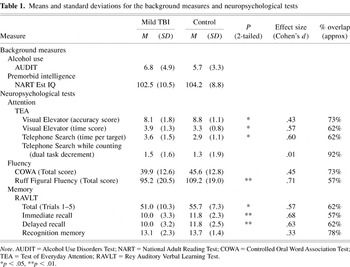
The performance of the mild TBI and Control groups on the neuropsychological tests was compared using one-way ANOVAs (refer to Table 1 for means and standard deviations). With respect to attention, the mild TBI groups differed from the control group on the TEA Visual Elevator accuracy [F(1,79) = 4.6, p = .035] and timing [F(1,79) = 5.18, p = .026] scores, as well as the time to detect targets in the Telephone Search task [F(1,79) = 6.43, p = .013], with the mild TBI group being less accurate and slower to switch attention when cued to do so, while also taking longer to select relevant from irrelevant target stimuli. In contrast, there was no difference between groups on the divided attention task (TEA Telephone Search While Counting task), indicating that the mild TBI group was not more adversely affected by the need to divide their attention between two competing tasks than the control group.
Means and standard deviations for the background measures and neuropsychological tests

A comparison of the fluency scores of the mild TBI and control groups yielded a significant difference on the test of non-verbal or design fluency [F(1,79) = 9.96, p = .002] but not for the test of verbal fluency (p = .051). Finally, when the two groups were compared in terms of their verbal memory performance, they were found to differ in terms of their learning on the RAVLT [total of Trials 1–5: F(1,79) = 5.74, p = .019], and on their immediate [F(1,79) = 8.13, p = .006] and delayed [F(1,79) = 7.76, p = .007] recall of the word list, with the mild TBI group recalling significantly fewer words on all of these measures. As expected, there was no difference between the recognition memory performance of the mild TBI and control groups.
Reaction time tasks
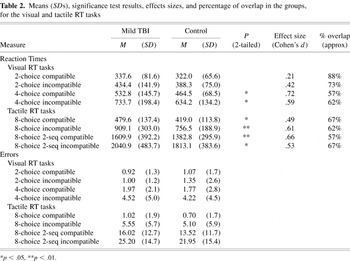
Three-way ANOVAs with repeated measures were used to assess differences between the mean RTs of the mild TBI and control groups. The visual and tactile data were analyzed separately. Task difficulty (visual tasks: two- or four-choice; tactile tasks: eight-choice or eight-choice, two-sequence) and compatibility (compatible or incompatible stimulus–response format) were the within-subjects factors, while group (mild TBI or control) was the between-subjects factor. A summary of the mean visual and tactile RTs is given in Table 2, together with the results of t tests comparing groups on individual tests, effect sizes, and percentage overlap between groups.
Means (SDs), significance test results, effects sizes, and percentage of overlap in the groups, for the visual and tactile RT tasks

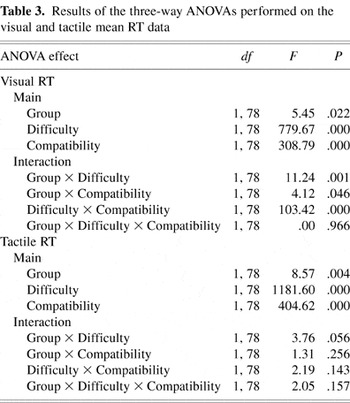
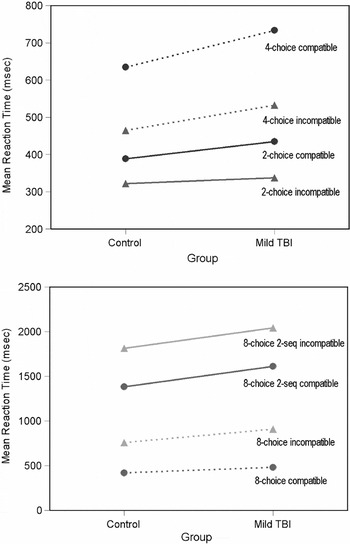
A repeated measures ANOVA comparing the mean RTs of the mild TBI and control groups on the visual RT tasks found a significant effect for group (refer to Tables 2 and 3 for means and ANOVA results). Thus, mild TBI participants were slower to respond to these tasks than the controls. Not unexpectedly, there were also highly significant main effects for difficulty and compatibility, reflecting the fact that both groups were slower on the more difficult four-choice task and were slower to respond when the task required an incompatible response. Consistent with our predictions, the interaction effects between Group × Difficulty, and Group × Compatibility were significant, indicating that the mild TBI group performed disproportionately slower on the more difficult tasks and on the tasks requiring the inter-hemispheric transfer of information, when compared to the control group. These effects are illustrated in Figure 1a. The Difficulty × Compatibility interaction was also significant, indicating that both groups were slower to make an incompatible response to the more difficult visual RT task.
Results of the three-way ANOVAs performed on the visual and tactile mean RT data


Mean RTs for the (a) visual and (b) tactile tasks, illustrating the effects of Group and, in the case of the visual tasks, the Group × Difficulty and Group × Compatibility interaction effects.
A repeated measures ANOVA performed on the tactile RT data revealed a significant group effect for the tactile RT tasks (refer to Tables 2 and 3 for means and ANOVA results), with mild TBI participants being slower to respond. The main effects for difficulty and compatibility were also highly significant, indicating that both groups were slower on the more difficult tactile task (eight-choice, two-sequence task) and on tactile tasks requiring an incompatible response. Unlike the visual RT tasks, the interaction effects between Group × Difficulty, and Group × Compatibility were not significant (see Figure 1b).
Both speed and accuracy can potentially be affected by TBI, making it desirable to assess the influence of the independent variables (group, difficulty, compatibility) on both speed (RTs) and accuracy (error rates). However, the analysis of errors rates is problematic if RTs and error rates are correlated with one another because participants may be differentially trading off speed for accuracy in response to the different tasks. Pearson correlation coefficients between the RTs and error scores for each of the visual and tactile RT tasks, calculated separately for the mild TBI and control groups, did not yield any significant correlations. Two 3-way repeated measures ANOVAs (Group × Difficulty × Compatibility) were, therefore, performed on the error rates for the visual and tactile tasks. Both ANOVAs failed to find significant effects for group, Group × Difficulty, and Group × Compatibility for the visual and tactile tasks, suggesting that mild TBI participants did not make more errors overall, or in response to the more difficult tasks or tasks requiring an incompatible response (refer to Table 2 for Ms and SDs). Thus, accuracy of performance on the visual and tactile RT tasks was not adversely affected in the mild TBI group.
Finally, effect sizes (Cohen's d) for the standard cognitive tests and the RT tasks, together with the percentage overlap between groups, were calculated using the procedures described by Zakzanis (2001). Effect sizes for the cognitive tests that differed significantly between groups ranged between .43 and .71, with figural fluency having the greatest effect size (i.e., largest deficit; refer to Table 1). Small effect sizes were found for the two-choice visual RT tasks but there were medium to high-medium effect sizes for the four-choice tasks (Cohen, 1992) (refer to Table 2). Effect sizes for the tactile RT tasks all fell within the medium range (.49–.66), as defined by Cohen (1992). Interestingly, the mild TBI group showed the greatest deficit on the four-choice compatible visual RT task and the eight-choice, two-sequence compatible tactile RT task, with approximately 57% of overlap in the scores of the TBI and control groups.
DISCUSSION
The present study found that when mild TBI participants were assessed approximately 4 weeks after their injury, they showed evidence of problems in the speed and accuracy with which they were able to switch attention, the speed with which they were able to select relevant from irrelevant information, their non-verbal or design fluency, their initial learning of verbal information, and their immediate and delayed recall of verbal information. Moreover, effect size calculations indicated that design fluency and delayed memory were most impaired in this group.
In the case of attentional switching, the TBI group was slower and less accurate than their non-injured peers. Speed and accuracy scores were not significantly correlated (r = .19, p = .25), suggesting that, in addition to reduced processing speed, the mild TBI group demonstrated problems in the redeployment of their attention. The mild TBI group was also slower when required to selectively focus on stimuli embedded amongst other irrelevant stimuli. In contrast, divided attention appeared to be intact. However, non-verbal fluency, the initial learning of verbal material, and the immediate and delayed recall of verbal information, were all impaired. The fact that the mild TBI group showed normal recognition memory, suggests that the poorer verbal recall of this group may reflect subtle problems in verbal retrieval. However, once encoded, the information remains accessible, provided external cues were given to assist retrieval.
The finding that mild TBI participants showed deficits in selective and sustained attention is consistent with a number of studies that have reported problems with attention (e.g., Gentilini et al., 1985, 1989; Mclean et al., 1983; Stuss et al., 1989). The poorer verbal memory of the mild TBI group also confirms the findings of previous studies undertaken with mild TBI patients (e.g., Dikmen et al., 1986; Stuss et al., 1985). Finally, the failure to find deficits in the verbal fluency skills of the mild TBI group is consistent with the findings of Leininger et al. (1990) but not with those of Fos et al. (1995), Levin et al. (1991), and Mathias and Coats (1999). Non-verbal fluency, on the other hand, was clearly compromised in the mild TBI group; a finding supported by Levin et al. (1987, 1991) in the acute stages after a mild TBI (around the time of the injury) but not in the more chronic phases (i.e., 1–3 months post injury). Importantly, the effects observed here accord very well with those reported by Zakzanis et al. (1999) who noted, in their meta-analysis of mild TBI research, that the domains with the greatest observed deficits are cognitive flexibility (assessed here by the RFFT, COWA), followed by delayed recall (RAVLT short and long delayed recall), memory acquisition (RAVLT Trials 1–5), attention and concentration (TEA subtests) and verbal ability (not assessed). With the exception of the COWA, our effects sizes are similarly ranked and are consistent in size with the mean values that are reported for these domains.
It could be argued that some caution should be exercised when interpreting these findings, as multiple statistical comparisons were made without correcting for the increased likelihood of making a Type I error. More stringent levels of significance were not adopted because it was thought that the consequences of making a Type II error were equally serious (i.e., falsely concluding that mild TBI patients do not have cognitive problems when they do). It is therefore important to consider the internal consistency of the results. In this study, seven of the nine predicted differences were significant, indicating a coherent pattern of findings. Moreover, the effect sizes, which were largely above .5 (medium effect size), enable the results to be evaluated independently of statistical significance.
In addition to these tests, this study used RT tasks in order to determine whether there were information processing deficits, consistent with what would be predicted to occur as a consequence of diffuse damage or disruption. Specifically, callosal transfer was assessed by comparing intra- with inter-hemispheric processing, with visual and tactile RT tasks being chosen in order to target the posterior CC, as there is evidence to suggest this region is vulnerable to diffuse damage following mild TBI (Blumbergs et al., 1994, 1995; Gale et al., 1993, 1995; Gentry et al., 1988).
As predicted, the mild TBI group was slower on the visual tasks, particularly when task difficulty was increased, as well as being more impaired on the tasks requiring the transfer of information between hemispheres. The results from the tactile RT tasks also provided some evidence of a general slowing following mild TBI but this group was not more adversely affected by the difficult or incompatible tasks. Finally, there was no evidence to suggest that the TBI group experienced problems in the accuracy with which they were able to perform these tasks. Thus, it appears that RTs might provide a more useful index of the functional consequences of mild TBI. Inaccurate finger localization has, however, been found following commissurotomy (e.g., Geffen et al., 1985) and severe TBI (e.g., Levander & Sonesson, 1998), suggesting that error scores may be more useful when there is evidence of focal damage or more extensive damage to the CC. Although slower RTs have previously been reported for TBI patients (e.g., MacFlynn et al., 1984; van Zomeren, 1981; Waterloo et al., 1997), there does not appear to have been any research that has attempted to target inter-hemispheric transfer using RT tasks. Similarly, RT tasks have not been widely used to target the functional consequences of the diffuse damage and dysfunction following TBI, despite evidence that they may be more sensitive to the effects of diffuse damage than standard neuropsychological tests (Waterloo et al., 1997).
The effect size calculations (Zakzanis, 2001) for the RT tasks showed that the group differences were all medium or greater in size, which equates to 0.5 standard deviations or more difference between the groups on these measures (Cohen, 1992). Moreover, these effects were comparable to those obtained for the standard cognitive tests. Interestingly, the largest effect size was for one of the visual RT tasks (four-choice compatible).
The failure to find significant results suggestive of problems with the inter-hemispheric transfer of tactile information may be attributable to a number of factors. Firstly, it is possible that mild injuries do not cause sufficient damage or disruption to interfere with the inter-hemispheric transfer of tactile information. Blumbergs et al. (1994, 1995) only documented the distribution, and not the extent, of diffuse damage following mild TBI. Given that the amount of DAI to the CC has been found to be related to injury severity (Gale et al., 1995; Gentry et al., 1988), it may be that only moderate and/or severe TBI patients demonstrate deficits in the inter-hemispheric transfer of tactile information. Alternatively, it may be that our measures were not sensitive enough. Finally, the mild TBI group may have sustained reversible axonal injury (Gentleman et al., 1995; Sherriff et al., 1994) or transient biochemical changes. This raises the additional possibility that the deficits found in the mild TBI group may partially or completely resolve over time. Indeed, this may explain why studies often report a higher frequency of problems in the early stages after a mild TBI than in the later stages (Kibby & Long, 1996; Lishman, 1988; Van der Naalt et al., 1999). It remains to be seen whether measures designed to target the effects of diffuse damage are better able to predict which mild TBI patients will experience long-term residual problems than traditional neuropsychological tests.
Finally, there were a number of problems associated with the RT tasks that need to be addressed before undertaking further research. For example, some participants admitted responding to the non-stimulus (i.e., the outline of a blank square rather than the solid square) for the incompatible visual RT tasks, turning the incompatible task into a compatible task for these participants. This could be overcome by keeping the same stimulus but having the outline of the squares present at all times. Participants also reported having difficulty in responding to the tactile stimuli, especially the eight-choice, two-sequence tactile RT task, due to problems with the dexterity and sensitivity of the little finger. A simpler task, using fewer stimuli and longer inter-stimulus intervals, may better discriminate between groups. Lastly, while the incompatible RT tasks were designed to target inter-hemispheric transfer, it is also conceivable that slower performance reflected compromised executive functioning as this condition required participants to inhibit a more automatic response (response compatible with the stimulus) and make a more deliberate response (response not compatible with the stimulus).
In addition, there are a number of cautionary notes that should be considered when interpreting the data. Although the data (Rey 15-item and RAVLT recognition memory performance) suggests that disingenuous performance was not a problem in this TBI sample, the Rey 15-item is one of the least sensitive screening measures, and so exaggerated symptomatology cannot be completely ruled out. However, the fact that testing was completed entirely for research purposes and that the one person who scored 9 was not involved in litigation, reduces some of the motivation to perform sub-optimally. The fact that 30% of the mild TBI patients identified for this study were not contactable or declined to participate is also worthy of consideration. Although recruitment rates are rarely provided in mild TBI research, higher participation rates are unlikely given the nature of the injury and the age group involved. Moreover, it is not possible to determine whether this results in a sample that has a better or worse outcome than that of the non-participants. Finally, the fact that healthy controls rather than medical controls were used in this study may increase the size of the group differences. While healthy controls were chosen because most test norms are based on healthy samples and it was our intention to determine whether there were cognitive differences that would be detectable in a clinical situation, this research needs to be replicated with medical controls in order to determine the effects of general injuries, and any associated stressors, on cognitive functioning. If injury-related psychological factors are contributing to the current results, group differences are likely to be less using medical controls.
In conclusion, the present study suggests that in the early stages after a mild TBI, patients experienced problems with selective attention (speed and accuracy), non-verbal fluency, the initial learning and free recall of verbal information, the speed with which they were able to process visual and tactile information, and with visual tasks requiring the inter-hemispheric transfer of information. These deficits, including slower performance on two attention tasks, fewer designs on the non-verbal fluency task (also a timed task), slower initial encoding on a verbal memory task, and slower visual and tactile RT scores, are consistent with what would be expected to occur as a result of disruptions to integrated white matter pathways. In addition, deficits in the visual RT tasks requiring the inter-hemispheric transfer of information may reflect damage or disruption to callosal pathways.
The possibility that the current battery of measures, especially the RT measures, provide functional assessments of diffuse damage or dysfunction now needs to be evaluated by replicating this study with the addition of MRI or other types of neuroimaging. Significant advancements in detecting subtle white matter abnormalities have recently been made (Adelson et al., 2001; Arfanakis et al., 2002; Hofman et al., 2002) and should be investigated in the context of RT and mild TBI. Additional research, using samples of moderate and severe TBI patients, medical controls, and RT tasks that incorporate the above-mentioned modifications, is also needed in order to extend our understanding of the functional consequences of diffuse damage caused by TBIs. Moreover, research is needed to determine the permanency of these deficits and the extent to which RT measures predict long-term outcome.
ACKNOWLEDGMENTS
The authors would like to acknowledge the Medical Director, Dr. Hugh Grantham, and the staff of the South Australian Ambulance Service, for their assistance with this project. This study was partly supported by grants from the Faculty of Health Sciences at the University of Adelaide (grant to J. Mathias) and the Ira Fulton Foundation (grant to E. Bigler). Preliminary findings from this study were presented at the conference Neuropsychological Assessment for Research and Clinical Practice, London, October 1999.
References
REFERENCES
Adelson, P.D.,
Jenkins, L.W.,
Hamilton, R.L.,
Robichaud, P.,
Tran, M.P., &
Kochanek, P.M.
(2001).
Histopathologic response of the immature rat to diffuse traumatic
brain injury.
Journal of Neurotrauma,
18,
967–977.CrossRefGoogle Scholar
Arfanakis, K.,
Haughton, V.M.,
Carew, J.D.,
Rogers, B.P.,
Dempsey, R.J., &
Meyerand, M.E.
(2002).
Diffusion tensor MR imaging in diffuse axonal injury.
American Journal of Neuroradiology,
23,
794–802.Google Scholar
Banich, M.T.
(1995).
Interhemispheric processing: Theoretical considerations and
empirical approach. In
R. Davidson &
K. Hugdahl (Eds.),
Brain asymmetry (pp.
427–450).
Cambridge, MA:
MIT Press.
Banich, M.T.
(1997).
Neuropsychology: The neural bases of mental function.
Boston:
Houghton Mifflin.
Banich, M.T. &
Karol, D.L.
(1992).
The sum of the parts does not equal the whole: Evidence from
bihemisphere processing.
Journal of Experimental Psychology: Human Perception and
Performance,
18,
763–784.CrossRefGoogle Scholar
Banich, M.T. &
Shenker, J.I.
(1994).
Investigations of interhemispheric processing: Methodological
considerations.
Neuropsychology,
8,
263–277.CrossRefGoogle Scholar
Benavidez, D.A.,
Fletcher, J.M.,
Hannay, H.J.,
Bland, S.T.,
Caudle, S.E.,
Mendelsohn, D.B.,
Yeakley, J.,
Brunder, D.G.,
Harward, H.,
Song, J.,
Perachio, N.A.,
Bruce, D.,
Scheibel, R.S.,
Lilly, M.A.,
Verger-Maestre, K., &
Levin, H.S.
(1999).
Corpus callosum damage and interhemispheric transfer of information
following closed head injury in children.
Cortex,
35,
315–336.CrossRefGoogle Scholar
Bentin, S.,
Sahar, A., &
Moscovitch, M.
(1984).
Intermanual information transfer in patients with lesions in the
trunk of the corpus callosum.
Neuropsychologia,
22,
601–611.CrossRefGoogle Scholar
Bigler, E.D.
(2001).
The lesion(s) in traumatic brain injury: Implications for clinical
neuropsychology.
Archives of Clinical Neuropsychology,
16,
95–131.CrossRefGoogle Scholar
Bigler, E.D.
(2003).
Neurobiology and neuropathology underlie the neuropsychological
deficits associated with traumatic brain injury.
Archives of Clinical Neuropsychology,
18,
595–621.CrossRefGoogle Scholar
Bigler, E.D. &
Snyder, J.L.
(1995).
Neuropsychological outcome and quantitative neuroimaging in mild
head injury.
Archives of Clinical Neuropsychology,
10,
159–174.Google Scholar
Binder, L.M.
(1997).
A review of mild head trauma. Part II: Clinical Implications.
Journal of Clinical and Experimental Neuropsychology,
19,
432–457.Google Scholar
Binder, L.M.,
Robling, M.L., &
Larrabee, G.J.
(1997).
A review of mild head trauma. Part I: Meta-analytic review of
neuropsychological studies.
Journal of Clinical and Experimental Neuropsychology,
19,
421–431.Google Scholar
Blumbergs, P.,
Scott, G.,
Manavis, J.,
Wainright, H.,
Simpson, D.A., &
McLean, A.J.
(1994).
Staining of amyloid precursor protein to study axonal damage in
mild head injury.
Lancet,
344,
1055–1056.CrossRefGoogle Scholar
Blumbergs, P.C.,
Scott, G.,
Manavis, J.,
Wainright, H.,
Simpson, D.A., &
McLean, A.J.
(1995).
Topography of axonal injury as defined by amyloid precursor protein
and the sector scoring method in mild and severe closed head
injury.
Journal of Neurotrauma,
12,
565–572.CrossRefGoogle Scholar
Clarke, J.M. &
Zaidel, E.
(1994).
Anatomical–behavioural relationships: Corpus callosum
morphometry and hemispheric specialisation.
Behavioural Brain Research,
64,
185–202.CrossRefGoogle Scholar
Comerford, V.E.,
Geffen, G.M.,
May, C.,
Medland, S.E., &
Geffen, B.
(2002).
A rapid screen of the severity of mild traumatic brain injury.
Journal of Clinical and Experimental Neuropsychology,
24,
409–416.CrossRefGoogle Scholar
Curry, L.M.,
Ivins, R.G., &
Gowen, T.L.
(1991).
Philadelphia Head Injury Questionnaire (PHIQ) administration and
use.
Los Angeles, CA:
Western Psychological Services.
Damasio, A.R.,
Chui, H.C.,
Corbett, J., &
Kassel, N.
(1980).
Posterior callosal section in a non-epileptic patient.
Journal of Neurology, Neurosurgery, and Psychiatry,
43,
351–356.CrossRefGoogle Scholar
de Lacoste, M.C.,
Kirkpatrick, J.B., &
Ross, E.D.
(1985).
Topography of the human corpus callosum.
Journal of Neuropathology and Experimental Neurology,
44,
578–591.CrossRefGoogle Scholar
Dikmen, S.,
Mclean, A., &
Temkin, N.
(1986).
Neuropsychological and psychosocial consequences of minor head
injury.
Journal of Neurology, Neurosurgery, and Psychiatry,
49,
1227–1232.CrossRefGoogle Scholar
Evans, R.W.,
Ruff, R.M., &
Gualtier, T.
(1985).
Verbal Fluency and Figural Fluency in Bright Children.
Perceptual and Motor Skills,
61,
699–709.CrossRefGoogle Scholar
Fos, L.A.,
Brooks, J.,
Greve, K.W., &
Hammond, J.S.
(1995).
Assessment of executive functioning in mild traumatic brain injury
patients.
Paper presented at the International Neuropsychological Society and
Australian Society for the Study of Brain Impairment, Second Pacific Rim
Conference, Cairns, Queensland, Australia.
Gale, S.D.,
Burr, R.B.,
Bigler, E.D., &
Blatter, D.
(1993).
Fornix degeneration and memory in traumatic brain injury.
Brain Research Bulletin,
32,
345–349.CrossRefGoogle Scholar
Gale, S.D.,
Johnson, S.C.,
Bigler, E.D., &
Blatter, D.D.
(1995).
Nonspecific white matter degeneration following traumatic brain
injury.
Journal of the International Neuropsychological Society,
1,
17–28.CrossRefGoogle Scholar
Garnett, M.R.,
Blamire, A.M.,
Corkill, R.G.,
Cadoux-Hudson, T.A.D.,
Rajagopalan, B., &
Styles, P.
(2000a).
Early proton magnetic resonance spectroscopy in normal-appearing
brain correlates with outcome in patients following traumatic brain
injury.
Brain,
123,
2046–2054.Google Scholar
Garnett, M.R.,
Blamire, A.M.,
Rajagopalan, B.,
Styles, P., &
Cadoux-Hudson, T.A.D.
(2000b).
Evidence for cellular damage in normal-appearing white matter
correlates with injury severity in patients following traumatic brain
injury: A magnetic resonance spectroscopy study.
Brain,
123,
1403–1409.Google Scholar
Geffen, G.M.,
Nilsson, J.,
Quinn, K., &
Teng, E.L.
(1985).
The effect of lesions of the corpus callosum on finger localisation.
Neuropsychologia,
23,
497–514.CrossRefGoogle Scholar
Gentilini, M.,
Nichelli, P., &
Schoenhuber, R.
(1989).
Assessment of attention in mild head injury. In
H.S. Levin,
H.M. Eisenberg, &
A.L. Benton (Eds.),
Mild head injury (pp.
161–175).
New York:
Oxford University Press.
Gentilini, M.,
Nichelli, P.,
Schoenhuber, R.,
Bortolotti, P.,
Tonelli, L.,
Falasca, A., &
Merli, G.A.
(1985).
Neuropsychological evaluation of mild head injury.
Journal of Neurology, Neurosurgery, and Psychiatry,
48,
137–140.CrossRefGoogle Scholar
Gentleman, S.,
Roberts, G.W.,
Gennarelli, T.,
Maxwell, W.L.,
Adams, J.H.,
Kerr, S., &
Graham, D.I.
(1995).
Axonal injury: A universal consequence of fatal closed head injury?
Acta Neuropathology,
89,
537–543.Google Scholar
Gentry, L.R.,
Godersky, J.C., &
Thompson, B.
(1988).
MR imaging of head trauma: Review of the distribution and
radiopathologic features of traumatic lesions.
American Journal of Neuroradiology,
9,
101–110.CrossRefGoogle Scholar
Gronwall, D.
(1989).
Cumulative and persisting effects of concussion on attention and
cognition. In
H.S. Levin,
H.M. Eisenberg, &
A.L. Benton (Eds.),
Mild head injury (pp.
153–162).
New York:
Oxford University Press.
Gronwall, D. &
Sampson, H.
(1974).
The psychological effects of concussion.
Auckland:
Oxford University Press.
Guo, Z.,
Cupples, L.A.,
Kurz, A.,
Auerbach, S.H.,
Volicer, L.,
Chui, H.,
Green, R.C.,
Sadovnick, A.D.,
Duara, R.,
DeCarli, C.,
Johnson, K.,
Go, R.C.,
Growdon, J.H.,
Haines, J.L.,
Kukull, W.A., &
Farrer, L.A.
(2000).
Head injury and the risk of AD in the MIRAGE study.
Neurology,
54,
1316–1323.CrossRefGoogle Scholar
Hofman, P.A.M.,
Verhey, F.R.J.,
Wilmink, J.T.,
Rozendaal, N., &
Jolles, J.
(2002).
Brain lesions in patients visiting a memory clinic with
postconcussional sequelae after mild to moderate brain injury.
Journal of Neuropsychiatry and Clinical Neurosciences,
14,
176–184.CrossRefGoogle Scholar
Hoptman, M.J. &
Davidson, R.J.
(1994).
How and why do the two cerebral hemispheres interact?
Psychological Bulletin,
116,
195–219.Google Scholar
Horowitz, M.,
Wilner, N., &
Alvarez, W.
(1979).
Impact of Events Scale: A measure of subjective stress.
Psychometric Medicine,
41,
209–218.Google Scholar
Jones, N.R.,
Blumbergs, P.C.,
Brown, C.J.,
Mclean, A.J.,
Manavis, J.,
Perrett, L.V.,
Sandhu, A.,
Scott, G., &
Simpson, D.A.
(1997).
Correlation of postmortem MRI and CT appearances in brain trauma: A
comparison of two methods.
Journal of Clinical Neuroscience,
4,
1–7.Google Scholar
Kibby, M.Y. &
Long, C.J.
(1996).
Minor head injury: Attempts at clarifying the confusion.
Brain Injury,
10,
159–186.CrossRefGoogle Scholar
Leininger, B.E.,
Gramling, S.E.,
Farrel, A.D.,
Kreutzer, J.S., &
Peck, E.A.
(1990).
Neuropsychological deficits in symptomatic minor head injury
patients after concussion and mild concussion.
Journal of Neurology, Neurosurgery, and Psychiatry,
53,
293–296.CrossRefGoogle Scholar
Levander, M.B. &
Sonesson, B.G.
(1998).
Are there any mild interhemispheric effects after moderately severe
closed head injury?
Brain Injury,
12,
165–173.Google Scholar
Levin, H.S.,
Amparo, E.,
Eisenberg, H.M.,
Williams, D.H.,
High, W.M.,
McArdle, C.B., &
Weiner, R.L.
(1987).
Magnetic resonance imaging and computerized tomography in relation
to the neurobehavioral sequelae of mild and moderate head injuries.
Journal of Neurosurgery,
66,
706–713.CrossRefGoogle Scholar
Levin, H.S.,
Williams, D.H.,
Eisenberg, H.M.,
High, W.M., &
Guinto, F.C.
(1991).
Serial MRI and neurobehavioural findings after mild to moderate
closed head injury.
Journal of Neurology, Neurosurgery, and Psychiatry,
55,
255–262.Google Scholar
Lewine, J.D.,
Davis, J.T.,
Bigler, E.D.,
Hartshorne, M.,
Thoma, R.,
Funke, M.,
Sloan, J.H., &
Orrison, W.W.
(in press a).
Multimodal brain imaging in mild and moderate head trauma: Integration
of MEG, SPECT, and MRI.
Journal of Head Trauma Rehabilitation.
Lewine, J.D.,
Davis, J.T.,
Thoma, R.,
Bigler, E.D.,
Sloan, J.H.,
Funke, M.,
Moore, K.R., &
Orrison, W.W.
(in press b).
Long-term psychological consequences of mild and moderate head trauma:
A magnetoencephalographic investigation.
Brain Injury.
Lezak, M.D.
(1995).
Neuropsychological assessment
(3rd ed.).
New York:
Oxford University Press.
Lishman, W.A.
(1988).
Physiogenesis and psychogenesis in the ‘post-concussional
syndrome.’
British Journal of Psychiatry,
153,
460–469.CrossRefGoogle Scholar
MacFlynn, G.,
Montgomery, E.R.,
Fenton, G.W., &
Rutherford, W.
(1984).
Measurement of reaction time following minor head injury.
Journal of Neurology, Neurosurgery, and Psychiatry,
41,
1326–1331.CrossRefGoogle Scholar
MacKenzie, J.D.,
Siddiqi, F.,
Babb, J.S.,
Bagley, L.J.,
Mannon, L.J.,
Sinson, G.P., &
Grossman, R.I.
(2002).
Brain atrophy in mild or moderate traumatic brain injury: A
longitudinal quantitative analysis.
American Journal of Neuroradiology,
23,
1509–1515.Google Scholar
Mathias, J.L. &
Coats, J.
(1999).
Emotional and cognitive sequelae to mild traumatic brain injury.
Journal of Clinical and Experimental Neuropsychology,
21,
200–215.CrossRefGoogle Scholar
McGowan, J.C.,
Yang, J.H.,
Plotkin, R.C.,
Grossman, R.I.,
Umile, E.M.,
Cecil, K.M., &
Bagley, L.J.
(2000).
Magnetization transfer imaging in the detection of injury
associated with mild head trauma.
American Journal of Neuroradiology,
21,
875–880.Google Scholar
Mclean, A.,
Temkin, N.R.,
Dikmen, S., &
Wyler, A.R.
(1983).
The behavioural sequelae of head injury.
Journal of Clinical Neuropsychology,
5,
361–367.CrossRefGoogle Scholar
Mittl, R.L.,
Grossman, R.I.,
Hiehle, J.F.,
Hurst, R.W.,
Kauder, D.R.,
Gennarelli, T., &
Alburger, G.W.
(1994).
Prevalence of MR evidence of diffuse axonal injury in patients with
mild head injury and normal CT findings.
American Journal of Neuroradiology,
15,
1583–1589.Google Scholar
Nelson, H.E. &
Willison, J.R.
(1991).
National Adult Reading Test (NART): Test manual
(2nd ed.).
Windsor, UK:
NFER-Nelson.
Newcombe, F.,
Rabbit, P., &
Briggs, M.
(1994).
Minor head injury: Pathophysiological or iatrogenic sequelae.
Journal of Neurology, Neurosurgery, and Psychiatry,
57,
709–716.CrossRefGoogle Scholar
Oppenheimer, D.R.
(1968).
Microscopic lesions in the brain following head injury.
Journal of Neurology, Neurosurgery, and Psychiatry,
31,
299–306.CrossRefGoogle Scholar
Pandya, D.,
Karol, E.A., &
Heibronn, D.
(1971).
The topographical distribution of interhemispheric projections in
the corpus callosum of rhesus monkey.
Brain Research,
32,
31–43.CrossRefGoogle Scholar
Plassman, B.L.,
Havlik, R.J.,
Steffens, D.C.,
Helms, M.J.,
Newman, T.N.,
Drosdick, D.,
Phillips, C.,
Gau, B.A.,
Welsh-Bohmer, K.A.,
Burke, J.R.,
Guralnik, J.M., &
Breitner, J.C.S.
(2000).
Documented head injury in early adulthood and risk of
Alzheimer's disease and other dementias.
Neurology,
55,
1158–1166.CrossRefGoogle Scholar
Povlishock, J.T.
(1992).
Traumatically induced axonal injury: Pathogenesis and
pathobiological implications.
Brain Pathology,
2,
1–12.Google Scholar
Povlishock, J.T.,
Erb, D.E., &
Astruc, J.
(1992).
Axonal response to traumatic brain injury: Reactive axonal change,
deafferentation, and neuropathology.
Journal of Neurotrauma,
9,
S189–S200.Google Scholar
Rimel, R.W.,
Giordani, B.,
Barth, J.T.,
Boll, T.J., &
Jane, J.A.
(1981).
Disability caused by minor head injury.
Neurosurgery,
9,
221–228.Google Scholar
Robertson, I.H.,
Ward, T.,
Ridgeway, V., &
Nimmo-Smith, I.
(1994).
The Test of Everyday Attention.
Bury St. Edmonds, Suffolk, UK:
Thames Valley Test Company.
Rubens, A.B.,
Gerschwind, N.,
Mahowald, M.W., &
Mastri, A.
(1977).
Posttraumatic cerebral hemispheric disconnection syndrome.
Archives of Neurology,
34,
750–755.CrossRefGoogle Scholar
Saunders, J.B.,
Aasland, O.G.,
Babor, T.F.,
de la Fuente, J.R., &
Grant, M.
(1993).
Development of the Alcohol Use Disorders Identification Test
(AUDIT). WHO collaborative project on early detection of persons with
harmful alcohol consumption–II.
Addiction,
88,
781–804.Google Scholar
Schmidt, M.
(1996).
Rey Auditory Verbal Learning Test (RAVLT): A handbook.
Los Angeles, CA:
Western Psychological Services.
Schretlen, D.,
Brandt, J.,
Krafft, L., &
Van Gorp, W.G.
(1991).
Some caveats in using the Rey 15-item Memory Test to detect
malingered amnesia.
Psychological Assessment,
31,
667–672.CrossRefGoogle Scholar
Sherriff, F.E.,
Bridges, L.R., &
Sivloganathan, S.
(1994).
Early detection of axonal injury after human head trauma using
immunocytochemistry for B-amyloid precursor protein.
Acta Neuropathology,
87,
55–62.CrossRefGoogle Scholar
Sinson, G.P.,
Bagley, L.J.,
Cecil, K.M.,
Torchia, M.,
McGowan, J.C.,
Lenkinski, R.E.,
McIntosh, T.K., &
Grossman, R.I.
(2001).
Magnetization transfer imaging and proton MR spectroscopy in the
evaluation of axonal injury: Correlation with clinical outcome after
traumatic brain injury.
American Journal of Neuroradiology,
22,
143–151.Google Scholar
Spreen, O. &
Strauss, E.
(1998).
A compendium of neuropsychological tests: Administration, norms,
and commentary
(2nd ed.).
New York:
Oxford University Press.
Strich, S.J.
(1961).
Shearing of nerve fibres as a cause of brain damage due to head
injury, a pathological study of 20 cases.
Lancet,
2,
443–448.CrossRefGoogle Scholar
Stuss, D.T.,
Ely, P.,
Hugenholtz, H.,
Richard, M.T.,
LaRochelle, S.,
Poirer, C.A., &
Bell, I.
(1985).
Subtle neuropsychological deficits in patients with good recovery
after closed head injury.
Neurology,
17,
41–47.Google Scholar
Stuss, D.T.,
Stethem, L.L.,
Hugenholtz, H.,
Picton, T.,
Pivik, J., &
Richard, M.T.
(1989).
Reaction time after head injury: Fatigue, divided and focussed
attention, and consistency of performance.
Journal of Neurology, Neurosurgery, and Psychiatry,
52,
742–748.CrossRefGoogle Scholar
Tate, D. &
Bigler, E.D.
(2000).
Fornix and hippocampal atrophy in traumatic brain injury.
Learning and Memory,
7,
442–446.CrossRefGoogle Scholar
Van der Naalt, J.,
van Zomeren, A.H.,
Sluiter, W.J., &
Minderhoud, J.M.
(1999).
One year outcome in mild to moderate head injury: The predictive
value of acute injury characteristics related to complaints and return
to work.
Journal of Neurology, Neurosurgery, and Psychiatry,
66,
207–213.CrossRefGoogle Scholar
van Zomeren, A.H.
(1981).
Reaction time and attention after closed head injury.
Lisse, The Netherlands:
Swets & Zeitlinger B.V.
Vuilleumier, P. &
Assal, G.
(1995).
Complete callosal disconnection after closed head injury.
Clinical Neurology and Neurosurgery,
97,
39–46.CrossRefGoogle Scholar
Waterloo, K.,
Ingebrigsten, T., &
Romner, B.
(1997).
Neuropsychological function in patients with increased serum levels
of Protein S-100 after minor head injury.
Acta Neurochirurgica (Wien),
139,
26–32.CrossRefGoogle Scholar
Witelson, S.F.
(1989).
Hand and sex differences in the isthmus and genu of the human
corpus callosum.
Brain,
112,
799–835.CrossRefGoogle Scholar
Zakzanis, K.K.,
Leach, L., &
Kaplan, E.
(1999).
Neuropsychological differential diagnosis.
Lisse, The Netherlands:
Swets & Zeitlinger, B.V.
Zakzanis, K.K.
(2001).
Statistics to tell the truth, the whole truth, and nothing but the
truth: Formulae, illustrative numerical examples, and heuristic
interpretation of effect size analyses for neuropsychological
researchers.
Archives of Clinical Neuropsychology,
16,
653–667.CrossRefGoogle Scholar
Means and standard deviations for the background measures and neuropsychological tests
Means (SDs), significance test results, effects sizes, and percentage of overlap in the groups, for the visual and tactile RT tasks
Results of the three-way ANOVAs performed on the visual and tactile mean RT data
Mean RTs for the (a) visual and (b) tactile tasks, illustrating the effects of Group and, in the case of the visual tasks, the Group × Difficulty and Group × Compatibility interaction effects.
 You have
Access
- 114
- Cited by