Introduction
Multidimensional physical, environmental, social and economic aspects link the nutritional status of women and children. Women of reproductive age and children are particularly vulnerable to malnutrition due to inadequate dietary intake, inequitable distribution of food within the household, improper food storage and preparation, dietary taboos, infectious diseases, severe and repeated infections and limited health care. The physiological costs of pregnancy and lactation also contribute significantly to the poor nutritional status of women.
Evidence from developing countries indicates that malnourished women with a body mass index (BMI) below 18.5 show a progressive increase in mortality rates as well as increased risk of illness (Rotimi et al., Reference Rotimi, Okosun, Johnson, Owoaje, Lawoyin, Asuzu, Kaufman, Adeyemo and Cooper1999; Girma & Genebo, Reference Girma and Genebo2002). Increased perinatal and neonatal mortality, a higher risk of low birth weight and stunted babies, stillbirths and miscarriage are some of the consequences of malnutrition in women (Teller & Yimar, Reference Teller and Yimar2000; Girma & Genebo, Reference Girma and Genebo2002; Myatt et al., Reference Myatt, Duffield, Seal and Pasteur2011). Other studies also confirm that a malnourished mother is more likely than a well-nourished mother to give birth to a low birth weight baby susceptible to disease and premature death, which further undermines the human capital development of the family and society, and continues the cycle of poverty and malnutrition (Blössner & de Onis, Reference Blössner and de Onis2005). Recent studies indicate that maternal and child undernutrition contributed to more than one-third of all child deaths and to more than 10% of the total global disease burden in 2005 (Black et al., Reference Black, Allen, Bhutta, Caulfield, de Onis, Ezzati, Mathers and Rivera2008).
Ethiopia faces one of the world's highest rates of maternal malnutrition. According to the Ethiopian Demographic and Health Survey, EDHS (CSA & ORC Macro, 2005), 27% of women in Ethiopia are malnourished with a BMI less than 18.5; only 4% are overweight or obese (BMI ≥25 or ≥30, respectively). Based on recently conducted DHS country surveys, the proportion of women with BMI <18.5 in sub-Saharan African countries ranges from 7% to 37%, indicating that Ethiopia has one of the high proportions of malnourished women in the region (Macro International, 2008). In addition to low BMIs, approximately 22% of mothers have some degree of vitamin A deficiency, 26% have anaemia and 35.8% have goitre, reflecting iodine deficiency (Abuye & Berhane, Reference Abuye and Berhane2007). One of the most serious and long-lasting impacts of maternal malnutrition is observed in increased child malnutrition. According to the national survey results, 47% of Ethiopian children aged 6–59 months are chronically malnourished (i.e. <−2 Z-score in height-for-age).
Knowledge of malnutrition of women in the study area is limited as few population-based studies have been conducted. However, a very recent study by Regassa & Stoecker (Reference Regassa and Stoecker2011) observed that household food insecurity and hunger are very severe in the study area, which may trigger higher mother malnutrition. The current study, therefore, was conducted to estimate the magnitude of maternal malnutrition and examined associated contextual risk factors in one of the most populous areas of southern Ethiopia, the Sidama zone.
Body mass index was calculated, for non-pregnant women, using the standard formula of weight (kg)/height (m2) (WHO, 2006). Because the BMI formula depends only upon weight and height, the distribution between lean mass and adipose tissue is not exact (Romero-Corral et al., Reference Romero-Corral, Somers, Sierra-Johnson, Thomas, Collazo-Clavell, Korinek, Allison and Batsis2008). Therefore, mid-upper-arm circumference (MUAC) was also used to classify women as malnourished (MUAC <22) or normal (MUAC ≥22) in order to have another estimate of the main outcome variable, i.e. mothers' nutritional status.
Because this study focuses on one of the most food-insecure zones of the region, the household food insecurity scale was included as one of the explanatory variables. The level of household food insecurity, which was included as a variable in the regression analysis, was measured by the widely used Household Food Insecurity Access Scale (HFIAS) developed by the FANTA project and validated in a number of sub-Saharan African countries (Coates et al., Reference Coates, Swindale and Blinsky2007). The tool assigns households along a continuum of severity in food access from food secure (1) to severely insecure (4) (Coates et al., Reference Coates, Swindale and Blinsky2007) and had been analysed for the study area (Regassa & Stoecker, Reference Regassa and Stoecker2011). Other core household- and individual-level variables (such as women's age, work status, literacy status, duration of breast-feeding for the last child, land size, marital form, priority access to food and the like) were included in the analysis.
Methods
The study setting
The study was conducted in the Sidama zone of the Southern Nations, Nationalities and Peoples Region (SNNPR) of Ethiopia. The Sidama zone is bordered mostly to the south, north and east by the Oromia region and to the west by the Bilate River. The administrative centre for Sidama is Hawassa Town. According to the recent census (CSA, 2007), the total population of the zone is 2,954,136. With an area of 6538 km2, Sidama had a population density of 452/km2 with an average household size of 4.99 persons. Of the population, 5.51% are urban inhabitants and 0.18% are pastoralists (CSA, 2007). A substantial area of Sidama land is used to produce coffee, which is the major cash crop in the region. ‘Enset’ (Enset ventricosum) is the single most important root crop grown in the study area and the bulk of the population depends heavily on it for survival, especially in times of drought.
Sampling
The 1094 households surveyed were selected from two agro-climatic zones, i.e. highland and lowland areas of the Sidama zone of southern Ethiopia, using appropriate probability sampling. The two agro-climatic zones (districts) have similar population sizes, but are different in terms of some characteristics such as economic activities, availability of and access to services, susceptibility to drought and food insecurity. These two different zones were chosen for better generalization of the findings to the larger population. The sample size determination formula used for this study was adopted from Woodward (Reference Woodward1992). The estimated sample size, including the 20%, was 1100 households. Then, a two-stage sampling method, with simple random sampling to select households, was used. The first stage of the sampling started by selecting five kebeles (small administrative units) from the list of 38 and 36 kebeles in the lowland and highland districts, respectively, using simple random sampling. As the two districts were of similar size, samples were not weighted. At the second stage, households with a child less than 24 months of age were randomly selected from the available list to give a total of 1100 households. Six households did not consent to participate.
Data collection
The data for this study were generated through structured interviews, and the main data were generated from non-pregnant mothers with a child under 24 months. Antropometric measurements were used to collect information on mothers' nutritional status. Information on household and some background characteristics was collected from husbands. Prior to the data collection, the checklists/schedules underwent intensive review and pre-testing on a small sample of subjects from all categories of respondents.
Mothers' nutritional status was measured using BMI and MUAC. The Kappa coefficient indicated that the two measures agreed with each other and gave consistent results in a significant proportion of cases (p<0.001) Both BMI and MUAC were used to assess chronic energy deficiency of the mothers. Height, weight and MUAC were measured carefully by trained personnel using standard protocols. Height of the mothers was measured to the nearest 0.1 cm as they stood straight against a height-board (Shorr Productions, Olney, MD, USA). Weight of the mothers, wearing light clothes and without shoes, was measured to the nearest 100 g with a digital scale (UniScale, UNICEF, Copenhagen). The MUAC of all mothers was measured to the nearest 0.1 cm at the mid-point on the relaxed left arm using UNICEF insertion tapes.
Data processing and analysis
A multivariable analysis in a form of logistic regression was employed to identify the risk factors of chronic energy deficiency in women. The analyses rest on two outcomes of nutritional status of women: whether they are undernourished or not. Women with a BMI <18.5 kg/m2 were code 0; those above were coded 1. The independent variables were coded based on previous empirical studies and distribution of responses in the data. The collinearity effect was tested using the Variance Inflation Factor (VIF) for all independent variables given by VIF (Xi)=1/1−R 2i, and there were no multicollinearity problem among the selected predictors. The odds ratio, which is determined from the logistic regression coefficients, tells us the increased or decreased chance of malnutrition given a set level of the independent variable while controlling for the effects of the other variables in the model. Estimates of odds greater than 1.0 indicate that the risk of malnutrition is greater than that for the reference category. Estimates less than 1.0 indicate that the risk of malnutrition is less than that for the reference category of each variable.
Results
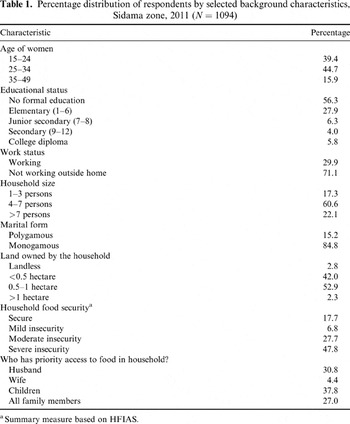
Table 1 presents the background characteristics of respondents. The age distribution of the women shows that the largest proportion of them (44.7%) are in the age group 25–34, followed by those in the age group 15–24 (39.4%). The distribution of respondents by educational status revealed that the majority of the women respondents had no formal education (56.3%) followed by elementary level education (27.9%), while the remaining women account for only a small proportion of the respondents. Most of the respondents (71.1%) reported themselves to be housewives (not working outside the household) and the remaining 29.9% were participating in income-generating activities during the survey. The average household size for the study population was 5.87.
Percentage distribution of respondents by selected background characteristics, Sidama zone, 2011 (N=1094)

a Summary measure based on HFIAS.
The analysis showed that 15.3% of the women were engaged in a polygamous marriage arrangement, which is slightly above the national average (the DHS 2005 reported 11% for the country). Land ownership by households in the study area was quite small and fragmented. Table 1 shows that more than 95% of the households owned less than one hectare of land. The distribution of household-level food insecurity showed that 82.3% of the respondents were living in households with mild to severe household food insecurity (Table 1).
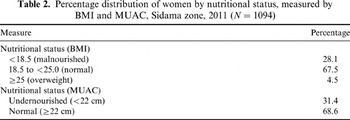
As described in the Methods section, the study used two established measurements as outcome variables: BMI and MUAC. Table 2 presents the distribution of the respondents using these two anthropometric measures. Based on BMI measures, 28.1% of the women were malnourished (BMI <18.5), 67.5% fell in the normal category (BMI 18.5 to <25) and a small proportion (4.5%) were found to be overweight (BMI 25 to <30) or obese (0.8%). The mean height for all women was 155.7 cm, mean weight was 47.9 kg and mean BMI was 19.32. Assessing maternal malnutrition by MUAC gave slightly different results: that is, the proportion of undernourished women increased to 31.4%. The mean MUAC for the sample women was 20.7. In fact, both measures show that about one-third of women in the sample are malnourished.
Percentage distribution of women by nutritional status, measured by BMI and MUAC, Sidama zone, 2011 (N=1094)

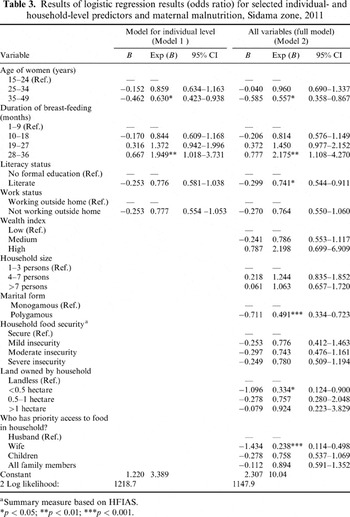
Table 3 presents the results of the logistic regression analysis. The MUAC was used as the dependent variable because it has been recommended for assessing malnutrition at the population level in serious food insecurity situations (Collins, Reference Collins1996) and is considered a practical alternative to BMI in multi-purpose surveys (Doocy & Burnham, Reference Doocy and Burnham2006). Two models are presented to clarify understanding of the factors associated with women's nutritional status in the study area: the individual model and the full model (individual plus household variables). In the individual model, four variables are included: women's age, work status, literacy status and duration of breast-feeding for the last child, whereas the full model contains individual- and household-level variables that are hypothesized to have some association with the dependent variable.
Results of logistic regression results (odds ratio) for selected individual- and household-level predictors and maternal malnutrition, Sidama zone, 2011

a Summary measure based on HFIAS.
*p<0.05; **p<0.01; ***p<0.001.
The results reveal that a woman's age is an important predictor of maternal nutritional status. Women in the age group 35–49 are 37% less likely to be malnourished compared with the reference category (age 15–24).
There is a strong association between duration of breast-feeding and women's nutritional status. As duration of breast-feeding becomes very long, the risk of maternal malnutrition becomes higher. With those who breast-fed for 1–9 months as the reference category, women who breast-fed their last child for 28–36 months are 1.95 times more likely to be malnourished compared with the reference category. The literacy status and work status of the respondents were insignificantly associated with maternal malnutrition in Model 1.
In the full model (Model 2), more household-level variables were added. The results show that women's age and duration of breast-feeding are still significant predictors of maternal malnutrition, while women's work status still shows an insignificant association. Literacy status of the respondent was a significant predictor in Model 2, where literate women were 24.9% less likely to be malnourished compared with women with no formal education.
In the full model, three additional household variables were found to be significantly associated with the dependent variable: marital form, land size and priority access to food in the household (representing intra-household food distribution). Women in the age group 35–49 were 44.3% less likely to be malnourished compared with the reference category. Those who breast-fed their last child for 28–36 months were 2.175 times more likely to be malnourished compared with the reference category.
Another variable included in the full model (Model 2) – marital form – showed a strong significant association with the dependent variable. First wives living in polygamous marriage were only half as likely to be malnourished compared with those in monogamous unions.
Those women who were living in households owning <0.5 hectares of land were 66.6% less likely to be malnourished compared with those living in landless households. However, the results did not show significant association for the remaining categories of land ownership. Finally, Model 2 showed a strong significant association between priority access to food in the household and maternal malnutrition. Keeping other things constant, women in households where wives were given priority access to food were 76.2% less likely to become malnourished compared with the reference category (households where husbands had first access to food).
Discussion
This study measured maternal malnutrition in rural Sidama, southern Ethiopia, using the two accepted yardsticks of BMI and MUAC, then examined the individual- and household-level risk factors associated with maternal malnutrition. Although there was relatively good agreement between BMI and MUAC in the current study, MUAC was used as the dependent variable in the logistic regression models since previous studies in Ethiopia demonstrated more difficulty in using BMI than MUAC, and that the prevalence of malnutrition between ethnic groups had less variation when estimated using MUAC compared with BMI (Teller & Yimer, Reference Teller and Yimar2000; Doocy & Burnham, Reference Doocy and Burnham2006).
One important finding of this study is that, based on BMI, the proportion of malnourished mothers in the study area is high and comparable to national-level statistics, i.e. that more than one in every four (27%) women of reproductive age in Ethiopia is undernourished (CSA & ORC Macro, 2005), twice the sub-Saharan average of 13.3% (Mukuria et al., Reference Mukuria, Aboulafia and Themme2006). The mean height of the sample women, which was 155.7 cm (with 25.3% <150 cm), is another indicator of severity of nutritional risk. A small-scale study in Kersa sub-district of Oromiya region showed that 35% of non-pregnant women in this south-western part of the country had a BMI lower than 18.5, indicative of poor nutritional status. The average height of these women was 155.5 cm and 20% of them were under 150 cm (Zerihun et al., Reference Zerihun, Larson and Hanley1997). Likewise, a study conducted near the current study area that used anthropometric measures to estimate the nutritional status of women found that 17% of the sample had a BMI below 18.5 (Gibson & Mace, Reference Gibson and Mace2006).
As expected, the multivariable analyses revealed that the two variables in Model 1 (age and duration of breast-feeding) were strongly associated with maternal malnutrition. Younger women in the age group 15–24 were more likely to be malnourished. This may be partly due to the fact that younger women build up fewer assets (such as land and employment) and may lack access to enough food in the household compared with the older ones. Demographic and Health surveys conducted in Burkina Faso, Ghana, Malawi, Namibia, Niger, Senegal and Zambia have likewise showed that a greater proportion of mothers aged 15–19 exhibit chronic energy deficiencies (Macro International, 2008). A study in Ethiopia showed that women in the youngest age group (15–19) and women in the oldest age group surveyed (45–49) were the most affected by undernutrition (Teller & Yimar, Reference Teller and Yimar2000). Analysis of the 2005 Ethiopian DHS data (Bitew & Telake, Reference Bitew and Telake2010) also confirmed that women (in Ethiopia) in the age group 15–19 were 1.4 times more likely to be at risk of undernutrition than older ones.
The results have documented that women who breast-fed their last child for 27–36 months were significantly more likely to be at risk for malnutrition compared with those who breast-fed their child for 1–9 months. Research findings agree that nutritional depletion of the mother can occur in prolonged lactation, especially if the practice is not accompanied by an appropriate balance of food for the mother. Conversely, prolonged breast-feeding may lengthen the birth intervals and delay the physiological drain of the next pregnancy.
The results of the study have shown that in Sidama breast-feeding is nearly universal, with more than 85% of mothers with children under 2 years of age breast-feeding during the survey, and a large proportion (86%) continuing to breast-feed their last child for two years or more. Because a large proportion (about 35%) of households were living with moderate to severe hunger (spending days and nights without food or sleeping without food), mothers were more likely to become malnourished as they continually breast-feed their child. This finding in no way calls for a reduction in breast-feeding duration, nor does it emphasize the disadvantages of breast-feeding. The WHO and UNICEF clearly recommend that breast-feeding for up to 2 years or beyond (WHO/UNICEF, 2003) should be promoted for its far-reaching importance as a source of nutrition and immune protection for the newborn, as well as for emotional bonding between the infant and mother. However, the mother's need for supplementary food and the necessity for her to have adequate quality and quantity of food should be given due attention.
In the full model (Model 2), four additional variables were found to be significantly associated with the dependent variable: literacy status, marital form, land size and priority access to food in the household (representing intra-household food distribution). The results indicate a negative relationship between literacy status and maternal malnutrition, with respondents who were literate being less likely to become malnourished. Previous studies also have documented that individuals who are younger and literate may have more exposure to media (printed and non-printed), which influence their behaviour in matters related to their own feeding and health (Begum & Sen, Reference Begum and Sen2009).
The first wife living in a polygamous marriage was 50.9% less likely to be malnourished compared with those in monogamous unions (however, only the first wife was surveyed in this study). Women in the polygamous system usually live with their children, and husbands join the household only on a part-time basis, and hence it is likely that such women have some level of independence to make household decisions, including feeding the family, purchase of household consumption items and financial issues. In the context of the study area, polygamous marriage survives in a situation where the polygamous husband has enough land and resources to enable him to marry additional wives. Because the families usually live in different compounds, women in such a system get relative independence and decision-making power, which also affects their ability to access food (Toru, Reference Toru2006).
A very striking result of the logistic regression analysis was the association between the priority access to food in the household and maternal nutritional status. About 30% of the husbands had priority for food in the household (n=338). The results suggest that in households where women had priority for food (n=47) there was a decreased likelihood of maternal malnutrition, indicating that husband dominancy was likely to be a major obstacle to ensuring a fairer distribution of food between household members. In the study zone, it is the custom that husbands are given priority in intra-household food distribution regardless of the amount of food available in the household. During seasons of acute food shortage within the household, women may stay without food as they give priority to their husband and children. Even during times of food surplus in the household, women usually eat their meals after their husband. In most cases, this may not be due to nutritional ignorance but often relates to tradition and to power relations within the household. Women with less influence or power within the household will be less likely to procure fair food distribution within the household.
Some variables that were found to be significantly associated with nutritional status in other studies were insignificant in this study. For example, household wealth was found to be an important predictor for malnutrition in some studies conducted in Ethiopia (Teller & Yimar, Reference Teller and Yimar2000; Girma & Genebo, Reference Girma and Genebo2002; Doocy & Burnham, Reference Doocy and Burnham2006). However, in the current study, the majority of the sample women were living in relatively poor households, making it difficult to see variations. Furthermore, husbands' education and occupation were found to have no significant relation to maternal undernutrition, and hence were excluded from the analysis. There are also variables that were not included in this study, but which may have their own impact on maternal nutritional status. For instance, women-headed households and place of residence were not included in this study because all data were collected from married and rural residents.
The study results confirmed the high proportion of malnourished mothers in the Sidama zone, which calls for more understanding of the problem by local and national governments. The study indicates the importance of encouraging the redistribution of available food within the family, ensuring that the poorest have the ability to obtain an adequate entitlement for food by expanding safety net programmes, and food supplementation to at-risk groups. There is also a need to improve maternal nutritional status prior to and subsequent to pregnancy (especially during the long period of breast-feeding). Priority for such interventions may need to be given to very young women who are more vulnerable to malnutrition.
Finally, because of the cross-sectional nature of the study, the underlying causes and mechanisms related to maternal malnutrition are difficult to establish. Despite these weaknesses, the present study has showed that there are certain individual- and household-level variables that predict maternal malnutrition: woman's age, duration of breast-feeding, literacy status, marital form, land size and intra-household food distribution. The study also concludes that maternal malnutrition is a serious problem in the study area and that there are contextual risk factors that could be addressed to partially tackle the problem. Since the study was based on a large sample (1094 women) selected randomly from Sidama zone, southern Ethiopia, its findings can be generalized to a larger, similar, population.
Acknowledgments
This research is fully sponsored by the third phase of a Norwegian government supported fund. The authors would like to express their heartfelt thanks to Hawassa University-NORAD Project for financial support. They also acknowledge the contribution of Mr Tafere G/Egziabher, Mr Girum Zigale and Yeshewafanos Kibe for co-ordinating and handling the field work. Finally, their appreciation goes to those men and women respondents who shared their precious time during the data collection period.