“Two Indians have been arrested, charged with voting illegally in the Town of Lenox [Madison County, New York]. It is understood to be a test case.”
Cazenovia Republican (Cazenovia, New York), March 15, 1877
“The motion has been made and the question is now presented, whether or not the Oneida Indians are citizens of the United States, and as such entitled to vote.”
Judge William James Wallace, United States v. Elm, December 24, 1877
Introduction
The year 1876 is best known for three events: numerous countrywide celebrations of American independence, culminating in the Philadelphia Centennial; the defeat of George Armstrong Custer and his entire cavalry company by Sioux and Cheyenne warriors at the Battle of Little Big Horn; and the disputed presidential election that catapulted Rutherford B. Hayes into the White House and formally ended Reconstruction. That same year, Abram Elm and Lewis Doxtator (also spelled Doxtater and Dockstader), Oneida Indians from central New York State, were arrested for voting in the twenty-third congressional district election. Their trial, United States v. Elm (1877), was the first federal case after the ratification of the Fourteenth Amendment to the Constitution in 1868 to examine whether American Indians were citizens under its meaning and were thus entitled to vote in a U.S. election.Footnote 1 It was held in Rochester, then the Northern District of New York, four years after Susan B. Anthony was tried by the same prosecuting attorney and convicted and fined in the same jurisdiction for voting illegally in the 1872 presidential election.Footnote 2
In a recent article in the Journal of the Civil War Era, the historian Stephen Kantrowitz wrote that “while the struggle over African American citizenship remains central to the history and indeed the national identity of the United States, the history of Native American citizenship remains almost invisible.”Footnote 3 Despite United States v. Elm’s significance, no scholar has previously focused entirely on the case, its origins, why the decision was rendered, or its short-term and long-term impact. Importantly, the Elm case cast a long shadow over U.S. Supreme Court decisions from Elk v. Wilkins (1884) right up to City of Sherrill v. Oneida Indian Nation (2005). From 1877 onward, briefs, motions, and decisions have cited Elm, focusing on questions of American Indian voting and U.S. citizenship, as well as on the rights of the Hodinöhsö:ni´ (or Haudenosaunee, also known as the Iroquois or the Six Nations) to bring land claims suits and have tax-exempt status on their lands.Footnote 4
By pushing for U.S. citizenship and the right to vote, Elm and Doxtator not only confronted white racism, but also diverged from the prevailing Hodinöhsö:ni´ attitudes of the time. Even today, chiefs on the Iroquois Grand Council at the Onondaga Indian Reservation consider the push for suffrage misguided. Numerous (but not all) Hodinöhsö:ni´ in New York, especially on the Onondaga and Tonawanda Seneca reservations, reject U.S. citizenship as well as the concept of dual citizenship, insisting that they are citizens of the Iroquois Confederacy and allies of the United States under the provisions of the Treaty with the Six Nations at Canandaigua, New York, in 1794.Footnote 5
In going to the polls in 1876, Elm and Doxtator were not denying their Oneida identity; they saw themselves as dual citizens advocating a different course of resistance in fighting the prevailing roadblocks placed on their own Native people. They carefully selected their only ballot choices, voting for the local congressman’s reelection, and not for either presidential candidate. Their decision to seek the right to vote by going to the polls was not altogether new in 1876: Oneida ideas about suffrage had been slowly evolving in the century after the American Revolution.
One Hundred Years of Oneida Existence, 1776–1876
In the federal Treaty of Fort Stanwix with the Six Nations in 1784, the United States defined the Oneida Indians’ homeland to be approximately six million acres in central New York State.Footnote 6 Despite the Oneidas’ significant role in aiding the American rebels in the Revolution, Albany officials—colluding with land-jobbers and transportation interests—began coveting Indian lands in central and western New York. Although the Trade and Intercourse Acts enacted by Congress from 1790 onward provided for federal supervision at treaty councils and formal approval of any accord involving land transactions between states or individuals and American Indian nations, these acts were mostly ignored.Footnote 7
With the Erie Canal’s construction through Oneida territory after the War of 1812, the white population in the heart of Oneida lands (Madison and Oneida Counties) grew exponentially, intensifying pressures on the Oneidas to leave the area. Faced with worsening economic conditions and unprotected by state and federal officials who encouraged removal, the vast majority of Oneidas left the Empire State.Footnote 8
The Oneidas were also weakened in dealing with these pressures because they were highly fractionated. Some pro-British Oneidas left with Mohawk war chief Joseph Brant for Ohsweken, Ontario, after the American Revolution. As early as 1805, those Oneidas remaining in New York agreed to partition their lands to temporarily settle internal political divisions that were getting out of hand. Despite this accord, the Oneidas continued to squabble. Later, after the federal treaty at Buffalo Creek in 1838, the Oneidas split even further. In four state treaties in the 1840s, they agreed to divide into three separate entities: in central New York, in Wisconsin, and in Southwold, Ontario.Footnote 9
The Oneidas had also faced significant assimilationist pressures over the centuries on top of these pervasive efforts to force them out of New York State. From the mid-seventeenth century to the time of Abram Elm’s birth, they had been exposed to the religious teachings of Jesuit Catholics, Anglicans, Baptists, Quakers, Presbyterians, Episcopalians, and Methodists. Madison and Oneida Counties had started to establish Indian district schools with an assimilationist focus in the 1850s. Moreover, many Oneida men, including Elm, were laborers in the wage economy—building and repairing canals, working in forest industries including logging, millwork, and potash production, and doing farm labor—and had therefore become dependent on whites for employment.Footnote 10
In an effort to promote the Oneidas’ absorption into the general body politic, the New York State legislature passed a bill in 1843 dealing with the allotment of the remaining Oneida lands in Madison and Oneida Counties. In this act, Albany legislators gave the Oneidas the “right” to accept allotment and sell off their lands if they so chose.Footnote 11 These allotted parcels, formerly tribal lands, now could be sold off by individual Indians. If the Indians accepted allotment, their lands would also be subject to state and local taxes, as well as sales for nonpayment. In 1847, another state law “allowed” individual Oneidas to deed lands in transactions supervised and witnessed by local justices of the peace.Footnote 12 Although these acts were not forcibly applied, many Oneidas—mostly out of financial necessity—sought fee simple patents on their land and agreed to allotment.
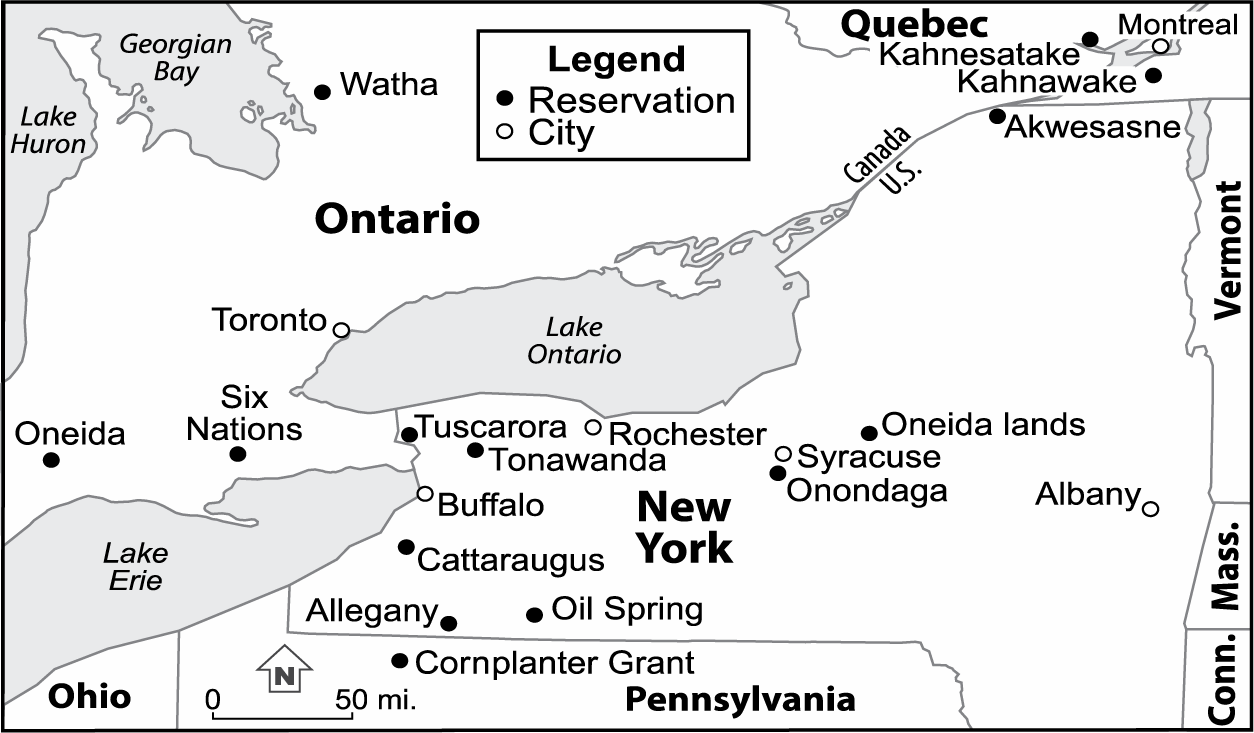
Those Oneidas who remained behind in the homeland resided on lands that had been reduced to approximately one half of one percent of their nation’s estate in 1783; thirty-one state treaties had resulted in their land loss.Footnote 13 By the middle of the nineteenth century in New York, two separate Oneida communities continued to exist three miles apart: at Windfall in the Town of Lenox in Madison County and at the Orchard, also known as Marble Hill, in Oneida County (fig. 1).Footnote 14 Importantly, both Abram Elm and Lewis Doxtator maintained residences within the Oneidas’ historic homeland at the time of their arrests.
Eastern Iroquoia, 1870. The place-name “Oneida lands” on the map refers to two Oneida Indian communities at the time: Windfall territory in Madison County and the Orchard (Marble Hill) territory in Oneida County, New York. Map by Joe Stoll.

By 1876, the American public had been conditioned to view the Oneidas as an antiquated race on the verge of extinction. Writers continually treated them as a people unable to withstand the inevitable march of “Progress.” After encountering three Oneida women near her home in Cooperstown, New York, Susan Fenimore Cooper, the first woman author of a major work in environmental literature and the daughter of the famous novelist James Fenimore Cooper, lamented in her 1850 classic Rural Hours that the Indian world was quickly fading away.Footnote 15 In 1860, the Gazetteer of the State of New York described the Oneidas as a “small remnant” of a once powerful nation that still managed to reside in the state. They were viewed as “ancient curiosities,” a race that had largely vanished from the face of the earth.Footnote 16 Fifteen years later, Luna Hammond, an author of a local history of Madison County, described the Oneidas in a similar vein. She claimed that they were mere vestiges of the past, slowly becoming extinct, although she acknowledged that these same Indians continued to speak their own native language. Hammond maintained that the Oneidas were interspersed with whites and faced “impending doom” brought about by the “evils of civilization.” To her, their only hope for survival was twofold—accepting the “benefits of civilization” and intermarrying with whites, since “their color, in a few generations, would disappear.”Footnote 17
These narratives, based on stereotypes and misconceptions, had little basis in fact, but they would affect Elm and Doxtator’s trial and strongly influence the judge’s decision in that they confirmed that Oneida identity indeed persisted. These Indians had retained their native language and continued to sell their traditional baskets, pots, and beadwork along with sassafras at local gatherings, county fairs, and tourist destinations like Saratoga Springs and Niagara Falls.Footnote 18 Each year they received their “treaty cloth,” dispensed by a federal Indian agent, which to them symbolized their continued separate status as well as their special relationship with Washington, cemented in two accords—the Treaty of Canandaigua (November 11, 1794) and the United States–Oneida Treaty (December 2, 1794).Footnote 19
From the mid-nineteenth century to Elm’s and Doxtator’s 1876 arrests, the Oneidas in central New York and their relatives in Wisconsin frequently petitioned the state legislature challenging the legitimacy of state treaties that Albany officials had made with them; however, each time these efforts failed.Footnote 20 Federal Indian agents in their annual reports to Washington continued to count Oneidas with other Six Nations Indians and comment on their “progress” toward “civilization.” In his report to the Indian affairs commissioner at the time of the Elm case, agent Daniel Sherman indicated that there were 249 Oneidas still in New York, with most residing in or near their two communities at Windfall and Marble Hill or on the Onondaga Indian Reservation.Footnote 21
The Two Oneidas
The federal census of 1860 lists Lewis Doxtator. He appeared to be successful, farming on twenty-seven acres of land valued at $1,600 in the town of Lenox. Besides raising corn, he had three milch cows and two pigs worth $75. By 1886, Doxtator was recorded as being fifty-five years of age, living in historic Oneida territory with his wife Mary and stepdaughter Susie. Unfortunately, we know little else about him.Footnote 22
By contrast, we know much about Abram Elm. He was a descendant of Pagan Peter, also known as Peter Elm, the son of the great Oneida Chief Good Peter. Most state and federal census records indicate that Abram was born in the town of Lenox in Madison County on May 15, 1842, whereas his military record lists him as being born in Canada. Whatever the case, his parents were born in the Oneidas’ central New York homeland and the federal judge in Elm accepted his birthplace as Lenox, Madison County, New York.Footnote 23 State treaties of the 1840s indicate that some of his family members did actually migrate out of central New York both to Wisconsin and to Ontario; others remained in the homeland after that date or subsequently relocated to the Onondaga Indian Reservation.Footnote 24 Indeed, it was not unusual for the Oneidas to move back and forth across the U.S.–Canadian boundary.
Elm’s name shows up for the first time in the 1865 New York State census. He and his wife Margaret (also known as Maggie Honyoust Cornelius) and their children also appear on the Office of Indian Affairs list of tribal members residing on Oneida lands in New York in 1886. Both Oneida Episcopalians, the couple were married in a Presbyterian church just off the Tonawanda Seneca Reservation in Akron, New York.Footnote 25 Throughout his life, Elm frequently sought work, mostly as a farm laborer, and lived in areas outside of the Oneida territory—at Caledonia in Livingston County, New York, at Wheatland in Monroe County, New York, at Rockwell Springs in Onondaga County, New York, on the Onondaga Indian Reservation, and as far away as Vermont.Footnote 26
Although we have no record of Elm’s life from the onset of the Civil War until the last month of the conflict, records show that on March 13, 1865, while in northeastern Bennington County near the border with Rutland County, Vermont, the twenty-two-year-old Oneida enlisted for three-year service in the Union Army and was assigned to Company B of the 5th Vermont Infantry Regiment. The unit was part of the much-heralded Vermont Brigade that had sustained heavy casualties throughout the war. Elm’s compiled military service record indicates that his enlistment was counted for the town of Woodstock, Vermont, and he is listed as a “substitute” for Edwin B. Batchelder of Peru, Vermont.Footnote 27
Elm’s late entry into the war and his status as a substitute indicate that his enlistment was probably the result of being in dire financial straits. Those individuals seeking substitutes generally paid $300 for a replacement, but in the last two years of the war, these soldiers could earn other bonuses from town and county boards as well as from state and federal governments. Elm also received a clothing allowance and arms totaling $31. Upon mustering out with the other company members on June 29, 1865, he received $80 service pay.Footnote 28
Despite his limited military service and his enlistment as a substitute, Elm was later accepted into and became a proud member of the Civil War veterans’ fraternal order, the Grand Army of the Republic (GAR), at its Caledonia, New York, post no. 235. One of his grandson’s earliest memories was attending Abram’s funeral in 1913 and noticing an American flag draped over his coffin, indicating his veteran status. Undoubtedly, his camaraderie with other veterans and their acceptance of him, an American Indian, as a full member of the GAR reinforced his optimism that American attitudes were changing, however incrementally. As a savvy Oneida, Elm surely also saw the value of his membership in this politically influential veterans’ organization.Footnote 29
U.S. Citizenship and American Indian Voting Rights in New York before the Elm Case
The push for United States citizenship and suffrage by some Hodinöhsö:ni´ was not new in the mid-1870s. As early as 1802, eight Oneidas had petitioned for U.S. citizenship (without success).Footnote 30 Twenty years later, in a case involving John Sagoharase, an Oneida veteran of the American Revolution, New York Supreme Court Justice Ambrose Spencer maintained that the Indian was a citizen subject to New York State laws, concluding that Sagoharase had the right to deed his property to the land speculator Peter Smith, the father of the famous abolitionist Gerrit Smith.Footnote 31 However, in Goodell v. Jackson (1823), the Court for the Correction of Errors reversed the decision. In his ruling, Chancellor James Kent extensively discussed the question of Indian citizenship and deemed them not citizens of New York State, but members of distinct tribes.Footnote 32 The New York State Chancellor’s Court in 1845 challenged Kent’s position in Strong v. Waterman, a case involving trespass on Seneca lands, stating in its opinion: “The laws of the State do not recognize the different tribes within our borders as independent nations, but as citizens merely, owing allegiance to the State government; subject to its laws, and entitled to its protections as such citizens.”Footnote 33 With this in mind, members of the New York State legislature in 1846 took up the question of Indian citizenship and debated a joint resolution calling for “extending the right of suffrage to the Indians of this State.” But the measure did not pass.Footnote 34
In the fervor for reform after the Civil War, new calls for Indian suffrage began to be heard—and not just in New York. The question of Indian citizenship arose during the heated debate in Congress over the Civil Rights Bill of 1866. It soon became a “conceptual dilemma” for the Republicans since the party had committed itself to birthright citizenship and African American suffrage.Footnote 35 Senator Lyman Trumbull of Illinois proposed that citizenship be provided to “all persons born in the United States, and not subject to any foreign power.” When his proposed amendment was vociferously challenged, since most feared it would naturalize all American Indians, Trumbull modified it: he offered up another proposal, one that would have provided citizenship to those Indians “who are domesticated and pay taxes and live in civilized society” and are “incorporated into the United States.” During debate, Senator Henry Lane of Kansas offered an amendment that called for allowing citizenship to those Indians who held their lands “in severalty by allotment.”Footnote 36 In the end, the Civil Rights Act that was later enacted by Congress proclaimed that “all persons born in the United States and not subject to any foreign power, excluding Indians not taxed, are declared to be citizens of the United States.”Footnote 37 Two years later, the ratified Fourteenth Amendment incorporated the distinction between Indians taxed and not taxed and declared in section one:
All persons born or naturalized in the United States, and subject to the jurisdiction thereof, are citizens of the United States and of the State wherein they reside. No State shall make or enforce any law which shall abridge the privileges or immunities of citizens of the United States; nor shall any State deprive any person of life, liberty, or property, without due process of law; nor deny to any person within its jurisdiction the equal protection of the laws.Footnote 38
On March 4, 1869, in his first presidential inaugural address, the newly elected Ulysses S. Grant specifically recommended that U.S. citizenship be awarded to American Indians.Footnote 39 The next year saw the ratification of the Fifteenth Amendment, which prohibited states from denying any U.S. citizen the right to vote based on race or color.Footnote 40 However, in the same year, the Senate’s Committee on the Judiciary insisted that tribal Indians had not in fact become citizens under the Fourteenth Amendment.Footnote 41
The convoluted movement for Indian citizenship in New York had nevertheless gained impetus by the ratification of these two new constitutional amendments. In New York, the state legislature soon began debating whether American Indians should be included in the population count for reapportionment purposes, and references to taxed and nontaxed Indians came up in the debate.Footnote 42 The call to award citizenship to American Indians had also gained some traction when Ely S. Parker, the prominent Tonawanda Seneca sachem whom President Grant appointed commissioner of Indian affairs in 1869, favored citizenship.Footnote 43 By the time Elm and Doxtator were arrested, newspapers were featuring stories about state officials who favored extending citizenship and voting rights to American Indians.Footnote 44
Thus, it was no coincidence that some Oneidas—taxpaying Indians and proud veterans or their descendants of America’s wars since 1776—began to favor U.S. citizenship and demanded the right to vote. By the mid- and late 1870s, unlike most Hodinöhsö:ni´, they increasingly saw themselves as dual citizens and, as a result, participated in numerous events with their non-Indian neighbors, including those celebrations related to the centennial of the American Revolution. They pointed back with pride to August 1777, when their grandfathers had helped Generals Herkimer and Arnold stop the British advance to Saratoga at the Battle of Oriskany.Footnote 45
The Election of 1876 and the Hodinöhsö:ni´
United States v. Elm coincided with one the most disputed presidential elections in American history. Samuel J. Tilden, the Democratic governor of New York, won the popular vote, but disputes over nineteen electoral votes in Florida, Louisiana, and South Carolina led to secret and controversial political dealings, usually referred to as the “Compromise of 1877” that helped elect Rutherford B. Hayes. However, the two Oneidas who were arrested for voting in 1876 had not gone to the polls to vote for either of the two presidential candidates.
The Hodinöhsö:ni´ viewed Hayes’s candidacy through the lens of his predecessor. Despite Grant’s appointment of Parker as Indian affairs commissioner, his promise to extend citizenship and suffrage to American Indians, and his “Peace Policy” initiative (which aimed to increase missionary and reformer involvement in Indian affairs to rid out rampant corruption), had largely failed by the time Custer was defeated in June 1876.Footnote 46 Indeed, Grant’s two administrations were marred by increased violence on the frontier, including massacres of Piegans along the Marias River in Montana in 1870 and Apaches at Camp Grant in Arizona in 1871, as well as wars with the Apache, Cheyenne, Comanche, Modoc, and Sioux peoples.Footnote 47
The Hodinöhsö:ni´ in particular had good reason to be perturbed by the two Grant administrations. Commissioner Parker’s power was slowly eroded when Congress gave the newly created U.S. Board of Indian Commissioners oversight authority over all the financial dealings of the Office of Indian Affairs. Late in 1870, William Welsh, the board’s chairman, accused Parker of “frauds in the purchase of goods for the Indian service,” claiming that the commissioner had violated the Indian Appropriations Act of 1870.Footnote 48 The accusations prompted a formal congressional investigation about Parker’s handling of Indian affairs. Parker, who had played a major role in saving the Tonawanda reservation in the 1840s and 1850s, was declared innocent of all charges in the end, but not before the proud Seneca was humiliated and subjected to racist jibes by members of the Board of Indian Commissioners, as well as by members of the congressional committee, all of which led to his resignation in July 1871.Footnote 49 The indignities heaped on Parker were not lost on the his fellow Hodinöhsö:ni´.
In the same year as Parker’s resignation, much to the regret of most Hodinöhsö:ni´, Congress passed an act ending the U.S. government’s formal treaty-making with Indian nations.Footnote 50 The enactment stymied Hodinöhsö:ni´ efforts to use the treaty route to seek compensation for federal failures to live up to the obligations set forth in the Buffalo Treaty of 1838, specifically about lands set aside for the Six Nations in Kansas, then part of Indian Territory.Footnote 51 Although Parker had favored ending future treaty-making, he supported honoring past treaty obligations and continued to back Hodinöhsö:ni´ in their Kansas claims until his death in 1895. While Parker’s advocacy of dual citizenship and an end to Indian treaty-making went against the conservative thinking of other Iroquois Grand Council sachems, some Hodinöhsö:ni´ found his positions somewhat excusable in light of his past efforts to save the Tonawanda Reservation.Footnote 52
Notwithstanding the Hodinöhsö:ni´s’ negative view of Hayes and the Republican Party in the 1876 presidential election, they were also suspicious of Tilden, the Democratic candidate. Tilden was a reformer and had exposed the corruption by state and local officials in building New York’s elaborate canal system, but his political career began as a Jacksonian Democrat. He and his father Elam had been members of Martin Van Buren’s Bucktail political machine that had helped push removal of Indians from New York State in the late 1830s.Footnote 53 Indeed, since the administrations of George Clinton, New York State’s first governor from 1777 to 1795, the Oneidas (and other members of the Six Nations) distrusted Albany’s politicians and saw them as a threat to their landholdings and their resources.Footnote 54 Thus, instead of going to the polls to vote for president, the two Oneidas decided to vote only in the local congressional election.
The election for a seat in the forty-fifth Congress was hotly contested between two former judges: the Republican William Bacon and the Democrat Scott Lord, the incumbent congressman. Bacon, a strong advocate of temperance, was a descendant of the Reverend Samuel Kirkland, the controversial missionary to the Oneidas.Footnote 55 Kirkland had made promises to the Oneidas not to seek or acquire any of their territory. However, Albany officials had awarded Kirkland and his two sons several thousand acres, including what later became Hamilton College, for helping New York State obtain Oneida lands in a series of questionable state treaties. Kirkland had also worked for the land-jobbers Oliver Phelps and Nathaniel Gorham, and was rewarded for facilitating their efforts to secure a sizeable chunk of Hodinöhsö:ni´ territory.Footnote 56 In addition, Oneida chiefs had supported Kirkland’s educational efforts to found the Hamilton-Oneida Academy in 1792–93, whose initial mission was to educate members of the Six Nations; however, despite Kirkland’s promises, few Indians ever attended (and none after 1808).Footnote 57 Thus, it is little wonder why the Oneidas disdained Kirkland and his descendants.
Bacon was to defeat the Democrat, Scott Lord, the son of Dartmouth College president Nathan Lord.Footnote 58 Scott Lord had been a member of the American Party, the Know-Nothings, was then a Whig, and finally became a Democrat. Elm’s and Doxtator’s support for his candidacy may have been influenced by the congressman’s record in the House of Representatives during the second Grant administration: Lord had been on the House committee that recommended the impeachment of Secretary of War William Belknap for accepting payments from John Evans, the post trader at Fort Sill in the Indian Territory.Footnote 59 In addition, Congressman Lord had introduced a resolution in the House calling for the punishment of anyone resorting to violence to stop “the free exercise of the right of suffrage in any State.”Footnote 60
The Arrests and the Trial
To understand why Elm and Doxtator were imprisoned for illegally voting, one also needs to examine the local and state elections that occurred the year before their arrest. In November 1875, some Oneidas went to the polls to elect local Democratic candidates.Footnote 61 They were subsequently arrested. The debate over these arrests and over Indian citizenship more broadly became a hotly debated issue in the press. According to the Oneida Democratic Union newspaper:
Those thus engaged and who would deny the Indians of the county the rights of citizenship, are the very men, most ardent in pressing forward every negro [sic] whose vote they are to, manipulate and this too, when it is a known fact that several Indian voters pay taxes on real estate, while on the other hand, we believe that of the several negroes [sic] who cast their votes at our polls in November, not one pays a cent of taxes. Such unfairness can not [sic] fail to bring down just public indignation.Footnote 62
In sharp contrast, the Cazenovia Republican printed that the only reason the Oneida Democratic Union supported the Oneidas’ right to citizenship and suffrage was because they voted for Democratic candidates. A Cazenovia Republican reporter sarcastically commented, “Perhaps that is sufficient in these days of reform.”Footnote 63
In November 1876, Elm, along with Doxtator, decided to go down to the local polling place to cast their votes for Congressman Lord. After doing so, the two Oneidas were taken before the elections commissioner, who ordered the local constable to arrest them. Both men were then brought before a local magistrate, who set their bail at $500 each. Neither of the two men could pay such high bail, and as such, they were remanded to a jail in Utica, New York. They were subsequently indicted and convicted for the crime of illegally voting.Footnote 64
An attorney named Matthew Shoecraft, a senior partner in the law firm Shoecraft, Bennett, and Tuttle in Oneida, New York, represented the men. He soon appealed the local magistrate’s decision, and he brought the case into federal court since it dealt with a constitutional issue. The son of a famous mathematician, Shoecraft was a graduate of Union College. He was one of the most prominent residents in the region, and his beautiful Italianate home on Main Street in Oneida’s historic district still stands. However, Shoecraft was much more than just another successful local attorney. After his schooling in engineering, and subsequently reading law and establishing his law practice, he was elected mayor of Oneida. In the ensuing years, the Democrats nominated him for district attorney, a judgeship, a seat in the state assembly, and even Congress. By 1876, he had become the president of the Oneida Tilden Club, actively campaigning in the New York State governor’s presidential campaign. He later became a successful venture capitalist, investing in gold mines and railroads from West Virginia to California.Footnote 65
The case reached the federal district court for the Northern District of New York, then in Rochester, in the early spring of 1877. The judge, William James Wallace, suspended making a final decision, but asked the two opposing attorneys to submit briefs to help him decide the constitutional question about Indian suffrage. At this preliminary hearing, Shoecraft represented Elm and Doxtator, who had the added benefit of an Indian interpreter as well as the support of an Oneida Indian chief who had journeyed all the way from Wisconsin.Footnote 66
Richard Crowley, the United States attorney for New York’s Northern District, who had prosecuted Susan B. Anthony for voting, opposed Shoecraft at trial. Crowley, a Republican from Lockport, New York, had previously been a New York State senator before President Grant appointed him U.S. attorney. He served in that capacity until 1879, when he was elected to Congress.Footnote 67 While Shoecraft argued that the franchise should be extended to taxable Indians, Crowley resurrected Chancellor Kent’s opinion in Goodell v. Jackson, deeming them once again noncitizens.Footnote 68
When the trial began, the Oneida Dispatch newspaper commented that United States v. Elm was more than simply a case of individuals illegally voting. According to the Oneida Dispatch reporter, Judge Wallace saw the case’s historic significance, calling it “one of importance and a novel question.”Footnote 69 President Grant had appointed Wallace to the bench in 1875. Born in Syracuse in April 1837, like William Bacon, he was a graduate of Hamilton College. After receiving his legal training, Wallace went on to practice law in Canastota, near Lenox. He later became a partner in the firm Roger, Wallace, and Jenney in Syracuse. Running on the Republican ticket, he was elected mayor of Syracuse in 1874. The judge, a fiscally conservative member of Roscoe Conking’s Stalwart faction of the Republican Party, would go on to have a long and distinguished judicial career.Footnote 70
Wallace took the case under advisement, refusing to make a quick ruling. He realized that the case raised a constitutional issue and told the attorneys that “this was a test question merely and no punishment would follow,” even if the court determined that “the defendants were not citizens and consequently not entitled to vote.” Wallace then asked the attorneys on both sides to prepare written arguments about whether the defendants were entitled to vote and to submit their briefs at the court’s next term.Footnote 71
After the briefs were submitted, Wallace resumed the federal case in November 1877. The judge referred to the both the Civil Rights Act of 1866 and the Fourteenth Amendment, which had excluded “Indians not taxed” from citizenship and suffrage. However, Wallace insisted that states set forth voting requirements, and that it was insufficient for a federal court to confer citizenship on an Indian born in the United States unless the individual had previously been subject to the state’s jurisdiction and laws, including its requirements for voting. Wallace then pointed out that New York State’s constitution allowed suffrage to any twenty-one-year-old male who had been a citizen for ten days prior to voting and had resided in the state for one year, the county for four months, and the election district for twenty days prior to the date of an election.Footnote 72
At the federal district court, Crowley argued against Indian citizenship and the right of suffrage, citing Kent’s opinion in Goodell v. Jackson. The judge, however, rejected this argument outright, insisting that circumstances had changed since the 1820s. Wallace continued, “As the State and the United States can impose upon them all the duties and obligations of subjects [for example, taxation and laws], they are entitled to the corresponding rights which spring from that relation. These are the rights which a government owes to its citizens.”Footnote 73
Wallace then reflected on whether Oneida tribal existence persisted in New York. If it no longer existed, then that would support the conclusion that the two defendants were citizens of the state, and therefore that Kent’s 1823 opinion would not apply. Like most New Yorkers at the time, Wallace saw Indians in Darwinian fashion (to wit, as relics of a distant past). Yet he viewed the Oneidas—unlike the Plains and Southwestern Indians, who were still militarily resisting American expansion—as having evolved from the “stage of barbarism,” now being taxpayers who owned private property. He insisted that the Oneidas had come under the New York State Allotment Act of 1843 that allowed them “to purchase, take, hold, and convey real estate, and when they became freeholders to the value of $100, they became subject to the civil jurisdiction of courts of law and equity in the same manner and to the same extent as citizens.”Footnote 74
Apparently relying on the writings of Luna Hammond, the judge noted that there were merely twenty Oneida families living in the vicinity of their original reservation. He maintained that they no longer constituted a community and that in “religion, customs, in language, in everything but the color of their skins, they are identified with the rest of the population.” Wallace then questioned whether the Oneidas in New York still had a system of governance, since he claimed that only one chief showed up every year to collect treaty annuities. As further proof of his reasoning, the judge asserted that most Oneidas had left the state, that the majority were now residing in Wisconsin, and that the remaining families had no separate tribal status since they had been placed by New York State “upon an equality with its citizens respecting important rights denied to aliens.”Footnote 75 Thus to Wallace, Elm and Doxtator had been improperly arrested since they were eligible voters, subject to New York State taxes, and citizens of the United States protected under the Fourteenth Amendment. Despite this ruling, which overturned the convictions and extended citizenship rights to these two American Indians, the judge’s opinion was to plague the Oneidas in their legal battles well into the twenty-first century.
The Aftermath
Seven years later, the U.S. Supreme Court cited the Elm case in Elk v. Wilkins (1884). John Elk, who had been born on Winnebago Indian lands in Nebraska, had attempted to register to vote, but was denied this right by Charles Wilkins, the registrar of voters for the fifth district in the city of Omaha. Unlike Elm, Elk had renounced his tribal affiliation and lived apart from his native people. Elk maintained that he was a U.S. citizen deprived of his right to vote under the Fourteenth and Fifteenth amendments. Unlike Elm and Doxtator’s criminal case, Elk’s was a civil action in which he sought $6,000 in damages.Footnote 76
Once again, the question arose as to whether American Indians had been made citizens under the Fourteenth Amendment. On Nov. 3, 1884, the Supreme Court, by a vote of 7 to 2, decided that Elk was not due any compensation. Justice Horace Gray’s majority opinion stated that Elk was not a U.S. citizen because he owed his allegiance at the time of his birth to his Winnebago tribe. Gray concluded that, under the first section of the Fourteenth Amendment, an American Indian did not simply become an American citizen at birth or by leaving his reservation and residing among white people. However, in the important dissenting opinion, Justice John M. Harlan rejected this argument, tracing congressional intent from the Civil Rights Act of 1866 onward. Harlan maintained that Elk was indeed a citizen since he was born within a territory or state of the United States, owed no allegiance to any foreign power, and paid taxes.Footnote 77 Three years later, in 1887, Congress passed the Dawes General Allotment Act, which “rewarded” American Indians with U.S. citizenship, but only if they accepted fee simple title—namely, private not tribal ownership of land ownership following a twenty-five-year trust period. In the Burke Act of 1906, Congress began eliminating this trust period. The establishment of federal competency commissions before, during, and immediately after World War I further tied citizenship and suffrage to Washington’s official allotment policies.Footnote 78
At the state and local levels, Judge Wallace’s decision clearly affected Indian voting in the Empire State. On July 11, 1888, before a New York Assembly committee investigating the so-called “Indian problem,” an Oneida from the Marble Hill community testified that he and others had been voting in elections for the past decade.Footnote 79 At the same hearing, Spencer B. Stafford, a non-Indian who was serving as the local justice of the peace and who had formerly been the Oneidas’ tribal attorney, responded to a question about citizenship posed to him by the committee’s attorney. Citing Judge Wallace’s decision in the Elm case, Stafford maintained that the Oneidas were citizens of the United States and that “they vote here.”Footnote 80
The Oneidas’ and other Indians’ right to vote, nevertheless, continued to be challenged in New York State. In 1889, Charles F. Tabor, the New York State attorney general, issued an official opinion that once again cited Kent’s 1823 Goodell v. Jackson decision. Tabor denied citizenship and with it voting rights to both taxed and untaxed Indians.Footnote 81 However, in an official opinion in 1896, New York State Attorney General T. E. Hancock, resurrecting Judge Wallace’s decision in Elm, extended citizenship and voting rights to taxpaying Indians. Hancock rejected Tabor’s opinion, referring to Kent’s decision “as an exception to the general rule.” Hancock concluded that “where remnants of a tribe no longer constitute a nation or community, but have become scattered and incorporated among the whites, subject to the same laws as native born or naturalized citizens, and acknowledging their allegiance to the government of the United States, they must be considered as standing upon an equality with other citizens, in all respects, and entitled to vote under the laws of this State.”Footnote 82
In World War I’s aftermath, a diverse national movement promoted universal Indian citizenship—including reformers intent on protecting Indians’ rights under the laws of the United States, individuals encouraging the Indians’ assimilation into mainstream American life, and members of the Society of American Indians founded in 1911. The Indian Citizenship Act (also known as the Snyder Act, for the Republican New York congressman Homer P. Snyder, who proposed it) passed Congress and was signed into law by President Calvin Coolidge in 1924, granting all American Indians U.S. citizenship.Footnote 83 Despite this legislation and the landmark case of Harrison v. Laveen, decided in Arizona in 1948, several states continued to deny Indians the right to vote well into the 1950s. Other states, such as North Dakota, continued to place roadblocks to Indian voting, including as recently as the 2016 presidential election.Footnote 84
Since the end of the second decade of the twentieth century, the Elm case has been used in specious efforts in federal courts in attempts to stymie Oneida land claims and torpedo their assertions of tax-free status. Attorneys opposing the Oneidas have selectively used Wallace’s words, even though the circumstances were far different from those at the time of the 1877 decision. In briefs and motions as well as at trial, they have argued that reservation lands had been disestablished by allotment policies and by the selling off of former reservation lands after the New York State Allotment Act of 1843. They have quoted Judge Wallace’s ruling to back claims that the Oneida Nation no longer existed as a federally recognized tribe in New York. As recently as 2003, Ellsworth Van Graafeiland, one of three judges on the Federal Court of Appeals for the Second Circuit, cited Wallace’s argument in a case (Oneida Nation v. Sherrill) involving Oneida tax exemption claims on lands that they had reacquired within their historic territory. The Oneidas, nevertheless, insisted that the reacquired land and enterprises they established on it were not subject to local and state taxes.Footnote 85
While the federal decisions have rejected Wallace’s argument each time since 1920, the Supreme Court nevertheless in 2005 denied the Oneidas’ claim to tax exemption on those reacquired lands in an 8 to 1 decision. The majority opinion, written by Justice Ruth Bader Ginsburg, pointed out that the city of Sherrill and its environs “are today overwhelmingly populated by non-Indians,” and that extending Oneida jurisdiction would create a serious burden on the state and local governments as well as on local landowners. Justice Ginsburg also added that the Oneidas had circumvented the existing processes in failing to petition the Department of the Interior to put these lands in trust—the proper avenue “to reestablish sovereign authority” over this territory.Footnote 86
Conclusion
Whereas Washington and Albany policymakers saw extending U.S. citizenship as a way of dispossessing Native peoples of their land, dissolving their tribal governments, and absorbing them into the American body politic, the two Oneida defendants in United States v. Elm saw citizenship and the right to vote very differently. They were proud Hodinöhsö:ni´ who were attempting to remain Oneida, while recognizing that to do so, they had to make compromises. By not voting for either presidential candidate, and voting only for Congressman Scott Lord’s reelection, the two savvy Oneidas were actually rejecting both Tilden and Hayes—Tilden because of his past Indian removal stance and his ties to Albany’s power structure, which was often in conflict with the Hodinöhsö:ni´ interests; and Hayes because his Republican Party during the previous Grant administrations had failed to stem frontier violence and had allowed Commissioner Ely Parker to be run out of office. In their participation in the election, their support for Congressman Lord (who had pushed suffrage and even attempted to stem corruption in the Indian Office), and their rejection of William Bacon (a descendant of the controversial missionary Samuel Kirkland), Elm and Doxtator were making a conscious decision and demonstrating their convictions—not abandoning their beliefs in Oneida nationhood.
The two Oneidas’ push for U.S. citizenship and suffrage were acts of courage going against prevailing attitudes, be they in Albany, in Washington, DC, or on reservations in New York State. Although they were not great warriors of old, Elm and Doxtator understood that the Oneidas’ strategy of allying themselves with the United States in the Revolution and in the War of 1812 had failed miserably. They recognized the need to devise some new way to save what was left of the quickly vanishing Oneida world in central New York, but their attempt to do so went astray when Judge Wallace denied the Oneida Nation’s continuing existence in the state. Worse yet, the judge’s opinion was later appropriated by attorneys and jurists to challenge Oneida land claims and tax status right up into the twenty-first century.
Abram Elm died on April 23, 1913, and was buried at Glenwood Cemetery in the city of Oneida.Footnote 87 Much like Susan B. Anthony, Elm had gone against the grain, challenging faulty assumptions, misconceptions, and stereotypes. Although he was affected by the assimilationist pressures of the day, Elm never rejected being Oneida, and his ideas about dual citizenship lived on with his descendants, including his grandson, the late Ray Elm, an expert on Hodinöhsö:ni´ culture, history, language, and traditions. Despite serving as the Oneida representative on the Iroquois Grand Council at Onondaga, Ray Elm went to the polls to vote every election day. It was his way of honoring his grandfather’s memory.Footnote 88
Acknowledgments
The author would like to acknowledge the role of two Oneidas in helping him to understand the life of Abram Elm: the late Ray Elm, Abram Elm’s grandson, who lived on the Onondaga Reservation; and the late L. Gordon McLester III, a Wisconsin Oneida community historian. He would also like to thank Dr. James Folts of the New York State Archives in Albany for providing information about the history of the courts in nineteenth-century New York State.