Children's ability to tolerate waiting for rewards is believed to depend to some extent on their skill at emotion regulation (Kopp, Reference Kopp1989). Emotion regulation is thought to require the initiation of strategies, such as distracting oneself from a desired but restricted object or activity, that should modulate frustration associated with being unable to attain what is desired (Calkins & Hill, Reference Calkins, Hill and Gross2007; Kopp, Reference Kopp1989). Development of the ability to initiate strategies to regulate emotion is regarded as a key feature of early childhood emotional competence (Blair & Raver, Reference Blair and Raver2015; Denham, Reference Denham2006). The limited longitudinal evidence supporting these views is based on variable-centered approaches that assume emotion regulation development during the toddler and preschool years follows more or less the same developmental pattern across children (e.g., Cole et al., Reference Cole, Tan, Hall, Zhang, Crnic, Blair and Li2011). If certain groups of children follow unique pathways and evidence distinct patterns of growth in emotion and strategy use aspects over the course of early childhood, variable-centered approaches may obscure the true nature of variation in emotion regulation development.
From a developmental psychopathology framework, it is necessary to address the possibility that there are multiple pathways with qualitatively distinct developmental patterns to a given outcome (Cicchetti & Rogosch, Reference Cicchetti and Rogosch1996). Some groups of children may behave differently initially and yet reach similar levels of skill at a later age point (e.g., Montroy, Bowles, Skibbe, McClelland, & Morrison, Reference Montroy, Bowles, Skibbe, McClelland and Morrison2016; Wanless et al., Reference Wanless, Kim, Zhang, Degol, Chen and Chen2016). Other groups of children may not differ markedly from each other initially, and yet each follows a different developmental path, one perhaps deviating from a more typical path. Identification of subgroups that follow qualitatively distinct pathways may inform the varied ways that emotion regulation develops, including developmental pathways that lead toward and away from competent emotion regulation. Such evidence may suggest age points for pathway-specific opportunities to foster healthy emotion regulation, which could lead to more person-tailored preventive interventions than are currently available.
Understanding individual pathways to emotion regulation development requires attention to two critical issues. First, appreciation of unique developmental patterns and pathways requires a shift from a focus on variables to individuals, that is, person-centered approaches (Bergman & Magnusson, Reference Bergman and Magnusson1997; Block, Reference Block1971; Cicchetti & Rogosch, Reference Cicchetti and Rogosch1996). Second, there is a need to operationally define emotion regulation in ways that are consistent with its conceptualization. One conceptualization posits that emotion regulation entails the behaviors, skills, and strategies children use to modulate their experience of emotion and its expression (Calkins & Hill, Reference Calkins, Hill and Gross2007). Modeling emotion regulation development, then, requires measurement based on a set of variables reflective of these varied aspects. In this study, we modeled emotion regulation as children's angry reactions to being required to wait as well as recruitment of executive attention (strategic use of distraction) and language (verbal bids to parent about the demands of waiting) skills. Using multiple indicators to define emotion regulation pathways may afford investigation of how specific indicators (e.g., anger expression and strategy use) of early childhood emotion regulation develop more rapidly or slowly for different children. If a person-centered approach detects meaningful variability in emotion regulation development, then identified pathways should also be associated with theory-based developmental antecedents and outcomes (Calkins & Johnson, Reference Calkins and Johnson1998; Kopp, Reference Kopp1989).
This study used a person-centered approach to identify distinct pathways in emotion regulation development based on age-related changes in young children's anger expression and strategy use. Pathways were then related to theory-driven antecedents and outcomes. In particular, the study tested the effects of a key intrinsic factor (children's language skill) and extrinsic factor (parenting practices that capitalize on children's language) on the likelihood of following certain pathways. Finally, the study tested whether these pathways predicted early school-age externalizing behavior outcomes.
The Development of Early Childhood Emotion Regulation
Children's ability to autonomously modulate anger expression is thought to develop during the toddler and preschool years (Calkins & Hill, Reference Calkins, Hill and Gross2007; Kopp, Reference Kopp1989). Supporting evidence is generated by using tasks that block a goal, frustrating children's desire for rewards by requiring them to wait for a snack or a gift. Two putative strategies, presumed to help children deal with the frustration of waiting, are common in the study of children's ability to wait: calm bids about the demands of the challenging situation (e.g., “Mom, I can have it once you are done, right?”) and distraction (e.g., shifting attention away from the desired object and becoming absorbed in a different, appropriate activity). Calm bids entail the use of language to seek support or information about the source of children's frustration (i.e., the restricted object, the boring nature of waiting, and the limited availability of the parent's attention). Bidding calmly indicates a child is using words to express needs and concerns rather than venting angrily (Cole et al., Reference Cole, Tan, Hall, Zhang, Crnic, Blair and Li2011). Distraction indicates the use of executive attention, that is, controlling the direction of attention (Jones, Rothbart, & Posner, Reference Jones, Rothbart and Posner2003). Distraction helps a child tolerate waiting by shifting attention away from the restricted object and focusing it on an activity that absorbs attention, reducing the salience of a source of frustration (Kochanska, Coy, & Murray, Reference Kochanska, Coy and Murray2001; Peake, Hebl, & Mischel, Reference Peake, Hebl and Mischel2002). Both calm bids and distraction are considered appropriate and effective strategies in waiting tasks (Gilliom, Shaw, Beck, Schonberg, & Lukon, Reference Gilliom, Shaw, Beck, Schonberg and Lukon2002; Silk, Shaw, Forbes, Lane, & Kovacs, Reference Silk, Shaw, Forbes, Lane and Kovacs2006).
Kopp (Reference Kopp1989) posited that most children begin to deploy such strategies less reflexively, with more volition and without adult instruction, around their third birthday. Between ages 24 and 36 months, the average child begins to self-initiate calm bids and distraction more quickly and for longer periods during a wait, while anger expressions take longer to appear and last for shorter periods of time (Cole et al., Reference Cole, Tan, Hall, Zhang, Crnic, Blair and Li2011). However, for some young children, anger reactivity persists into the preschool and elementary years (Calkins & Keane, Reference Calkins and Keane2009; Gilliom et al., Reference Gilliom, Shaw, Beck, Schonberg and Lukon2002). Developmental patterns of self-initiated strategy use for anger-reactive children are not yet well understood.
Individual Differences in Early Childhood Emotion Regulation Development
Research on individual differences in the early development of emotion regulation generally relies on variable-centered designs that demonstrate how children in a sample vary around the hypothetical “average” child's developmental patterns. If there are distinct pathways (e.g., at risk) in a sample, variable-centered aggregation across individuals may overlook important differences and limit conclusions (von Eye & Bogat, Reference von Eye and Bogat2006). For example, two children may vary in the timing of the emergence of a skill set and yet both ultimately achieve it, demonstrating the principle of equifinality. That is, one child may demonstrate precipitous growth in emotion regulation skill early in development and then show a leveling off, while another child exhibits slower, steady growth across the early childhood years (e.g., Montroy et al., Reference Montroy, Bowles, Skibbe, McClelland and Morrison2016; Wanless et al., Reference Wanless, Kim, Zhang, Degol, Chen and Chen2016). Although both children develop emotional competence, each represents a different pathway of development with distinct antecedents and outcomes. Other children may appear on a similar path at a given age point but, over the months and years, deviate from each other, with one pathway possibly signaling risk for psychopathology. This would be indicative of the principle of multifinality (Cicchetti & Rogosch, Reference Cicchetti and Rogosch1996). Thus, pathways toward and away from competent emotion regulation may exhibit unique patterns and reflect distinct groups of children, a facet best captured by person-centered analysis.
The study of early childhood emotion regulation has also been limited by overreliance on single indicators, usually emotion expression (Cole, Martin, & Dennis, Reference Cole, Martin and Dennis2004). When made to wait for a desired object, children's emotion regulation entails not just how frustrated they become but also whether they deploy strategies. Recent advances in person-centered approaches can capture this developmental variation across multiple indicators (e.g., anger expression as well as strategy use). Using multiple indicators may be clinically informative, possibly differentiating among anger-reactive children who are concomitantly less able to use effective strategies (perhaps indicative of risk for behavior problems) from those children whose strategy use develops more slowly but successfully.
Multitrajectory modeling (MTM; Nagin, Jones, Lima Passos, & Tremblay, Reference Nagin, Jones, Lima Passos and Tremblay2016) is a person-centered form of longitudinal data analysis that is well suited for the proposed examination. MTM is a recent extension of group-based trajectory modeling (Nagin, Reference Nagin2005). Group-based trajectory modeling identifies subgroups of individuals in a sample who share similar patterns of development in a given indicator of a construct of interest. The MTM extension also classifies individuals, but on the extent to which they demonstrate similar patterns of development across multiple indicators of a specific construct over time (Nagin et al., Reference Nagin, Jones, Lima Passos and Tremblay2016). MTM may identify subgroups of children that follow different emotion regulation pathways, which we operationally define as coordinated development across multiple indicators (e.g., anger expression, calm bids, and distraction) of early childhood emotion regulation. MTM can also determine whether identified pathways have similar or divergent origins and end states insofar as pathways are predicted by and predict theory-driven antecedents and outcomes, respectively. Thus, MTM and follow-up predictor analyses can jointly describe where different subgroups of children in a sample begin and how they develop toward or away from competent emotion regulation.
Antecedents of Emotion Regulation Pathways
Kopp (Reference Kopp1989) proposed that intrinsic cognitive factors, such as early childhood language skills, and extrinsic factors, such as parenting behaviors, interact to influence the development of emotion regulation in early childhood. This postulate has not been tested empirically in longitudinal analysis. If a person-centered approach can identify meaningful patterns of emotion regulation development in early childhood, then language skill and parenting behavior should be related to those patterns in a predictable fashion.
Expressive language in early childhood appears to contribute to how quickly children develop skill at regulating frustration associated with waiting (Roben, Cole, & Armstrong, Reference Roben, Cole and Armstrong2013). Expressive language may aid emotion regulation in varied ways (Cole, Armstrong, & Pemberton, Reference Cole, Armstrong, Pemberton, Calkins and Bell2010). Using words should reduce reliance on nonverbal angry reactions to communicate their needs. It should also enhance attempts at distraction, enriching alternative activities such as playing while waiting. Toddlers whose language skills are more advanced than their age-mates should have an advantage at autonomous emotion regulation. Toddlers with language delays display more anger at age 30 months than their age-mates with advanced language skills (Horwitz et al., Reference Horwitz, Irwin, Briggs-Gowan, Heenan, Mendoza and Carter2003; Tervo, Reference Tervo2007). Evidence also indicates that young children's linguistic skills are correlated with their use of verbal support seeking and distraction (Grolnick, Kurowski, McMenamy, Rivkin, & Bridges, Reference Grolnick, Kurowski, McMenamy, Rivkin and Bridges1998; Stansbury & Sigman, Reference Stansbury and Sigman2000), and predict age-related changes in anger expression (Roben et al., Reference Roben, Cole and Armstrong2013).
Development of competent emotion regulation during early childhood should also depend on the nature and quality of parenting practices (Kopp, Reference Kopp1989; Thompson & Meyer, Reference Thompson, Meyer and Gross2007). Specifically, parenting that capitalizes on young children's burgeoning language skills in an effort to harness them into the service of self-regulation (e.g., parent emotion talk, cognitive stimulation, and verbal structuring of coping strategies) should help children develop independence in deploying appropriate strategies (Hoffman, Crnic, & Baker, Reference Hoffman, Crnic and Baker2006). For example, parental language about emotion (e.g., labeling emotions and conversing with children about their emotional experiences) is associated with young children's ability to describe, understand, and monitor their emotions (Cervantes & Callanan, Reference Cervantes and Callanan1998; Denham, Cook, & Zoller, Reference Denham, Cook and Zoller1992). Emotion talk of this sort may increase children's awareness of their emotions and needs, which may enhance young children's capacity to apply their developing language abilities to communicating calmly about emotion-eliciting situations. Similarly, parental stimulation of cognition (e.g., expanding verbally on children's vocalizations) and use of language to structure children's self-regulation (e.g., suggestions of strategies to use) capitalize on children's language skills while also supporting their ability to self-regulate. Structuring, for example, is associated with young children's use of distraction and lower levels of negative emotion (Fagot & Gauvain, Reference Fagot and Gauvain1997; Hoffman et al., Reference Hoffman, Crnic and Baker2006; Landry, Smith, Swank, & Miller-Loncar, Reference Landry, Smith, Swank and Miller-Loncar2000).
Kopp (Reference Kopp1989) proposed that children's language skills and parenting practices work in concert to contribute to individual pathways in emotion regulation development. However, most of the evidence is based on concurrent correlational designs that limit conclusions about the interactive influences of children's language abilities and parenting practices that support children's use of language in their emotional lives. In the current study, we focus on parenting practices that capitalize on child language skill to support autonomous emotion regulation (e.g., emotion talk, cognitive stimulation, and verbal structuring of coping strategies), which should be most helpful when children have the requisite language abilities. Thus, children with an early advantage in language skills may more readily elicit and reap the benefits of such early parenting practices, and this should facilitate the integration of children's language skills in emotion regulation development. This proposition has yet to be tested empirically in person-centered longitudinal analysis.
Emotion Regulation Pathways and Externalizing Outcomes
Difficulties regulating negative emotions in early childhood are thought to underlie later impulsive and aggressive behaviors associated with externalizing problems (Cole, Michel, & Teti, Reference Cole, Michel and Teti1994; Fox & Calkins, Reference Fox and Calkins2003). Children whose early anger reactivity persists across early childhood often present with more externalizing behavior than their peers at early school ages (Calkins, Gill, Johnson, & Smith, Reference Calkins, Gill, Johnson and Smith1999; Eisenberg et al., Reference Eisenberg, Cumberland, Spinrad, Fabes, Shepard, Reiser and Guthrie2001, Shaw, Bell, & Gilliom, Reference Shaw, Bell and Gilliom2000). Early externalizing of this sort is a risk factor for more severe problems like attention-deficit/hyperactivity disorder and oppositional defiant disorder (Campbell, Shaw, & Gilliom, Reference Campbell, Shaw and Gilliom2000). Thus, understanding which pathways signal the development of skill at emotion regulation and which signal risk for later problem behavior is necessary to guide early identification and intervention efforts.
Anger reactivity alone, however, is insufficient to account for externalizing problems. From a functional perspective, anger serves competence (e.g., motivating a child to persist at solving a frustrating problem; Barrett & Campos, Reference Barrett, Campos and Osofsky1987; Thompson, Reference Thompson1994). Enduring difficulties regulating anger likely reflect insufficient or ineffective use of strategies. Thus, the pairing of emotion and strategy, and not just the presence of anger reactivity, should predict externalizing problem behaviors (Cole, Hall, & Hajal, Reference Cole, Hall and Hajal2008; Hill, Degnan, Calkins, & Keane, Reference Hill, Degnan, Calkins and Keane2006; Keenan, Reference Keenan2000). Identifying pathways by modeling multiple aspects (e.g., anger as well as strategy use) of emotion regulation development during early childhood may potentially identify children at risk (e.g., persistent anger reactivity as well as limited strategy use development) for later externalizing problems.
Methodological Considerations
Thompson (Reference Thompson1994) asserted that emotion regulation can be inferred from temporal variables, such as the latency to anger expression or the duration of self-initiated strategies. In the context of wait tasks, the longer children occupy themselves with an alternate, appropriate activity, the more their attention is turned from the source of desire and frustration, which should help tolerate waiting. Age-related changes in these temporal aspects of children's anger expressions and strategy use have been documented; between ages 24 and 36 months, children waiting to open a gift increased their latency to anger expression, expressed anger for briefer periods, and were quicker to engage in strategy use and did so for longer periods (Cole et al., Reference Cole, Tan, Hall, Zhang, Crnic, Blair and Li2011). Thus, we identified pathways using latency and duration variables for both anger expression and strategy use, based on observations of children's behavior during a wait task at 24, 36, and 48 months.
To establish the contributions of toddler language skill and parenting practices as predictors of early childhood emotion regulation pathways, other possible contributors must be controlled. Girls are generally better regulated than boys (Chaplin & Aldao, Reference Chaplin and Aldao2013), though this difference may be due to young girls’ better language skills (Bornstein, Hahn, & Haynes, Reference Bornstein, Hahn and Haynes2004; Leaper & Smith, Reference Leaper and Smith2004), one of our target antecedent predictors. Girls are also rated as higher in effortful control, a temperamental factor associated with regulation (Kochanska, Murray, & Harlan, Reference Kochanska, Murray and Harlan2000). In addition to gender-related effects, there are family factors that may play a role. Higher economic status is associated with better child language skill (Hart & Risley, Reference Hart and Risley1995), although economic status effects on emotion regulation are likely explained by the nature of parenting practices (Borstein & Bradley, Reference Bornstein and Bradley2003; Sarsour et al., Reference Sarsour, Sheridan, Jutte, Nuru-Jeter, Hinshaw and Boyce2011). In the present study, the children and mothers were from economically strained households that varied from above poverty to median income, allowing for variation in children's language skills and parenting practice without the confounding influences of economic advantage or poverty. Therefore, child gender and family income were included in the analyses.
The Current Study
There were three aims to the study. The first was to identify subgroups of young children who followed different pathways in emotion regulation. A pathway was operationally defined by coordinated development across six temporal anger expression and strategy use indicators. We expected most children to follow a pathway indicative of typical development in skill at emotion regulation. As per the sample-average pattern in Cole et al. (Reference Cole, Tan, Hall, Zhang, Crnic, Blair and Li2011), children on this pathway should become quicker to (shorter latency) engage in more sustained (longer duration) strategy use and slower to anger (longer latency) and faster to recover (shorter duration) from it. Given evidence that some children do not amply develop these skills in early childhood (Calkins et al., Reference Calkins, Gill, Johnson and Smith1999; Shaw et al., Reference Shaw, Bell and Gilliom2000), we expected to identify a pathway indicative of risk for anger-related problems; children on this pathway should remain quick to anger and express it longer and remain slow to initiate strategies and use them briefly across early childhood. Thus, we expected to identify two pathways: typically developing and at risk.
The second aim of the study was to test two theoretically derived antecedents of these pathways. Controlling for child gender and family income, we expected toddler language skills and parenting practices that capitalize on that language skill to positively predict membership in our hypothesized typically developing group relative to at risk. We also tested Kopp's (Reference Kopp1989) prediction that intrinsic and extrinsic factors interact in predicting emotion regulation by including a child language skill by parenting practices effect. That is, better child language skill would predict typically developing group membership relative to at-risk membership in the presence of better parenting practices.
The third and final aim of the study was to test a predicted outcome of the different pathways. Based on research by Calkins and by Shaw and their colleagues (Calkins et al., Reference Calkins, Gill, Johnson and Smith1999; Shaw et al., Reference Shaw, Bell and Gilliom2000), we expected divergent parent-reported child externalizing problems outcomes. That is, we expected typically developing children would have fewer externalizing behavior problems than at-risk peers at age 5 years.
Method
Participants
A multistage strategy was used to recruit families from rural and semirural neighborhoods in the northeastern United States. Families with a child who would be age 18 months at Time 1 and whose household incomes were below the national median for their family size but above the US government defined poverty threshold were targeted. Census data was used to concatenate tracts with higher density of families with young children and higher density of families within the income range. Birth records from those higher density tracts were used to identify families to whom a recruitment letter was sent.
Families (N = 124) were enrolled at Time 1 (child M age = 18.44 months, SD = 0.57), of which 120 (65 boys) participated in most visits between ages 18 and 48 months. Of those 120 families, 96 (52 boys) were available for a visit at age 5 years. Withdrawn families (n = 4) and families who no longer had time to participate in an additional visit (n = 24) did not differ from those who completed the age 5 years visit on any demographic characteristic. Families were seen within 2 weeks of the target child's birthdate at four later time points. Child mean age at each time point was 24.39 (SD = 1.30), 36.44 (SD = 0.80), 48.33 (SD = 0.67), and 68.20 (SD = 2.47) months. Children were identified as White (93.3%) or biracial (6.7%) by their mothers. Most mothers (M age = 30.86 years, SD = 6.20) completed high school (19.2%) or attended (21.7%) or completed college (36.7%). The average annual family household income at 18 months was $40,502.94 (SD = 14,480.73).
Procedures
Graduate and undergraduate research assistants (RAs) administered study procedures at each of nine visits, five of which took place in the lab (18, 24, 36, and 48 months, and age 5 years) and four of which took place in the home (18, 30, 36, and 42 months). At each lab visit, mothers and their children participated in an alternating series of standard tasks designed to either tax child self-regulation or provide interval relief periods (e.g., free play). Home visits were scheduled at a time when most family members would be present. Home observations were 90–120 min in length during which families were asked to behave as usual. Observers limited their engagement with family members and gave no explicit instructions that would encourage or discourage family interactions. As video equipment appeared to distract children, only audio recordings of child speech and observer ratings were obtained at each visit.
Emotion regulation task
Children's anger expressions and strategy use were observed during an 8-min wait task (Dennis, Reference Dennis2006). Prior to the task, mothers were briefed about its purpose and materials. Mothers were instructed to tell their children that they had to wait to open a gift while mothers completed some questions. Mothers were further instructed to do what they would usually do when their children needed to wait for them to do something desirable. The RA placed the mother's “work” (questions on paper) on her table, saying “There is the work that I told you about.” Next, the RA put a shiny wrapped bag, tied tightly with a ribbon, on the child's table, saying “And here is a surprise for you!” Next, the RA handed the child a boring toy, saying “And here is something for you to play with. I'll be back in a few minutes.” The boring toy differed at each age point: one of a pair of cloth cymbals (24 months), a toy car with missing wheels (36 months), and a toy horse with one missing leg (48 months). As the RA left the room, she signaled to the mother to tell her child to wait to open the gift until she finished her work. After 8 min, the RA returned and the mother let the child open the gift.
Measures
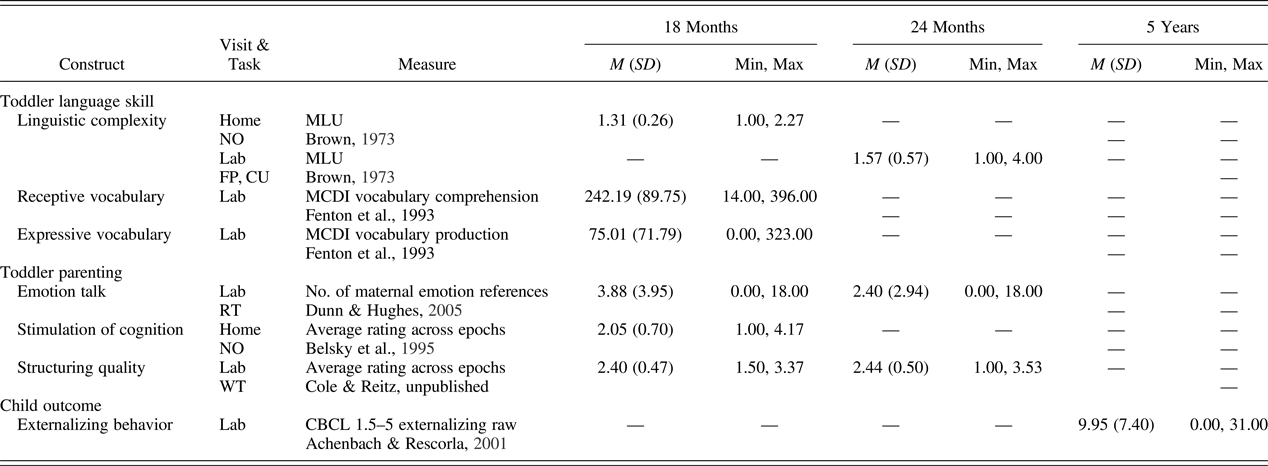
Table 1 outlines the study's constructs and measures. Child behavior during the wait task at 24, 36, and 48 months was video recorded. Subsequently, one team coded children's nonverbal emotional expressions and a second, independent team coded children's strategy use. Each coder was trained to 80% accuracy with master coders. Each team met weekly to discuss coding challenges. Reliability estimates were based on 15% of cases, randomly selected, for each system.
Antecedent and outcome measures and descriptive statistics

Note: MLU, mean length of utterance; NO, naturally occurring; FP, free play; CU, clean-up; MCDI, MacArthur Communicative Development Inventory; RT, reading task; WT, wait task; CBCL, Child Behavior Checklist.
All coding was conducted in 15-s epochs, with a score of 1 indicating that criteria was met in a given epoch. If a behavior continued into subsequent epochs, that behavior was defined by the set of contiguous 15-s epochs in which it was observed (i.e., bout). Temporal variables for observed child behavior were created as per Thompson (Reference Thompson and Thompson1990). Anger expression and strategy use bouts were calculated. Average duration (total number of epochs target code was present divided by total number of bouts) and latency (number of epochs prior to first occurrence) variables were created for each code. Coding scheme, as well as antecedent, outcome, and covariate instrument details are provided below.
Anger expression and strategy use
Anger expression was coded on the basis of facial, gestural, and vocal cues (e.g., furrowed brow, pressed lips, and harsh voice tone; Cole, Zahn-Waxler, & Smith, Reference Cole, Zahn-Waxler and Smith1994). The 15-s epoch was used in order to match anger expression with independently coded focused distraction (described below). Average κ for anger expressions across ages was 0.88 (range = 0.81–0.94). Multiple strategies were included in the coding system (Gilliom et al., Reference Gilliom, Shaw, Beck, Schonberg and Lukon2002; Mangelsdorf, Shapiro, & Marzolf, Reference Mangelsdorf, Shapiro and Marzolf1995). We focus on two. Calm bidding about the challenge (e.g., “Mom, are you almost done?”) was coded when a child's bid occurred during an epoch in which the child was calm (i.e., neutral or happy). Focused distraction was coded when children's behavior was indicative of being absorbed (i.e., looking at something intently or with interest, eye gazes greater than 5 s, or adjusting posture to make it easier to focus on or manipulate the object of distraction) with an alternate object or appropriate activity. The 15-s epoch gave strategy coders the time needed to make a determination of whether distraction behaviors were focused. Only nondisruptive, child-initiated strategies were analyzed. Average κ for these two strategies across ages was 0.82 (range = 0.73–0.91).
Language skill
Standard language indices were used to estimate toddler language skill. They were used to create a composite estimate of toddler language skill.
Mean length of utterance (MLU) estimates linguistic complexity and was calculated from 50 spontaneous speech samples (Brown, Reference Brown1973) from the 18-month home and 24-month lab (during unstructured free play and cleanup task) visits. A team of RAs trained in the Child Language Data Exchange System (MacWhinney, Reference MacWhinney2000) transcribed a minimum of two 10-min periods, using the periods with the highest and lowest amount of child emotion; if there were not 50 utterances in those two periods, additional periods were transcribed. Using Child Language Analysis (MacWhinney, Reference MacWhinney2000), MLU was computed as the average number of morphemes in a child's utterances. MLU is reliable across home and laboratory settings during toddlerhood (Bornstein, Haynes, Painter, & Genevro, Reference Bornstein, Haynes, Painter and Genevro2000).
The MacArthur Communicative Development Inventory Word and Gestures (MCDI; Fenson et al., Reference Fenson, Dale, Reznick, Thal, Bates, Hartung and Reilly1993) was completed by the mother at the 18-month lab visit. The MCDI contains 889 items rating the number of words, gestures, and phrases a mother believes her child understands and uses. The words and gestures scales index receptive and expressive vocabulary, respectively. Raw scores for words understood and produced were used (Cronbach α = 0.95 and 0.96, respectively) as scales were not normed for 18-month-olds. A child language skill composite was created by standardizing and summing across 18-month MCDI scores and MLU scores from 18-month home and 24-month lab visits.
Parenting
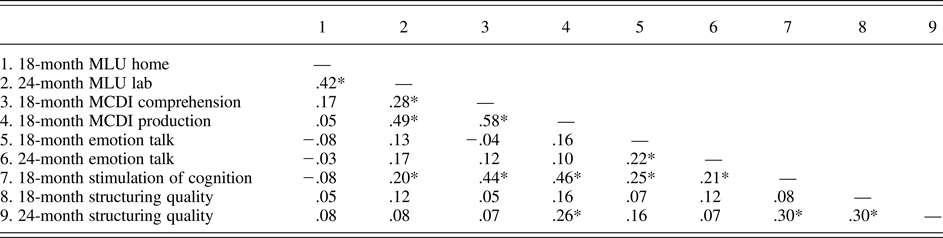
Three parenting practices were used to create a parenting composite for the toddler years. Although the strength of parenting variable associations varied (Table 2), our aim was to parsimoniously capture a robust, comprehensive depiction of practices that capitalize on child language to support children's emotion regulation.
Two-tailed Pearson product moment correlations for toddler language and parenting variables
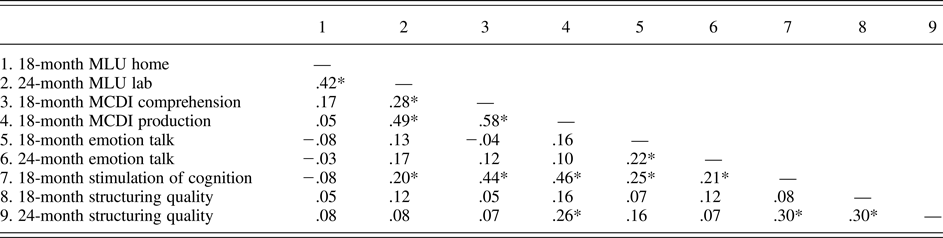
Note: MLU, mean length of utterance; MCDI, MacArthur Communicative Development Inventory.
*p < .05.
Emotion talk was coded at the 18- and 24-month lab visits during a 5-min reading task in which mother and child interacted with a wordless book (Mayer & Mayer, Reference Mayer and Mayer1975). Joint reading tasks such as this one have been used to elicit conversations about emotion (Brownell, Svetlova, Anderson, Nichols, & Drummond, Reference Brownell, Svetlova, Anderson, Nichols and Drummond2013). A coding team used Dunn and Hughes' (Reference Dunn and Hughes2005) Inner State Coding Manual to identify explicit reference to emotions made by the mother and child during the task (e.g., “The little boy is fishing. Look how happy he is!”). The team was trained to 90% accuracy under a graduate RA. Interrater reliability among coders was calculated on a random 20% of the transcripts. The κ at the 18-month visit was 0.97 and at the 24-month visit was 0.96. Emotion talk scores reflect the sum of all emotion talk codes during the task.
Stimulation of cognition was derived from the 18-month home visit during which trained RAs rated parenting using the Home Observation Coding System (Belsky, Crnic, & Woodworth, Reference Belsky, Crnic and Woodworth1995). In each of six 10-min periods, RAs used a 5-point Likert type scale to rate five parenting behaviors: stimulation of cognition, sensitivity, positive affect, intrusiveness, and negative affect. Stimulation of cognition captured the extent to which mothers interacted with the child in ways that encouraged children's use of cognitive and language skills (e.g., elaborating on children's verbal or vocal initiations). Stimulation of cognition scores reflect the average rating across all six 10-min periods.
Structuring quality was coded at 18- and 24-month lab visits during the 8-min wait task. Structuring refers to attempts to engage a child's language and cognitive abilities to regulate behavior. In addition to analyzing how the mother engaged in structuring (e.g., did she use her voice or words or both), structuring quality was rated and defined by how well timed, flexible, and developmentally appropriate the attempt was. Specifically, structuring attempts were coded in 15-s epochs and quality was rated on a 4-point Likert scale: 1 = structuring that lacked quality (“Just give me a minute”), 4 = high quality structuring (“I know it is hard to wait! Tell me about your cymbals. Do you think there is a parade going on?”). The coding team was trained to 80% accuracy with prior jointly coded cases. Interrater reliability among coders was calculated on a random 15% of cases. Structuring quality scores reflect the average quality rating across all 15-s epochs. The average intraclass correlation across 18 and 24 months was 0.84. A composite was created by summing across the three standardized parenting variables.
Externalizing behavior problems
When the children were at least 5 years old, there was an extra visit during which mothers completed the Child Behavior Checklist (Achenbach & Rescorla, Reference Achenbach and Rescorla2001). In this 100-item questionnaire mothers indicated how often the child engaged in problem behavior (0 = never, 1 = sometimes, 2 = often). The raw score for the externalizing behavior scale (Cronbach α = 0.93) is the sum of 24 items that involve behaviors such as defiance and moodiness. Raw scores were used to allow for maximum variation across the sample and for ample statistical control of child gender as age 5 years t scores are standardized for gender (e.g., Hill et al., Reference Hill, Degnan, Calkins and Keane2006).
Covariates
Child gender
Boys were coded 0 and girls were coded 1.
Income to needs ratio (INR)
Mothers reported annual household income at the 18-month lab visit. The INR is an index of household income relative to national poverty line norms. Middle-income family INR ranges between 2.0 and 4.0 (Duncan, Smeeding, & Rodgers, Reference Duncan, Smeeding, Rodgers, Papadimitriou and Wolfe1993; Evans & Marcynyszyn, Reference Evans and Marcynyszyn2004) while an INR of 1.0 is indicative of poverty. The INR mean for this sample was 2.37 (SD = 0.94).
Results
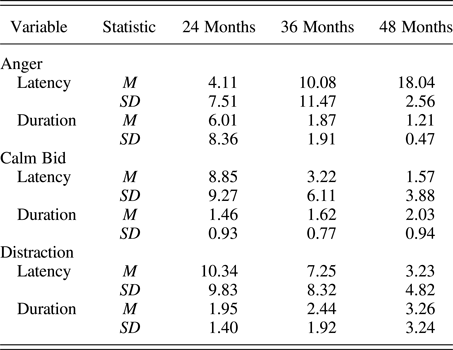
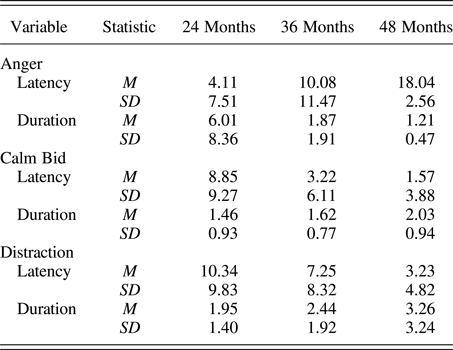
Descriptive statistics and intercorrelations for antecedent and outcome variables are in Tables 1 and 2. Sample-level univariate statistics for child anger expression and strategy use duration and latency indicators are reported in Table 3, while bivariate associations at each study time point are reported elsewhere (see Cole et al., Reference Cole, Tan, Hall, Zhang, Crnic, Blair and Li2011).
Sample-level descriptives for latency to first bout and average bout duration of children's anger expression, calm bid, and focused distraction at each age point
Early childhood emotion regulation pathways
Analyses
MTM was used to identify subgroups of young children who followed different emotion regulation pathways, defined by unique patterns of development across six temporal indicators of emotion regulation: latency and duration of children's anger expressions, calm bids, and focused distraction. In other words, subgroups were identified by the extent to which children exhibited similar patterns of concurrent developmental progression in each of and across all six indicators. To do this, PROC TRAJ (SAS 9.3; Jones, Nagin, & Roeder, Reference Jones, Nagin and Roeder2001) with the MULTGROUPS option was employed and specified to operate on a censored normal model. Log10 transformations improved indicator distributions to meet model assumptions. PROC TRAJ handles missing data by utilizing maximum likelihood when estimating model parameters.
A determination of the best fitting MTM involves identifying the optimal number of subgroups as well as the polynomial function that best describes the shape of each of the six indicator trajectory patterns within a subgroup. As recommended by Andruff, Carraro, Thompson, Gaudreau, and Louvet (Reference Andruff, Carraro, Thompson, Gaudreau and Louvet2009), second-order polynomial functions were specified for each indicator in the initial single-group and more complex multigroup solutions. Nonsignificant second-order effects suggested that quadratic growth did not adequately capture the shape of a given trajectory and were systematically removed at each step. Linear functions were retained despite statistical nonsignificance (Louvet, Gaudreau, Menaut, Gentry, & Deneuve, Reference Louvet, Gaudreau, Menaut, Genty and Deneuve2009). The log Bayes factor approximation served as a fit index at each model specification step (Jones et al., Reference Jones, Nagin and Roeder2001), with values greater than 10 taken as strong evidence for superior fit of the more complex (i.e., more groups) model. Though a priori hypotheses predicted a two-group solution, we allowed model fit to inform the optimal number of subgroups. After specification, we evaluated the model adequacy by calculating the average posterior probability (AvePPj), odds of correct classification (OCCj), and the ratio of the probability of group assignment to the proportion of sample actually assigned to group (Nagin, Reference Nagin2005). To distinguish each group, Wald tests examined differences in trajectory values at 24, 36, and 48 months.
Emotion regulation pathways
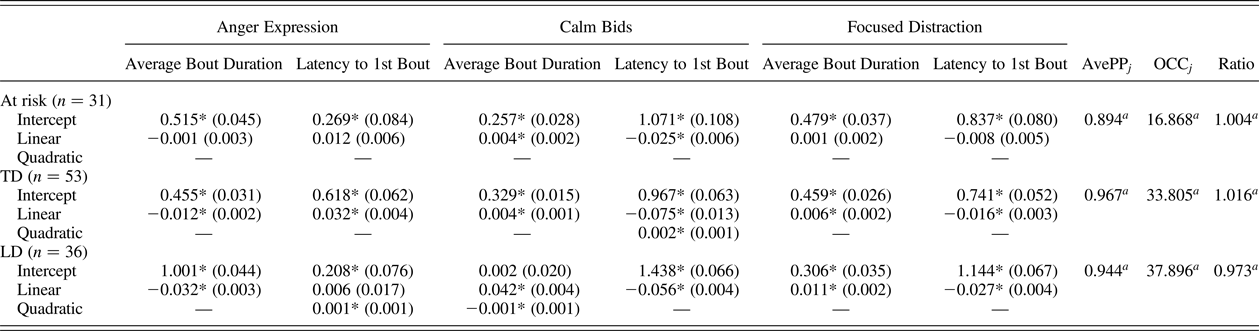
Following MTM guidelines outlined by Nagin et al. (Reference Nagin, Jones, Lima Passos and Tremblay2016), we estimated trajectory models for each indicator separately to inform the types of distinct trajectories to be represented for each indicator in our MTM. Quadratic and linear trajectories were identified for both anger expression and calm bid latency and duration indicators while only linear trajectories were identified for focused distraction latency and duration indicators. In addition, using the log Bayes factor as a fit index, both anger expression and calm bid latency and duration indicators yielded three-group solutions while two-group solutions were obtained for focused distraction latency and duration indicators. As per recommendations in Nagin et al. (Reference Nagin, Jones, Lima Passos and Tremblay2016), we concluded that at least a three-group solution was essential for our MTM. The log Bayes factor comparing the one- and two-group MTM solution (2loge[B10] ≈ 170.58) and the two- and three-group MTM solution (2loge[B10] ≈ 23.22) supported the three-group solution. A negative value obtained for the three- and four-group MTM solution comparison (2loge[B10] ≈ –30.72) signaled a decrement in fit. Model adequacy indices suggested that the final three-group solution fit the data well (Table 4; Nagin, Reference Nagin2005).
Parameter estimates (standard errors) and model adequacy indices for final three group solution
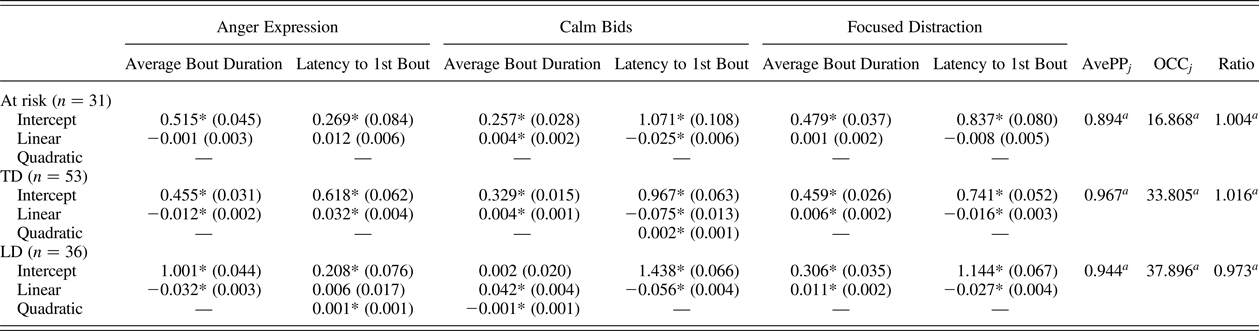
Note: AvePPj, average posterior probability; OCCj, odds of correct classification; Ratio, ratio of probability of group assignment to proportion of the sample assigned to each group; TD, typically developing; LD, later developing.
aMeets model adequacy criteria as per Nagin (Reference Nagin2005).
*p < .05.
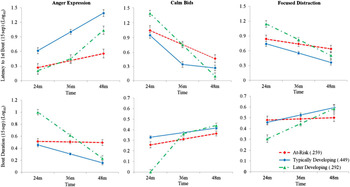
Figure 1 depicts predicted anger expression and strategy use trajectories for the final three-group solution. Parameter estimates for each subgroup's trajectories are displayed in Table 4. The largest group, consisting of 53 children (44.17%, 25 boys), is referred to as typically developing. With the exception of latency to calm bids, these children's latency to self-initiated strategy use decreased, and strategy use durations increased between 24 and 48 months in a linear fashion. In parallel, their latency to anger expression increased, and anger expression duration decreased in a linear fashion.
(Color online) Predicted anger and strategy use trajectories for the three-group multitrajectory model solution. Error bars represent estimated standard errors of the mean. Legend values in parentheses reflect group membership probabilities.
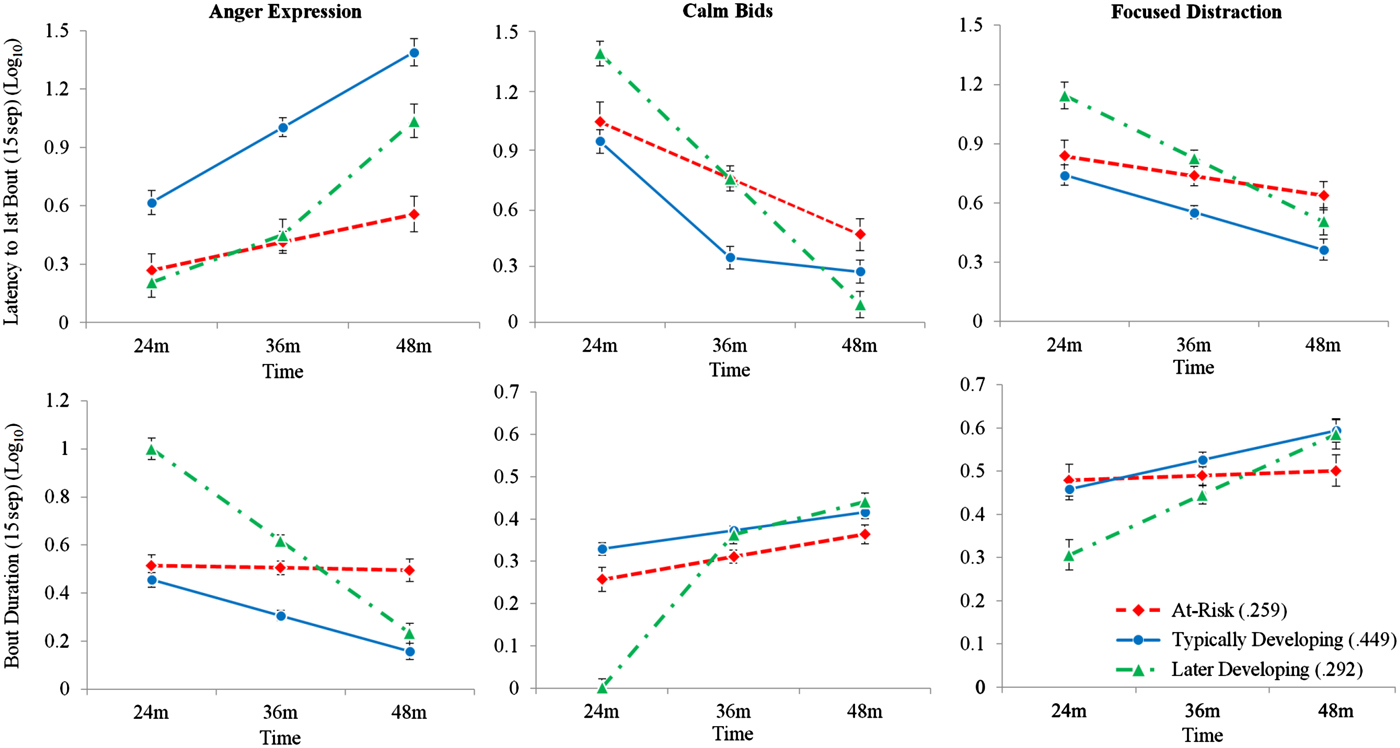
A second group, composed of 31 children (25.83%, 22 boys), is referred to as at risk. While these children's latency to bid decreased and bidding duration increased between 24 and 48 months in a linear fashion, this group did not display significant changes in latency to or duration of anger expressions or distraction. A third group, composed of 36 children (30.00%, 17 boys), is referred to as later developing. At 24 months, this group appeared to have longer latencies to briefer strategy use and shorter latencies to more prolonged anger expressions relative to both typically developing and at-risk groups. Yet, later developing children also displayed marked changes between ages 24 and 48 months. Their latency to strategy use decreased, and strategy use duration increased in a steep linear fashion, while more precipitous growth was observed between ages 24 and 36 months for duration of calm bids. Furthermore, a more precipitous increase was observed between 36 and 48 months for their anger expression latency while their anger duration decreased between ages 24 and 48 months in a steep linear fashion.
Trajectory distinction
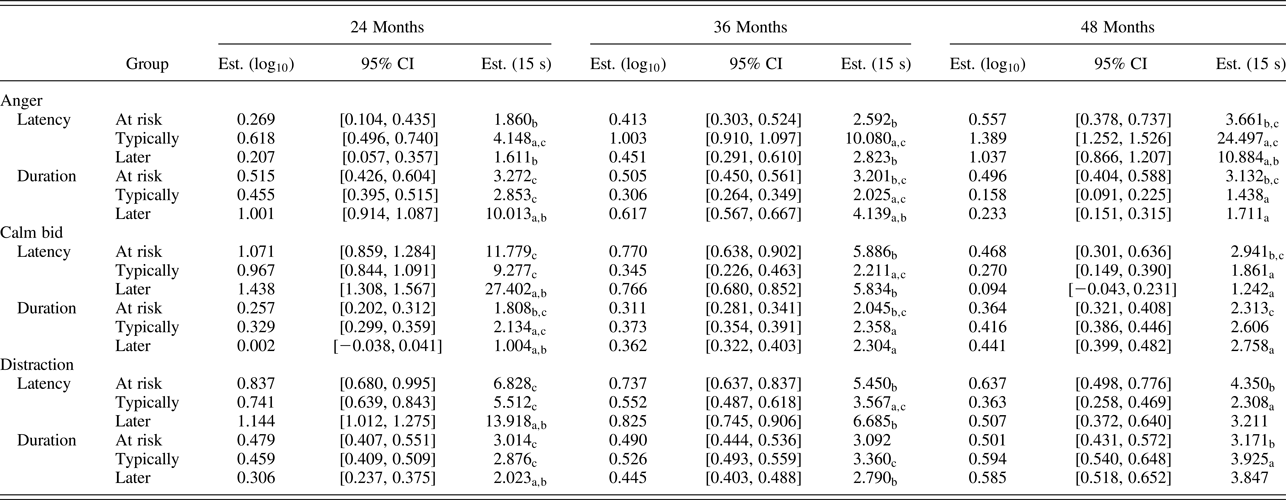
Table 5 displays duration and latency estimates for the average child in each group across all age points. Wald tests indicate that typically developing and at-risk group trajectories, for the most part, could not be distinguished at 24 months, but were significantly different at 36 and 48 months. Specifically, compared to typically developing children at 36 and 48 months, at-risk children had longer latencies to using strategies and those strategies were briefer in duration. They also had shorter latencies to anger expressions and those expressions were longer in duration. Though distinct from typically developing and at risk at 24 months, later developing trajectories, with one exception (quicker to anger than typically developing), could not be distinguished from typically developing trajectories at 48 months.
Estimated anger and strategy use latency to first bout and average bout duration for an average child in each group at all ages
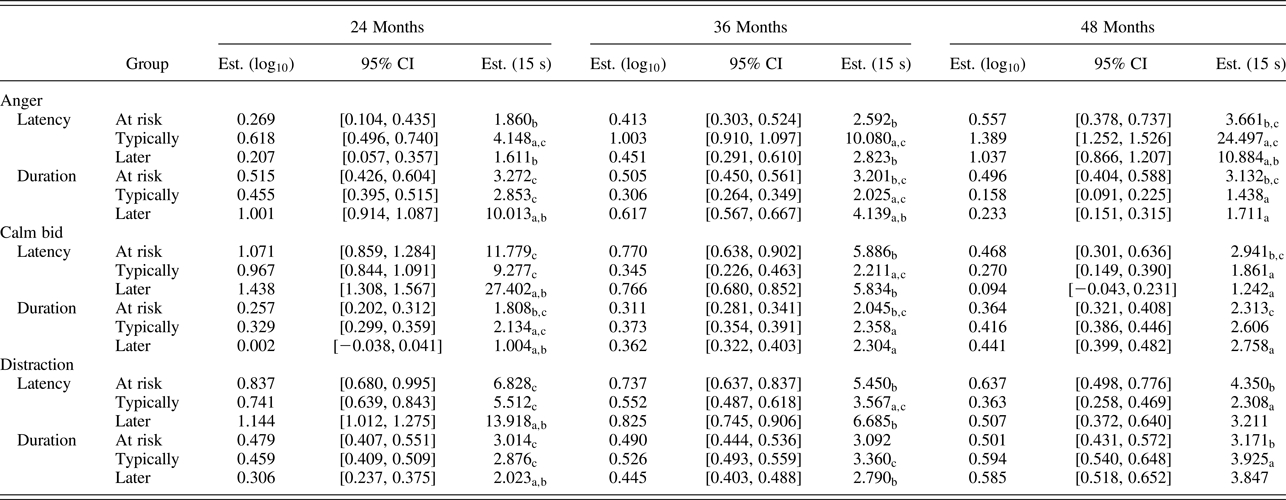
Note: N = 120; Est., estimate; 15 s, 15-s epoch. Subscript letters refer to Wald test significant differences between group estimates at each time point for each variable: subscript “a” indicates the estimate is significantly different from the at-risk group estimate (p < .05); subscript “b” indicates the estimate is significantly different from the typically developing group estimate (p < .05); and subscript “c” indicates the estimate is significantly different from the later developing group estimate (p < .05).
Antecedents of early childhood emotion regulation pathways
Analyses
For our second aim, a single multinomial logistic regression (MLR) model predicting subgroup membership was examined using PROC CATMOD (SAS 9.3). Child gender and family INR were entered as covariates while the child language composite, the parenting composite, and the interaction of child language and parenting, computed following guidelines in Aiken and West (Reference Aiken and West1991), were entered as predictors of subgroup membership. The χ2 test statistic was used to determine model significance.
Covariates
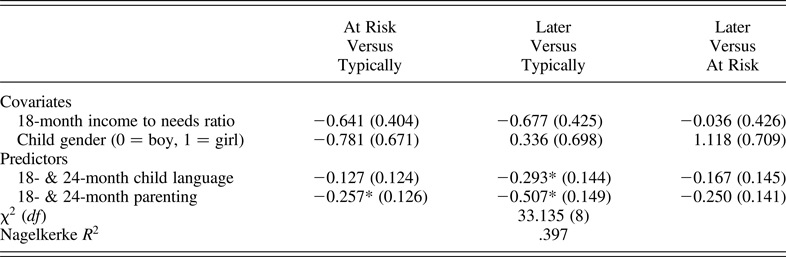
Table 6 displays parameter estimates for our MLR model predicting group membership. The MLR model was significant, χ2 (8) = 33.135, p < .001, Nagelkerke R 2 = .397. Neither family INR nor child gender predicted group membership.
Parameter estimates (standard errors) for a multinomial logistic regression predicting multitrajectory modeling group membership

Note: Typically, typically developing; Later, later developing. Parameter estimates reflect multinomial log-odds of membership in the comparison group relative to the reference group (comparison vs. reference) for each unit increase in the covariate or predictor of interest.
*p < .05.
Antecedents
Contrary to expectation, typically developing relative to at-risk group membership was not positively predicted by toddler-age language skills. However, as hypothesized, the odds of being in the typically developing relative to the at-risk group increased with parents’ greater use of practices that capitalized on toddler language skill (B = –0.257, SE = 0.126, p < .05). Typically relative to later developing group membership was positively predicted by both better toddler language skill (B = –0.293, SE = 0.144, p < .05) and greater use of language-capitalizing parenting practices (B = –0.507, SE = 0.149, p < .001). At risk relative to later developing membership was not significantly predicted by either antecedent. The Language × Parenting interaction was nonsignificant (B = 0.054, SE = 0.046, p = .24), and its addition did not alter study conclusions.
Early childhood emotion regulation pathway outcomes
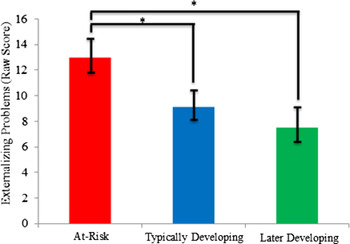
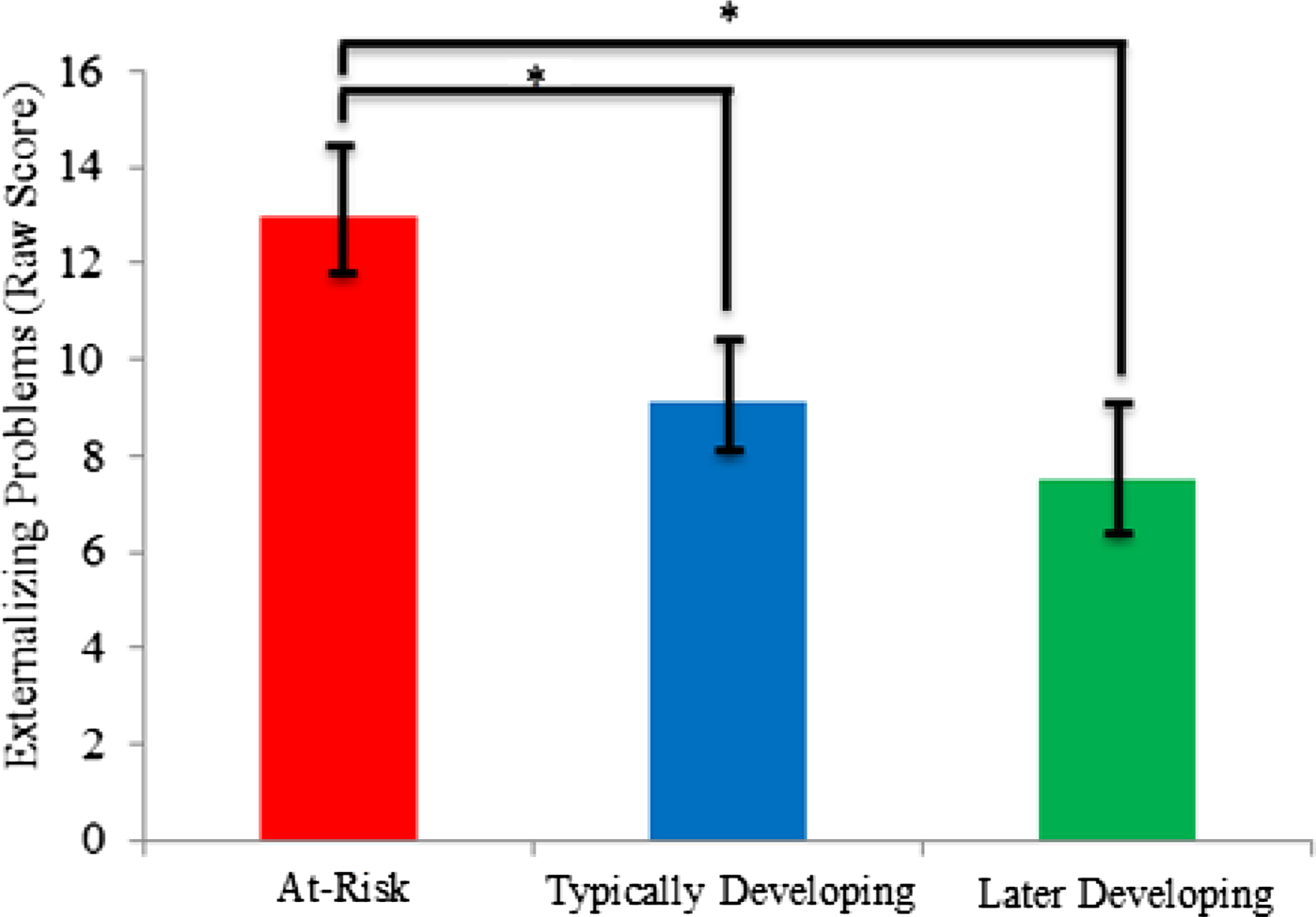
Although only 96 families provided age 5 years externalizing data, the original distribution of children among typically developing (n = 42, 43.8%, 20 boys), at-risk (n = 26, 27.1%, 19 boys), and later developing (n = 28, 29.1%, 13 boys) subgroups at this time point was maintained, χ2 (2) = 0.795, p > .25. Analyses of covariance via PROC GLM (SAS 9.3) were used to examine mean differences in externalizing ratings across groups adjusting for effortful control and INR. Group membership was related to child externalizing behavior, F (5, 90) = 3.177, p < .05. Bonferroni comparisons indicated that at-risk children had significantly more externalizing problems at age 5 years relative to typically and later developing children (Figure 2), whose externalizing levels did not significantly differ.
(Color online) Estimated marginal means, standard errors bars, and Bonferonni comparisons (*p < .05) for age 5 years externalizing problems for an average child in each group.
Discussion
The current study identified three pathways in young children's development of emotion regulation that were associated with theory-based antecedents and outcomes. MTM of longitudinal changes in multiple indices of children's emotion regulation (anger expressions, calm bids, and focused distractions) across ages 24, 36, and 48 months revealed three child subgroups. Their pathways are consistent with conceptualizations of the development of emotion regulation, which posit that individual differences in the emergence of self-initiated strategies help children regulate negative emotion (Calkins & Hill, Reference Calkins, Hill and Gross2007; Kopp, Reference Kopp1989). The findings also illustrate two pathways that differ at the outset but converge toward emotional competence (typically and later developing), and two pathways that appear similar at the outset but diverge (typically developing and at risk), one signaling risk for the development of psychopathology. Thus, this study extends evidence on the development of emotion regulation and reveals pathways that reflect equifinality and multifinality (Cicchetti & Rogosch, Reference Cicchetti and Rogosch1996).
Most children followed a pathway that we labeled as typically developing. Over the early childhood years, these children became slower to express and quicker to recover from anger while also initiating strategies more quickly and sustaining them longer. Thus, the typically developing pathway is consistent with prior evidence of associations between declines in anger and increases in strategy use over the course of this age period (Cole et al., Reference Cole, Tan, Hall, Zhang, Crnic, Blair and Li2011; Gilliom et al., Reference Gilliom, Shaw, Beck, Schonberg and Lukon2002; Silk, Shaw, Skuban, Oland, & Kovacs, Reference Silk, Shaw, Skuban, Oland and Kovacs2006). Our findings build on this prior work by coordinating indicators that are usually examined independently to build pathways, providing converging evidence from multiple measurements about how young children achieve competent emotion regulation (Cole et al., Reference Cole, Martin and Dennis2004). To this end, the typically developing pathway strengthens inference that burgeoning skill at self-distraction and bidding calmly to parents about frustrations may increasingly help limit and forestall anger expression during early childhood.
The person-centered approach identified two additional pathways: at risk and later developing. The at-risk pathway is consistent with evidence that anger reactivity persists beyond toddlerhood into the early school years for some children (Degnan, Calkins, Keane, & Hill-Soderlund, Reference Degnan, Calkins, Keane and Hill-Soderlund2008; Smith, Calkins, Keane, Anastopoulos, & Shelton, Reference Smith, Calkins, Keane, Anastopoulos and Shelton2004), placing them at risk for later behavior problems (Calkins & Keane, Reference Calkins and Keane2009; Gilliom et al., Reference Gilliom, Shaw, Beck, Schonberg and Lukon2002). However, the use of multiple indicators to capture this pathway provides additional evidence about possible strategy-specific contributors to at-risk children's persistent anger reactivity. Over their early childhood years, these children showed much less change than the other groups; they showed not only stable levels of anger reactivity but also (a) nonsignificant growth in the use of distraction, a key strategy for tolerating frustration while waiting (Kochanska et al., Reference Kochanska, Coy and Murray2001; Peake et al., Reference Peake, Hebl and Mischel2002), and (b) significant increases in calm bids to adults for support. Thus, they are at risk because they show little progress toward autonomous emotion regulation (Kopp, Reference Kopp1989).
Finally, MTM identified a third pathway, labeled as later developing. At toddler age, these children's anger expressions were quicker and longer, and their initiation of strategies slower and shorter, relative to both other groups. Yet, during early childhood, they evinced marked changes seen in anger declines and strategy use growth. By age 48 months, their behavior differed from typically developing only in that they remained quicker to anger. Anger alone may not signal risk for compromised emotion regulation development. Despite quickness to anger, some children are able to engage in socially appropriate, strategic behaviors (Dennis, Cole, Wiggins, Cohen, & Zalewski, Reference Dennis, Cole, Wiggins, Cohen and Zalewski2009), highlighting the advantages of using both emotion and strategy indices to create developmental pathways.
The validity of the three identified pathways was supported in that their antecedents and outcomes differentiated among them. Kopp (Reference Kopp1989) posited that the early childhood development of autonomous emotion regulation is influenced by the interaction of factors both intrinsic and extrinsic to the child. Kopp highlighted children's developing language skills as one important intrinsic factor. Nevertheless, their role in the development of emotion regulation has received little longitudinal analysis (but see Ayoub, Vallotton, & Mastergeorge, Reference Ayoub, Vallotton and Matergeorge2011; Roben et al., Reference Roben, Cole and Armstrong2013). Kopp further stated that parenting practices are extrinsic factors that help children's language skills become integrated into emotion regulation. These specific intrinsic and extrinsic factors discriminated among some, but not all, identified pathways.
Better child language skills and greater use of target parenting practices increased the odds of children following the typically relative to the later developing pathway. Poorer language skills and less optimal parenting in toddlerhood are often associated concurrently with more child negative emotion, and longitudinally with more child anger and aggression (Girard et al., Reference Girard, Pingault, Falissard, Boivin, Dionne and Tremblay2014; Hoffman et al., Reference Hoffman, Crnic and Baker2006; Kubicek & Emde, Reference Kubicek and Emde2012; Nozadi et al., Reference Nozadi, Spinrad, Eisenberg, Bolnick, Eggum-Wilkens, Smith and Sallquist2013; Roben et al., Reference Roben, Cole and Armstrong2013; Salley & Dixon, Reference Salley and Dixon2007). Thus, later developing children may have appeared at risk initially, but even so, they still showed growth in autonomous strategy use. One possibility is that this growth may have been supported by age-related gains in language such that any risk was mitigated as has been shown in other studies (Hawa & Spanoudis, Reference Hawa and Spanoudis2014; Whitehouse, Robinson, & Zubrick, Reference Whitehouse, Robinson and Zubrick2011). These gains may have concomitantly given parents a chance to use language-capitalizing practices later on in development to support emotion regulation. The precise nature of how delayed language development, children's emotions, and parenting predict different pathways requires further investigation (Fields-Olivieri, Cole, & Maggi, Reference Fields-Olivieri, Cole and Maggi2017).
Early language skills and language-capitalizing parenting practices, however, did not interact in predicting group membership, although their independent effects are nonetheless consistent with Kopp's (Reference Kopp1989) proposition that both intrinsic and extrinsic resources contribute to competent emotion regulation. As expected, parents of typically developing children were more likely to engage in language-capitalizing parenting practices relative to parents of at-risk children, but these two groups of children did not differ in their toddler language skills. This suggests that parental scaffolding of children's language skills may be needed in order for those skills to be successfully integrated into the development of effective emotion regulation in children. Parents’ contributions through discussions about emotional experiences, using emotion terms, and reasoning about how to handle challenging situations may require that children have sufficient receptive and/or expressive language skills (Cervantes & Callanan, Reference Cervantes and Callanan1998; Denham et al., Reference Denham, Cook and Zoller1992; Fagot & Gauvain, Reference Fagot and Gauvain1997; Wertsch, Reference Wertsch1979). In the absence of such parenting practices, an early advantage in language skills may not support the optimal strategy in waiting contexts (distraction) although the evidence indicates it does support children's ability to verbalize calmly. Clearly, research is needed to understand the specific ways that young children's language ability contributes to their strategy use and its effectiveness (Cole et al., Reference Cole, Armstrong, Pemberton, Calkins and Bell2010; Kopp, Reference Kopp1989). Such knowledge could be leveraged in designs of early prevention and intervention efforts.
The three identified emotion regulation pathways also had convergent and divergent externalizing behavior problem outcomes when children were kindergarten age. The at-risk group children presented with more externalizing behavior problems at age 5 years compared to children in the typically developing group. Preschool-age children with persistent, intense anger and who use less planful strategies are at risk for early school-age externalizing problems (Gilliom et al., Reference Gilliom, Shaw, Beck, Schonberg and Lukon2002; Morris, Silk, Steinberg, Terranova, & Kithakye, Reference Morris, Silk, Steinberg, Terranova and Kithakye2010; Trentacosta & Shaw, Reference Trentacosta and Shaw2009). They also presented with more problems than the later developing group, who did not differ in this respect from typically developing. This finding lends credence to the view that later developing children are able to develop an ability to initiate and sustain strategies relatively well despite their anger proneness (Dennis et al., Reference Dennis, Cole, Wiggins, Cohen and Zalewski2009). It also contributes to an emerging literature on the clinical utility of examining various facets (e.g., reactivity and regulation) of young children's emotion dysregulation (Graziano & Garcia, Reference Graziano and Garcia2016). Specifically, anger proneness, or quickness to anger, may not pose a risk factor for externalizing behavior problems in the context of waiting if and when it is accompanied by similarly swift, maintained self-distraction and abbreviated anger duration (e.g., later developing).
Our approach to identifying individual pathways to emotion regulation addressed some critical issues. Person-centered techniques revealed a relatively even distribution of children among subgroups, supporting the claim that early childhood is a period marked by substantive variability in the rate at which autonomous emotion regulation emerges (Kopp, Reference Kopp1989). However, other person-centered developmental studies analyzing single indicators (e.g., strategy use) yielded fewer or less evenly distributed clusters of children (Chang & Olson, Reference Chang and Olson2016; Supplee, Skuban, Trentacosta, Shaw, & Stoltz, Reference Supplee, Skuban, Trentacosta, Shaw and Stoltz2011). Thus, by using multiple emotion and strategy use indices to approximate emotion regulation development (Calkins & Hill, Reference Calkins, Hill and Gross2007; Cole et al., Reference Cole, Martin and Dennis2004), we may have also increased our capacity to capture meaningful variability therein where single-indicator person-centered analyses could not. As pathways were identified by modeling temporal aspects, they may be more indicative of emotion regulation processes (Cole et al., Reference Cole, Martin and Dennis2004; Thompson, Reference Thompson1994).
Strengths, limitations, and future directions
The findings of this innovative application of a person-centered approach were strengthened by a longitudinal design, lab- and home-based observational methods, and the use of MTM. Nonetheless, the study has several limitations. First, the sample size was relatively small for a person-centered design, requiring cautious interpretation and future replication with larger samples. Second, the results are limited to a sample of predominantly White, economically strained, rural and semirural families. These families were selected, however, given that this population is underrepresented in child development research. Moreover, restricting income enabled investigation of individual variations in language-related phenomena without the potentially overriding influences of socioeconomic status (Hart & Risley, Reference Hart and Risley1995), that is, correlates of poverty or of economic advantage. Third, the study did not include temporal contingencies between anger and strategy variables restricting the evidence that children's strategy use regulated their anger. The findings nonetheless add to evidence for the possibility that a growing capacity for self-distraction and calm bidding helps children tolerate frustration. Fourth, despite evidence of unique antecedents for different pathways, the study does not inform how developmental trajectories of child language and parenting practices interact to contribute to young children's emotion regulation development. Research that focuses on the ongoing interplay between intrinsic and extrinsic factors, including both facilitative and compromising (e.g., harsh parenting) influences, is needed. Person-centered analysis of such coordinated development may possibly discern for whom and when intrinsic and extrinsic factors matter most and point to additional sensitive time points for intervention.