Almost all economic indicators show that the rise of China is all but inevitable. Many argue that it is already happening. China may rank as the second, or the third, or the fourth largest world economic power, depending on how one does the counting, after enjoying an average annual GDP growth rate of nearly 10% in the past quarter of a century (1983–2007) (National Bureau of Statistics of China). China currently has the largest foreign currency reserve in the world, reaching one trillion U.S. dollars (People's Bank of China) and China became the second largest trade country after the U.S. in 2007 (Wenweipo 2007). In fact, no discussion of world economy is adequate without talking about China. Even though the United States is currently embroiled in Iraq and the war on terror, there is no question that the rise of China is still very much in back of the minds of American foreign policy makers and political elites, especially during the current presidential campaigns. For instance, one survey of American international relations scholars reveals that while 58% of the scholars believe that the greatest strategically important region for the United States is the Middle East right now, 60% of them think it will be China and East Asia in 20 years (Peterson, Tierney, and Maliniak 2005). A public survey shows that a majority of the citizens in many developing countries think it would be a good thing if China were to become as large a military power as the United States (Pew Global Attitudes Project 2005).
Interest and concerns about China are becoming popular topics even among regular Americans due largely to American media coverage. Questions often raised include: Will China replace the United States as the dominant power in the world? How soon? What kind of superpower will China be? Will there be a military clash between the United States and China over Taiwan in the future? Will China ever become a democratic country and when? The American public is, at best, ambivalent about China's rise. According to the Pew Global Attitudes Project findings in 2005, 49% of Americans saw benefits for America in China's economic growth while 40% held the opposite view. However, 78% of Americans believed that it would be a bad thing if China were to become a militarily powerful country like the United States. In the same survey, 43% of Americans had a favorable opinion of China while 35% held unfavorable impressions (Pew Global Attitudes Project).
To help understand what is going on in China and the future of U.S.-China relations, we believe it is important to tap into the views of China scholars in the United States. This study surveys the opinions of one major group of China scholars in the U.S.—scholars teaching Chinese politics and international relations involving China in American universities. The importance of studying their opinions can be summarized as follows. First, China scholars who study China as a career are better informed about developments in China and U.S-China relations. They have arguably a deeper understanding of Chinese culture, history, and society. Because of their detailed knowledge and understanding of China, these scholars are in the position to offer insightful assessment and judgment concerning China and U.S.-China relations. Their views can be educational and enlightening to the general American public. They are often invited to share their expertise on China-related issues with their local community and through print and electronic media. In other words, these scholars are often the opinion leaders and shapers on China. Secondly, some of these China scholars in the U.S. have been called upon to appear at Congressional hearings and provide policy input to U.S. foreign policy makers. A few of them, such as Allen Whiting, Michel Oksenberg, Susan Shirk, and Kenneth Lieberthal, have served in the government and played important roles in U.S. policy-making on China. A recent example was the appointment of Thomas Christensen, a China scholar who previously taught at Princeton University, as deputy assistant secretary for East Asia and Pacific Affairs in the Department of State in 2006. Third, given China's rise, classes concerning China are becoming more popular than ever on U.S. campuses. As educators in higher learning institutions, China scholars teaching at American universities inevitably have an impact upon their students in shaping and molding their views on China. China scholars' views are particularly important and influential given that most U.S. college students do not know much about China and many of these future college graduates will become influential elites of this country.
About Our Survey
It is interesting to find out what China scholars in the United States today think about China and U.S.-China relationship in the twenty-first century and in the new era of war on terror. Our survey consists of five background questions and 17 substantive questions concerning four broad issue areas: U.S-China relations, cross-Taiwan Strait relations, China's global role, and political and economic developments in the three Chinese societies (i.e., mainland China, Hong Kong, and Taiwan). We conducted the survey, which took the form of emailed and mailed questionnaires, from late April to mid August 2006. Our targeted population was faculty members who teach Chinese domestic or transnational politics, U.S.-China relations and U.S.-East Asian/Asia-Pacific relations with a Chinese component in departments/schools/institutes of political science, international/global relations, and Asian studies with graduate programs in U.S. academic institutions. We identified the scholars primarily from three sources: Directory of Political Science Faculty published by the American Political Science Association in 2002, U.S. News and World Report, and Gradschools.com, which claims to have the most comprehensive online source of graduate school information in the United States.
We sent out a total of 316 questionnaires to identified China scholars, including many renowned political scientists who study and teach Chinese politics, and 132 of them returned responses: a rate of 41.8%, which is reasonably good for a mail questionnaire survey. Of our identified scholars, 46% received their doctorate from one of the following schools: Harvard; Columbia; University of California, Berkeley; University of Michigan; Yale; University of Chicago; Stanford; Princeton; and the University of Washington. Most of our respondents (59.7%) got their Ph.D. degrees in the 1990s and beyond and most of them (58.3%) use original Chinese sources in their research. In addition, 59.9% have lived in mainland China, Taiwan, or Hong Kong for at least of six months.
Assessing U.S.-China Relations
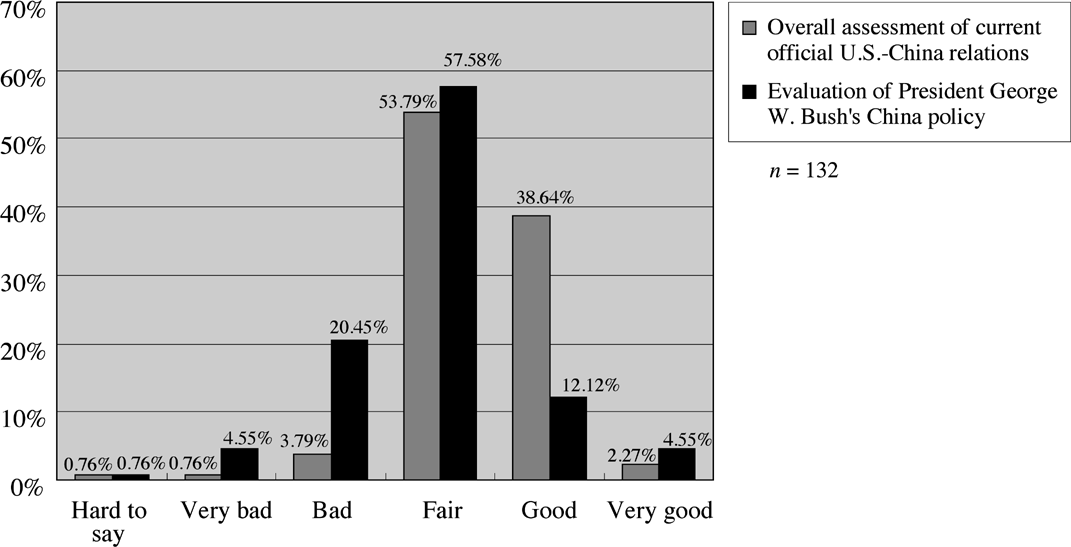
It seems that a majority of the China scholars in our survey are positive in their evaluation of the overall official relationship between the United States and China. Over 90% of our respondents think that U.S.-China relations are either fair or good (see Figure 1). This finding is in sharp contrast to the finding in a similar survey conducted in 1992, in which over 40% of China scholars viewed U.S.-China relations as bad due to the vivid aftermath of the Tiananmen crackdown in 1989 (Zhong and Wu 1994). Our respondents' positive assessment is not surprising given that U.S.-China relations have indeed improved substantially in the last few years after the September 11 terrorist attacks, bouncing back from the low ebb in the bilateral relationship, due to the U.S. bombing of the Chinese embassy in Belgrade in 1999 and the surveillance airplane incident in spring 2001. Since September 11, the Bush administration has definitely changed its previous harsh rhetoric and adversarial posture toward China to get China on board with the war on terror. For the most part, China has been cooperative in the U.S.-led global war on terror even though China disagreed with U.S. invasion of Iraq. China has also been helpful, by and large, to U.S. efforts to denuclearize North Korea and Iran. In addition, trade/investment volume and cultural exchanges between the two countries have increased significantly since the aftermath of the violent crackdown on the Tiananmen democracy movement in 1989. Former U.S. Secretary of State Colin Powell even commented that the United States and China are enjoying their best relations since Nixon's first visit to China in 1972 (Powell 2003). Secretary of State Condoleezza Rice also restated that, “We have one of the strongest relationships with China that any administration has had” (Rice 2007).

U.S.-China Relations
In addition, we find that a majority of our respondents seem to approve of President George W. Bush's dealings with China (see Figure 1). Close to 60% of our respondents rate Bush's China policy since 2001 to be fair and 17% think it is good or very good, even though most of our respondents identify themselves as Democrats. When asked to rank the importance of different issues in the bilateral relations between the United States and China, most China scholars seem to be more concerned with regional stability in Asia and U.S.-China economic ties than anything else. They have good reasons to be concerned with stability in Asia, given the tensions over North Korean nuclear weapons, spats between China and Japan in the last few years, and perennial disputes between mainland China and Taiwan. For the China scholars in our survey, human rights and democracy in China rank as the last concerns after economic development and political stability in China.
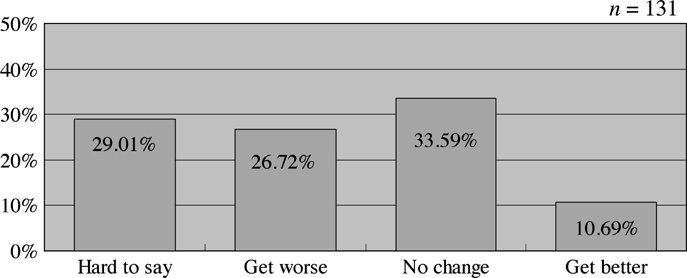
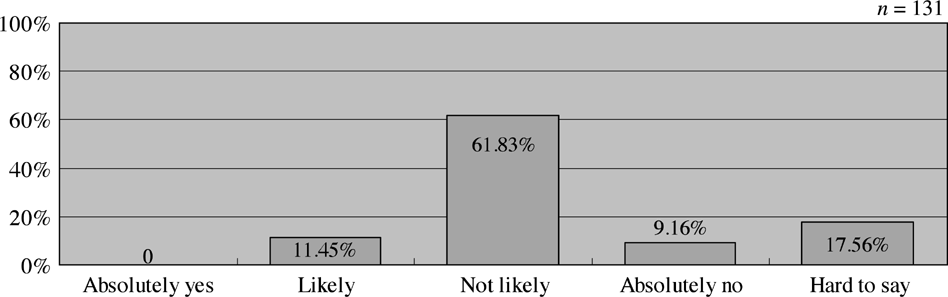
Our scholars' positive assessment of U.S.-China relations certainly does not mean that the relations are free of troubles and conflicts, nor does it mean that future relations will be smooth. In fact, these bilateral relations are still very fragile and lack sufficient mutual trust. Many of the Bush administration's policies indicate that the administration still considers China a potential threat to long-term national interests, while Chinese leaders are deeply suspicious that the United States will do everything possible to prevent China from becoming a major world power. Thus, it is no surprise that our survey reveals that there is little consensus on the future development of U.S.-China relations. Only 11% of our respondents believe that official U.S.-China relations will get better in the next five years, about a quarter think they will get worse, and one-third believe they will remain the same (see Figure 2). These findings show the complexity of the relations between the United States and China. U.S.-China relations have experienced many ups and downs since 1979—when the two countries established formal diplomatic relations. A number of factors down the road could affect this bilateral relationship, such as the huge trade imbalance between the two countries, product safety issue, competition for energy resources, the Taiwan issue, human rights issues, and domestic politics in the United States. Maybe that is why nearly 30% of our respondents find it hard to predict the future of U.S-China relations even in the next five years. However, we also find that a majority of our respondents (about 71%) do not expect a military confrontation or showdown between the United States and China in the next 20 years (see Figure 3). Any military confrontation between the countries could spark a highly intensive conflict.

Official U.S.-China Relations in the Next 5 Years

Expectation of a Military Conflict between the U.S. and China in the Next 20 Years
Views on Cross-Taiwan Strait Relations
Taiwan remains undoubtedly one of the thorniest issues in Sino-U.S. relations and arguably the most potentially explosive one that could cause a direct military confrontation. The U.S. is also the most crucial external factor in influencing bilateral relations between mainland China and Taiwan. When asked to evaluate current U.S. policy toward cross-Strait issues, half of our China scholars think the United States has a balanced policy toward Taiwan and China, 22% believe U.S. policy leans toward Taiwan, and about 15% think that U.S. policy leans toward mainland China. These findings may be a bit surprising to the people on both mainland China and Taiwan since many of them believe that the United States tends to favor their opponent.
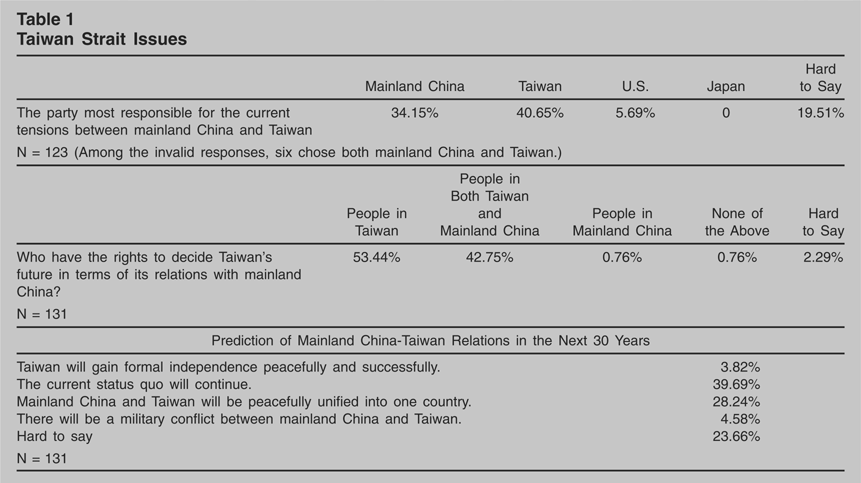
Cross-Taiwan Strait relations took a sharp downturn in 1995 and 1996 after then-Taiwan President Lee Teng-hui paid a visit to Cornell University, his alma mater, and China fired missiles to the surrounding sea areas of Taiwan to intimidate Taiwanese not to vote Lee to another term. Since then both sides have not had much official contact. For our next question, “Whom do you think is most responsible for the current tensions between mainland China and Taiwan,” we deliberately forced our respondents to choose just one party. A plurality majority of our respondents (about 41%) think that Taiwan is most responsible while 34% believe that mainland China is to blame for the current tensions across the Strait (see Table 1). The fact that more people think that Taiwan ought to be blamed for the tensions between the two parties may have something to do with President Chen Shui-bian's attempts to change the status quo (either by mainland Chinese or American definition) in the relationship across the Taiwan Strait. President Chen, elected in 2000, has adopted measures to harden Taiwanese separate identity by removing “Chineseness” in Taiwan society, abolishing the Unification Council and Unification Guidelines, pushing for referendum proposals for a new constitution, and trying to increase Taiwan's international visibility by applying for a membership in the UN under the name of Taiwan. It should be noted that many believe that by these actions President Chen and some other ruling Democratic Progressive Party leaders are playing politics to earn political capital and to shift public attention in Taiwan away from the poor economic performance of his administration and the financial scandals involving their trusted subordinates, family members, and themselves.
Taiwan Strait Issues

A major dispute between mainland China and Taiwan is over who should decide the future status of Taiwan. An overwhelming majority of Taiwanese believe that only the 23 million people living on Taiwan have the right of self-determination to decide the future of Taiwan. On the other hand, the mainland Chinese governmental position is that there is only one China in the world, both mainland China and Taiwan are parts of China, and the island's future cannot be changed by the Taiwanese alone and it should be decided by both sides. A slight majority of our China scholars (53%) seem to agree with the Taiwanese that only the people in Taiwan have the right to decide their future, while 43% think that people on both sides of the Taiwan Strait have the right to do so (see Table 1).
Predicting the future of bilateral relations between mainland China and Taiwan is a risky business. There is no question that the independence sentiment and self-awareness of their separate identity among the Taiwanese has grown considerably in the last 20 years. There is a clear trend, according to public opinion polls conducted in Taiwan, that more Taiwanese are in favor of independence from mainland China than people who support unification, even though most people still prefer the status quo (which can be seen as a form of de facto independence). After all China threatens military attacks against any de jure independence for Taiwan. The independence trend in Taiwan is on a collision course with the strong unification desire among mainland Chinese. By all accounts, a majority of mainland Chinese are in favor of unifying Taiwan back to China either by peaceful means or military force, if necessary. The feeling among many Chinese is that their leaders, whoever they are (either authoritarian or democratically elected), simply cannot afford to allow Taiwan to be separated from China without a fight.
According to our China scholars, the chance of Taiwan gaining formal or de jure independence peacefully and successfully in the next 30 years is very small (see Table 1). This is probably because they understand China's history of national unity and the strong feeling of nationalism among the mainland Chinese over Taiwan. In addition, the military balance between the two sides has tilted toward to mainland China and will continue to do so. However, our China scholars do not believe that there will be a military conflict across the Strait. In other words, they think that mainland China will not use force to unify Taiwan since any military attack on Taiwan may invite U.S. military intervention and will definitely derail economic development in China. It is not a decision that the Chinese leaders will make lightly. In addition, the use of force will no doubt leave serious scars on Taiwanese people. As a result, according to 40% of our China scholars, the status quo (i.e., neither unification nor formal Taiwan independence) will continue for quite some time. In fact, both Beijing and Washington prefer the status quo to some other alternatives. What is surprising in our survey is that close to 30% of our respondents believe that mainland China and Taiwan will peacefully unite into one country in 30 years. A main source for this optimism is probably the close economic ties and integration between mainland China and Taiwan. Billions of U.S. dollars from Taiwanese businesses are invested in China every year and Taiwan enjoys a huge trade surplus against mainland China. Indeed many argue that China is making Taiwan's independence option an extremely costly proposition with regard to its economy and to lure Taiwan into some sort of political integration with the mainland down the road.
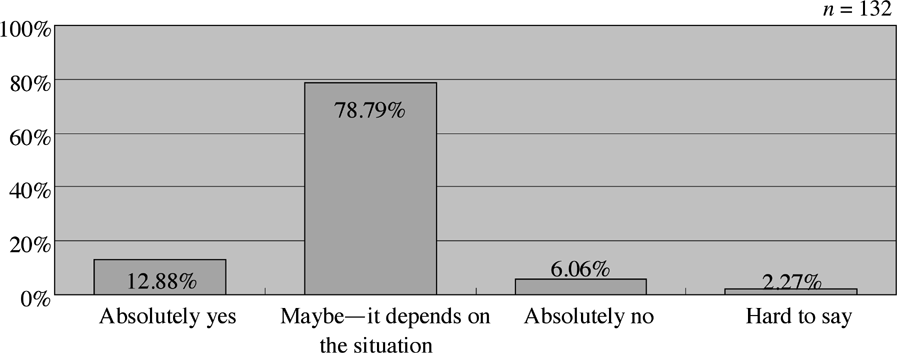
There is no doubt that the United States is the single most important factor in cross-Taiwan Strait relations. The Taiwan Relations Act, which was passed in 1979 by the U.S. Congress, provides the legal basis for U.S. military intervention in case of an attack by China on Taiwan. Various U.S. administrations had adopted the policy of “deliberate strategic ambiguity” prior to 2001 in dealing with a potential military attack by China on Taiwan. This policy seemed to change in spring 2001 when President George W. Bush announced in an interview that the United States would do “whatever it took” to defend Taiwan (ABC News 2001). Even though 70% of our China scholars do not expect a military conflict between the United States and China in the future, close to 80% of them believe that, depending on the situation, it is possible that the U.S. government would risk a military confrontation with China to protect Taiwan against an attack (see Figure 4). Only 6% rule out any possibility of U.S. military involvement in a crisis across the Taiwan Strait. The findings show the danger that a Chinese military attack on Taiwan may entail. However, the findings also indicate that there is no guarantee that the United States will militarily protect Taiwan, as many pro-independence people in Taiwan believe. A number of factors may affect the U.S. reaction to a possible Chinese military attack on Taiwan. For example, the United States may find it hard to defend Taiwan if the Taiwanese government prematurely and unnecessarily provokes a Chinese attack by declaring formal independence or proposing a brand new constitution. Even late Congressman Jim Leach (R-Iowa), who is perceived as one of the pro-Taiwan “gang of four” in the U.S. Congress and former chairman of the Subcommittee on Asia and the Pacific, warned against any unilateral independence move by Taiwan that might lead to “a catastrophic and unwinnable conflict between the mainland and the island” (Leach 2005). It is also extremely difficult for the United States to be involved militarily in the Taiwan Strait if it is busy fighting another war. U.S. military intervention in an all out war between China and Taiwan risks a highly intensive war or even a potential nuclear confrontation with China.

Possibility of the U.S. Government Risking a Military Confrontation with China to Protect Taiwan if Taiwan is Militarily Attacked by China
Views on China's Global Role
What kind of superpower would China be? The United States is particularly concerned about whether China will be a benign or a militaristic and aggressive superpower challenging American interests around the world. Washington has been openly encouraging China to become a responsible stakeholder in international system (Zoellick 2005). China has taken some actions, such as sending peacekeeping forces to trouble spots around the world, such as East Timor, Lebanon, and Sudan, and providing prompt aid to countries affected by the tsunami, proving that it is a responsible member of the world community. In addition, the Chinese government has been trying hard to pacify and assure its neighbors and the United States by repeatedly emphasizing that its rise, unlike Germany and Japan in the 1930s, is peaceful and the world should have nothing to worry about (Zheng 2005). Chinese officials often remind the world that China is not even an economically developed country yet and it will take China years to achieve world power status. Even though many economic, demographic, and military indicators seem to have painted China as a world power, Chinese leaders themselves tend to think of China as a developing country that won't be a modernized, medium-level developed country until the mid twenty-first century.
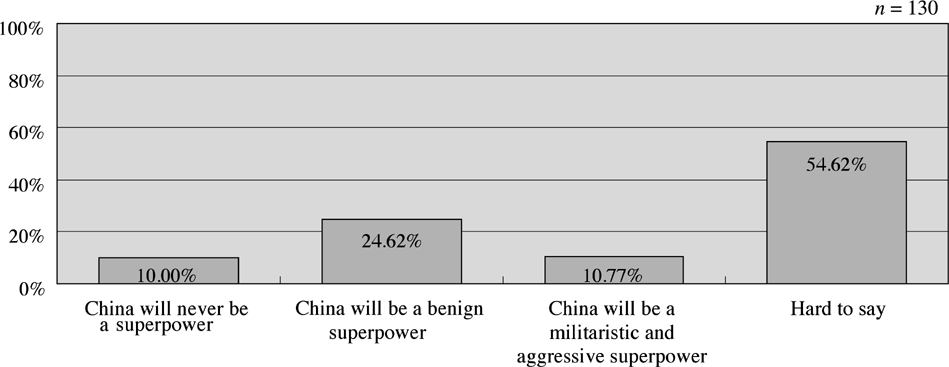
When asked what kind of superpower China would be, 10% of our China scholars think China will never become a superpower, 25% believe China will be a benign superpower, 11% think China will be a militaristic and aggressive one, and 55% of our respondents are not sure what kind of superpower China would be in the future: the largest percentage of uncertainty among answers to all our survey questions (see Figure 5). Indeed, we can find past examples of each possibility in China's several-thousand-year history. However, the fact that such a high percentage of our China scholars are unsure indicates that they are not yet convinced by Chinese leaders' repeated assurance that China will definitely be a peaceful force in the world. In the past 30 years China has been reluctant to be involved and assertive in world affairs. For example, China has vetoed less than the other four permanent members of the UN Security Council. Even though Beijing has had many disagreements with Washington on the international stage, it has often hidden behind countries like Russia and France to oppose U.S. positions. China gets more involved in matters and regions that directly affect its national interests. However, since 2006 there have been indications that China is more willing and ready to get involved in global affairs beyond its immediate geographical proximities. For example, China sent about 1,000 peacekeeping troops to Lebanon in fall 2006. The Chinese government also hosted a high-level seminar on the Middle East involving official delegations from Israel and Palestine. The type of superpower that China will become certainly depends on China's domestic development and current major powers' reactions to China's rise.

What Kind of Superpower Will China Be If China Does Become a Global Superpower?
Assessing Economic and Political Developments in Three Chinese Societies
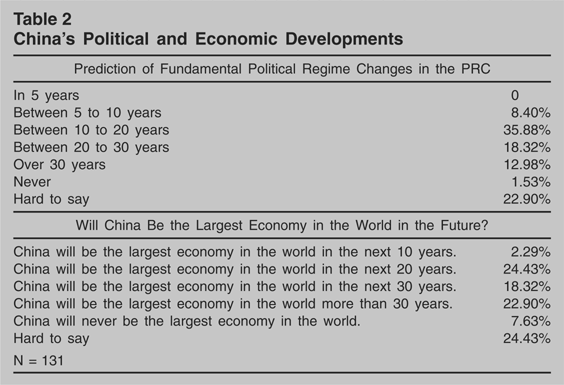
Almost everyone in our survey thinks Chinese economic reform has been successful or very successful and many believe that China will have the largest economy in the next 30 years (see Table 2). Indeed, China's spectacular economic development in the last 25 years is unprecedented and nothing short of a miracle. The Chinese economy has been transformed from a strictly planned economy to a predominantly market one. Even though China has experienced an economic makeover, its political system has changed little. As most Latin American, Asian, and eastern European countries have become democratic in the past three decades (the so-called “third wave” named by Samuel Huntington), China seems to be an exception. It appears that the Chinese Communist Party is in firm control of the country and there is little sign that China is moving toward institutional democratization and political liberalization. Will China ever become a democratic country? Our China specialists seem to be divided about the timetable for fundamental future political changes. Nobody predicts the current political regime will collapse within five years, less than 10% believe that fundamental political changes will occur between 5 to 10 years, and over a third tend to think that these changes will only happen in 10 to 20 years (see Table 2). Also, close to one-third of our respondents do not predict more meaningful political changes within the next 20 years in China and about a quarter find it hard to answer this question. Even to many China scholars, political development in China seems unpredictable.
China's Political and Economic Developments

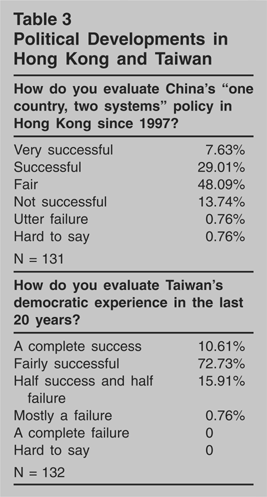
It has been 10 years since Hong Kong was returned to China's sovereignty. China promised to adopt the “one country, two systems” policy; i.e., not changing Hong Kong's existing main economic, social, and political system, for 50 years after the transfer of sovereignty. More than a third of our respondents think China's running of Hong Kong is either successful or very successful, while 48% think it is fair (see Table 3). Even though some argue that China has interfered unnecessarily and diffidently in Hong Kong's affairs, a majority surveyed seem to be modestly positive about China's handling of Hong Kong since 1997. For the most part, Beijing has by and large left Hong Kong alone. Hong Kong has maintained its economic system and civil liberties inherited from the British colonial era; Hong Kong does not pay a dime of tax to the central government; and any migration from mainland China to Hong Kong is strictly controlled. Moreover, the Chinese central government provides preferential treatments to Hong Kong through the Mainland-Hong Kong Closer Economic Partnership Arrangement. However, Beijing has interfered to a certain degree with Hong Kong's political process. A major controversy that has caused public dissatisfaction in Hong Kong is Beijing's refusal to allow a popular election for Hong Kong's chief executive and all members of the Legislative Council until 2017 and 2020 respectively. The main reason for China's roughly better-than-expected treatment is that it uses Hong Kong to showcase its “one country, two systems” policy to the people of Taiwan, even though they do not find the Hong Kong model as attractive as the status quo.
Political Developments in Hong Kong and Taiwan

What do our China scholars think about Taiwan? Western politicians and political scientists often cite Taiwan as a textbook example for democratization in developing countries. Its peaceful transition from authoritarianism to liberal democracy occurred as a result of rapid economic growth, the improved education level, and a growing middle class. However, many Taiwanese, including elites, intellectuals, and ordinary people, have been disillusioned and disappointed by the political developments since the late 1990s, such as worsening official corruption, questionable economic and educational policies, some politicians' irresponsible play of ethnic politics, and the incessant and excessive confrontation between the ruling party and the opposition parties that has often led to governmental gridlock and paralysis.
In contrast to the disappointment many Taiwanese feel about Taiwan's democratic experience, an overwhelming majority of our China scholars are fairly upbeat about Taiwan's democratic development in the last 20 years. Over 80% of our respondents think Taiwan's democratization is either fairly successful or very successful (see Table 3). Almost no one believes that Taiwan's democratic experiment is a failure. We believe that our China scholars' optimistic evaluation of Taiwan's democratic experience has something to do with the fact that, despite some difficulties in Taiwan's democratic consolidation, Taiwan's young democracy has survived. There have been three peaceful democratic presidential elections in Taiwan, the former ruling party KMT gave up power peacefully in 2000, and civil liberties remain by and large intact. And people in Taiwan have had the chance to grade their politicians and political parties through both the legislative and presidential elections since the 1990s.
Conclusion
Our survey of America's China scholars generates interesting findings that we feel policy makers and the general public should take note of. The majority of our respondents think relations between the United States and China are good or fair and approve of President George W. Bush's handling of China. Even though our respondents are divided on what these bilateral relations will look like in the future, indicating the uncertainty of this relationship, a majority of them, however, do not expect a military conflict in the next 20 years. On cross-Taiwan Strait relations, which may become the most explosive issue in U.S.-China relations, more respondents blame Taiwan on the current tensions between mainland China and Taiwan and half of them think the U.S. policy toward the Taiwan Strait issue is a balanced one. When it comes to Taiwan's future, most scholars believe that either the status quo will continue or mainland China and Taiwan will peacefully unify in the next 30 years; very few believe that Taiwan will gain formal independence peacefully and successfully or that the two sides will come to a military conflict; and most of our polled scholars believe that the future of Taiwan in terms of relations with mainland China should be decided by the Taiwanese. In addition, most of our scholars do not rule out the possibility of a U.S. military intervention in case China attacks Taiwan.
Most of our China scholars find it hard to predict what type of superpower China will be, benign or militarist/aggressive, if China does become one. Moreover, even though most of our scholars praise China's economic reform, few of them predict any fundamental political regime changes within the next 10 years. Most respondents also gave fair grades to China's handling of Hong Kong since its return to Chinese sovereignty and they are complimentary of Taiwan's democratic experience.
The overall opinions on U.S.-China relations, cross-Taiwan Strait relations, and the rise of China are very interesting and informative. Our China scholars seem to be more in agreement on some issues, such as the assessment of current official U.S.-China relations, President Bush's China policy, the possibility of a military conflict between the United States and China, and democratization in Taiwan. Yet, our scholars seem to be divided and uncertain on some other issues, such as what kind of superpower China will be, the future of mainland China-Taiwan relations, and when fundamental regime changes will occur in China. These findings indicate that China is still a delicate issue that the current and future U.S. administrations need to handle with care and patience.
Author Bios
Yang Zhong is professor of political science and chair of Asian studies at the University of Tennessee, Knoxville. His main research interest is comparative politics with a focus on China. His work has been published in journals such as the Journal of Politics, Comparative Political Studies, and Political Research Quarterly. He can be reached at yzhong@utk.edu.
Jeffrey Che-huan Shen, originally from Taiwan, R.O.C., is a doctoral student at the Graduate School of International Studies, University of Denver (che-huan.shen@du.edu). His research focuses on political participation, conflict resolution, foreign/security policy, and Asia Pacific politics.