INTRODUCTION
We may now have an external reference to one of the manumission acts recorded in the Athenian ‘phialai inscriptions' of the fourth century bc.Footnote 1 The metalworker Kittos appears in as many as two contemporary sources outside the phialai inscriptions, one of which (a recently-published oracular tablet from Dodona) refers to his promised manumission. This provides a rare opportunity to watch the life of an Athenian slave unfold across multiple documents. It also brings new evidence to bear on the debate over the nature of the phialai inscriptions, which – despite their traditional identification as manumission lists – have become a source of controversy in recent years.
For well over a century, scholars have almost universally accepted that the phialai inscriptions relate, whether directly or indirectly, to slave manumission (for detailed literature review, see Meyer Reference Meyer2010, 17–21; see also Lewis Reference Lewis1959, 237–8). In Reference Köhler1878 Ulrich Köhler first argued for associating the phialai inscriptions with the phialai exeleutherikai (‘freedmen's bowls’) mentioned in fourth-century acropolis inventories. Confirmation of this view would soon seem to be found in the heading of IG II2 1578, l. 2, where the broken word [-]στασίου calls to mind dikē apostasiou trials – a type of prosecution against freed slaves (discussed in greater detail below). First to draw on this evidence was Ulrich von Wilamowitz-Möllendorff, who in Reference Wilamowitz-Möllendorff1887 (110 n. 1) proposed the restoration [δίκαι ἀπο]στασίου. Over the following years his suggestion gained widespread acceptance, and a communis opinio swiftly congealed around an identification of the phialai inscriptions as documents with some connection to manumission, even if many of the specifics remained up for debate. In Reference Martin1990 Dale Martin voiced dissent (186 n. 52), but it was not until 2010 that the manumission hypothesis met its first comprehensive challenge. In Metics and the Athenian Phialai-Inscriptions: A Study in Athenian Epigraphy and Law, Elizabeth Meyer not only re-edits the entire corpus of phialai inscriptions, but also offers a detailed rebuttal to earlier arguments. The [-]στασίου in IG II2 1578, Meyer argues, refers to graphē aprostasiou, not to dikē apostasiou; the defendants named throughout the inscriptions are not exclusively freed slaves, she maintains, but rather metics charged with lacking a prostatēs or failing to pay the metic-tax. Meyer's thesis is original and provocative, and though it has attracted its share of criticism (e.g., Vlassopoulos Reference Vlassopoulos2011; Zelnick-Abramovitz Reference Zelnick-Abramovitz2013, 94–104; Rocca Reference Rocca2011, 258), it has succeeded in shaking the confidence of some scholars in the manumission interpretation. For instance, Edward Harris (Reference Harris and Faraguna2013, 171–2 n. 60) has stated his dissatisfaction with both the traditional dikē apostasiou argument and Meyer's graphē aprostasiou alternative. In a similar vein, Adele Scafuro (Reference Scafuro, Leão and Thür2016, 96) has pondered whether we might explain the verdicts of the phialai inscriptions without appealing exclusively to apostasiou or aprostasiou.
As for my own view of the matter, I believe that the manumission hypothesis is considerably stronger than many scholars recognize. As long as the consensus went unchallenged, little need was felt to seek out additional corroborating evidence. But now, in light of Meyer's meticulous counter-arguments and the renewed attention they have brought to the subject, it is worth probing more fully the merits of a consensus that has persisted for so many decades. Careful scrutiny of the inscriptions, I will argue, suggests that the manumission hypothesis is probably correct; that its basic explanatory power remains as strong as ever; and that competing explanations likely cannot bear the weight of the evidence. In short, the manumission hypothesis deserves to retain its position as the standard working interpretation of the phialai inscriptions.
Kittos, the subject of this paper, lends support to such an argument. Even if one rejects my proposed connection to the Dodona tablet, Kittos still exhibits an onomastic phenomenon consistent with a master–slave relationship – he was, it seems, a slave named after his master. But this only reinforces what is already a compelling case. The example of Kittos rests upon a body of evidence which, in my view, amply supports the notion that the phialai inscriptions pertain to manumission acts (see below, ‘Evidence for a Manumission Context’). Still, even among those who accept the link between these documents and manumission, there is disagreement. As one argument holds, the inscriptions relate to cases of dikē apostasiou, a type of lawsuit a slave-owner could bring against his former slave. An alternate position maintains that the inscriptions represent dikē apostasiou cases repurposed to serve as a form of manumission, or to waive a freed slave's ongoing obligations to serve his former master, with the law-courts of Athens providing a public setting to execute the change in legal status. (Such a procedure should perhaps be described as collusive litigation, in which both parties to the lawsuit seek a mutually desired outcome; cf. Patterson Reference Patterson1982, 236–7.) Either way, the documents record the two parties – slaves and slave-owners – involved in the original manumission acts.
The discussion of Kittos should be situated within this broader conversation about the phialai inscriptions. My point of departure is an attempt to classify the inscriptions, rejecting the common view, endorsed by a number of scholars in recent years, that they serve as inventories of dedications. Meyer (Reference Meyer2010, 59–69) urges that the phialai inscriptions are inventory inscriptions characteristic of the Lycurgan period. Likewise, Edward Harris (Reference Harris and Faraguna2013, 172) states ‘they are really financial records’ that ‘aim to prevent embezzlement by officials’, and are ‘similar to the records of dedications in the Parthenon and Erectheum’. Diane Harris (Reference Harris1992, 637–8) considers them kathairesis inventories. None of these interpretations, I suggest, can pass muster.
I will then review various pieces of evidence suggesting a manumission context for the phialai inscriptions, including a new argument about the presence of families and children in the inscriptions. Only then will I turn to Kittos, and consider what his case might add to the debate. Finally, I will defend the hypothesis of repurposed apostasiou. The verdicts recorded in the inscriptions are, I suggest, manumissions effectuated in court by means of apostasiou acquittal. Two literary sources from the 350s–340s may attest to this very method of freeing slaves in court. Popular since mid-century, it was not until the 330s that this form of manumission entailed a mandatory phialē dedication – one of many contemporary measures associated with the statesman Lycurgus that aimed to revitalise the economic and religious life of the Athenian polis.
PHIALAI INSCRIPTIONS: LISTS, NOT INVENTORIES
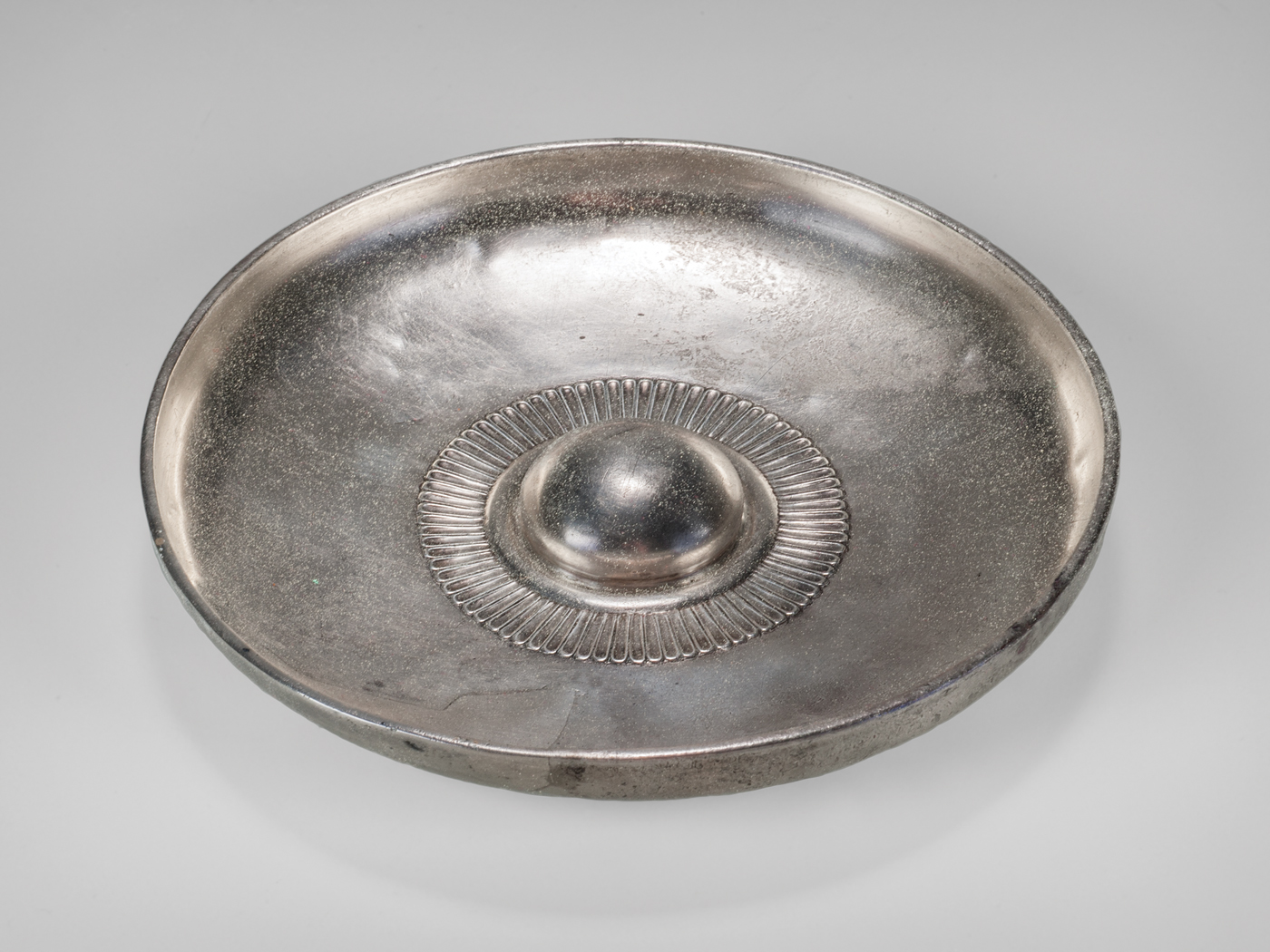
The Athenian phialai inscriptions defy easy classification. The surviving fragments constitute at most 19 different stelae, their content divided into columns and short entries. The roughly 421 entries preserved in whole or in part must be only a fraction of the original figure.Footnote 2 On most (but not all) of the stelae, each entry records the dedication of a 100–drachma libation bowl (φιάλη; Fig. 1).Footnote 3 On all the stelae, each entry lists two or more names, framed as prosecutors and defendants in a trial, often accompanied by the word ἀποφυγών (‘acquitted’) indicating the verdict. Some fragments lack any indication of verdicts, although the courtroom setting remains apparent (see SEG XXV 180, esp. ll. 12–19). Entries of this format omit the word ἀποφυγών and reverse the order of names, placing the prosecutor's name first (in the nominative) and the defendant's name second (in the accusative). (Interestingly enough, the same format can be found among the manumission inscriptions of Oiniadai, with the manumission verb omitted, the manumitter's name in the nominative, and the slave's name in the accusative [Powell Reference Powell1904, 181–6].) Despite occasional debate over the precise significance of this ‘reversed formula’, scholars up to and including Meyer have always understood the basic truth of the matter – those entries which omit ἀποφυγών list the prosecutor first, and the defendant second (Lewis Reference Lewis1959, 235, 237; Reference Lewis1968, 372; Meyer Reference Meyer2010, 12–13, 136). Whatever the entry format, the type of case reflected in the phialai inscriptions is traditionally identified as dikē apostasiou on the basis of the broken word [-]στασίου preserved in a fragmentary heading.Footnote 4
Greek. Libation Bowl (Phiale), 5th century bc. Silver. Overall: 7/8 × 6 3/16 in. (2.2 × 15.7 cm). Evan F. Lilly Memorial. Eskenazi Museum of Art, Indiana University 69.102.2. Photograph by: Kevin Montague.

In fourth-century Athens, slave-owners had the right to bring apostasiou prosecutions against their freed slaves. According to Valerius Harpocration, the second-century ad Alexandrian scholar who produced a glossary to the Attic orators (s.v. ἀποστασίου):
ἀποστασίου· δίκη τίς ἐστι κατὰ τῶν ἀπελευθερωθέντων δεδομένη τοῖς ἀπελευθερώσασιν, ἐὰν ἀφιστῶνταί τε ἀπ’ αὐτῶν ἢ ἕτερον ἐπιγράφωνται προστάτην, καὶ ἃ κελεύουσιν οἱ νόμοι μὴ ποιῶσιν. καὶ τοὺς μὲν ἁλόντας δεῖ δούλους εἶναι, τοὺς δὲ νικήσαντας τελέως ἤδη ἐλευθέρους.
apostasiou: it is a lawsuit granted to those who have set slaves free, against those who have been freed, in case they neglect their manumitters or register someone else as prostatēs, and fail to do what the laws command. Those convicted must become slaves, while those acquitted are then absolutely free.
Vulnerability to apostasiou prosecution, then, entailed a freed slave failing to honour certain legal requirements and service obligations towards the former master. Those convicted on such charges, Harpocration explains, were re-enslaved, while the acquitted achieved ‘absolute freedom’ from the various requirements and obligations, removing any risk of future apostasiou prosecution (τελέως ἤδη ἐλευθέρους).
In the phialai inscriptions, each entry includes a non-citizen defendant, identified by oikōn en nomenclature and often by occupation title, and at least one prosecutor, who is usually a citizen, but sometimes a metic, an isotelēs, a proxenos, a foreign refugee, a minor acting through a kyrios, or even a public slave. In an apostasiou context, these two roles will correspond to the freed slave and the slave-owner, respectively. Most of the stelae expressly identify acquittal as the outcome of the case; conviction is never mentioned. The inscriptions seem to date roughly to the Lycurgan era of Athens (338–322 bc), and another fragmentary heading containing [-]ούργου suggests that a policy of Lycurgus himself may have generated these documents.Footnote 5
With all this in mind, we can take up questions of epigraphic genre. How should we classify the texts, and what function do they serve? In recent years scholars have tended to describe the phialai inscriptions as inventories of dedications (D. Harris Reference Harris1992, 637–8; Meyer Reference Meyer2010, 59–69; E. Harris Reference Harris and Faraguna2013, 172). This notion carries a certain intuitive appeal, given the prominence of dedicatory phialai throughout the documents. Yet it is, I believe, a misclassification. That some of the fragments categorically omit any mention of dedications from their entries precludes a simple identification of the inscriptions as inventories. Surely an ‘inventory’ could not omit the very objects it seeks to record. Among the stelae that omit phialai from their entries (‘Typ U’ in Kränzlein Reference Kränzlein and Wolff1975) is IG II2 1576 – which in fact accounts for two, if Meyer (Reference Meyer2010, 129) is correct that its two fragments come from separate stelae. IG II2 1578 is probably another; as Lewis (Reference Lewis1959, 236–7) notes, ‘although the phialai have been restored, there is no reason to suppose their presence.’Footnote 6 Another possibility is IG II2 1577, which ‘may not have phialai, but is so fragmentary that nothing is certain’ (Meyer Reference Meyer2010, 13 n. 9). Meyer (Reference Meyer2010, 136) proposes that the lost headings of these stelae would have originally stated that each entry corresponds to a dedication. Lewis's (Reference Lewis1959, 237) solution – and I agree – is that this format predates the imposition of mandatory dedications upon courtroom manumissions. Either way, the phialē-free format would seem to prioritise the trial verdict content (and the individuals named therein) over any function as an inventory.
Moreover, the inscriptions do not conform to any standard class of ancient Greek inventory: they are not magistrates’ annual paradosis accounts, nor ad hoc exetasmos inventories, nor kathairesis accounts of melting down old dedications (on these three types see Aleshire Reference Aleshire1989, 103–10). Of these options only the last appears promising, since phialai exeleutherikai (commonly associated with the dedications mentioned in the phialai inscriptions) were in fact melted down, starting in 321/320 bc (IG II2 1469, ll. 3–12). But this appears to be the very first melting of phialai exeleutherikai, and the year is too late to reasonably assign a kathairesis function to inscriptions dating back to the 330s.Footnote 7 The 321/320 date suggests policy changes implemented by the post-Lamian War oligarchy rather than the continuation of a Lycurgan melting programme. While it may be inadvisable to insist that all inventory documents must rigorously conform to the three standard types, the challenge of classifying the phialai inscriptions remains.
But the problem is not intractable. Another class of phialai inscription provides a close parallel – so close, in fact, that one stele includes both types of phialai record on opposite faces (IG II2 1575). I refer to the phialai leitourgikai inscriptions, which record the 50-drachma phialai dedications of liturgists (Lewis Reference Lewis1968, 374–80; Lambert Reference Lambert2012, 224–34). These documents show great interest in the dedicatory vessels, recording their weight in each entry, meticulously noting deviations in weight as small as one drachma, and even listing a sum total of phialai (IG II3 1 550, ll. 27, 31; SEG XXV 177, l. 51). Yet they are not inventories, at least not primarily, and this is clear enough from the documents’ own words. The heading of IG II3 1 550 provides a crucial insight into their function: ‘the following were liturgists’ (οἵδε ἐληιρτού[ργ]ησαν, l. 5), it says, before launching into the body of the text. As important as the dedications may be, the emphasis is above all on the people involved. The same must be true of the phialai inscriptions that record trial verdicts, which can omit dedications but never the names of prosecutors and defendants. Both types of phialai record, then, are not inventories, but rather lists of individuals and publicly consequential actions, which happen to record (on most of the stelae, at least) related dedications as well.Footnote 8
Fiscal matters are thus of secondary importance in these inscriptions, though hardly insignificant. Recording the dedications and their precise weights on the stelae would have reflected positively on the achievements of Lycurgus, giving a sense of the volume of income paid to Athena thanks to his new financial measures. But the primary function, it seems, was to publicise information in the interest of the individuals named on the stelae. The phialai leitourgikai records proclaim the deeds of the liturgical class, providing an outlet to make their philotimia manifest to the Athenian people. A stele attesting not only to the performance of a liturgy, but also to the dedication of a metal vessel, would stand as an enduring testimony to one's civic-minded achievements. The phialai inscriptions concerning trial verdicts will have played a comparable role: propagating certain information favourable to the individuals named on the stelae. If, as I argue below, the idea of manumission through apostasiou is correct, that role comes sharply into focus. The inscriptions publicised information of vital importance to freed slaves, with lists of apostasiou verdicts and corresponding phialai dedications certifying their new freedom.
EVIDENCE FOR A MANUMISSION CONTEXT
Numerous pieces of evidence suggest a link between the phialai inscriptions and manumission.
1) ἀφίημι ἐλεύθερον
One fragment of the phialai inscriptions appears to explicitly refer to manumission, and this must number among the strongest clues about the nature of the documents. The fragmentary heading of IG II2 1560 contains the word [ἀ]φιεμένου (face A, l. 2), which Meyer (Reference Meyer2010, 106) proposes to interpret as ‘acquitted’, though acknowledging that it ‘often or even usually means “the one let go” or “the one set free”’. This latter interpretation is strengthened by what immediately follows on the stone. Although a diagonal streak of weathering makes the reading difficult beyond the omicron of [ἀ]φιεμένου, the three most recent editions of the text – those of Kirchner in IG II2, of Meyer, and most recently of Francesca Rocca – all agree that the following word begins with an epsilon.Footnote 9 This naturally leads one to think of the expression ἀφίημι ἐλεύθερον (‘I set free’), a standard manumission phrase.Footnote 10 This impression has recently received additional support from Rocca's (Reference Rocca2011) thorough autopsy of the stone. Rocca adds a crucial dotted lambda to the text, reading the entire line as:
[– – –] ἀ̣φιεμένου ἐλ̣[– – –]
Again, it must be acknowledged that the reading is difficult. For my part, however, having examined several digital photographs of the stone, I find the lambda convincing. The word ἀφιεμένου by itself is significant, and in light of Rocca's ἐλ̣[-] it becomes increasingly difficult to avoid seeing a form of the phrase ἀφίημι ἐλεύθερον – and thus a clear reference to manumission – in the heading of IG II2 1560.
Otherwise, the heading refers to a law ([κ]ελεύο[ντ]ος τοῦ νό[μου]), includes provisions for inscribing names (ἀναγρά̣φ̣ειν τὰ ὀν[όματα]), and mentions dedications (ἀνα̣θήματ̣α Meyer, ἀνά̣θημα Rocca), jurymen (οἱ δικασ[ταὶ]), descendants (τῶ[ν] ἐκγόνων), and prytaneis ([τῶ]ν πρυτά̣νεων). In the judgment of Lewis (Reference Lewis1968, 376), the law outlined in this heading ‘seems to have added the compulsory dedication of φιάλαι to the previously existing manumission institution’ (see also Lewis Reference Lewis1959, 234, 237). After a vacat following the heading, the individual phialai entries commence at l. 12 of face A, and continue on face B.Footnote 11
2) dikē apostasiou
A second partially preserved heading contains the broken word [-]στασίου, traditionally restored as [δίκαι ἀπο]στασίου (IG II2 1578, l. 2). Apostasiou cases involved a master prosecuting a freed slave, with acquittal resulting in ‘absolute freedom’ from various legal obligations (Harpocration s.v. ἀποστασίου). Since most of the phialai stelae expressly mention acquittal as the outcome of the case (and conviction is never mentioned), the inscriptions would thus provide a record of freed slaves who had achieved absolute freedom via the law courts of Athens. Meyer (Reference Meyer2010, 133–7), rejecting the association between these documents and manumission, instead restores a reference to graphē aprostasiou, giving us cases of metics prosecuted for lacking a prostatēs or for avoiding the metic-tax. In epigraphic terms, both restorations are possible, but dikē apostasiou has the advantage of according with the other evidence for manumission presented in this section.
3) phialai exeleutherikai
In the last quarter of the fourth century, the inventories of the treasurers of Athena make reference to a group of phialai associated with freed slaves (phialai exeleutherikai). The surviving fragments record metalworkers melting down phialai exeleutherikai to produce larger silver vessels in 321/320, 320/319, and c. 314/313 bc (IG II2 1469, ll. 3–27; IG II2 1480, ll. 8–11). While ‘phialai exeleutherikai’ is an expression that occurs nowhere in the phialai inscriptions themselves, the widely-inferred relationship between the two appears sound. The phialai inscriptions attest to hundreds of dedications involving non-citizens of manifestly humble origins: retailers, textile workers, donkey-drivers, hired labourers. Contemporary to these documents, the freed slaves’ phialai housed on the acropolis naturally entailed non-citizens of a comparable economic status, and they likewise originally numbered in the hundreds: the preserved references alone attest to 13,264 drachmas of silver from melted phialai exeleutherikai. The original figure was probably much greater, with the melting spanning at least eight years.
On this point, two further issues demand consideration. First, where are the phialai exeleutherikai in accounts of the treasurers of Athena prior to 321/320? Absent – but that is hardly surprising.Footnote 12 The surviving records dated to the 330s–320s (IG II2 1456–1470) are highly fragmentary, and the inventories can mention groups of phialai collectively in the space of just a few lines. For example, the record of 376/375 uses only four lines to mention 60 100-drachma phialai, divided into three groups of 20 (IG II2 1445, ll. 31–4; see also Harris Reference Harris1995, 63). Such a reference to phialai exeleutherikai could have easily escaped survival.
Second, what was the relationship in Classical Athens between the two terms for ‘freed slave’, exeleutheros and apeleutheros? Ancient scholars debated this question.Footnote 13 Athenaeus (3.115b–c) broaches the subject but declines to investigate further. Hesychius and Nicander claim that exeleutheroi were the children of freed slaves, but Photius suspects this notion owes to a mistaken reading of a play of Cratinus (Hesychius s.v. ἐξελεύθερος; Photius s.v. ἐξελεύθερος). A competing ancient explanation posits that exeleutheros designated someone who fell into slavery or debt bondage and was subsequently freed (e.g. Ammonius 65). However, Aristophanes of Byzantium, Pollux and the ‘Antiatticist’ author of a second-century ad lexicon all present exeleutheros and apeleutheros as synonyms (Ar. Byz. fr. 332.333 Slater; Pollux 3.83; Antiatticist ε 75 Valente). Both terms were in use in Athens around the time of the phialai inscriptions, when Hyperides attributes the stoa of Zeus Eleutherios to the exeleutheroi, and Demosthenes speaks of laws governing apeleutheroi and exeleutheroi (Harpocration s.v. Ἐλευθέριος Zεύς; Pollux 3.83). What distinction – if any – existed between these two words in the fourth century is a question that continues to attract discussion (Zelnick-Abramovitz Reference Zelnick-Abramovitz2005, 120–6; Dimopoulou-Piliouni Reference Dimopoulou-Piliouni2008, 36–8). That exeleutheros roughly meant ‘freed slave’ is perfectly clear, however, and if the distinction in meaning was lost on Athenaeus, Photius, Aristophanes of Byzantium, Pollux and the Antiatticist, it must have been quite subtle.
4) Families and children
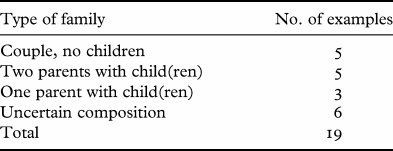
Seventeen children and around nineteen family groupings occur among the defendants in the phialai inscriptions (see Appendix; Table 1). Though the interpretive value of this evidence has rarely been recognised, the presence of families and children is one of the inscriptions’ strongest indications of a manumission context – so strong, in fact, as to verge on a diagnostic feature.
Families in the phialai inscriptions.

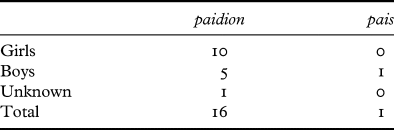
First of all, the presence of so many children is an obstacle to any argument that the phialai verdicts are unrelated to manumission. Minors could, it seems, be held legally responsible in certain circumstances, such as involuntary homicide (Golden Reference Golden2015, 35; see also [Plutarch] Lives of the Ten Orators 842e). Yet the phialai inscriptions concern not only children, but young children – in 16 out of 17 cases, the child is identified as a paidion. That the remaining child is called a pais (on the same stele as several paidia, no less) shows that the documents do intend an age distinction between the two terms, with paidion conveying its literal meaning of ‘young child’ (cf. Rosivach Reference Rosivach1989, 368–9; see also Golden Reference Golden2015, 10–12). A paidion could be as young as a baby and was, according to a fragment of Hippocrates, no older than seven years (Philo, De Opificio Mundi 36.105).Footnote 14
If the idea of genuine prosecutions seems to crumble under such circumstances, the presence of families and children is entirely consistent with manumission. It is completely intuitive – and amply attested in slave systems throughout history (e.g., Mouritsen Reference Mouritsen2011, 285–6; Hünefeldt Reference Hünefeldt1994, 79–85; Whitman Reference Whitman1997, 119–39; Groth Reference Groth2017, 59) – that manumission would accompany a concerted effort to secure freedom for one's enslaved family members (even if those family ties, formed within the bonds of slavery, lacked legal recognition). Significantly, the phialai inscriptions do not only furnish examples of families residing together in the same deme; two or three families include a child living apart, readily explainable as families broken up by slavery, with the parents managing to secure their child's freedom following their own manumission (see Appendix, nos 3, 6, 7). If one rejects a manumission context for the inscriptions, these cases seem to elude explanation.
Furthermore, the preponderance of paidia over older paides (Table 2) very plausibly reflects the economics of manumission: it would be cheaper to purchase the freedom of a paidion than of a pais. This price disparity shows up in the ‘Attic stelae’, when a paidion sells for 72 drachmas, while a pais sells for 174 drachmas, ‘the average fee for an adult’ (Pritchett Reference Pritchett1956, 276). It is also significant that a majority of the child defendants are female: 10 girls, 6 boys, and 1 unknown. Though hard figures are lacking to prove the point, Athenian slave-owners may have assigned less value to enslaved girls than to boys, and set a lower manumission fee accordingly. Such is apparent in the Delphic manumissions from the second and first centuries bc, in which the average price of freedom is higher for boys than for girls at a roughly 55:50 ratio (Hopkins Reference Hopkins1978, 159). A modern example will nicely illustrate the kind of economic calculations I see at work in the phialai inscriptions. Consider the case of early national Maryland, ably treated by T. Stephen Whitman, where manumission documents exhibit the same trend with respect to both age and gender:
Free black parents whose children had been born as slaves would have known that buying out their sons and daughters would become more costly as they grew older and that girls, even infant girls, could be freed more cheaply than boys … Nearly twice as many children were freed before their fifth birthday as between ages five and nine, and more than twice as many were freed before age five as were liberated between the ages of ten and fourteen. (Whitman Reference Whitman1997, 133)
The factors that Whitman adduces to explain the Maryland evidence could apply just as well to Classical Athens: risk of child mortality; lack of economic productivity on the part of young children, despite the necessity of expending resources to raise them; expectations that, on average, boys would yield greater returns than girls over the course of a lifetime (Whitman Reference Whitman1997, 132–3). To this we can add the risk that girls would grow up to die in childbirth. There is, in short, ample reason why young children and girls would have been freed at a higher rate than older children and boys. Thus, manumission offers a good explanation for the appearance of so many young children in the phialai inscriptions, as well as the slight preponderance of girls over boys. There is no obvious reason why lawsuits unrelated to slavery should disproportionately target very young children – in fact, their regular presence as defendants seems most unlikely – and the inclination towards girls over boys suggests a price of freedom that varied according to gender.
Children in the phialai inscriptions.

Finally, it is necessary to state that the occasional manumission of families is entirely consistent with the available Athenian evidence. In ancient Greece more broadly, it was not unusual to find enslaved family members set free together: the Delphic manumissions include numerous instances of mothers manumitted together with their children, and other locations throughout the Greek world provide further examples of manumission respecting family ties (Zelnick-Abramovitz Reference Zelnick-Abramovitz2005, 163–7; Reilly Reference Reilly1978, 111 n. 5). Classical Athens was no exception. The will of Aristotle promises freedom to a father and his child following the marriage of Aristotle's daughter (Diogenes Laertius 5.15). The will of Theophrastus contains provisions for Pompylos and Threpte, perhaps manumitted simultaneously as a romantic couple, since they are described collectively as ‘long since emancipated’ (Πομπύλῳ δὲ καὶ Θρέπτῃ πάλαι ἐλευθέροις οὖσι; Diogenes Laertius 5.54). In Hyperides’ Against Athenogenes, the plaintiff describes purchasing an enslaved father from a perfume shop, along with his two sons, in order to free them; a family of perfume dealers in the phialai inscriptions is remarkably similar in composition (Appendix, no. 19). In the recently published fragment from Hyperides’ speech Against Timandros, the speaker asserts that even slave-traders (ἀνδραποδοκάπηλοι) avoid splitting up families, to the point of willingly suffering economic loss (Jones Reference Jones2008). Whatever the extent of rhetorical exaggeration here, the claim's persuasive force depends on an audience of fourth-century Athenians assigning some value to maintaining the integrity of slave families, and slave-owners may have been in a position to feel these social pressures rather more acutely than slave-traders. But one need not attribute the existence of slave families purely to the benevolence of masters; allowing slaves to form family structures could just as well function as a form of social control (Xenophon, Oeconomicus 9.5). And masters eager for profit might have turned familial affection to their advantage, motivating a slave seeking freedom to procure a self-purchase fee not only for himself, but for an entire family. Thus, the presence of families in the phialai inscriptions points to the social and economic logic at work behind the scenes of manumission.
5) Onomastics
A number of scholars have observed the prevalence of common slave names among the phialai defendants (Rosivach Reference Rosivach1991; Masson Reference Masson1972, 17; Rädle Reference Rädle1969, 17 n. 2). Such evidence should be treated with caution, as the ancient Greek world is not characterised by names reserved exclusively for slaves (Masson Reference Masson1972, 21). Despite this caveat, one cannot afford to ignore the many names scattered throughout the phialai inscriptions that are consistent with servile naming conventions. For instance: Aigyptia, Armenios, Chresimos, Daos, Epikerdes, Lyde, Manes, Onesimos, Onesime, Pyrrhias, Sosias, and Thraitta (IG II2 1553, 4–7, 24–8; IG II2 1567, ll. 3–6; IG II2 1574, ll. 4–8; IG II2 1576a, ll. 21–5; Meyer Reference Meyer2010, nos 2–9, face A, ll. 194–5, 209–12, 221–4, 328–31, 485–8, 493–6). This selection is far from exhaustive, but gives a sense of the various foreign names, ethnic adjectives used as names, and names signifying physical characteristics or desirable qualities (for instance, ‘profitable’) that occur throughout the documents. Though names more typical of free people also occur, this is perfectly consistent with the practice of changing one's name following a change in legal status (Theophrastus, Characters 28.2; Vlassopoulos Reference Vlassopoulos, Taylor and Vlassopoulos2015, 116–19; Rosivach Reference Rosivach1991).
By itself, this onomastic makeup is not proof of a manumission context. Meyer (Reference Meyer2010, 69) reasonably points out that a group of metics on the lower end of the economic spectrum, including but not limited to freed slaves, might look similar. Yet a different class of onomastic evidence deserves consideration: names that suggest a personal connection between prosecutor and defendant. Vlassopoulos (Reference Vlassopoulos, Taylor and Vlassopoulos2015, 111–14) has recently noted that slaves in Classical Athens were, on rare occasions, named after their masters. He identifies six entries in the phialai inscriptions which possibly reflect this practice. To take one example, consider the case of Chairephilos and Philon. Chairephilos son of Pheidon of Paiania prosecutes Philon living in Kollytos, a seller of salt fish (Meyer Reference Meyer2010, nos 2–9, face A, ll. 510–13). The shared philo- name element cannot be explained away as a family connection, since Chairephilos is an Athenian citizen, while Philon is not. Perhaps, then, Philon is a freed slave and Chairephilos had chosen the name as an allusion to his own. Elsewhere in the Greek world, it was fairly common that ‘a slave's name borrows one or more components from the master's or the master's relatives’ names’ (Vlassopoulos Reference Vlassopoulos, Taylor and Vlassopoulos2015, 111). In Athens such naming practices were rare, but not unheard of.Footnote 15 Of course, one might appeal to coincidence to dismiss the similarities that Vlassopoulos identifies in the phialai entries. But Kittos, as we will see below, presents the strongest case yet for identifying a phialai defendant as a freedman named after his master.
6) Prosopography
A generally humble status is manifest among the phialai defendants. Without exception, the cases involve at least one non-citizen, frequently identified by an occupation title in retail or manufacturing. As Stroud (Reference Stroud1974, 181–2) notes, the special provision for enslaved vendors in the Athenian coinage law of 374/373 is consistent with the many phialai defendants whose occupation titles terminate in -πώλης/-πωλις. The prosecutors, by contrast, are usually citizens, are never given an occupation title, and are often otherwise attested in Attic prosopography. That several of the metic prosecutors are described by patronym hints at their relatively elite status within the metic community. Thus, the cases on the whole resemble master–slave pairings. Closer scrutiny produces specific examples bearing out this suspicion.
Among the phialai defendants are two professional secretaries. If the inscriptions are in fact manumission records, we would expect the prosecutors in these cases (as owners and manumitters of enslaved secretaries) to have some need for secretarial services – and as it happens, they do. Both prosecutors are Athenian citizens who performed annual magistracies in the 330s–320s. In each case it appears that the defendant's occupation is directly related to the prosecutor's magistracy, and manumission explains well the dynamics at work here: the slave has been freed in appreciation for – or anticipation of – his assistance in performing a high-profile magistracy with great record-keeping demands.
First is Nikon the hypogrammateus, whose prosecutor was Proxenos son of Pylargoros of deme Acherdous (Meyer Reference Meyer2010, no. 11, ll. 31–4 [= IG II2 1561]). Proxenos served as grammateus of the Boule in 335/334 bc (PAA 789855). Grammateus and hypogrammateus – this pairing ‘can hardly be a coincidence’, as Nikolaos Papazarkadas (Reference Papazarkadas2012, 554) has written. I would suggest that Nikon worked as an assistant to Proxenos, and this subordinate relationship points us back to the likelihood of a master–slave relationship and, further, the manumission interpretation.Footnote 16 The second example is Philon, a professional grammateus living in Thorikos. He, along with his spouse and daughter, appear in the phialai inscriptions prosecuted by Pherekleides son of Pherekles of Perithoidai (Meyer Reference Meyer2010, nos 2–9, face A, ll. 464–75). This Pherekleides was elected stratēgos at least twice, including a tenure as general over the countryside (stratēgos epi tēn chōran), perhaps in the 320s when he is known to have discharged a second generalship at Akte (Pouilloux Reference Pouilloux1954, 114; PAA 920110). Philon's deme of residence, an unusual one for the phialai inscriptions, suggests that he was involved in military record-keeping on behalf of Pherekleides. Encountering a resident of Thorikos in these documents is quite remarkable by itself; the majority of phialai defendants are concentrated in the city proper or in Piraeus, and none live in Thorikos besides this family.Footnote 17 Thorikos was the site of important coastal fortifications protecting the Athenian mining district, and this immediately reminds us of the generalship of Pherekleides (Xenophon, Hellenica 1.2.1; Poroi 4.43; Pseudo-Skylax 57.2; Mussche Reference Mussche1961). At this time there was not yet a dedicated general of the coastal regions, a position that branched off from the general of the countryside in the third century bc (Tracy Reference Tracy1995, 44). As general of the countryside in the 320s, Pherekleides would have been responsible for the fortifications at Thorikos. Philon's secretarial efforts, then, probably supported Pherekleides during his tenure as general. One can readily imagine that this kind of service was instrumental in securing freedom for himself and his family.
7) Epigraphic genre
If (as argued above) the phialai inscriptions cannot be classified as inventories of dedications, it becomes increasingly difficult to explain their function without appeal to manumission. Numerous states throughout Greek history saw fit to publish manumission records. The existence of inscribed manumission lists in Athens would thus come as no surprise; rather, it would conform to a broader practice stretching from the fifth century bc to the Roman period (Zelnick-Abramovitz Reference Zelnick-Abramovitz2005, 61–9). A series of lists devoted solely to prosecutions against non-citizens would seem to be a remarkably idiosyncratic product of Greek epigraphy. A collection of manumission acts would not.
8) Potential objections
Finally, none of the objections that have been levelled against the manumission interpretation seem to me to outweigh the evidence presented above. The chief characteristics of the inscriptions that lead Meyer to reject a manumission context are the following:
stones that look like inventories all dating to a narrow time-frame, lists of phialai with inscriptions so abbreviated that the identification of the dedicator is uncertain, defendants whose nomenclature indicates metic status, families and children among the defendants, prosecution by metics and eranistai and even public slaves. (Meyer Reference Meyer2010, 78; objections discussed in greater detail at 22–7)
But as discussed above, the phialai inscriptions are not inventories – at least not primarily. The use of abbreviation (mostly in the deme, profession title and formulaic words like phialē) is rarely so extreme as to cause serious ambiguity, and abbreviation is common in a variety of document types of the fourth century. The metic oikōn en nomenclature is perfectly consistent with genuine apostasiou trials, in which the defendants, as freed slaves, were in fact metics. If manumission through apostasiou is the correct interpretation of the texts, such a system could have treated the defendants as already-freed slaves, with their masters freeing them in private and apostasiou acquittal formalising the act.Footnote 18 It is equally possible that the oikōn en formula was chosen simply because it reflected the most up-to-date information at the time of inscribing the stele. We have seen above that the presence of families and children in the phialai inscriptions is in fact strong evidence for manumission, not an argument against it. The eranistai are consistent with the use of eranos loans to purchase freedom, a strategy known from the Delphic manumissions and from the famous case of Neaira (Zelnick-Abramovitz Reference Zelnick-Abramovitz2005, 220–2). Of course, eranos loans were far from unique to manumission, but are certainly consistent with a manumission context. Similar types of loans and group-sponsored manumission occur in later history as well (e.g. Harrill Reference Harrill1993, 122–32; Mulvey Reference Mulvey1982, 49–51). In the phialai inscriptions the koinon eranistōn never acts alone, and is always listed after a case's main prosecutor. There is no evidence that such organisations could not participate in private suits as co-prosecutors (Rubinstein Reference Rubinstein2000, 87–91). Finally, as Paulin Ismard (Reference Ismard2015, 103–7) has recently shown, slave ownership by public slaves is not so counterintuitive as it appears at first, but rather accords with what we know of the status of dēmosioi in Athens and elsewhere.Footnote 19
The central mystery of the documents – the one feature which has given rise to all other objections to the manumission interpretation – is the inscriptions’ presentation of their content as trial verdicts. If the inscriptions concern manumission, one naturally wonders, why do their entries speak of acquittal? But this becomes considerably less troubling when we consider a single fact, a fact that can be demonstrated without appeal to the testimony of the phialai inscriptions: among the forms of emancipation practiced in fourth-century Athens was manumission in court (Dionysius of Halicarnassus, Isaeus 5 [= Isaeus fr. 15 Thalheim]).
KITTOS AT ATHENS AND DODONA
By now, I hope to have shown that the phialai inscriptions have something to do with manumission, even if it remains difficult to see exactly what was going on behind the scenes (I will defer that discussion until the penultimate section of this paper, ‘Apostasiou as Manumission’). We can now ask what evidence Kittos adds to the conversation. Here is his entry in the phialai inscriptions (Meyer Reference Meyer2010, nos 2–9, face A, ll. 100–3 [= IG II2 1554, ll. 10–13]):
[Κ]ίττος ἐμ Πει οἰκῶν
χαλκεὺ ἀποφυγὼν vv
Διονύσιον ἰσοτελῆ
φιάλη σταθμὸν :H: vvv
Kittos the metalworker, living in Piraeus, acquitted in a prosecution by Dionysios isotelēs; libation bowl, weight: 100 dr.
These lines inform us that Kittos, a non-citizen metalworker (χαλκεύς) residing in Piraeus, has been acquitted in a prosecution by Dionysios, himself a non-citizen enjoying the honorary isotelēs status in Athens. A phialē weighing one hundred drachmas has been dedicated. Immediately following these lines, we find an entry for a woman named Mnesithea, a textile worker (talasiourgos) living in Piraeus, acquitted from the same Dionysios. Mnesithea was probably the wife or cohabitant of Kittos.Footnote 20 According to the traditional interpretation of the phialai inscriptions, these two entries inform us that Dionysios has manumitted both Kittos and Mnesithea.
Compare the phialē entry of Kittos to the following oracular tablet from Dodona, dated by its editors to the mid-fourth century (Dakaris, Vokotopoulou and Christidis Reference Dakaris, Vokotopoulou and Christidis2013, no. 1411; printed provisionally by Eidinow Reference Eidinow2007, 104 [= SEG LVII 536]):
Κίττωι εἰ ἔστι ἡ ἐλευ-
[θ]ερία ἡ παρὰ Διονυσίου
ἣν οὖν ἔθετ’ αὐτῶι
Διονύσιος
Will Kittos attain the freedom from Dionysios which Dionysios promised him?
Here we again find a Kittos and Dionysios, and the question at hand is manumission. Kittos, presumably the questioner (referring to himself in the third person), inquires whether Dionysios will set him free as he promised.Footnote 21
Although the name Dionysios is very common, there is reason to believe that these two inscriptions refer to the same individuals. Supporting the identification of Kittos and Dionysios is, first of all, the date of each document. The Dodona tablet dates to roughly the middle of the fourth century bc, and the phialai inscriptions date to the 330s–320s.Footnote 22 No archon year survives on the stele listing Kittos's phialē, but one of the other manumission acts recorded on the same face may date to the 320s.Footnote 23 While precise dating may be impossible for both documents, the dates seem to support a chronology in which Kittos first inquired about – and was later granted – his freedom.
Second, it seems clear that the Kittos in the Dodona tablet was a slave from Athens. Not only is the tablet written in the Attic dialect, but the name itself betrays an Athenian origin – Κίττος, not Κίσσος, with the Attic double tau rather than a double sigma. The name Kittos is otherwise unattested outside of Attica during the Classical period, and thereafter it is limited to only four non-Athenian attestations.Footnote 24 True, the double tau is not exclusive to Attic, appearing also in the Boeotian, Cretan, and Euboean dialects (Buck Reference Buck1955, 69–70), but none of these can be said to apply to Kittos's oracular tablet, which is fully consistent with Attic.Footnote 25 Thus, Kittos – seemingly a slave from Athens, and owned by a certain Dionysios – inquired at Dodona about his potential manumission around the time when homonymous individuals appear in the Athenian phialai inscriptions. Arguably, they are identical.
The situation is somewhat more complicated, however, because this pairing of names is no accident. The word κισσός (κιττός in Attic) means ‘ivy’. As a pair, the names Kittos and Dionysios betray a meaningful onomastic relationship, making reference to the sacred ivy associated with the god Dionysus. (In Attica this aspect of the god found expression in the cult of Dionysus Kittos at Acharnai.Footnote 26) It is not uncommon for the name Kittos to coincide with a variety of Dionysian names. Excluding the phialē entry and Dodona tablet, I am aware of five such examples.
(1) A second-century bc Attic gravestone commemorates Kittos, son of Dionysios Sinopeus (IG II2 10331 [= IG II2 10350]).
(2) A Kittos and Dionysiodoros occur together in a list of actors from the late fourth or early third century bc (IG II2 2418; Ghiron-Bistagne Reference Ghiron-Bistagne1976, 72). These are perhaps stage names, perhaps relatives in a family of actors – but in either case the names signal their theatrical trade, an art associated with the god Dionysus.
(3) Members of a family of potters in fourth-century Athens used the names Bakchios and Kittos, ultimately emigrating towards the end of the century (Robertson Reference Robertson1992, 292–5).
(4) The preceding family must be separate from the Bakchios and Kittos targeted in an Attic curse tablet from the third century bc (Audollent Reference Audollent1904, no. 72). The curse does not specify their relationship to each other, but the Dionysiac onomastic connection may extend to Kados, listed a few lines above in the same curse, whose name denotes ‘a vase used to store and transport wine’ (Amyx Reference Amyx1958, 186–90).
(5) Kittos son of Kados on a second-century bc gravestone would then exemplify this same phenomenon (IG II2 11845a [= Agora XVII 879]).
What does all this mean for the phialai inscriptions? Chiefly, it shows that the pairing of the names Dionysios and Kittos as prosecutor and defendant is probably not coincidence. Finding both names together suggests a personal relationship. A master naming a slave, a father naming a son, or a more distant family connection could all account for such onomastic similarities. But the pairing in the phialē entry cannot, I believe, be explained by appeal to family ties. It is clear enough from context that we are not looking at two family members. This would require positing that Kittos, seemingly a humble artisan, belonged to the same family as Dionysios, a recipient of an honorary status typically reserved for the wealthy (Niku Reference Niku2007, 31). But it is not at all implausible to imagine Dionysios amassing wealth, and ultimately procuring a grant of isoteleia, through ownership of a metalworking business based on slave craftsmen. For comparison one naturally thinks of the shield-making workshop owned by the family of Lysias, or the knife-making workshop inherited by Demosthenes, both of which utilised dozens of slaves in their day-to-day operations (Lysias 12.8, 19; Demosthenes 27.9). A donation of shields was one of the benefactions that led Athens to honour Pasion with citizenship (Demosthenes 45.85; [Demosthenes] 59.2). Thus, the Dionysios and Kittos of the phialai inscriptions suggest neither family ties nor an onomastically random encounter in the law-courts, but a master–slave relationship.
At this point one might acknowledge the onomastic connection between Kittos and Dionysios, but dispute the likelihood of identifying the slave at Dodona with the freedman at Athens. After all, Dionysios was one of the most common names in the Greek world, and even though Kittos was not (the names occur 1139 and 25 times respectively in LGPN IIA), the name-pair clearly is not random. Perhaps Dionysioi at Athens often named their slaves Kittos, and the Dodona tablet is simply another example of this trend. But at present this appears unlikely, as one crucial point reveals: the available evidence suggests that slaves in Classical Athens were sometimes named after their masters, but only rarely (Vlassopoulos Reference Vlassopoulos, Taylor and Vlassopoulos2015, 111–14; above, note 15). The unique naming convention apparent in the case of Kittos, then, somewhat mitigates the risk of coincidental homonyms. Not only are the phialē entry and Dodona tablet linked by chronology, by emancipatory context and by homonymy of master and slave, they are also linked by the rarity of the naming convention at work. This strengthens the argument that the slave who inquired about his freedom at Dodona is identical to the Kittos recorded in the phialai inscriptions.Footnote 27
Moreover, one can point to a specific historical event around the time of Kittos's manumission that may well have drawn the enslaved metalworker to Zeus's oracular precinct. At some point in the period 331/330–325/324, Athens dispatched a special religious procession to Dodona (Hyperides, Defence of Euxenippus 24–6; Whitehead Reference Whitehead2000, 155–7, 223–9). Such processions may have been a recurring event, but on this occasion it took on an added significance: Zeus himself had ordered the Athenians to refurbish a cult statue of Dione at Dodona.
ὑμῖν γὰρ ὁ Zεὺς ὁ Δωδωναῖος προσέταξεν ἐν τῇ μαντείᾳ τὸ ἄγαλμα τῆς Διώνης ἐπικοσμῆσαι· καὶ ὑμεῖς πρόσωπόν τε κοσμησάμενοι ὡς οἷόν τε κάλλιστον καὶ τἆλλα πάντα τὰ ἀκόλουθα, καὶ κόσμον πολὺν καὶ πολυτελῆ τῇ θεῷ παρασκευάσαντες, καὶ θεωρίαν καὶ θυσίαν πολλῶν χρημάτων ἀποστείλαντες, ἐπεκοσμήσατε τὸ ἕδος τῆς Διώνης ἀξίως καὶ ὑμῶν αὐτῶν καὶ τῆς θεοῦ.
Dodonian Zeus decreed through an oracle for you to adorn the statue of Dione. Having prepared a face as beautiful as possible, and all the other accompanying things; having procured abundant and lavish ornamentation for the goddess; and having dispatched a procession and sacrifice of great value, you adorned the statue of Dione in a manner worthy of yourselves and the goddess. (Hyperides, Defence of Euxenippus 24–5)
The Athenians prepared three types of new adornment for the statue: (1) a ‘face’ (prosōpon), (2) related objects accompanying the face and (3) kosmos. If not the others, the last of these would have depended on the efforts of metalworkers, since a statue's kosmos regularly included metal objects: rings, bracelets, gold crowns, tiaras and the like (Mansfield Reference Mansfield1985, 506–7). The passage implies that the objects were crafted in Athens before the procession set out. If the city engaged a workshop of Dionysios to forge the kosmos, Dionysios may well have chosen or needed to see the task of kosmēsis to completion, accompanying the procession to Dodona and bringing Kittos along.
Of course, it may instead have been somewhat more mundane circumstances that drew Kittos to Dodona. Such a prominent temple facility would surely require metalworkers on a regular basis. (Dodona was particularly renowned for its enigmatic Δωδωναῖον χαλκεῖον.Footnote 28) Though it might seem strange for the sanctuary to recruit metalworking talent from so far afield, Greek temple authorities often enlisted the aid of foreign craftsmen (Feyel Reference Feyel2006, 341–68). In 334/333 bc, several metalworkers voyaged from Athens to Delphi to work on a krater and perirrhanterion, working for twelve days at a daily wage of three obols (CID 2.79A, ll. 23–32). And what if the motivation to visit Dodona was not economic, but purely religious? The great diversity of dialects preserved in the oracular tablets confirms that the site attracted believers from across the Greek world; variants of Doric Greek prevail, but Attic, Ionic, and Aeolic also occur (Lhôte Reference Lhôte2006, 363–80). Esther Eidinow feels it is plausible that slaves who lived apart from their masters had sufficient autonomy to make the voyage to the oracle, and slaves’ questions about their potential freedom are a recurring theme among the inquiries (Eidinow Reference Eidinow2007, 102–5; Parker Reference Parker2016, 83–4).
Still, if any episode of the Lycurgan era offers a likely context for Kittos's trip to Dodona, it is the embellishment of the statue of Dione. This event may even offer a clue about the origin of Dionysios's grant of isoteleia. The preparations for adorning the statue would have sparked public interest domestically, arising as they did from an oracle to the Athenian state. The procession that followed was of such a scale as to stir up commotion at Dodona – Olympias later fired off angry missives urging the Athenians to stop interfering in Molossia – and Athens must have incurred great expense preparing the adornments for the statue (Hyperides, Defence of Euxenippus 24–6). If Dionysios had, for instance, let his workshop forge the kosmos at cost, such a service would be grounds for an honour like isoteleia. Suddenly thrust into the public eye, Dionysios's reputation as a business-owner would have been on the line. A promise to manumit Kittos for a job well done may have served both their interests.
As it happens, Dionysios arguably turns up again on a fourth-century Attic gravestone (IG II2 7868 [= CAT 2.885]):
Εὐτυχίς.
Φίλιππος.
Διονύσιος
Φιλίππου
ἰσοτελής.
Eutychis.
Philip.
Dionysios isotelēs, son of Philip.
Three names are inscribed on the stone, corresponding to the three figures depicted in relief: Eutychis, Philippos and (inscribed later in a different hand) their son Dionysios isotelēs. The name Dionysios is so common that any attempt to associate this isotelēs with the owner of Kittos must remain tentative. It is possible that two contemporaries of the same name enjoyed isotelēs status in Athens. With that disclaimer in mind, several details make the identification worthy of consideration. First, it appears that no other known Dionysios isotelēs apart from the manumitter of Kittos can make a claim to this tombstone.Footnote 29 Though Dionysios was a very common name, the number of mid-fourth century isoteleis named Dionysios was certainly a much smaller figure. In the judgment of Michael Osborne (1981–3, vol. 2, 33), ‘Isoteleia was not very frequently granted in Athens in practice.’ Next, the tombstone itself yields several details about the life of Dionysios which seem compatible with the master of Kittos. Clairmont observes,
It looks as if Eutychis was the deceased who takes leave of her husband Philippos; they are accompanied by their son, Dionysios, who calls himself [an isotelēs] and whose death occurred at a later date, at any rate probably not when he was still a boy as which he is depicted on the stele. (CAT 2.775)
The inscription further reveals that Dionysios earned his isoteleia himself rather than inheriting the status from his father, since Dionysios alone is described as isotelēs, and his name was added to the stele later. This all raises chronological questions: for the two Dionysioi to be identical, their biographical details must be compatible with the date of the tombstone. Kirchner assigns a date of ‘med. s. IV a.’, while Clairmont dates it on iconographic grounds to 375–350 bc. This dating window would accommodate a timeline in which Dionysios, a child when his mother died, grows up, accumulates wealth (including a metalworking business), earns a grant of isoteleia and ultimately frees Kittos and Mnesithea in the 320s before dying himself, at which point his name was added to his parents’ gravestone.
Kittos makes one final appearance. A joint account of the treasurers of Athena and a board overseeing the golden Nikai, dating to roughly the 330s–320s, records the work of several goldsmiths who melted down old dedications. Among them was a man named Kittos, who took over 2950 drachmas in golden objects, produced 2531 drachmas of pure gold upon melting them down, lost 419 drachmas in the process, but was able to recover 116 drachmas ‘from the ashes’, ultimately giving back a total of 2647 drachmas of pure gold to the treasurers (IG II2 1495, ll. 3–10).Footnote 30
[χρυσωτὴς Κ]ίττος ἔλα[βεν]
[ΧΧ ΗΗΗΗ
 ]: τούτου ἀ[π]ό[καυ]-
[σ]ις ἐγένετο :ΗΗΗΗΔ[ ]·
[λοι]πὸν καθαροῦ :ΧΧ [ΔΔ]
[Δ :]· ἐκ τῆς τέφρας ἐξ[ει]-
[ρέ]θη :ΗΔ [: v] κεφάλ[αιον]
[κα]θαροῦ παρὰ Κίττο[υ]
[ΧΧ] ΗΔΔΔΔ
 · vacat
Kittos the goldsmith received 2950 dr. Of this amount, the loss was 419 dr. The remainder of pure gold: 2531 dr. Recovered from the ashes: 116 dr. Total amount of pure gold received from Kittos: 2647 dr.
As Diane Harris (Reference Harris1988, 330–1 n. 3) has observed, this Kittos χρυσώτης may be identified as Kittos χαλκεύς of the phialai inscriptions. Indeed, the different occupation title (χαλκεύς vs. χρυσωτής) is no cause for alarm, since χαλκεύς was a generic word for ‘metalworker’.Footnote 31 In fact, Kittos's apparent proficiency in working with gold is reminiscent of the work he (possibly) performed crafting kosmos for the statue of Dione. There is some reason to believe that Kittos took on this melting project before his manumission, although certainty is impossible (compare the dates above in nn. 23 and 30). Either way, this document highlights two points. First, we see how the policies of Lycurgus permeated the age in which Kittos lived. Finding employment with the same board of treasurers who oversaw the dedicatory phialē commemorating his freedom, Kittos came into contact with a celebrated Lycurgan initiative: the restoration of golden Nikai that were melted down to mint coinage during the Peloponnesian War ([Plutarch] Lives of the Ten Orators 841d, 852b). Second, an economic observation: between taking on a contract for the treasurers of Athena and (perhaps) working temporarily at Dodona, one gets a sense of the various short-term metalworking projects that helped Kittos earn a living. Given his residence in Piraeus, one even wonders if the production of bronze naval rams for the fleet was among Kittos's diverse sources of income.
APOSTASIOU AS MANUMISSION
The available evidence points in favour of associating the phialai inscriptions with manumission, and Kittos presents an opportunity to examine the life of an individual slave in some detail. Still, we have hardly begun to address what has traditionally been the principal controversy surrounding these documents: do the phialai dedications correspond to genuine dikē apostasiou trials, with slave-owners prosecuting their former slaves who shirked the obligations incumbent upon them (thus Zelnick-Abramovitz Reference Zelnick-Abramovitz2005, 284–90)? Or are these cases instead a form of manumission carried out in the law-courts, perhaps through some form of collusive litigation? I support the latter view.
Central to this debate is a fact drawn from Harpocration's definition of apostasiou (s.v.): freed slaves acquitted in apostasiou cases become ‘absolutely free’ (τελέως ἤδη ἐλευθέρους). That the phialai inscriptions mention acquittal but never conviction has led many to accept the notion that apostasiou could function as a purely administrative procedure, either to set slaves free outright or to release freed slaves from certain legal obligations. This reasoning deserves to be met with some scepticism. Why should we make a speculative leap beyond the simplest explanation of the legal terminology in these documents? When we encounter references to juries, law-courts, acquittal, and even the standard panel of five men charged with overseeing the water clock and the votes, it seems reasonable enough to envision full-fledged trials underlying the phialai inscriptions (IG II2 1560, ll. 4–5; SEG XXV 180, ll. 12–19; cf. [Aristotle] Athenian Constitution 66.2).
Nonetheless, several features of the inscriptions elude explanation by appeal to genuine apostasiou prosecutions. Foremost among them are the 100-drachma phialai. Understood as a kind of manumission fee or tax, the phialai dedications are consistent with the revenue-generating policies of the Lycurgan period, and such a tax finds numerous parallels in other quarters of the Greek world (Zelnick-Abramovitz Reference Zelnick-Abramovitz2013, 71–107; Migeotte Reference Migeotte2014, 273–5). But if the dedications were the outcome of genuine prosecutions, how could the state reasonably impose such a great expenditure on freed slaves, regardless of their ability to pay?Footnote 32 Whereas we can envision masters occasionally helping their slaves finance a required fee upon manumission, either through outright contributions or by organising friendly eranos loans, this would surely not occur in an adversarial context – and yet there is at least one example of a prosecutor who also leads the koinon eranistōn involved in the case.Footnote 33 Alternatively, if the phialē was not mandatory but only an optional fee to publicise one's new legal status following apostasiou acquittal, it remains difficult to envision freed slaves embracing this expenditure with such enthusiasm. One-hundred drachmas would be a steep price to pay for the likes of textile workers, donkey drivers and fishmongers.
Moreover, associating the phialai exeleutherikai with cases of manumission in the law-courts lets us avoid several startling conclusions: that Proxenos and Pherekleides prosecuted their secretarial assistants; that apostasiou prosecutions were ubiquitous in Lycurgan Athens; that ten or more genuine private suits could occur in the same law-court on the same day (SEG XXV 180, ll. 41–68, note ll. 12–19; cf. [Aristotle] Athenian Constitution 67.1); and that individual children (even young children) were regularly prosecuted for apostasiou. This solution also accounts for the families that appear to be split apart through slavery – while manumitted parents would naturally strive to secure their children's freedom, it is unclear how a context of genuine apostasiou (or any other type of trial) could explain such examples (see Appendix). The notion of apostasiou as manumission is fully consistent with the phialai inscriptions’ standard entry format, ‘NN [slave] acquitted in a prosecution by NN [manumitter].’ But even more compelling, it offers a good explanation for the ‘reversed’ entry format that places prosecutors’ names in the nominative case, followed by defendants in the accusative, while omitting the formulaic word ‘acquitted’ (ἀποφυγών) (Lewis Reference Lewis1959, 237–8; Reference Lewis1968, 372; ‘Typ B’ in Kränzlein Reference Kränzlein and Wolff1975). What verb should be understood in its place? A reasonable guess is to supply something like ἀφῆκε ἐλεύθερον, a phrase pertaining to manumission.Footnote 34 This is consistent with the presence of ἀ̣φιεμένου ἐλ̣[-] at IG II2 1560, l. 2 (as read by Rocca Reference Rocca2011). The reversed formula would thus signify ‘NN [manumitter] has set free NN [slave].’
The hypothesis of apostasiou as manumission thus has broad explanatory power, and merits serious consideration. But we need not settle for supposition; at least two literary sources seem to attest to the practice.Footnote 35 First, a fragment of Isaeus, quoted by Dionysius of Halicarnassus, plainly reveals the existence of manumission in court in mid-fourth-century Athens (Isaeus 5 [= Isaeus fr. 15 Thalheim]):
τριηραρχοῦντος γάρ μου ἐπὶ Κηφισοδότου ἄρχοντος καὶ λόγου ἀπαγγελθέντος πρὸς τοὺς οἰκείους, ὡς ἄρα τετελευτηκὼς εἴην ἐν τῇ ναυμαχίᾳ, οὔσης μοι παρακαταθήκης παρ᾿ Εὐμάθει τούτῳ, μεταπεμψάμενος τοὺς οἰκείους καὶ φίλους τοὺς ἐμοὺς Εὐμάθης ἐνεφάνισε τὰ χρήματα, ἃ ἦν μοι παρ᾿ αὐτῷ, καὶ ἀπέδωκε πάντα ὀρθῶς καὶ δικαίως. ἀνθ᾿ ὧν ἐγὼ σωθεὶς ἐχρώμην τε αὐτῷ ἔτι μᾶλλον καὶ κατασκευαζομένῳ τὴν τράπεζαν εἰσευπόρησα ἀργυρίου. καὶ μετὰ ταῦτα ἄγοντος αὐτὸν Διονυσίου ἐξειλόμην εἰς ἐλευθερίαν εἰδὼς ἀφειμένον ἐν τῷ δικαστηρίῳ ὑπὸ Ἐπιγένους.
When I was trierarch during the archonship of Kephisodotos [358/357], and word was brought to my relatives that I had died in the naval battle, this Eumathes sent for my relatives and friends, since some wealth of mine was deposited with him. Eumathes presented my money which was in his possession, and gave it all back properly and justly. For this reason, having survived the battle, I did even more business with him, and contributed a large sum of money for setting up his bank. And afterwards, when Dionysios claimed him, I asserted his freedom, knowing that he had been set free in court by Epigenes.
This case concerns an incident of aphairesis eis eleutherian, with Dionysios claiming Eumathes as a slave and the speaker (apparently named Xenokles [Isaeus fr. 16 Thalheim]) asserting Eumathes's freedom. Though the speaker makes no explicit reference to apostasiou, he justifies his position by stating that Eumathes had been manumitted in court (ἐν τῷ δικαστηρίῳ). This courtroom manumission by Epigenes is not itself a matter aphairesis eis eleutherian, but rather a prior action which the speaker invokes to defend his assertion of Eumathes's freedom (pace Meyer Reference Meyer2010, 21 n. 42). As Dionysius of Halicarnassus writes in preface to the quotation, the heir of the manumitter seeks to claim Eumathes as his slave. Epigenes, then, is the original manumitter from whom Dionysios claims to have inherited Eumathes – a claim the speaker disputes, given his knowledge of the courtroom manumission.Footnote 36
The fragment provides no specific date for the manumission of Eumathes, but it plausibly coincided with Eumathes opening his own bank.Footnote 37 Probably no more than a few years had passed since the speaker's trierarchy in 358/357, and this comes as something of a surprise, as it well predates Lycurgus's oversight of financial affairs beginning in the 330s. But an attractive solution presents itself: that mandatory phialai dedications were a later addition to a pre-existing form of manumission in court. This, in fact, solves two problems at once, for it was in precisely these terms that David Lewis explained the handful of phialai inscriptions that omit the phialē from each entry (Lewis Reference Lewis1959, 235–7; cf. n. 3 above). The emergence of ‘apostasiou as manumission’ in the mid-350s seems a good contextual fit with the policies of the time. Following the Social War there was some desire among Athenians to improve the lot of metics (Meyer Reference Meyer2010, 47–50). The clearest example of this attitude is Xenophon's Poroi of c. 355/354, proposing to ‘remove whatever seems to dishonour metics while according no benefit to the city’ (εἰ ἀφέλοιμεν μὲν ὅσα μηδὲν ὠφελοῦντα τὴν πόλιν ἀτιμίας δοκεῖ τοῖς μετοίκοις παρέχειν; 2.2). The ultimate goal, of course, was to augment revenues from the metic-tax, and instituting a new type of manumission would lure no new immigrants to Attica. But freed slaves were metoikion-payers in their own right, and providing a form of manumission that stripped away various triggers for re-enslavement (as apostasiou acquittal naturally accomplished) would help ensure that freed slaves remained within the Athenian tax base. Such a policy may have also sought to reduce the emigration of freed slaves, as it entailed granting freedom on comparably favourable terms. I doubt that any regulation existed at this time to compel masters to use the courtroom for manumission (perhaps later Lycurgus would have introduced such a requirement in order to maximise income from the phialai). But the social pressures of a civic effort to increase revenues from the metic tax, combined with masters’ willingness (as shown by a fourth-century reference to theatre proclamations [Aeschines 3.41, 3.44]) to embrace public forms of manumission, may have been enough to make the law-courts a popular venue for freeing slaves in the 350s–340s.
While the Isaeus fragment speaks of manumission in court without expressly referring to apostasiou, a passage of Aristotle helps make the case that apostasiou was in fact used as a mechanism for freeing slaves in fourth-century Athens. One consequence of acquittal in apostasiou trials was the right to choose one's own prostatēs (Harrison Reference Harrison1968, 185). If manumission through apostasiou really existed, it would have granted the same freedom of choice. Aristotle's Rhetoric seems to allude to this very freedom (3.8.1):
Τὸ δὲ σχῆμα τῆς λέξεως δεῖ μήτε ἔμμετρον εἶναι μήτε ἄρρυθμον· τὸ μὲν γὰρ ἀπίθανον (πεπλάσθαι γὰρ δοκεῖ) καὶ ἅμα καὶ ἐξίστησιν· προσέχειν γὰρ ποιεῖ τῷ ὁμοίῳ, πότε πάλιν ἥξει. ὥσπερ οὖν τῶν κηρύκων προλαμβάνουσι τὰ παιδία τὸ “τίνα αἱρεῖται ἐπίτροπον ὁ ἀπελευθερούμενος; Κλέωνα.”
The speaking style must not be metrical nor without rhythm. The former is unpersuasive (for it seems contrived) and even distracting, because it makes one fixate on when the same thing will recur. Likewise, the children anticipate the heralds’ question, ‘Whom does the freed slave choose as patron?’ and say ‘Cleon.’
The idea here seems to be that Athenian children, overhearing proclamations of manumission, were accustomed to utter the name ‘Cleon’ as a joke, apparently ridiculing the fifth-century Athenian politician known for his populism; just as the children await the herald's calls, Aristotle says, the audience of an oration in verse fixates on when certain metrical structures will recur (cf. Chiron Reference Chiron2008, 27 n. 1; Burkett Reference Burkett2011, 188–90; Dimopoulou-Piliouni Reference Dimopoulou-Piliouni2008, 33 n. 25). Thus Aristotle reveals in passing that freed slaves in his day were regularly offered the right to choose their own patron, exactly as one would expect following manumission through apostasiou.Footnote 38 The passage's use of the term epitropos, though surprising, tends to be understood as a reference to the prostatēs (Youni Reference Youni and Gonzales2008, 167; Mactoux Reference Mactoux and Gonzales2008, 441; implied by Harrison Reference Harrison1968, 183 n. 2, 185), and the two words are intuitive enough as synonyms. The choice of patron Aristotle describes surely cannot refer to ordinary apostasiou cases, which could hardly be common enough to generate a well-known childhood ritual of this nature. Proclamations of manumission, however, were so common in Athens that they were banned from the theatre at some point before 337/336.Footnote 39
Chronologically, this all fits well with the idea that manumission in court emerged in the mid-to-late 350s. Apart from some later revisions, Rhetoric 3.2–12 appears to date to Aristotle's first stay in Athens, before his departure following the death of Plato in 348/347 (Kennedy Reference Kennedy and Rorty1996, 418–21; Fortenbaugh Reference Fortenbaugh2006, 396, 411 [3.8 written ‘toward 347 B.C.’]). Perhaps the children who regularly disrupted manumission proclamations were present at the courtroom; their presence would be unsurprising among the well-known bystanders (περιεστηκότες) of Athenian legal proceedings, a notably heterogeneous group (Lanni Reference Lanni1997, 186–7). But the reference to heralds – and the apparent pervasiveness of their cries – makes one think of the frequent theatre proclamations. The attendance of children at dramatic productions is firmly attested (Henderson Reference Henderson1991, 135, 140 n. 36). Thus, by the time Aristotle became aware of this childhood ritual and incorporated it into the Rhetoric, the practice of manumission in court was in full swing, and the corresponding theatre proclamations were becoming an annoyance – due to their sheer number, and to the raucous replies of children, in unison, mocking an infamous demagogue of years past.
Taking these disparate pieces of evidence into account, we can, I believe, construct a satisfying chronology of the Athenian phenomenon of manumission in court.
1) 355/354–348/347 bc
Amid the policy changes spearheaded by Eubulus following the Social War, manumission through apostasiou emerges as a way to free slaves on especially favourable terms. This arrangement liberates freed slaves from various service obligations and allows them to choose their own prostatēs, reducing the risk of re-enslavement. It also formally establishes the manumitted slave's freedom, with the very act of apostasiou prosecution (and acquittal) marking the defendant as a freedman. Epigenes frees the banker Eumathes by this method (Dionysius of Halicarnassus, Isaeus 5). The new form of manumission proves popular, and a childhood ritual emerges of shouting ‘Cleon’ in response to heralds’ proclamations of manumission. Aristotle becomes aware of this practice before leaving Athens in 348/347, and incorporates it into the Rhetoric (3.8.1).
2) Before 337/336 bc, perhaps in the late 340s–early 330s
Proclamations of manumission in the theatre, so common as to become a burden, are banned (Aeschines 3.41, 3.44). In their place, the apostasiou manumission verdicts are henceforth inscribed on marble stelae rather than proclaimed by heralds. IG II2 1575, probably IG II2 1578 and possibly IG II2 1577 all come from this period.
3) 336/335 bc
Lycurgus begins his tenure over Athenian finances (Lewis Reference Lewis and Rhodes1997, 221–9). Seeking to bolster revenues, he imposes a mandatory 100-drachma phialē dedication upon manumissions in court. The resulting phialai exeleutherikai are deposited with the treasurers of Athena, and the inscribed lists of manumissions in court begin to record the dedications in each entry, probably starting with IG II2 1560 (Lewis Reference Lewis1959, 235). This new initiative proves successful, and within a few years Lycurgus imposes a similar phialē dedication on liturgists (around 333/332 or 332/331: Lambert Reference Lambert2012, 228–30).
4) 321/320 bc
In 322/321 bc, following the Athenian defeat in the Lamian War, the Macedonian general Antipater installs an oligarchic regime in Athens. However, ‘the changes in Athens’ magistracies which we associate with that oligarchy took effect only with the start of the next archon year, 321/20’ (Williams Reference Williams1984, 301). In this very year, the phialai exeleutherikai begin to be melted down and consolidated into larger silver hydriai, and the melting continues into 320/319 and beyond (IG II2 1469, ll. 3–27; IG II2 1480, ll. 8–11). Under the new oligarchy various initiatives of Athenian democracy come to an end (Mitchel Reference Mitchel1964, 347), apparently including the practice of manumission in court and the corresponding phialai dedications.Footnote 40
5) c. 314/313 bc
Phialai exeleutherikai are still being melted down (IG II2 1480, ll. 8–11).
6) 307/306 bc
A posthumous honorary decree for Lycurgus states that he ‘gathered much money on the acropolis’ (χρήματα πολλὰ συνήγαγεν εἰς τὴν ἀκρόπολιν; [Plutarch] Lives of the Ten Orators 852b), perhaps recalling, among other policies, his institutions of phialai exeleutherikai and phialai leitourgikai.
CONCLUSION
In concluding I would like to stress three points. The first is a prescriptive statement about terminology: the corpus of texts discussed in this paper under the name ‘phialai inscriptions’ is most properly called – as David Lewis entitled his classic 1959 article – the ‘Attic manumissions’. I have argued that the stelae record acts of manumission in court, some of which predate the institution of dedicating phialai exeleutherikai. The term ‘phialai inscriptions’ should now apply instead, I suggest, to both types of Lycurgan documents concerning phialai dedications: the records of phialai exeleutherikai as well as phialai leitourgikai. Both document types are not truly inventories, but rather lists of actions that terminated in a dedication. The stelae seek to publicise information favourable to the individuals involved: the attainment of freedom on the one hand, and the performance of a liturgy on the other. To the extent that they are financial documents (and this function is secondary), they aim to communicate the volume of sacred income generated by specific Lycurgan policies.
The second point concerns the phialai exeleutherikai as a Lycurgan initiative. Lycurgus did not invent a new form of manumission; by the time he began his tenure as financial administrator in c. 336/335 bc, the procedure of manumission in court had already been in place since mid-century. The real Lycurgan innovation was, as Lewis (Reference Lewis1959, 237; Reference Lewis1968, 376) suspected, adding the phialai dedications as a type of fee or tax to the pre-existing practice of courtroom manumission. It is not clear if, to maximise income, Lycurgus required every Athenian manumission to be channelled through the legal system.Footnote 41 Nonetheless, the fact that the melting of phialai exeleutherikai spanned at least eight years testifies to the sheer number of dedications. One can see why Lycurgus was famed for greatly increasing the wealth of Athens, and his policies sought to bolster the sacred treasury as well as public funds: the land sales recorded in the rationes centesimarum include a one per cent sales tax paid, like the phialai exeleutherikai, to Athena (Lambert Reference Lambert1997, 269–76). This pursuit of both fiscal and religious objectives in tandem is characteristic of Lycurgan measures (Parker Reference Parker1996, 244–5). The addition of phialai dedications to pre-existing civic institutions – slave manumission and the liturgy system – is likewise consonant with the spirit of the age. The Lycurgan policy agenda ‘was a program not of innovation but of restoration. Its purpose was to bring back the status quo ante of Athenian prominence and leadership in Greece. Lycurgus embarked upon no new policies and programs. He strengthened and made more effective the old’ (Reinmuth Reference Reinmuth1971, 128).
The third and final point relates to Kittos himself. We should not let the well-travelled metalworker get lost in the shuffle of a broader epigraphical debate. Liberally accepting each of the prosopographical arguments above, it is possible to compose a speculative biographical sketch of Kittos and Dionysios, allowing a glimpse into the life of an Athenian slave – and his owner.
Born to a family of Athenian metics in the first half of the fourth century bc, Dionysios endured the death of his mother at a young age. Nevertheless he grew up to perform some commendable service for the Athenians, earning the honorary status of isoteleia. By this time Dionysios had probably already accumulated considerable personal wealth, including at least two slaves and perhaps an entire workshop devoted to metalwork. Helping the Athenians prepare metal ornamentation for a statue of Dione – at the bidding of Dodonian Zeus, but to the ire of Olympias – is a plausible origin for his grant of isoteleia. Upon taking ownership of his slaves he named one Kittos in reference to the ivy of Dionysus. Another was Mnesithea, whose name similarly evokes piety (‘remembering God’). Together Kittos and Mnesithea constituted a slave family. Their service as a metalworker and textile worker, respectively, contributed to the wealth of Dionysios's estate.
Dionysios assured Kittos that he would one day be set free. Kittos had his doubts. He eventually found his way to Dodona, perhaps as part of the Athenian procession to refurbish the statue of Dione. While at Dodona Kittos found time to submit a question to the oracle, inquiring whether his promised freedom would ever be realised. It was. Kittos and Mnesithea were freed in court, saw to the dedication of two silver phialai, registered as metics living in Piraeus and drew on their professional skills to earn a living as free people. Their children, if they had any, were not set free along with them.
Around the same time, Kittos took on a contract to work as a goldsmith for the treasurers of Athena, part of a Lycurgan project to restore the golden Nikai on the acropolis. If the phialai inscriptions constitute one of the largest bodies of epigraphic material seemingly linked to the statesman, by the late fourth century the Nikai had already become a cornerstone of Lycurgus's legacy. Thus, two of the key policy initiatives of Lycurgan Athens shaped Kittos's journey from slave to freedman.
ACKNOWLEDGEMENTS
Funding from the University of Chicago's Edward L. Ryerson Fellowship and Boyer Fellowship allowed me to travel to Greece in the summer of 2016, during which time I examined certain of the inscribed fragments discussed above. All translations in this paper are my own. I am grateful to Alain Bresson and Stephen Lambert for discussing this project and offering comments on early drafts. I also extend thanks to Francesca Rocca for sharing digital images of IG II2 1560 and discussing her autopsy of the stone.
APPENDIX: FAMILIES IN THE ATTIC MANUMISSIONS
A number of families appear among the freed slaves of the Attic manumissions (Rosivach Reference Rosivach1989, 368–70; Meyer Reference Meyer2010, 72 n. 204). In at least three instances the family relationship is stated explicitly, with a child identified in relation to a parent (nos 4, 6, 18; perhaps also no. 3). Otherwise, I infer a family relationship based on any of the following criteria:
1. A man and woman residing in the same deme, listed on the stone consecutively (or in close proximity) and freed by the same owner(s), suggesting a slave marriage or cohabitation.
2. A group of one or more adult slaves and one or more children, listed on the stone consecutively (or in close proximity) and freed by the same owner(s), suggesting a parental relationship.
3. The presence of a child in circumstances suggesting a separated family (nos 3, 6 and 7 below).
I have excluded certain more doubtful instances, such as adults of the same gender freed together. These may be siblings or unrelated slaves freed by the same master (for references to such cases, see Meyer Reference Meyer2010, 65 n. 190).
Especially interesting are the separated families, which seem to involve parents seeking to restore the family by purchasing their children's freedom. This is reminiscent of the letter of Lesis, which – though it does not pertain to manumission – shows a slave separated from his mother and appealing to her for help in desperate circumstances (Harris Reference Harris2004).
1) Couple
Meyer Reference Meyer2010, no. 1 (= IG II2 1553), ll. 4–7, 13–16.
Σωσίας living in Alopeke, occupation unknown.
Σωτηρίς living in Alopeke, καπηλίς.
Both freed by Σώστρατος of Hermos and Τιμαρχίδης of Euonymon.
2) Couple
Meyer Reference Meyer2010, nos 2–9 (= SEG XVIII 36), face A, ll. 100–107.
Κίττος living in Piraeus, χαλκεύς.
Μνησιθέα living in Piraeus, ταλασιουργός.
Both freed by Διονύσιος ἰσοτελής.
3) Separated family; single parent and child
Meyer Reference Meyer2010, nos 2–9 (= SEG XVIII 36), face A, ll. 148–51; Meyer Reference Meyer2010, nos 2–9 (= SEG XVIII 36), face B, ll. 243–4.
Μοσχίων living in Piraeus, ἔμπορος.
Freed by Λύκις son of Βίων of Acharnai.
NN, child(?) of Μοσχ[-] the ἔμπορος.
Freed by Εὔβουλος Κη[-].
On the opposite face of the same stele listing Moschion, a certain Euboulos frees a slave whose name includes ἔμπο Μοσχ[-].Footnote 42 This is, I believe, part of a patronym describing the child of the Moschion freed by Lykis. Mosch- himself should not be the emporos listed in the entry, since the occupation title would in that case follow the defendant's name rather than precede it (Meyer Reference Meyer2010, 104). If not the defendant's name, then, it may be the father's name – and there are comparable examples of child defendants identified in reference to a parent (nos 4, 6 and 18 below). I suggest the following restoration:
Εὔβουλος Κη[– – – τὸν ἢ τὴν δεῖνα]
ἐμπό(ρου) Μοσχ[ί(ωνος) παιδί(ον) ἐν – οἰκ φι: H]
Thus, Moschion the merchant attained his own freedom first, and some time later raised the funds necessary to pay for his child's manumission. By then it was impossible to inscribe father and child consecutively (face A was inscribed earlier: Lewis Reference Lewis1959, 237), so the drafter of the text of face B inserted a patronym referring back to Moschion on the opposite face of the stele, including his occupation title to combat ambiguity (for another child identified by the parent's occupation title, see no. 4).
4) Single parent with child
Meyer Reference Meyer2010, nos 2–9 (= SEG XVIII 36), face A, ll. 255–62.
Λαμπρίς living in Skambonidai, τίτθη.
Εὐπείθη living in Skambonidai, παιδί(ον) τίτθ(ης).Footnote 43
Both freed by Ἀριστοφῶν son of Ἀριστίων of Aphidna.
The daughter of Lampris is described as ‘child of the wet nurse’ rather than by her mother's name. This is reminiscent of Demosthenes's statement that matronyms were unheard of in Athens (39.9). Cf. no. 3 above, which seems to use occupation title and personal name in reference to a father.
5) Two parents with child
Meyer Reference Meyer2010, nos 2–9 (= SEG XVIII 36), face A, ll. 464–75.
Φίλων living in Thorikos, γραμματεύς.
Ῥοδία living in Thorikos, ταλασιουργός.
Κορδύπη living in Thorikos, παιδίον.
All freed by Φερεκλείδης son of Φερεκλῆς of Perithoidai.
6) Separated family; two parents and child
Meyer Reference Meyer2010, nos 2–9 (= SEG XVIII 36), face A, ll. 489–96, 514–17.
Ἡρακλείδης living in Melite, κάπηλος.
Θρᾶιττα living in Melite, καπηλίς.
Both freed by Μενέδημος living in Melite.
Χρυσίον living in Xypete, παιδίον Ἡρακλεί(δου)
Freed by Φορμίων son of Εὔμαχος of Rhamnous.
Chrysion is given a patronym because there are four intervening entries between her record and that of her parents (cf. no. 4 above). Chrysion's residence in a separate deme from her parents, as well as her manumission from a different owner, reveals that this family had been split apart while enslaved.
7) Separated family; single parent and child
Meyer Reference Meyer2010, nos 2–9 (= SEG XVIII 36), face A, ll. 546–54.
Σωτηρίδης living in Diomeia, ὀνηλάτης
Freed by Ἀντιμένης son of Πιστοκλῆς of Kephisia.
Σωστράτη living in Kerameis, παιδίον
Freed by Ἀντιμένης son of Πιστοκλῆς of Kephisia and Ἅγνων son of Εὐθύκριτος of Kydathenaion.
Soterides and Sostrate are listed consecutively on the stele; on onomastic grounds they appear to be related; and finding Antimenes acting as manumitter in both cases confirms this suspicion. Soterides is presumably the father of the child Sostrate. Slavery has separated child from parent: Sostrate lives in a different deme than Soterides, no doubt relating to the fact that she, unlike her father, is co-owned by Hagnon.
8) Family of uncertain composition
Meyer Reference Meyer2010, nos 2–9 (= SEG XVIII 36), face B, ll. 17–21.
NN living in Piraeus, παιδίον.
Freed by Πάνκαλος son of Ἀθηνάδης, πρόξενος, and Ἄρχων son of Ταχύδημος of Koile.
NN (text breaks away; probably a member of the preceding child's family).
Freed by Πάνκαλος son of Ἀθηνάδης, πρόξενος (text breaks away; Archon possibly acts as co-manumitter again).
9) Family of uncertain composition
Meyer Reference Meyer2010, nos 2–9 (= SEG XVIII 36), face B, ll. 34–9
NN living in Piraeus, ταριχοπώλης.
[-]εφάνης living in Piraeus, παῖς.
NN living in Piraeus.
All freed by -μαχος son of Καλλίμαχος of Marathon.
Lines 40–1 (and following; text breaks away) possibly record another member of this family.
10) Family of uncertain composition
Meyer Reference Meyer2010, nos 2–9 (= SEG XVIII 36), face B, ll. 93–6.
[.]ρτινίων living in Peiraieus, ὀρεωκόμος.
Σῖμος living in Peiraieus, παιδίον.
Both freed by Θέρσιππος son of Ἀντιφάνης.
11) Two parents with children
Meyer Reference Meyer2010, nos 2–9 (= SEG XVIII 36), face B, ll. 112–22.
Ἀττᾶς living in Keiriadai, ὀσπριοπώλης.
Μαλθάκη living in Keiriadai, ταλασιουργός.
Πλαγγών living in Keiriadai, παιδίον.
Μόσχος living in Keiriadai, παιδίον.
Ἀριστονίκη living in Keiriadai, παιδίον.
All freed by Μενίτης son of Μένων of Kydathenaion.
12) Family of uncertain composition
Meyer Reference Meyer2010, nos 2–9 (= SEG XVIII 36), face B, ll. 232–9.
Ἀρίστη, occupation unknown.
Σίμαλος, παιδίον.
Νικαρίστη, παιδίον.
All freed by Αὐτοκράτης son of Ἀγ[-].
Rather than the male name Σίμαλος, the LGPN understands here a feminine name Σίμαλον. But Σίμαλον is otherwise unattested.
13) Family of uncertain composition
Meyer Reference Meyer2010, nos 2–9 (= SEG XVIII 36), face B, ll. 253–66.
NN living in Melite, δακτυλιογλύφος.
[-]νων living in Melite, παιδίον.
Στρατονίκη living in Melite, ταλασιουργός.
Ἀριάνθη living in Melite, ταλασιουργός.
All freed by Νικήρατος son of Νικήρατος of Melite and Φείδιππος son of Σωσίδημος of Xypete.
14) Family of uncertain composition
Meyer Reference Meyer2010, nos 2–9 (= SEG XVIII 36), face B, ll. 335–42
NN.
Ἡδίστη living in Skambonidai, παιδίον.
Both freed by Μισγόλας son of Ναυκράτης of Kollytos and Ναυκλῆς son of Ναυκράτης of Kollytos.
15) Couple
IG II2 1561, ll. 22–30.
Μίδας living in Melite, σησαμοπώλης.
Σωτηρίς living in Melite, σησαμόπωλις.
Both freed by Ἱππαρχίδης son of Κάλλιππος of Kephale.
16) Couple
IG II2 1569, ll. 53–60.
Ἀριστιππίδης living in Μelite.
[…σ]τράτη living in Melite.
Both freed by Νεοπτόλεμος of Melite.
17) Couple
IG II2 1570, ll. 51–6.
Ἑλλάς living in Kydathenaion, ταλασιουργός.
Δημέας living in Kydathenaion.
Both freed by Ἀριστόπολις son of Ἀριστόπολις of Lamptrai.
18) Two parents with child
IG II2 1576b, ll. 57–64.
Φιλόθηρος living in Piraeus.
Φιλοκράτης Φιλοθή(ρου), παιδίον
Μενεστράτη living in Piraeus, ταλασιουργός
All freed by Βίων of Acharnai.
The child Philokrates is identified by patronym. Cf. nos 3, 4 and 6 above.
19) Two parents with child
SEG XXV 180, ll. 29–37.
Ἕρμων living in Piraeus, μυροπώλης.
Ἁβροσύνη living in Piraeus, μυρόπωλις.
Φιλτάτη living in Piraeus, παιδίον.Footnote 44
All freed by Ἱπποκράτης living in Piraeus.
This family is reminiscent of Hyperides’ Against Athenogenes, in which a metic sells three slaves to be manumitted: a father who runs a perfume shop and his two sons (cf. Lewis Reference Lewis1968, 373).