Childhood hypertension and obesity have been shown to be risk factors for cardiovascular events in adulthood including coronary artery disease, premature heart failure, and stroke. The Bogalusa Heart Study showed that the majority of pathologic changes resulting in adult cardiovascular disease begin in early childhood. Reference Lai, Sun and Cen1 In adults, left ventricular hypertrophy, a pathologic increase in left ventricular mass in response to hypertension, is independently associated with cardiovascular events. Importantly, adequate treatment of blood pressure and obesity can result in reversibility of end organ damage and normalisation of cardiovascular risk. Reference Juonala, Magnussen and Berenson2
Obesity and increased body mass have previously been shown to be independently associated with left ventricular hypertrophy. Race and ethnicity are also risk factors; African American and Hispanic children have an increased prevalence of left ventricular hypertrophy. 3,Reference Pruette, Fivush, Flynn and Brady4 African Americans continue to have higher death rates from cardiovascular disease than non-Hispanic Whites. Reference Mynard, Park and Ntsinjana5 Hypertension with target organ damage and heart failure are prevalent in this population. There are limited data on the relative effects of hypertension and obesity in African American children, with one study suggesting the prevalence of left ventricular hypertrophy being highest among African American adolescents with both hypertension and obesity. Reference Falkner, Deloach, Keith and Gidding6
Pre-hypertension and hypertension have been independently associated with pathologic left ventricular hypertrophy. Reference Stabouli, Kotsis and Rizos7 Other authors concluded that the incidence of left ventricular hypertrophy correlated only with body mass index score and was not related to the presence or severity of hypertension. Reference Ramaswamy, Chikkabyrappa, Donda, Osmolovsky, Rojas and Rafii8 In contrast, Urbina et. al found that elevated blood pressure was independently correlated with left ventricular hypertrophy and suggested the pre-hypertensive range was an appropriate cut-off to predict cardiac target organ damage. Reference Urbina, Mendizábal and Becker9 Furthermore, findings of left ventricular hypertrophy on electrocardiogram remain a common reason for referral to paediatric cardiology clinic despite studies showing that it is a poor diagnostic tool compared to echocardiography, when used alone, to detect left ventricular hypertrophy. Reference Tague, Wiggs and Li10
Prior studies evaluating left ventricular hypertrophy in paediatrics have been limited by sample size and cumbersome manual methods. To access and incorporate a large amount of data from two separate databases, we used a novel data analytics technology that combines patient specific data across multiple diagnostic modalities. This tool allows for a rapid and efficient way to perform a complex analysis. To further define the population most at risk in paediatrics, we evaluated the association of systolic blood pressure percentile, obesity, and race with left ventricular hypertrophy in children and utility of electrocardiogram in assessing left ventricular hypertrophy. Using data analytics, we analysed patients with left ventricular hypertrophy on electrocardiogram and echocardiogram.
Materials and methods
This is a retrospective cross-sectional study design based on historical data from patients referred to the Cardiology Department at Children’s National Hospital from May 2003 to January 2020. The study was approval by the Children’s National Hospital Institutional Review Board. All electrocardiograms and echocardiograms were identified by study date and integrated by patient medical record number into a Structured Query Language (SQL) server database. SQL Server 2012 is a relational database management system that can store, maintain, and query databases of any size that are coded with the SQL, a commonly used coding language within electronic medical record systems. Any SQL database incorporated into SQL server can then be joined with others to form one large database that can include multiple modalities and vendors. A novel SQL-based data analytics client was developed to simultaneously access, across all electronic cardiology diagnostic databases, and mine data. Defined patient specific data were taken from the electrocardiogram (MUSE, General Electric, Milwaukee, WI) and echocardiogram (Intellispace Cardiovascular (ISCV), Philips, Best, Holland) databases from May 2003 to January 2020. Specifically, patient demographics, including age and gender, were extracted from the echocardiogram database and patient race was extracted from the electrocardiogram database and incorporated into the analytics client. The technician performing the electrocardiogram enters the patient’s race into the electrocardiogram database, which is taken from the electronic medical record. This novel analytics tool enabled us to mine, within minutes, two separate large databases and create a unified database for further analysis. Reference Tague, Wiggs and Li10
Patients aged 2–18 years with an electrocardiogram and echocardiogram on the same date were included. Race was classified as Caucasian, African American, and other. Starting with the echocardiogram database, echocardiograms were filtered by international classification of diseases(ICD) codes. ICD-9 and ICD-10 codes for common reasons for cardiology referral including murmur (ICD-9 758.2, ICD-10 R01.1), chest pain (ICD-9 786.50, ICD-10 R07.9), dizziness (ICD-9 780.4, ICD-10 R42), syncope (ICD9- 780.2, ICD-10 R55), palpitations (ICD-9 785.1, ICD-10 R00.2), abnormal electrocardiogram (ICD-9 794.31, ICD-10 R94.31), hypertension (ICD-9 401.9, 404.9, 402, ICD-10 I10, I13.10, I11.0), elevated blood pressure (ICD-9 796.2, ICD-10 R03.0), cardiomegaly (ICD-9 429.3, ICD-10 I51.7) end-stage renal disease (ICD-9 585.6, ICD-10 N18.6), and obesity (ICD-9 278, ICD-10 E66.9) were included. Additional inclusion criteria were available race, gender, systolic and diastolic blood pressure, height, and echocardiogram measurements for Left ventricle mass. The studies were filtered to include only outpatient transthoracic echocardiograms based on location codes. CHD diagnoses and cardiomyopathies were excluded. Within the electrocardiogram database, electrocardiograms with finding codes of normal electrocardiogram, normal sinus rhythm, left ventricular hypertrophy, biventricular hypertrophy, and possible left ventricular hypertrophy were included. Arrhythmia diagnoses were excluded. Data quality checks were completed excluding unrealistic outliers that did not make sense clinically or missing data.
Left ventricular hypertrophy was defined using echocardiography-derived Left ventricle mass indexed by height2.7 by age. For patients greater than 9 years of age, left ventricular hypertrophy was defined in females as >40 g/m2.7 and males with >45 g/m2.7. For patients less than 9 years of age, reference curves established by Khouri et al were used, defining left ventricular hypertrophy as the Left ventricle mass indexed by height2.7 greater than the 95th percentile for age. Reference Khoury, Mitsnefes, Daniels and Kimball11 Left ventricular hypertrophy on electrocardiogram was defined by the listed diagnosis of electrocardiogram if it contained any of the following diagnostic phrases: left ventricular hypertrophy, biventricular hypertrophy, borderline left ventricular hypertrophy, borderline criteria for left ventricular hypertrophy, moderate voltage criteria for left ventricular hypertrophy, minimal voltage criteria for left ventricular hypertrophy, and possible left ventricular hypertrophy. For analysis, the last five codes were grouped as “possible LVH”. A normal electrocardiogram was defined by the listed diagnosis on the electrocardiogram if it contained the diagnostic phrases of normal sinus rhythm without other diagnoses or normal electrocardiogram. Blood pressure measurements included in the analysis were taken from the echocardiogram database. These were automated blood pressure measurements obtained by the nursing staff in the combined cardiology and nephrology clinic at the time of the echocardiogram. Classification of systolic and diastolic blood pressure percentiles for each patient was done using the clinical practice guidelines as defined by the American Academy of Pediatrics. Reference Flynn, Kaelber and Baker-Smith12
Groups were dichotomised by the presence of left ventricular hypertrophy on echocardiogram and calculated using chi-squared tests for categorical variables including gender and race and ANOVA for continuous variables including age, height, body mass index percentile, systolic blood pressure percentile, and diastolic blood pressure percentiles. Sensitivity and specificity of left ventricular hypertrophy on electrocardiogram for left ventricular hypertrophy on echocardiogram were calculated with diagnoses of possible left ventricular hypertrophy and normal being defined as a normal electrocardiogram, and left ventricular hypertrophy and biventricular hypertrophy defined as left ventricular hypertrophy on electrocardiogram. The analysis was repeated with the diagnoses of possible left ventricular hypertrophy, left ventricular hypertrophy, and biventricular hypertrophy defined as left ventricular hypertrophy on electrocardiogram. The electrocardiogram database has searchable diagnostic fields, and the diagnostic codes included are all final electrocardiogram readings done by a paediatric cardiologist. Using left ventricular hypertrophy as the dependent variable and systolic blood pressure percentile as the primary independent variable, sensitivity and specificity were calculated for each systolic blood pressure percentile cut-off. Receiver operating characteristic curves were calculated using cut-offs of 50th, 90th, 95th, and 99th systolic blood pressure percentiles. Odds ratios were calculated using multivariable linear regression with variables including age (categorized by 1-year range), race, gender, body mass index percentile (categorized by not obese and obese), systolic blood pressure percentile (categorized by <95th and ≥95th), and diastolic blood pressure percentile (categorized by <95th and ≥95th). Significance level was set as less than or equal to 0.05.
Results
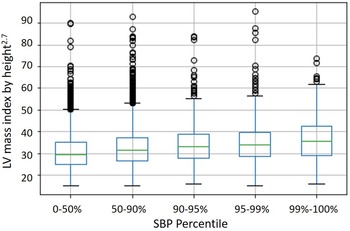
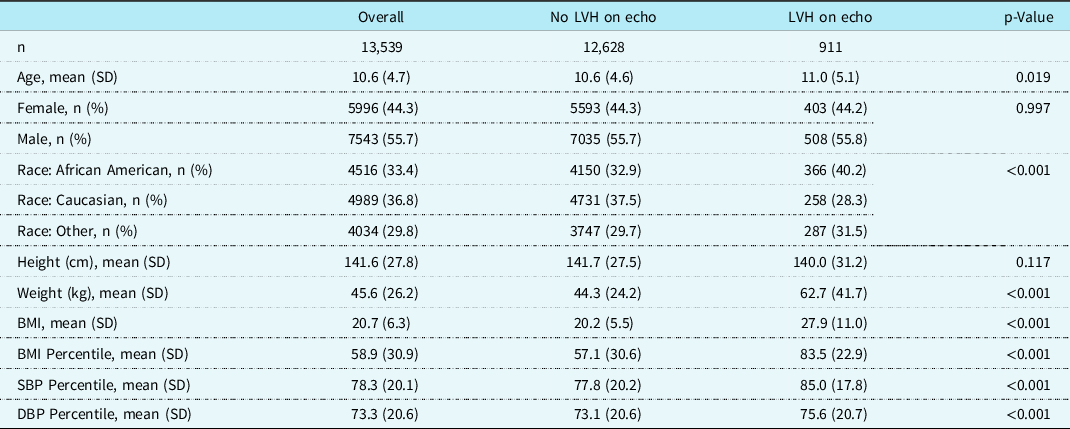
There were 128,268 echocardiograms and 414,896 electrocardiograms in the database. Of these, 13,539 studies were analysed on 13,539 patients that met the inclusion criteria of having both studies done on the same day in the outpatient setting without any other exclusion criteria. Table 1 shows the population separated by no left ventricular hypertrophy and left ventricular hypertrophy on echocardiogram. There were 911 studies out of 13,539 studies with left ventricular hypertrophy on echocardiogram (6.7%). The age of the group with left ventricular hypertrophy on echocardiogram had a mean age of 11.0 years, slightly older than the group with no left ventricular hypertrophy on echocardiogram of 10.6 (p = 0.019). The groups had similar proportions of each sex, with left ventricular hypertrophy on echocardiogram comprised of 44% females and 56% males (p = 1.00). There was no significant difference in the heights of the groups with left ventricular hypertrophy on echocardiogram and no left ventricular hypertrophy on echocardiogram (p = 0.117). The left ventricular hypertrophy on echocardiogram group had a significantly higher mean body mass index percentile of 83rd percentile (p < 0.001), higher mean systolic blood pressure percentile of 85th percentile (p < 0.001), and higher mean diastolic blood pressure of 75th percentile (p < 0.001). Figure 1 shows a box plot of Left ventricle mass index by systolic blood pressure percentile. Higher systolic blood pressure percentile correlate with increased Left ventricle mass index (p < 0.001). Prevalence of left ventricular hypertrophy increased across systolic blood pressure percentile groups.
Boxplot of LV mass index by systolic blood pressure percentile.

Cohort separated by the presence of LVH on echocardiogram

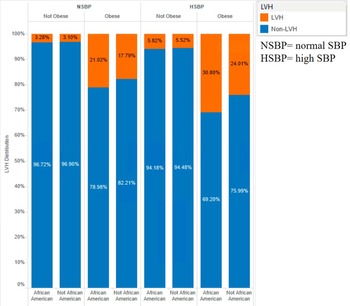
Figure 2 shows the prevalence of left ventricular hypertrophy by African American race, obesity, and systolic blood pressure, with the highest prevalence of left ventricular hypertrophy in African American, obese, and hypertensive patients. African American race (OR 1.31, 95% CI = 1.10, 1.56, p = 0.002), systolic blood pressure percentile >95% (OR = 1.61, 95% CI = 1.34, 1.93, p < 0.001), and higher body mass index (OR = 7.22, 95% CI = 6.23, 8.36, p < 0.001) were independently associated with left ventricular hypertrophy on echocardiogram. These factors were significant in all age groups. The odds ratio for diastolic blood pressure percentile association with left ventricular hypertrophy on echocardiogram was not significant.
Prevalence of left ventricular hypertrophy by African American race, obesity, and systolic blood pressure percentile.

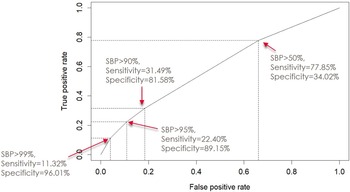
Figure 3 shows the receiver operating characteristic curve for systolic blood pressure percentile and left ventricular hypertrophy on echocardiogram. In our cohort, systolic blood pressure percentile had poor sensitivity for left ventricular hypertrophy on echocardiogram, with a systolic blood pressure percentile >90 having a sensitivity of 36% and specificity of 82%, and systolic blood pressure percentile >95 having a sensitivity of 26% and specificity of 89%. In African American patients, systolic blood pressure percentile >95 had a sensitivity of 30% and specificity of 87% for left ventricular hypertrophy on echocardiogram. In obese patients, systolic blood pressure percentile >95 had a sensitivity of 32% and specificity of 77% for left ventricular hypertrophy on echocardiogram. In African American and obese patients, systolic blood pressure percentile >95 had a sensitivity of 36% and specificity of 74% for left ventricular hypertrophy on echocardiogram. In the Caucasian, non-obese population, the sensitivity of systolic blood pressure percentile >95 was lowest at 10% with a specificity of 92% for left ventricular hypertrophy on echocardiogram. Similarly, in the whole cohort, diastolic blood pressure percentile had a poor sensitivity for left ventricular hypertrophy on echocardiogram, with a diastolic blood pressure percentile >90 having a sensitivity of 17% and specificity of 91%. In African Americans, diastolic blood pressure percentile >90 had a sensitivity of 19 and 90% specificity. In obese patients, diastolic blood pressure >90th percentile had a sensitivity of 19% and specificity of 88%. In African American, obese patients, diastolic blood pressure >90th percentile had a sensitivity of 20% and specificity of 89%. In Caucasian, non-obese patients, diastolic blood pressure >90th percentile had a sensitivity of 11% and specificity of 91%.
ROC curve of left ventricular hypertrophy versus systolic BP percentile.

Left ventricular hypertrophy on electrocardiogram was a poor predictor of left ventricular hypertrophy on echocardiogram, with a 9% sensitivity and 92% specificity when defining possible left ventricular hypertrophy diagnostic codes on electrocardiogram as normal. When analysing possible left ventricular hypertrophy diagnostic codes on electrocardiogram as pathologic, the sensitivity improved to 21% with a decrease in specificity to 79%. When looking at the performance of electrocardiogram for left ventricular hypertrophy in the setting of hypertension, obesity, or African American race, there was still a low sensitivity in our cohort. For African American race, left ventricular hypertrophy on electrocardiogram had a 14% sensitivity and 86% specificity for left ventricular hypertrophy on echocardiogram. In the hypertensive population defined as systolic blood pressure >95th percentile, the sensitivity of left ventricular hypertrophy on electrocardiogram was 13% and specificity was 91% for left ventricular hypertrophy on echocardiogram. In our obese population, left ventricular hypertrophy on electrocardiogram had a sensitivity of 8% and specificity of 92%. Combining risk factors did not improve the sensitivity of electrocardiogram for left ventricular hypertrophy on echocardiogram. In African American, obese, and hypertensive patients, electrocardiogram had a sensitivity of 15% and specificity of 86% for left ventricular hypertrophy on echocardiogram. For non-obese Caucasian patients, electrocardiogram had a 4% sensitivity and 96% specificity for left ventricular hypertrophy on echocardiogram.
Discussion
This study is the largest known cohort in paediatrics assessing risk factors for left ventricular hypertrophy on echocardiogram using a novel form of data analytics. This tool can help change the way large-scale data collection is employed in the future, allowing a rapid and efficient analysis less prone to the error of traditional data collection. The cohort adds to prior literature by including a larger sample size, wide age range, both normotensive and hypertensive patients, and a diverse population. Our study confirms the findings of previous studies that African American race and obesity are significant risk factors for the development of left ventricular hypertrophy in children. 3,Reference Pruette, Fivush, Flynn and Brady4 In contrast to the study by Ramaswamy et al Reference Ramaswamy, Chikkabyrappa, Donda, Osmolovsky, Rojas and Rafii8 but consistent with the study by Urbina et al, Reference Urbina, Mendizábal and Becker9 we found that hypertension on routine clinic blood pressure measurements was associated with left ventricular hypertrophy on echocardiogram, independent of the effect of body mass index.
Despite being independently associated with left ventricular hypertrophy in multivariable modelling, systolic blood pressure percentiles >90 and >95 had a poor sensitivity for left ventricular hypertrophy on echocardiogram in this population. Widespread ambulatory blood pressure measurement in the general population, without consideration of their pre-test probability of left ventricular hypertrophy, is a poor screening test to detect left ventricular hypertrophy. The sensitivity of systolic blood pressure for left ventricular hypertrophy on echocardiogram was not improved within African American, obese, or Caucasian patients.
In our cohort, electrocardiogram was a poor predictor of left ventricular hypertrophy on echocardiogram, consistent with prior studies showing that electrocardiogram has minimal utility in the outpatient assessment of hypertension and left ventricular hypertrophy. Reference Tague, Wiggs and Li10 Electrocardiogram screening is an ineffective tool to decide which patients need to be referred for echocardiographic evaluation of left ventricular hypertrophy. Voltages can be influenced by age, gender, and race and are based on historical studies. When accounting for physiologic variables including body mass index, systolic blood pressure percentile, and African American race in our cohort, the performance of electrocardiogram as a screening test did not improve significantly to predict left ventricular hypertrophy on echocardiogram.
Limitations to this study include its retrospective nature of data collection at a single centre. The cohort included many reasons for cardiology referral, resulting in a likely lower pre-test probability for elevated Left ventricle mass index, affecting the predictive values of our model. Although systolic blood pressure percentile correlated independently with Left ventricle mass, the data have clear limitations and should be interpreted with caution. A one-time retrospective clinic blood pressure, in comparison with other studies, is not as accurate as prospective measurements of blood pressure. Furthermore, the clinical definition of Left ventricle mass indexing for body size in paediatrics is one that has been subject to debate for years. We defined left ventricular hypertrophy indexed by height instead of body surface area, to not filter out the known clinically important effects of obesity. However, Foster et al found that left ventricular hypertrophy indexed by body surface area likely correlates more with lean body mass. Reference Foster, Gao and Mackie13 Left ventricle mass indexed by height seems to be the most widely used measure of defining left ventricular hypertrophy by paediatric subspecialists in prior studies. This study did not explore the social determinants of health that could explain the differences in Left ventricle mass by race.
Further prospective studies with longitudinal follow-up are necessary to study the clinical outcomes of children with left ventricular hypertrophy, hypertension, and obesity to define the populations at highest risk and eventually evaluate interventions in these groups to prevent pre-mature cardiovascular events in young adulthood. Prospective blood pressure measurements in future studies may help to confirm its independent association with elevated Left ventricle mass index, separate from obesity. Additionally, determining the contribution of social determinants of health in the development of risk factors for left ventricular hypertrophy are critical for preventing heart disease in children and young adults.
Acknowledgements
None.
Financial support
This research received no specific grant from any funding agency, commercial or not-for-profit sectors.
Conflicts of interest
Philips Research North America provided statistical research support for the data analysis of this project. The first author wrote the first draft of the manuscript and has not received any form of payment to produce the manuscript.