Introduction
Marine Protected Areas (MPAs) are internationally recognized as a spatial management tool to protect and conserve marine and coastal habitats, species biodiversity and abundance, as well as community, economic, social and cultural heritage values. While implicit in their intended function of promoting broader socio-economic and ecosystem health, the implementation of MPAs frequently requires that their effectiveness be evaluated. Spiny lobster species provide good subjects to examine the potential effects of MPAs because they are commonly targeted in commercial fisheries and often have available biological information collected over many years of fishery assessments from which to make before-and-after comparisons.
Changes in lobster abundance, biomass, density and individual size are frequently used to measure the efficacy of MPA protection. The biomass of European spiny lobster (Palinurus elephas) from a Mediterranean no-take marine reserve more than doubled in the absence of fishing over a 25-year period (Diaz et al., Reference Diaz, Mallol, Parma and Goni2016). In New Zealand, increases in abundance and mean size of southern rock lobster (Jasus edwardsii) inside two marine reserves were recorded by Babcock et al. (Reference Babcock, Kelly, Shears, Walker and Willis1999) following 13–20 years of protection. Similarly, in New Zealand, Kelly et al. (Reference Kelly, Scott, MacDiarmid and Babcock2000) recorded a 9.5% increase in density per year for southern rock lobster inside protected areas, while Shears et al. (Reference Shears, Grace, Usmar, Kerr and Babcock2006) recorded an 11-fold increase in abundance and 25 times higher biomass of southern rock lobster following 22 years of protection.
Recovery responses of southern rock lobster populations via marine park protection have also been recorded in Australia. Following a 10-year period of reserve implementation, Barrett et al. (Reference Barrett, Buxton and Edgar2009) recorded a 250% increase in abundance and 30 mm increase in mean size (CL), relative to fished sites, of southern rock lobster in the Maria Island reserve in Tasmania. Similar increases in lobster abundance, biomass and individual size have been reported in other studies from Australian waters (Edgar & Barrett, Reference Edgar and Barrett1997; Edgar et al., Reference Edgar, Barrett and Stuart-Smith2009; Young et al., Reference Young, Ierodiaconou, Edmunds, Hulands and Schimel2016). A review of these studies indicates that the rates at which lobster populations respond to protection vary according to the time period over which protection is measured, site differences in environmental conditions (e.g. habitat or oceanographic conditions) and competitive interactions (Freeman et al., Reference Freeman, MacDiarmid, Taylor, Davidson, Grace, Haggitt, Kelly and Shears2012).
Australia's obligations to protect marine biodiversity and ecosystem integrity are listed internationally under the Convention on Biological Diversity (UNEP, 1992) and nationally under various policy frameworks such as the Intergovernmental Agreement on the Environment (IGAE) (Commonwealth of Australia, 1992a) and the National Strategy for Ecologically Sustainable Development (Commonwealth of Australia, 1992b). In 1998, Australia committed to the expansion of its existing marine reserve system through the establishment of a National Representative System of Marine Protected Areas (NRSMPA). The primary goal of the NRSMPA was ‘to establish and manage a comprehensive, adequate and representative system of MPAs to contribute to the long-term ecological viability of marine and estuarine systems, to maintain ecological processes and systems, and to protect Australia's biological diversity at all levels’ (ANZECC, 1998). Commitment to the NRSMPA in South Australia led to the design of a network of 19 marine parks encompassing locally representative ecosystems and habitats across eight marine bioregions. In November 2012, the zoning arrangements and management plans were finalised for each park under the Marine Parks Act 2007 (Anon, 2007). On 1 October 2014, the marine parks network was fully implemented and fishing restrictions inside specific no-take sanctuary zones came into effect.
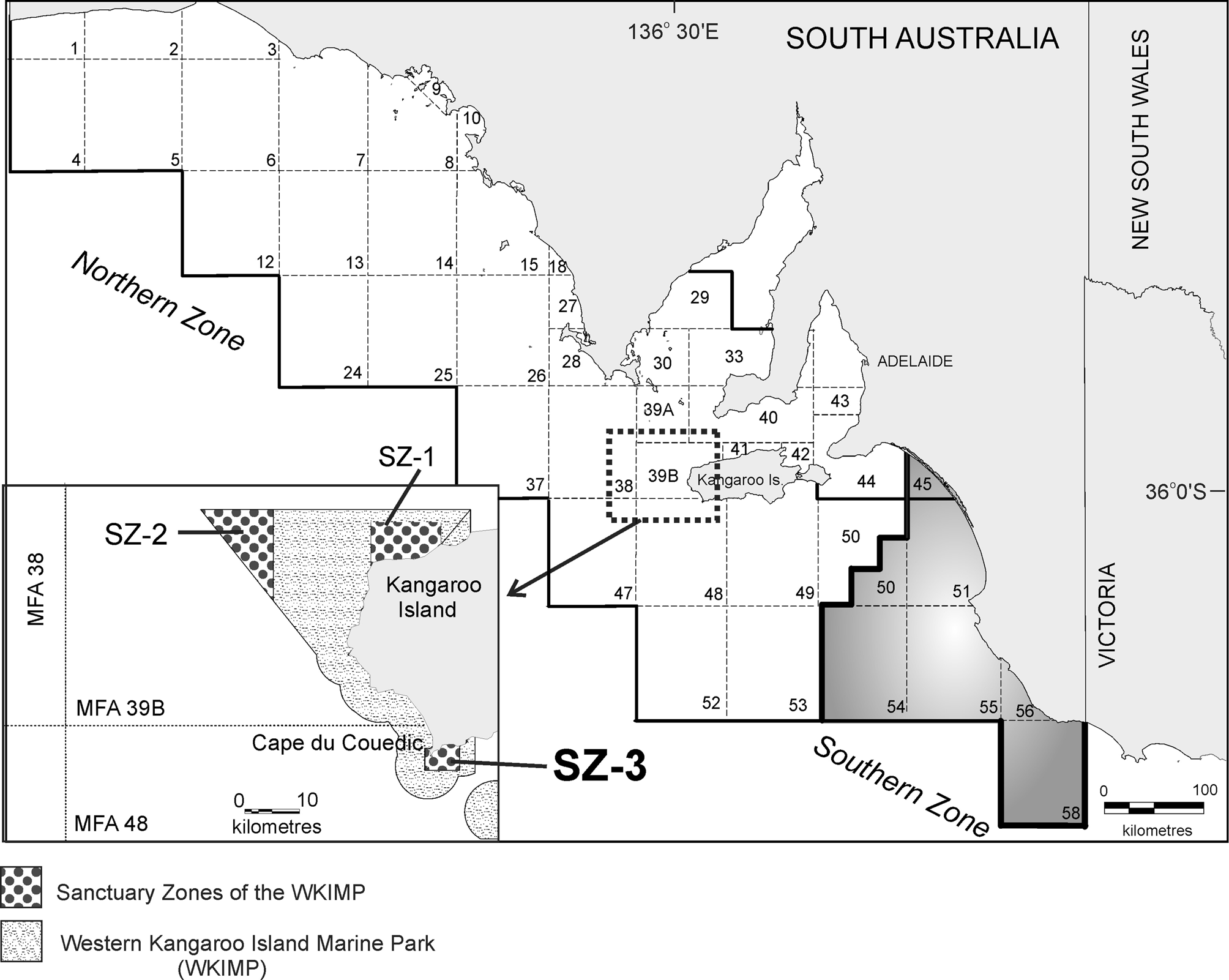
South Australia's marine parks currently include 26,670 km2 of marine waters and 267 km2 of coastal land and islands (Bryars et al., Reference Bryars, Brook, Meakin, McSkimming, Eglinton, Morcom, Wright and Page2016). The Western Kangaroo Island Marine Park (WKIMP) is located in the Eyre Bioregion, between Cape Forbin and Sanderson Bay, Kangaroo Island, and comprises an area of 1020 km2 (DEWNR, 2012; Bryars et al., Reference Bryars, Brook, Meakin, McSkimming, Eglinton, Morcom, Wright and Page2016) (Figure 1). The WKIMP has three Sanctuary Zones (SZs) consisting of no-take areas that prohibit the removal or harming of plants, animals and marine products. Sanctuary Zone 3 (SZ-3) of the WKIMP is located to the south of Cape du Couedic and encompasses Marine Fishing Area (MFA) 48 of the South Australian Northern Zone Rock Lobster Fishery (NZRLF) (Figure 1). The fishery targets southern rock lobster (Jasus edwardsii) that inhabit inshore rocky reefs within continental shelf waters of South Australia between the mouth of the River Murray and the Western Australian border, including Kangaroo Island. Its season extends from 1 November to 31 May in the following year, with annual catches ranging between 300 and 1200 tonnes (t) since 1970 (Linnane et al., Reference Linnane, McGarvey, Feenstra and Graske2019). A Total Allowable Commercial Catch (TACC) was introduced in 2003 and is currently set at 296 t. MFA 48 is one of the fishery's most productive areas, contributing 10% (30 t) of the total NZRLF catch in the 2018 season (Linnane et al., Reference Linnane, McGarvey, Feenstra and Graske2019).
Map showing location of the Northern Zone Rock Lobster Fishery, Marine Fishing Areas and Sanctuary Zone 3 (SZ-3) in the Western Kangaroo Island Marine Park (inset).

The implementation of the WKIMP on 1 October 2014 resulted in the cessation of commercial lobster fishing within MFA 48 within SZ-3 from the start of the 2014 fishing season. In 2017, the South Australian Department of Environment Water and Natural Resources, in collaboration with SARDI Aquatic Sciences and the NZRLF Association, initiated a southern rock lobster survey of SZ-3 as part of its marine park monitoring, evaluation and reporting programme. Specifically, a project was developed to assess temporal trends in southern rock lobster abundance and size both inside and outside SZ-3 before, and following, its implementation on 1 October 2014. The specific aims of the survey were to (i) estimate the relative abundance and size of southern rock lobster, both within and outside SZ-3 and (ii) compare survey estimates of abundance and size to historical estimates of abundance and size obtained from commercial fishery-dependent data.
Methods
Marine park survey
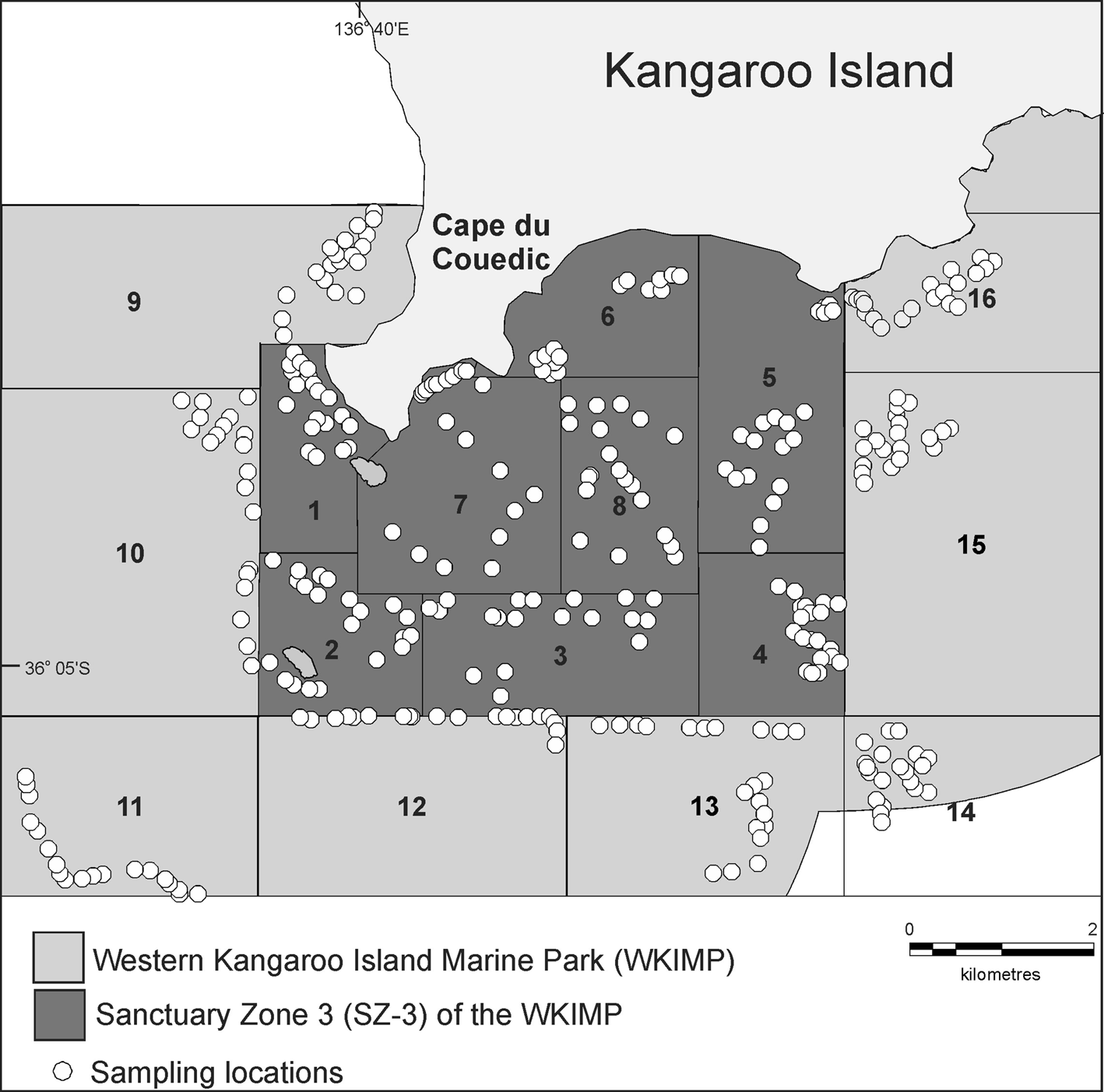
The survey was undertaken from 20–23 February 2017 using the southern rock lobster marine fishing vessel (MFV) ‘Quadrant’ and standard NZRLF fishing pots (PIRSA, 2014). A total of 315 pots were deployed among 16 pre-defined spatial strata; 8 strata located inside and 8 strata located outside SZ-3 (Figure 2). The size, shape and location of strata were designed to enable comparison of survey data with historical commercial fishing data sampled from lobster reef habitat inside and outside SZ-3. To further maintain comparison of the survey data with the historical data collected by fishers in commercial fishing operations, pots (with escape gaps covered) were set and retrieved at locations chosen at the discretion of the Master of the MFV based on his previous fishing experience (~30 years) in the area.
Pot sampling locations within 16 spatial strata inside and outside Sanctuary Zone 3 of the Western Kangaroo Island Marine Park during 2017.

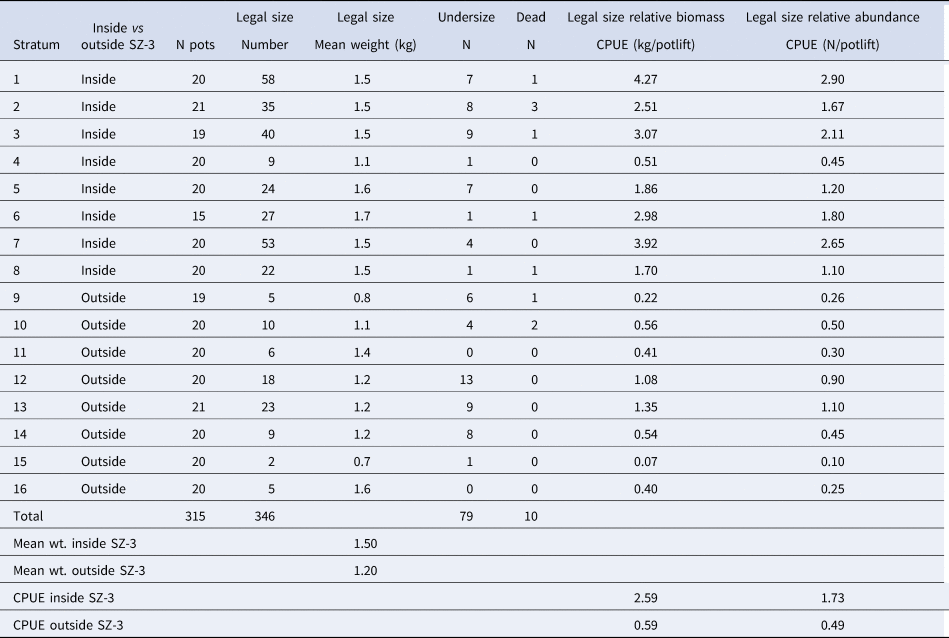
The number of pots deployed per stratum ranged between 15 and 21 (Table 1). Pots were baited with blue mackerel (Scomber australasicus), set overnight and retrieved the following day. Two SARDI scientists were on-board the vessel throughout the survey to record all data relating to each potlift including: pot location (latitude, longitude), depth, lobster carapace length (CL) and sex. All lobsters were returned to the water at point of capture.
Summary of number of pots deployed and lobsters sampled within each spatial stratum inside and outside Sanctuary Zone 3 of the Western Kangaroo Island Marine Park in 2017

Survey analyses
Catch per unit effort (CPUE) is used as an indicator of relative abundance in crustacean fisheries worldwide and is the primary performance indicator used to assess fishery performance in the NZRLF (Linnane et al., Reference Linnane, McGarvey, Feenstra and Graske2019). To estimate CPUE by weight (kg/potlift) based on CL measurements, the following size/weight relationships for both males and females were used:
 $${\rm Males}\colon {\rm Wt}\;\lpar {{\rm kg}} \rpar = {\rm C}{\rm L}^{2.98} \times 5.4092 \times 10^{{-}7}$$
 $${\rm Females}\colon {\rm Wt}\;\lpar {{\rm kg}} \rpar = {\rm C}{\rm L}^{2.89} \times 9.00784 \times 10^{{-}7}$$
Estimates of relative abundance in each stratum, both inside and outside SZ-3 were then calculated for legal-size (CL ≥ 105 mm) lobsters captured and released during the survey as follows:
 $${\rm CPU}{\rm E}_{{\rm legalsize}} = \displaystyle{{{\rm Total\;weight\;}\lpar {{\rm legal\;size}} \rpar {\rm \;}\lpar {{\rm kg}} \rpar } \over {{\rm Total\;number\;of\;potlifts}}}$$
The mean length of male and female lobsters was analysed and compared inside and outside SZ-3. Carapace length data of all lobsters sampled during the survey were grouped into 5 mm bins and analysed to estimate the percentage frequency of female and male lobsters present in each size class inside and outside SZ-3. The total percentage of legal-size lobsters (CL ≥ 105 mm) inside and outside SZ-3 was also compared.
Historical catch analysis
To provide an overview of historical trends in fishery performance, data were analysed from a voluntary catch sampling programme within MFA 48. Participating fishers voluntarily report catch and effort data from up to three pots per day. Data collected by fishers include the latitude and longitude of each pot location thereby allowing spatially resolved estimates of CPUE from years prior to the establishment of the sanctuary. In addition, sampling is also undertaken by SARDI and industry observers for multi-day trips on board commercial vessels where data from all fished pots are recorded. Escape gaps are used in the fishery to promote escapement of undersize lobsters so escape gaps of all sampling pots are covered to enable collection of data for undersize lobsters. Data collected by fishers and observers in this programme between the 1994/95 and 2015/16 fishing seasons were assigned using GIS (ArcMap 10.3.1) to groupings of inside and outside SZ-3 as defined for the marine park survey.
Historical catch rates show a strong seasonal trend (Linnane et al. Reference Linnane, McGarvey, Feenstra and Graske2016). To enable a temporal comparison of historical CPUE with that estimated during the marine park survey undertaken in February, a general linear model with a Gaussian error structure and log link was applied to obtain a yearly index that corrected (standardized) the time series for the February timing of the 2017 survey. The model had the form:
 $${\rm \;Index}\sim {\rm Month} + {\rm Season} + {\rm Insid}{\rm e}_{{\rm or}}{\rm Outside}.$$
All pot sample data were fitted to estimate seasonal and monthly coefficients inside and outside the sanctuary. Other models were tested and this one showed lowest or equal lowest AIC. Legal-size CPUE (kg/potlift) values for February of each season from 1994/95 to 2013/14 were estimated by setting Month = February in the base R predict.glm() function of the fitted model. Trends across Season of this index, for both inside and outside SZ-3, were then compared with results of the marine park survey undertaken 3 years after the sanctuary no-take zone was established.
Statistical analyses
All data used in statistical analyses were tested for assumptions of normality and homoscedasticity using Shapiro–Wilks' test and Levene's test, respectively. Differences in standardized annual estimates of legal-size CPUE between 1994/95 and 2013/14 inside and outside SZ-3 were tested using ANOVA in SPSS. Differences in male and female lobster size inside and outside SZ-3 between 1994/95 and 2013/14 were tested using Kruskal–Wallis tests in SPSS®. Differences in male and female lobster size inside and outside SZ-3 during the 2017 survey were tested using Mann–Whitney U tests. Means are reported ± SE.
Results
Marine park survey
A total of 315 pots were set and sampled during the survey (Table 1). Depths sampled ranged between 5 m in Stratum 7 to 48 m in Stratum 12. A total of 346 legal-size and 79 undersize lobsters were measured, tagged and returned to the sea. Ten dead lobsters were recorded during the survey and no spawning lobsters were sampled.
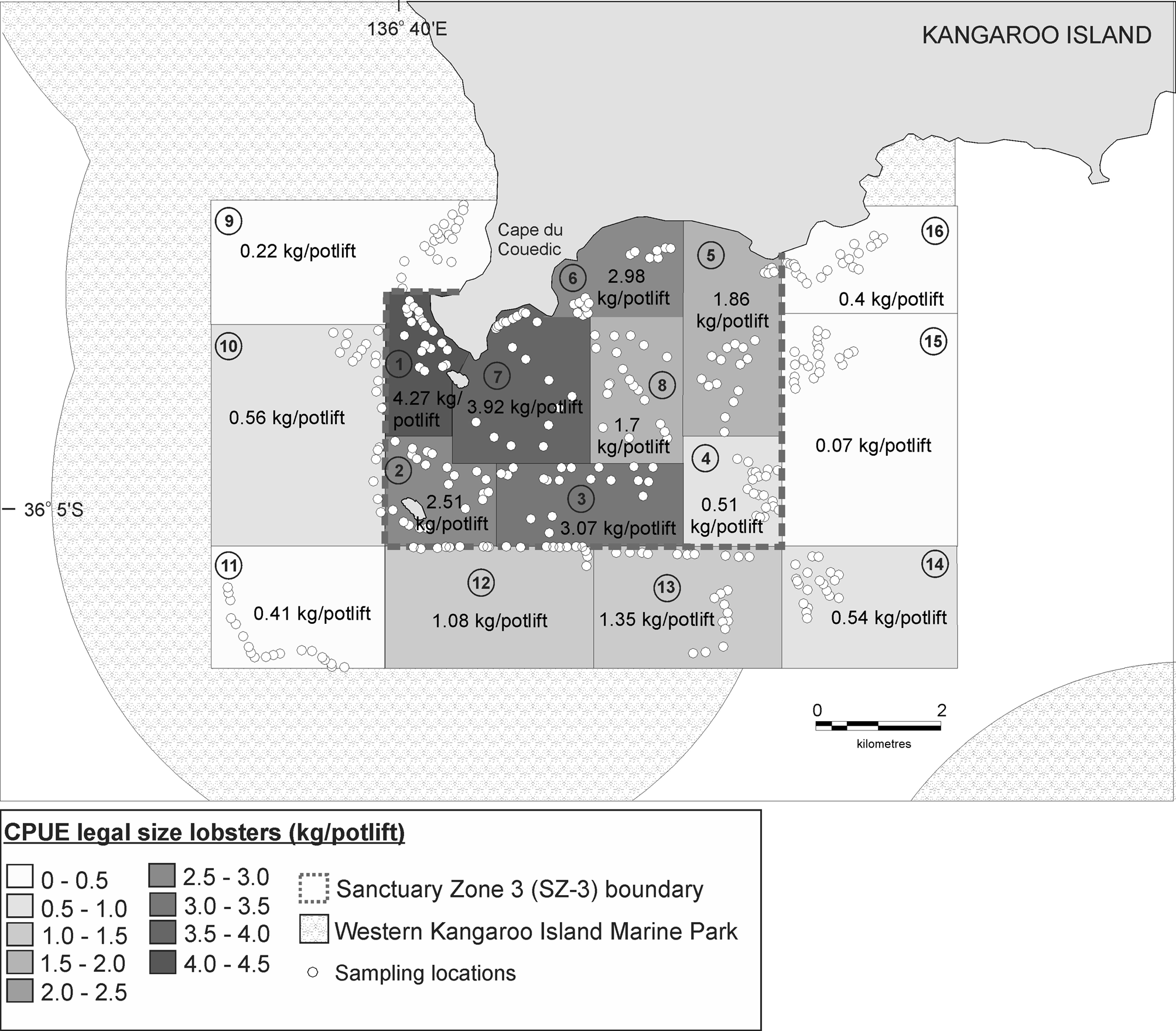
Estimates of CPUE by weight of legal-size lobsters ranged from 0.07 kg/potlift in Stratum 15 located outside SZ-3 to 4.27 kg/potlift in Stratum 1 located inside SZ-3 (Table 1, Figure 3). The CPUE estimate of 2.59 kg/potlift for all legal-size lobsters surveyed inside SZ-3 (Strata 1–8) is 4.4 times higher than the estimate of 0.59 kg/potlift measured outside SZ-3 (Strata 9–16) (Table 1, Figure 3).
Map showing 2017 (2016/17 fishing season) survey estimates of legal-size southern rock lobster biomass (catch per unit effort (CPUE), kg/potlift) within 16 spatial strata inside and outside SZ-3 of the Western Kangaroo Island Marine Park.

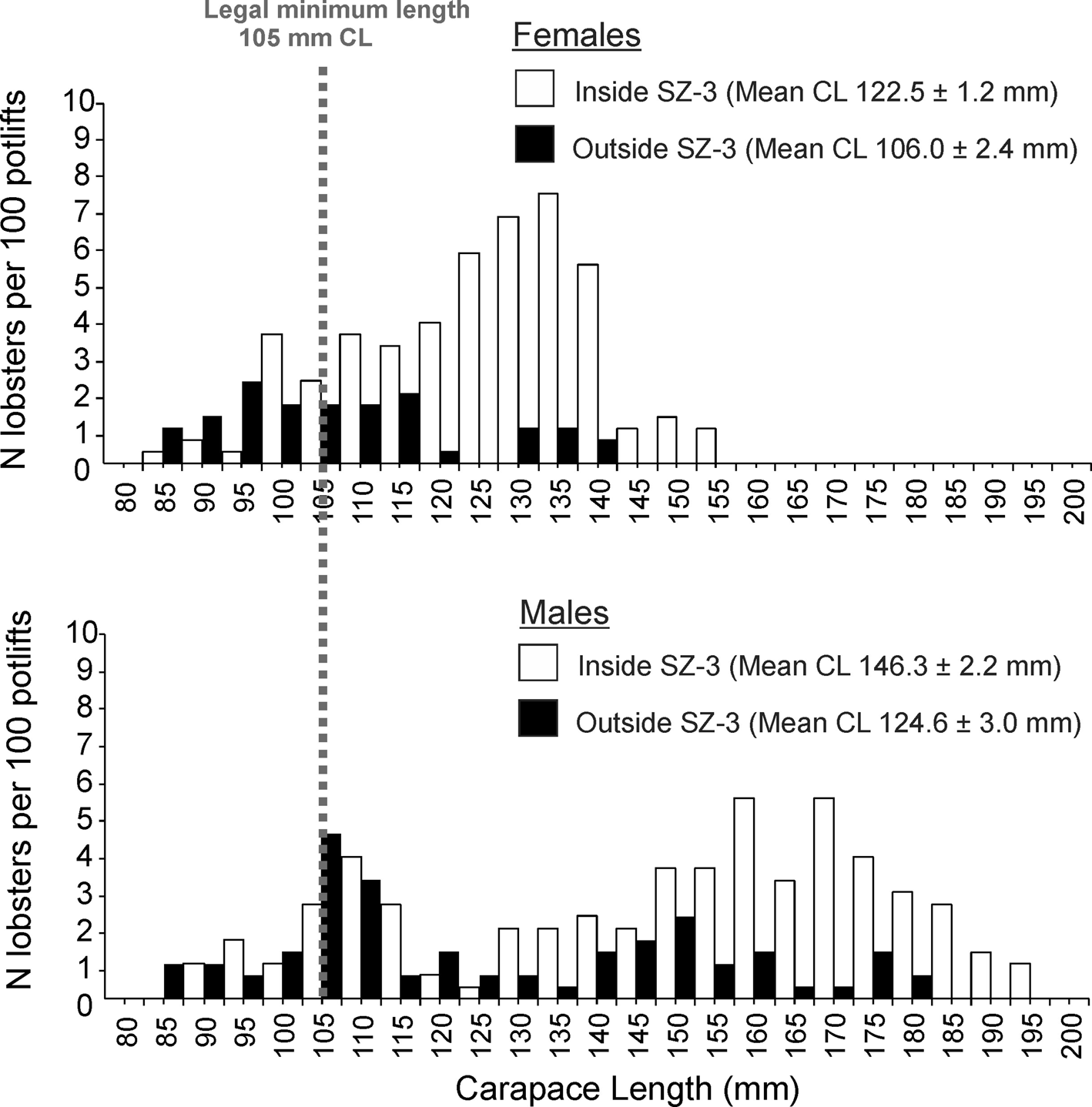
A total of 89.6% of females and 93.5% of males sampled during the survey inside SZ-3 were of legal minimum length (≥105 mm CL) (Figure 4). In comparison, a total of 56.8% of females and 84.6% of males outside SZ-3 were of legal minimum length (Figure 4). The relatively high abundance of legal-size male and female lobsters sampled inside SZ-3 compared with outside SZ-3 was represented across all size classes (Figure 4) and both males and females were significantly larger in size (CL) inside SZ-3 compared with outside SZ-3 (females: Mann–Whitney U test 5.413, P < 0.001; males: Mann–Whitney U test 5.480, P < 0.001). The mean size of female lobsters sampled inside SZ-3 was 122.5 ± 1.2 mm CL, which was 15.6% larger than female lobsters sampled outside SZ-3 (106.0 ± 2.4 mm CL) (Figure 4). Similarly, the mean size of male lobsters inside SZ-3 (146.3 ± 2.2 mm CL) was 17.4% larger compared with males outside SZ-3 (124.6 ± 3.0 mm CL). The estimates of mean weight (kg) of legal-size lobsters sampled inside and outside SZ-3 reflected these results, with legal-size lobsters inside SZ-3 being an average of 0.3 kg larger than legal-size lobsters found outside SZ-3 (Strata 9–16) (1.50 kg vs 1.20 kg, respectively) (Table 1).
Abundance (number of lobsters per 100 potlifts) at length (carapace length, mm) of male and female southern rock lobster inside and outside Sanctuary Zone 3 of the Western Kangaroo Island Marine Park.

Historical catch analysis
Annual standardized estimates of CPUE for legal-size lobsters from inside and outside SZ-3 (Strata 1–8 and 9–16) between 1994/95 and 2013/14 were estimated from a total of 5245 potlifts reported through the voluntary catch sampling programme (1995 pots inside SZ-3; 3250 pots outside SZ-3) reflecting 38% of all effort recorded in the voluntary catch sampling within MFA 48 (N = 13,920 pots). Estimates for CPUE of legal-size lobsters inside SZ-3 (Strata 1–8) were calculated from an average of 100 ± 24 potlifts per year between 1994/95 and 2013/14 while CPUE outside SZ-3 (Strata 9–16) was calculated from an average of 163 ± 31 potlifts per year.
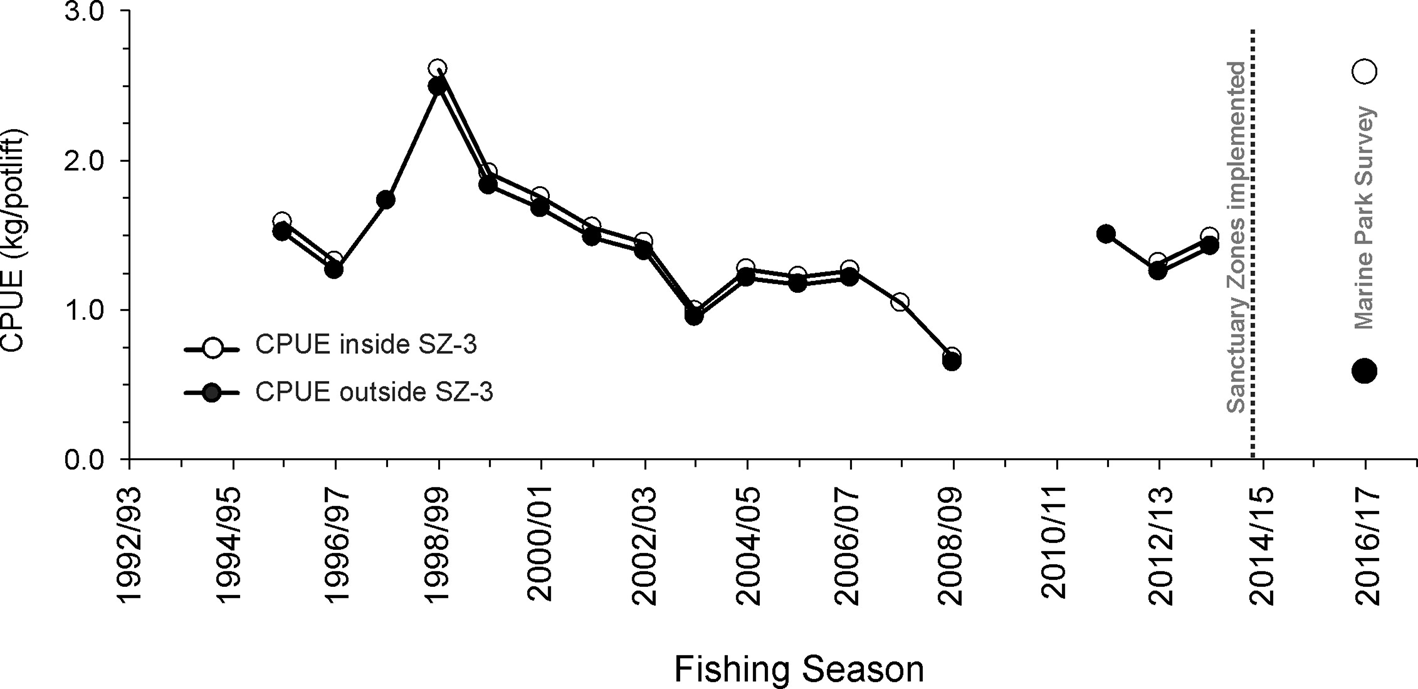
No significant difference was detected between annual estimates of standardized legal-size CPUE by weight inside and outside SZ-3 between 1994/95 and 2013/14, the period prior to sanctuary zone implementation (ANOVA, within group df 38, between group df 1, F = 0.246, P = 0.623). However, the estimate of CPUE of 2.59 kg/potlift measured inside SZ-3 during the marine park survey in February 2017 (2016/17 season) was 75% higher than the previous estimate of 1.48 kg/potlift measured inside SZ-3 in 2013/14 and is the second highest estimate on record (Figure 5). In contrast, the estimate of legal-size CPUE by weight (0.59 kg/potlift) recorded outside SZ-3 during the 2017 survey was the lowest on record.
Standardized legal-size southern rock lobster catch per unit effort (CPUE) (kg/potlift) inside and outside SZ-3 between the 1994/95 and 2013/14 fishing seasons. Note, some annual (fishing season) estimates of CPUE could not be presented due to confidentiality requirements that restrict publication of data from <5 fishers. The February 2017 survey data are plotted against the 2016/17 fishing season.

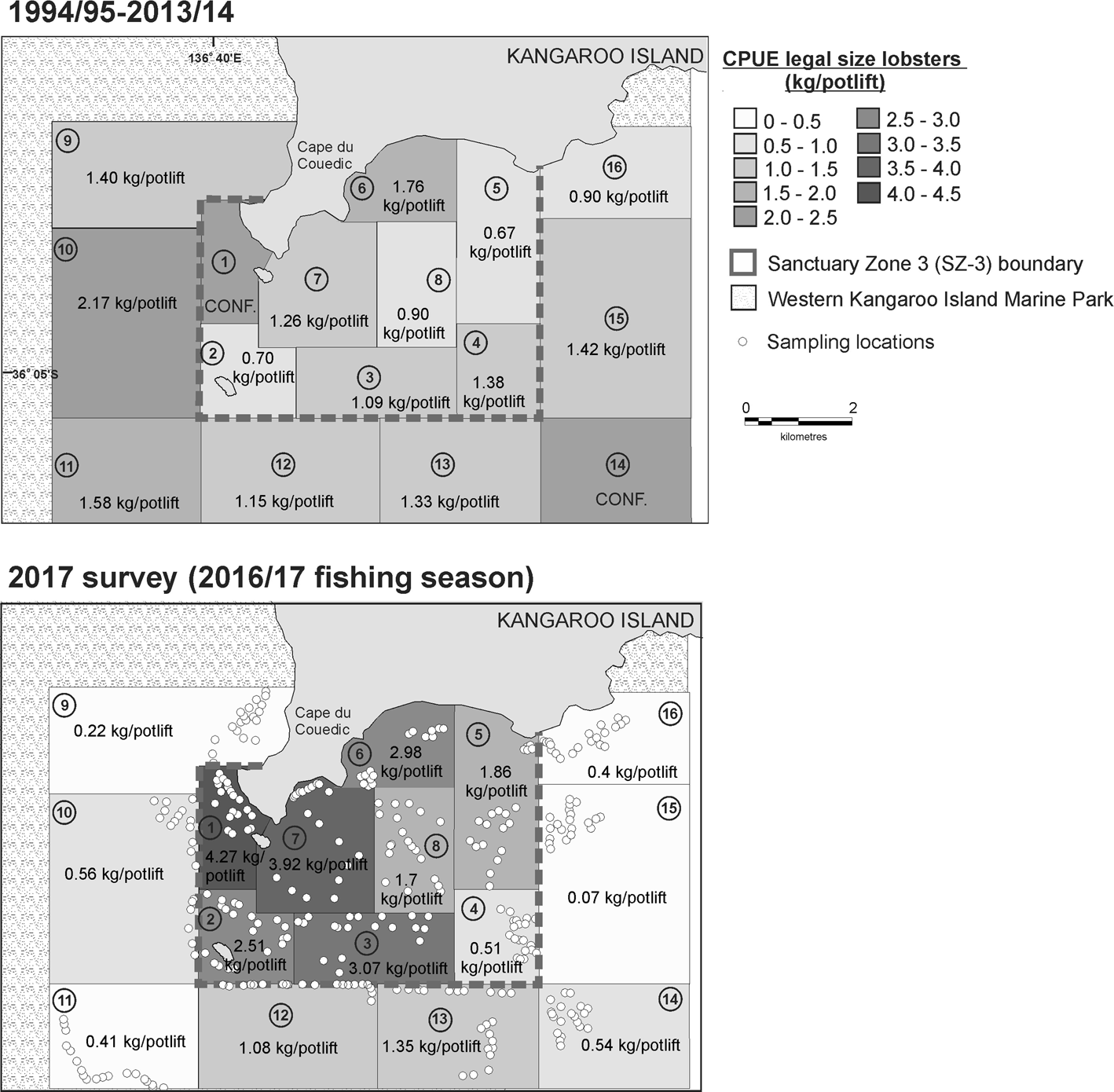
Spatial comparison of legal-size CPUE (by weight) before and after sanctuary zone implementation supports the temporal trends in legal-size CPUE inside and outside SZ-3 shown in Figure 5. Figure 6 compares the average legal-size rock lobster CPUE (by weight) inside and outside SZ-3 for the fishing seasons prior to sanctuary zone implementation (average CPUE: 1994/95–2013/14) with estimates of legal-size rock lobster CPUE (by weight) inside and outside SZ-3 following sanctuary zone implementation (February survey 2017–2016/17 fishing season). Average legal-size CPUE (by weight) between 1994/95 and 2013/14 was distributed relatively evenly across the 16 strata prior to sanctuary zone implementation, ranging from 0.67–1.76 kg/potlift inside SZ-3 to 0.90–2.17 kg/potlift outside SZ-3 (Figure 6). In contrast, the February 2017 survey (2016/17 fishing season) recorded higher legal-size CPUE and larger ranges of legal-size CPUE inside SZ-3 (0.51–4.27 kg/potlift) compared with outside SZ-3 (0.07–1.35 kg/potlift) (Figure 6).
Legal-size southern rock lobster catch per unit effort (CPUE) (kg/potlift) inside and outside SZ-3 prior to sanctuary zone implementation (average: 1994/95 to 2013/14 fishing seasons) and following sanctuary zone implementation (2017 survey). Note, some estimates of CPUE (1994/95–2013/14: Stratum 1 and Stratum 14) could not be presented due to confidentiality requirements relating to data from <5 fishers.

Temporal trends in rock lobster size inside and outside SZ-3
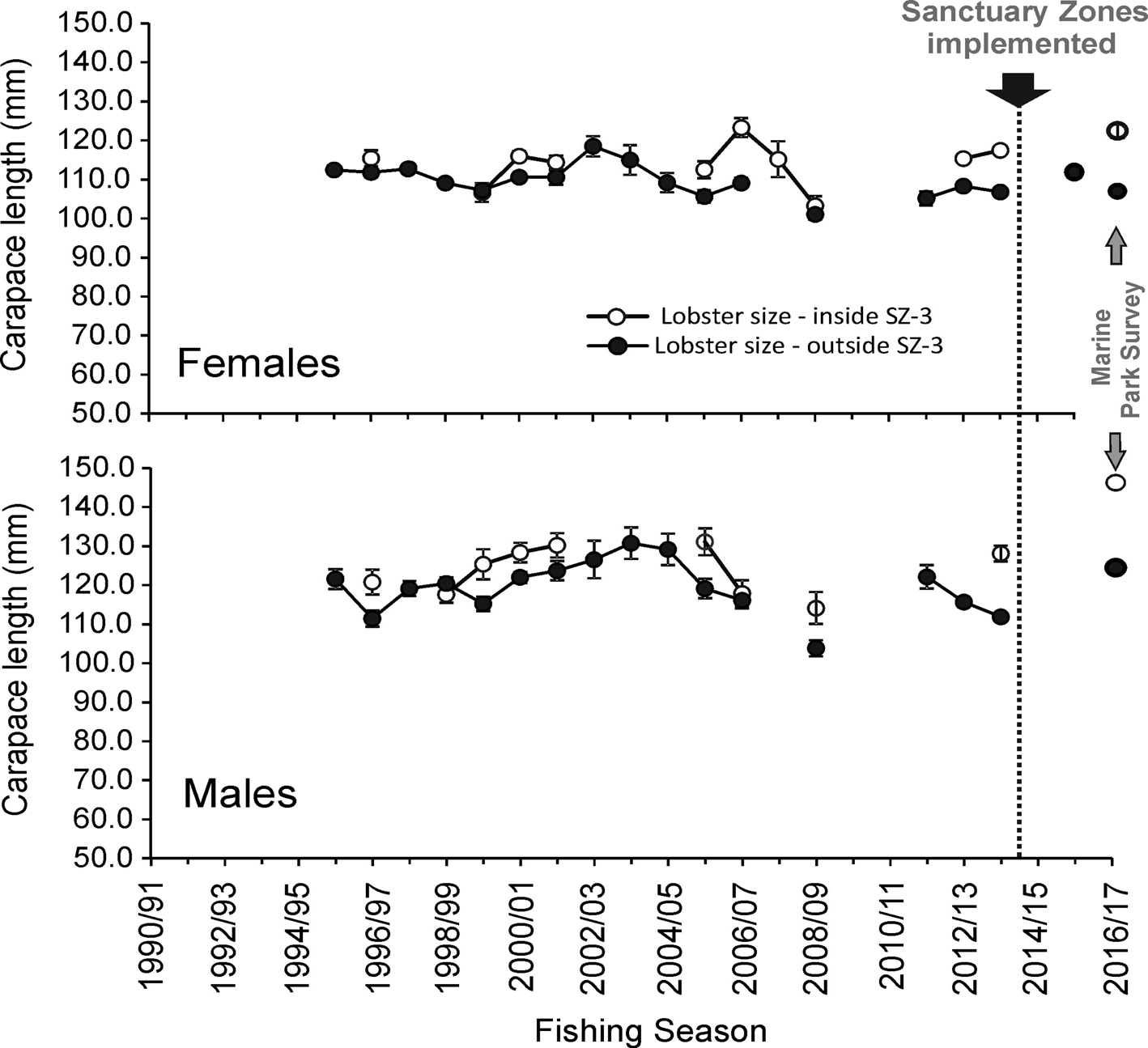
Between 1994/95 and 2013/14, mean annual estimates of female rock lobster size (CL) ranged from 103.3–123.3 mm (CL) inside SZ-3, and from 101.1–118.5 mm (CL) outside SZ-3 (Figure 7). Females were significantly larger inside SZ-3 compared with outside SZ-3 (Kruskal–Wallis test 120.3, df 1, P < 0.001) over this time. Mean annual estimates of male rock lobster size (CL) ranged from 114.2–131.1 mm (CL) inside SZ-3 and from 103.8–130.8 mm (CL) outside SZ-3 over this time (Figure 7). Males were also significantly larger inside SZ-3 compared with outside SZ-3 (Kruskal–Wallis test 85.7, df 1, P < 0.001).
Average size (CL) of female and male southern rock lobster inside and outside SZ-3 between the 1994/95 and 2016/17 fishing seasons. Note, some annual (fishing season) estimates could not be presented due to confidentiality requirements that restrict publication of data from <5 fishers. Error bars are ± SD. 2015/16 season data, after establishment of marine parks, are presented (females only) but were not included in statistical analyses. The February 2017 survey data are plotted against the 2016/17 fishing season.

The mean size of females recorded inside SZ-3 during the marine park survey (122.5 mm CL, 2016/17 season, Figure 7) was the second largest value on record and 4.1% higher than the mean size recorded in 2013/14 (117.5 mm) when fishing in SZ-3 was permitted. Similarly, the mean CL of 146.4 mm recorded for males inside the SZ-3 during the survey is the largest on record, 11.7% higher than the largest value recorded for males since 1994/95 (131.1 mm in 2005) and 12.5% higher than the mean size recorded in 2013/14 (128.1 mm) before the sanctuary zone was established.
Discussion
The use of CPUE (by weight) as an indicator of relative biomass in crustacean fisheries is common worldwide, and CPUE is one of the principal metrics used to develop models of absolute biomass for stock assessment of the NZRLF (Linnane et al., Reference Linnane, McGarvey, Feenstra and Graske2019). Our study was fortuitous in having fine spatial-scale data recorded from the voluntary catch sampling programme in the NZRLF that enabled a ‘before’ and ‘after’ comparison of lobster CPUE inside SZ-3. Studies that can analyse long time series of data collected from sites inside and outside a marine park prior to and following its implementation may provide more convincing evidence of the effects of marine park protection than snapshot studies that only compare data from sites inside and outside a marine park in a single point in time. This is because data collected from the same sites over time remove the potential effect of site differences that could potentially be attributed to other ecological factors (e.g. habitat or productivity differences) (Ward et al., Reference Ward, Heinemann and Evans2001).
Data collected in the 2017 survey indicate that the biomass of the southern rock lobster population within SZ-3 in the WKIMP has increased in the absence of fishing pressure since implementation of sanctuary zones in 2014. The 75% increase in relative biomass (CPUE) observed in the sanctuary zone since the 2013/14 season, when fishing was last permitted, appears to be rapid, but is biologically plausible considering that southern rock lobster in SZ-3 have been protected through 3 summers and 2 winters since the sanctuary zone was implemented in 2014. The growth schedules of southern rock lobster vary according to size and sex, with larger (>120 mm) males generally moulting once or twice yearly and larger females (>120 mm) moulting once between April and June (MacDiarmid, Reference MacDiarmid1989; Prescott et al., Reference Prescott, McGarvey, Ferguson and Lorkin1997). Smaller (<90 mm CL) males and females may moult up to twice a year (Prescott et al., Reference Prescott, McGarvey, Ferguson and Lorkin1997). Consequently, depending on their size prior to protection by sanctuary zones in 2014, lobsters would have moulted at least two to four times before being measured in the 2017 survey.
This period of growth is represented in the 4.1% and 12.5% increases in mean size of female and male lobsters, respectively, since size was last estimated in 2013/14, with the relatively lower percentage increase in size attained by females relative to males during this time explained by the reductions in female growth rate that occur upon maturity (Aiken & Waddy, Reference Aiken, Waddy, Cobb and Phillips1980; McKoy & Esterman, Reference McKoy and Esterman1981). The increases in size recorded are also supported in the mean annual growth rates recorded for legal-size lobsters in MFA 48 by McGarvey et al. (Reference McGarvey, Ferguson and Prescott1999). Consequently, the increases in legal-size lobster population biomass (CPUE, kg/potlift) observed in SZ-3 in the February 2017 survey, probably represent (1) the growth of undersize lobsters into legal-size, and (2) an overall increase in the mean size of all lobsters within SZ-3 since sanctuary zone implementation.
Historical estimates of legal-size CPUE inside and outside SZ-3 between 1994/95 and 2013/14 were derived from the voluntary catch sampling programme in the NZRLF which represents 0.6% of the total effort recorded from MFA 48 between 1994/95 and 2013/14, and 37.7% (14.3% inside SZ-3 (Strata 1–8); 23.3% outside SZ-3 (Strata 9–16)) of all effort recorded in the voluntary catch sampling within MFA 48. Although representing a small percentage (0.6%) of total commercial effort within MFA 48, trends in annual estimates of legal-size CPUE inside and outside SZ-3 resemble those recorded from commercial logbook data for MFA 48 and the entire NZRLF (Linnane et al., Reference Linnane, McGarvey, Feenstra and Graske2019), indicating that the reduced sample size used to calculate legal-size CPUE inside and outside SZ-3 from the voluntary catch sampling data was adequate.
No significant difference was detected in our study between annual estimates of standardized CPUE inside and outside SZ-3 between 1994/95 and 2013/14, indicating that the relative abundance of legal-size rock lobster in each area was similar in the period prior to marine park implementation. These results support the research of Kosturjak et al. (Reference Kosturjak, Whetton, O'Neil and Trevithick2015) that compared CPUE (by weight) inside and outside South Australia's sanctuary zones at broader spatial scales and indicate that the lobster population located south of Cape du Couedic was distributed relatively homogeneously across rocky reef habitat inside and outside SZ-3 during this period.
The estimates of relative abundance (0.59 kg/potlift) of legal-size lobster outside SZ-3 from the survey in 2017 were among the lowest on record. The pot sampling locations from which these CPUE estimates were derived were located within 3.4 km of the SZ-3 boundary. Although CPUE across MFA 48 has generally declined since 1998/99 (Linnane et al., Reference Linnane, McGarvey, Feenstra and Graske2019), it is possible that the low CPUE recorded outside SZ-3 during the survey also reflects the occurrence of edge effects relating to fishing that has occurred on or near the SZ-3 boundary since sanctuary zone implementation. Fishers readily try to capitalize on ‘spillover’ of animals from protected areas by ‘fishing the line’ and several studies have recorded increased fishing effort near to the boundaries of areas closed to fishing (Murawski et al., Reference Murawski, Brown, Lai, Rago and Hendrickson2000; Kelly et al., Reference Kelly, Scott and MacDiarmid2001; Bohnsack & Ault, Reference Bohnsack and Ault2002). Fishing the line was also observed in the mapping of fishing locations recorded during voluntary catch sampling operations after SZ-3 implementation, as well as during the 2017 survey when the master of the vessel, in replicating normal fishing behaviour, fished along the boundary of SZ-3 (Strata 10, 12 and 13, Figure 3). Current rates of spillover from SZ-3 are unquantified. Future data acquired from lobsters tagged during the survey and recaptured in commercial fishing operations or future surveys may provide some information on rates of movement from inside or outside SZ-3.
Female and male lobsters were significantly larger inside SZ-3 than outside SZ-3 in all years between 1994/95 and 2013/14. These data suggest ontogenetic separation of habitat use among southern rock lobster. The reasons for the observed size-related patterns of spatial separation are unclear without more information on the habitat characteristics within the WKIMP, however ontogenetic differences in habitat use have been reported previously for southern rock lobster and attributed to (1) changes in social behaviour, mediated by chemical cues that enhance aggregation of large lobsters; (2) differential mortality of lobsters among habitats that creates patches of survivors of different sizes; and (3) differences in the spatial distribution of habitat (e.g. rock crevices) that favour different size lobsters (MacDiarmid, Reference MacDiarmid1991, Reference MacDiarmid1994; Butler et al., Reference Butler, MacDiarmid and Booth1999). As part of their ongoing monitoring programme, the DEW is collating information relating to benthic habitat characteristics within the WKIMP. These data may help clarify the reasons behind ontogenetic separation of southern rock lobster in the WKIMP in the future. Additionally, these data could be in any future studies to stratify sampling locations with respect to habitat type. This would also potentially inform the location of near and far control sites so that the effects of ecosystem variables, such as habitat type, on lobster population responses both inside and outside sanctuary zones can be assessed.
In summary, the increases in mean size, abundance and biomass recorded for southern rock lobster within SZ-3 of the WKIMP support the findings for other marine park studies worldwide and indicate that the rock lobster population biomass within SZ-3 has increased in the absence of fishing since sanctuary zones were implemented in South Australia on 1 October 2014. The initial response of the southern rock lobster population inside SZ-3 has been rapid, and future research may determine if rates of population increase inside SZ-3 remain on the same trajectory, stabilize or decline in response to density-dependent effects, or whether SZ-3 is contributing to spillover of juveniles or adults to outside fishable areas, and enhancing total rates of larval export, settlement and recruitment within the NZRLF.
Acknowledgements
Funds for this research were provided by the Department for Environment and Water (DEW, formerly the Department of Environment and Water and Natural Resources (DEWNR)). Thanks to staff within the DEW Marine Parks Program for background information relating to research and monitoring of South Australia's Marine Parks. The Northern Zone Rock Lobster Fishermen's Association coordinated the hire and use of the commercial rock lobster fishing vessel ‘Quadrant’ and we thank the skipper and crew of the Quadrant for their assistance with the survey. Kylie Odgers (South Australian Research and Development Institute (SARDI)) provided valuable and timely administrative support for data entry.
Conflict of interest
No potential conflict of interest was reported by the authors.